Writing at a stroll

I haven’t been writing too much these past few days, or revising much either, but I have been rereading a lot of stuff and getting myself back into the fantasy world of my next big novel. I’ve made a few changes, but decided to keep most of the stuff that I wrote while in Georgia, and that amounts to about 50k words.  Just today, I finished the chapter where I’d left off, so now I’m ready to go full steam ahead.

I changed the title from The Sword Keeper to The Sword Bearer, since the story is more about Tamuna than Ivanar, and I may end up adding a subtitle since this is going to turn into a series.  Right now, the tentative deadline for the first draft is September 30th, which should be plenty of time to finish it, even with all the traveling I plan to do for the rest of the month.

The projected total word count at this point is 120k words, but I’m not so sure about that anymore.  I’m in the middle of Part II, at about 52k words, and while I’ve got a pretty good idea of what happens in the next three chapters, there’s a lot in the middle that I don’t know about.  I know how the book is supposed to end, but how to get there is the question, and I’m not sure if it will take me 120k words or 90k words, or upward of 150k words (though I doubt it).  I’ll probably have to discovery write most of it.

I’m looking forward to that, though.  Some of the best stuff pops out of my head when I have no idea what’s supposed to happen next.  Characters take on a life of their own, and reveal some really surprising things about themselves that end up becoming central to the rest of the story.  But to do it well, I need to spend some time just thinking about things in a loosely structured way, allowing myself to get immersed in this world.  That’s why I haven’t been pushing myself too much.

At the same time, I’ve picked up work on another Star Wanderers story, mostly as a way to keep putting words on the page when I just don’t feel up to working on The Sword Bearer.  This is either going to be Part IX or Part X, and frankly I’m really worried about botching it up.  A lot of you have really enjoyed the Star Wanderers stories so far, and I’m pretty sure you’ll like this one too once I’m done with it, but I’m going some places in this book that really make me uncomfortable, and I’m not sure how to do it without crossing the line that makes me never want to make it available for the world to read.

I dunno.  I’m probably angsting about it too much, and should just write the thing and see how it turns out.  But for now, that’s a background project to keep things fresh while I work on The Sword Bearer.  And really, I should probably work exclusively on the novel for the next week or so, just to get some momentum going.  One day, I’ll be really excited to work on it, while the next, I can barely bring myself to open the manuscript.  That’s how I tend to be when I haven’t yet latched onto a project, which seems to be most of the time.

SW-VII Reproach (thumb)Star Wanderers: Reproach (Part VII) is in the alpha reading stage right now, though if you would like to give it a read, feel free to shoot me an email.  I only let people I know in real life read my unpublished stuff, though, and even then only if we’re close friends.  Depending on the feedback, it could come out anywhere between the end of August (unlikely) to the end of September (more likely).

This is another one I’ve angsted a lot over, so I’m not sure when it will be ready but I know it will be before the end of the year.  Part VIII, on the other hand … Part VIII is probably on the verge of being ready right now, and I really want to get that one out soon, so all the more reason to publish Reproach!

That’s about it for now.  I’m heading on the train back to Massachusetts on Tuesday, where I’ll be for most of the rest of the month.  I might put together that A to Z blogging challenge thing as an ebook, just to publish something while I’m on vacation.  That would be a good diversionary project, something to do while on vacation.  Though I certainly plan to write as well–at least 2k words a day, hopefully.  Gotta build up that momentum.

Speaking of which, it’s 2am and I should get some sleep.  Gnight!

Why I don’t like George R.R. Martin

I was thinking today about George R.R. Martin’s A Game of Thrones and the fact that I’ve more or less given up on the series after reading the first book.  A lot of my friends are rabid-at-the-mouth crazy about it, both the books and the TV miniseries, but I’m just not all that into it.

Don’t get me wrong—I can see why other people like it so much.  The story is engaging, the political intrigue is deliciously complex, the world building is wonderful and immersive, and the fantasy tropes are played quite well.  I enjoyed a lot of things about the first book, and intended to read the rest of the series after finishing it.  After all, it’s one of the most important works of epic fantasy to come out in the last few decades, with people calling George R.R. Martin an American Tolkien.

But the truth is, I just wasn’t all that into it.  And the more I think about it now, the more I’ve realized that this isn’t the kind of series I would enjoy at all.

The strange thing is, I’m a HUGE fan of David Gemmell, who writes almost the exact same sort of thing.  Immersive fantasy worlds, dark and gritty characters, shades of gray, lots of fighting, lots of sex, lots of brutality, the realization that anyone can die off at any time … the list goes on and on.  And yet, there’s something about David Gemmell’s books that turns me rabid-at-the-mouth and has me squeeing like an otaku fangirl, whereas with George R.R. Martin, all I can manage is “meh.”

I think the reason for this is that Martin’s characters basically fall into one or both of two camps: victim or victimizer.  There isn’t any middle ground—at least, none that anyone can stand on for long without dying in some horrific and brutal way.  The story requires the characters to all become monsters, and anyone who isn’t willing to do that meets a horrible, tragic end.

There were only two characters in A Game of Thrones that I really cared about: Arya and Ned Stark.  Ned was the only character who really tried to stand for something, and Arya was just a spunky little girl who resisted all the stupid girly stuff in favor of more practical stuff like street smarts.

<spoilers ahoy>

The trouble was that Ned was a complete idiot, trusting in the honor of a guy who explicitly said “do not trust me” and making stupid decisions that ended up getting half of House Stark killed or captured.  It’s almost as if Martin purposefully set him up to be a straw man character—that he wanted this one character to represent all the goody-goodies of the world, and knocked him off in the most brutal way possible.  It’s like Martin killed him off to make a point, and had the story drive the character rather than the character drive his own story.

And Arya … I forget exactly what happened to her, but she basically became a victim in such a horrible, twisted way that I could tell she’d be scarred for the rest of the series.  If she didn’t die off herself, she’d probably become a dirty street rat—the slit-your-throat-for-a-copper kind, not the Disney version.  So yeah, I pretty much gave up on her.

Jon Snow was okay, but he was so far removed from everything else in the story that I just got bored with him.  Tyrion was funny, but he was also a pervert, and all the reasons to sympathize with him basically revolved around “I’m a dwarf, everyone mistreats me”—again, the victim vs. victimizer thing.  Lady Catelyn was pretty cool, but I always saw her as more of a supporting character, and while I found myself rooting for Daenerys at the end, it was only out of frustration with all of the other douchebags in Westeros—I just wanted her to come over the sea and claim the throne so that everyone else would die.

It was a pretty good book, I’ll admit—other than the fact that I didn’t really like any of the characters, everything else was quite enjoyable.  It certainly held my attention long enough to finish the thing.  But I didn’t really feel compelled to read the next one because I frankly didn’t care what happened to any of the characters.  You could give me a list of all of the ones who die off, and I would just shrug and say “oh well.”

In contrast, with every David Gemmell book I’ve read, I fall in love with the characters after reading just a paragraph or two in their viewpoint.  Drenai or Nadir, civilized or barbarian, I not only like the characters, I fall deeply in love with them.  I care about them right from the outset, even the ones with a dark past, like Skilgannon or Waylander.  In fact, Waylander is probably my favorite of them all.

The fact that I know that some of these guys are going to die only makes me more invested, because even though Gemmell kills of most of his characters in any given book, the main characters’ deaths almost always mean something.  Maybe they have some awful secret that they finally are able to give up, or maybe they’ve been running from a fate that they finally gather the courage to face.  Or maybe they just happen to be in a circumstance that requires them to give up their lives, and they rise to meet the occasion.  Not every death is cathartic, but Gemmell never kills off a character merely for the sake of killing off a character, whereas with Martin, I get the sense that that’s sometimes the only reason.

But the biggest difference between the two is that with Gemmell, the victim vs. victimizer paradigm just doesn’t exist.  Gemmell’s books are all about unlikely heroism—characters in situations that require them to be something more, or do something beyond looking out for just themselves.  Anyone can be a hero, because a hero is nothing more than someone who does something heroic.  No matter your past, no matter your fears, no matter your weaknesses, when the chips are down, we’re not all that different.

The counter argument I’ve heard is that all of this heroism stuff is superfluous, and Martin is trying to get beyond it, kind of like the 19th and 20th century philosophers who were trying to get beyond morality.  The thing is, if that’s the case, then Martin has to have the darkest and most depressing view of human nature of almost any fantasy writer alive.  If his point is that there’s nothing intrinsically heroic about anyone, that being a hero is just a matter of rising to a role and becoming a figure in one of the stories that people tell to make sense of the world—if his point is to show that every hero is really just a douchebag, there’s something about the world that he’s really missing.

In Gemmell’s books, there are douchebags who rise to the heroic roles required of them—but in the act of filling that role, something about them changes, and you see that they’re really not as evil as you thought they were.  Because in Gemmell’s view, people are essentially good and everyone is redeemable, even the rapists and murderers.  One of his darkest characters, Skilgannon the Damned, learns at the end of his story that the difference between salvation and damnation is allowing yourself to receive the light—that the only thing damning you is yourself.  Whether or not you agree with that, you have to admit that’s a pretty optimistic way of seeing the world.

In the end, that’s why I love David Gemmell’s books so much—not just because anyone can die, but because anyone can be redeemed too, sometimes at the very same time.  From what I’ve read of George R.R. Martin, it seems that he redeems no one—that to the extent I’m rooting for any one character, it’s only because I can’t wait for them to kill or brutalize all the other horrible monsters in the book.  And frankly, I find that pointless and tiresome.

There are moments in almost every David Gemmell book I’ve read that stand out to me with great clarity, so that sometimes while I’m standing in line at the grocery store, or walking down the street to the library, they pop into my head completely unbidden.  With George R.R. Martin, that has never happened to me, even for the books of his that I’ve enjoyed.

I dunno.  Everyone is different.  Maybe George R.R. Martin really strikes a chord in you, so that you feel for him like I do for David Gemmell.  Maybe you actually like some of the characters whom I’ve dismissed as douchebags.  Or maybe you don’t read fantasy for the same things I do.  This post isn’t to knock you for that, it’s just to point out and analyze why I don’t like George R.R. Martin’s stuff as much as most other fantasy fans seem to.  And if you do feel about this the same way that I do, then my point is to declare that that’s all right.  You can still be a fantasy geek and not like A Sword of Ice and Fire or anything else by George R.R. Martin, no matter how much it’s hyped.  That’s perfectly okay.

I’m writing an epic fantasy right now, and it’s not going to be anything like A Sword of Ice and Fire.  It’s probably not going to be much like any of David Gemmell’s books either, but Gemmell is certainly a bigger influence on me than Martin.  We’ll have to see how it turns out.

Last chance to get my books 50% off on Smashwords!

swlogoHey guys, just a heads up that tomorrow and Wednesday are the last days to get all my books 50% off on Smashwords for the annual summer sale.  Everything is under $2.50 USD, and the $.99 stuff is free!  That might seem like a pretty steep discount, but I actually earn as much from each sale as I would for a trade paperback sale if my books were traditionally published, and I don’t mind passing on the savings to you.

Also, my friend and fellow writer Ben Keeley did a blog post about our low-key backpacking trip up Rock Canyon, so if that interests you, you can check it out on his blog.  That rattlesnake was pretty freaky!  Good thing he was about as eager to get away from us as we were to get away from him.  We didn’t climb any mountains on this one, but we did find a gorgeous campsite on the side of a steep ravine. I definitely want to go camp there again sometime.

I’m taking it easy as far as the writing goes, but making some progress on The Sword Keeper.  A lot of it right now is gathering ideas and reviewing what I’ve written so far (eleven chapters, or about 50k words).  The first chapter requires some changes, but the rest I’ll probably let stand as it is and pick up where I left off.  Once I’m fully immersed in this story again, I think the rest will come quite readily.

In the meantime, here’s a video of Mariam Elieshvili singing “ჩვენ ახლა ერთურთს,” chven axla erturts.  I have no idea what the lyrics mean (something about looking for love in each others’ eyes), but Mariam’s voice is amazing and I think I may have a small celebrity crush on her.  All this Georgian music definitely puts me in the mood to work on The Sword Keeper, kind of like how all that Arabic music helped me to write Desert Stars.

… and now I want to go back to Georgia.  Again. :'(

Trope Tuesday: Smart People Play Chess

Why?  Because Anastasia Gavrilova playing chess is HOT.
And if you’re Anastasia Gavrilova, chess gives you +10 charisma as well.

Want a fast and easy way to show that your characters are smart?  Not bookish, necessarily, or nerdy, or even the designated smart guy in the five-man band, but intellectually adept no matter what else their role in the story?  Well, you could indicate that through inordinate loquaciousness, but too much of that tends to make your dialog unreadable (not to mention, it’s way overdone).  You could have them rock a chalkboard, but not every story takes place in high school, and finding a chalkboard outside of academia is a bit of a challenge.  So what else can you do to indicate a high level of intelligence?

Show them playing chess.

It’s true.  Stereotypes aside, one of the most effective ways to indicate that your characters are intelligent is to show them playing chess.  From Star Trek to Discworld, Independence day to Doctor Who, Big Bang Theory to Harry Potter to Command & Conquer, chess is a fast, dirty, and effective way to show intelligence.  And while popular conceptions of chess nerds give the game a bit of baggage, it’s not as bad as you might think.  Sure, Sheldon might fit the stereotype, but Cain and Spock certainly don’t.  Even David Levinson from Independence Day turns out to be something of a badass in the end.

So why is chess such an effective way to show that a character is smart?  Probably because of all the other tropes associated with chess.  As one of the oldest and deepest strategy games of all time, chess is thoroughly embedded into our cultural consciousness.  Chess motifs are common in all sorts of stories, and the chess master is a significant character archetype.  There’s a reason we call the most complicated gambit pileup Xanatos Speed Chess.

Besides all the archetypal reasons for this trope, there are quite a few real-world reasons as well.  Playing chess can potentially do all sorts of interesting things to your brain, like stave off Alzheimer’s and improve your concentration and problem-solving skills.  All over the world, people associate chess skills with intellectual prowess, and after you’ve played a few games, it’s not hard to see why.  According to Carl Sagan, the game requires “strategy, foresight, analytical powers, and the ability to cross-correlate large numbers of variables and learn from experience.” If you’ve got all of those, chances are you’re at least above average.

Of course, this trope can be inverted in some clever and interesting ways.  In Bill and Ted’s Bogus Journey, for example, the ditzy main characters challenge Death to games of Battleship, Clue, Twister … basically, a whole host of non-cerebral games, in lieu of the expected trope.  In Foxtrot, the only character who loves chess is the Dad, who is rather dumb compared to his kids (maybe they all got bored of it?).  The classic example, though, has got to be Star Wars, where Chewbacca’s emotional impulsiveness is lampshaded over a game of <X> chess:

I haven’t used this trope a whole lot in my own work yet, but I just started work again on The Sword Keeper, an epic fantasy novel where chess tropes are going to be a major part of the story.  The mentor figure is something of a chess master, though because he’s a sentient sword he can’t experience or interact with the world except through his telepathic connection with the main character, a simple tavern girl.  She knows the basic rules of chess, however, (“chadrak” in this universe) and so one of the ways the sword trains her is through putting her through chess scenarios.  Later, it becomes apparent that the story itself is kind of like a game of chess, with the major characters loosely correlating with the different pieces, and the main character as the queen.  I’m excited–it’s going to be really cool. 😀

So yeah, this is definitely a trope you’re going to see from me in the future, and not just as a one-scene throwaway either.  Stay tuned for more!

Trope Tuesday: Knight Templar

For this one, I’m going to pull the description straight from tvtropes itself, since the whole page is pretty good:

Sometimes, the Forces of Light and Goodness get too hardcore. In a deadly combination of Well-Intentioned Extremist, The Fundamentalist and, generally speaking, not so different, they get blinded by themselves and their ideals, and this extreme becomes tyrannical sociopathy.

Usually, the Knight Templar’s primary step (or objective) to his perceived “utopia” is to get rid of that pesky “free will” thing that is the cause of crime and evil. Many Knight Templar types are utterly merciless in dealing with those whom they consider evil, and are prone to consider all crimes to be equal. The lightest offenses are met with Draconian punishments such as full imprisonment, death, brainwashing, or eternal torture.

It’s important to note that despite being villains/villainous within the context of the story, Knights Templar believe fully that they are on the side of righteousness and draw strength from that, and that their opponents are not. Trying to reason with one isn’t much good either, because many Knight Templar types believe that if you’re not with them, you’re against them. Invoking actual goodness and decency will have no effect, save for making Knights Templar demonize your cause as the work of the Devil. After all, they are certain that their own cause is just and noble, and anyone who stands in the way is a deluded fool at best.

Basically, this is what happens when the villain not only believes that he is the hero of the story, but a heroic hero.  It’s not himself he’s fighting for, but his cause–and because the righteousness of his cause is unassailable, anything that stands in the way of achieving it must be destroyed.

The name of the trope comes from the Knights Templar, the medieval military order established during the Crusades to maintain European dominance in the Middle East.  They were an elite fighting force that became associated with many of the atrocities of the Crusades.  When Saladin conquered the Kingdom of Jerusalem, he was careful to avoid civilian casualties but took no prisoners among the Templars and Hospitaliers.

Of all the story tropes I’ve studied, this one reflects reality more accurately than most.  When people believe unquestioningly that they’re right, they tend to stop listening to anyone who disagrees with them.  They turn the space around them into an echo chamber, like a one-sided Facebook feed or a narrow message board community.  When their beliefs reach a certain degree of fervency, they start to become angry not only with those who disagree, but with those who fail to agree with or support them.  Once their cause compels them to action, it doesn’t take long for the ends to justify the means.  Give them a little power, and you’ve got yourself a real life Knight Templar.

It’s precisely because this trope so closely reflects reality that it’s one of the better ways to create motivations for the villain.  It’s not enough to want to take over the world, you’ve got to have some reason to take it over–and what better reason than a cause you firmly believe in?  Assuming, of course, that the cause is believable–it’s still quite easy to botch things in the execution.

This is precisely the sort of thing Gandalf was trying to avoid when he refused to take the ring:

Understand. I would use this ring out of a desire to do good. But through me, it would wield a power too great and terrible to imagine!

Galadriel and Faramir refused the ring for similar reasons.  Boromir succumbed to the temptation, but repented for it by giving his life to defend the hobbits against the attack of Saruman’s Uruk-Hai.

In Christopher Nolan’s Batman trilogy, this is also a recurring trope.  It’s the main motivation behind Razalgul in Batman Begins, and describes Harvey Dent’s face-heel turn as he transforms from Gotham’s white knight into Two Face.  Come to think of it, it seems that the superhero genre in general is teeming with this trope.

There aren’t very many true Knights Templar in my own books, but I’m writing a fantasy series that should feature a few of them.  In The Sword Keeper, a brotherhood of sentient swords has passed on the fighting skills of generations of warriors, enabling their bearers to unite the world into a peaceful empire.  Then, one by one, the swords go insane, driving their bearers insane with them.  It all starts when one of them goes Templar, and ends when all the swords are lost or destroyed … all, that is, except the one whom the hero of prophecy will take up to save the world.  And that hero happens to be a backwoods tavern wench who isn’t even strong enough to lift it, much less wield it in battle.

So yeah, even though this isn’t a trope that I’ve played with much, it’s one that really irks me in real life, so that probably means you’ll be seeing it soon my own fiction.  If you have any other thoughts or examples to share, please be sure to drop a comment.  I’d be very much interested to hear your thoughts on this one.

Image source: Templar Knight in Battle Dress

Back in Utah…again!

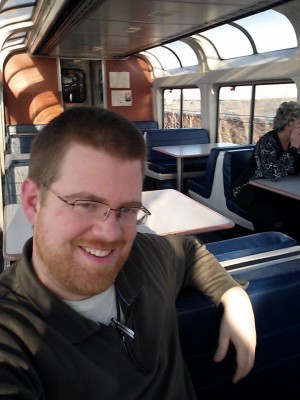
Chillin' on the observation car of the California Zephyr.

So Sunday afternoon, I boarded a train with most of my earthly possessions (at least, all of the ones I care to enjoy for the next year) and headed out to Utah.  I arrived Tuesday night, without a car, a job, or a place to live, but things have been working out really well so far and I hope to get all that stuff squared away in the next few days.

This was my sixth or seventh time traveling cross country by train, so I knew the drill.  The hardest part is getting enough sleep, so I brought a blindfold and some earplugs, and that actually worked out really well.  There were a lot of interesting people on the train, and I spent some time chatting with a few of them.  The train is one of the easiest place to make friends, just because the people who take it tend to be very laid back and friendly.

BAsUBItCIAAYenbMost of the time, though, I spent reading, figuring out my new phone, and writing.  Made some good progress on The Sword Keeper, though it looks like I’ll be putting it on hold for a while to get Stars of Blood and Glory ready for publication.  Wrote a little bit in Star Wanderers: Benefactor as well–man, whenever I need a good escape, it’s always fun to write a Star Wanderers story!  I have no idea when this one will be ready, but I think it will turn out well.

The train arrived in Provo late Tuesday evening, and I spent the night at my brother in law’s family, where I’m staying until I find a place to live.  Let me just say, it’s great to have friends and family to help you out when you really need it.  My old car was in the shop, so I set out on foot the next morning in search of an apartment.  Not much luck on that front so far, but I got my car back and found a few job leads, so it looks like I should be settled back down before long.

So why am I moving back to Utah?  A lot of reasons, but mostly because I just really like it out here.  I wanted to take a break before my next overseas adventure, catch up with some old friends and spend some time in a place that I know and love.  It also helps that there’s a good writing scene out here, with a bunch of great local conventions and conferences in the spring.

I didn’t always like Utah, but it’s really grown on me since I first came out here for college back in 2006.  The landscape is beautiful, with lots of amazing places to explore.  The people are really friendly and easy to get along with, even if your political views aren’t conservative (though admittedly, it’s harder).  The Mormon culture makes some things kind of quirky, but not in a way that makes it too hard for me to fit in.  In fact, if there’s any place in the world where I “fit in,” it’s probably here.

Things are kind of upside down right now, of course, but that will change once I find a place to live.  That’s going to take the focus away from my writing for a while, though hopefully not for too long.  In the meantime, today is another day, so I’d better get busy!

4:04 hours and 2.8k words. Not bad!

You know, sometimes I miss the days when I would churn out 1,000+ badly written words and throw up a badly written blog post, still reeling in awe from a white-hot creative heat.

Well, I think those days are coming back!  Except hopefully, my writing has improved since then.  Today was the first day I hit my four hour writing goal, and it was awesome.  Also, I wrote over a thousand words in two different projects: The Sword Keeper (which is my primary project right now) and Star Wanderers: Benefactor (a secondary project, though that may change in a month or so).  Not bad!

The really cool thing, though, is that when I woke up, my brain was actually wordsmithing.  It was weird–I was actually crafting sentences in my sleep.  Of course, being an idiot, I didn’t actually sit my butt in the chair until around 11:00 am.  Still, the words came out all right, and they didn’t stop coming all day.

I think my new time tracking goal is going to work out really well.  For most days this week, I managed to get at least 3:00 hours in.  Also, I noticed a lot of interesting things about the way I write.  Starting is the hardest part, especially first thing in the day.  Frequent short breaks can help, but the internet is a huge trap and should definitely be cut from my writing computer.  If I can’t manage 500 words/hour, chances are I’m not going to stay put for very long, but once I hit 800 wph, it’s smooth sailing.

Keeping a daily time goal also makes me conscious of a lot of things.  For example, when I first wake up, I look at the clock and think “if I do my full four hours right now, I’ll be finished by XX:XX.” That motivates me to start earlier, since it means I can finish earlier (or at least have less pressure later when I’m tired).  Also, it motivates me to write for longer lengths at a time, rather than writing in short, less productive bursts.  And even though I’m still keeping track of how many words I write, the pressure to hit a certain word count is less, since once the four hours are up, the goal is accomplished no matter what’s on the page.

Of course, all this mean I’m actually writing more.  Even on the days when I didn’t hit the full four hours, I wrote a lot more than I otherwise would have.  And the neat thing about writing is that the more you do it, the easier it comes.  It takes a while to build momentum, of course, but if you can just ease back on your inner editor and let the words come, they really will come.

So the next few days are going to be interesting.  I’m leaving Massachusetts on Sunday, to take the train across the country.  That will give me plenty of writing time, I’m sure, but once I arrive in Utah, things are going to get tricky.

My first priority will be finding an apartment, then a job–probably a crap job, though in this economy even those can be hard to find.  From what I’ve heard, things haven’t changed much since I left.  My writing is starting to take off, though, so I’m not too worried about the long-term–it’s the short-term that’s going to be a challenge.

I don’t know how long I’ll stay in Utah this time, but definitely until the summer.  There’s a lot of old friends to look up, and writing conferences to attend.  If I’m not totally broke by August, I’ll do my best to attend Worldcon as well.

That’s just about it for now.  I’ve got a lot of chores tomorrow, so I’d better get some sleep.  Later!

Slow going (but still going)

I’ve been back in the States for exactly one week now, and while my stomach is still having trouble adjusting, I’m more or less used to the American way of life.  Not much culture shock this time, though that could change once I get back to Utah.  That place is pretty strange.

So without a foreign culture to navigate (or a job, though hopefully that will soon change), I have a lot more time to focus on my writing.  Trouble is…it’s coming slow.  Like, reeeally slow, at least for me.  I’ve been clocking in at less than 800 words per hour, sometimes as low as 500.  I’m still hitting betwen 1.5k and 2k words per day, but still, it’s way more of a struggle than it needs to be.

I think the main problem right now is that I’m writing with my internal editor looking over my shoulder.  Somehow, I seem to have forgotten how to turn him off (maybe that’s why I didn’t get very much written in Georgia, hmmm…).  To compound matters, it seems like every ten minutes I want to get up and do something else.  That’s not a very good way to be productive at anything, let alone writing.

Fortunately, I think I’m slowly getting the good habits back.  I’m writing a little less than two scenes a day, and the momentum is building.  With this timer constantly staring me in the face, I’m much more conscious about how I structure my day.  I haven’t hit four hours of productive writing time yet, but I am consistently getting to three, so I think it’s just a matter of self discipline before I can up that to four.

All boring writer stuff, I know.  But the long and short of it is that I’m slowly getting back into the swing of things.  If I can turn off that internal editor and start writing faster, I think I can finish The Sword Keeper before the end of the month.  That would free me to work on a lot of other things, most noticably publication of Stars of Blood and Glory.  That’s the next one in the publishing queue, though I’m still waiting on a couple of first readers <cough>.

That’s about it.  I just wanted to vent some frustration, since man, writing is tough when your internal editor is breathing down your neck.  But don’t worry–I’ll shut him up soon, and my writing will be better because of it.

Time to get immersed back in story.

A new daily writing approach

So last summer, I decided to stop tracking my daily writing word count.  There were a lot of reasons for this, mostly having to do with the way it led me to focus on the wrong things and beat myself up in ways that were ultimately counterproductive.

The trouble is, I’d structured almost my whole writing life around keeping track of word counts.  Without an easy way to measure my daily progress, it was really hard to know whether I was being productive or not.  As a consequence, I didn’t push myself as hard as I could have, and ended up bouncing around between projects without really finishing anything.

Well, I think I’ve figured out a solution to that.  Instead of tracking daily word count, I’m going to use a countdown timer to make sure I spend at least X number of hours each day writing new words.  Whenever I take a break to do something else, even if it’s writing related, I’ll pause the timer, then start it up again when I get back to writing.

I tried it out last week, using a program called TimeLeft.  It worked out pretty well, I think.  Definitely gave me a lot more insight into my writing process.  I think it will help me to get some good habits back, like writing in the morning and staying focused for longer.  It will also help to have something I can accomplish each day.  It doesn’t matter how much I write, just that I spend the time actually writing.

To start out, I’m going to shoot for four hours of daily writing time.  It might not sound like a lot, and without a day job perhaps it isn’t, but I think it’s a good starting point.  Then again, if the guys at Writing Excuses are right, I might end up scaling back a bit.  Either way, I’ll probably end up adjusting that goal over the next few weeks.

Other writing stuff I’d like to figure out this year:

  • How to juggle two projects at the same time.  I’m kind of doing it now with The Sword Keeper and Star Wanderers: Benefactor, but it’s tough to keep one of them from getting the short end of the stick.
  • How to go for a week without checking my ebook sales.  Kris Rusch had a really good post on this last week.  I’ve tried it before, but I always end up breaking down and checking.  Well, no longer!
  • How to write good short stories.  I think I’ve put it off for too long.  Yes, novels and short stories are different arts, but they’re both writing, and I’m a writer.  Time to learn.

That’s just about it for now.  Hopefully, it will turn out well.

A not-so-obligatory New Year’s resolution

First of all, happy New Years!  I hope you’re all looking forward to 2013 as much as I am.  Last year was full of awesome life-changing experiences, but I have a feeling that this one is going to be even better.

So after chatting about resolutions with some old friends, I’ve decided that a good new year’s resolution should be more than just another mundane daily goal.  Those are great, but you shouldn’t just set them at the beginning of the year and forget about them around February or March, you should adjust and rework them constantly no matter what time of the year it is.

Instead, a good resolution is some extraordinary task or challenge with a deadline of December 31st.  Basically, it’s something from your bucket list that you hope to accomplish that year.  Because it’s extraordinary, it’s not something that you forget in a month or two.  And the deadline gives you a sense of urgency, so you don’t put it off for “someday.”

With that in mind, here’s my 2013 resolution:

Hike four of the seven peaks of Utah County.

I was originally going to go for all seven, but I’m not (yet) an experienced climber, and some of the peaks look a little difficult.  Others, though, seem pretty doable.  I’ve hiked Y Mountain several times, and got a chance to do a little hiking in Georgia.  Four shouldn’t be too much, even with my relatively limited skill level right now.

Here are the seven peaks:

Of course, I’ll wait until June to make the first hike (probably Provo Peak).  In the meantime, I’ll do what I can to get ready: eat healthy, climb a few smaller mountains, and otherwise get in shape for the big ones.

As far as writing goes, I’m going to go back on the early morning writing schedule and shoot for three hours of writing new words per day.  My monthly goal is to start / finish / publish at least one thing, and my yearly goal is still to finish at least two novel-length works (2012 was Star Wanderers I-IV and Stars of Blood and Glory).

But it’s hard to call any of those goals resolutions, since most of them are probably going to change over the coming weeks and months.  It’s hard to know exactly what life’s going to throw at me once I get back in Utah, so I’m going to stay flexible and just try to do the best I can.

I do want to publish Stars of Blood and Glory next month, and I think I can finish The Sword Keeper before then–if not, then definitely Star Wanderers: Benefactor.  After that, I’d like to do a print version of Star Wanderers I-IV with some decent cover art.  And Star Wanderers: Dreamweaver will probably be out sometime in the spring.

Beyond that, who knows?  It all depends on where the muse takes me.  One thing’s for sure, though–I’ll definitely keep writing.