New Star Wanderers cover mockup

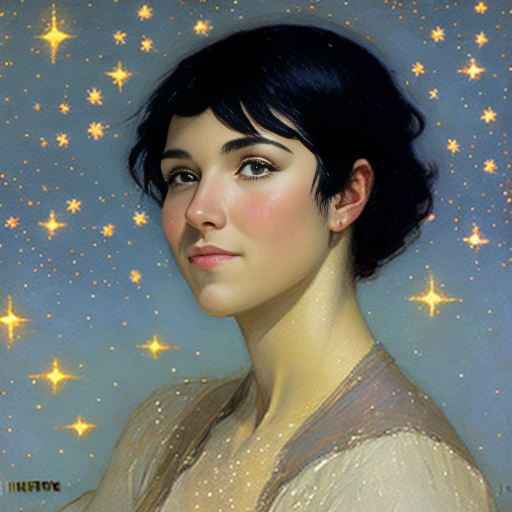
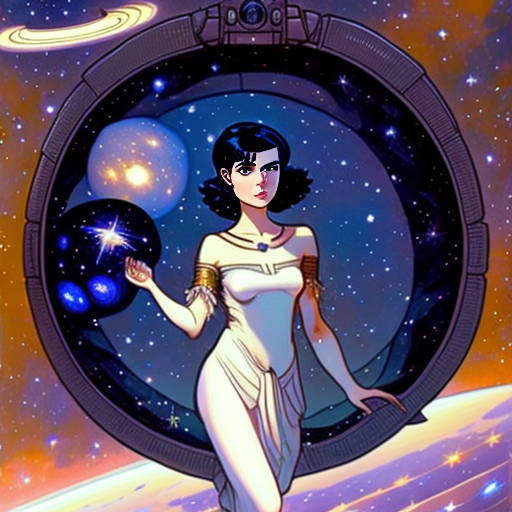
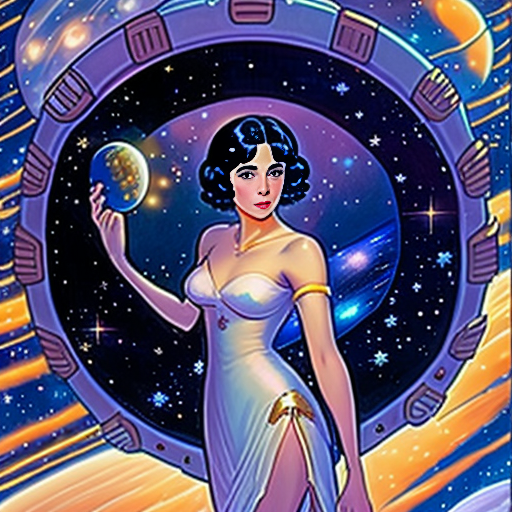
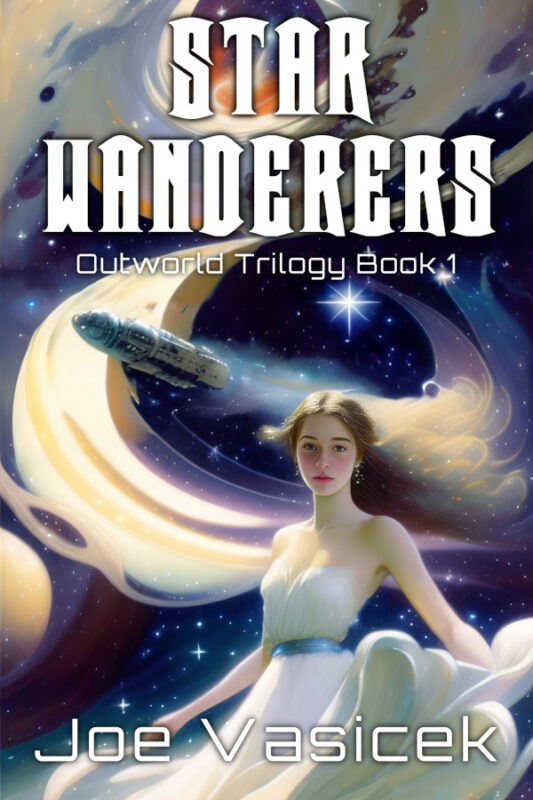
So I’ve been playing around with Stable Diffusion, working on a new cover for Star Wanderers. This is what I came up with:

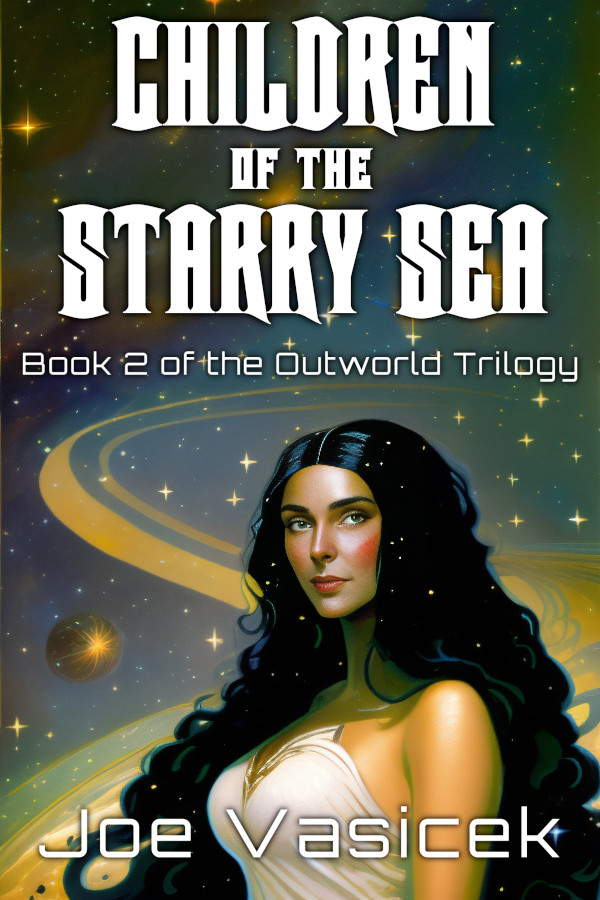
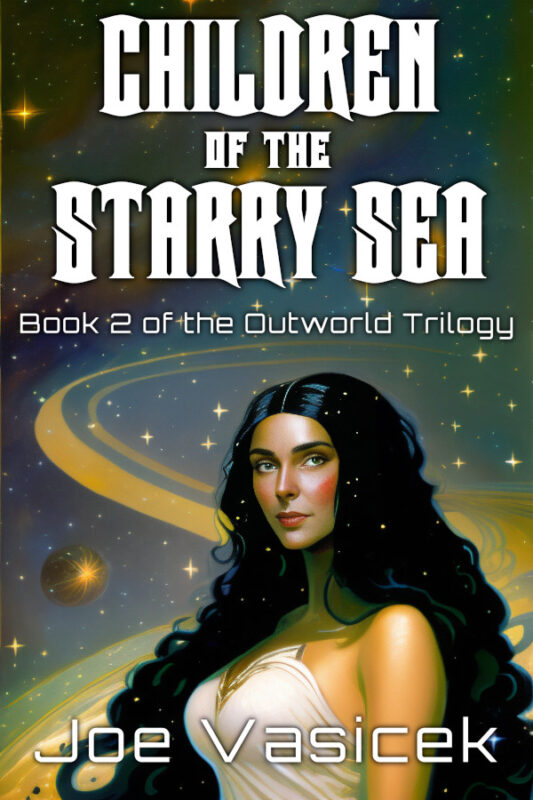
What do you guys think? And how does it compare with the cover mockup I did yesterday for Children of the Starry Sea?

…and now I should probably take a break from Stable Diffusion for a while. Need to get back to writing.

So I’ve been playing around with AI art…

Note: this post originally appeared in my newsletter, but I was so excited about it that I decided to post it here too. Enjoy!

So my wife is getting a PhD in computer science, which means that she’s on the cutting edge of research into things like language learning and topic models and other techy stuff that I don’t totally understand.

A couple of weeks ago, she downloaded Stable Diffusion, an open source text-to-image program that creates AI art, kind of like Dall-E and Midjourney. Besides playing with it herself, she thought it might be useful for me to create my own cover art. So for the last two or three days, I’ve been playing around with it, and the results are absolutely amazing!

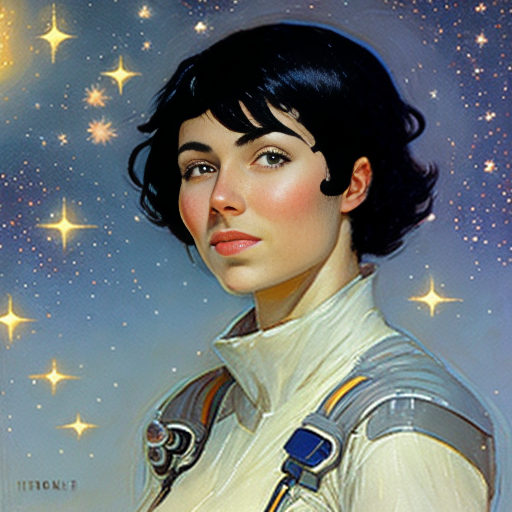
These were some of my first attempts. I’ve forgotten what the prompt was: I think it was something like “a spunky young woman with short black hair, surrounded by stars, in the style of Frank Frazetta and Minerva Teichert.” The difference between the first one and the second one was adding “in space.”

I also tried inputting a couple of paragraphs straight from my novel, including a lengthy description of this character, but the results were… uncanny. These AI art programs tend to do better if you give them short descriptions with only a handful of details.

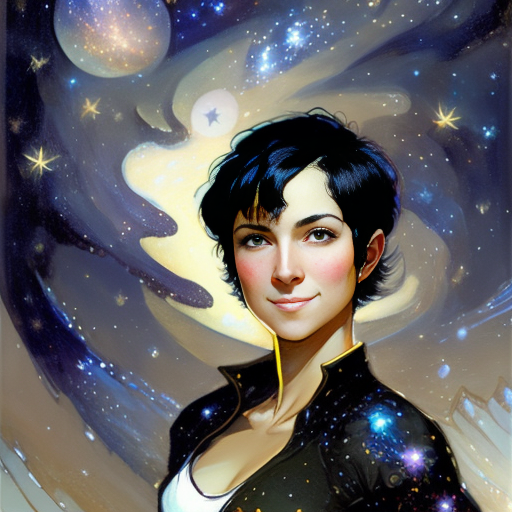
The next day, I played around with it some more, and came up with this one:

The secret sauce for this one was adding “Minerva Teichert” and “Baen Books.” Who is Minerva Teichert? She’s a famous Latter-day Saint painter from the early 20th century who paid for her son’s tuition to Brigham Young University in original paintings, many of which are still on display in the BYU Museum of Art and the Joseph Smith Memorial building.

As you can see, there are still some weird artifacts to this piece, such as the stars on the character’s jacket. That’s the tricky part with AI art: if you look at it closely, you’ll find something weirdly uncanny, like a hand with seven fingers, or a person with three arms. The steepest part of the learning curve has to do with removing these uncanny bits, either by giving better starting prompts, or by tweaking it in subsequent iterations.

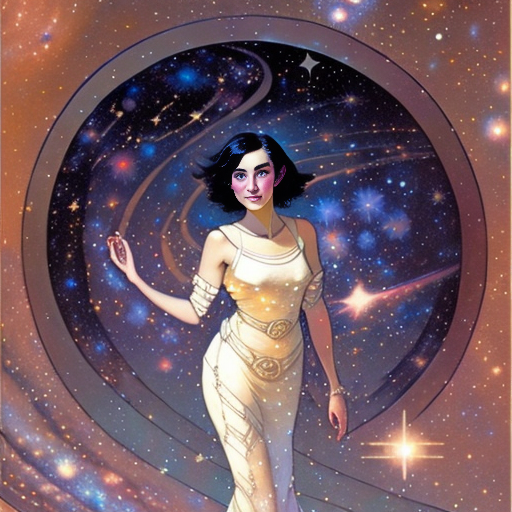
I believe the prompt for this one was “a dreamy young woman with short black hair, bare shoulders, in space surrounded by stars and galaxies. Minerva Teichert and Baen Books.” The original image was a woman in a space suit, but I used something called “image to image” to create new images based on the previous one, in batches of four. I would pick what I thought was the best one for that generation, and run the program again. That’s how I eventually got to this one:

and this one:

Still need to work on the hands. Also, there’s this weird artifact, almost like poor JPEG compression, that happens if you don’t give the program enough creative leeway with each successive generation. Another method I’ve heard of is to create a really large batch based on a given image, and then use GIMP to cut and paste all the pieces that you like from each one, before running it through one final image to image pass to seamlessly combine them.

A lot of people are either really angry or really scared about AI art and what it means for the future. It’s the same with other forms of automation, I guess. Will it replace artists entirely? Will all our art be 100% AI-generated in the future? Personally, I don’t think so. These programs are just another set of tools, and require quite a bit of practice to master.

Same thing with stuff like ChatGPT and other language learning models that can be used to write poems and stories. It takes a lot of work to come up with an AI-generated story that isn’t totally boring, or has a terrible ending. It can be done, but it does require quite a bit of human input.

So I don’t see these tools replacing artists or writers, at least in the forseeable future. Rather, I think that the successful artists and writers will be the ones who incorporate these tools into their workflow, using them as force-multipliers to make some really amazing stuff. Personally, I would absolutel love it if I could use something like ChatGPT to put out a new novel every month, or even every week.

The other thing with things like novels is that most people only read them once, because they already know what’s going to happen. So if you use an AI to write a novel, but you have to feed it all the twists and plot points… what’s the point? You’ve basically already read it. This is a problem that a lot of amateur writers have with outlining: since they already know how the story is going to end, they find it difficult to sit down and write. 

Now, what I could see is a prompt like “rewrite Lord of the Rings so that Sauron wins,” or “rewrite such-and-such romance novel so that this other guy ends up with the girl.” Or “make Lord of the Rings a gritty cyberpunk novel,” or… you get the picture. And honestly, I’m fine with that. If someone who enjoyed the “alpha” version wants to create a “beta” or a “gamma” version for fun, that’s cool. It might be kind of fun to see how an AI tweaks my books.

What isn’t cool is if someone takes that beta or gamma version of my novel and tries to sell it under their own name. And that’s where most of the legal stuff needs to be hammered out, over issues like copyright. I’m not going to use Stable Diffusion to remove watermarks, or to take someone else’s copyrighted art so that I can enjoy a derivative product without having to pay the artist. And when it comes to using prompts, I’m going to err on the side of using artists like Minerva Teichert who have already passed away, or large publishing houses like Baen whose style doesn’t belong to a single artist.

So after playing around with it some more, I finally came up with some concept art for my current novel WIP and used it to throw a cover together! What do you think? This isn’t going to be the final version—in fact, I will probably produce quite a few other test covers before I settle on the one I like. But for my current skill level (still beginner), I’m quite pleased with how it turned out!

How I hacked my ADHD to triple my daily word count

Writing with ADHD can be tough. It’s easy to beat yourself up for being “undisciplined” or “lazy” when the greater problem is that you’re trying to work against your ADHD instead of finding ways to make it work for you. It’s like swimming against a rip current instead of swimming sideways to get out of it.

In the last month, I’ve made a really fantastic breathrough that I think will change the way I write from here on out. So far, it’s helped me to double or even triple my usual word count. The novel I’ve been wrestling with for more than a year now—the longest one I’ve written since I started indie publishing—now looks like it will be finished in just a few of weeks, when I expected it to take a couple of months. Needless to say, I’m really excited.

What changed? I found a way to make my ADHD work for me, rather than against me.

In my previous post, A reading hack for the ADHD addled brain, I explained how I exploited my ADHD to read more books. Basically, I did the same thing, but for writing. There was a lot that had to happen first, though, and the biggest of those was that I had to learn how to make and keep an outline.

Step 1: Learn how to outline properly

For years, I just sort of assumed that I was a discovery writer, probably because of the ADHD. Most of creativity has to do with finding novel or unexpected ways to combine two or more ideas, and when you have ADHD, your brain naturally jumps from idea to idea. That was why I always hated taking meds when I was a kid: I felt that it stifled my creativity. And since most of this idea jumping happened subconsciously, I assumed that outlining would also kill that process.

But after a few years of struggling as an indie author, I realized that my writing process was too slow. In order to succeed, I needed to publish more frequently, but in order to do that, I needed to produce more content regularly. Back then, I would usually write a novel from start to finish, laying it aside for a month or two if I ran into a serious block, and also after finishing each draft. A typical novel would go through two or three revision drafts, so it would literally take years before a +70k word novel was ready to publish.

I decided that the best way to shorten my writing process was to “cycle” through the book, combining all the drafts so that I was working on revisions while simultaneously writing the rough draft. In order to keep track of all that, I needed to keep an outline. So I tried out a few different methods and tweaked them until I came up with a method that worked well for me.

The thought of outlining can scare a lot of writers who consider themselves “pantsers” or “discover writers,” but the thing to keep in mind is that there is no one right way to keep an outline. In fact, there are probably as many ways to outline as there are writers. For some, a couple of quick sketches on the back of a napkin is enough, while for others, it turns into a massive story bible that’s just as long (or longer) than the actual book. But without trying out a lot of different methods, you’ll never figure out what works for you.

It took me a couple of years, but I eventually developed a method that worked really well for me. With it, I was able to write Edenfall and The Stars of Redemption, as well as the last two Gunslinger books, in much less time than it took for my other ones. I was also able to combine all eight of the Star Wanderers novellas into a novel—something I probably wouldn’t have been able to do very well without a solid outline to keep it straight.

But I still would run into blocks that would occasionally derail the project, at least for a little while. I ran into that a lot with my current WIP, Children of the Starry Sea. Sometimes, they were genuine story problems that I needed to work through. More often than not, though, the problem was one of momentum: I was having too many bad writing days interspersed with the good writing days, so that each day felt like I was starting from zero. After a while, that becomes difficult to keep up.

Step 2: Allow yourself to write out of order

When I came back from my second hiatus to work on Children of the Starry Sea, it was clear that my new method wasn’t working as well as I needed it to work. Children of the Starry Sea is much longer than anything I’ve published so far, and I found that I just wasn’t producing enough new words consistently to make my “cycling” process of revisions work.

Around this time, I remembered something I’d heard on a recent convention panel, where one of the authors shared how he collaborated with another author. Instead of going back and forth, he told his cowriter: “how about you just write all the odd chapters, and I’ll write the even chapters, and when we’re both done we’ll combine it all together and see how it turns out.” To their surprise, it actually turned out really well.

So with that in mind, I decided to experiment with skipping around my current WIP, rather than writing it in order from start to finish. If I woke up and felt like I wanted to write an action scene, I would pick one of the action scenes out of my outline and write that. If I felt like I wanted to write the ending, I would skip ahead and write that. If I felt like I wanted to write the next scene, I would go back to where I’d left off and write that.

The outline was the key. Without it, there’s no way I’d be able to keep everything straight and know where each part is supposed to go. The outline also had the added benefit of dividing the novel up into smaller chunks, making the overall project much less intimidating. The way to eat an elephant is to take one bite at a time, just like the way to climb a mountain is to take one step at a time. Same thing with novels.

That’s all well and good, you may be thinking, but what happens when you’ve written all the stuff that you want to write, and all that’s left is the stuff you didn’t want to write? Isn’t that a bit like eating your dessert first, and leaving your vegetables for last? Not really, because chances are that if you really don’t want to write a particular scene, the reader probably won’t want to read it either. So if you can find a way to rework your story so that scene becomes unnecessary, you’re probably better off doing that.

But I actually haven’t had that problem yet. The thing about ADHD is that it actually feels right to jump around all over the place like that. Just because I don’t want to write a particular scene on one day doesn’t mean that I won’t want to come back to it sometime later. And more often than not, writing a later scene actually makes things fall into place with the earlier scenes, and makes me more excited to write them.

It’s as if the project itself is a puzzle. Can you imagine trying to put a puzzle together in linear order, starting from the top left corner and moving to the bottom right? That would be pure torture! Instead, you pick up whatever pieces catch your eye, and try to fit them in with other, similar pieces, until the puzzle itself begins to take shape.

There a lot of disadvantages to writing with ADHD, but there are some areas where the ADHD can actually become a strength, if you learn to work with it instead of against it. I’ve already mentioned how it can help with creativity, since your mind is always bouncing around between different ideas. What I’ve learned in the last month is that writing out of order is another great way to harness ADHD as a strength, since something that leaps out from writing one scene can often lead to a breakthrough in another. Writing out of order gives your ADHD brain the space it needs to make those intuitive leaps, and harnesses the “oh, shiny!” toward something productive, rather than driving you to procrastinate.

Step 3: Start in the middle, not the beginning

For me, the hardest part of writing is getting started. That’s probably my ADHD: it’s always easier to get distracted than it is to settle down and do what you’re supposed to do. Once I’ve settled down, though, and gotten into a groove, I can usually stick with a task until it’s done. In fact, once you’re in something of a flow state, the ADHD can actually make you hyperfocus.

So if the hardest part of writing is getting started, how do you turn that from a weakness into a strength? By leaving the next scene(s) unfinished, so that the next time you sit down to write, the scene has already been started and you just need to figure out the next word. One word leads to the next, and before you know it, you’re in the groove again.

By far, this has been the biggest part of my breakthrough: realizing that I don’t have to write every scene from start to finish in one sitting. In fact, it’s better if I don’t. Instead, I’ll typically finish one or two scenes in the morning, then pick out three to four scenes in the afternoon and write the first couple hundred words or so, deliberately leaving them unfinished so that I have a variety of scenes to choose from the next day.

If the hardest part of writing is getting started, then the hardest part of getting started is feeling overwhelmed at how much you have to do. But if all I have to do is write a couple hundred words, that’s easy! It also works with my ADHD instead of against it, since I get to jump from scene to scene instead of getting bogged down.

With the way that I used to write, most of my “writing blocks” had less to do with the actual writing and more to do with working myself up to write. Many times, I found that if I just sat down and opened up my WIP without thinking too much about it first, the writing would come a lot easier. Starting in the middle is a great way to harness that, because you aren’t confronted with a blank page the moment you sit down. It takes a lot less effort to find the next word than it does to find the first word.

So with where things stand right now, I just need to start four new scenes every day this week and I’ll have every remaining scene in my novel WIP started by Saturday. From there, if I can finish two or three scenes a day, I can easily finish the rough draft stage of this novel WIP before the end of February—which will be amazing, since I’m only at the 65% mark right now, and historically that’s always the part where I find it most difficult to write.

I’m really looking forward to writing a whole novel from start to finish using this method. As soon as Children of the Starry Sea is finished, I’ll start outlining the sequel, Return of of the Starborn Son, and write it the same way. If things go well with my current WIP, I’ll be very optimistic about finishing the next one before the end of the year—perhaps even before the end of the summer.

I do expect things to get crazy around here soon, though. Our second child is due in the early spring, which means enduring a month or two of chronic sleep deprivation. I’ve gotten to be pretty comfortable with writing at 4AM, but we’re also getting a lot more uninterrupted sleep than we were when Princess Hiccup was a newborn. I anticipate that we’ll have at least a month where nothing gets productively done.

So it will be really fantastic if I can finish Children of the Starry Sea NOW, before the baby comes—and not just the rough draft, but the revisions too. Fortunately, I don’t think I’ll have too much difficulty with the revisions. I’ve already cycled through the first half of the book a couple of times, and it’s working pretty well. Also, revisions come a lot easier to me than writing new words. I’m not sure why that’s true, but it is.

And for the record, I don’t advocate jumping around all over the place while doing revisions. It’s probably best to do that part in sequential order, if nothing else than to make sure that all the scenes and chapters flow properly. I haven’t gotten to that part of this writing method yet, so it will be interesting to see how it goes. So far, the stuff I’ve cycled through actually seems to flow pretty well, but I need to take it from the beginning to really be sure.
A weird thing I’ve noticed

So I’ve been making good progress on Children of the Starry Sea, writing about 2k words or one scene per day. But in the last couple of weeks, I’ve also had a bunch of short stories drop in my lap, two of them from dreams.

My best writing time is between 4am and 6am, so on both occassions I simply wrote the story as I dreamed it, or as I reimagined it right after waking up. This has taken a little bit of time away from working on Children of the Starry Sea, but not too much. For the first story, “We Should Have Named You Corona,” I spent one day knocking it out, then was back to work on my novel WIP the next day.

The other story is “On the Eve of the Flood,” and it’s more like I dreamed the general setup, not the actual story. I spent most of today working on it (I had the dream last night), but I still managed to finish another short scene from Children of the Starry Sea, so I don’t think this one is going to distract much from my novel WIP going forward—unless I decide to just buckle down and finish it in the next couple of days, which I may decide to do.

The third story, “Hell From Beneath,” is actually a J.M. Wight story that I wrote a few months ago, but wasn’t very satisfied with. One day, though, the solution to that story’s problems just sort of opened up to me, and I knew what I had to do to fix it. I wasn’t even thinking about it at all—I was working on Children of the Starry Sea, and making quite good progress on it, not even thinking about this other story.

With that one, it took me another three or four days to get back into the headspace for Children of the Starry Sea, just because the other story is so much darker and heavier. But that was more of a momentum / procrastination thing: getting started is always the hardest part of writing, at least for me, and I delayed starting back on Children of the Starry Sea until I was no longer in that headspace. In retrospect, I probably could have solved the headspace problem just by getting back to work, maybe with a partially written scene that was easy to finish.

In any case, the weird thing I’ve noticed is that the more I work on one project, the more it stimulates my mind to work on other projects. It’s not even that it detracts from the primary project—which is good, since otherwise how would I ever finish anything? But it does mean that if I want to have more story ideas, I should focus on whatever project is on my plate, rather than laying it aside and trying to come up with story ideas. In that way, it’s kind of like stargazing: if you look at a star directly, it tends to disappear, but if you look at it sideways, it becomes much more visible.

Or maybe it’s this new writing technique I’m trying out. Instead of trying to write my whole novel front to back, I’ve broken into scenes, and outlined the scenes well enough that I can write them out of order. So each day I ask myself “which scene(s) do I feel like writing today?” which is actually quite liberating.

I’ll do a deeper blog post on this writing technique after I’ve finished Children of the Starry Sea. If it works out well (and so far I think it is) I’ll have a lot of interesting things to share with you. But for now, I find it interesting that the more I write in my novel, the more ideas I get for other stories—and the easier it is to write them.

Toward a new writing technique

For the last year, I’ve been struggling to write this novel (Children of the Starry Sea, Book 2 of the Outworld Trilogy) according to my new novel writing method, which I’ve been developing since about 2017. The method involves creating a rigorous scene-by-scene outline and cycling through each scene multiple times, so that you basically revise the book as you go.

However, for a novel WIP the size of Children that doesn’t seem to work very well: either my mind is stuck in the revisions, or I’m so focused on producing new words that I don’t get around to revising, or (as happens most often) I’m so torn between both that I can never get in the right headspace, and my productivity suffers.

One of the things that happens is that I get hung up on a scene that I don’t really want to write. There are other parts of the story that appeal to me, but in order to get to them, I have to write that scene first… IF I’m writing the whole book in order from start to finish. So because I don’t want to write the next scene, I end up working on revisions for a while, which makes it harder to get back into the right headspace to write new stuff… you get the picture.

But the thing is, because I have such a rigorous scene-by-scene outline, I don’t actually need to write all the scenes in order. So lately, I’ve been picking and choosing which scene to write next, experimenting with writing the book out of order.

So far, it’s worked out pretty well. The outline gives me all of the plot points and character arcs that need to be worked out, so I can treat each scene as a sort of mini-story, which helps to eat the proverbial elephant. (How do you eat an elephant? One bite at a time.) Also, my ADHD-addled brain really loves the creative freedom of being able to pick and choose what to work on next, ignoring whether it has anything to do with what I wrote yesterday.

Of course, this means that the revisions will have to wait until all the holes in the narrative have been filled. I may be able to do it on a chapter-by-chapter basis, with the first revision happening once all the scenes in a chapter are done, and the next revision focused on fitting the chapters together, but I don’t know. It may just be better to put off the revisions altogether until the entire rough draft is complete.

Then again, there are advantages to cycling through the manuscript during the drafting process. It can help to identify plot and story problems as they emerge, which can help to remove writing blocks before they become really onerous. Also, it leaves me with a lot less work to get to the final version, once the initial manuscript is complete.

So here’s how I think I’m going to do it:

  • Prewriting: Develop a rigorous outline that includes a scene-by-scene map with all important plot points and character/relationship arcs.
  • Rough Draft: Pick and choose which scenes to write, focusing on hitting the plot/character/relationship points and making each scene cohesive.
  • First Revision: Fix all the points in the revision notes (such as things that need to be foreshadowed) and focus on making each chapter cohesive.
  • Second Revision: Fix any remaining revision notes and focus on overall story and chapter flow.
  • Final Revision: Focus on the sentence and paragraph level writing to cut the book’s word count by at least 10%.

So maybe I’ll do the first revision in-line with the rough draft, as each chapter comes together. Unless the book has major problems, the second revision should be pretty straightforward and not take longer than a week or two—besides, it should probably wait until the first draft is totally done, since that’s the time to work on overall story flow. And the final revision can go in-line with that.

I don’t know if any of that makes any sense to anyone but me. Thinking out loud does help to put my thoughts together, though I’m not sure how much it makes for good internet content. Still, I’m curious if anyone has any thoughts on the subject. Have you tried out something similar? Or does the very thought of writing like this feel like scraping nails on a chalkboard? Let me know! I’m curious to hear your take on it.

Rethinking some things

So I had an extremely vivid dream last Friday night where I got cancer and learned that I had only a month to live. Among other things, I found myself asking: “What am I going to do about my writing career? Who is going to finish all these books? Are they going to fade into obscurity, or will someone promote them so that my family will benefit from them after I’m gone?”

The whole thing made me feel like the race was suddenly over, and I hadn’t finished it, but had to hand off the baton to someone else who would. So instead of spending that final month of my life writing, I would have to spend it outlining things in such a way that the person who carried it all after me would be able to do it right.

(And then, hilariously, when I told my friend and cowriter Scott Bascom that I had terminal cancer, his response was: “So what? Get back to writing.” And when I told him IRL about that dream, his reaction was: “Well, was I wrong?”)

Obviously, it was an incredibly sobering and emotional dream, for reasons that had nothing to do with my writing. But it also got me to thinking about some things I’ve taken for granted about my writing process, and how I ought to change them or at least experiment with other ways of doing things.

For example, for the last fifteen years—really, since I started writing professionally—I’ve just sort of assumed that I would 1. work on one novel WIP at a time, and 2. write that novel sequentially from start to finish, rather than hopping around.

In the early years, I experimented with doing things differently and decided that I just wasn’t wired that way. But that was also when I thought I was a 100% discovery writer and didn’t have any sort of outlining process. Basically, I tried to keep the whole novel in my head, a nearly impossible task even for a veteran writer.

Now, I have a much more rigorous outlining process that divides each novel WIP into chapters and scenes, so that instead of trying to keep an entire novel in my head, I can eat the elephant one small bite at a time. So I’ve actually got the infrastructure in place right now to experiment with those things, in a way that I didn’t before.

Another thing that I’ve always taken for granted is that in order to be a working professional, I need to set strict deadlines for each project and schedule those deadlines at least a year in advance. Never mind that I have never kept an original deadline that I’ve made for a project, or kept to those schedules. Instead of finding a better way, however, those deadlines and schedules always just keep getting pushed back.

I’ve also been trying to find a way to write a novel all the way through from start to finish, without getting stuck in the middle and feeling like I need to put it aside for a while (on the “back burner,” as I used to say). In fact, that was one of the main reasons why I developed my outlining process in the first place. But even with a well-developed outline that still has some flexibility to adapt to a changing story, I still can’t write a novel straight through without having to take a break.

Another thing I’ve always failed at is hitting my daily word count goals consistently. Instead, I typically write in starts and fits, especially when I’m in the messy middle of whatever novel WIP I’m working on at the moment. However, I did have some success with those nanowrimo challenges where I worked on short stories—in other words, where I hopped from project to project.

Also, until this year, I could never manage to read very consistently. I’d go through phases where I’d read a lot, followed by long reading droughts where I’d read almost nothing. But then, I discovered some reading hacks that completely changed everything, and now I’m reading between one and two dozen books a month (most of them just the first and last chapters, but about 6-10 of them all the way through).

One of those reading hacks was—wait for it—reading more than a dozen books simultaneously and hopping from book to book. And the thing that made that possible was my reading log, which provides some structure and helps me to see how much I need to read from each book to not just totally drop the ball.

So why don’t I try something similar with my writing? What if, instead of working on one novel WIP at a time, I used these outlines to break them all up into scenes and just skipped around, writing whatever stands out as the most interesting thing to write at the moment? The outlines will help to keep it all straight, so I don’t have to keep an entire novel in my head. And when I inevitably get stuck with one WIP, I don’t have to lay it aside for months on end—instead, I can jump to something else, since I’m already jumping around in the first place.

It sounds kind of crazy, but I’ve found that my ADHD brain actually works better that way, at least when it comes to reading. So why not writing as well? It’s worth a shot, at least. And maybe one of the upsides will be that I won’t have to angst so much about those deadlines. If the focus is on hitting daily word count instead of staying on deadline for my current WIP, then solving the first problem will ultimately solve the second one, once I hit my stride.

So that’s what I’m going to experiment with: hopping from project to project, with a goal of hitting my daily word count goal rather than advancing a single project to an arbitrary deadline.

In order to do that, I need to make some outlines. Here are all of my unfinished novel(ish) WIPs that I haven’t trunked yet:

  • The Sword Bearer (Twelfth Sword Trilogy #2)
  • The Sword Mistress (Twelfth Sword Trilogy #3)
  • Captive of the Falconstar (Falconstar Trilogy #2)
  • Lord of the Faconstar (Falconstar Trilogy #3)
  • Children of the Starry Sea (Outworld Trilogy #2)
  • Untitled (Outworld Trilogy #3)
  • A Brotherhood of Swords (First Sword Trilogy #1)
  • Untitled (First Sword Trilogy #2)
  • Untitled (First Sword Trilogy #3)
  • The Lifewalker Chronicles (standalone)
  • Starship Lachoneus (standalone, may be a collection)
  • The Justice of Zedekiah Wight (collection)
  • The Mercy of Zedekiah Wight (collection)
  • Christopher Columbus, Interstellar Explorer (collection)

Of those, only Children of the Starry Sea and Captive of the Falconstar are fully outlined. So I’ve got a lot of work to do.

Instead of taking time off to outline all of these, however, I’m going to prioritize hitting word count, and work on the outlines on the side, in my voluminous spare time </sarc>. It’ll probably take a while, but I’ll eventually get it done—and that will provide some extra motivation to hit word count each day.

Also, I plan to outline all of them, even the book 3s where book 2 still hasn’t been written. The reason for that is so that I’ll have something to hand off to another writer, in case that crazy dream comes true. I don’t think that it will, but I’m gonna go sometime, so it’s better to get into the habit of doing that now. Besides, it may be helpful to skip ahead to the next book and write a few scenes: give me something to write toward.

TL;DR: I’m going to be doing a lot of experimentation in the next couple of months, skipping around in all of my WIPs instead of focusing on one at a time. It’s going to be crazy, but hopefully in a productive way. And a fun way too.

Bowing Out

Back at the end of August, I blogged about how I was going to do a writing challenge in September to produce more short stories to fill out my publishing queue. At the time, I had a couple of stories that looked like they were going to be picked up by one of the major magazines: the editor had expressed interest in buying them, and we were going back and forth with an editorial discussion about the series.

Well, to make a long story short, all of that fell through, and it looks like I’ll be self-publishing those stories after all. I’m not really sure what changed, but to give you an idea of what kind of a short story market this is, it’s been around for decades and regularly gets written up in Locus Magazine’s year-in-review. The editor said that things had gotten crazy on his end, then didn’t respond for about a month, and when I sent a polite followup email asking for an update on the status, he gave me the standard “I’m going to pass on this one, but send me your next story.” Which strikes me as kind of weird, given how our previous correspondence led me to believe that the contract was just a formality and he’d be sending one over soon, but whatever.

So now that these stories are back in the publishing queue, I no longer need to write a bunch more to fill it out. In fact, I’ve actually got enough stories to publish one a month through next April, and after I finish the third Christopher Columbus story, I’ll have enough to get through June (one of my older stories comes out of exclusivity in May 2023). Here is the schedule as of right now:

  • OCT 2022: “Blight of Empire”
  • NOV 2022: “Christopher Columbus, Wildcatter”
  • DEC 2022: “The Freedom of Second Chances”
  • JAN 2023: “The Body Tax” (needs to be revised, but it’s already been workshopped)
  • FEB 2023: “Christopher Columbus, Treasure Hunter”
  • MAR 2023: “The Library of Fate”
  • APR 2023: “Hunter, Lover, Cyborg, Slave” (needs to be workshopped and revised)
  • MAY 2023: “Christopher Columbus, Wormhole Mechanic” (partially written, needs to be finished)
  • JUN 2023: “In the Beginning” (still under exclusivity, though I got a special exception to publish it in my third short story collection, The Stars Our Destination.)

Given that I have enough stories to fill out the next nine months, I’m going to bow out of the September Shorts challenge. This is really good for two reasons: first, it allows me to focus more attention on my current novel WIP, the sequel to Star Wanderers; and second, because I’ve fallen really behind on the Zedekiah Wight stories for my J.M. Wight pen name, and this should give me some space to work on the next few of those.

So that’s the plan: refocus on Children of the Starry Sea and work on Zedekiah Wight stuff on the side.

New Short Story Writing Challenge

I self-publish a new short story every month, and I try to keep at least six in the hole so that I have some time to send each one to the magazines and anthologies. Right now, I’ve only got three, soon to be two, so I need to write some short stories. Sounds like it’s time for a writing challenge!

So for the month of September, in addition to working on Children of the Starry Sea (though at a slower pace), I plan to write 40k words of short stories—enough for a small collection, which should fill out the buffer for a while. That comes to between 1,500 and 1,800 words a day, which honestly shouldn’t be that hard, since once I tend to get going on a short story, I’ll write it to the end, whether that’s 2k words or 4k words. I’ll spend the next few months workshopping them through my writing group and cleaning them up, then put them out on submission.

For purposes of this challenge, I’m going to include some of the short story fragments I have lying around, since those need to be cleaned up and turned into something useful. Also, I’ll definitely be working on some Zedekiah Wight stories, since I desperately need more of those to put out into the world. Also some Christopher Columbus stories, though it looks like those are going to get picked up by one of the magazines soon, so look out for that.

As an incentive, if I manage to accomplish this writing challenge, I’ll buy myself a couple of things on my Amazon wish list. I tend to put things on that list and forget about them, or else decide that it’s not worth spending the money, so it should be a good incentive. And I’ll post about each story as I write them. One of the things I want to do is to go through the whole Mythulu deck and write at least one story with each card. This would be a great time to do that.

So get ready! This should be a lot of fun!

Slight Change of Direction

I’m currently a little over 54k words into the rough draft of Children of the Starry Sea, the sequel to Star Wanderers and second book in the Outworld Trilogy. Most of my novels fall somewhere between 40k and 80k words, so if this was a typical WIP, I would be pretty close to finishing it. However, I expect that this novel will turn out to be somewhere north of 140k in the final draft, and the rough draft is already shaping up to be at least 160k. So I’ve still got a long way to go before this one is finished.

I was hoping to release this book by the end of the year, but I also want to release book 2 and book 3 within two months of each other, with book 3 already set up for preorder by the time I release book 2. That seems to be the best way to launch the later books in a trilogy, especially in conjunction with a price promotion on the first book. Launching book 2 without book 3 anywhere in sight, it’s much more difficult to make a splash. So I don’t want to publish Children of the Starry Sea until at least the rough draft of book 3 (which doesn’t even have a title yet, let alone an outline) is done.

So with all of that in mind, I’m looking at my publishing schedule for the rest of the year, and without Children of the Starry Sea and the yet unnamed book 3, it looks pretty sparse. I’ve got my fourth short story collection coming out in May, another short story later this month, two short stories sometime in the summer, a J.M. Wight short story that I’m workshopping through my writing group this month, and two more J.M. Wight projects that I haven’t even written yet. And that’s it.

I would like to publish at least one new title every month, preferably two if they’re both short. Also, I would like to have enough short stories in production so that I can keep them on submission for a while, preferably at least six months.

At this point, it seems that the best solution to this problem is to take some time off from my WIP to write short stories, fill up the publishing schedule from now to the end of the year, and go back to writing Children of the Starry Sea and its untitled sequel. To do that, I need to write ten short stories in addition to the two unfinished J.M. Wight works. One of those is going to be a novella, so I’ll probably have to take an extra couple of weeks for that, but I should be able to write about two short stories per week.

So my new goal is to write a dozen stories between now and Memorial Day. That will be more than enough to fill up the publishing schedule through the end of the year, especially if I have enough stories to bundle into another short story collection (which I almost certainly will). It’ll also give me something to blog about, which should be fun.

I wish I were the kind of writer who could write five secret novels on top of everything else I’m doing. Heck, I wish I were the kind of writer who could write three or four novels a year, instead of just one or two. Perhaps in time I’ll get to that point, but for now all I can do is strive to make incremental improvements, and I do think that writing more short stories will help me to be a better writer. And I’m not putting Children of the Starry Sea completely aside, just on the back burner for now. Hopefully that helps me to finish it faster when I do make it my primary WIP again.

NaNoWriMo 2021: Day Two

  • Words Written Today: 2,072
  • Children of the Starry Sea: 1,626
  • “In the Wake of Zedekiah Wight”: 446
  • Total Words Written: 4,094
  • Total Words Remaining: 45,906
  • Total Words Ahead: 760

Today is day two, and I’m making very good progress so far. I’ve found that it really helps to keep my daily word count goal if I have two projects to work on: my main WIP, which is usually a novel, and a side project like a short story. When I run out of steam on the main WIP, I can switch to the other project and usually crank out a few hundred words to round out the day.