A little family history

Holy crap, it’s been a long time since the last blog post. I wish I could say that things got busy, but the truth is that things just got disorganized. We’ll see how quickly I can put things back in order.

I spent most of last week either working a landscaping job or doing family history. Until now, I haven’t really blogged much about family history, but it’s something I’ve been working on fairly consistently for the past six months. My ultimate goal is to find all my first generation immigrant ancestors, which may well take a lifetime, but I’m off to a decent start:

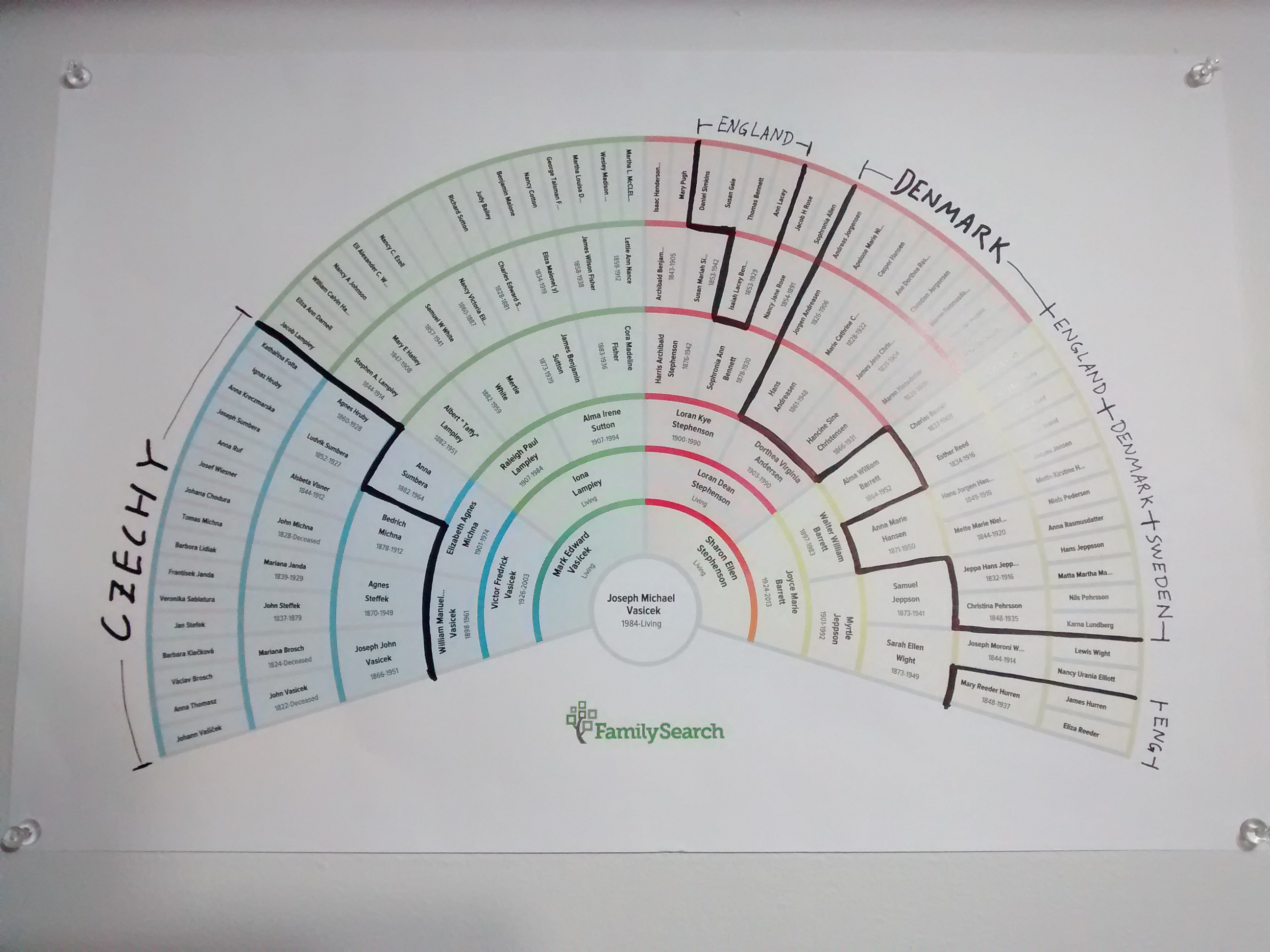
JV fanThe fan chart shows six generations, starting with me at generation zero. I’ve outlined with a sharpie where all the lines hop the pond. My paternal grandfather’s side (blue) is all from the Czech lands, under the Habsburgs and the Austro-Hungarian Empire. My paternal grandmother’s side (green) goes way, way back to colonial America, with most of the lines still needing to be researched.

On my mom’s side, there are only three lines that go back to colonial America, and those are the ones I’ve been focused on. Joseph Moroni Wight goes back to Massachusetts and the Pilgrims, and has been fairly well documented back to the early 1600s. Nancy Jane Rose’s father was cursed by a Mormon apostle, which is just about the only thing we know about him. He’s a brick wall, but her mom’s side goes all the way back just like J.M. Wight.

The other line is Archibald Benjamin Stephenson, which has some colorful history including a brief stint with the Strangites. Unlike all my other Mormon lines, this one has not been thoroughly researched. I’m trying to find out why that is, and to push back further if possible.

My ultimate goal is to specialize in early American research, from the original colonies to the pre-Civil War era. With family history, you really have to be a jack of all trades and a master of one. I’ve got a pretty good grasp of the basics, but I still have a lot of work to do before I develop any sort of mastery.

Of course, my work with family history isn’t going to replace or supersede my writing. If anything, it’s feeding into it. There are tons of interesting family stories I’m uncovering through this research, which makes for excellent writing material. For example, my 6th great uncle Lyman Wight once looked a murderous mob in the eyes and said: “shoot, and be damned.” I’m definitely working that into Gunslinger to the Stars.

So that’s what I’ve been up to. There’s a chance I may branch into historical fiction as I get more involved in family history. For now, all of the story ideas gnawing at my head are science fiction, but who knows what will happen in the future?

I’ll leave you with a little something from the Austrian connection in my family history: Roses of the South by Johann Strauss.

Coming right along

I’m making good progress on The Sword Keeper, but I keep having to push it back to help a friend remodel his basement. His wife is having a baby in a couple of weeks, and he needs to get things finished before his mother-in-law comes over. There have been a ton of setbacks and delays, mostly having to do with the shoddy construction work done by the guys who built the place, but we seem to have passed the biggest hurdle which is to install the bathtub. Now, it’s mostly a matter of installing insulation and putting up drywall.


There’s this really fantastic game that I’ve been looking at called Stellaris. It seems like a combination of Masters of Orion and Europa Universalis. Really really tempted to play it, but as of right now, I’m holding back. When I finish this WIP, though, I may just treat myself.

Also, I recently signed up for a 30 day trial of Instafreebie, a site that (among other things) lets authors do ebook giveaways in exchange for readers’ email addresses. I’m running a giveaway for Genesis Earth, which you can pick up here if you haven’t already gotten a copy. Depending on how things go, I may sign up and run a few more campaigns in the future.

I’m really, really itching to get back to work on Gunslinger to the Stars. That will probably be the next full-length novel that I publish. In the meantime, I’ve got a bunch of short stories that should be coming out soon, starting with a Sad Puppies related piece that is sure to make a lot of people smile. Look for that one in June.

That’s pretty much it for now. Thanks for reading!

Breaking down the elephant

I came to a realization about productivity just recently. It’s one that I’ve known for a while now, but never really applied to my own quirks and strengths.

In order to accomplish a massive, multi-stage task (like writing a novel), you have to break it down into manageable chunks first. Otherwise, you’ll just get overwhelmed. If you try to eat an elephant in one sitting, you won’t be able to do it, but if you process the ground elephant meat into meal-sized tupperware containers, put some recipes together, set a meal schedule, and freeze the meat until you need it, then eating an elephant becomes much more doable.

The question is, what’s the best way to break down the elephant? The answer, of course, is that it depends on the person.

Some writers break their WIPs down into chapters. Others prefer raw word count as a measure of progress. Others use story beats, or a timer, or a hard and fast deadline. A lot of writers don’t use much of a system at all, which is probably why so many of them fall behind.

The hardest part of writing is often just getting yourself to sit down and do it. The blank page really is the most intimidating part of the job. If I had to guess, I’d say that about 50% of writer’s block is not having a good way of breaking down the elephant. And by “good system,” I mean one that is personalized to work for you.

I’ve tried out a lot of systems that didn’t really work—for me, that is. I’m sure they work just fine for other people.

For a long time, I used raw word count, but then I found myself cutting corners by dropping a project and going back to revise a half-finished one, just to get a higher word count boost. After that, I started tracking hours worked per day, but again the quality of my work fell as I started looking for busywork just to feel like I’d accomplished something.

I bounced back and forth between unfinished projects, sometimes starting new ones, sometimes making progress on old ones. Every once and a while, the story would hit me in just the right way to compel me to finish it, which is how I’ve finished probably 80% of the books I’ve written over the past three years. But that’s a very unreliable way to write books.

Then I started using a timer to break my work down into short, measurable writing sessions. The main reason I did this was to work my way up to hitting 10k words in a day (something I’m still working on). The idea was to develop more focus and train myself to write faster. What I didn’t realize until now was that this is a great way to break down the elephant.

Before, I would wake up in the morning and think “how am I going to write X,XXX words before the end of the day?” Understandably, this was a bit intimidating, and over time it tended to grind me down. But now when I wake up, the question is “am I ready for the day’s first writing session? Why not—it’s only 20 minutes.” And then I’m off.

Now, I’m not completely in that mindset yet. I still tend to think in terms of daily word count, which can make me fall back into the old habits of procrstination. And if the day starts off with something non-writing related, it can really throw me off. But using this method, I was able to get through 66% of Gunslinger to the Stars in about six weeks. And if I keep working on it, I’ll bet I can accomplish much more.

I do not consider myself a fast writer. Some of my professional writing friends think that I’m fast, but there are tons of indies out there who write much faster (and better) than me. But a lot of it really just comes down to the psychology of breaking down the elephant. And now that I’ve got a system, I just need to be better about using it.

If you guys are interested in keeping track of my writing progress, I’ll go back to using the WIP progress bars. I took them down in order to keep the sidebar from getting too cluttered, but that is a major reason why readers come to an author blog (to see the ongoing progress on the author’s next book), so I’ll redesign things a bit and figure it out. It would certainly help me to get back on the horse, knowing that people are following this sort of thing.

Right now, I’m about 35k words from finishing The Sword Keeper, a project I’ve been working on and off on for the last four years. It’s a fantastic book, perhaps even the best I’ve ever written, and getting it done is going to be huge.

After that, I’ll probably finish Gunslinger to the Stars. Put it on the back burner after LTUE, but it shouldn’t be too hard to finish it up. It’s a rip-roaring adventure that doesn’t take itself too seriously, and I could frankly use the break.

And then? I think it may be time to finish the Genesis Earth trilogy. Book two, Edenfall, has been on the back burner for a looong time (almost five years), but there seems to be a lot more interest in it now, with sales of Genesis Earth increasing and readers posting reviews that say “can’t wait for the next book!” When you guys speak, I listen.

So that’s the plan for the next couple of months. Beyond that, I have a couple of short stories coming out soon, so be sure to keep an eye out for those.

Thanks for reading!

The timelessness of novels

Every few months, an article about the “death of the novel” makes the rounds on the internet. This subject, the impending doom of one of literature’s most enduring forms, is a perennial favorite for bookish handwringers everywhere. If it isn’t ebooks that’s going to kill the novel, it’s millennials, the internet, our dwindling attention spans, or one of a hundred other things.

As a professional writer, though, I am awestruck by the timelessness of the novel. Think about it:

From its origin with Don Quixote in 1605, the modern novel has endured through social and political upheaval, global pandemics, the collapse of numerous societies, the most devastating war the world has ever seen, genocide and holocaust on an industrial scale, and rise and fall of half a dozen global empires. The world today would be unrecognizable to a person from Cervantes’ time, yet the novel has endured.

Movies didn’t kill the novel. Television didn’t kill the novel. Video games didn’t kill the novel. On the contrary—numerous franchises from Star Trek to Halo have a thriving line of novel tie-ins. When the ebook revolution was just getting started, people thought that so-called “enhanced novels” would dominate the marketplace. They failed to realize that all of the added audio-visual content was a distraction for most readers. Plain text is not a bug, it’s a feature.

It’s important here to make a distinction between novels and other literary forms, such as novellas and short stories. The other forms have endured as well, but not with anything approaching the popularity of the novel. Short stories are great for exploring an idea, but not so good at immersing the reader into another world. Novellas are great for telling an intimate story about two or three characters, but not nearly as good at conveying scope or intrigue.

There’s something about a novel-length story that captures the imagination in a way that other forms just can’t. Whether it’s the large cast of characters, the intricate world-building, or the interplay of numerous subplots, novels are more immersive, and therefore have the capacity to be much more satisfying. Little wonder, then, that the novel has endured.

I’ve seen this in my own books, too. Over the years, I’ve done relatively little to promote my full-length novels, and yet they still chug along with a steady month-to-month trickle of sales. When I do promote them, such as with this month’s free run of Genesis Earth, the results are astounding. My full-length novels also tend to receive much higher reviews.

In my second year of self-publishing, I got impatient and switched to novellas. While I don’t think that was a mistake, it did not provide the foundation for a lasting career. The Star Wanderers novellas did well for a couple of years, but I don’t think they’re going to endure in their current form.

I love writing novellas, but the books that I’m proudest of are all novels. Where novellas entice, novels satisfy. Where novellas tell an intimate story, novels possess greater depth. As such, I think it’s time for a change.

In the next couple of months, I’m going to prune back my catalog a bit. The Star Wanderers series will still all be up there, but I’m going to remove the individual novellas from sale, keeping the omnibus editions instead. This will pave the way for a sequel novel, Children of the Starry Sea, which I’ve already started work on.

I will probably remove most of my older short stories, and some of the derivative works. I don’t want to clutter my book pages with my earlier practice work, or anything that looks too obviously self-published.

I’m not sure what I’m going to do with Sons of the Starfarers just yet. I’ll definitely finish the series, but I’m not sure whether to do the other two omnibus editions or to just release each individual book in print. I’m toying with the idea of releasing the last four books in rapid succession, to build some momentum for the series, but it would take some time to write them, which means that Patriots in Retreat (Book VI) would be delayed for maybe a year.

I’m definitely going to turn Genesis Earth into a trilogy. No idea when the next book, Edenfall, is going to come out, but I’m going to do as thorough a job with that book as I did for Genesis Earth, which means it may take a while.

Novels take a lot longer for me to write than shorter books, but the end result is generally worth it. The trouble is that without a busy release schedule, sales tend to dwindle as you fall out of readers’ minds. I’ll try to make up for that by upping my marketing game and running more free and group promotions. In the meantime, anything you guys can do to spread the word would help!

I’ve got a couple of really awesome projects that should be coming out before the end of the year: The Sword Keeper, Gunslinger to the Stars, and a bunch of other stuff that’s really going to branch out my catalog. I’ve also got a couple of short stories that should be appearing in some new markets soon. Be sure to keep an eye out, and let me know what you think!

Recalibrating

One of the things about being a creative person is that it’s very hard to keep an organized daily routine for very long. Usually you’ll have one that works out well for a couple of weeks before something happens to make it fall apart completely, and then you have to recalibrate and start over. Nothing necessarily wrong with that, but it is something you have to adjust for.

I’m in one of those recalibrating phases right now, as you can probably tell by the fact that my unfinished WIP is past the self-imposed deadline and I haven’t posted in this blog in over a week. Don’t worry, though—things are going well, and I’ll soon be back up to speed.

Interestingly enough, it wasn’t LTUE that blew up my writing routine. I actually managed to write every day while I was there. It was a bunch of stuff that happened afterward, most notably taxes and car issues. The taxes are completely squared away, but the car issues are ongoing, so I dropped the writing to take a temp job all last week.

Gunslinger to the Stars is still unfinished but at a good stopping point. What I’m probably going to do is put it on the back burner for a month or two as I work on other projects.

Top on that list is to get Captives in Obscurity (Sons of the Starfarers: Book V) ready for publication. The copy edits are back and I have the cover now, so it should be up for pre-order before the end of the week.

Also, there’s another J.M. Wight short story I’m getting ready to put out. Just need to get some feedback and write the author’s note. Though what I may do is bundle that with another J.M. Wight story that I haven’t written yet, so that I can justify putting it out at the $2.99 price point. And the author’s note for this one is going to be a bit unusual too: an essay that tells my own personal story of how I got into family history and some of the spiritual things I’ve experienced from it.

So it may be another month or two before that J.M. Wight bundle comes out. But one thing that definitely is coming out is my short story “L’enfer, C’est la Solitude.” It will be appearing online at Perihelion for their March issue, where you can read it for free. More links as that becomes available.

I’ve also got some short story ideas that I want to flesh out. I’ll probably take the next week or two to work on those, but you won’t see them for a while since they’ll be on submission. But I do have a lot of blog posts that I want to write as well, including:

  • #RIPTwitter and the ongoing controversy there.
  • Thoughts on making a living with short fiction.
  • The guest lecture I gave to Sanderson’s English 318 class.
  • Cover reveal for Captives in Obscurity.
  • Some book reviews.

As for the personal issues that blew up my writing routine in the first place, don’t worry—everything’s fine. Right now, my plan is to buy a scooter and sell my car, just because a scooter would fit my needs better (and would be a lot of fun to ride!). It would also help me to save up for another vehicle next winter, possibly a truck. I’m not too keen on taking out an auto loan, but with taxes out of the way my personal finances are actually in a pretty good place—much better than I expected them to be. So things are looking up.

In any case, that’s what’s going on with me. I haven’t dropped off the face of the Earth yet, just recalibrating and making some adjustments. Expect to see some more stories very soon!

Four-part structure and the writing process

Over the course of writing Gunslinger to the Stars, I’ve learned some interesting new things about my writing process, as well as being reminded of some of the basic lessons I learned back when I was getting started. These lessons have helped me to have some fantastic writing days, like today, where I hit 2200 WPH at one point and knocked off 1.7k words before lunch.

Just a week ago, though, I was struggling to write anything, which was strange considering how well the story had been coming along up to that point. The realization that helped me to get through that and get back to writing strong was that my difficulty was a function of story structure, and that different parts of the story require a different process.

What follows are my personal conclusions about my own writing process, which may or may not be similar to your own. Every writer is different, so what works for me may not work for you. At the same time, there are enough similarities that I hope my own process may provide some insight into your own.

Four-Part Story Structure

First of all, let’s talk about story structure. There are a lot of different possible structures, but the most common one in the West is the three-act structure. This often echoes the hero’s journey, which goes something like this:
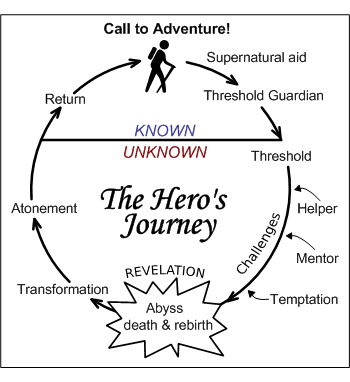
heros_journeyFor purposes of this blog post, I’ll assume you’re already familiar with both the three-act structure and the hero’s journey. If not, there are plenty of other resources where you can learn about them in-depth.

I prefer to think in terms of four-part structure, however, where act two is divided into two halves. In typical three-act structure, the hero hits his lowest point at the midpoint of act two. This is also the midpoint of the story itself, where the hero reaches the nadir of the hero’s journey. In four-part structure, that midpoint is just treated like a plot point, dividing part two from part three. Everything else is the same.

Thus, when you frame a particular story in four-part structure, it looks like this:

  1. The Call to Adventure
  2. Tests, Allies, and Enemies
  3. The Darkest Hour
  4. The Final Battle

Part One: The Call to Adventure

The first part of the story typically starts in the ordinary world, until the inciting incident somewhere around the middle of part one calls the hero to adventure. He then either refuses the call (which usually leads to bad things because the call knows where you live), or he accepts it and has to fight off some threshold guardians to get into the realm of adventure (sometimes, he refuses it and has to fight the guardians). Typically around this point, he meets a mentor to help him on his way.

Prewriting: To get off to a good start, I have found that the key is to know (or at least have a good idea) how the story is going to end before I begin to write it. That way, I know that I’m starting in the right part and I have a general idea where I’m going. I don’t know how I’m going to get there yet, but that doesn’t really matter yet.

Writing: The hardest part about writing this part is the first scene. After that, it usually comes quite easily. It helps to do a bit of world building, or to outline the characters and their backstories, but it isn’t always necessary. Personally, I’ve found that I can discovery-write these things pretty well (and yes, if you haven’t guessed already, I’m a pantser).

Revising: This is usually the part that needs the most revising. It’s also the part that can get me into the most trouble if I don’t do it well. I’m a chronological writer, and if something in the story is seriously off, I have to go back and fix it before I can proceed to the end. I’ve forced myself to finish even when I knew that things were broken, and it only made the writing process worse. So for me, the beginning usually gets the most revision work, whether I plan on it or not.

Part Two: Tests, Allies, and Enemies

Part two is where the adventure really begins. The hero crosses the threshold into the unfamiliar world, and everything is new and exciting. This is also the part where things start to become truly dangerous. Not everyone is who they seem in this part, and the hero may fall into some traps. But the mentor is usually still there to help him get back up.

Prewriting: In my experience, this is the part that needs the least pre-writing. It’s almost always pure discovery. With the ending clearly in mind but still distant enough not to worry about, I can afford to let the story meander a little and take me to some unexpected places.

Writing: This is usually the easiest part of the story to write, for the same reasons as above. I can afford to do almost 100% discovery writing at this part, and it usually feels quite effortless. When the writing does get blocked, it’s usually because something in part one is totally broken.

Revising: Most of the revision process for part two consists of making sure that later events are properly foreshadowed. I usually don’t add enough foreshadowing when I write the first draft, so it’s essential to go back and add it later. Thankfully, this can usually be accomplished by a couple of tweaks, or adding a couple extra paragraphs to an already extant scene.

Part Three: The Darkest Hour

This is where the story gets real. The hero falls into a much larger trap than any of the others, and the mentor can no longer help him (usually because he’s dead). Alone, the hero has to find his own way out, usually hitting rock bottom along the way. Just when it looks like all is lost, some new twist sends the hero in a different direction, setting things up for the final act.

Prewriting: This is where prewriting goes from being unimportant to absolutely essential. Whereas in part two, I can afford to let the story meander a little bit, in part three I absolutely need direction. It’s not enough just to know how the story will ultimately end: at this point, I’ve found that I really need to map my way there.

Writing: This is also typically the most difficult part for me to write. However, when the prewriting is done well and the plot is set up properly, it’s actually not that bad. But it’s important to go really hard on your characters—to make life truly miserable for them. There can be no easy way outs for them, otherwise the entire story will suffer.

Revising: For part three, revising usually consists of putting scenes in the proper order, not in rewriting them completely from scratch. If the foundational elements of the previous two parts were set up correctly, then everything in part three will usually come out well too, but they’re almost always in the wrong order. Transitions then are the part that usually need the most cleanup.

Part Four: The Final Battle

At this point, the hero has a clear direction and a knowledge of how to get there. In climbing up from his lowest point, he finds the boon that will save the world, makes peace with the higher power, and comes back stronger than ever before. But the forces of evil have never been stronger either, and the clash marks the climax of the entire story. There may be a big damn hero moment, or a last minute rescue from the cavalry. There may also be a standoff with no apparent solution, or some truly complex power plays. Inevitably, though, there is a resolution, followed by a return (even if only to the world of adventure). The hero saves the world, gets the girl, and rides off into the sunset. Curtains, applause, and lights.

Prewriting: By this point, most of the prewriting has already been done. The important thing is to have the flexibility to change and adjust, because this is the point where the story often surprises me. It is also the point where discovery-writing is often the most satisfying.

Writing: At this point, I’m usually tearing it up in a white-hot heat of creative energy. It’s extremely rare that I’ll get blocked at this point, but if I do, the key is almost always to just write through it. Often, I’ll make notes of things to change in revision and just barrel ahead—and it works, because there’s no need to set anything up for later. This is the moment of truth, where everything comes together.

Revising: Most of the revision at this point of the story has to do with tying up loose ends. That’s usually not a problem for me, though, because I tend to write very clean. If there is a loose end, it’s usually something that I’ve made a note to fix earlier in the story. For me, the ending is usually the part that needs revising the least.

So there you have it. The biggest lesson I’ve learned just recently is how important it is not to neglect the prewriting aspect of the creative process, especially around part-three. When everything is in place, it makes the story flow so much better.

What are your thoughts? Any plotters or outliners out there with a different take on the process? Everyone is different, but we’re all basically trying to do the same thing, so it’s interesting to see what works for different people!
Still alive (though it may not seem like it)

Sorry for not posting to the blog in a while. I seem to be chronically disorganized, and updating the blog is unfortunately rather low on the priority list. But I’m still alive, and still writing.

Gunslinger to the Stars is coming along well, though it’s not been without its hiccups. I’m about halfway through right now, and while I’m probably not going to hit the original deadline, I should have no problem finishing the rough draft by the end of February.

I’m also happy to report that I’ve got the edits back for Captives in Obscurity (Sons of the Starfarers: Book V) and am working with the cover designer to get that part squared away soon. Once I have the cover, it’s a simple matter of writing up the metadata and formatting the ebook. So you can expect to see that go up for pre-order sometime in February.

Also in February, it looks like I’ll have a short story come out, possibly two! “The Gettysburg Paradox” is coming off of submission soon, and I recently wrote a J.M. Wight short titled “A Covenant of Hearts.” No idea where to submit that one, so I’ll probably just publish it myself. The J.M. Wight short needs a bit more work, but “The Gettysburg Paradox” is ready to go up almost right away. All I need to do is figure out a cover.

So even though things have been quiet, there’s a lot going on behind the scenes over here. Expect to see some more cool stuff really soon!

Gunslinger to the Stars: Sam introduces us to his guns

I was going to write another trope post for this Monday, but I got a little carried away with family history research (on the Texas Czech lines, no less), so instead I’m going to share another excerpt from my current WIP: Gunslinger to the Stars. I’m happy to report that it’s coming along fantastically well and the first draft should be finished early February.

For those of you who aren’t familiar with Gunslinger, it’s basically Monster Hunter International meets Guardians of the Galaxy. I’m not as much of a gun nut as Larry Correia, but I hang out with a lot of friends who are, and they’re helping me out with that aspect of the story. The main character is Sam Kletchka of New Texas, one of the Gliese colonies in Earth-space, and his love of guns is as Texan as you can expect:


Before I continue, I should take a few moments to introduce you to my guns. I’ve acquired quite a variety in my travels, but when I started out from New Texas, I had only six. These weapons form the core of my arsenal, and have gotten me out of more hard spots than I can recount.

My father was never particularly religious, but my mother was a devout Christian, and she made me read the Bible cover to cover before I left home for the stars. In the quiet moments between adventures, I sometimes pull out my pocket KJV to read a passage or two. My favorite is the book of Psalms, and on the long voyage from New Texas to Aldebaran, I must have read it a dozen times. About midway through the voyage, I read the following passage in Psalm 36:

5 Thy Mercy, O Lord, is in the heavens; and thy faithfulness reacheth unto the clouds.

6 Thy righteousness is like the great mountains; thy judgments are a great deep; O Lord, thou preservest man and beast.

7 How excellent is thy lovingkindness, O God! Therefore the children of men put their trust under the shadow of thy wings.

It was from this verse that my guns got their names.

MERCY is a supressed Ruger 22 Charger™ Rimfire Pistol. She’s fairly small and doesn’t pack much of a punch, but she’s as silent and stealthy as a Zan cloakship in deep space. Besides being perfect for cloak-and-dagger type stuff, Mercy is also quite excellent for hunting small game, on the few occasions where I’ve been stranded planetside without supplies.

The next two are AR-15 uppers that I can swap out depending on my needs. FAITHFULNESS is a suppressed 300 Blackout with a 9” barrel, perfect for boarding action. I use a homemade subsonic round with the ballistics tuned down just a notch, to allow for onboard fire that won’t accidentally puncture the ship’s hull. The suppressor is excellent for firing in confined spaces, and the standard 30 round magazine has plenty of capacity for most jobs.

RIGHTEOUSNESS is a .50 Beowulf upper that I can swap out for Faithfulness. This massive gun packs an enormous punch, enough to blow through a bulkhead and vent some atmo. I mix an oxidizer in the cartridges to allow it to fire in a vaccuum, making it an excellent weapon for EVA assaults. You just have to be careful to lock your magnetic boots firmly onto the ship’s hull, otherwise Newton’s third law will send you flying.

JUDGMENT is an M203 grenade launcher that attaches quite nicely onto Faithfulness and Righteousness. She makes the rifle a little heavier, but in zero gravity, that doesn’t really matter much. With the proper munitions, Judgment can light up a firefight like Christmas.

PRESERVATION is an 18” Mossberg 590A1™. She’s a tough little girl that can pack a serious punch. The best thing about shotguns, though, is that the ammunition is super easy to fabricate. That’s no small thing when you have to fab all your ammunition yourself. For that reason, if I were stranded on a desert planet and could take only one of my guns with me, it would be Preservation.

LOVE is my father’s trusty old 1911 9mm. She’s been in the family for quite a while, and when I left the Gliese colonies for the stars, he wanted me to take her. Besides being stupidly rugged, the 1911 is also quite easy to maintenance or to fabricate replacement parts. For that reason, it’s the handgun of choice for most offworld colonists.

KINDNESS is the Gliese Arms 2011 .45 ACP that you’ve already met. The 2011 is a lot like the 1911, but the 140mm double stack magazine allows for a capacity of 14+1, not bad for a .45. As you already saw from the gunfight at the Oasis, Kindness is a great gun for everyday carry, when you don’t know what you’re gonna need.

TRUST is a Himalayan Imports Chainpuri 15” Kukri: not a gun, but an excellent combat knife. The Nepalese Gurkhas were some of the most badass warriors of Earth, and the kukri is their signature weapon. I acquired Trust at the Earthfleet Academy on Luna, after winning a game of poker with my fellow cadets. She’s such a beauty, I wouldn’t dream of ever gambling her away.

Those are the weapons I started out with, and the main core of my personal arsenal. Over the course of my travels, I’ve picked up a few others, but I’ll introduce them to you later.


Tomorrow, I get to write about Sam’s other three guns: Faith, Hope, and Charity. These are alien weapons that he re-engineered for human use (he’s a fairly decent gunsmith—has to be, since he’s usually the only other human wherever he goes). True to its namesake, the greatest of these is Charity, for Charity never faileth, and whosoever is found possessed of it at the last day (or the end of the book), it shall be well with him.

Needless to say, Gunslinger to the Stars has a veritable arsenal of Chekhov’s guns. Before it’s over, I intend to fire them all. Repeatedly. If Sam had a theme song, this would probably be it:

On the way to 10k

A couple of weeks ago, I wrote about how I plan to achieve my writing goal of hitting 10k words of fiction in a single day. The steps I laid out to getting there were:

  1. Write first thing every day.
  2. Write in timed, focused sessions.
  3. Strive to achieve 2k words per hour.
  4. Strive to hit at least 6 writing sessions.
  5. Pre-write each day for the next day.

I’m happy to report that the writing has been coming along very well! Ever since I started timing my sessions and keeping track of how much and how fast I write, it’s been as if someone turned on a switch inside my brain. The words are flowing, the story is coming along very well, and I’m a lot happier and more productive than I was only a month ago.

The main thing that does it is, ironically, forcing myself to stop every half hour or so. When I wake up in the morning and thing of how much I want to write that day, it can be a little daunting. By writing in short bursts, it helps to break the big goal down into parts. When you think too much about all the writing you want to achieve, it’s very easy to get caught up in the procrastination trap. But when you think of it as just a half-hour session of 400-600 words, it seems a lot more doable. And it is!

So things are coming along very well with Gunslinger to the Stars. My goal is to finish the first draft by February 6th and send it out to my first readers shortly thereafter. If things keep going the way they have been, I may actually finish it sooner.

As for reaching 10k words, I’m still a ways off but headed in the right direction. For now, I’m laying the foundation for it: building good habits and hitting a consistent stride. Once I’ve got that laid out, I’ll start to stretch myself, pushing the limits further and further until I’m ready to make the final approach to the summit. No sense in pushing too hard and burning out along the way.

In other news, I’ve sent Captives in Obscurity (Sons of the Starfarers: Book V) off to my editor, and should be getting it back in early February. The cover art should be ready around the same time. If all goes well, the book should be up for pre-order by the end of February, with a release date of May 15th.

I’m not sure when Patriots in Retreat (Book VI) will come out, since I’m still writing it, but as of right now I’m tentatively planning for a release sometime in August. After I’ve finished with Gunslinger to the Stars, I’ll move on to Patriots and see if I can’t knock that out before the end of February. If so, I might actually push the release date up to July.

As for other WIPs I intend to tackle, The Sword Keeper and Edenfall are on the top of the list. The free month for Genesis Earth went a lot better than I had expected, leading me to believe that there’s enough potential to make finishing the trilogy worthwhile. Besides, Edenfall is already plotted out, so if I can keep up the 10k pace it should be a cinch to write. Same with The Sword Keeper.

That just about does it for this post. I intended to write another Self-Sufficient Writer post responding to some of the craziness going on in the world right now, but that will have to hold off until next week. I’ve also got another trope post planned for Monday, so that should be interesting.

In the meantime, I’ll leave you with this video about how many twinkies it would take to power the Death Star. Take care!

WIP excerpt: Gunslinger to the Stars

Here’s the first thousand words from my current WIP, Gunslinger to the Stars. It’s a departure from my usual stuff: a shoot-em-up adventure in the vein of Firefly and Guardians of the Galaxy. TONS of fun to write, and the ending is going to be absolutely spectacular. This may turn out to be the most entertaining book I’ve written to date.

But enough of me blabbering about it. Here it is!


Stranded in the Armpit of the Galaxy

The Gorinal Star Cluster is, in every meaningful sense, the armpit of the galaxy. It was just my luck to get stranded there right as shit hit the fan.

I didn’t know that at the time, of course. My ship, the Star Runner, was in pretty bad shape after a botched-up mission that I’d rather not talk about, and since the only trading commodity I had was the fuel in my tank, I was getting rather desperate for work. The Gorinal Cluster wasn’t my first choice of venue, but it was the closest place with plenty of job opportunities for a man of fortune like me.

The name’s Sam, by the way. Sam Kletchka. I was born on Gliese 832c, othewise known as New Texas, but didn’t spend much time there. Shipped off to Earthfleet Academy when I was nineteen standard years and dropped out after my first year to seek my fortune among the stars.

You see, back in those days, Earthfleet consisted mostly of 20th century submarines, lifted into orbit and repurposed for space. Only thirty-five years had passed since we’d made contact with the galactics, and we were in a mad scramble to put as many colonies on the starmap as possible. The Immortals had promised not to build a jumpgate within fifty light-years of Sol, and tech trading had given us fission-powered FTL and cheap ground-to-orbit. All of this meant that Earthfleet’s resources were tied up in the Gliese colonies—no boldly going where no one has gone before, at least not for members of Earthfleet.

Fortunately, we didn’t have to seek out new life and new civilizations—they were more than happy to come to us. So after dropping out of the Earthfleet Academy, I signed up on a Hyadean star freighter and never looked back.

The voyage out to the jumpgate at Aldebaran was long and boring. Like most ships built by the galactic junior races, Hyadean starships aren’t designed for long-range FTL. The reason for this became apparent when we arrived. Imagine an ancient ring almost five kilometers in diameter, built out of virtually indestructible material. When you look through the ring, you’re looking at a whole other starscape, light-years away. It very literally is a doorway to the stars, and it’s always open, with no gatekeepers to stop anyone from coming through. The Aldebaran gate has been open for hundreds of thousands of years—more than a hundred times older than the pyramids—and it’s one of the younger ones.

From there, it was a simple matter to travel between stars. The Immortals built the jumpgate network more than a hundred million years ago, and it runs almost the whole length of the galaxy. They don’t levy fees for it, either: the gates are as much a feature of the galactic landscape as planets, or black holes, or nebulae. Anyone can use them, and no one wants to live in a galaxy without them.

Which is why it freaked the hell out of everyone when the Gorinal Prime jumpgate went dark.

I had just flown the Star Runner through not fifteen minutes before. My ship only had about a half-tank of deuterium left, thanks to some evasive maneuvers I’d been forced to pull, and I’d also dumped most of my cargo, so I was pretty much flat broke. To add injury to insult, my right sublight engine was shot all to hell and the cabin was venting atmo. Like I said, I’d rather not talk about it.

In any case, I was navigating my approach to G-Prime V when the jumpgate shut down. Went dead. Turned off. There wasn’t a flash or anything, just a very brief flicker across the portal membrane, and then it was nothing more than a giant floating ring.

The comms went haywire almost immediately. A massive Nidrexian freighter has been passing through (one of those insanely long jumpgate hopping ships) and had effectively been chopped in half. Emergency first responders from the nearby monitoring station were scrambling to help out, and all the other ships queued to leave were filling the airwaves with all sorts of chatter. No one knew what to do, because nothing like this had ever happened before.

Yes, I’ve heard all the theories. No, none of them are true. How do I know? You’re jumping ahead. Trust me, it’s worth it to hear the full story.

So there I was, staring slack-jawed at a screen that showed the impossible: a jumpgate that had just shut down. Realizing that I was broke and stranded, I did what any sensible man would do: I headed to the nearest bar to get a drink.

The fifth planet in the Gorinal Prime system is the only one that’s habitable, for a given value of “habitable.” The world is essentially a giant desert, with oceans of sand instead of water. Fortunately, the spaceport that served as the main hub for the system was on the planet’s north pole. The weather was cool enough there to have clouds, rain, and even a couple of salty seas. Figuring it was the best I could do on a half-empty fuel tank, I decided to go down and try what was left of my rapidly deteriorating luck.

The first thing I learned after leaving Earth-space was that every jumpgate hub has a seedy cantina somewhere nearby. Sure enough, the place I was looking for was just a couple hundred yards outside the main spaceport entrance.

The second thing I learned was to get used to being the only human everywhere I went. Oh, it’s not so bad in the Orion Arm, where you can usually find a small expat community if you look hard enough. Xenopoligists, merchanters, vagabonds, and men of fortune like myself are all pretty common in that corner of the galaxy. But the Gorinal Cluster is in the Scutum-Crux Arm, on the far side of the galactic core. In that part of the galaxy, humans are as rare as ice on a neutron star.

So you can imagine my reaction when I saw a twenty-something blonde at the bar—one who was definitely not happy to see me.


Gunslinger to the Stars
Phase:3.0 Draft
100%