Quick update and Star Wanderers cover previews

First off, I’m happy to say that Stars of Blood and Glory is coming along quite nicely.  I’m currently finishing up with the last couple of chapters, and should have the first draft done by the middle of next week.  Hopefully by then I’ll know if and when I’m starting my TEFL job overseas, but I’m sure I’ll have it finished before then.

This first draft is pretty rough, so I’m sure it’ll be a while before it’s up and ready for you to read.  For some reason, this draft is extremely short–I doubt it’ll be much longer than 80,000 words.  I don’t know if that means my writing has gotten tighter since Bringing Stella Home, or if I’ve unintentionally left too much out.  I’ll probably let it simmer for a few months, do a quick revision, and send it out to some first readers, just like I’ve done for Heart of the Nebula.

In the meantime, I’m getting really excited to pick up work again on Star Wanderers. I’ve been workshopping part II in Kindal’s writing group, just to get some reactions.  I’ll probably revise that part while I’m writing parts III and IV, getting it ready for publication after I hear back from Writers of the Future according to the serial model I outlined previously.

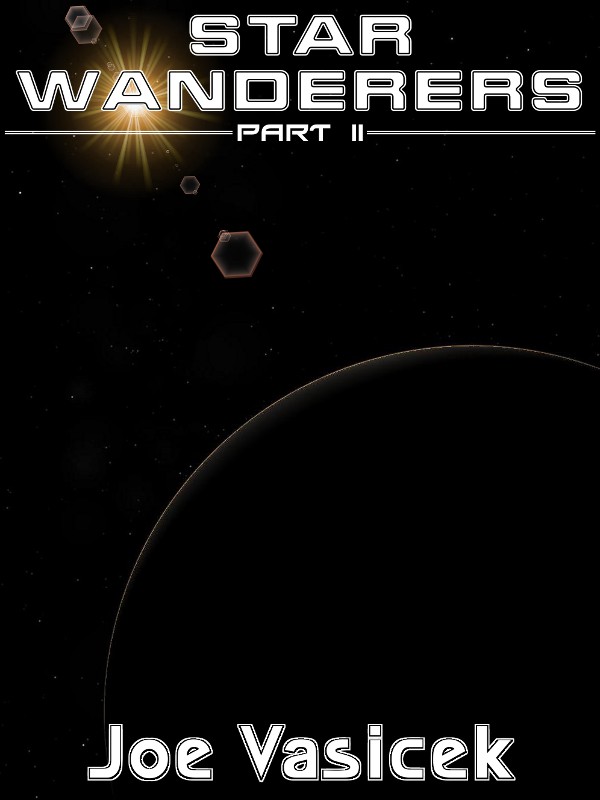
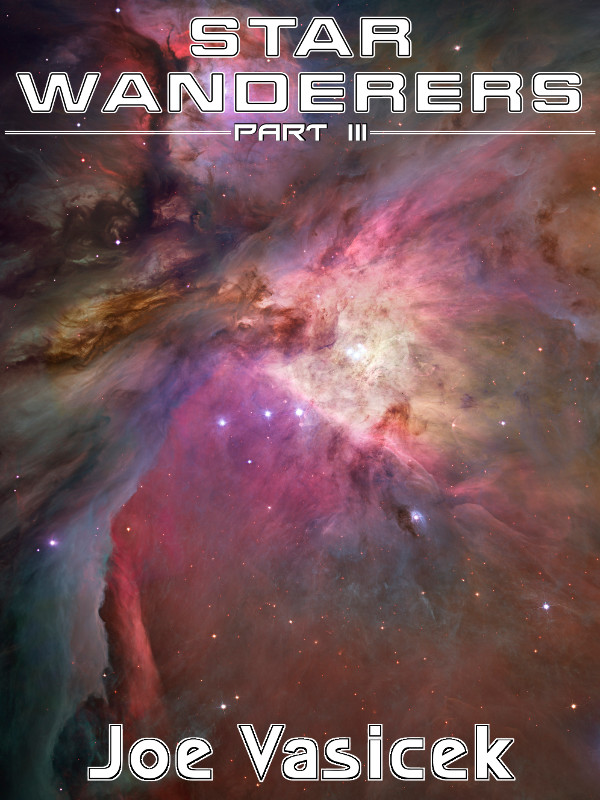
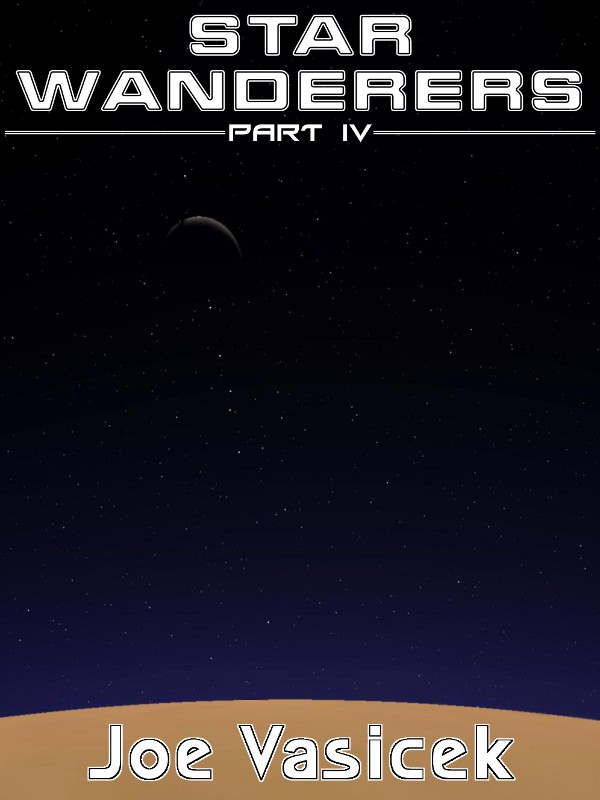
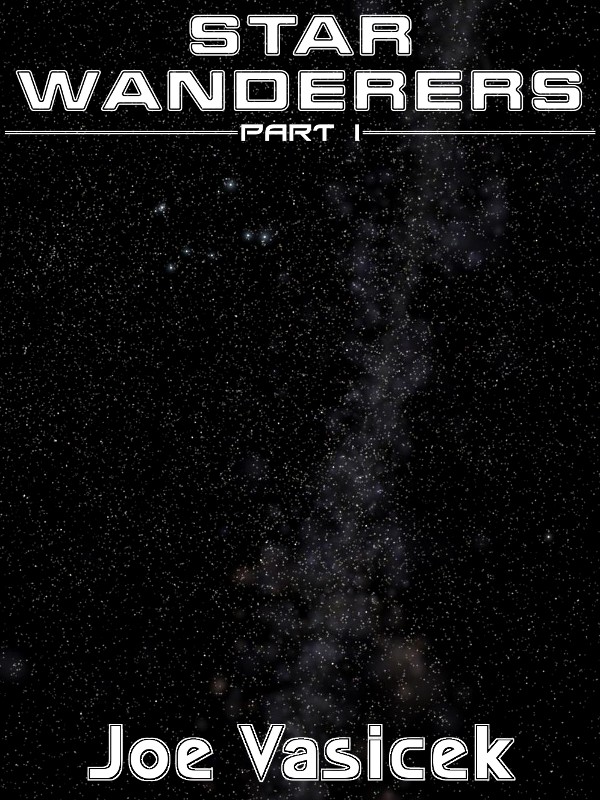
I’m so excited, in fact, that I went ahead and made some mock-ups for the cover art!

Pretty cool, huh?  These make me sooo happy. 🙂

I’m not quite sure if this is the right design, though.  Star Wanderers is very much a science fiction romance, and while these covers definitely scream “science fiction!” they don’t really seem to say “romance!”

My original idea was to use these as backgrounds and commission an artist to do some character portraits from the waist up, using one portrait each for the foreground.  But then again, that might make the covers a bit too complicated.  I can always redo the first one to get rid of the planet, keeping the galaxy–the other ones probably wouldn’t be so bad with a character in the middle.  But then again…

I don’t know.  What do you guys think?  If you saw one of these covers while browsing for ebooks, what kind of impression would it give you, and would you be interested in checking it out?

(By the way, I made the covers with Celestia.  Coolest.  Space simulation.  Ever.)

EDIT: I decided to redo the first cover; the planet wasn’t quite doing it for me.  I’m not sure if that means I should redo the cover for the third part, since that one is a heck of a lot more colorful than the others…hmm.  We’ll have to see.

What I’ve been up to recently

I thought it would be a good idea to do a quick post explaining what I’ve been up to the past month or so, since a lot of things have changed and I’m sure they will be changing a lot more in the future.  So, here’s what’s up:

As you may or may not know, I decided about four or five months ago to leave the USA to teach English abroad.  For the past few little while, I’ve been applying for a program to teach English to elementary school kids in Georgia.  I had the interview over Skype just yesterday, and I think it went pretty well!  I should hear back in the next couple of days, so fingers crossed on that.

If they decide to hire me, I’ll leave in three weeks and stay until at least mid-June.  At that point, I’ll either sign up for another semester or go somewhere else, either the Middle East or Eastern Europe. The pay isn’t great, but it seems like a good cultural experience, and I’m a lot more interested in the Caucasus than I am in East Asia (no offense to Asians).

Ever since I graduated in 2010, I’ve been looking for a fulfilling career that I can balance with my writing aspirations.  I learned pretty quick that that simply doesn’t exist in Washington DC; either you sacrifice everything for your career, including your family, or you end up trapped in an office pushing papers all day.  In Utah, I bounced around a lot of temporary jobs while struggling to make ends meet, but I never found anything more permanent that seemed to strike a balance.

I hope that teaching English will help me to find that balance, and from what I’ve heard from some of my former expat friends, I’m optimistic that it will.  Perhaps more importantly, it will probably enrich my writing by exposing me to new peoples and cultures.  Desert Stars was certainly enriched by the time I spent in Jordan; without having lived in that culture, I don’t think I would have been able to write it.  Besides, English is something I’m good at, and so is teaching–so why not capitalize on the skills I already have?  It certainly sounds better than wasting my 20s in a warehouse.

So that’s the plan: launch a TEFL career and spend at least the next three to five years abroad.  At least.  I might not get married until my 30s–or who knows, I might find someone out there and go native–but this is something I want to do as a career, not just as temporary filler before I figure out what I want to do with my life.  I’m through with filler.  Whether it takes one year or ten for my writing career to take off, I’m going to get out and do something useful and worthwhile.

That’s the plan, anyway.  And of course, I’ll always keep writing.

Right now, I’m finishing up Stars of Blood and Glory; I’m on chapter 15, with only three more and an epilogue after that, so I should finish that well before I leave.  After that, the next big project is Star Wanderers, which is already about halfway finished.  I’ll probably take some time off and work on polishing part II, then release parts I and II sometime in the spring–unless by some weird fluke it wins Writers of the Future.  I’ll know in February.

And after that?  Well, I’m thinking it’s almost time to pick up Edenfall again, but I can’t say for sure. Probably, though–I definitely want to finish that one before the end of the year, and preferably get it published.  After Stars of Blood and Glory, I’ll probably take a break from the McCoy continuity in the Gaia Nova universe, though I may pick up something from Jeremiah’s timeline in Star Wanderers.  I really want to do a parallel novel from Noemi’s point of view–maybe that’s the one I’ll do in seven days, just to hit that resolution.  Everything has to be ready fist, though, and right now it isn’t.

So much is changing–I have no idea where I’ll be in the next six months, creatively or physically. But right now, I’m just enjoying a relaxing time with my parents and getting ready for the next big transition.  Life is good.

Trope Tuesday: Lawful Good

Lawful Good is the character alignment that is the most unambiguously heroic.  These are the white hats, the caped crusaders, the knights in shining armor who fight for Truth, Justice, and the American way.  They might not always be smart, and they might not always be nice, but you can always count on them to do the right thingalways.

From the easydamus character alignment page:

A lawful good character acts as a good person is expected or required to act. He combines a commitment to oppose evil with the discipline to fight relentlessly. He tells the truth, keeps his word, helps those in need, and speaks out against injustice. A lawful good character hates to see the guilty go unpunished.

Although most Lawful Good characters are unambiguous, their conflicts are often quite complicated.  This is because their dedication to the moral code is itself a weakness which an intelligent villain can exploit.  Typically, this is done by putting them in a situation where they have to choose between being lawful (catching the bad guys) or being good (saving all the innocent people who will die in the process).  A smart Lawful Good character, however, will come up with a third option that turns the ethical dilemma on its head, though it might require a heroic sacrifice.

Very often, these kinds of characters appeal to us because they represent some higher ideal which we wish we could follow.  However, that’s not always the case, especially in more cynical works like A Game of Thrones, where the most lawful good characters also tend to be the most stupid.  Ultimately, it all comes down to the bias of the writer; even when you’re trying not to be didactic, it’s hard not to use the Lawful Good character as a vehicle for some sort of message.

A shallow Lawful Good will be little more than a paragon for whatever virtue they’re meant to represent.  A more nuanced Lawful Good will have some sort of a flaw (besides the backhanded ones), or some sort of internal conflict connected with their moral code to make them more human and relatable.

My favorite Lawful Good would probably be Sir Galahad from Le Morte d’Arthur, but mostly because of the sharp counterpoint he provides next to all the thugs and criminals other Knights of the Round Table.  Carter from Halo: Reach is a pretty cool Lawful Good, though he wasn’t my favorite (that would be Jorge).  And even though he’s a complete idiot, Ned Stark is still the only adult character from A Game of Thrones that I found remotely likable.

In my own work, Jalil from Desert Stars starts out as Lawful Good, though he shifts to Lawful Neutral in the middle and up to Neutral Good by the end.  In Bringing Stella Home / Sholpan, Lars and Narju definitely fall under this alignment, putting a lot of pressure on Stella to live up to their ideals.  I explore Lars’s idealistic character a bit further in Heart of the Nebula, a direct sequel to Bringing Stella Home which I hope to release later this year.  And in Star Wanderers, Noemi tends to fall under this alignment–though the story is not so much about saving the world as it is about saving each other.

Writing log results

For the last month or so, I’ve been keeping track of my daily writing habits to look for patterns that might give me some insight on how to improve my creative process.  I’ve amassed somewhere around 65 data points, and I think the results are clear enough to notice some trends.

Just some preliminary background information: for most of this time, I’ve either been on vacation or at my parents’ house, waiting to start an English teaching job in another country.  I haven’t had school or a full-time job, so my schedule has been pretty open and flexible.  Also, the numbers track progress on the first drafts for Star Wanderers and Stars of Blood and Glory, and do not count revisions of any kind.

Here are the results:

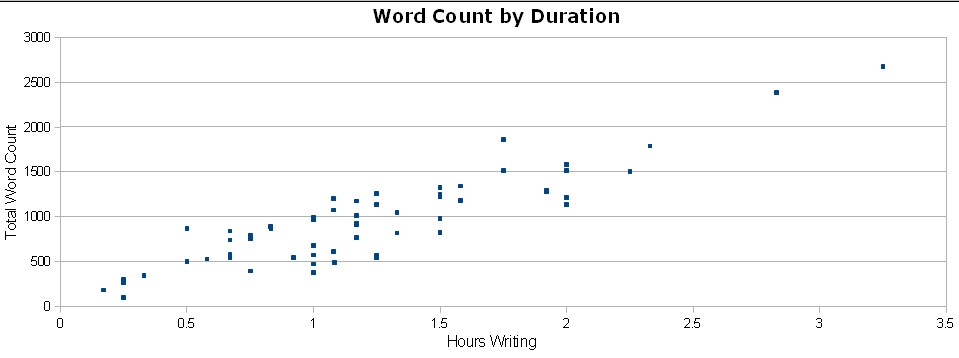
The first graph plots word count by duration spent writing.  As you can see, there’s a definite trend: the longer I write, the more I tend to write.  No surprises there.  Most writing sessions are somewhere between 45 and 90 minutes, or 500 and 1,500 words.

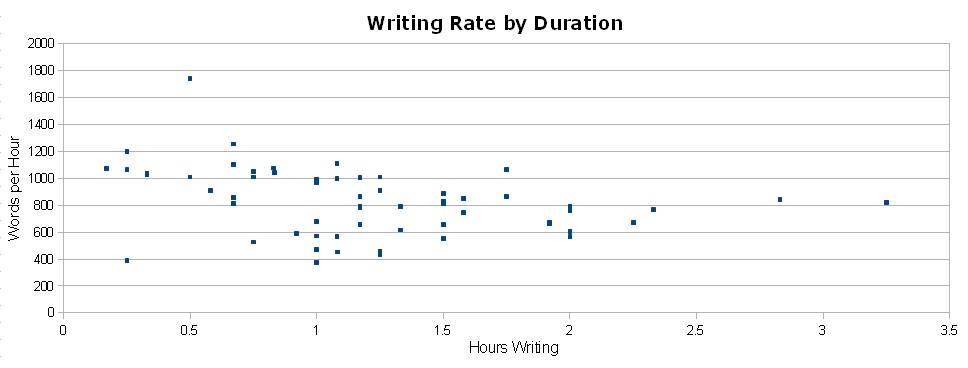
The second graph plots the average writing rate (in words per hour) per session by hours spent writing, and it’s a little bit murkier.  In writing sessions of less than 45 minutes, I tend to average a little over 1000 words/hour, but things get murkier between 45 and 90 minutes, and after 90 minutes, I tend to be around 600 and 800 words/hour.

The overall trend appears to be down–that is, the longer I write, the slower I tend to write–but there appears to be a counter-trend, too, where if I start off slow I can increase the pace by writing for a longer amount of time.  Is that true, or is that simply a sharper downward trend line?

I think it’s a genuine counter-trend, and here’s why:

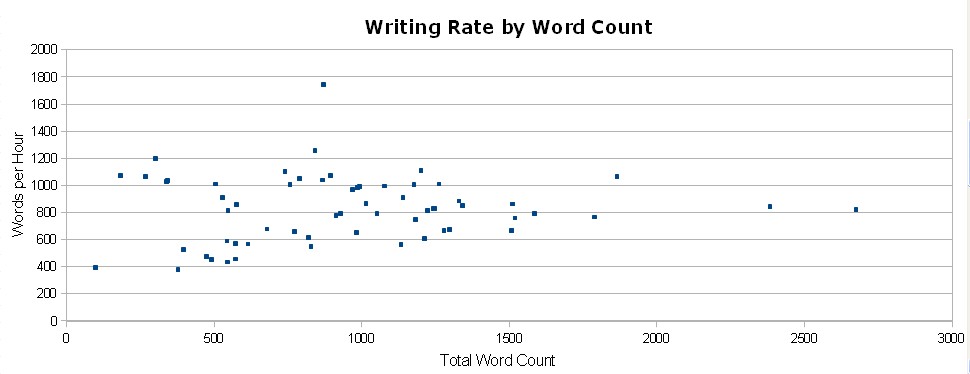
This graph shows writing rate plotted against word count, and it pretty clearly shows two trend lines: one starting at 1,000 to 1,200 words/hour and going slightly down, the other starting at 400 to 600 words and going up.  At about 1,500 total words, they converge at around 800 words/hour and appear to remain flat, though there isn’t really enough data to be able to say.

What I think this shows is that I have two different writing styles.  The first is to start off slow and gradually write my way into the story, picking up the pace but never really going over 800 words/hour.  The other is to start off at a sprint of 1,200 words/hour or so, but to slowly drop off to 800 words/hour at around 90 minutes or 1,500 words.

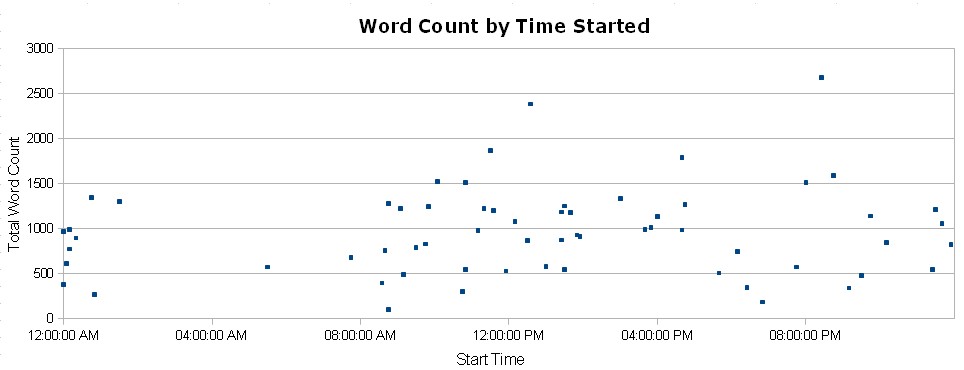
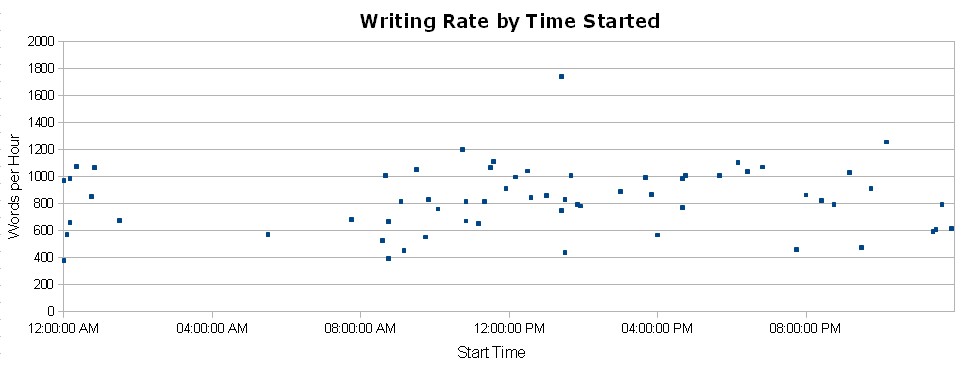
The next graph plots the total word count of each writing session by the time of day in which I started the session.  Interestingly, there is no trend; the points are all over the map.  This tells me that there is no “best time” for me to write.  Other time-related factors might influence how much I can write, but time of day itself does not.

A quick glance at the next graph confirms this.  It plots writing rate by time of day, and the results are much the same as the graph for word count.  I tend to write at a more consistent pace in the afternoon–around 1,000 words/hour–but really, there is no consistent trend.

This tells me that my first session of the day tends to be slow and gradual, but that once I’ve written myself into the story, the writing comes a lot faster.  In other words, if I wake up early and hit the ground running, I tend to write more and write faster throughout the day.  If I get lazy and sleep in, the whole day tends to be shot.

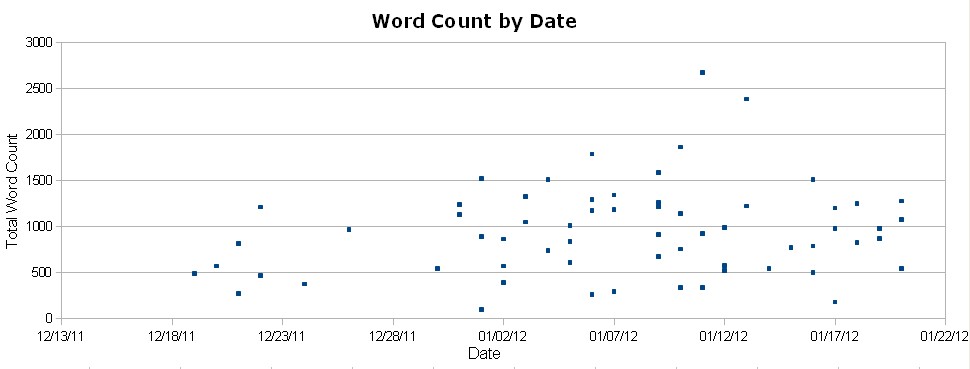
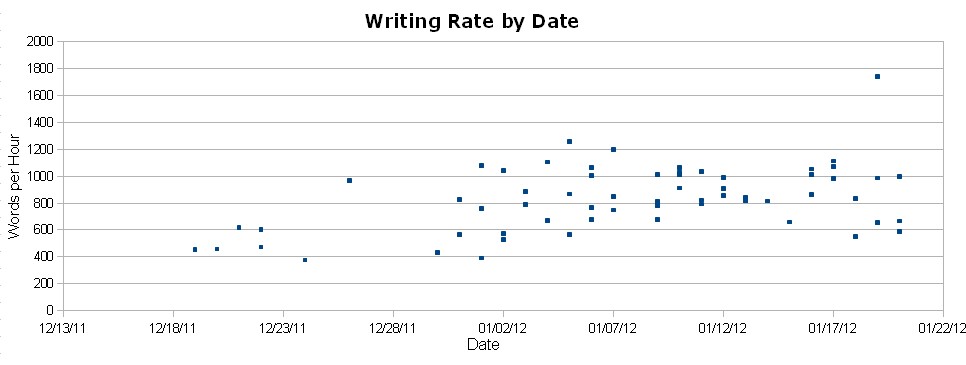
The last two graphs plot word count and writing rate by date.  Before January 3rd or so, I was either spending time with family or on the road / traveling cross-country by train.  Even so, there wasn’t a whole lot of variation, though my writing rate converged around 800-1,000 words/hour for a while before fluctuating again.

What this tells me is that stability and momentum tend to lead to more consistency in my writing habits.  If I’m constantly on the road, it becomes more challenging to keep up the pace.  Even so, as long as I can find make at least 45 to 90 minutes to write, I can pound out about the same number of words per session.

So in conclusion, it seems that the best way to improve my writing habits and streamline my creative process would be to:

  1. Get up early and start the day writing.
  2. Write in short, condensed sessions of 45 to 90 minutes each, with periodic breaks in between.
  3. Don’t worry about time of day when planning time to write; just do it whenever time can be made available.

However, unless I can get to the point where I’m regularly averaging +1,000 words after two hours, it’s going to be really hard to put in 10k words or more per day.  At 800 words/hour, it takes 12.5 hours to hit 10k, and after about four or five sessions at 1,000 words/hour, the well starts to dry up.

A much more practical goal, for now at least, would be to shoot for a consistent 5k words per day.  The week before last, I hit about 5.5k on Monday, a little less than 4k on Tuesday and Wednesday, and back around 2.5k for Thursday, Friday, and Saturday.  My running 7-day total for the entire week was above 20k, which is pretty good, but if I could get to stay between 25k and 30k for some time, that would be an accomplishment.

I haven’t totally given up on hitting a 10k/day average, but at this point, it seems that I need to set some stepping stones first.  5k/day seems like a much better goal for now–especially since I don’t know how things are going to change once I’m traveling again.  But at least I have a better idea of how my own process works.  I expect I’ll be writing a lot more in the weeks and months to come!

plot vs. PLOT and an interesting serial publishing idea

Back in English 318 at BYU, Brandon Sanderson used to tell us that there was a big difference between “little-p plot” and “big-p Plot.” The first applies mostly to chapters and scenes, which he said he could teach us.  The second refers to the overall story structure, which he couldn’t teach in a classroom setting and said we’d have to discover on our own.

I’ve been thinking a lot about this recently, because it seems that my books are starting to fall into a recognizable pattern–and that pattern has some interesting potential for serials and other alternate forms of publication.  Each book is divided into 3-4 parts, each part is divided into 3-6 chapters (typically 5), and each chapter is divided into 3-5 scenes.  Here’s how it works:

Chapter 1: Setup for the basic story arc.  Introduction of the characters and setting, the prominent theme or premise, and a little foreshadowing of the coming conflict.
Chapter 2: The inciting incident, a discovery or event that starts the plot rolling and puts the characters in motion and conflict.
Chapter 3: Complications arise, the problem gets worse, the first attempt at a solution fails, generally leaving the characters at a loss.
Chapter 4: Setup for the resolution.  The characters discover or build something that will help them to settle the conflict.  They stop reacting and start to be more assertive.
Chapter 5: The resolution.  The characters either succeed or fail, but the arc comes to a close either way.  The story question is answered, the thematic elements come full circle, and the story either closes or moves on to the next part.

Basically, it’s the 3-act format divided into five chapters.  When I wrote Heart of the Nebula, all four parts fell into this pattern, and now that I’m writing Star Wanderers, I’m finding myself  falling into the exact same pattern again.  Stars of Blood and Glory is a little bit different; there are three parts instead of four, and each part is divided into six chapters instead of five.  But still, it’s all very structured.

In short, Brandon was right.  It took me a few books to really learn “big-p Plot,” but now that I’ve found a story structure that works for me, it’s starting to come quite naturally.

The cool thing about this particular structure is that it’s very conducive to serialization.  Each chapter is between maybe 3,000 to 5,000 words, so each complete sub-arc is between about 15,000 to 25,000.  That’s the length of a short novella, and it takes me only a month or two to write (sometimes three, depending on how much revision it needs).

The only reason I haven’t done more with serialization up to this point is because I’ve found that sharing my work while it’s still unfinished tends to throw a wrench in my creative process.  The idea of publishing a work in progress on a chapter-by-chapter basis scares me, because if one of the story arcs has a flawed beginning, I wouldn’t be able to fix it.

However, by following a five-chapter arc format (with bits and pieces here and there to hint at a larger overarching structure), I can see myself publishing a novel or epic in a serial format.  It would be something like the Perry Rhodan series, which follows an arc structure of 25 to 100 issues (each a small novella) per cycle.

So here’s how I’m thinking of doing it:

  1. Publish the first installment and price it at free while writing the second one.
  2. Publish the second installment and price it at free, raise the price of the first installment to $.99 and write the third one.
  3. Publish the third installment and price it at free, raise the price of the second installment to $.99 and write the fourth one.
  4. Publish the fourth installment for $.99, drop the price of the first installment to free and publish the completed novel for $2.99.

So what do you think?  Does it seem like a good way to publish a book?  It gives the reader a reason to keep coming back, and rewards those who got in early by charging them less for the completed work.  By selling the novel in shorter chunks, I would be able to put more work out and hopefully gain more visibility, especially by making a portion of it free at any given time.

I’m seriously thinking about publishing Star Wanderers this way, once I hear back from Writers of the Future.  I’ve already finished the rough draft for the second part; it probably needs a good revision or two before it’s ready, but since it’s shorter, it shouldn’t take more than a few weeks to get feedback from some first readers and finish the next draft.  And if the third part is already finished by then…

So many awesome possibilities! 🙂 What do you think?

Torn between projects and some new thoughts on the creative process

So I have a confession to make: a couple of days ago, when I was in something of a rough spot with my current novel, Stars of Blood and Glory, I had this overwhelming urge to go back and revisit Star Wanderers.  In two days, I went through everything I’d written up to the point where I’d gotten stuck, and something just clicked.  All of a sudden, I knew exactly where to take the story.

So today, I sat down and wrote the next scene…and man, it was hot!  The words were flying, the characters were leaping off the page (and almost into the sack with each other–almost, but not quite)–it was awesome!  The flame for this project has definitely been rekindled, and I’m really enthusiastic to get it rolling again.

Trouble is, I’m already working on Stars of Blood and Glory–and making some good progress on that one as well.  In fact, I’m still quite excited about it.  I’ve got all the twists planned out, the characters are really coming alive, and while the manuscript is still pretty rough, none of the problems are too serious to stop the creative process.

But sometimes…well, sometimes I feel like I’ve been writing so fast on this one, that the story hasn’t had time to really percolate.  I’ll have the next few scenes planned out, but I just won’t want to write them–not because I’m lazy, I don’t think, but because it hasn’t really clicked yet in my mind.

This is something I’m slowly coming to grips with.  The creative writing process isn’t something you  can completely capture with metrics (like daily/weekly word counts, hours worked, writing rates etc). There’s a whole lot of mental-space work that, on the outside, looks a whole lot like procrastination or laziness–and can easily degenerate into that, if you aren’t careful.  However, these mental activities are absolutely crucial, because they serve to refill the creative well.  Without them, writing becomes painfully difficult, and the quality of the stuff you do manage to put out tends to suffer.

That’s what I’m starting to notice, in any case.  I’ve found it somewhat helpful to go on a long walk each day, like maybe for an hour or more, but I wonder if it might also be helpful to have multiple projects to fall back on, so that even if I’ve got to refill the well for one of my projects, I can still be actively creating.

Because it’s more complicated than just outlining the next chapters.  The best scenes to write are the ones that go off in their own direction, without any planning (or perhaps minimal planning) on my part.  Discovery writing is definitely a part of my process.  To make that happen, however, I have to get a real feel for what’s happened up to that point, and think through all the implications of their possible choices.  If I do it right, something I haven’t considered comes to mind, and it helps the scene to come to life enough for me to write through it.

So yeah.  For Star Wanderers, the ideas have been percolating since a conversation I had with my brother in law and former roommate over Christmas break.  For Stars of Blood and Glory, I feel almost as if I’m going too fast to percolate–or that at least I need to take a little time off here or there.  And the real trouble is that I’m probably going to be going overseas in a couple of weeks–which means that all the free time I enjoy right now is probably going to become extremely scarce in the near future.

So I’m going to do my best to finish Stars of Blood and Glory before the end of the month, but if I’m not getting enough prewriting in to do the story justice, I’m not going to push it.  And when I’m not working on that one, I’ll work on Star Wanderers, since I’m really in love with this project (seriously, very much in love) and it’s not in my heart to put it off any longer.  I just hope that it doesn’t get in the way…

Anyhow, if I’m going to pound out another 4k to 5k tomorrow, I’d better get to bed.  I’ll leave you with this:

Man, I need to get this girl to do the soundtrack for my life. Either that, or my next book, which pretty much amounts to the same thing. 😛

G’night!

Halfway to 10k

I was going to post my ebook numbers for December and a report for the last quarter, but then I got caught away in my latest novel, Stars of Blood and Glory and wrote over 5.6k words for the day.

This is probably the most new material I’ve written in a single day since 2009–perhaps ever.  Revising tends to come a lot easier for me, so I’ve spent a lot of time in the past doing that, but this indie publishing gig is making me up my game.  I’m working my way up each day; hopefully I’ll be able to write even more tomorrow and keep up the pace until the book is finished.

Of course, it helps that I’m hanging out at my parents’ place without any obligations or time commitments.  I finished my application to the TLG program last week, and they just sent it out today; with luck, I’ll hear back that I’ve been accepted within the next five days, and then I’ll have a definite idea of how much time I have left before I’m off on the next adventure.  It probably won’t be much longer than two or three weeks at that point.

My (rather lofty) goal is to finish the rough draft of Stars of Blood and Glory while I’m here in Massachusetts, seeing as I have nothing else to compete for my time.  Once I’m overseas, it’ll be a flurry of activity and I’ll probably be lucky just to manage one or two thousand words per day, at least until things settle into some kind of routine.

So that’s the plan for the next few days.  In order to finish this book by the end of January, I’ll have to average over 3k words per day, but I think I can do it.  This story is so much fun–the characters are practically leaping off the page at me, and I’ve got some awesome twists planned.  Space battles, mercenaries, a runaway princess, and opposing princes who are determined to prove themselves men–it’s going to be a clash of epic proportions!  I can hardly wait to write it!

Character Interview: Master Sergeant Roman Andrei Krikoryan

So I recently heard about a really interesting blogfest, where the goal is to blog about the characters in your story, as well as have a little fun with flash fiction.  The prizes look pretty good, too: a couple of free books and a manuscript critique, from a couple of up-and-coming editors.

Not bad…but the 250 word limit on the character interview seemed a little too restrictive.  The idea really caught my imagination, though, so I decided to go ahead and do it for the main character of the book I’m writing now: Stars of Blood and Glory.

It was really fun!  Stuff like this can be great for working out different aspects of your character.  I already knew most of this stuff about Roman, but the exercise helped to solidify it.

And so, without further ado: enjoy!

========================================

Hello, and welcome!  I’m here on the Tajji Flame with Master Sergeant Roman Andrei Krikoryan, one of the Tajji mercenaries in Bringing Stella Home and a major character in the sequel, Stars of Blood and Glory.  How are you doing today, Roman?

How do you do, my friend.

Very well, thank you.  Let’s get started shall we?  First question: What is your biggest vulnerability? Do others know this or is it a secret?

What is my vulnerability?  This is strange question to be asking a mercenary.  Why do you wish to know? <narrows eye>

Um, it’s not meant to be intrusive, more just as ah, um…well, what would you say is your biggest emotional vulnerability?

“Emotional vulnerability”?  Look at me.  I am not a man anymore, but a cyborg; what “emotions” I still feel, they are distant and weak.  Rare pleasures, like sweet, unbidden memories.

I tell this to the doctor every time at check up, but she does not believe me.  She is still young, and wishes to believe that there is some humanity left in me.  Who knows?  Perhaps she is right.  But cyborgs do not die, my friend: their humanity fades until they are a ghost within a machine.

I have wandered the stars for over seventy standard years; I have seen my homeworld conquered not once, but twice.  I have killed many men, I have slept with many whores, I have watched my old friends die, and had other friends watch me, thinking I was dead.  I am old–too old.  And yet cyborgs do not die: they fade.

So if you consider this as “emotional vulnerability,” then this is mine: to be alive, and yet not truly living.  And it is no secret.  I am a man of very few secrets.

What do people believe about you that is false?

Many things, some more false than others.  You cannot be soldier for as long as I without learning how to cultivate a certain, how do I say?  Persona.  My men, they see the side of me that is strong–and it is a true side, for in battle, it is impossible to live a lie.  But the side that they do not see, that is the pain–the memories, the weariness, the silent longing.  It is dull now, but it is still there, even if I do not show it.

And so, if there is something that people believe about me that is false, it is that I feel no pain.  I have always felt pain, until even before the rebellion was lost.  It is way of life for me now.  When the pain finally stops, then I will know that I am no longer human.

What would your best friend say is your fatal flaw? Why?

My best friend is the captain, Danica Nova.  She knows of my pain; she shares in it.  And what would she say is my flaw?  That I suffer in silence, perhaps.  Every time she has question, she is asking me for help, seeking for my guidance.  She believes that everyone must have someone on whom they can lean, that without this, no one can truly stand.  And so she sees me suffering, and wishes that I would talk with her, so that these wounds might heal.

But I do not wish for my wounds to heal.  They are the last thing I have left–the pain which tells me I have not yet faded, that I am still human.  I have lived many years with this pain, and I do not know what would become of me without it.  And so, it is not my friends, but the pain, that has been my constant companion these many long years.

I do not know if this is flaw, but I do know that Danica would say that it is.

What would the same friend say is your one redeeming quality? Why?

That question, I know without a doubt what is the answer.  It is that I will do anything–anything–for my men.  You see my arm, how that it is prosthetic?  I lost the original fighting in a battle that all of us thought we would lose.  If I am fading, it is because I have given my life for my men–and I will continue to do so until I have nothing left to give.

What do you want most? What will you do to get it? 

<laughs> A strange question, with an even stranger answer.  As you can see, I am man of war–but if there is one thing that I wish for, it is peace.  Peace!  And what sort of peace, you may ask?  I will tell you.  I wish for the peace that one feels by coming home. <throws back head and laughs again>

And so you see, my friend, this is a peace that I can never feel.  My homeworld is gone–slagged into oblivion.  My country has been destroyed, my people scattered across a hundred stars. I have nothing left but to keep on fighting; and so, even though I long for peace, I continue to make war, because it is all that I am.

But what will I do to get this peace?  I will tell you.  Since I do not have a homeland, I will find this peace by dying for my men.  It is fitting, is it not?  That the man of war should only find peace in his own death?  This is as it should be.  But it must not be a selfish death–it must be a sacrifice, so that others may live.

Thank you very much, Roman.  I enjoyed writing Bringing Stella Home, and look forward to chronicling your further exploits in Stars of Blood and Glory.

My pleasure.

========================================

As an interesting side note, if Roman had a theme song, this would be it.  Have a great day!
Getting back into things

Sorry I haven’t posted much lately; I just got back to Massachusetts from a cross-country train trip (after spending Christmas between Utah and Texas), and I’m still getting situated here at my parents’ house.  If all goes well, I’ll be leaving by the end of the month to teach English in Georgia; worst case scenario, I sign up for a different program and spend a few more months here than I’d bargained for.

Things on the writing front are going well, though; I’ve been pulling between 1.5k and 2.5k words per day pretty consistently, all on Stars of Blood and Glory.  It’s very refreshing to be working on a new project again, and while I don’t feel like I’m into it as much as I could, with nothing else to distract me hopefully that will soon change.

One other interesting thing I’m doing right now is keeping track of the stats for my writing sessions: how many words I write, what times I start and finish, how many words per hour I average, etc.  The data is turning out to be quite interesting, so once I get to about 50 or 100 data points, I’ll post my findings.  It’s definitely giving me some much needed insight into my writing process.

In the next couple of days, I’ll post the ebook numbers for December and my quarterly report (I might actually combine the two into one post, come to think of it).  Also, I’ll finally get around to sending out the email newsletter, with some goodies like desktop wallpaper for Desert Stars.  If you haven’t yet signed up for the newsletter, you can do that via the form on the sidebar. —>

Finally, to round things out, I’ll link you to this awesome Final Fantasy VI tribute I found on teh internets:

Man, such an awesome, awesome game. I almost did a full length novelization of FF6. Instead, I wrote my first novel. It was definitely the better choice at the time…but a part of me still wants to revisit that world through writing my own fanfic. Someday, maybe…

Trope Tuesday: Xanatos Speed Chess

Well, I can’t say any of this mess was part of my original plan, but it’s all working out so beautifully that I can’t complain.

Tarvek, Girl Genius.

The Xanatos Gambit is when a character plans out a scheme such that all possible outcomes (including abject failure) ultimately benefit that character.  Named after David Xanatos from Gargoyles, it is most often used by villains who are very good at evading karma.

Xanatos Speed Chess, on the other hand, is when the character relies not on setting up an only-win scenario from the beginning, but on being able to adapt and change their plans quickly enough to pull off a victory even after their first few attempts inevitably fail.  For this character, the important thing is not to keep everything from falling apart, but to outsmart their opponent even after everything already has.

Both heroes and villains can play at this game, but the heroes generally tend to be better at it.  Part of the reason for this is that try-fail cycles are much more conducive to Xanatos speed chess than the Xanatos gambit.  The heroes might lose a pawn or two, or even the queen, but that doesn’t stop them from turning defeat into victory.  In fact, depending on the story, it may provide exactly the sort of dramatic tension that makes the ending so awesome.

A good example of this in recent cinema would probably be the new Mission: Impossible movie.  Over and over, the mission falls apart–and the characters respond either by changing the mission or by crafting a new one.  It’s one of the things that makes it such a great spy thriller: the tension is always high, because you never know how they’re going to pull it off.

The opposite of this trope is the Indy Ploy.  This is because Xanatos speed chess is still chess; even though the plans are dynamic, they are still plans, and involve a large degree of calculation and forethought.  With the Indy ploy, the character is just wingin’ it, jumping into the thick of things and making it up as they go along.

The main reason I’m interested in this trope is because my current project, Stars of Blood and Glory, has a strong military plot, and I want one of the characters to be a magnificent bastard.  Let’s just say that if Bringing Stella Home is the Mongol conquests in space, Stars of Blood and Glory is the Battle of Ayn Jalut.  It’s going to be challenging to pull it off, but that’s part of what makes writing so much fun…