Weekly Roundup for 2018-2-17

I thought it would be interesting to do a weekly blog post of all the remarkable things I saw or read on the internet in the past seven days, with my thoughts and/or reactions. If nothing else, it should be entertaining. Let’s try it out for a few weeks.

1) Proof that the internet has all the maturity of a horny teenager

Or at least Twitter:

2) Extra Sci Fi concludes the Martian Chronicles

Extra Sci Fi is turning out to be a really great YouTube series. They started with Frankenstein, then spent some time on William Gibson, and recently went through the Martian Chronicles by Ray Bradbury. They really do a good job of getting to the heart of classic science fiction.

It reminds me of a Trope Tuesday post I did a while ago about settling the (final) frontier. The whole idea of restarting humanity by leaving Earth behind is one of those things that draws me to science fiction the most. The stories in Bradbury’s Martian Chronicles are more artistic and thematic, but still, that idea is very much a part of them.

3) Roadster, Starman, Planet Earth

If there was any remaining doubt that Elon Musk is secretly trying to help an extraterrestrial get home, APOD posted this awesome photo last Saturday:
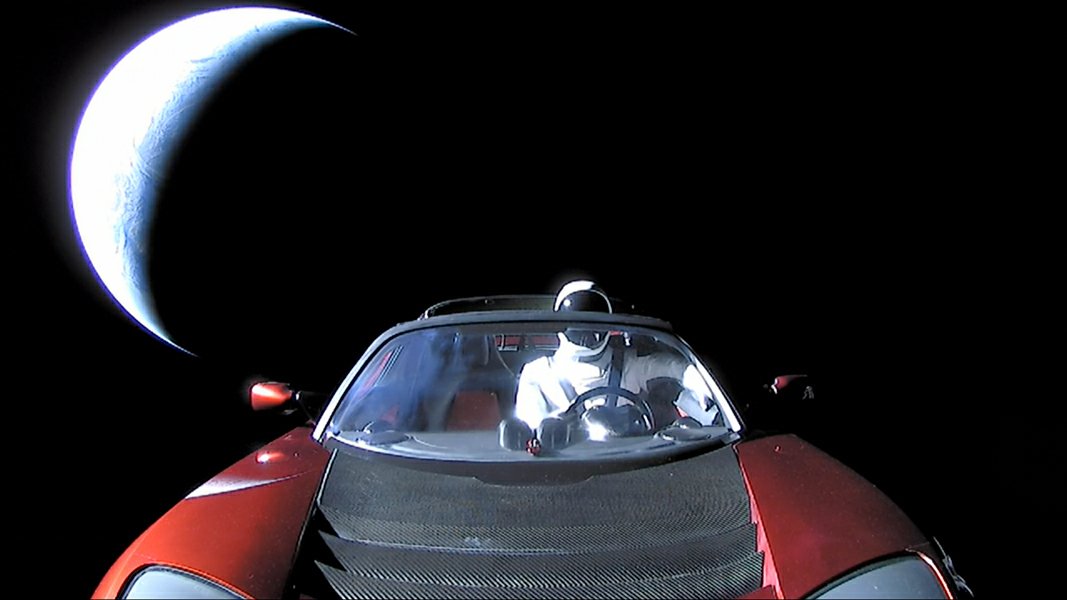
I have got to find a way to fit Elon’s roadster into Gunslinger to the Galaxy.

4) Barnes & Noble Layoffs

In publishing news, Barnes & Noble is laying off a bunch of full-time employees in an effort to save on benefits and health insurance. Passive Guy covered it twice, once for the Publishers Weekly article, and again with comments by the employees on The Layoff. There’s also a lively discussion on Mad Genius Club on the subject.

Felix J. Torres, who often has great nuggets of wisdom, shared his insights in a comment on The Passive Voice:

– Those experienced “leads” is where a company’s corporate memory really resides. The people who’ve been through the wars and seen it all, who know where the scripts and handbooks end and common sense crisis management and experience takes over. They are lobotomizing operations.

– If the difference between “lead” pay and entry level is the only thing between them and bankruptcy… Well, they might as well file right now. $40M in “savings”? That’s less than $80,000 per store. For that they disrupt people’s lives and cripple their operations? Smacks of desperation. Chapter 11 must be closer than even the harshest critics expects.

Looks like choppy waters and a major shakeup for the book industry in the coming months and years.

That does it for this week, but I’m sure I’ll have more in the weeks to come!
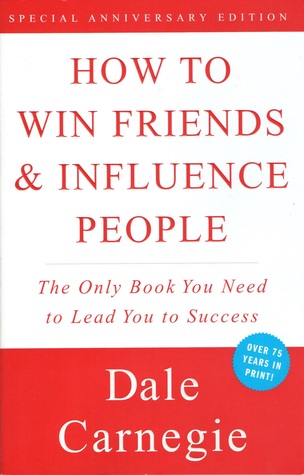
How To Win Friends And Influence People by Dale Carnegie

This is the book that invented the self-help genre, and for good reason. It was written more than 80 years ago and still stands as the definitive work on the subject. Unless you live in a cabin in the mountains where you never interact with other people, this book really is as important and life-changing as everyone says it is.

I bought this book at the urging of a friend way back in 2015, but I kept putting off actually reading it until now. I’m not entirely sure why I did. Maybe the titles were too clickbaity, or the language read like something from a sensationalist blog. Truth is, though, that Carnegie was the one who invented that kind of writing and everyone else is just trying to imitate him. And unlike your typical internet clickbait, there is actually a lot of substance behind the words.

I can summarize this book in one sentance: “To win friends and influence people, build them up and make them feel important.” There really isn’t any secret to it. The difficult part is learning how to do it and mastering the technique, for which it may take a lifetime of practice. I’ve heard that many billionaires make it a point to reread this book on a yearly basis.

This book is especially helpful if you struggle with social skills in any way. That alone should make it a must-read for most of us geeks, especially me.

Weird things happen whenever I decide to practice the advice in this book. I complimented a man on his hat, and he offered to give it to me. I gave the TSA officer a smile, and he let me pass through security without confiscating my >3 oz container of homemade fruit preserves from my cousin’s wedding. I told the cashier at the Creamery that I liked her braids, and her expression went from “I’m having a horrible day” to cheerful and happy.

It’s honestly a little freaky how well this advice works. If I’d read this book back in 2015, I may have even convinced my parents not to vote the way that they did. I certainly would have toned down the politics on this blog, and would probably have persuaded a lot more of you to see things the way I see them in the process.

So yeah, unless you’re alone on an interstellar voyage light-years from the nearest human being, this book is a must-read. And even if you are on that voyage, if there’s so much as a single other person on that starship, you definitely need to read this book.

Trope Tuesday: Manic Pixie Dream Girl

Oh dear. I’m probably going to take some heat for this one, especially if it gets picked up by File 770.

What is a “manic pixie dream girl”? Tvtropes puts it this way:

An upbeat young woman whose love gives the brooding male hero a new lease on life.

Wikipedia puts it this way:

…the MPDG “exists solely in the fevered imaginations of sensitive writerdirectors to teach broodingly soulful young men to embrace life and its infinite mysteries and adventures.” MPDGs are said to help their men without pursuing their own happiness, and such characters never grow up; thus, their men never grow up.

You know how the term “space opera” was originally a derogatory term for crappy science fiction? I’m going to go out on a lark, invoke tropes are tools, and argue that Wikipedia is wrong and there’s nothing inherently bad about this trope.

Anita Sarkeesian is not a huge fan of the manic pixie dream girl. In fact, it was the first trope she deconstructed way back 2011, before her scammy kickstarter. I’m not a huge fan of Anita Sarkeesian, but it’s worth rewatching her take on it:

In particular:

The manic pixie perpetuates the myth of women as caregivers at our very core—that we can go fix these lonely, sad men, so that they can go fix the world.

Here’s the thing, though: when you study the men who have fixed the world, you almost always find a strong, caregiving woman behind them. This is portrayed very well in The Darkest Hour, with Winston Churchill’s wife, Clementine:

Granted, Clementine Churchill is no manic pixie, but she did provide critical support to her husband, and was one of the key influences that shaped him into the great man of history that he ultimately proved to be.

Here’s the thing: men need women, just as women need men. All the feminist eye-rolling in the world doesn’t make that untrue. And for men who are lonely, depressed, or overly introspective, a perky outgoing woman can really have a positive impact.

The key to doing this trope well is to make the MPDG a complete character in her own right. Critics rightly point out that something is wrong when she exists solely for the benefit of the male protagonist. That’s not a feature of this trope, though: that’s just bad writing in general.

The best example of a MPDG in my own work is probably Deirdre from Heart of the Nebula. The rest of this post is going to be full of spoilers, so if it’s on your TBR list, you should probably skip to the end now.

Deirdre is very much a character in her own right. She’s the ship’s historian of the Chiran Spirit, a generation ship that James liberates from pirates before going into cryosleep. In spite of her perky, cheerful demeanor, she has experienced deep pain in her life. She immediately latches onto James, but over time this transforms from an interest in a living historical figure to genuine attraction and love.

James and Deirdre round off each others’ rough edges. She helps him to recover his optimism and self-respect, while he helps her to understand herself better and decide what she truly wants. They both help each other to reconcile with difficult baggage from each of their pasts, and though they both go through a period of disillusionment, they ultimately come out stronger for it on the other side.

Here’s the thing, though: if Deirdre was anything but a manic pixie dream girl, she wouldn’t have been able to help James through his darkest hour. It’s her bouncy enthusiasm, clumsy excitement, and unfailing optimism that draws him out of his callused shell. Without those characteristics, the story—and her character—wouldn’t have worked.

In short, I believe that the manic pixie dream girl trope very much has a place, and isn’t inherently sexist or mysoginistic at all. It can be, if done poorly, but when done well it points to the reality that men need women just as women need men, and that’s actually a good thing, no matter what the feminists say.

Why writing every day may still be the best advice

A week ago, I blogged about how writing every day may not be the best advice. I pointed out how following that advice had helped me when I was first starting out, but it had also hurt me later on. I pointed out how sometimes it’s better to work smarter than harder. After all, why throw out 80% of what you write if by taking a little time to properly outline things, you can write a clean first draft?

Well, I’ve been reading a book called The Compound Effect, and it’s made me rethink some of those ideas. The main point the book makes is that it isn’t the big things that make the most difference, but the small, regular things compounded over time.

Is it still a good idea to work smarter? Yes, definitely. If by taking the time to prewrite a book, you can avoid throwing out 80% of your work, then by all means that’s more important than hitting your 2k / 3k / 10k words for the day, or whatever. But here’s the thing: there’s a smarter way to write every day too, and it has to do with momentum.

If you’ve been in a writing rut, it’s very hard to go from 0 to your daily word count goal in a single day. Over time, that goal becomes a ceiling instead of a floor. It’s all very psychological. Your writing time fills up with procrastination or busywork, to the point where it takes all your energy just to hit that daily goal.

All of that changes if instead you say “I’m going to write 500 / 200 / whatever words more than I did the day before.” Even from a rut, it’s not that difficult to go from 0 to 500 in a single day. And once you’ve hit 500, it’s not difficult to hit 1k. Compounded this way, you can soon break through that ceiling and still have energy to hit everything else.

It’s an interesting approach to daily writing goals, one that I’m trying out right now. But for it to really work, you do have to write every day, otherwise the compounding never happens.

When I first started this blog back in 2007, I used to write a lot about momentum. I was very much a novice writer, but even back then I could feel how much easier it was to write when I was on a streak than when I was starting from zero—and a streak can start with a day of just a few hundred words.

The things to avoid are busywork and useless guilt. If your writing goals have become a ceiling that you just can’t break through, perhaps it’s time to recalibrate. Work smarter AND harder.

And now, for no particular reason at all, here’s a Sabaton music video.

Free and 99¢ books for February

Free:

Nothing Found

Brothers in Exile

Brothers in Exile

eBook: free!

Isaac and Aaron are nothing if not survivors. Their homeworld lost and their people scattered, all they have left is each other. Then, in the Far Outworlds, they find a dead colony with a beautiful young woman frozen in cryostasis. She is also a survivor—and she needs their help.

More info →

99¢

Strangers in Flight

Strangers in Flight

$9.99eBook: $2.99

When Reva went into cryosleep, she wasn't prepared to be the sole survivor of a people that history never remembered. Isaac wants to help her, but he carries a secret that may decide the outcome of the war. Little does he know, the Imperials aren't the only ones hunting him.

More info →
Comrades in Hope

Comrades in Hope

$9.99eBook: $0.99

Isaac and Aaron have joined the war effort, and not a moment too soon. The Imperials are poised to strike at the heart of the New Pleiades and obliterate the ragtag flotilla standing in their way. Aaron always wanted to prove himself, but he was never ready to make the ultimate sacrifice—until now.

More info →

Trope Tuesday: Death Seeker

The Death Seeker is a character who wants to die, but for whatever reason isn’t willing to commit outright suicide. The TVtropes page has a good summary:

At some point in the past, some characters have had a traumatic experience, found themselves dishonored, committed a crime they could not repay, or lost everything worth living for. For whatever reason, rather than turning to suicide, they went off seeking battles to fight, hoping to find an enemy who would kill them, and achieve an honorable, heroic, awesome, or otherwise acceptable death, sometimes going as far as outright surrendering and offering their life to their enemies.

I’ve written a surprising number of these characters, but more often than not they end up living instead of dying. Quite often, they have a mentor who used to be a death seeker themselves, who makes them promise to find a reason to keep on living.

Escapist fiction is fun, but I like to read stories that are meaningful as well. The two are not mutually exclusive. When the protagonist is a death seeker, the question “what is worth living for?” tends to be a major driver for the story.

One character who’s very much on my mind right now is Mara Soladze from Sons of the Starfarers. A refugee turned marine, she has a traumatic experience in Comrades in Hope that very nearly pushes her over the despair event horizon. She can’t just give up and die, though, because there are people depending on her. As she climbs up the ranks from first mate, to captain, and finally to commodore, that tension never goes away.

Probably the biggest difference between a death seeker and someone who’s simply suicidal is that the death seeker is looking for something to die for. They’re much more likely to make a heroic sacrifice or go out in a Bolivian army ending.

But if something is worth dying for, isn’t it also worth living for? That is ultimately the question.

February Update

So much stuff going on behind the scenes here.

First, Sons of the Starfarers is coming along right on schedule. A Queen in Hiding (Book 7) is now up for preorder, and An Empire in Disarray (Book 8) is with my editor. Should be up for preorder in the next few weeks, with a release date of May 18th.

I’ve made a few changes to my publishing schedule for the year. Sons of the Starfarers is still on track for release dates in March, May, and June. I’ve switched up some of the short stories, though, and decided to focus on finishing the Gunslingers trilogy before I work on anything else. Both of those books (Gunslinger to the Galaxy and Gunslinger to Earth) should be out before the end of the year.

I’d rather have one complete trilogy than three partially completed ones, which is where things stand right now. The first book, Gunslinger to the Stars, has done modestly well for a standalone, and it was so much fun to write that I’m sure the sequels will be as well. I could use a fun project to lighten things up a bit.

The goal is still to release a new book (and/or rerelease an old one) every month this year, and I’m very much still on track to do that.

On a slightly different note, I’m considering whether or not to start a Patreon account. The goal is to set up a small supplementary income stream that enables me to publish more books without taking too much time away from the writing. I still have a lot of research to do, but some of the benefits I’m considering include digital ARCs and entry into a character naming lottery.

What do you think? Should I start a Patreon? Let me know what you think by filling out this short survey.

Other than that, it’s mostly just a bunch of little stuff and adjustments here and there. Data crunching, marketing analysis, and a lot of small and incremental improvements that don’t warrant mention (yet).

Why writing every day may not be the best advice

When I started writing back in college, the prevailing advice was to write every day. And to be fair, at the time, that was very good advice. I was just getting started on my writing career and had a lot of learning to do. My writing improved by leaps and bounds as I strived to make progress on my WIPs every day.

Now, though, I’m not so sure that writing every day is the best thing to strive for.

It’s not that I’m against the idea of practice. Writing is one of those rare creative professions where people don’t think you get better the more you do it. Of course, that’s flat-out wrong. The best musicians put in hours and hours of practice, as do the best chess players, or the best soldiers, or the best sports stars. Writing is no different. If you don’t put in the time and effort, you won’t get the results.

At the same time, there’s a tendency among aspiring and even journeyman writers to become consumed with guilt because they missed their writing goal for the day. This is counterproductive. Goals don’t exist to give you satisfaction or guilt, but to give you direction. Satisfaction comes from what you achieve in pursuit of a goal, not in the goal itself.

So that’s one aspect of it. But there’s another aspect, and that’s how effective it is (or isn’t) to write every day.

Between high school and college, I worked as a gofer on a masonry crew. One of the things my boss used to say was “work smarter, not harder.” He often said it rather tongue-in-cheek, but it’s still an important concept. It doesn’t matter how hard you work if you’re doing it wrong.

This applies to writing as well. What does it matter that you write every day, if you’re just going to throw out most of it anyway? Is that really the best use of your time and energy? If by taking a week to establish things like plot, character, world-building, etc, you could write a much cleaner and better first draft, does it matter that you technically weren’t writing every day during that week?

Write smarter, not harder.

Now, I’m very glad that I did write every day back when I was starting out. My first (and possibly my second) million words were mostly crap, so it was better to put in the time and get through it as quickly as possible, just for the learning and growth.

But now that I’m an established journeyman writer, I find that the results are much better if I take the time to do some basic prewriting before I attack the first page. My first drafts are cleaner. The story comes together easier, with fewer problems. I don’t have to do “triage” revisions, where I’m throwing out characters, subplots, or even major plot points simply because they don’t work.

In Brandon Sanderson’s writing class, I once asked what I needed to change so that I could write my WIPs straight through without getting stuck in the middle. Brandon asked me if I was still finishing them, and when I said yes, he basically said don’t worry about it. That was good advice then, but it isn’t anymore. I’ve reached the point where writing smarter is more important than writing harder.

Anyway, those are my thoughts at the moment. Things change a lot when you’ve been writing for 10+ years, and unlike all the resources available for aspiring writers, there isn’t a whole lot of stuff out there to help guide you through the later phases. I’m basically figuring it out as I go.

12 Strong

This movie was fantastic. Every bit as good as the trailers make it out to be. A sight above Zero Dark Thirty, and on par with American Sniper. I wouldn’t be surprised if it’s the best movie I see all year.

It’s really fascinating to see how combat forges bonds between people. At the beginning, right after ODA 595 gets dropped in Afghanistan, there’s a real sense of tension as they don’t know who they can trust. That clears up after a few good battles, and by the end, it’s totally gone.

There’s also a really euphoric sense of victory that can be hard to find in Hollywood war movies. It’s easy to find movies that say “war is horrible,” and this one certainly says that as well, but it can be difficult to find a movie that portrays American forces as righteous leaders and unambiguous heroes. This one certainly does, without hamming it up or going over the top in any way, because these men really are heroes.

And the scale of the victory… I mean, Saving Private Ryan was a great movie, but the victory was less about the war and more about saving a single man. Zero Dark Thirty was about killing Osama Bin Laden, but there wasn’t a whole lot of actual combat. Hacksaw Ridge was a tremendous story about the heroism of one man, but the scope was still limited to the island of Okinawa.

In contrast, the scope of 12 Strong was the entire Taliban, and the War of Afghanistan itself. To this day, the victory marks Al Qaeda’s greatest defeat. Besides all that, there’s something awesomely badass about leading an outnumbered cavalry charge against tanks, rockets, RPGs, and truck monted machine guns, and winning.

Awesome movie. Though I have to say, I think there’s a bug on Rotten Tomatoes, because they have the scores for 12 Strong and The Last Jedi switched. In any case, this is definitely a war movie worth seeing.