Joe Vasicek is the author of more than twenty science fiction books, including the Star Wanderers and Sons of the Starfarers series. As a young man, he studied Arabic and traveled across the Middle East and the Caucasus. He claims Utah as his home.
There’s this video clip currently making the rounds where Senator Josh Hawley (R-MO) confronts a crazy-eyed law professor from Berkely and gets called out for, among other things, saying that trans people “don’t exist.” It’s a highly partisan exchange that I’m sure will be used by both sides to rally the base, but it also gets at the fundamental incoherence of the modern LGBTQ+ movement, which I find absolutely fascinating.
First of all, it’s worth examining the accusation that Hawley doesn’t think that trans people “exist.” What exactly does that accusation mean? It can actually mean one (or both) of two things:
The category of “trans” is not (or should not be) a legitimate identity for legal and societal purposes.
People who identify as “trans” should be un-personed and deprived of all their basic human rights.
It’s extremely disingenuous of the professor to conflate those things, because it is entirely possible to believe the former without believing the latter: that is, to believe that “trans” as a category is illegitimate while also acknowledging that people who identify as “trans” are still people and deserving of basic human rights. Also, it’s disingenuous of her to argue that denying “trans” as a category causes people who identify as “trans” to commit suicide, as the suicide rate for transgender people is the same after they transition as it is before they transition. But I digress.
The thing that makes this interesting, at least to me, is that if you follow the professor’s logic to its conclusion, it actually undermines the fundamental premise of the gay rights movement: that gays, lesbians, and bisexuals didn’t choose to be gay, but in fact were “born this way.” Allow me to explain.
At first, the argument was “I didn’t choose to be gay, I was born this way.” Thus the concept of sexual identity was born, with categories for heterosexual, homosexual (gay/lesbian), and bisexual.
Then, the argument was “I’m a man/woman who was born in a woman’s/man’s body.” In other words, that gender and sex are separate things, and it is possible to identify with a gender that is different than your sex. Thus, the concept of gender identity was born, and with it the category of transgender.
At this point, it’s important to point out that the “born this way” argument still held sway. The idea wasn’t that trans people choose to change gender, but that they were, in fact, born in the wrong body. Thus the distinction between sex and gender.
But once the trans category was added to the movement, transforming it into LGBT, that created a major epistemological problem for its members: how do you know which category you belong to? That is, how do you know whether you’re actually a gay man, or really a woman in a man’s body? You can’t be both. You were either born one way, or you were born the other. So which one is it, and how do you know?
This is where the movement began to fall apart, because there is no objective way to tell the difference between gay/lesbian and trans. It’s entirely subjective. And once we allowed that, suddenly we got a bunch of people saying things like:
“What if I feel like a man today, and a woman tomorrow?”
“What if I don’t feel like a man OR a woman?”
“What if I feel like I’m actually a cat, or a wolf?”
“What if I feel like I’m a totally different gender/sexual category that none of y’all have imagined yet?”
And suddenly, just like that, the “born this way” argument was completely undermined, because if gender and sexuality are subjective, then it can be whatever you want it to be. Which is how we got personal bios like this one:
Serah Eley is a software developer and former podcaster who once produced a weekly science fiction podcast called Escape Pod. It’s since gone on to become somewhat successful. She strangely mispronounced her name as Steve Eley at the time; she’s since realized that life is much more fun as a woman, and came out as transgender last year. Serah lives in Atlanta, Georgia with her two wives, Alison and Cat.
So if there were ever any betting pools on what happened to Steve: changed sex, joined a committed lesbian love triangle is the dark horse winner. She is, obviously, still Having Fun.
So gender is something you can change on a whim because it’s “more fun”? That doesn’t sound at all like Serah was “born this way.” It sounds a lot more like “reality is whatever I want it to be.”
But if sexuality and gender are all subjective, the entire premise that the movement was originally built upon—that LGBT people are “born this way”—is completely false, and the “born this way” argument is outdated at best, and at worst was a Trojan Horse for the LGBTQ+ agenda from the very beginning.
Either way, by the standards of this Berkeley professor, gays, lesbians, and bisexuals “don’t exist.”
Just like man and woman “don’t exist.”
Just like objective reality doesn’t “exist.”
Because biological sex, “born this way” arguments, and objective reality itself are all fundamentally transphobic.
That’s where you get if you follow the LGBTQ+ logic to its ultimate conclusion. The fundamental premises on which the movement is based are totally incoherent and self-contradictory. It’s remarkable, really, because the language the movement uses is not all that different from the Orwellian doublespeak of 1984.
But hey, I’ve also been reliably informed that reason and logic are all just constructs of white supremacy, so obviously that means that professor crazy-eyes is right and there’s nothing to see here. Move along. Move along.
This was a fun one to write, even if it did go a little dark at first. The idea for it came from this article about a couple in San Francisco who received an outrageously huge warning fine ($1,500) for parking their car in their own driveway. In the comments to the article, I wrote:
This is why property taxes are evil. If the government can seize your house for non-payment of taxes, was it ever really yours to begin with?
But here’s the thing: every possible answer to that question is terrifying.
If you answer “no, I guess it wasn’t ever really my house,” you’re acknowledging that Mao was right and all power (and with it, ownership) flows from the barrel of a gun.
If you answer “yes, it’s still my own house,” then you have to answer the question: does the state have the right to issue property taxes?
Answer “yes, the state is within its rights,” then congratulations, you’ve just given the Maoist approach to property ownership a veneer of legitimacy and revealed yourself for a boot-licker and a coward.
Answer “no, the state is not within its rights,” then you’ve just acknowledged that you live under a tyrannical regime. It might be a relatively benign regime, but a petty tyrant is still a tyrant, as we saw during the covid lockdowns.
But you’ve still got one more question: do you pay the property taxes, or don’t you?
Answer no, and the state seizes your property and/or throws you in prison.
Answer yes, and you’ve just put yourself in the same position as the landlord who pays protection money to the mob. The only difference is that this mob wears uniforms and has a geographic monopoly on the use of deadly force.
This is why the Roman farmers welcomed the barbarians. Perhaps we should as well.
Later, as I thought on it, I wondered if perhaps I couldn’t write a short story that gets across everything I hate about the property tax. I came up with an idea where the thing that’s being taxed isn’t your property, but your time and your body—literally.
Once a quarter, you are required to voluntarily submit your body to the state, who uses a chip in your brain to turn you into a mindless zombie and exploit you for manual labor. If you have no record and a clean social credit score, it’s typically only for a couple of days. Otherwise, you’ll be a mindless zombie slave of the state for a couple of weeks, or maybe even a couple of months. If you’re a criminal, you may spend more of your life as a zombie slave than as a free man.
To make it even more outrageous and controversial, the story is about a young woman who wakes up from the body tax and finds that she’s pregnant. She was used as a sex worker, and the birth control failed. But the twist is that she’s pro-life, and wants to keep the child. Yay for controversy!
Like I said, it was a really fun story to write. And even though it goes to some pretty dark places, it actually has a happy ending, oddly enough. But the way I’ve currently written it, I think it’s a bit too sappy, so hopefully my writing group can help to smooth that out and make it end on the right note.
This will probably be my last short story for a while. I’ve decided to turn “Christopher Columbus, Wildcatter” into two stories: “Christopher Columbus, Wildcatter” (which I’ve already written) and “Christopher Columbus, Treasure Hunter.” That will probably turn into a wild and zany series of short stories. Also, based on the feedback from my writing group, I will probably turn “The Freedom of Second Chances” into two short stories (one of which will also be very pro-life, oddly enough).
But I may have to come back and write more short stories soon. “Blight of Empire” and “Christopher Columbus, Wildcatter” are both out on submission to the traditional markets, and both of them have received some surprisingly favorable responses from the editors. No contracts yet, but they are on hold for consideration. If they do get picked up, then I’ll have to write a couple more short stories (probably in the Christopher Columbus series) to fill out my publication schedule. Got to keep a solid buffer of short stories to publish.
In the meantime, I’ve resumed work on Children of the Starry Sea and hope to have it done by Thanksgiving. That should be enough time to finish the rough draft and cycle through all the necessary revisions, barring some unforeseen hangups like another major writing block or a difficult life event. But that’s the plan.
That’s all for now. I’ll leave off this post with an excerpt from “The Body Tax,” where Ellie (the protagonist) confronts the terrorist leader who has kidnapped her:
“If the state can throw you into prison—or worse, turn you into a robota—for failure to pay the body tax, was your body ever really yours to begin with? Be careful, because every possible answer to that question is terrifying.”
I sighed heavily. “All right. Suppose I say that you’re right, and it means that I don’t own my own body?”
Mav leaned forward, grinning manically from ear to ear. “Then you’ve just admitted that Mao Tsedong was right, and all power—as well as ownership—flow from the barrel of a gun. But consider the implications if your answer is no—that in spite of the body tax, you do still own your body. Then you have to ask yourself: does the state have the legitimate authority to levy such a tax, or does it not?”
“I don’t know,” I said, growing tired of these rhetorical games.
“If you answer that the state is acting within its authority to issue such a tax, then congratulations, you have just legitimized the Maoist philosophy of property and ownership. Might makes right, the strong always take what is theirs, and possession is the whole of the law. But if you answer contrarywise, that the state does not have legitimate authority to issue the body tax, then why do you pay it? Is it not simply because you fear what the state will do to you if you do not pay? In that case, your position is no different than the man who pays protection money to the mob—only this mob wears uniforms and calls itself the law. In which case, the state is simply the dominant criminal enterprise—or dare I say it, terrorist organization—in the area in which you live. Terrifying, yes?”
“Yes,” I agreed, more to get him to drop the subject than anything else. “It’s terrifying.”
My 2022 reading resolution: Read or DNF every novel that has won a Hugo or a Nebula award, and acquire all the good ones.
This is the last one of these resolution updates that I’m going to post here on this blog. I’ve only got three books left now: Falling Free by Lois McMaster Bujold (1989 Nebula), A Fire Upon the Deep by Vernor Vinge (1993 Hugo), and Doomsday Book by Connie Willis (1993 Hugo and Nebula). Since I already own all of those, I’ll probably finish reading them by the end of July, and the only other books I need to acquire to finish the resolution are Way Station by Clifford D. Simak (1964 Hugo), Rainbows End by Vernor Vinge (2007 Hugo), and Powers by Ursula K. Le Guin (2009 Nebula).
I will, however, do an in-depth study of the final results and post them here. There should be some interesting trends, and hopefully my own reading preferences will provide some useful insights, though really those preferences say more about me than they do about these books. Reading tastes are very subjective, so I’m sure there are a lot of good and brilliant people who love some of these books that I’ve passed on, and vice versa. But maybe sharing my own reading preferences will help others to develop their own, and if that helps to encourage more reading, that would be great.
One of the major insights that I’ve already discovered is that the best predictor that I will not like a book is if it won a Nebula without winning a Hugo. In a post last month, I speculated as to why that may be. I’ve already expanded my Hugo/Nebula award spreadsheet to include all of the nominated books as well, but I’ve blacked out the Nebula nominated books and will probably skip most of them. After all, if there’s something about the Nebula books that rubs me the wrong way, maybe I can get more use from that award by using it as a “do not read” list rather than a recommended reading list.
I’m also branching out to the Dragons and Goodreads Choice award-winning books, starting with the most recent ones and working my way back. The really neat thing about Goodreads Choice is that they post how many votes each top-20 book got in each category, and how many votes were cast in each category overall, so it’s very easy to quantify and rank each book. For example, in the science fiction category, Project Hail Mary by Andy Weir won first place in 2021 with 92,831 votes out of 281,584, or a 32.97% plurality. That is the largest plurality that any book has ever won in that category, so either Project Hail Mary is a damned good book, or all the other books really sucked—and I tend to think it’s the former, which is why I’m reading it now.
The Dragons are very different, but I haven’t read enough of them to notice any trends or form any opinions. However, there are some indications that the Dragons are the anti-Hugos/Nebulas, and to some lesser extent the anti-Goodreads Choice Awards, which seem to swing more toward the Hugo/Nebula crowd, even if most of the Hugo and Nebula nominated books only typically get between 5% and <1% of the vote. To gather more data, I’ve decided not to skip any of the Hugo/Nebula books that placed in the Goodreads Choice Award, especially since 2015 when the Sad Puppies schism really shook things up in the science fiction book world. So it will be interesting to see which of these books I think are worth reading and owning, and which ones I think aren’t.
So in short, now that I’ve (just about) read all of the Hugo and Nebula winning books, I’m going to move on to the Hugo (but not Nebula) nominated books, the Dragons, and the Goodreads Choice winners and nominees. But I’m not going to set a deadline, or hold myself to reading all of them. Rather, I’m just going to take it as a starting point, and instead set a goal of 100 pages per day, reading whatever strikes my fancy.
Books that I read and plan to or have already acquired
Hyperion by Dan Simmons (1990 Hugo)
Books that I did not finish
Startide Rising by David Brin (1984 Hugo and Nebula)
The Uplift War by David Brin (1988 Hugo)
To Say Nothing of the Dog by Connie Willis (1999 Hugo)
A Deepness in the Sky by Vernor Vinge (2000 Hugo)
Darwin’s Radio by Greg Bear (2001 Nebula)
Jonathan Strange & Mr. Norell by Susanna Clarke (2005 Hugo)
Just a quick update post. My parents came over to visit last week, and we’ve all come down with a mild cold, so our family routine has been more or less up-ended. That’s just the nature of routines, though: they work until they’re inevitably disrupted, at which point you need to reassess and adapt to the new circumstances.
In our case, the big thing we need to adapt to is our two year-old daughter. Currently, I watch her in the morning and my wife watches her in the evening (we both work from home). Which works out pretty nice, especially since she’s just started taking one long nap (usually in the morning) instead of two shorter ones.
I’ll have to talk with Mrs. Vasicek about how we want to adjust our schedules because of that. But before we do that, I suppose I should break down the elements of what I need to accomplish, and figure out how best to do those:
Writing
My daily writing goal is to hit at least 1k new words, and 2.5k words on what I call the daily index. Basically, new words count 1x and words revised or other words (such as what I’m writing now for this blog) count .5x. So I could hit the daily index by writing 2.5k new words in my WIP, or 1k new words and 3k words revised.
It’s a fairly modest goal, but I’ve found it quite challenging to hit it consistently. For that reason, I allow myself one admin day (for doing all the mindless work and/or refilling the creative well) per week, but I really do need to hit those daily writing goals more regularly. And I’ve found through sad experience that the longer I put off doing the writing, the harder it gets to actually do.
So what I really need is to start writing first thing in the morning. If I can get 500 words in before breakfast, that would be fantastic. But the trouble with that is that I’m the one watching the baby while Mrs. Vasicek makes breakfast, and the baby is always—always—super hangry when she wakes up. I know we’re supposed to minimize screen time, but I usually put on something for her to watch to keep her happy. But that’s usually either piano music or Tabernacle Choir, so I suppose I could write on my other monitor while the video plays on the other one. And sometimes I get lucky and the baby wanders off to the kitchen to get a piece of whatever Mommy is cooking. So I could probably fit in some writing that way.
The other obvious time to fit in some writing time is during her nap. I usually need at least a little time to decompress first (putting the baby down can be an ordeal) but if I set a timer, that would probably help keep the down-time from taking up all of naptime. Also, it would probably help if I read a book instead of browsing the internet. Reading is much better for decompressing than vegging out on the latest clickbait trash.
If I can hit 500 words before breakfast and another 500 words during naptime, it should be much easier to hit word count later. The first couple hundred words are always the hardest. After hitting 1k words, it’s surprisingly easy to write another thousand. So getting those words in early is the key.
Publishing
In my experience, there are four kinds of publishing tasks, forming a 2×2 grid:
Takes very little brainspace
Takes a lot of brainspace
Tend to enjoy
Tend to procrastinate
Tasks that require a lot of brainspace are things like writing a blog post, or writing a book description, or responding to fan mail. Tasks that take very little brainspace are things like crunching numbers, typesetting a print book, or submitting books for promotions.
The procrastination angle is a bit more personal. I imagine the kinds of things I tend to procrastinate are very different from the things that other people procrastinate. But the big danger here is that the tasks I actually enjoy will become the excuse for procrastinating something else—like writing. For that reason, I try to limit myself to only 1 hour of publishing tasks per day.
But when is the best time to fit in that hour? If I do it first thing to get it out of the way, there’s a very good chance I’ll just keep working through the timer and end up having an admin day. On the other hand, if I put it off to the end of the day, then writing tends to fill up that space instead—which isn’t terrible, but these publishing tasks do need to get done sometime.
What I probably need to do is set a time in the middle of the day, maybe around 3pm when we start intermittent fasting. That should be late enough not to turn the day into an admin day, but early enough that I still have time and energy. Besides, for me writing isn’t usually a continuous thing: instead, it tends to happen in creative bursts with a little bit of necessary downtime in between. So setting 3pm as the publishing tasks time shouldn’t interrupt my writing time too badly—and if I happen to be in the flow, I’ll just push on to the next stopping point and do publishing tasks then.
I have a pretty good accountability system in place to maximize the productivity of that hour, so I’m not concerned about needing more time or dropping the ball on the important-but-not-urgent tasks. However, I will procrastinate some of those important-but-not-urgent tasks if I’m not mindful enough. So this is probably the best way to handle all that:
Takes very little brainspace
Takes a lot of brainspace
Tend to enjoy
Leave for the next admin day.
Pay closer attention to the time.
Tend to procrastinate
Start first, then listen to podcasts.
Plan it out ahead.
Of course, this will change depending on how urgent/important the task is. The mindless enjoyable tasks tend to be neither urgent nor important, but that isn’t always the case. And by “start first, then listen to podcasts,” what I mean is to start it off with a good amount of focus, then switch on a podcast in the background after I’ve hit my stride.
Reading
Reading is something that I enjoy, but it isn’t a mindless activity, so if I’m not careful I’ll end up filling my free time with useless things like playing a phone game. So reading time needs to be scheduled.
My wife and I have found that reading before bed tends to work really well, so long as we don’t put off going to bed. The key to that is to turn off the computer before getting the baby down, which means accomplishing all of my work (including personal stuff) before about 7pm. Also, on the nights when it’s my turn to do the dishes, it helps to do those sometime during the afternoon, to keep the rest of the evening free.
We also do a fair amount of reading in the early morning (theoretically, we wake up at 5am, though we haven’t been as good about that lately), but when the baby gets up, it’s usually time to start the morning routine, so it isn’t good to rely on that time.
I could probably also fit in some reading time while watching the baby. The key here is to cut back on podcasts, which probably would be a lot healthier, considering how many political podcasts I listen to. Also, as I mentioned above, reading would be a great way to decompress after putting the baby down for a nap.
So that’s pretty much what I have in mind: start off each day with writing time, carefully schedule and limit publishing time, and be more deliberate about reading time. Hopefully that works.
So I’m reading The Expanse, and I recently finished the third book in the series, Abaddon’s Gate. Really great book! I thoroughly enjoyed it. Lots of action, lots of adventure, and a very optimistic ending, which is not something you see a lot of in science fiction and fantasy these days.
However, there was one small thing that bugged me about one of the major viewpoint characters: Anna, the Christian pastor. To be fair, they played her religious devotion straight, and didn’t just make her a hypocrite or the bad guy—which is another thing we don’t see a lot of in SF&F these days (more on that later). But they also made her a lesbian, and to be honest, yeah, that bugged me.
Why did that bug me? Because most conservative Christians (and most Muslims, by the way) believe that homosexuality is a sin. Not that being attracted to the opposite sex is inherently sinful, but that acting out on those sexual desires is. Of course, there are plenty of liberal churches that do not believe this, but their theology is in conflict with all of mainstream Christian teaching from the time of Christ himself. So by making Anna a lesbian, the authors were basically saying “yeah, she’s a Christian, but she’s not that kind of Christian.”
Not that I blame the authors for doing that. I totally get that they were writing for a mainstream SF&F audience and wanted to be able to bring up theological topics in the story without turning off any non-religious or LGBT readers. By making the religious character a lesbian, they signalled that the character was “safe,” even if she was a Christian.
But it got me to thinking: when was the last time that a mainstream, bestselling book, movie, or series had a devoutly religious Christian main character who 1) is not a villain or anti-hero, 2) is not a hypocrite, and 3) is not LGBT? Kind of like the Bechdel test, except for Christians.
Firefly comes to mind, though that was twenty years ago. Monster Hunter International has a devoutly religious side character—does he get his own book? I haven’t read far enough in the series yet to know. Looking at my bookshelf, I can see A Canticle for Leibowitz,The Speed of Dark,Hyperion, and Folk of the Fringe, but all of those books are old now. The most recent award-winning example I can think of is Eric James Stone’s novelette “That Leviathan Whom Thou Hast Made” (2010).
I’m having a very hard time thinking of anything published in the last ten years that passes the test. Even with authors like Larry Correia and John C. Wright, those guys have faced tremendous pushback from the left. It really does seem like there is an effort, at least from some quarters to erase good, faithful, conservative Christian characters from SF&F, and to ostracize or marginalize any authors who dare to buck that trend.
It reminds me of a family history podcast from NPR that I checked out once, only to find that the very first episode was about someone finding that two of their ancestors were gay. Laying aside the rather obvious (and hilarious) biological problems with that—adopted family is still family, after all—the implication here was that by making family history LGBT, NPR was making it “safe,” probably for their liberal listeners who have come to associate family history with the Latter-day Saints.
At the same time, we’ve heard a lot in recent years about how important it is to include underrepresented groups in fiction—to make sure that every reader can find characters who “look like them,” or “love like them.” And yet, none of the people championing this cause seem to care whether I can read about characters who “look like me” when it comes to religion. In fact, it seems that the people screaming the loudest about how we need “more diverse books” and more “own voices” are also the loudest in trying to erase and marginalize Christians like me.
So was it really ever about “representation” or “diversity” at all, or was all of that lip service about tolerance and diversity just a Trojan horse from the very beginning? Because here’s the thing: if I as an author don’t include any LGBT, BIPOC, or LMNOP characters in my books, I’ll get slammed by the woke activists for not having enough representation in my books… but if I do include any “marginalized” characters, then I’ll be accused of cultural appropriation. Unless, of course, my book promotes the woke activists’ agenda visavis things like climate change, ESG, gay pride, etc.
“Show me the man and I’ll show you the crime” said Lavrentiy Beria, one of the most psychopathically evil agents of the Soviet Union. That is exactly the same principle that the woke movement operates on, and unfortunately, that movement has come to dominate the SF&F field (just look at what they did to Mercedes Lackey). So really, it should not come as a surprise to anyone that they don’t apply the same principles of tolerance, diversity, and equal representation to conservative Christians—which are rapidly becoming the most marginalized and underrepresented minority in science fiction and fantasy.
So what is the solution? Honestly, it may just be to smile and turn the other cheek. If we give these people enough rope, they will hang themselves with it. Get woke, go broke. Granted, there are reasons to be worried about ESG, Big Tech, and Amazon’s dominance, but it is still possible to build a resilient author career where you aren’t beholden to all that. The more of us accomplish that, the less power these woke crazies will have over us.
Lash out in kind, bend the knee, or smile and turn the other cheek… definitely the third option is best. It’s what Christians have been doing since the time of the Savior Himself, and is the unique genius of the religion that has allowed it to thrive in the face of so much persecution. But it’s important to keep in mind that turning the other cheek is not the same as bending the knee.
I’ve been following Astronomy Picture of the Day longer than any other blog—since 2006, in fact. Usually, the pictures are okay but not all that memorable. This one, however, is amazing. Planets one through six of our solar system, all captured in one amazing shot. Very well done.
By the way, if you’re looking for something astronomy related that will blow your mind:
In last week’s post, I tried to make a comprehensive list of all the pros and cons associated with the various book formats. The purpose of that exercise was to figure out when to acquire a book in print, in audio, in ebook form, or some combination of all three. It’s long been my goal to build a magnificent personal library, and with the upsides (and downsides) of each format in mind, I think I’ve developed some personal guidance toward that end.
For the purpose of this exercise, I think it’s best to consider first what the platonic ideal would be, if money or availability were no object. So assuming that every book is available in every format, at a price that I can afford, this is what I would do.
If a book is worth owning, it’s worth owning in print.
For all the advantages of digital format, print is still better in enough ways that if I’m going to own a book, I want to own it in print. This really comes down to the rule of thumb that if you don’t hold it, you don’t own it. Also, the fact that print books are immutable, more private, and so much easier to share.
However, my calculation would be different if I hadn’t married and settled down. Back when I was a global nomad, ebooks were so much better than print, and even when I was a student my print books were more of a liability than anything. I moved so much in my college years that for most of the time, my books just sat in cardboard boxes under my bed. When I left on my internship, I ended up giving most of them away.
But now that I’ve settled down, print books are definitely the way to go. As for hardbacks vs. trade paperbacks vs. mass-market paperbacks, or used vs. new, I still have to figure that out. Personally, I prefer MMP to the other print formats, but that’s mainly because it’s what I grew up with and because I don’t really care if it gets banged up. For the purpose of building a personal library, the calculus is probably quite different.
If a book is worth rereading, it’s best to have a digital copy too.
There are a lot of reasons to own a book even if you’re probably not going to reread it—for example, if you want to share it with your friends, or display it prominently on your shelf. But if money were no object, I would want to own at least one digital format of every book I plan to reread. That way, if something happens to the print copy, I have another one to fall back on.
More than that, though, I think it would be interesting to change up the reading experience by rereading it in another format. Does a book hold up in audio as much as it does in print? How about ebook? Maybe it would be fun to see which passages other people have highlighted and shared the most.
Also, if I’m planning to reread a book at the same time as my wife or my friends are reading it, it would be great to have a digital copy so that they can borrow the print one. Or maybe they get the digital copy, and I keep the print one.
For all these reasons, multiple formats seems like the way to go, provided that money is no object. But then, the question becomes whether to get the ebook, the audiobook or both? To figure that out, here are the questions I need to ask:
Do I want to find and share my favorite passages?
One of the biggest advantages of ebooks that make that format unique is that the text of an ebook is searchable. That is no small thing for the kind of books that I want to go back through and pick out certain passages. Print books are better for flipping through, but they aren’t text-searchable in the way that ebooks are.
Another unique advantage of ebooks is that you can share passages that stick out to you, or see what passages other people have highlighted and shared. So if it’s the kind of book that I want to go back and think about, or reread certain passages in greater depth, the best digital format for that is probably ebook.
Do I want to read it quickly, without too much depth?
The biggest advantage of audiobooks is that your eyeballs can be elsewhere while you read. So with audiobooks, you can fit more reading time into the interstitial parts of your day, like commuting or doing chores, but it comes at a tradeoff because you’re not going to be concentrating all that much.
However, that probably won’t be as much of a problem on a reread, since you’re already familiar with the story. But it will be a different reading experience, one where your attention is not as concentrated. For that reason, I lean more toward owning a book in audiobook if it’s the kind of think I want to reread for enjoyment, not for depth.
But I can’t buy it all!
Okay, so all of this is great if money is no object, but few if any of us live in that world. I certainly don’t, and some of these formats—especially the audiobooks—can get to be quite expensive. So, what’s the best thing to do?
Since I tend to be more of a spreadsheet guy, my solution is to make a list of all the books I want to own, in each format. Some of these books will end up on various wishlists, and will probably come my way as gifts. For others, I just need to keep an eye out for good deals—it’s surprising how many excellent books come through the local thrift stores, some of them in rare or signed copies.
But the key here is patience. If you’re time-rich and money-poor, learn how to wait and keep an eye out for good deals. Books tend to come and go, just like so many other things in life.
So that’s how I plan to acquire books going forward. What about you? What’s your personal guidance on when to own a book?
A couple of months ago, I was discussing genre trends with my indie publishing mastermind group where we drew some fascinating connections between grimdark fantasy, noblebright fantasy, and Strauss-Howe generational theory. In that discussion, we came up with a theory that predicts when each type of fantasy (grimdark, nobledark, noblebright, and grimbright) will be ascendant, and explains exactly why. According to this theory, grimdark is currently in the beginning phase of a multi-generational decline, and will be replaced by noblebright as the ascendant form of fantasy by about the mid-2030s.
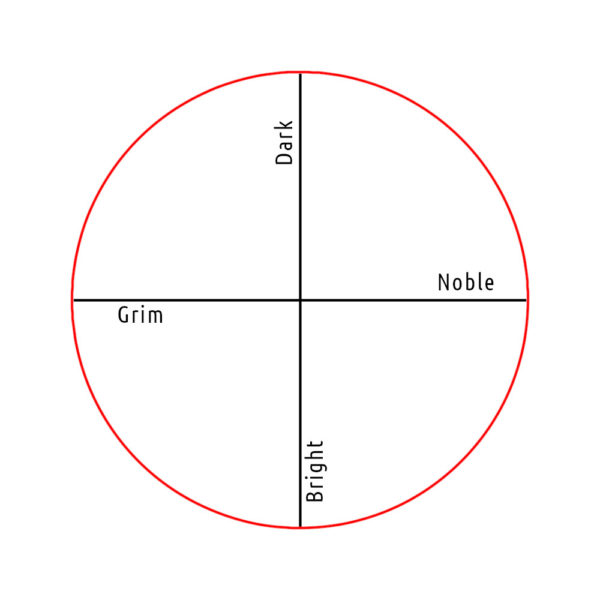
To start, we need to understand the difference between grimdark and noblebright. Both forms of fantasy exist on a field with two axes: noble vs. grim and bright vs. dark.
The bright vs. dark axis describes whether the fantasy takes place in a world where good usually triumphs over evil (bright), or a world where evil usually triumphs over good (dark).
The noble vs. grim axis describes whether the characters have the power to change the world (noble), or whether they do not (grim).
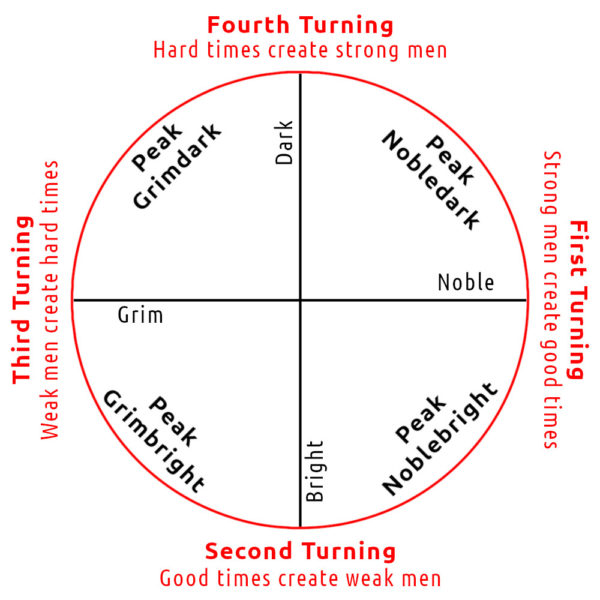
Thus, with these two axes, we get the following combinations:
Noblebright: A fantasy world where good usually triumphs over evil and the characters have the power to save it.
Grimbright: A fantasy world where good usually triumphs over evil, but the characters aren’t on a quest to save it and are usually preoccupied with smaller concerns.
Grimdark: A fantasy world full of moral shades of gray, where evil usually triumphs over good and the characters are either anti-heroes or otherwise fail to save the world.
Nobledark: A fantasy world where evil usually triumphs over good, but the characters are empowered to change it.
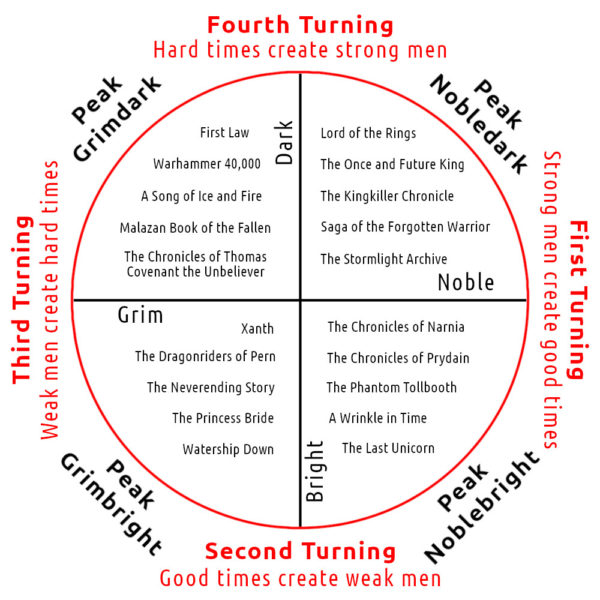
These categories are subjective to some degree, and fans will often disagree about which category to put each book/series. However, I think that most fans will agree on the following examples:
Noblebright: The Chronicles of Narnia by C.S. Lewis
Grimbright: The Princess Bride by William Goldman
Grimdark: A Song of Ice and Fire by George R.R. Martin
Nobledark: Lord of the Rings by J.R.R. Tolkien
Next, let’s review in the broadest possible terms William Strauss and Neil Howe’s generational theory. To really understand their work, I highly recommend that you read The Fourth Turning. I have some criticisms of the finer nuances of that book, but their ideas are really excellent, and their predictions hold up surprisingly well three decades later.
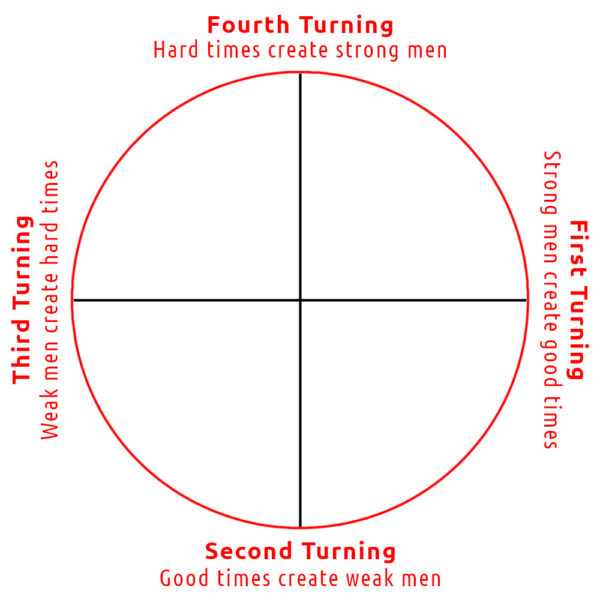
If I had to boil their theory down to one simple, easy-to-understand statement, it would be this:
Strong men create good times.
Good times create weak men.
Weak men create hard times.
Hard times create strong men.
Thus, our society and culture passes through a secular cycle that takes about 80-100 years to complete (or in other words, the length of a long human life). The cycle has four seasons, or turnings, each one corresponding to a generational archetype (since it takes about 20-25 years for people born in the one turning to start having children of their own, thus moving us into the next generational turning).
The first turning happens when the society comes together after resolving a major crisis (eg the Revolutionary War, the Civil War, World War 2) and builds a new, stable order. The second turning happens when their kids rebel against that order, seeking freedom (eg the First and Second Great Awakenings, and the various counterculture movements of the 60s). The third turning happens when the order breaks down completely and everyone goes their own way (eg World War I, the Roaring Twenties, and the culture wars of the 90s). Finally, the fourth turning happens when the society faces a major existential crisis that totally reshapes it.
According to the theory, each axis of the grimdark/noblebright field corresponds to a different generational turning. Thus, stories that are noble have the most resonance in a first turning, stories that are bright have the most resonance in a second turning, grim stories resonate most in a third turning, and dark stories resonate most in a fourth turning.
In other words, the generation that comes of age during a major existential crisis will tend to gravitate more toward fantasy where evil typically triumphs over good, whereas the generation that comes of age during a period of rebuilding will tend to gravitate more toward fantasy where the characters have the power to change the world. And so on for bright and grim stories: the generation that comes of age during a spiritual awakening will gravitate more toward stories that take place in a world where good usually triumphs over evil, and the generation that comes of age in a declining and/or decadent society will gravitate more toward fantasy where the characters are relatively powerless.
Another way of thinking about it is to consider what each generation is not going to be drawn to, or which stories are not going to resonate well. An American who came of age in the 40s and 50s, when US power was on the rise and the Pax Americana was reshaping the world, isn’t going to resonate well with grim stories about powerless characters. Likewise, a boomer who came of age during the counterculture movements of the 60s and 70s isn’t going to resonate well with a dark fantasy world where evil usually triumphs, because (as much as they hate to admit it) they grew up in a very sheltered world that generally made sense—so much so, in fact, that they couldn’t help but rebel against it.
According to this theory, the next generational turning begins when one of the four forms of fantasy (noblebright, grimbright, grimdark, or nobledark) is at a peak. Over the course of the turning, that fantasy form declines until the next form in the cycle becomes ascendant, at which point the next generational turning begins.
Thus, at the start of a first turning, nobledark stories are typically ascendant, where the fantasy worlds are dark and morally gray, but the characters are empowered to save the world. As that generation successfully establishes a new order, the culture’s taste in fantasy shifts away from dark stories and toward noblebright stories, where the characters are still empowered but the world is more ordered and stable.
At the start of the spiritual awakening that characterizes a second turning, noblebright fantasy is ascendant: stories with an optimistic outlook on the world where the characters are larger than life. But as the awakening progresses, people in the society care more about freedom and individuality and less about the group, so stories about characters who sacrifice everything to save their world resonate less with them. Thus, by the end of the second turning, the ascendant form of fantasy is grimbright, which is really more of a slice-of-life fantasy about beloved characters having fun (but not world-altering) adventures.
At the start of a third turning, where the social order has started to break down and corruption begins to permeate all levels of the society, these grimbright stories start to take a darker tone. Readers find it too “unrealistic” to believe that good always triumphs over evil, and they certainly do not believe that good people have the power to change the world—at least, not the “smells like teen spirit” world that they inhabit. Their tastes shift away from the fun, adventurous slice-of-life of grimbright, and toward the dark and gritty anti-heroes of grimdark.
Finally, at the start of the fourth turning, grimdark is ascendant, but readers are starting to lose patience with it. As each new crisis in the real world compounds with all the others, they find it unbearable to read about characters that don’t have the power to change the fantasy worlds they inhabit. At the height of the fourth turning, society reaches an existential breaking point where, in the words of Strauss and Howe, “all of [our] lesser problems will combine into one giant problem, [and] the very survival of the society will feel at stake.” (The Fourth Turning, p277) At this point, readers are ravenous for books about characters who are empowered to fight back against the tides of evil and darkness. Grimdark fantasy declines and nobledark fantasy ascends.
I haven’t read all of the series in the diagram above, but I do have a pretty good sense of most of them, and I put the diagram together with the help of my mastermind group. The key thing about it is that each fantasy series came out in roughly the generational turning that corresponds with each quadrant.
Now, it’s worth pointing out that these trends aren’t absolute. In each of the secular seasons, you can find examples of contemporary fantasy that runs counter to trend. For example, David Gemmell’s Drenai Saga came out in the 80s, at the start of the last third turning when grimbright should have been ascendant, and yet the Drenai Saga is solidly nobledark. Terry Pratchett’s Discworld books had their heyday in the 90s, 00s, and arguably 10s, but they probably fall into grimbright (though you could make the argument that, as absurdist fantasy, they are more similar to grimdark: stories where good and evil really doesn’t matter, and the characters are just doing their best to go along).
But the theory doesn’t state that each fantasy form’s antithesis dies completely when that form is ascendant: only that it reaches a nadir of decline in its resonance with the culture. But without sufficient contrast, the ascendant form cannot stand out. Thus, there still has to be some noblebright Paolini to provide sufficient contrast with the grimdark of Abercrombie and Martin, some low fantasy slice-of-life Legends and Lattes grimbright to make the epic nobledark high fantasy of Sanderson stand out stronger.
According to this theory, as we continue to muddle our way through this present fourth turning, the decline of grimdark fantasy will accelerate, and the bestselling fantasy books of the 2020s will mostly be nobledark. And indeed, we can already see that happening with the meteoric rise of Brandon Sanderson (especially his Stormlight Archive series), the popular enthusiasm surrounding Larry Correia (whose Saga of the Forgotten Warrior falls squarely into nobledark), and the enduring anticipation of Patrick Rothfuss’s fans for the conclusion to the Kingkiller Chronicle. Meanwhile, enthusiasm for George R.R. Martin has waned significantly with the train wreck of Game of Thrones, and Abercrombie, though still quite popular, seems to be testing the nobledark waters with his YA books.
It would really be interesting to do a deep dive on the generational archetypes and make a study of how that affects the fantasy forms that run counter to the cycle. But that’s beyond the scope of this blog post, and frankly I need to get back to writing my own books. But what do you think of this theory? Does it resonate with you, or is there something that we missed?
Every age fraught with discord and danger seems to spawn a leader meant only for that age, a political giant whose absence, in retrospect, seems inconceivable when the history of that age is written.
There was a time when science fiction was bigger than fantasy. More people read it, more authors wrote it, and more editors demanded it. Would-be fantasy authors were steered toward writing science fiction, because they knew that it would sell better than the stuff they actually wanted to write.
Now, the roles are reversed. More people read fantasy, more authors write it, and more editors are demanding it (except in the short story world, but none of them are in it for the money, which proves my point). For every year of the Goodreads Choice Awards, the fantasy section has gotten more total votes than the science fiction section. And authors like me, who often prefer to write science fiction, are instead veering more toward fantasy, because we can see that it sells better.
I’m not decrying this shift. I enjoy fantasy differently than I enjoy science fiction, but I genuinely enjoy them both. And as science fiction writers have pivoted to writing fantasy, I think it’s improved fantasy considerably, with magic systems that actually have rules and fantasy worlds that are actually realistic, given our understanding of physics, geography, etc. So just to be clear, I’m not complaining about this.
But I have wondered more than once how it got to be this way. What caused science fiction to fall out of favor? What made readers turn toward fantasy instead? Why has science fiction been on a general decline for the better part of half a century?
There was a time when science fiction was fun and inspiring. When scientists, engineers, inventors, and pioneers cited their favorite science fiction stories as major inspiration for their work. These were the people who put satellites in orbit, who put a man on the moon, who invented computers and the internet and in many ways built our modern world. And it worked both ways: not only did the fiction writers inspire the scientists and pioneers, but the new discoveries and inventions inspired the next generation of science fiction writers to write fun and inspiring stories about that.
What broke the cycle? What got us to the point where today’s kids no longer dream about becoming astronauts or paleontologists, but about being YouTube stars and “influencers,” whatever the hell that means? Why is there such a dearth of truly inspiring science fiction nowadays?
To be sure, there are a lot of factors at play, and no one single person or organization bears all of the responsibility. But if I had to point to just one thing as the primary cause, it would be SFWA.
The Science Fiction and Fantasy Writer’s Association, formerly known as the Science Fiction and Fantasy Writers of America, formerly known as the Science Fiction Writers of America, was started in 1965 by noted author and Futurian member Damon Knight. (Who were the Futurians? We’ll come to that later.) It is a professional organization for writers with a membership requirement of making at least 3 professional short story sales (only from SFWA-approved markets, of course), or a professional novel sale (also only from SFWA-approved markets), or to make something like $5,000 in sales on a single title if you’re self-published (which involves opening the kimono to these sleazeballs), or… frankly, I don’t know what the membership requirements are these days, and I don’t think SFWA does either, because their membership requirements page currently says that they have “a plan to create a comprehensive market matrix or scorecard to better guide creators toward professional publishers,” and that they are just now “starting with short fiction markets on this rollout.” Whatever the hell that means.
In practice, SFWA is a very snobbish club of “important” science fiction (and fantasy?) writers, or rather, a club of snobbish people who consider themselves to be important. Every year, they give us the Nebula Awards, which are supposed to represent the “best of the best” that science fiction (and fantasy?) has to offer.
The reason I’m keeping “fantasy” in parentheses is because the organization was very clearly founded with a focus on science fiction, and to the extent that it later expanded to include fantasy, it did so as a means to stay relevant in a world where fantasy had come to dominate science fiction. At least, that’s what I gather. But even if I’m wrong about that, I’m not wrong that the SF in SFWA originally standed for “science fiction,” and that the addition of fantasy came much later—and not without a ridiculous amount of controversy typical of this toxic and disfunctional organization.
Those of you who have been following the devolution of the genre since the dumpster fire that was the response to the Sad Puppies will no doubt agree that SFWA is a major part of the problem. But the thing that may (or may not) surprise you is that SFWA was toxic from the moment of its inception, and was always the primary factor in science fiction’s decline.
To see why, let’s go back to the Futurians. This was a small but tight-knit community of superfans, kind of like the Inklings, whose members went on to found Worldcon, the Hugos, DAW books, the Nebulas—and yes, SFWA itself. These were all people who grew up with the pulps, were active during the golden age, and became the movers and shakers in the field in the latter half of the 20th century: people like Donald A. Wollheim, Frederik Pohl, Isaac Asimov, Damon Knight, and others.
The key thing to know about the Futurians is that they were left-wing radicals. In the 1930s, when communism was a very dirty word, Pohl was literally a communist. Wollheim was also a believer in communism, and stated that science fiction writers and fans “should actively work for the realization of the scientific world-state as the only genuine justification for their activities and existence.” (Carr, Terry (1979). Classic Science Fiction: The First Golden Age p430) According to Asimov, the Futurians broke off from the Greater New York Science Fiction Club precisely because of their political and ideological differences. In short, the Futurians were all true blue, dyed-in-the-wool, die-hard Marxists of one stripe or another, and they were very overt about bringing their politics into their fiction.
When I first started to get involved in fandom, I heard an apocryphal story that at the very first Worlcon, there was a schism between the group of fans who wanted science fiction to advance the cause of global communism—basically, the Futurians’ view—and the majority of fans, who just wanted to read and talk about fun science fiction stories. That first major schism (or so the story goes) became the root cause of every fannish conflict and controversy that has ever happened since.
Now, if we had to sum up the chaos and insanity of the last ten years in just three words, most of us would probably agree that “politics ruins everything” is a fair assessment. For science fiction, it was no different. The science fiction of the golden age, for all its flaws, was fun, adventurous, inspiring—and not overtly political (for the most part). Then, in the 60s and 70s, science fiction took a strong turn to the political left, glorifying sexual liberation and Marxist utopias, and pounding the idea that the world was going to end very soon in some sort of climate catastrophe, or a nuclear holocaust brought on by politicians like Goldwater and Reagan.
I used to think that science fiction was an inherently political genre, but why should it be? After all, there is nothing inherently political about science. If the pandemic has taught us anything, it’s that the moment science becomes politicized into “The Science,” it becomes toxic and unreliable. And the more I read, the more I’m convinced that this is true of science fiction as well. The difference between art and propaganda, truth and narrative, is the same difference between science and “The Science.”
What happened in the 60s and 70s was science fiction’s version of the long march through the institutions, as the Futurians and their ideological allies came to dominate the professional side of the field. Even though they were outnumbered and their political views put them solidly in the minority, they took their love of science fiction way more seriously than everyone else, and so while a lot of those early fans of the 40s and 50s either grew out of science fiction or moved on to other things, the Futurians and their allies stayed. Science fiction was their life. Science fiction was their passion. And thus they became the next generation of authors, editors, and publishers.
Through SFWA, they were able to leverage their position and influence into real power. With Worldcon and the Hugos, anyone who was willing to shell out the money could vote or join the convention, and a lot of people did. It was much more democratic that way. But with SFWA, you had to sell enough stories to the qualifying markets—and increasingly, all of those qualifying markets came to be run by left-wing political ideologues.
In a recent Project Veritas expose, an engineer at Twitter explained that one of the reasons why Twitter has such a left-wing bias is because the left-wing extremists refuse to compromise on any of their views. According to the engineer, right-wingers tend to say “I disagree with what the other side is saying, but I don’t think they should be silenced for it,” whereas left-wingers tend to say “that’s violence and hate speech, and if you don’t censor it, I won’t use your platform.” Because the left-wingers are the super-users, Twitter is more likely to cater to them, and thus rewards their extremism instead of limiting it.
A similar dynamic emerged in science fiction, where the left-wing editors and publishers—many of whom had always viewed science fiction as a means to achieving their ideological ends—rewarded politically like-minded authors with story sales, publishing contracts, favorable reviews, and the Nebula Award. These left-wing authors went on to join SFWA and vote for other left-wing authors in the Nebulas, feeding the cycle.
Meanwhile, all the other authors and fans—the ones who cared more about telling good stories than conveying a political message—only stuck around so long as the quality of the stories hit a certain minimum threshold. And I’ll be the first to point out that there were many left-wing authors who wrote genuinely good stories: Ursula K. Le Guin, for example. But there were also some real hacks who were awarded the Nebula mainly because of their politics. Since the minimum threshold was different for every reader, as the stories got more political, more and more readers abandoned science fiction.
In other words, the reason why science fiction became so political was because the institutions—most notably, SFWA—rewarded political purity more than they rewarded telling a good story. From the beginning, SFWA had this toxic dynamic, because it was founded by political ideologues who wanted to use science fiction to achieve their ideological ends. And because politics ruins everything, SFWA ruined science fiction.
How does all of this end? With an insanely toxic purity spiral and a collapse into cultural irrelevance. That is what we are witnessing right now, with the recent brouhaha over Mercedes Lackey accidentally saying “colored people” instead of “people of color.” (Both terms are equally racist, by the way: it’s just that the one flavor of racism is more fashionable right now.) The purity spiral has been ongoing for years, perhaps since SFWA’s inception, and the collapse into cultural irrelevance is well underway. The only questions left are 1) how much damage will be done before SFWA fades into much-deserved obscurity, and 2) if science fiction has a comeback from its long decline, who or what will turn it around?
As to the second question, it’s possible that the damage is permanent and nothing will stem the genre’s decline. That’s what ultimately happened to the western, after all. Or maybe it will follow the same path that horror did, with some authors adapting to the changing market and rebranding as something else (ie urban fantasy, paranormal romance), while the genre purists languish, at least in terms of commercial viability.
Or maybe, if SFWA just dies, science fiction will begin to experience a renaissance. Same thing at this point if Worldcon doesn’t survive the pandemic (or gets totally captured by the Chinese, which honestly would be an improvement). With the advent of indie publishing, the field is very different right now, and we’ve already seen some amazing indie authors like Andy Weir and Hugh Howey take the field by storm. Without the toxicity of SFWA holding us back, I think we will see some very good things come out of the genre in the coming years.
But for that to happen, SFWA really does need to die, or at least fade into cultural irrelevance like the Author’s Guild and the Libertarian Party. Starve the beast. Don’t let them have any of your money. Mock the organization relentlessly, both online and offline, or else ignore them entirely. And if a book or a story wins a Nebula, take that as a mark against it. I’ve read all but five of the Hugo and Nebula award winning novels, and now I can say with certainty that the best predictor that I will personally hate a book is if it won a Nebula but not a Hugo. Test that out for yourself. If you haven’t been red-pilled yet, you’ll probably be surprised.
Also, check out this podcast if you haven’t already. Good stuff as always from Steve Diamond and Larry Correia.