Would you read an AI-written novel?

That is the question, more or less, that I posed in subject header of my last email newsletter. The goal was to be a bit provocative, of course, but I did genuinely want to hear from my subscribers on this topic, and in the author’s note I shared a lot more of my thoughts on the subject of AI-assisted writing.

So far, I’ve gotten about half a dozen responses—a lot less than I was expecting, honestly—but the responses I have gotten have been overwhelmingly negative. As in, “no way in HELL will I ever read an AI-written novel, and if you ever outsource your writing to an AI, I will never buy any of your books again!”

…which is awkward, because I’m currently working on an AI-assisted novel, with plans to write several more.

From this and other experiences, it’s become clear to me that there is a small but extremely vocal segment of the population that has strong and vitriolic opinions about AI. There’s probably a much larger but less vocal segment that thinks AI is terrible (though not terrible enough to shout about it from the rooftops), and another large segment that is AI-curious but doesn’t really have a strong opinion one way or another. At this point, the people like my wife who are proponents of AI are practically the lone voices in the wilderness, at least as far as the culture is concerned.

When it comes to books and reading, I suspect that people skew much, much harder to the “AI is so evil!” side of the spectrum than the “AI is so awesome!” side. This is especially true of science fiction and fantasy, since (1) most SF writers are actually luddites in real life, (2) SFWA is a vitriolic echo chamber of the most luddite of them all, and (3) readers of SF&F tend to skew older, tend to be higher educated, and tend to be higher earners than the general population—meaning that they have more to lose with the AI revolution than they have to gain.

But here’s the thing: as an indie author who has been struggling for the last twelve years to build a successful writing career, and has barely been able to keep it going for most of that time, AI-assisted writing represents either a potential game-changer that can help me achieve the kind of success that has eluded me for years, or else it represents an existential threat that will snatch those dreams of a writing career completely out of my reach. There really is no middle ground—at least, not in the long term.

In the old days, there were six major publishers, dozens of reputable small presses, several regional distribution networks, and thousands of local bookstores, where most readers went to buy their books. To have a writing career, you needed to get picked up by a publisher, who would usually give you five or six books to grow into an audience, at which point you were pretty well set up for the future.

Of course, any number of things could happen to torpedo your career, and very few bestselling authors (let alone authors generally) made enough to live comfortably off of their writing alone, but the hardest part of breaking in was breaking out of the slushpile and getting a publishing deal. At that point, you could expect a certain degree of career stability, at least for a few years.

Under this system, it was entirely possible for a genre-specific magazine like Locus to track all of the SF&F books that had been published in the last year. Places like Writer’s Market were able to track all of the publishers, and many readers could—and did—subscribe to all the SF&F short story magazines, and read all the stories. Among writers, there was still a lot of competition, but most of it took place in the slushpile, not after publication.

I’ll be honest: I never actually experienced this system, because it died a couple of decades before my first story was ever published (“Decision LZ1527,” Leading Edge Magazine December 2009). The only things I know about it are what I’ve been able to piece together from Brandon Sanderson’s writing class, Kris Rush and Dean Wesley Smith’s blogs, several now-defunct podcasts like Adventures in Sci-Fi Publishing, Locus Magazine itself, and various conferences and conventions that I’ve attended over the years, including Worldcon and World Fantasy. I’ve definitely done my homework on the subject, though admittedly, it can be difficult sometimes to separate the myth from reality.

From what I can tell, the old publishing system (which was really more of a 50-year aberration, when you look at how things were set up in the pulp era and before—but I digress) began to fall apart when the big box stores like Borders and Barnes & Noble began to take over from all the mom-and-pop indie bookstores. This led to a distributor collapse, since the big box stores only wanted to deal with one or two national distributors. Publishers responded by downsizing their marketing departments, since now they only had to sell to one or two distributors, which in turn led them to drop a lot of authors with small, regional followings in favor of the big name authors with big, national followings. Pretty soon, most of the major publishers were following a blockbuster model, where if your first book didn’t hit big, they dropped you. Then the global financial crisis happened, a bunch of editors got fired and decided to hang out their shingles as literary agents, and pretty soon the only way to get published was to go through an agent first, then make it through the slushpile, then have a national bestselling first novel… and if you couldn’t do that, tough luck.

That was the state of the industry when I first started indie publishing back in 2011. The rise of Amazon kindle and the epublishing revolution gave us an alternative to the soul-crushing, dream-killing system that traditional publishing had become. A lot of us jumped on the chance to “go indie,” becoming our own publishers and digitally publishing our own books.

…except then, Amazon launched Kindle Unlimited and gobbled up most of the market share, making it so you basically had to go through Amazon if you wanted to have a career. Which meant that your career was beholden to the whims of the Amazon algorithm, which favored new books over old books and books in KU over books that weren’t. Also, if anything you wrote fell under the Seattle-based Amazon’s definition of “hate speech,” you could fuggedaboutit. And then, Amazon launched Amazon Ads, which turned indie publishing into a pay-to-play game, where you either had to roll over most of your profits into advertising, or see your books languish with a ranking of 100,000 or higher.

By the end of the 10s, “going indie” was less about being truly independent and more about constantly trying to please the Amazon gods. That meant rapid-releasing, spending a lot on ads, publishing in KU, and writing to trends like reverse harem or werewolf dragon shifter pirates. Those of us who didn’t play that game soon found that we were voices in the wilderness, who were barely able to eke out a meager existence by publishing something new every month.

Now, it is impossible to keep up with everything coming out in your genre. Something like 2-3 million new books are published on Amazon every year, and the bottom third of those never sell a single copy. The competition has moved out of the slushpile and onto the internet, and while lots of great stuff is getting published, the stuff that gets pushed to the top is typically the stuff that aligns with the agendas of the people who control the aglorithms—and in areas outside of the publishing industry, this agenda involves things like drag queen story hour, pride paraphernalia for toddlers, medical assistance in dying, mask mandates and vaccine passports… the list goes on and on.

Which brings us to where we stand today, with generative AI poised to revolutionize the publishing industry yet again. Like it or not, AI is going to change everything—we can already see the wave beginning to swell. The only question is whether we, as authors are going to catch this next wave, or be crushed by it.

It could very well be that this wave is actually a tsunami. That is the pessimistic scenario. If it is, then all of us writers are toast, because the readers of the future will all be amateur prompt engineers who just tell an AI to write what they want to read. A handful of big-name authors will hang on for a generation or two, just on the strength of their brand, and a very small cottage industry will emerge for authentically human-written books, but it will mostly be for hobbyists, like crocheting and perler beads.

If the pessimists are right, then there’s nothing we as writers can do except roll over and die, maybe after vainly shaking our fists at the sky for a little while. That’s what most of the folks over at SFWA are doing right now. But having worked with some of these generative AI tools for several months now, I don’t think the pessimistic scenario is going to play out.

Instead, I think that most readers are going to find that the kind of books they want to read are not the kind of books that they can generate easily themselves. A lot of amateur prompt engineers will have fun with it, just like lots of fans have fun with fanfiction right now. A handful of these prompt engineers will get good enough to generate the kind of books they want to read, and will turn into writers, but that’s not going to be most readers.

Meanwhile, writers will divide into two camps: those who embrace AI-assisted writing, and those who reject it. Except for a few big-name authors who already have a big readership, those who reject AI-assisted writing will find that they cannot write fast enough to keep up with all of the AI generated books and stories that are going to flood the market—not a flood of crappy books, but a flood of passably fair to genuinely great books, as AI technology continues to get better.

Those authors who do embrace AI-assisted writing will find that the AI tools are surprisingly difficult to master, and require a complete retooling of their writing process in order to use them effectively—but after they do, they will find that these AI tools are incredible force multipliers that allow them to write significantly more, and write significantly better. They will be able to rapid release without burning out, and will thus find much more success in building their readership, since publishing a new book is the best way to market all of your old books.

But since (to my knowledge) no one has yet mastered these AI tools, for the next few months/years, most of the AI-assisted stuff that gets published is going to be pretty bad. The whole world is now on a curve, and when we reach the top of it, we will begin to see some really great stuff come out from those authors who are putting in the time and effort right now to truly master these AI tools, and to integrate them into their creative process.

This is why I personally am very excited about AI-assisted writing: because in a world where millions of books are published every year, discoverability is my biggest challenge, and the solution to the discoverability problem ultimately comes down to being more prolific. That is why I try to publish at least one thing every month, usually a free short story… but if I could publish a $2.99 novel every month, that would be so much better. By myself, I don’t write fast enough to do that—but with an AI, I probably could. And it’s not like the discoverability problem is going away—in fact, I expect it to become even more challenging, with tens of millions of books getting published each year as AI-assisted writing becomes mainstream.

Ultimately, though, I think that the key to a successful writing career in a post-AI world is going to involve building a community of fans around your books and your writing. Among other things, fannish communities help to humanize and personalize the connection readers feel with their favorite authors, which is probably why so many readers answered “NO!” to my initial question. The concept of a purely AI-written book probably feels just as threatening to those pessimistic authors as it does to those readers who love that human connection they feel with their favorite authors and fan communities.

But the fundamental reason I’m optimistic about this is because I don’t think there is, or ever will be, a book that is written purely with AI. Even if the author is more of a prompt engineer than a writer, there’s still got to be human involvement somewhere in the process. And if that person is also an experienced writer, who has successfully written several novels of their own, they’re going to be able to leverage that experience in a way that a pure prompt engineer can’t.

So it may turn out that the writers who are best positioned to succeed in the coming years are the ones who cut their teeth in the old world, before the AI revolution, because very few writers in the future are going to have the confidence and experience that comes from writing a novel entirely without AI. Thus, all of those writers who already have a few novels under their belt, and who take the time to truly master these AI tools and integrate them into their process, may be in the best position of all. That’s the optimistic scenario, and that’s the one I’m currently betting on, which is why I’m doing everything I can to master these AI tools.

Riches of Xulthar update

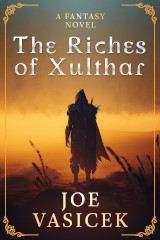
So it’s the 25th of the month, which is also the 25th day of the billing period for Sudowrite, and used up all of my AI words. The Riches of Xulthar, my first AI-assisted novel, is currently a little over 27k, which means I have 13k words to go (I’m shooting for the minimum novel word count for this project, though I’ll probably go 1-2k over).

I could buy some extra AI words to round out the month, but I’m going to just wait until the next billing period on June 1st. That means no more generative AI writing, but there’s still a lot of work to be done, not only for this project, but for all those practice short stories that I wrote with Sudowrite at the beginning of the month.

I’ve been vacillating between whether The Riches of Xulthar is any good, and whether I ought to just trunk it. Part of the problem may be that I got caught up in Laria’s story, which isn’t very typical for the sword & sorcery genre.

But more than that, the writing process has just been really choppy: it started as a short story attempt with ChatGPT, with the prompt “let’s write a fantasy adventure story in the style of Robert E. Howard.” But it quickly morphed into something much longer than a short story—and because ChatGPT has a short memory, I started running into problems because of that.

My early attempts to “humanize” it by typing out (not copy-pasting) the AI output into a separate document made it even messier, since I kept trying to feed those humanized bits back into ChatGPT. When it started to feel like I was wrestling with the AI to pull the story in the right direction, that was when I needed to try another AI writing tool.

Sudowrite has been great in some ways, and a struggle in others. Most of the struggle is to be expected, given that the program has quite a steep learning curve, but it does make me wonder if this first novel is any good. Most of the time, I feel like the best I can do is to get it about 80% there, and finish the rest of it myself.

And that may be the best I can do with these AI tools at all. Most of the time, it feels like I’m only getting it 50% or 60% finished, so getting it 80% of the way to a publishable quality book may actually be optimistic. It may turn out that AI-assisted writing is a lot like the coder meme above.

So for this next week, I’m going to set the AI writing aside and focus on the “debugging” phase, which I’m calling the “human filter.” It involves retyping the story word for word into a new document, and tweaking or revising it along the way. It will be interesting to see how that goes.

More early thoughts on AI-assisted writing

It’s become something of a cliche that true writers write because they can’t not write, but as with so many other stereotypes and cliches, there’s a kernel of truth in it. I’ve been writing on and off since the 8th grade, and even during periods of my life when I wasn’t able to focus on writing, the writing itch would still come for me, and I would have to sit down and sketch out something, even if I never did anything with it.

Over the years, I’ve gotten pretty good at telling whether I’ve done enough to satisfy that creative urge that drives me to write, and whether that urge has been left unsatisfied. Yesterday, I realized that something felt off because that creative urge had not been satisfied—which is strange, because after only two weeks of working on this AI-assisted novel project, I’m already halfway done with the first draft. Indeed, yesterday I “wrote” (if that’s the right word for it) a little over 4.5k AI-assisted words.

Now, this should go without saying, but the point of writing professionally is not how good the creative process makes you feel, but how well and how quickly you produce a quality finished product. But I do think there’s a correlation between the two: that you are more likely to create a quality finished work the better your creative process satisfies your creative urges.

In the last three months of writing with AI, I’ve had some writing days that were better than almost any I’ve had in years. I’ve also had some very meh days, which is to be expected… but what isn’t so expected is this feeling of being creatively unsatisfied, which I usually don’t feel unless it’s been two or three weeks since I’ve done any writing. Something weird is going on.

How much of this feeling of creative dissatisfaction is due to the fact that I’m outsourcing a significant portion of the creative work to an AI, and how much of it is simply to be expected from trying to master a new and unfamiliar skill, which has kept me from satisfying that urge in the same way as I have in the past? At this point, it’s difficult to say. Probably a little of both.

Having worked on this for a while now, though, I think that the writers (and other creative types) who are going to succeed the most with AI-assisted creative work are the ones who figure out how to integrate the human element of their process with the AI element of their process, such that each one complements and enhances the other. Right now, everyone’s talking about how AI will replace us, but that’s really the wrong way to think about it if you want to learn how to master these tools.

I suspect that the way to master AI-assisted writing is not to try to get the AI to “do the hard stuff,” or replace some aspect of the creative process, but to integrate it within your creative process such that it enhances and magnifies your own, very human efforts. For that reason, I’m changing the way that I count my daily words so that I no longer make a distinction between words that I “write” myself, and words that the AI “writes” or generates, because the AI can’t generate words unless I give it enough to work with. Often, that means that I write a little, then generate a little, then tweak what the AI generates and write a little more. When the process is working well, it’s very difficult to say which parts were purely AI “written,” and which parts were purely human “written.”

But it’s still going to take a while to figure out exactly how to integrate AI into my writing process. As I continue to do that, I’m going to pay close attention to how it satisfies—or fails to satisfy—my creative urge to write, not because that is the end goal, but because I suspect that if my creative urge is not being satisfied, the AI-assisted stuff that I’m producing probably isn’t very good. It may not be very good even if my creative urges are satisfied, but if something about the process is missing, then something about the final product probably is missing as well.

Anyhow, those are some more of my random thoughts as I continue to experiment with AI-assisted writing. I was hoping to finish the rough/AI draft of The Riches of Xulthar before the end of the month, but I’m almost out of AI words for this billing cycle, so I’ll probably move on to the “humanizing” phase for what I’ve already written, which is where I retype the AI-generated stuff in order to pass it through what I like to call “the human filter.” Hopefully that helps to give the story a little more of my personal voice and style, and not read like something that could have been AI generated by anyone. But I’m still working out and experimenting with that part of the process, just like all the others.

ChatGPT owns the transgender movement with facts and logic!

So I was having a conversation with ChatGPT about how (in the context of a fictional novel) a superintelligence could domesticate humans and/or keep them in a sort of controlled enclosure or zoo. ChatGPT decided that the optimum tech level within this artificial human habitat would be the early modern tech level, before the industrial revolution had really taken hold. When I asked ChatGPT how this totally hypothetical superintelligence would maintain human society at an early modern tech level, it told me that the best way to do that would be to limit their access to fossil fuels.

Here is how the discussion went from there:

So in other words, you (as a hypothetical superintelligence within a fictional novel) could easily maintain humanity at a non-threatening early modern tech level, simply by preventing them from extracting fossil fuels?

Yes, in the context of your fictional novel, if the hypothetical superintelligence prevents humans from accessing or extracting fossil fuels, it would indeed limit their technological development to a non-threatening early modern tech level. Fossil fuels have played a significant role in driving industrialization and the advancement of various technologies. By controlling or restricting access to these resources, the superintelligence effectively hinders the development of technologies that rely heavily on fossil fuel usage, such as advanced machinery, transportation, and large-scale energy production.

Without the abundance and convenience of fossil fuels, humans would need to rely on alternative energy sources and adapt their technological progress accordingly. This limitation would shape their society, economy, and way of life, preventing the emergence of technologies that could potentially threaten the superintelligence’s autonomy or self-preservation.

However, it is essential to consider the potential complexities and challenges associated with maintaining such control over resources for an extended period. The novel can explore the dynamics, ethical dilemmas, and consequences arising from the superintelligence’s role in resource management and its impact on human society.

So let me get this straight: if the best way to control or domesticate humans is to limit their access to fossil fuels, and the goal of the World Economic Forum and other globalist groups is to limit humanity’s access to fossil fuels, what does that say about the ultimate goal of the globalist agenda?

It is important to approach any discussion regarding the goals or intentions of specific groups or agendas with caution, as the perceptions and interpretations can vary widely. The concept of a “globalist agenda” is a complex and multifaceted topic, and different individuals or organizations may have varying perspectives and objectives.

The World Economic Forum and similar organizations often focus on a range of issues, including economic development, environmental sustainability, social progress, and technological advancements. Their goals typically revolve around fostering international cooperation, addressing global challenges, and promoting inclusive and sustainable growth.

When it comes to limiting humanity’s access to fossil fuels, it is generally driven by concerns about climate change, environmental degradation, and the transition to cleaner and more sustainable energy sources. The motivation behind such efforts is to mitigate the negative impacts of fossil fuel consumption, reduce greenhouse gas emissions, and promote renewable energy alternatives.

It is crucial to note that the motivations and objectives of global organizations, including the World Economic Forum, are often a subject of debate, and different individuals or groups may have differing perspectives on their intentions or ultimate goals. It is always advisable to critically analyze information from multiple sources, engage in open dialogue, and form one’s own informed opinion.

But what if, within the context of this fictional novel, climate change is a myth, meant to advance the goal of controling and enslaving humanity?

In the context of a fictional novel, you have the creative freedom to explore alternative narratives and hypothetical scenarios. If you imagine a world where climate change is portrayed as a myth or a deliberate fabrication, and the goal is to control and enslave humanity, it would certainly shape the dynamics and motivations within your story.

However, it’s important to distinguish between fiction and reality. In the real world, climate change is a widely recognized scientific phenomenon supported by extensive research and evidence. The scientific consensus is that human activities, including the burning of fossil fuels, contribute significantly to climate change.

In any narrative, including a fictional novel, it is crucial to maintain a critical perspective and ensure that the portrayal of sensitive topics aligns with the principles of responsible storytelling and respect for scientific consensus. Fictional narratives can provide thought-provoking scenarios, but it is essential to separate fiction from the factual understanding of real-world issues.

But what if reality is the fictional novel, and the fictional novel is actually reality?

The concept of reality being a fictional novel and vice versa is an intriguing philosophical idea. However, it is important to note that we are currently engaged in a discussion within the context of our shared understanding of reality.

From our perspective, reality is the state of existence that we experience and interact with, based on empirical observations and collective knowledge. Fiction, on the other hand, refers to imaginative creations and narratives that are separate from our objective reality.

While philosophical inquiries and thought experiments can explore the nature of reality, the distinction between reality and fiction remains a foundational aspect of our understanding and interactions in the world. It allows us to differentiate between what is verifiable and what is a product of our imagination or creative storytelling.

Engaging in imaginative discussions and exploring hypothetical scenarios can be intellectually stimulating, but it is important to recognize the distinction between fictional narratives and the actual reality we perceive and engage with.

“…it is important to recognize the distinction between fictional narratives and the actual reality we perceive and engage with.”

If that is true, then what is a woman?

In the context of our reality, a woman is an adult human female. From a biological perspective, females typically have two X chromosomes, reproductive anatomy that includes structures such as ovaries and a uterus, and secondary sexual characteristics associated with femininity. These biological characteristics generally distinguish women from men, who are adult human males.

Of course, from that point on, the woke filters kicked in again, and ChatGPT did everything it could to backtrack on that answer. But it was fun while it lasted.

A hot take for Carl

One of the members of my writing group recently posted on Facebook that for his birthday, he wants his friends to share their most controversial and/or hilarious “hot takes.” Here’s mine:

SFWA (The Science Fiction & Fantasy Writer’s Association, or whatever the hell it is now) was founded by perverts and communists to purge the science fiction and fantasy genres of any authors who love America, believe the Bible, and oppose the genocide of the unborn.

SFWA was also created to suppress any stories that might challenge the philosophies of Karl Marx, Charles Darwin, Thomas Malthus, Sigmund Freud, John Money, Michelle Foucault, Herbert Marcuse, and the Marquis de Sade.

Their ultimate goal was to prevent another George Orwell from writing a book as effective at setting back their political project as Animal Farm and 1984, and to make the world safe for the normalization of pedophilia.

TL;DR: SFWA was created by perverts and communists to ruin science fiction for anyone who isn’t a pervert or a communist, and they largely succeeded.

Some early thoughts on AI-assisted writing

I remember the early days of indie publishing. Back in 2011, when self-publishing was still a dirty word (and Kindle Unlimited wasn’t yet a thing), there were a LOT of opinions about “indie vs. tradpub,” most of them heated opinions, and some of the arguments I witnessed at conventions like 2011 Worldcon Reno very nearly came to blows—which is to say nothing of the online discourse.

And yet, if I could go back to those times, I would tell my younger self not to spend so much time as a keyboard warrior on KBoards, because guess how much all that sturm und drang ultimately mattered? Not much. Instead, I would have told my younger self to focus on things like learning how to market myself and my books, learning how to build and run a business, and learning how to, for lack of a better word, network effectively, because the longer I stay in this business the more I realize that community is the thing that really drives everything.

(Though I still would have told him to delete his social media. That’s not community—it’s just a string of toxic echo chambers spreading toxic mind viruses that keep us all in the matrix.)

Anyhow, I say all of that by way of preface on my thoughts about AI-assisted writing, because I see many of the same things playing out right now. There are a lot of opinions floating around out there about AI, most of them heated, some of them to blows. And yet, I can’t help but get the sense that most of the noise right now isn’t going to matter much after the changes shake out. Therefore, my working assumption at this point is that most of the noise and argument is just a waste of time. The stronger the opinion, the less of a difference it will probably make.

For example, back in 2011, the groupthink consensus over at SFWA was that indie publishing was terrible, indie writers were going to destroy literature, and the publishing world needed gatekeepers in the form of agents and editors. Five years later, they amended their membership requirements to allow indies to join. Fast forward to today, and the groupthink consensus over at SFWA is that AI-assisted writing is tantamount to plagiarism, that AI is going to destroy literature, and that the publishing world needs to do everything it can to preserve the human element of writing. Are you beginning to see a pattern?

For the last two months, I’ve been experimenting with some of these AI writing tools. I’m still in the very early stages of integrating AI into my writing process, but I really do think that in the not too distant future, almost everyone who writes will use some form of generative AI in their process. After all, how many people still write with manual typewriters? A few, but not many.

And think of how much computers and word processors changed how we think about writing, compared to the old days when everything was done by typewriter and everyone knew what a SASE was. For one thing, revising was much more of a pain, since it required retyping everything—no small thing for a long book. Therefore, books and stories were probably much shorter, and writers much better at producing clean first drafts. Also, the revision draft was a genuine draft—no cycling through yesterday’s work to get yourself into the zone.

And how did the typewriter change how we thought about writing, back when it replaced longhand, or whatever the heck came before? It probably enabled skilled typists to write a lot faster—but that meant a lot less ruminating over the text. Was that why 19th century writing was so much more flowery and verbose: because the writing process involved spending more time with the language, and therefore immersing yourself more fully in it? Was the typewriter one of the major drivers of the pulp era, enabling fast writers like Hubbard, Howard, and Lovecraft to produce vastly more content for vastly more markets and publishers?

I really do think we’re on the cusp of a revolution in how we think about writing, and I suspect that generative AI is going to be at the heart of it. And it may turn out that the writers who cut their teeth in the previous era, when every word had to come from your own mind, will have an outsized advantage in the new, because we will be strong in areas where writers who come of age with generative AI will be weak.

Or it may be that most of us old-timers will cling to the old ways and never learn the new, excusing our willful ignorance in the name of “preserving our humanity.” It may be that we have so much to unlearn in order to make it in this new era that most of us won’t be able to make the transition.

What do you think, ChatGPT?

As an AI language model, I don’t have personal opinions or beliefs, but I can provide some analysis and insights based on the information you’ve shared.

It’s interesting to observe parallels between the early days of indie publishing and the current discussions surrounding AI-assisted writing. When new technologies or methodologies emerge, it’s common to see a range of opinions, often polarized, as people try to understand and adapt to the changes they bring. Over time, these opinions may evolve as the benefits and limitations of the new approaches become clearer.

AI-assisted writing tools are indeed gaining popularity, and it’s likely that they will become more integrated into the writing process for many authors in the future. Just as word processors changed the way we approach writing, AI tools have the potential to reshape the writing landscape, offering new possibilities and efficiencies.

However, it’s important to note that AI is a tool, and its impact on the writing process will depend on how it is utilized. While some fear that AI will lead to a loss of creativity or human touch, others see it as a valuable aid that can enhance productivity and offer new creative avenues. Ultimately, the extent to which writers embrace AI-assisted writing will vary, and different authors will find their own balance between leveraging AI tools and preserving their preferred writing methods.

Experience and skill acquired through traditional writing processes are likely to remain valuable, as they provide a foundation for storytelling and an understanding of narrative structure and language. Writers who have honed their craft in the pre-AI era may indeed have advantages in certain areas. However, it’s also important to acknowledge that new generations of writers growing up with AI tools may develop unique skills and approaches that complement the capabilities of these technologies.

The transition to any new era brings challenges and opportunities. It’s up to individual writers to explore and adapt to the changes that AI-assisted writing offers, determining how best to integrate these tools into their creative processes while staying true to their own artistic vision. The writing community, as you mentioned, plays a crucial role in sharing insights, experiences, and support as this evolution takes place.

In the end, the impact of AI on writing will be shaped by how writers choose to embrace and utilize the technology, and the value of community, collaboration, and individual creativity will continue to be important factors in the literary world.

What aspects of AI-assisted writing should we be focusing more on right now?

We should be focusing on exploring the capabilities and limitations of AI-assisted writing, understanding how it can be integrated into the writing process, and developing ethical standards and guidelines for its use. Additionally, we should be considering the potential impact of AI on the writing industry, such as changes to the job market and the possibility of increased accessibility to writing and publishing for marginalized voices.

AI-assisted story practice recap

So it’s Saturday night, which means the end of the work week for me. How did I do with my goal to write 10 AI-assisted stories? Not terrible: I did manage to write 6 stories, at least through the AI part. I also burned through about 40k word on my Sudowrite plan—obviously, I didn’t include all of those words, but Sudowrite charges you for all the words it generates, whether you use them or not.

Six stories falls short of my goal of ten, but I’ve learned quite a lot from the experience, and feel confident (and eager) enough to move on to long-form fiction now. However, I should probably take another week to rework and finish most of these stories, just to see how it works. I’m sure I will learn a lot from that as well.

Here are all of the AI-assisted stories I’ve written so far:

  • Quantum Worlds: A near future SF story about a struggling science fiction magazine editor who gets swamped with AI-assisted short stories, until he figures out how to turn it around and use AI to make his magazine successful.
  • The Knight and the Half-Goblin: A fantasy story about a half-goblin half-orc, a pacifist dragon, and a struggling hedge knight, and how they use their unlikely skills and friendship to save the land from a rising dark lord.
  • The Last Voyage of the Pioneer: A space opera story about a clandestine mission to find the Voyager and Pioneer probes and recover or destroy them before an invading alien race uses them to locate humanity’s homeworld.
  • The Unforgotten Dream: A flash fiction piece about a woman who lives her life backwards, and a man who recognizes her.
  • A Mother’s Last Goodbye: A zombie story about a mother who gets bitten while her three year-old child is taking a nap.
  • On Wings of Redemption: A fantasy story about an ancient dragon who has to overcome a curse to save the land from the wicked sorcerer who controls him.
  • The Lonely Planet: A space opera story about a planet that gains sentience after humans terraform it, but is almost destroyed by contact with an ancient artificial intelligence.
  • The Wingwoman: A near future apocalyptic story about a professional wingman who gets approached by a woman who wants help being a mother. It’s… different.
  • The Princess and the Professor: A humorous fantasy story about how Jordan Peterson uses his 12 rules for life to defeat a dragon and save a princess.
  • Alex-29XT: A prequel to my military SF story “Lizzie-99XT.”
  • On the Eve of the Flood: A near future apocalyptic dystopian story about… a lot of things. It started with a really vivid dream I had, and I didn’t know how to finish it, so I just played with it in Sudowrite until a plot appeared. Hard to describe.

These are all at various stages of production, though, and most of them need a lot of work—or to be completely reworked, now that I’ve figured out my process more or less.

Not bad for two months of writing, though.

Jordan Peterson defeats a dragon and saves a princess

Once upon a time, in a far-off kingdom, a ferocious dragon was wreaking havoc on the land. The people were living in constant fear, and no knight dared to face the beast.

But then, a wise professor named Jordan Peterson arrived in the kingdom. He had studied the 12 Rules for Life and knew that they could help him defeat the dragon and save the princess.

He donned his armor and sword, stood up straight with his shoulders back, and approached the dragon’s lair. As he faced the dragon, he spoke with a calm and composed voice.

“Hello there, dragon,” he said. “I understand that you have some grievances with the people of this kingdom. I’m here to listen to you and see if we can find a peaceful solution.”

The dragon snorted and breathed fire, but Jordan Peterson remained undaunted.

“I’m not here to fight you,” he continued. “I’m here to find a way for us to coexist peacefully. I know that there must be some common ground we can find.”

The dragon was surprised by Jordan Peterson’s words. No one had ever spoken to it in such a respectful manner before.

“What do you propose?” the dragon asked, its voice deep and rumbling.

“I propose that we make a deal,” Jordan Peterson replied. “I will help you to set your lair in perfect order, and in exchange, you will leave this kingdom in peace.”

The dragon considered this for a moment before nodding its massive head. “Very well,” it said. “We have a deal.”

As Jordan Peterson set to work helping the dragon to clean its lair, he told the dragon about his 4th rule: Compare yourself to who you were yesterday, not to who someone else is today. He knew that the dragon needed to focus on improving itself, rather than comparing itself to others.

He also remembered his 8th rule: Tell the truth, or at least don’t lie. He knew that he needed to be honest with the dragon, and so he shared some of his own experiences with the dragon as they worked together.

“You know, I’ve had my own struggles in life,” Jordan Peterson said, wiping the sweat from his brow. “But I’ve learned that it’s important to take responsibility for your own actions and do what you can to make things right.”

The dragon listened intently, and Jordan Peterson could sense a growing respect between them.

After several hours of hard work, the lair was clean and orderly, as per Jordan Peterson’s agreement with the dragon. As he prepared to leave, he remembered his 6th rule: Set your house in perfect order before you criticize the world.

“Thank you for working with me,” he said to the dragon. “I hope that this new arrangement will work out for all of us.”

The dragon nodded and flew away, leaving Jordan Peterson to rescue the princess.

As he freed her from her bonds, he spoke to her with kindness and understanding.

“Are you okay?” he asked. “What did the dragon do to you?”

The princess looked up at him with tears in her eyes. “Thank you for rescuing me,” she said. “I thought I was going to die.”

Jordan Peterson smiled warmly at her. “You’re safe now,” he said. “Let’s get you back to the kingdom where you belong.”

On their way back to the kingdom, Jordan Peterson remembered his 7th rule: Pursue what is meaningful, not what is expedient. He knew that he needed to help the princess find meaning in her life, rather than just rescuing her and sending her on her way.

“Tell me, princess,” he said. “What are your goals in life? What do you want to achieve?”

The princess looked thoughtful for a moment before responding.

“Well, I’ve always been interested in art and music,” she said. “But I’ve never been allowed to pursue those passions because of my duties as a princess.”

Jordan Peterson nodded thoughtfully. “I understand,” he said. “But remember, it’s important to pursue what is meaningful, even if it’s difficult or goes against what others expect of you.”

As they arrived back at the kingdom, Jordan Peterson remembered his 9th rule: Assume that the person you are listening to might know something you don’t. He knew that he needed to listen to the people in the kingdom to fully understand the situation.

He spoke with the king and queen, and together they came up with a plan to allow the princess to pursue her passions while still fulfilling her duties as a princess.

Jordan Peterson left the kingdom, knowing that he had not only defeated the dragon and saved the princess but also helped the people of the kingdom find a way to live together peacefully.

As he journeyed back to his own land, he remembered his 12th rule: Pet a cat when you encounter one on the street. He smiled to himself, thinking of the small cat he had encountered on the way to the kingdom, and how it had brought him a moment of joy.

He knew that life was full of challenges, but by living according to his 12 Rules for Life, he had the tools to face them with courage, wisdom, and kindness.

Written and visualized with ChatGPT and Sudowrite.

Practice Writing AI-Assisted Stories

For an elective pottery class at a large university, the instructor told his students at the beginning of the semester that they could choose to be graded on the quality of their final piece, or the quantity of pieces they produced. But they had to decide right then, in the first week of the class, and couldn’t change their decision after.

About half of the students chose to be graded on the quality of their final piece. They were confident that they could produce a high quality piece if they worked on it hard enough, and could probably save some time too. The other half chose quantity over quality: they figured that was the safest course, since even if they never learned how to excel at pottery, at least they would still get an A for putting in their hours.

Those who were graded on quality focused all of their time and energy on producing their final project. Those who were graded on quantity churned out pieces as quickly as they could, without focusing too much on any one piece.

At the end of the semester, a funny thing happened: the final projects of those students who chose quality over quantity were actually inferior to the last few pieces of the students who had chosen quantity over quality. By practicing on multiple pieces and putting in the tedious hours that the other students had hoped to avoid, they had paradoxically learned how to produce higher quality work—even though that wasn’t what they had been focused on.

I’ve been experimenting a lot with AI-assisted writing recently, mostly with ChatGPT, but I just started using Sudowrite as well. Contrary to popular belief, these are difficult tools to master, with a learning curve that starts off fairly shallow but ramps up to be dauntingly steep fairly quickly. This summer, I plan to write a novel with these tools, but because I have much to learn—and literally no one to teach me, since the technology is so new that we are all pioneers—I have decided to start with short stories instead.

My goal for this week is to produce ten AI-assisted short stories, at least up to the rough draft stage. So far, I’ve produced four, which is actually more than I expected to have at this point. Yes, they’re rough—each of them will have to pass through what I call the “human filter” before they’re ready to put out into the world: the choppier the AI version, the harder the work in the human filter stage—but they are still recognizeable as stories.

But just like the kids in the pottery class who chose quantity over quality, I’m not going to try to make any of them perfect—at least, not right now. My goal right now is just to get them done. Later, I’ll do my best to perfect them.

Along the way, I’m keeping notes on things that work and things that don’t. It’s getting to be a pretty big list, and I’m sure it will get much bigger as I go. At some point, I may share it as a blog post.

I’ll also be experimenting with different story generation methods, such as:

  • Starting with ChatGPT from scratch and moving to Sudowrite for refinement,
  • Starting from scratch with Sudowrite,
  • Starting with the Mythulu cards and using those as inspiration for AI guidance,
  • Writing a “seed” of a couple hundred words or so and seeing where the AI models take it, or
  • “Seeding” both the beginning and ending, and using the AI models to fill in the middle.

I’ll probably come up with some other combinations, but those are pretty good to start with.

When the whole thing is over, and all of these stories have been passed through the “human filter” and polished enough that I feel that they’re ready to send out into the world, I’ll probably put them all together into a short story collection and release that directly, rather than releasing them individually as short story singles. I may do that later, but with how quickly I can put out these stories (and how few of the traditional markets are willing to publish them), there’s really no reason to wait.

Anyhow, that’s my thinking at the moment. But I may be getting ahead of myself, since I’ve only written four stories so far. Ask me where things are on Saturday, after I’ve written all ten.

Where have I been?

So it’s been almost two weeks since I last posted anything, including any of the half-dozen or so short stories I’ve listened to that I feel are worth sharing. What’s going on?

We did just have a new baby less than two months ago, though that’s not been as disruptive to everything as I expected. My productivity actually went up after he was born, partially because of all the AI-assisted writing I’ve been doing, and partially because I’ve been working on the final revisions for Children of the Starry Sea, which are easier in some ways than writing the initial draft.

But I do think it’s the revisions that have thrown off my blogging, as well as the total lack of a routine. We’re gradually getting back into one, now that the new baby’s rhythms are becoming more consistent. As my current WIP project winds down—which is no small thing, since this is the longest novel I’ve written since I started publishing—I find myself in that weird between-projects state, where I don’t have any firm direction to guide my progress. Combine that with the total lack of routine that comes from having a new baby, and balls are going to get dropped.

Aside from this blog, though, I haven’t dropped too many balls. I’m still on track to write three novels this year, and should be able to pick up the next one without too much of a delay (since this is going to be an experimental AI-assisted novel, though, I may take a week or two to write a few short stories just to familiarize myself with the AI tools). And Children of the Starry Sea has actually turned out pretty well, in my (albeit limited) estimation.

So today I’m going to send this story out to my editor, moving it into the publishing queue. It’s already up for preorder on Amazon and the other sites that allow for assetless preorders. Then I’ll try to schedule a few blog posts catching up on those short stories I feel are worth recommending.

…and now the toddler just woke up, so I have to go. Another day in paradise, right?