Downbelow Station by C. J. Cherryh

“The stars, like all man’s other ventures, were an obvious impracticality, as rash and improbable an ambition as the first venture of man onto Earth’s own great oceans, or into the air, or into space.” Thus begins Downbelow Station, an epic tale of man’s future beyond Earth.

The outer colonies of Earth have rebelled and are fighting a long, ferocious war against the Earth colony. Mazian’s fleet, the main battle fleet aligned with Earth, has been out of contact with their superiors for so long that Earth company no longer controls them. As they fight their losing war against the Union of outer stations, they leave wreckage and destruction in their wake, determined not to give Union forces anything that could be used against them. One by one, the stations that serve as stepping stones to the Beyond fall into destruction in this terrible, senseless war of attrition.

Pell is the last major station before Earth, the nexus point between the two warring sides. It is also the only station orbiting a marginally habitable world with sentient life–the peaceful and primitive Hisa, who worship the sun and dream of traveling one day to the stars. The Konstantin family is determined to do everything they can to maintain Pell’s neutrality, but with the war coming closer and floods of refugees bringing crime and disorder, that proves increasingly difficult. It is made even more difficult by power players within the station who, unbeknown to Mazian or the Konstantins, are seeking to strike a deal with Union.

This story won the 1982 Hugo award. Since I like to write science fiction, specifically epic space opera much like this, I was very interested in reading this book and seeing what Cherryh’s vision of the far future looked like.

Her worldbuilding in this book is really, really cool. In the first chapter, she outlines how human history takes mankind to the stars–through commercial means and business interests, not government expansion. Each station serves as a jumping off point for the next expedition to the next star system, with independent merchanters hauling the profits back to Earth and conducting trade between the stations. As humanity expands, however, communication between Earth and the Beyond becomes more and more difficult, and when the Earth company tries to impose taxes on the outer stations, they rebel and form the Union.

Stationers and merchanters have distinct cultures, with the stationers feeling much more rooted to one place, trusting more in bureaucracy, and feeling more of an allegiance with Earth and the company. Merchanters, on the other hand, are much more nomadic and independent, putting more credence to family names than port of origin, and tend to have single-parent families (to keep the population from becoming inbred, merchanter women remain single, obtaining their children through short-lived relationships whenever they come into port). Two of the main characters (Damon and Elene) are a stationer-merchanter couple, and the cultural differences really come out in the way they interact with each other.

At the same time, it’s a story of first contact and what happens after first contact. The Hisa are a distinct race of sentient beings, creatures who don’t understand the ways of the humans, especially war. Their presence adds a degree of tension, especially when you consider how disastrous the war could be on Human-Hisa relations. The Hisa, however, are very clever, and the humans come to realize that they have a lot to learn from this peaceful race of furry little creatures. One of the viewpoint characters is a Hisa, and it’s really interesting to look at the station, the world, and the humans from this alien perspective. Cherryh did a good job creating a believable, complex alien race.

Overall, this story is more about grand ideas and concepts than it is about individual characters, so while Cherryh did a fair job with her characterization, her point of view was always a bit distant and I never felt extremely close to any of her characters (except perhaps Mallory–more on that later). That made it a bit hard to read the story as I got deeper and deeper into the story. There was a lot of setup before the action really started to break, and because I wasn’t very close to the characters, I didn’t feel as engaged by the story.

The action, too, was very difficult to visualize. I never really understood how faster-than-light travel worked in this book, and because all of the space battles happened partially inside warpspace, I never knew what was going on. That was a little frustrating, and kept me from really understanding or getting the tension. The gunfights and hand to hand combat was good, but it was almost always chaotic mobs against lines of armed police and/or soldiers, and never really described all that concretely. Cherryh didn’t really describe what the soldiers were wearing, what they looked like, what their guns were like, what the mobs looked like, sounded like, etc. Distant viewpoint, more conceptual than immediate.

The political situation, however, was very interesting and complex. There were a lot of different players, each with their own distinct goals and interests. There is the Company, whose chief spokesman in the beyond is Ayres, a diplomat whose delegation essentially becomes prisoner to the Union; the Union, lead by Admiral Azov, a shrewd, effective military commander; there’s Pell, led by the Konstantin family (Damon, Emilio, Angelo); but then within these three main parties there are all sorts of other divisions, such as Mazian’s fleet (and within Mazian’s fleet there is another division, with Mallory and her ship as a sort of loose cannon), the merchanters, the Lucas company (Konstantin’s main rivals within Pell), the refugees of Pell (known as “Q,” for quarantine), etc etc.

With some of these groups, you know clearly who is good and who is evil. With others, however, you’re not so sure. Mallory was a fascinating character to me–fascinating because even though I hated what she was doing to everyone else, I really admired the way she ran her ship, the way she respected and took care of her troops, and the way she was always on top of things. She earned my respect, despite that I spent a good portion of the book hating her, and of all the characters, she was the one I felt closest to. She always did what needed to be done, even if it meant getting her hands bloody, and though she was a bit arrogant, she made up for it by being an excellent, top-rate leader. She was by far the most interesting character, the wild card, and Cherryh played her very well.

Cherryh’s writing is very dense and abstract; this book took me a lot longer than I thought it would. It’s not for everyone, and I wouldn’t be surprised if ended up quitting midway through. I almost did that, but I forced myself to read through it until the plot really took off. Cherryh’s vision of the future, however, is really fascinating, something complex, futuristic, and yet very believable, from the way she connects everything together. A fascinating world, and a vision that is, for all the war and horror, satisfyingly hopeful in the end.

The end of an era

Today was my last writing meeting as Quark writing vp. :'(
It’s been a good run, two years as leader of the Quark Writing Group at BYU. I remember how it was when I started–I was still just a hobby writer, with a nebulous interest in getting published someday but without any real goals or plans. I heard about the group from some friends, but didn’t really start going until winter of ’07, as Reigheena and Aneeka were graduating. One day, I showed up after the meeting was finished (but everyone was still hanging around chatting) and Reigheena was like “so, you want to be writing vp next year?”

I was kind of nervous but really excited that first semester, with lots of ideas to try out. We posted our fliers around all the freshman dorms the first couple days of class (most of the members were graduating and/or moving on), and we got quite a few new members, as well as curious English majors who came for a couple of times before moving on.

Those first days, meetings were two hours long, the submissions were up to 4,500 words, and we did four of them every meeting. We met in the basement of the BYU library, in one of the study rooms, and we crammed between ten and fifteen people down there each meeting. Pretty intense! Two hours was not enough time to comfortably cover everyone’s story, and we always felt rushed. We held meetings every other week (or, more accurately, every 1.5 weeks) on a weird schedule that only I really had figured out.

Well, after that first semester, we made a few changes. Reduced the submissions length to 2,500 words, the number of submissions to 3, and the length of the meetings to one hour instead of two. I think we also started meeting weekly, instead of the weird Tuesday–Saturday–Tuesday schedule. We also got a real room, over in the Talmadge building.

Things have definitely changed. This past year, we didn’t really do much to get new members, but we have started to bring in people from the other sections of Quark. A lot of other old timers have moved on–Drek moved up to Draper, so I doubt we’ll see much of him, and Jakeson and Gamila have been coming less and less as they move on to the next stage of their lives. Still, it’s been fun, holding our weekly writing meetings each Saturday.

While I always tried to encourage everyone to be frank and honest with their criticism, we’ve also done a good job diffusing that tension with humor. Here are some of my favorite quotes from my time as writing vp:

“He has two guns in the office and he wants to give Autumn a talking-too for having a knife in her boots?”
“She’s an intern.”

“Other than that, I thought it was just good ol’ fashioned fantasy violence.”

“I don’t remember anything about your characters right now, but I remember when I was reading your story that they were very distinct and I knew who they were.”

“I’m trying to think of something I can say that doesn’t sound like a critique.”
“Your writing is…legible”

“I have a friend that had a way to hide a knife in her hair.”
“I want a wife like that!”

“Some books don’t have chapters, they have acts.”
“We have a name for those. We call them… ‘plays’.”

“As always, your writing was legible.”
“No, wait, it wasn’t! It was courier!”

“If this was meant as a short story and not the beginning of a novel, “defenestration” will suddenly become a useful word in your vocabulary.”

“Maybe I should write a prologue about a writer who’s writing a prologue and realizes that nobody ever reads them.”

“It doesn’t have to be functional, it can just be like ‘hey, we make gears.'”

“The love in Twilight is all based on scent: he smells nice and she smells delicious.”

“The goatee gives me programming x2.”

“Missions…”
“The first six months…”
“The first two years…”

“I like getting to the exciting event within a page of the story.”
“Frodo, see this ring? Destroy it!”

“I loved how flat your characters were!”
“You’re so good at poor writing!”

“Maybe ‘MacBeth’ could be a title. Like, the leader is known as ‘The Macbeth.'”
“Yeah! And all the lower downs would be ‘the Duncans.'”

“Wait… I did write something good… at the very end!”
“Like, ‘Oh good, it ended!”
“You are putting words into my criticism!”

“Then I thought, what would my characters be like if they were alive? And then I was afraid.”

Ah, the good times. It’s so sad to log onto the Quark forums now and not have moderator privileges, to know that I won’t be sending out those weekly emails, moderating things, doing all that other stuff. It’s the end of an era for me. My duties as writing vp for Quark have been a major part of my college experience here at BYU, and I won’t forget it.

Genesis Earth 1.0 word cloud

Hey, check this out! I used this site to create a word cloud for the rough draft of my novel, Genesis Earth. I did the same thing a while back for my other novel. Pretty interesting.

Wordle: Genesis Earth 1.0

Semester endgame

Seven days!  Seven days! And then the semester is over!  Hallelujah!
Unfortunately, in the course of those seven days, I’ve got three major papers to write. It’s going to suck.

But then it’s over!

Thank goodness.  This semester has been pretty crazy–not in terms of work, but in terms of motivation.  A lot of the classes I took (especially MESA 350) are basically just repeating the things I already know, which is really boring.  When you’re bored, you don’t have much motivation to do the work, and when that happens…well, let’s just say that bad things happen when that happens.

Fortunately (or unfortunately, as the case may be), there’s nothing quite as motivating as last minute panic.  The work will get done.

Unfortunately (and this is definitely unfortunately), the end-of-semester crunch will almost certainly take time away from my writing.  Just when things were going so well, too.  The revision of Genesis Earth is coming along VERY well–I’m not only enjoying it, I think I’m making some excellent fundamental improvements on the story.  Of all of the novels I’ve written or worked on, I think this one is the most promising.  If I didn’t have any other obligations, I could almost certainly finish this revision in a week–possibly even less.  I’d really love to get into it.

Also, the other day I had an idea how to revive Hero in Exile and turn it into a workable story.  Hero in Exile is the working title of the novel I started last fall, but after I got 70,000 words into it, I realized that the story I was writing and the story I had in mind were incompatible with each other.  I put it all away, recycled some of the basic ideas, and used those for Bringing Estella Home.  Well, now that I’ve put Bringing Estella Home on hold (ironically, after getting 70,000 words into it), I just had some really interesting ideas how I could make Hero in Exile work!  It would require throwing out my original outline almost completely, but I could use almost everything I wrote previously–basically, tell the story that I was writing instead of the story I thought I was writing.

Except I have to change the name of the main character.  “Tristen” just isn’t a good guy’s name–at least not for science fiction.

So now, I’m considering picking up that story and putting Bringing Estella Home on hold for a while.  I’m going to be really busy these next couple of weeks, but after all the craziness has settled somewhat it’s going to be a very interesting question.  Honestly, I have no idea.  It could go either way.

But it’s all academic until the semester is finally over.  But dude!  SEVEN DAYS!!!!  And then…FREEDOM!!!!

Some thoughts

This is going to be real quick, since it’s 1:30 am and General Conference is tomorrow.   The revision is going along really well for Genesis Earth–I am really excited about this project.  My only regret is that I don’t have more time to dedicate to it.  As it is, I’m probably putting too much time into it already.  But it’s worth it–it makes me happy, and I feel I’m telling a story worth hearing.

Yesterday was also the awards banquet for the English department.  It was a very positive experience.  I saw a few familiar faces–Chris from my English 318 reading group last year, and slipperyjim from Quark.

The main address and proceedings in general were very interesting.  There was a lot of talk about the value of literature, its importance in our society, but more than that, the importance to write good literature.  By that, I don’t mean the kind of stuff that has the stamp of approval of some elite clique of stuck up literary types somewhere–by that, I mean literature that has purpose and meaning, that shows us something worth living for, not merely pointing out the absurdities of our modern world.  There are plenty of absurdities and paradoxes and stupid little meaningless things, but where does it really get us to be pointing those out all the time?

I came away from the conference with something really valuable: a heightened awareness of all the things that made me want to write Bringing Estella Home, the novel I’ve been working on this semester. 

Bringing Estella Home is very tragic, a little dystopian, and has a lot of unrealized hopes–a lot of shattered lives.  It’s essentially a tragedy, and I’ve found that I don’t particularly enjoy writing tragedies.  When you’ve worked on one for a few months, it tends to grate on you–all of these suffering characters, and you with the knowledge that it’s only going to get worse.  Not very feel-good.

But that’s not the thing that made me want to write this book.  There were two things that I wanted to get across, two major ideas: sacrifice and loyalty.  If that makes any sense.  I guess it won’t, unless you read the finished book, but I wanted to show how people struggling to do the right thing in a world turned upside down could find meaning and depth in their suffering, in their trials.  Suffering comes and goes, but it shapes you in ways that last forever, and I wanted to show good people becoming better through their suffering.  I guess that’s the best way to put it.

I think I’d lost sight of that recently.  This novel needs a lot of major changes to it, especially in the middle section, which I was just wrapping up when I put it on hold.  But with a clearer idea of the overarching goal of the story–what deeper meaningfulness I’m trying to get across–I think I’ll be able to pick it up again and give it a strong finish.  That’s good.

I don’t know if I’ll ever write another tragedy again.  This one has been quite a ride.  However, I shouldn’t just throw it out and run away from it–I really need to listen to this story and tell it like it needs to be told.  I guess that’s the ultimate motivation, or should be.  I don’t just sit down and write because it’s what I do, I do it because it is something meaningful, something that can help others see the world in a new, better way, and obtain those truths that will really bless their lives.

Revision is underway

Well, I started working on Genesis Earth 2.0 over the weekend.  I’ve got to say, I’m really excited about it!

I’ve gotten a lot of really useful response from my alpha readers and I’ve compiled a master draft with everyone’s comments on it.  I’m reading that now, keeping a list of revisions that I need to make, chapter by chapter, and using that as I rewrite this book.  I’m not usually much for organization, but I really like the way this is set up–opening up that massive document and seeing all those comments across the pages.  It’s really cool!

Of course, I’m not responding to every comment.  When you have all the comments side by side in the same document, you can see where everyone disagreed as well as agreed.  There are comments saying “I really didn’t like how you did such and such” right next to comments that say “I love this section and how it did such and such.” Where everyone had the same negative response, I’ll see that as a problem that I need to fix, but for everything else it comes down to my own judgment call.  That’s how I’m doing things.

I rewrote the first chapter the other day, and I’m really satisfied with it.  It feels really good when you can take something that has problems and fix them, make it better.  That’s why I actually love the revising process.

Oh, and check out the REALLY awesome widget on the sidebar!  It’s something that Drek wrote for me on the fly today.  He’s really awesome–he wrote the speedometer widget that was up there before.  I must admit, it was much more fun playing around with that widget and setting it up than doing my homework.  And don’t worry–I repented for downloading and temporarily installing an ftp client on the public computers to upload the files to my server.  Twice.

This sucks and I’m a horrible writer

It’s getting really, really hard for me not to believe that statement, especially as I finish up with the middle part of this novel.  I’m starting to realize that I made a whole bunch of mistakes pages and pages ago, and that the climaxes just aren’t working without everything set up right.

I know, cognitively, that it’s mostly just psychological and that this book probably isn’t as bad as I think it is, but I’m finding it hard to convince myself of that.  I got to the climax of part II yesterday, and it was…not what I’d had in my head.  That’s probably what’s frustrating me the most.  If I can’t write down the story as I have it in my head, what does that mean?  It either means I’m a terrible writer, or that I didn’t get the setup right (or both…gah!).

So…where do I go from here?  Throwing out the entire story isn’t an option–I’m not going to allow myself to do that.  I could, however, put it on the back burner for a while, let it simmer…or I could do or die and finish the 1.0 draft, no matter how crappy it turns out.  I suppose that would accomplish something for my self esteem, but is that the way to best serve the story?

Fortunately, this past week we talked about revision in English 318.  Listening to my recording of the class gave me a few ideas.  I could make a list of known problems, with their fixes, and continue as if I’d already made them.  I think I did that a few times with The Phoenix of Nova Terra, but I don’t know how I feel about that now.  I could probably make it work…

The main issue is that I feel very, very distant from this book.  A month ago, I was immersed in the thing, writing over a thousand words each day, just chugging it out.  Now, for various reasons, other things have come up and drawn away my attention, so I don’t feel that I’m really in this world anymore.  I feel like I’m more of an outsider, writing for the sake of writing rather than trying to tell this story the way it wants to be told.  I can’t really remember what I wrote a hundred pages ago, despite that big sheet of butcher paper up in my closet.

Another thing that complicates all of this is that I’m really, really excited about the other novel, Genesis Earth. I’ve gotten back comments from most of my alpha readers, and I’m all but chomping at the bit to start working on it again.  If I had nothing else going on, no pressing obligations or assignments, with the enthusiasm I have for this project I could probably finish the second draft in a week, and the third draft the week after that.

So…what’s next?

Well, I think I’m going to start the revision on Genesis Earth today or tomorrow.  When I was this enthused about revising Pheonix, I decided to wait and finish Genesis Earth instead, and the enthusiasm for that project died down surprisingly fast.  Better to start now than wait until I’ve got the free time but struggle with motivation.

In the meantime, I’m going to finish the current chapter of Bringing Estella Home and let it rest for a bit.  I’ll probably reread what I’ve got from the beginning, make a few revision notes, perhaps an outline of sorts–try to figure out what’s wrong, what I need to change to make it work.  I’ll restrain myself from actually making those revisions (though I did that, mid-draft, for Genesis Earth, and it turned out alright…sort of), but once I feel I’m sufficiently “into” the story again, I’ll get back to work and finish the 1.0 draft.  Hopefully, I’ll be able to do all that before the end of May.

The trouble here is that I’ll probably end up writing the first draft of this novel and revising the other one at the same time…something I tried last September and failed miserably.  However, by the time all of this is finished, inshallah school will be over and I won’t have to worry about it.  Things are looking really good for me to get an internship in NYC, which makes me think I should drop my Spring classes and just take it easy for a month before I start (as for housing, that’s a whole other conundrum…).

Gah!  Writing is complicated.  Is this something I want to do for the rest of my life?  Something I can do?  I don’t know.  I really don’t know.  I just have to keep on writing through this depressing pessimism and trust that it will pass.

As a side note, I took the title of this post from a Writing Excuses episode some time ago; here is the link to that episode, in case you want to hear it.

The Martian Chronicles by Ray Bradbury

Welcome to Mars, a magical world of ancient ruins like giant glass chess sets and canals of wine and sandy desert seas. A world inhabited by golden eyed people who can telepathically project hallucinations–some of them still live up in the hills. A desolate, empty world, the next frontier for a new generation of pioneering spirits, each with different dreams, different reasons, different goals and outlooks on their new life in the new world. Some come with respect and reverence to the ancient world, while others come to exploit it. But no matter why they come, everyone is deeply and profoundly changed. Some never return.

Ray Bradbury is one of the biggest names in science fiction, and this book is one of his greatest works. A lot of my friends really love Bradbury, but strangely, I haven’t read a lot of him (Fahrenheit 451, way back in Middle School, and a few essays, but that’s pretty much it). After putting this book down, all I can say is wow. Now I know what my friends were talking about.

The Martian Chronicles is more of a collection of short stories than anything else. That’s understandable, when you consider that science fiction began with short stories, not with novels. Keep that in mind as you read it, too. This is not a book you can read all in one go; you have to take time between the chapters to let each one soak in, otherwise your mind will just get overloaded. Bradbury delivers a bang! ending to just about every story in this book, and some of them are really deep. My favorite one was the one with Sender, and how the fourth rocket discovered that all the Martians were killed off by the chicken pox. There are some really profound ideas in that one, and I loved reading it.

A lot of hard sf purists tend to call Bradbury a writer of fantasy disguised as science fiction, and I can see where they’re coming from. There’s nothing really scientific about this book; the Mars of Bradbury’s stories is a purely fantastic invention (even for the 50s). I remember the story about the third rocket, and how it landed on a grassy green lawn, and all the crew stepped out and found themselves in a little Ohio town, and all I could think was “what??” It was very fantastic, very surreal and even trippy at parts, but once you get the hang of it, it’s not so bad. And really, I’d argue with the whole “Bradbury = fantasy” thing–I think some of the ideas in these stories definitely blur the line between fantasy and science fiction.

One thing Bradbury is fantastically good at is infusing all of his writing with passion. There wasn’t a moment in this whole book when I couldn’t envision Bradbury himself, his eyes wide and bloodshot, gripping me by the shoulders and shaking me. His imagery was amazing, and his twist endings were incredible. You really read Bradbury for his prose and for his ideas; everything else takes a back seat, but he does so well with the first two that that’s ok.

These are the kinds of stories that stick with you long after you’ve read them. They might not be consistent with each other or follow in a coherent, logical order, but they will deeply and profoundly move you.

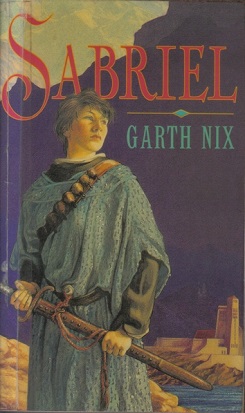
Sabriel by Garth Nix

Sabriel doesn’t know it, but her father is more than just a powerful necromancer; he is a key in the political intrigue of the Old Kingdom–the land beyond the wall. When he interrupts her class at Wyverly college by sending a hand–an enslaved spirit–from beyond the fourth gate of Death to drop off his sword and magic bells, Sabriel knows that something is wrong.

Something is holding her father hostage in Death, and Sabriel is determined to find him and rescue him. When she crosses over the wall, however, into the world of magic, both free and charter, she discovers just how little she knows about the history of the world, and the conflict in which her father was intimately involved. On this side of the wall, the world nearly ended two hundred years ago, and something that should have passed beyond the ninth gate of Death has come back to finish what it started and claim the world as its own…

I read this book for English 318 this year; we discussed it in class a couple of weeks ago. I ended up reading the book in about 48 hours, and as far as required reading goes, it wasn’t bad. Not bad at all. In fact, I really enjoyed it.

Garth Nix creates a fascinating world in this book, with magic that feels wondrous and otherworldly and places that feel fantastic. His conception of Death as a river with nine gates–nine waterfalls–is extremely fascinating, and the use of the bells to cast spells is really well done. The first hundred pages of this book felt a little bit like the beginning of The Dark Is Rising: it felt really dark and spooky, like being lost in the woods and knowing that something ancient and dangerous was out there with you.

The characters were also interesting and likeable. Sabriel is a necromancer who, in some ways, is afraid of facing death–the fact that everyone has to go at sometime. This is a YA book, so she was basically a young adult thrown in way over her head, tossed back and forth from crisis to crisis. At the same time, she takes charge often enough that she is definitely not just a weak character, driven passively from place to place. When the love interest enters the story, she’s basically the “prince” that rescues him from the “dragon,” repeatedly.

The biggest issue I had with this book was its predictability. It seemed that I could see every plot development and big reveal at least fifty pages before it happened. That said, the main thing driving me through the book wasn’t the plot–it was the setting and the characters. Sabriel has to learn some difficult lessons in order to succeed, and the magic she uses is just really freaking cool. Charter symbols, free magic, the five great seals of the charter, the nine gates of Death and the voices of the bells–cool stuff. That was enough to keep me interested, despite the relatively straightforward and unsurprising plot.

Overall, this was definitely a good fantasy. Garth Nix does a great job creating a sense of wonder, and his characters were interesting too. If you like fantasy and haven’t yet heard of this one, I’d definitely recommend it.

Ugghhhhh…

Man, I am sick.  It sucks.

I’m also at a low spot in writing this novel.  That sucks too.

When you get towards the last third of the book you’re writing, you start to have doubts about the whole project.  Is this really any go0d?  Is the story really holding out?  Things slow down a lot, and you lose most of the enthusiasm that carried you through the first half.  The daily drudgery of writing becomes harder and harder, and pretty soon you can’t see beyond the chapter you’re presently writing.  It’s not a whole lot of fun.

Then, as you get into the final stretch, the ending comes into sight and you start to regain a little bit of the enthusiasm.  Your goal isn’t too distant, and you start to see how things wrap up to bring you to that final climax and ending.  You find yourself believing in the story again, and excited to see it to the grand finale.

Of course, the actual writing gets harder and harder, exponentially, right up until the last page, but you’ve regained the motivation and you have at least a portion of the drive.

Right now, I’m kind of at the low point.  It doesn’t help that school is starting to get busier, too.  It certainly doesn’t help to be sick, even if it does give me more time around the house (man, I need to get out…I need to get out…).  But I’m almost at the end of the second act–one climactic battle, one huge and tragic development, one major try-fail cycle, and then I’m on the final stretch.  I’m currently at 64,250 words, so I should wrap up part two by about 68k and finish up the novel at around 100k.  Perhaps a little longer, but I don’t think part three is going to be much longer than part two.

One of the major doubts I have about this novel is that it’s too predictable.  All of my readers from English 318 have been making their predictions, and…really, most of them are correct.  In fact, they’re correctly predicting stuff that happens WAY later, stuff from part three that I haven’t written yet.  If this story doesn’t have any surprises, I worry that it might not be as good.

On the other hand, it has some ideas and concepts that are really drawing in my alpha readers, particularly with the Hameji.  Over and over again, that’s the comment I get–they want to find out more about the Hameji.  This is something that might help me to carry the book, even if it is a bit predictable: show this barbarian spacefaring culture at their most brutal, make them the key antagonists, and then slowly humanize them until the readers understand exactly why they do what they do, and even come to agree with them.  That is pretty fun.

So we’ll see how that goes.  In the meantime, I’m going to go to bed early–9:30 or 10:00.  This sickness is just killing me, and I don’t know of anything more effective at curing it than sleep.  G’night.