Joe Vasicek is the author of more than twenty science fiction books, including the Star Wanderers and Sons of the Starfarers series. As a young man, he studied Arabic and traveled across the Middle East and the Caucasus. He claims Utah as his home.
I witnessed a friend of mine propose to his girlfriend today…at one of the weekly meetings of The leading Edge. It was awesome.
We have this quirky tradition among Leading Edge slushpile readers (well, several actually). On the whiteboard, someone will write “Today is _____ day,” and then that person or someone else will fill in the blank with a different colored marker.
Well, when I showed up around 7:45, the message on the board was “Today is Multiple days,” with an asterisk that said “will be explained later.” Like most of the people there, I shrugged and didn’t think too much of it.
Well, around 8:15, Neal got up and said “I think it’s time to explain what I mean by ‘Multiple days.'” He then went up and started explaining how it’s harvest day, some other day, something else…
To be honest, we all kind of lost interest. Then he wrote down “the twist that no one saw coming,” and I think we cracked some kind of joke at it, but most of us still weren’t paying attention.
Then he wrote “Nyssa will you marry me?” and got down on his knees with a ring.
It was fantastically awesome. She screamed and went crazy, one of the girls got up with Neal’s phone and started taking pictures, and everyone clapped. Some of the editors came over to see what was going on, and when they saw it, their eyes just went wide. It was awesome.
Man, this science fiction and fantasy stuff at BYU leads to so many marriages. I can count at least half a dozen from Quark, and I’m sure there are a ton of others that were before my time. I think the main reason for it is that these sf&f clubs and events bring us together in a low-pressure environment where we can all just be ourselves and have fun. Friendships naturally lead to more-than-friendships when you don’t feel forced to date someone from the group every week (which is why Quark has just as many marriages, if not more, than most BYU singles wards).
Anyhow, congratulations Neal and Nyssa! I wish you both the best of luck! May all your children grow up to be just as geeky as you both!
Just a quick post before I turn in and try to catch up on the sleep that I didn’t get last night (insomnia sucks).
I’m entering a very difficult part of the revision for Mercenary Savior. I’m a little more than a third of the way through the story (as you can tell from the status bar to your right), which is usually where my writing starts to get iffy.
Up until now, most of the work has to do with revising or rewriting individual scenes. That’s no too difficult; it’s very easy, for me at least, to focus on the page itself and fixing problems on the sentence and paragraph level.
The problem now, though, is that some of the chapters aren’t working as coherent units. Some of them feel slapped together, as if scenes that don’t really have much in common have been thrown in the same chapter merely because I didn’t know where else to put them. That doesn’t make for good chapters.
So now, I need to take a few steps back from the page and look at the forest instead of the trees. I need to figure out which events need to be clustered into which chapters, in order for the scenes to resonate with each other and build up to the climax without bumbling on each others’ toes.
I’m going to try out a few new tools to help with the plotting, most notably Dan Well’s 7 point system. I’ve already worked out the essential plot points for about a dozen of the conflicts in the story; now I just need to see which ones go in which chapter.
I wish I had time to use it now, but dagnabit, it’s 1:30 in the morning, and I have to get up at 7:00 tomorrow. Dang. Well, at least I have work–and it’s good work for an aspiring writer in my position. More on that in a later post.
Man, so much has been happening, but now that I’m working an eight to five job, I never have the time to blog about it. It’s 2am and I’m running on only four hours of sleep from the previous night. Oh well, it’s a weekend. Here goes.
I passed the 50k mark for the rewrite of Mercenary Savior. I’m surprised how much I’m changing the draft. I’m especially finding a lot of slow chapter beginnings and thinly veiled expository lumps–not of scene descriptions so much as worldbuilding. Gotta remember the iceberg concept (to only include about ten percent or less of your worldbuilding in your story’s narrative).
I interviewed a few more people for the article on the “class that wouldn’t die.” Good stuff, all around. I met with Cara O’Sullivan today, and she had a very interesting comment about why there are so many LDS writers of science fiction and fantasy.
In her opinion, Mormon literary culture tends to push the more talented writers into sf&f because of the extreme lack of freedom in other genres of LDS writing. In mainstream and literary LDS fiction, there are so many expectations for the writers: for example, that the story will have a clear message, or that it will contain a certain brand of Mormon sentimentalism, etc. In science fiction and fantasy, OTOH, there’s much more freedom; therefore, LDS writers tend to gravitate that way.
I also had a phone interview for the wilderness job last Thursday. I think it went well, but we’ll find out at the end of the month, I suppose. Questions that caught me off guard include: “how do you define success?” and “how would you respond to something you heard secondhand about an employee from another shift?”
Finally, I recently got hooked on an old abandonware DOS game called Princess Maker 2. It is so freaking awesome. Basically, you are the father of this ten year old girl, and you have to raise her from childhood to adulthood.
There are so many possible ways to do this: build her fighting skills and send her on adventures, build her artistic skills and have her win dancing/painting contests, build her refinement and send her to court to build her social reputation, etc etc. There are over 70 different possible endings, including some really weird and crazy ones!
And yes, I know, it seems strange that I’d go for a game this girly–but dude, you have no idea until you try it out. It’s like being a father, but with magic and knights and dragons and stuff! So totally awesome!
The flipside is that I spent almost the entire day playing this game. Yeah…still got in 2.5k words, but I was hoping to put in somewhere around 6k or 7k. Man, I haven’t been this addicted since Alpha Centauri. Will it last? I don’t think it will, but then again, I don’t know. The bigger question is whether this is a game I can play in moderation (like Star Control II). I certainly hope it is, but I don’t know.
In the meantime, I’ve got five weeks to write 70k words. Lets go!
Sorry for the general lack of posts these past few days. I haven’t fallen off the face of the Earth (yet), I’m just working full time and living in a place that doesn’t have reliable internet. Someone in the complex tried to set up a wireless router, and now the internet is down. For some reason, the broadweave guys haven’t fixed it yet.
Student housing in Provo sux.
Anyways, here’s what’s going on in my life. I found a temporary full-time job working in a warehouse. They let me listen to my headphones while I work, so I’ve been catching up on a lot of podcasts and old recordings from cons and English 318. It’s actually kind of awesome. Definitely better than the call center.
I’m in the midst of finishing the research for the “class that wouldn’t die” article. Basically, I have about half a dozen more interviews to do, then write up the rough draft. I’m having lots of fun meeting all these awesome people and putting this article together.
But between work and the article, I’m finding it much harder to keep up with my writing. I’m still producing about 2k consistently, but that’s not quite enough to have Mercenary Savior finished by World Fantasy. Looks like I’ll have to sprint on the weekends.
I’m not too worried about it at this point, though. The revision is going great–in fact, I might post a few excerpts. I know the story’s solid, and the characters are a joy–especially Tamu, the slutty, self-centered concubine that becomes something of a mentor for Stella (to her horror, of course).
The Hameji are also quite interesting; one of my goals in this revision is to portray the rationale for their behavior as clearly as I possibly can. Towards that end, I have a list of points about their culture that I want to get across in the narrative, and I’m keeping track of which scenes convey which points. The goal is to have at least three scenes for each point, which will involve some substantial revision. But if it works, the Hameji will go from horrific, brutal antagonists in the beginning to sympathetic if still brutal by the end–kind of like George R. R. Martin’s stuff.
Speaking of George R. R. Martin, I’m reading A GAME OF THRONES right now and I’m absolutely loving it! I wish I had the time to sit down and read this book for hours. Alas, the only way I can do that is to give up writing, and I can’t do that. Weekends, though–better wait for the weekend.
Anyway, that’s what’s going on. I’d better go to bed now, before I jinx myself tomorrow morning. Or maybe I already have? Blarg. Night.
Tuesday Sept 11th, 2001
Day of the Terrorist Attacks on the WTC and Pentagon
Today has been an incredible day. In describing the events that happened today, one of the teachers said that “the world has changed significantly from what it used to be.” There’s no doubt that that’s true. It’s so strange, I’m still having trouble computing it; it seems almost like a dream; that tomorrow we’ll get up and nothing will be different.
On September 10th, 2001, I resolved to keep a daily journal for one full year (and actually followed through on it until June the next year). That journal turned into a detailed account of my personal reaction to the 9/11 terrorist attacks, the most historic, world-changing event to happen in my lifetime.
September 11th was the first day of school for my junior year in high school.
I first heard the news in 2nd period, which was AP US History with Mr. Gunn. I was excited to see his class, see what the year would be like, etc. Everyone was scrambling for a test. He came in a bit late, and was visibly shaken. He told us that the test was cancelled, and then broke the news to us.
I don’t think anyone computed it right then. I know I didn’t. I heard about it, and immediately my love of storms, breaking news, and perilous events kicked in. But I knew that what had happened was big – and not cool one bit.
I choked down the impulse to get excited, but I did want to know more – a lot more. I asked several questions about what had happened, but there wasn’t much info right then. I had no idea what the incredible magnitude of the event was; I still have trouble, it’s like something from a movie or something.
Needless to say, that was the weirdest first day of school I’ve ever had. Classes went on as scheduled, except for the last period of day, which was canceled for an impromptu school-wide assembly. Everything was upside down, with teachers and students trying simultaneously to launch another school year while doing everything they could to find out what the hell was happening on the news.
I didn’t get to a TV until the mid-afternoon, during my lunch break.
CNN was on, and they were showing footage of the Trade Center and the second plane ripping through it. They showed the buildings on fire and the scene around the buildings. It was incredible; eerie…it was really then that I started to comprehend the sheer magnitude of what had happened.
I watched footage of the Trade Center as the building collapsed – that was incredible. I watched the footage reels play over and over again. There was one of someone at the very foot of the building shooting the building as it burned, then caught it as it began to collapse, and then it started jiggling around as the guy and everyone around him scrambled as fast as they could to get out of there!
It was surreal. In the middle school just across the street, kids burst out laughing when they watched the second plane hit the other tower–then looked around in frightened disbelief as they realized that it was real. I remember looking at the photographs from the New York Times the next day and thinking I was reading a superhero comic, not the newspaper. It just didn’t compute.
I had a ton of questions on my mind that day, and they generally went in this order:
1) Was anyone I personally know hurt or killed in the attack?
2) Were any of the victims friends or family of people I know?
3) Is there going to be a war?
We’re going to remember this day for years and years, it’s incredible. The world has changed; I can feel it. It seems tonight like the stuff on the news is amazing and true, but it doesn’t seem real – not in the sense that I think any of us fully understand everything that’s gone on – everything about everyone who’s been affected by this, including ourselves.
For me, it feels exciting and horrifying at the same time, and I almost feel as if it’ll be gone tomorrow, or at least people will still be reporting on it and nothing will have changed from tonight’s events. Of course, that’s not true.
Interestingly enough, I had been watching the news on an almost daily basis for over a year, waiting for something like this to happen. When the second Palestinian intifada began in 2000, I spent all my free time at school on the internet, checking on the latest developments in the Middle East. When the nightly news stopped covering it, I became so disgusted I stopped watching TV news.
So I already knew who Osama Bin Laden was. I knew all about the Taliban and their egregious human rights abuses in Afghanistan. I heard about the USS Cole only hours after it was attacked, and I was disgusted that the US government wasn’t doing more to defend us from terrorism.
So when the 9/11 attacks happened, I felt simultaneously excited and guilty. Finally, after months and months of slow news, something BIG is happening! But people are dying, too–thousands of people. Is it wrong to be excited? But I’m sad too–does that make it all right? How should I feel about this?
I’m not scared, I’m not terrified like the terrorists want, I’m not angry about all this – I’m just in shock, waiting to see how it all plays out. This is BIG!
Of course, the mental and emotional impact of the attacks were much larger than I understood at the time. I didn’t feel a sense of peace in my life until sometime the next week, when I watched a special LDS devotional broadcast from the Mormon Tabernacle in Salt Lake City. Even then, the impact of the attacks continued to transform me in ways that I didn’t fully understand.
Before the end of the school year, I wrote a short story that amalgamated all of the ways that the events of that year had changed my life. It was my first creative writing project since elementary school that I’d actually finished, and I found it surprisingly cathartic. If you care to read it, you can download it here:
The writing is terrible, the plot is cheesy, and it gets a little preachy towards the end, but it’s more honest and genuine than anything else I can possibly say.
After the shock and horror and fear and sadness, the events of that day ultimately brought me closer to God and the people around me. It also led to a lifelong fascination of Middle Eastern cultures alien to my own–and the desire to show that no matter our background or culture, we are all equally human.
That’s the best way to defeat evil–become a better person because of it.
So I found a job today, which should keep me in the black until November and help me save up enough money for World Fantasy 2010.
The job is at a warehouse for a locally based costuming company. It only runs through October, but that’s perfect because the training for the wilderness job starts the week after. If all goes well, I should be gainfully employed for the rest of the year.
In a blessed stroke of good fortune, I landed a normal 8 to 5 shift. Graveyard is a good shift for writers, but only if you’re sitting at a desk spending 95% of your time doing nothing. I doubt that’s what this job will be like.
I don’t know what this new job will do to my writing, but I tend to think it will be positive. At the very least, it’ll give my life some much-needed structure, and at the worst, it’ll make me write as if my life (or livelihood) depended on it.
In unrelated news, my sister went into labor today. Go Kate! My mom texted everyone in the family–she’s way excited. This will be her second grandchild, and my first nephew. If all goes well, I’ll see him over Thanksgiving. Sarah and I are already planning the road trip down to Texas–it’s going to be awesome!
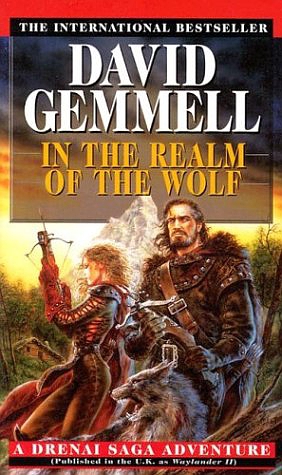
Never leave home without a weapon, Dakyras taught his adopted daughter Miriel. Though they live a quiet life alone in the mountains, death is never far from the man known as Waylander.
When the Assassin’s Guild puts out a high price on Waylander’s head, both Waylander and Miriel find themselves on the run. With them come two ill-fated gladiators from Drenai: the loyal and steady Angel, and the arrogant and reckless Senta. Both men vie for Miriel’s hand–and both are honor bound to kill each other.
But in the face of the evil hunting Waylander, Angel and Senta must lay aside their vendetta and take up arms against the Gothir army hunting the Wolf clan, tribe of the prophesied chieftain that will one day unite the Nadir. For deep in the realm of the Wolf lies a castle more ancient than the three empires–a castle whose dark secrets threaten to upset the global order forever.
This book was awesome. I loved every moment of it. With each page, the story just got better and better, right up to the climactic finish. If you’re looking for a rousing adventure, you can’t go wrong with David Gemmell.
One of the things I loved the most about this story was the love triangle between Miriel, Angel, and Senta. At first, I thought I knew who was good, who was bad, and which one she’d end up with, but then things changed and I wasn’t too sure. Even though I hated Senta at first, I spent most of the book vacillating with my feelings on him. And the way things ended–I wasn’t disappointed. Not one bit.
Even though the overall story conflict was much, much larger than life, Gemmell’s characters always felt very real. Perhaps it has to do with the way their true nature always seems to come out in battle–and Gemmell gives them plenty of opportunity to show their true nature.
It also has to do with the things they’re fighting for, though–the stakes are always clear for each character, and when they’re confused what they’re fighting for, that’s made clear too. Though the conflict itself is larger than life, the stakes for each individual character never are.
The ending really took the cake for me, though. When I finished the book, I couldn’t help but smile. Gemmell is a master at writing endings that make you want to stand up and cheer.
As awesome as this book was, though, the last book in the trilogy, Hero in the Shadows, is so much better. The last scene of that book stands out so much more to me, now that I know everything about Waylander’s past. So. Freaking. Epic.
But do yourself a favor: don’t read the last book first, like I did. Start with Waylander, which is a good book–not great, but good–and read through the trilogy. If you love stories about true heroes and epic adventures, you won’t be disappointed.
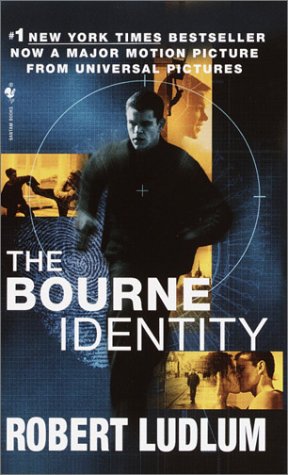
On a stormy night off the coast of Marseilles, a local fishing trawler recovers a man with a gunshot wound to the head. The local doctor patches him up, but when he recovers, he has no knowledge of his past life. Even his name is a mystery.
Fortunately, he has a clue to help him get started: a microfilm surgically implanted in his hip containing an account number for a bank in Switzerland.
When he arrives in Switzerland, he finds that the account contains millions of dollars, as well as a name: Treadstone 71. Before leaving the bank, however, a squad of hitmen attack and nearly kill him, for no reason that he can possibly understand.
On the run from people he doesn’t know for things he doesn’t remember, Jason Bourne finds himself in a struggle, not only for his life, but to find his true identity. But the answers, he fears, are much, much darker than he can possibly accept.
Okay, to start things off, let me say that this book is NOTHING like the movie. NOT AT ALL. The two are completely separate stories. The beginnings of both are similar, with the whole amnesia thing and the bank account number implanted in his hip, but after Jason leaves Marseilles, everything gets different. EVERYTHING.
For that reason, it’s difficult to say which is better, because they both try to do very different things. The movie is more about the action and suspense; the book is more about the intrigue and character development. Both succeed quite well at what they respectively set out to do.
That said, I enjoyed the book at least as much, if not more than the move. Ludlum’s writing is quite good, and he paints an excellent picture of both the exotic European setting and the complex psychological portrait of his main character. Unlike Crichton, whose characters often fall flat, Ludlum does an excellent job creating characters who stand up on their own right.
The suspense lagged somewhat in the middle for me, when the details about Cain and Medusa came to light (that’s one thing I’ve got to say about Crichton–he’s a master of suspense), but it wasn’t enough to keep me from finishing. The ending, however, was atrocious–not in a clumsy way, but in a too-many-loose-ends kind of way that meant that the story wouldn’t truly be resolved until the sequel. I hate stories that do that, but oh well, what can you do?
Overall, though, the book was quite good–better than I expected. I can see why Ludlum was such a successful writer: he created interesting, capable characters and put them in exotic, foreign settings to fight ruthless, evil villains in a desperate zero-sum struggle for survival.
Interesting characters + exotic setting + high stakes conflict + good writing = win. Oh, and Bourne is way more awesome than Bond. Just sayin’.
An Arabic speaker asked, in a youtube comment, for a translation of the recent Antoine Dodson rapist song meme. Since I didn’t have anything better to do was already busy procrastinating, I went ahead and made a rough translation. Here it is:
ومن الواضح أن لدينا في لينكولن بارك مغتصب انه يتسلق في شباككم انه يخطف اهلكم حتى محاول ان يغتصبهم فتحتاجوا إلى إخفاءوا أطفالكم ، إخفاءوا زوجاتكم وإخفاءوا أزواجكم لان ثم يغتصبون جميع الاشخاص هنا أنت لست بحاجة إلى أن تأتي وتعترف ، سنبحث عنك سنوجدك, سنوجدك فيمكنك ان تسار وتقول ذلك ،يا وحش عندنا تي–شيرتك وبصماتك الاصابع وخيرها انت غبي كثير ,ولا غبي كثير, انجد حصل الرجل بعيدا متارك وراءه أدلة أنا تعرضت لهجوم من قبل احمق في المشاريع غبي غبي غبي غبي
And if you’re not confused enough already, here’s the song:
Now excuse me while I start being productive for a change. Ahem.
Over the summer I worked part time at a local call center. At the time, it was just what I needed: a flexible job that helped me pay the bills while figuring out where I wanted to go next. That said, I learned very quickly that call center work is not the sort of thing I want to do for large portions of my life.
I’m glad to say I quit my job on good terms with the management, and was one of their more productive interviewers. I don’t harbor any hard feelings against the company I worked for or any of the particular employees.
However, I do want to reflect a bit on the nature of the work itself, which was less than awesome, as well as some of the things I learned about myself in the process. Since this has nothing to do with the company itself, I’m not going to mention it by name. Also keep in mind that the things I have to say are heavily influenced by my own opinions, so they may not apply to you.
That said, here are some of the things I learned from working in a call center:
1) In the long run, jerks only punish themselves.
I spoke with a lot of incredibly rude people in this job. I also spoke with a lot of people who were courteous and well-meaning. Without exception, the jerks seemed overstressed and miserable, while only the courteous people ever seemed genuinely happy and content with their lives.
I think the way we treat others says more about ourselves than anything else. People who are mean and nasty to each other are never truly happy.
2) A small amount of patience makes most things go faster and smoother.
I hated it when people told me “just put ten for everything.” As an interviewer, I couldn’t do that–I was required to ask every question verbatim. Those who were patient enough to let me do that got through the survey quickly and painlessly, while the impatient people who tried to rush things almost always got upset.
I think it’s safe to say that this has a general application as well. When we’re patient enough to let things happen the way they’re supposed to, things happen faster and more smoothly. When we try to rush things that shouldn’t be rushed, we screw up.
3) The ability to genuinely listen is a rare skill.
I can’t tell you how many times I asked a simple question on a survey, only to find the person on the other line answering something completely different. I didn’t expect anyone to drop everything and devote their full attention to me, but how much effort does it take to answer a simple question?
I’ve known for a long time that listening is a skill that requires work to cultivate, but apparently, it’s also one that few people have truly mastered. If you can’t understand a straightforward question well enough to give a yes or no answer, how can you understand something as complex as another person’s feelings?
4) Political campaigns are evil.
This is a little tongue in cheek, but I stand by it one hundred percent. Every survey we conducted for a political campaign asked questions that were clearly geared toward developing negative campaign ads and manipulating public perception. None of them asked how the government could best serve the people.
5) Having a flexible work schedule makes writing both easier and harder.
It makes it easier because you can plan your time around other things that are going on; it makes it harder because your days generally have less structure.
I think I hit a pretty good balance by working in the morning and writing in the afternoon, then going in to work again in the evenings if I needed the hours. Call centers are always looking for people to work in the evenings.
6) Reducing everything to numbers makes human interactions meaningless.
This was, by far, the thing I found most frustrating about my work. I talked with hundreds of people from all over the country and didn’t connect with hardly any of them on a personally significant level. It was all about checking off boxes, where each completed survey was just another number in the system.
This tended to be more true of the short surveys, less true of the longer ones. For that reason, I loved it when I got a survey that took twenty or thirty minutes to complete. It’s very hard to talk with someone for thirty minutes without making some kind of a connection with them, however fleeting.
7) If you have a love of learning, find a job that lets you use your mind.
To be perfectly honest, I never felt completely satisfied at my work. A robot with sufficiently advanced voice recognition software could probably have done my job as well as I could (at least for the ninety second surveys). Over time, I felt like my work was turning me into a robot.
That’s ultimately why I felt I had to get out. Maybe I have a problem with authority, but I can’t stand being just another cog in the corporate machine. There’s got to be a way to pay the bills and still live life meaningfully.