Deceptively unproductive day

Man, where did the day go?  I don’t feel like I was lazy, yet I only wrote about 1.2k words for the whole day.  And things were going so well the day before…

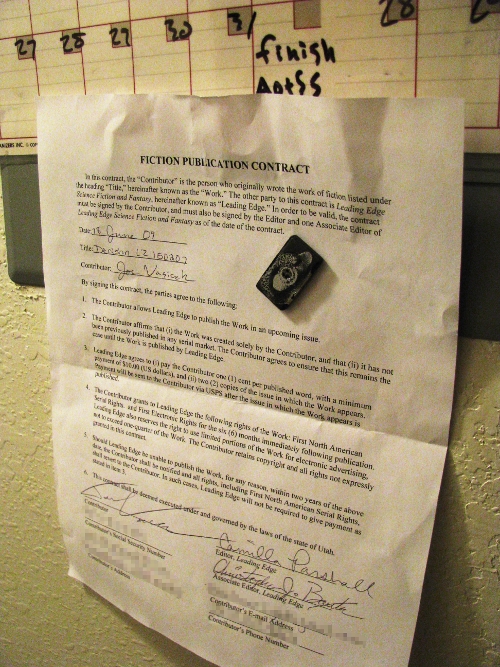
Well, I guess I was busy, just with a whole lot of other things.  Donated plasma (which took all morning), got some groceries, started GMing another round of werewolf on the quark forums, did some more research into ebooks, started the online TEFL course, went to Leading Edge and signed a contract for a poem they’re going to publish–

Oh yeah, check it out!  I signed my second publishing contract today–again, with Leading Edge.  They’re going t0 publish a short poem I wrote about Gliese 581g, otherwise known as Zarmina’s World.

(which reminds me, I’ve been meaning to blog about NASA’s Kepler mission since forever.  It’s an incredible mission which, I believe, will lead to some revolutionary astronomical discoveries–and may even rejuvenate interest in science fiction.  But more on that later…)

So yeah.  My goal is to finish WAFH before the end of February, which is going to require a lot of work.  Two and a half weeks, with LTUE 2011 sucking up one of the weekends…it’s going to be tough.

Numbers-wise, though, it’s still quite doable.  I want to keep this draft pretty close to 90k (no more than 100k), and I’m already at 53k words.  With sixteen days left in the month, I need to write between 2.3k and 2.9k words per day to make it.

In the meantime, it’s 2 am, and I’d better get some sleep. Waking up late is definitely bad for productivity, and I hate it. If I could train myself to wake up every morning at 5 am like Aneeka, that would be awesome. Actually, I’d probably just complain about how much it sucked to get up early every day, but hey–the grass is always greener…

Deceptively productive day and other updates

Man, I revised through about 4k words today…and wrote a 1.5k outline for Edenfall to boot.  Not bad, considering how much time I spent putzing around reading publishing blogs and job hunting on craigslist.

Things are going well with WAFH; after a slight dropoff at the end of last week, I’m rebuilding momentum rather quickly.  But then again, I’m currently at an easy part in the draft.  Pretty soon, I’ll have to throw everything out and start from scratch.

Job hunting sucks…but what else is new?  I signed up for an online TEFL certification course, to the tune of $250 (youch!).  Hopefully, that will help land me a good teaching job in an advanced pay grade overseas.

I swear, the job market here in the states is so bad that I don’t see any other way around it but to leave the country.  Maybe if I was a CS major, or had no qualms selling people crap they didn’t need, or was willing to wipe up elderly people’s butts after they’ve defecated all over the place…no thank you.  In any case, teaching English is an adventure, and I very much look forward to it.

In the meantime, there are a few local graveyard job openings that might allow me to write on the side while I babysit a desk.  If those don’t work out, hopefully I’ll find something else before my checking account dries up sometime in March.

I’m getting really excited for Edenfall.  Last night, as I was falling asleep, I ran through the basic storyline in my head.  Fortunately, I remembered it well enough in the morning to write it all down.  It’s going to be awesome.

I’m also starting to rethink my philosophy on writing direct sequels.  I used to follow Sanderson’s line of thought; it doesn’t make sense to finish the series, because if a publisher rejects the first book, they won’t be interested in the others.  However, with ebooks and self publishing becoming more accessible and lucrative, the ability to put out a complete trilogy all at once is a great strength.

I’m thinking very seriously about putting Genesis Earth out there, but it’s the first book in a trilogy, and it would probably boost sales of all three if I could put them all at once.  Aneeka gave me a good suggestion today: put out the first book for free, while selling the other two at a competitive price.  Sadly, it will probably be a year or two before the others are ready…but my writing skills are constantly improving, so maybe I’ll be able to produce them a little faster.

Which brings me to a very interesting post I read on Dean Wesley Smith’s blog yesterday about writing speed.  Thus far, I’ve been shooting to produce one polished book per year, but after reading that post, I wonder if I should shoot for more.  Can I write two books a year and still maintain a high level of quality?  I’m not so sure; GE and BSH both required five rewrites before I got them fully polished, and Mr. Smith’s numbers don’t seem to take the revision process into account.

This year, though, I’m hoping to produce two polished books: Bringing Stella Home, which I’ve already finished, and Worlds Away from Home, which is my current WIP.  I’m only on the second draft, and there are tons of story issues, but I’m working through them fairly quickly.  I’ll probably put in another two or three rewrites before the end of the year, and still have time to finish a couple of other rough drafts–Edenfall and The Stars of Redemption (third book), potentially.

Of course, if I land a job, that might throw a kink into things–as will traveling overseas.  But as with all things, I’ll take those eventualities as they come.

(image shamelessly lifted from this site.)

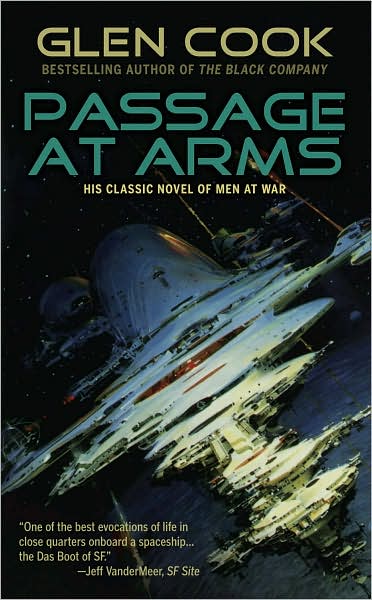
Passage at Arms by Glen Cook

Humanity is losing a long, bloody war of attrition against an alien race.  Our only military advantage lies in the climbers–small, guerrilla style gunboats that can cross into a higher dimensional plane.  Under the right conditions, this technology enables the ships to pass through space undetected.

As the war reaches a critical juncture, one former soldier, now a journalist, joins with the crew of a climber to get the inside story.  What he finds is a far cry from the brave, clean-shaven heroes portrayed by the official war propoganda; the climbers are a gritty, dirty-minded lot of soldiers, cursing the higher ups and living from leave to debaucherous leave.

When worst comes to worst, however, and crap hits the fan, everyone’s true colors come out.  When that happens, who will hold together, and who will fall apart?

I enjoyed this book a lot.  Parts of it were a little raunchy, but never too much for my taste, though your mileage may vary.  Glen Cook leans more towards flowery writing than pure storytelling, and while I had a few minor qualms with his writing style, the book was quite compelling.

Glen Cook really excels at character voice and viewpoint.  Even though the book was military sci-fi set almost entirely in space, it had a very distinct, almost noire feel to it.  Everything that happened was heavily filtered through the main character’s point of view, which made the narrative feel very intimate and personal.  When Charlie dances the foxtrot, you feel like you’re right there in the thick of it.

My favorite thing about this book, however, is the level of scientific realism in the combat systems.  Obviously, things like hyperspace and trans-dimensional drives are entirely speculative, but the orbital dynamics of the planetary siege and visual effects of the nightly bombardment gripped me from the first page.  It didn’t feel pulpy or cartoonish at all–in fact, it felt disturbingly reminiscent of news footage from the ’91 Gulf War, which haunted me for a while as a kid.  This isn’t your typical humans vs. aliens sf adventure novel–it’s like a firsthand account from someone who was there.

My biggest issue with the book was more stylistic than anything else; Cook tends to rely on one-sentence paragraphs to add extra punch–which can be effective, when done sparsely.  However, every page would have at least two or three of them, often occurring one after another.  For me personally, that was a bit too much, but obviously it didn’t keep me from finishing the book, or enjoying it.

So yeah, if you like your science fiction with a heavy dose of gritty realism, you’ll probably like this book.  Even if you don’t, it’s worth checking it out for the orbital dynamics and other interesting details.  Even though it probably isn’t perfect, it feels a lot more accurate than most of the other books out there.

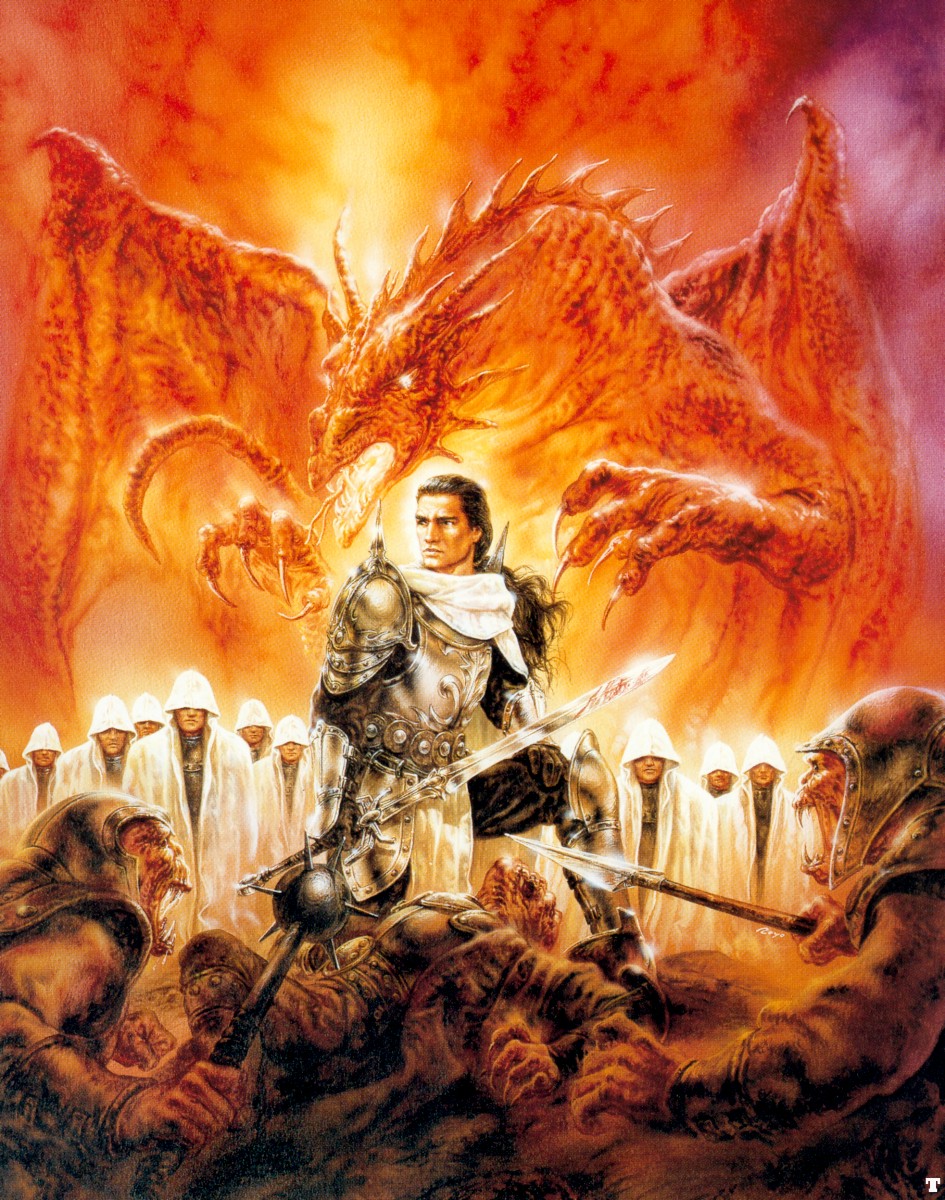
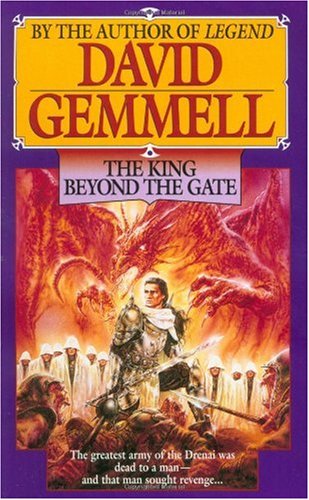
The King Beyond the Gate by David Gemmell

Tenaka Khan was a child of two nations and an outsider to both.  Half Nadir, half Drenai, the only home he ever knew was in the ranks of the Dragon, the elite fighting forces of the Drenai.  But now, a mad dictator rules the land, and the Dragon has been destroyed.

With all his friends dead at the hand of the evil Drenai emperor, Tenaka has only one desire: to steal into the palace and assassinate him.  Along the way, however, he makes a number of friends, all of whom seek the same thing, but all for different reasons.  As they join forces with the Skoda rebels, Tenaka realizes that he not only has something to die for–he has something to live for.

But in order to defeat the mad emperor, the rebels must fight the Joinings–terrible creatures made from man and beast, who slaughtered the Dragon years before.  Only the Nadir can save them–but the Nadir want nothing more than to ravage the Drenai.

If  you’ve read my review of David Gemmell’s Legend, you know why I love his books.  This one was no less incredible.  Parts of it were just as poignant as anything in Legend, and the ending, while bittersweet, was no less satisfying.

It’s really fascinating to me, because Gemmell’s books are not particularly flowery or well written.  His descriptions are sparse, his prose is unassuming, his characters, while distinguished from each other, sound more or less the same, and his viewpoint is often inconsistent.  But in terms of raw storytelling, his books are unequaled by anything else I’ve ever read.

He makes me fall in love with his characters: I cheer for them when they rise to the heroic deeds that circumstances demand of them, I cry when they fall short of what they could have been, and I weep when they give their lives in the service of something greater than themselves, which is almost invariably the case.

My favorite part of any David Gemmell book has got to be the order of warrior priests known as the Thirty.  They don’t show up in every book, but they show up in many of them, and they always share the same characteristics.  The warrior priests are dedicated to the Source (Gemmell’s equivalent of God in his Drenai universe), and have the supernatural abilities to speak telepathically, put thoughts into others’ minds, shield their comrades from the magic of the Chaos brethren, and leave their bodies to fly across the world and do battle in other dimensions beyond the grave.

The way the order is run is absolutely fascinating.  One person is the mouth, the other the ears, the other the heart, etc.  The most unlikely characters always fill the particular roles–but always for good reason.  They fight to defend the innocent and pure, but more than that, they always have some great destiny to perform–a destiny that invariably pits them against the forces of Chaos in some great, decisive battle.  In that battle, all of them invariably die, except for the weakest among them, who goes out to found the next order of the Thirty.

I don’t know about you, but this kind of stuff, just makes me want to jump up and down.  This is fantasy at its best–good versus evil, warriors facing death, and the most unlikely heroes rising to the level of greatness that war and honor demand of them.  Throw in a little magic, a brotherhood of evil sorcerers bent on crushing all that is good in the world, and terrible monsters the likes of which exist only in nightmares, and I am so there, man–I am so there.

In short, this book was nothing less than awesome.  If you love any book by David Gemmell, I think you’ll enjoy this one.  It’s got everything you could possibly expect from heroic fantasy, and more.
Looking for alpha readers and planning the next project

Worlds Away from Home 2.1 is going along well.  I had a hard time switching from Bringing Stella Home back to this other project, but I’ve got some good momentum going and assuming no major interruptions, should be able to do about 3k words a day for the rest of the week.

Then again, if I get interrupted by work, that might be a good thing…

The second draft is going to be pretty rough, but good enough to start sending out to alpha readers.  Anyone want to volunteer?  It’s basically a far future love story on a planet with desert-dwelling tribal nomads who drive micronuclear powered dune buggies and centuries-old arcologies under giant continent-sized domes.  Earth is an ancient, mythical legend, and roving bands of starfaring nomads stand poised to crush the galactic empire.

I hope to be finished with the second draft by March 1st, and I’d want to get feedback no later than the end of April.  If you’ve been one of my alpha readers before, or if we’re friends IRL, let me know if you’re interested.

So earlier today, I was thinking about the project I want to do after WAFH–a sequel to Genesis Earth.  I’ve been toying with the idea of releasing GE as an ebook, but I don’t want to do that until I have a sequel in the works.  Anyhow, I was thinking of ideas for the title, and out of the blue, it struck me:

EDENFALL.

Kind of plays on the subtle Adam and Eve theme of the first one (and no, Genesis Earth isn’t technically a sci-fi Adam and Eve story…but it kind of evokes one).  I like it because it fits well with my ideas for the story, which basically center around shattering the Edenic paradise that Michael and Terra reach at the end of GE.

I’ve got a lot of ideas for this book, and I think they’re reaching a critical mass.  Just last month, I came up with a great name for the main female protagonist: Estee.  She’s the eldest daughter of Terra and Michael, and kind of takes after her mother’s personality.  The male protagonist will be a young soldier from the military force sent out by panicky Earth officials to neutralize any threat on Icaria–which gives the commanders of the expedition a broad mandate to do whatever the hell they want. As you can imagine, conflict ensues.

I know how this story begins, and I know how it’s supposed to end (and thereby set things up for an awesome third book in the trilogy), but I have no idea how to build things up to the crazy twist ending.  It’s going to require some serious worldbuilding, and that’s going to take some time.  Daydreaming is such hard work, after all.

Anyhow, I should be ready by the time I finish WAFH 2.1.  As an experiment, I’m going to write the rough draft entirely in longhand.  Am I crazy?  Perhaps.  But I also want to spend some time in the Utah wilderness for inspiration while I’m writing it, so pen and paper is probably the best medium for that.

So those are my plans.  To close, let me link to this awesome cover of “Something About Us” by Daft Punk.  Now that’s some sweet theremin action…enjoy!

Thoughts on the protests in Egypt

So unless you’re living under a rock, you know that there’s a revolution going on in Egypt right now.

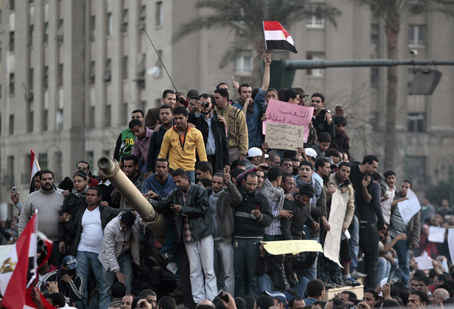
Protesters have been demonstrating 24 hours in Tahrir square in Cairo for the past seven days, demanding that President Mubarak step down from power.  With police unable to contain the protests, the army has been called out, but seems to be taking a neutral role.

It’s hard to tell exactly what’s going on right now, but from what I can see, it doesn’t seem likely that Mubarak can hold onto power much longer.  In some places, it seems that the military has actually sided with the protesters, allowing them to stand on top of tanks and blocking the police with their armored vehicles.  Many of the looters include police officers, who apparently have read the writing on the wall.

If Mubarak does step down, the effects will be incredible.  Egypt is by far the most populous Arab country, and a major center for regional cultural trends.  Mubarak’s regime has also been one of the most authoritarian and repressive, and until now, his hold on power seemed as absolute as any Arab ruler.  If he falls, where will the next revolution happen?  Libya?  Syria?  Yemen?  Sudan?  Iran?

This wave of protests didn’t start in Egypt; it started in Tunisia, where a citizen’s self-immolation sparked massive unrest.  When the protests reached their apex, the military and police stepped down, forcing President Ben Ali to flee the country.  Tunisia had one of the most repressive regimes in the region, and the speed with which it collapsed was absolutely stunning–and no doubt an inspiration to the people of Egypt.

Some articles I’ve read suggest that the Iraq War and the fall of Saddam Hussein was a major cause of the current revolution, but I disagree.  Most of the Arabs I’ve talked to consider the US invasion of Iraq to be a disaster, and have nothing positive to say about anything that’s come of it.  The fate of Iraq is still very much in the air, and many people (myself included) don’t expect democracy to take root in that country without another dictator coming to power.

Instead, I think the root cause of this revolution is economic.  According to the UN, food prices across the world have risen 25%, and the global recession has led to widespread unemployment.  No doubt the people of Egypt have been feeling this, especially with the huge disparity between the rich and the poor.  What we’re seeing right now is a loosely organized, broad-based popular uprising, with people from all segments of society demanding that Mubarak step down.

I’ve got to be honest; I think these protests are very exciting.  The chaos and violence is definitely bad, but if it leads to a more just and democratic Egypt, I think that it’s definitely a good thing.  When I visited Egypt back in 2008, my first impression of Cairo was that the place was a post-apocalyptic wasteland of a city, with trash in the streets and police armed with machine guns.  The longer I stayed, the more I felt that the country was backward–and that a major source of the backwardness was the corrupt Mubarak regime.

I’m not an Egyptian, so I can’t say what’s best for the Egyptian people, but I hope and pray that they get what they are fighting for–a more just and democratic country.

How do you write a character who is shy?

The writing is a little sporadic these days, but it’s coming along.  I’ve broken out of my most recent block, and progress is coming along on WAFH…or at least it was, when I didn’t have a temp job sucking up most of my time during the day.

Still, can’t complain about work–and even though all the job interviews from a couple weeks ago seem to have lead nowhere, I’ve got a few new opportunities opening up that seem promising.  More on those later.

One of the more challenging aspects of WAFH is writing the main female protagonist, Mira Najmi.  Mira is something of a shy pushover, who gradually learns to stand up for herself and make her own independent decisions.

Because of this, I find it difficult to write from her point of view.  When she isn’t letting people walk all over her, she’s either homesick and depressed or following others without making any real decisions for herself.  And yet, in order for her growth arc to work, this is the point at which she needs to start out; her gradual change into a strong and independent woman is a major part of the book.

In short, how do I make a shy, self-effacing protagonist sympathetic and interesting while remaining true to her character?

(Before I go further, I should note that Mira does have strengths.  She has a caring, nurturing personality, and is sensitive to the needs of others.  She often notices the little things that go right over the male protagonist’s head.  Besides that, she’s basically a good person, with a pure heart and an aversion to causing hurt or injury.  Oh, and she’s stunningly beautiful–though in some ways, that’s more of a handicap than a strength.)

Thus far, my strategy has been to delve into her internal monologue when in her viewpoint and try to make her underlying motivations clear.  I suspect it goes beyond that, though.  The best thing I can probably do is make her relatable to the audience–to make her shy in ways that make the readers feel like she’s one of them.

But that’s difficult for me, because I’m not a very shy person and I don’t generally relate well with people who are.  So how can I get a better understanding of what it’s like?  Do you guys have anything that you can share with me that would help me to understand?  Any tips or techniques for writing similar characters?

(image taken from http://webpages.scu.edu/ftp/lgrove/resign%20splashpage.htm)

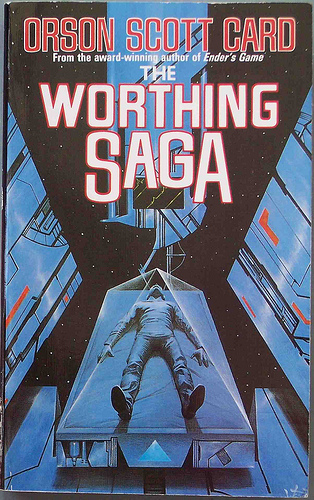
The Worthing Saga by Orson Scott Card

Somec: the miracle drug that allowed the rich and well connected to sleep through the centuries and postpone death almost indefinitely.  While the masses continued to live out their lives in normal time, the social elite watched over centuries as their investments multiplied, and their kingdoms grew into empires…

…and ultimately crumbled.

Thousands of years have passed.  Somec is unknown, except to the one man who saved humanity from its own corruption.  He has slept through the eons to find out if his last gambit brought about the peaceful and benevolent society that he hoped to leave behind.

But as he awakens from his slumber, he finds himself in a universe infinitely stranger than he could have imagined–among a people who revere him as their god.

I’ve heard that Orson Scott Card considers this book his best work, and I’d have to say, I agree with him.  Right up until the ending, it’s at least as good–if not better–than Ender’s Game, his most famous book.

The book unfolds magically from the first page, drawing you in to this beautiful, fantastical world.  The characters have depth and feeling, especially the ones from ages long past, whose stories are powerful and haunting.

I absolutely loved this book–right up to the end, which had a twist that caught me off guard, and not in a good way.

Story-wise, the ending was great.  It was a beautifully foreshadowed twist, right on the order of Ender’s Game and Speaker for the Dead.  Thematically, however, I had a hard time not feeling that it undermined everything that had come before.  I can’t get into details because I don’t want to give spoilers, but the last couple of pages jolted me out of the book and left me saying: “Huh?  How is that right?” I eventually warmed up to it, but it took a while.

Still, I’d definitely give the book five stars, or at least four and a half.  Everything about it is monumentally amazing.  The characters, the worldbuilding, the sense of wonder, the thought-provoking questions and issues it raises, and just the sheer joy of the experience of reading it.  This is a book that I can get lost in, and not just once.

As a side note, the book includes the short novel The Worthing Chronicles, as well as several short stories that take place in the same universe.  The short stories were all quite good, but personally I preferred the novel by itself.  Perhaps it’s because the epic scope came through so much better in the novel than in the stories, or because the stories didn’t allow me to spend much time with any of the characters.  Your mileage may vary, of course.

Interestingly, The Worthing Chronicles is a retelling of Hot Sleep, Orson Scott Card’s first novel.  As a writer, I find it interesting that Card revisited his first novel in this way–to basically rewrite it, keeping all the major events but telling it from the point of view of someone who meets the main character of the first (Worthing) much later in his life.  I haven’t read Hot Sleep, so I can’t compare the two, but The Worthing Chronicles turned out amazingly well.

Will I ever attempt something like this?  Not sure–but it’s interesting to think about.

Yet another reason why I love Quark

For those of you who may not know, quark is BYU’s science fiction and fantasy club.  I had the good fortune of being one of the club’s vice presidents for two years while I was a student, and I still keep in touch with a ton of friends from that group.

One of the funnest things about quark is the online werewolf games–currently, I’m GMing a round based on Interstella 5555.  Recently, Jerle and I decided to put together a database of all 49 rounds that we’ve played over the years, compiling player stats, setting up rankings, and other such nerdy things.

While I was going across some of the older threads, I came across this amazingly hilarious premise for round fourteen:

In the year 1815 Napoleon conquered Russia.
In 1817 he conquered China.
By 1830 he was the ruler of continental Europe, Asia, and parts of Africa that were interesting.
In 1834 he invaded Antarctica and defeated the United Federation of Penguins and Polar Bears.
His successor sent ships to conquer America and England, and succeeded, but not without a fight.

The year is 2015.
The entire world speaks either French or English, or, more likely, some mixture of two.
A great scientist has invented a Time Machine.
The only hope for penguins and polar bears is to infiltrate high-security research facility in New Paris, use the device to go back in time and present a plush toy of a penguin to young Napoleon. A rogue rebel Greenpeace group assists the penguins/polar bears.

The research facility is guarded by an elite team of 15 highly-trained frenchpeople. Through great ingenuity Greenpeace was able to replace three of them with its agents. Those three must kill everyone else and use the time machine.

There is also a rumor that one of the elite guardsmen has been replaced by a clown.

Playing:
Avulsion 7
Baggins 17
Beatobur 13
Cardasin 20
Child 10
Daen 17
Drek 5
Fezzik 11
HER0 0
Jerle 13
RamenSensei 1
SilverStorm 19
Sunstarr12 16
Thundershorts 12
Turin_Turanbar 0

3 Greenpeace members, 1 DGSE detective, 1 team medic, 1 clown.
And 9 FRENCHPEOPLE!

RULES

NIGHT.

Awaiting requests.

Hehehe…these are sooo my people!

I’m so happy…

…because I checked out five of the Drenai books by David Gemmell from the library this week, and I’m going to read them all by the end of the month.  I’m already in the middle of The King Beyond the Gate, and it is awesome.

Holy crap, I love the Thirty!  If/when I ever write fantasy, I am definitely including an order of elite warrior priests like those guys!  And the way the Nadir sometimes end up fighting for the good guys, with the interesting twists in their culture that make them more than just the evil rampaging hordes–man, I love that.

I’m also happy because the Provo Library had a used book sale today, and I picked up a ton of new books!  Here’s the list:

The Wayfarer Redemption by Sara Douglass,
Starman by Sara Douglass,
The Princess Bride by William Goldman,
The Eye of the World by Robert Jordan,
A song for Arbonne by Guy Gavriel Kay,
Abhorsen by Garth Nix,
The Man with the Iron Heart by Harry Turtledove,
Terraforming Earth by Jack Williamson,
A Bridge of Years by Robert Charles Wilson,
Bios by Robert Charles Wilson,
Serpent Catch by Dave Wolverton (his second novel!),
Looking for the Mahdi by N. Lee Wood,
Warhorse by Timothy Zahn, and
Changeling by Roger Zelazny.

Oh, and a gift book for my mom.  All for $7. 🙂

So after I get off my Gemmell binge, which book(s) should I read next?