Merry Christmas from Texas!

Merry Christmas y’all! I’m down here in Texas, spending the holidays with family; it was either Texas with my sister’s family, or Massachusetts with my parents, and we all agreed that the weather was better down south.

My brother-in-law and I drove down here from Provo, and it was a fun little road trip!  We passed through New Mexico just before the storm, stopping at Roswell to see the UFO museum.  Interesting stuff!  Spent a night with family in West Texas before driving across the state today, arriving just this evening.  Highlights include conversations about The Dispossessed, postmodernism vs. moral absolutism, the Lebanese civil war, and the excesses of modern consumer culture.

We’ll probably be here until Wednesday, then it’s back to Utah to drop off the car and back east for me, taking the train back to my parent’s house before heading overseas to teach English.  The last few weeks have been pretty hectic, what with moving and all, but now that I’m out of my apartment and on the road, I think things will be less stressful in some ways–fewer balls to juggle.

I don’t foresee getting into much of a routine again until after the holidays, but I’ve been able to write between 500 to 1,000 words per day in Stars of Blood and Glory so far, and hopefully I’ll be able to keep that up.  And of course, the train ride should be perfect for pounding out words.

Before the end of the year, I’ll probably do the whole reflections on 2011 thing and resolutions for 2012, but posting might be a little spotty over the next few days, at least until after Christmas.  It’s a time for family, after all.  So anyhow, I hope y’all have a wonderful holidays, and I’ll catch you after it’s over!

Trope Tuesday: Celibate Hero vs. The Fettered

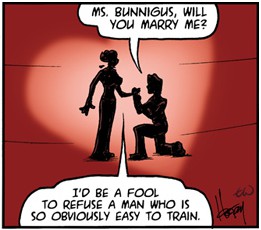
Yes, there are still good men out there...and they tend to know who's boss.

I’m mashing up two tropes this week because I’m not satisfied with the one.  There are a bazillion tropes about characters who are sexually active, but very few about sexually chaste characters that don’t portray them as weak, clueless, or socially inept.

According to tvtropes, a celibate hero is a main character who “doesn’t do the romance thing.” Unlike the chaste hero, who is just clueless, the celibate hero has made a conscious decision not to engage in sexual relations or get tied down in a relationship.  There may be any number of reasons for this, but it usually comes down to some combination of Love is a Weakness, Love Hurts, and It’s Not You, It’s My Enemies.

(As a hilarious example of this: TESLA!!!)

But what about the character who isn’t necessarily opposed to romance, but feels that they should wait until marriage to have sex?  Unfortunately, this trope is pretty rare nowadays.  I can only think of two mainstream examples: Edward from Twilight and Reverend Theo from Schlock Mercenary.

Theo in particular is a great example of this, because he’s not clueless, he’s not weak, and he not only gets the girl, he gets the girl that everyone wants.  The only reason he holds out is because his religious order forbids sex before marriage.  It does permit priests to marry, however, so Theo does manage to balance the two.

So why are characters like this so rare?  Unfortunately, I think it comes down to the widespread notion that a true man isn’t a virgin, and that sex makes people cool.  If we accept these tropes as true, then that means that men who exercise self-restraint are actually weak and pitiful, and couples who choose to wait are pathetic losers.

It’s worth pointing out that both Edward and Reverent Theo were created by writers who are practicing Mormons–people who belong to a religious community where it’s still the norm to wait until marriage.  If literature is the way that the culture speaks to itself, then this goes to show just how unrestrained the rest of Western society has become.

This is why I think that the better trope for this kind of character is The Fettered.  Unlike the celibate hero, who usually gives up sex for some kind of external reason, the fettered gives it up as a matter of principle.  Living by his ideals isn’t easy, and he’s constantly tempted to give in and break his moral code.  However, by resisting these temptations, the fettered gains great strength, and can stand like a beacon of light in an otherwise disillusioned world.

This is actually something that I tried to do with my latest novel, Desert Stars.  The main character, Jalil, is a man who believes in honor, and follows a code of abstinence before marriage.  However, to manipulate him into staying at the camp, his father charges Mira, the female protagonist, to seduce him.  Since the fettered’s strength is also his greatest weakness, if Mira can get Jalil to sully her honor, then out of shame he will return and marry her.

The catch?  She actually has feelings for him, and doesn’t want to manipulate him in this way.  In this way, merely persuading him to have sex isn’t a win condition–in fact, if done in the wrong way, it could be a very serious “game over.”

Whether or not I actually pulled it off well is up to the readers to judge.  But one thing I was definitely shooting for was to write a character who fulfills this trope in an unconventional yet powerful way.  And if you’ll permit me to step onto my soapbox for a little bit, I think our culture desperately needs more heroes like this–heroes who show that real men are capable of self-restraint, and that following a moral code is still cool, even if it means waiting to consummate a relationship.

Desert Stars is now published!

Desert Stars, my third novel (and second in the Gaia Nova series), is now available as an independently published ebook from Amazon, Barnes & Noble, and Smashwords.  Within the next couple of weeks, it’ll be available through Kobo, iTunes, Diesel, Sony, and Xinxii as well.

It’s been a long journey, and I’m thrilled to finally see it come through.  I started the first draft back in the fall of 2008, but had been working on ideas for the world since 2005, when I returned from my LDS church mission in California.  Spending the summer of 2008 in Jordan was a major catalyst for my imagination, and I soon was bursting with ideas for a far-future story on a desert world.

I got stuck in the winter of 2009, however–right before taking Brandon Sanderson’s English 318 class.  Since he encourages all of his students to work on something new, I decided to write a book in the same universe in order to work through some of the world-building things that were holding me up.  That book became Bringing Stella Home, which was a thrill to write all of its own.

The strategy worked; by the time I’d finished that one, I had a much clearer idea where to go with Desert Stars, and an awesome ending that was nothing like anything I’d planned in the first draft.  And so, after graduating in April 2010, I soldiered through and finished the rough draft that summer.

It still had a lot of problems, though.  Fortunately, my first readers were extremely helpful both in pointing those out and in giving me fantastic ideas for other things I could do.  In the second draft that winter, I completely scrapped a major subplot in the second half of the book and focused on perfecting the character arcs for the two main characters: Jalil and Mira.

Around this time, I made the paradigm shift from traditional to indie publishing.  Other projects like Genesis Earth and Bringing Stella Home took my attention for a while, as I learned the basics of the new world and prepared those books for publication.  However, I always kept coming back to Desert Stars: I knew I had a good story there, and I was just itching to bring it to its full potential.

In the fall of 2011, I finally had that opportunity.  The last draft flew by in three weeks, and was one of the funnest writing experiences I’ve had since I started writing seriously in 2007.  By the end, I knew it was ready.  I sent it out to my editor, Josh Leavitt, and started to prepare it for publication.

In writing any book, there are always moments that stand out; experiences where things come together in an unexpected yet memorable way.  One of those came to me in Jordan, while I was walking down Queen Rania street from the University of Jordan to Al-Dustour, and the phrase “Temple of a Thousand Suns” flashed into my mind and sparked the whole novel.  Another of those moments happened while I was driving from Salt Lake to Provo, and Mira’s final words in the last chapter came to me; I literally could not stop screaming for two or three minutes.

I could share more, but if I did, I’d find it difficult to maintain the illusion that I’m not a loony psychopath. 🙂

In any case, it’s just awesome to see the story come to maturity and embark out into the world.  I’m sure this isn’t the end of the journey, but it’s definitely entering a new and exciting phase.  I sincerely believe that this is my best book yet, and I hope you find it as worthwhile to read as I have found it worthwhile to write.  If you do, I would appreciate it greatly if you took the time to post a review, or share it with a friend.  Every little bit helps, and I’m grateful for whatever support you can give!

In the next couple of days, I’m going to send out a newsletter with some freebies including desktop backgrounds of the cover art.  If you’d like to get in on that, be sure to sign up for the email newsletter via the form on the sidebar; you’ll also receive notices for other giveaways, as well as new releases.  It costs nothing and you can always unsubscribe, so there’s no pressure or obligation.

And that just about wraps it up.  Now: on to the next book!

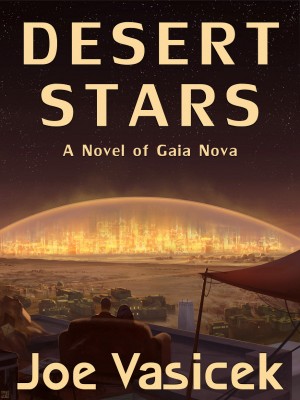
Desert Stars cover is finished!

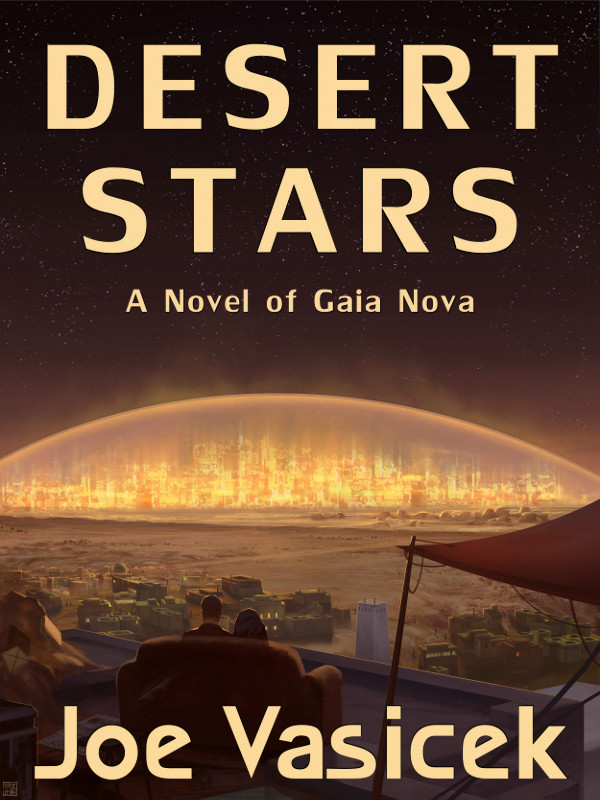
Here it is, guys!  What do you think?

I played around a little bit with the text this time, coloring it and putting in some noise to give it a hint of texture.  The title and subtitle font is LilyUPC, and the author name font is Alpha Centauri (from Sid Meier’s Alpha Centauri–best empire building strategy game ever).

If no one points out any glaring errors, I’m going to make the ebooks right now and upload them to Kindle, Smashwords, and Barnes & Noble sometime tomorrow.  I’d do it tonight, but it’s getting late, and I’m starting to come down with cabin fever.

After all these years, it’s finally happening!  Yay!

Desert Stars cover art is in!

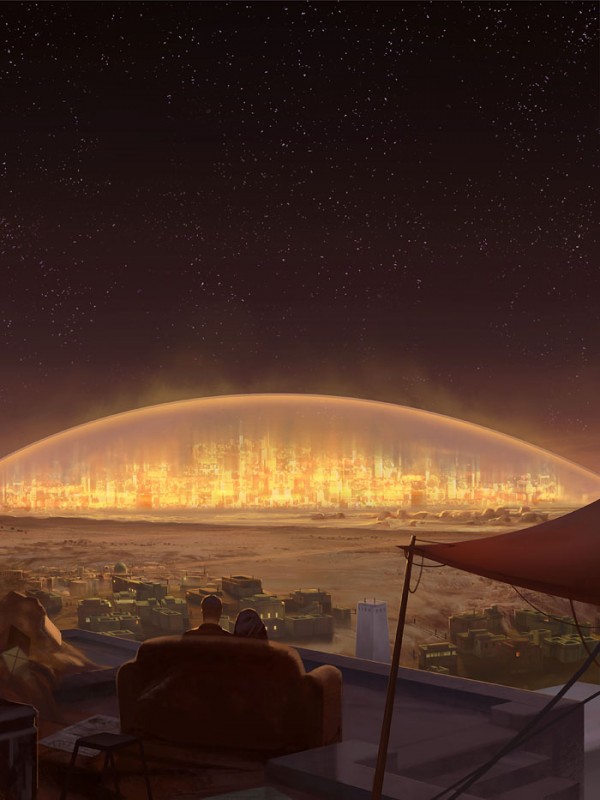
I just got the final version of the cover art for Desert Stars, and it looks great!  Here’s a preview:

Many thanks to Hideyoshi, who also did the art for Genesis Earth.

I’ll finish the cover and upload the ebook over the weekend.  By Monday or Tuesday, it should be up for sale across all sites.

Squee!  I’m so excited!

Climbing the 10k mountain

Many Bothans died to bring you this.

I recently read an amazing blog post by Rachel Aaron, in which she explains how she went from writing about 2k words per day (about what I’m doing) to routinely breaking 10k.

This is something I really want to do with my own writing.  As I noted a couple of weeks ago, I need to pick up the pace if I’m going to keep up with my professional goals.  If I could go from 2k to 10k, and make 10k the standard…holy cow, that’s a 500% jump in productivity.  Who wouldn’t want that?

From Rachel’s blog:

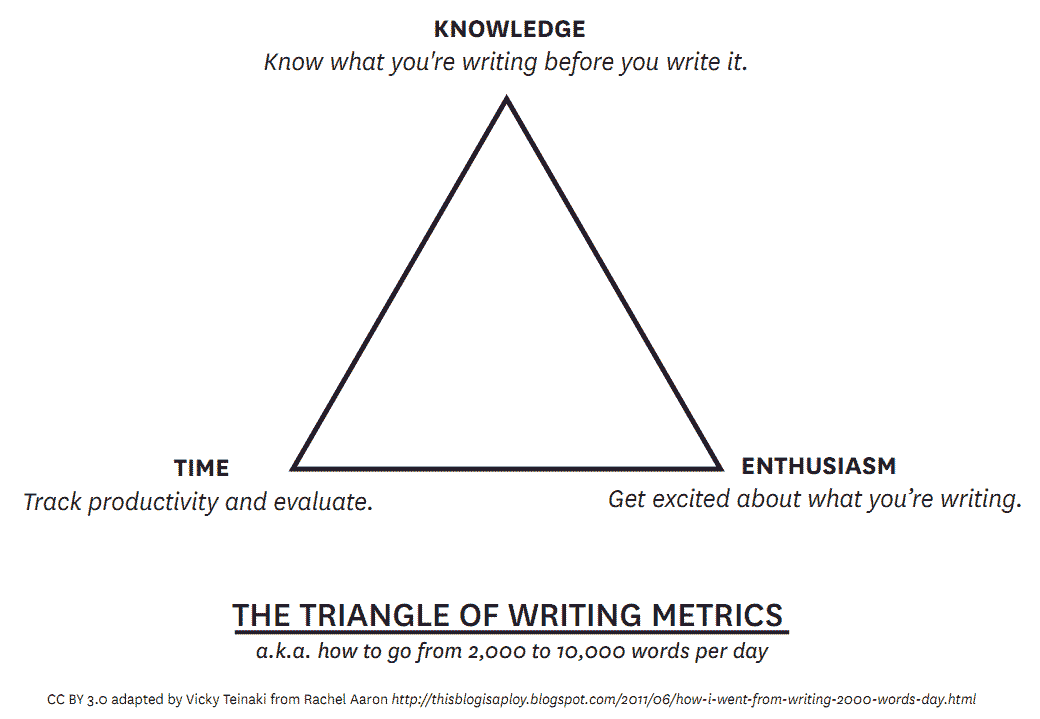
Drastically increasing your words per day is actually pretty easy, all it takes is a shift in perspective and the ability to be honest with yourself (which is the hardest part). Because I’m a giant nerd, I ended up creating a metric, a triangle with three core requirements: Knowledge, Time, and Enthusiasm. Any one of these can noticeably boost your daily output, but all three together can turn you into a word machine. I never start writing these days unless I can hit all three.

The point that I probably need to work on the most is time: I tend to start off the day slow, checking Facebook and blogs and other stuff before getting into the writing, then write for a little while before running off and doing some chore or allowing myself to get distracted again.  Sometimes, I don’t really buckle down until a couple of hours before I should go to bed, and that’s bad.

But really, I think the main obstacle is just thinking that writing is difficult.  If everything comes together in the right way, there really isn’t any reason why 5k or 6k or even 10k should be too difficult–and yet we naturally think that if 2k is hard, anything more should be that much harder.

I’m in a weird state of limbo right now between moving and preparing to go overseas, but I’m going to start a daily writing log so that I can figure out what time of day is most productive.  You can’t wait for life to settle down before you get to work; you have to roll with what you’re given.  Also, I’m going to put a lot more effort into outlining and planning, so that I don’t get hung up by research when I should be writing.  Even discovery writers need a little bit of time to ponder things before putting words to the page.

Also, after considerable thought and effort, I’ve decided to put Star Wanderers on the back burner again.  I finished the novelette last week and submitted it to Writers of the Future; I think it’s quite good, and stands a good chance of finding a home in one of the short markets.  But the full length novel, for various reasons, just isn’t coming to me.  I don’t know if it’s because I lack the life experience to write it, or because I’m too close to it to see what’s broken, but regardless of the reason, I need the break.

I’m not sure whether to do Edenfall or Stars of Blood and Glory next, but I’m leaning towards Stars of Blood and Glory.  This is a novel set in the Gaia Nova universe, with characters from Desert Stars, Bringing Stella Home, and Heart of the Nebula.  I’ve been itching to write it since this summer, but never got around to it because other projects got in the way.  Well, hopefully now that will change.

I know from emails and other correspondence that some of you are really looking forward to Edenfall, but don’t worry, I’ll get around to it soon.  In order to do it justice, I feel I need to reread Genesis Earth and immerse myself in some Carl Sagan, but right now I’m still running on a sci fi adventure trip.  If I can implement some of these metrics and push my daily word count upwards of 10k, it shouldn’t be long before Edenfall gets my attention again.  My goal is to finish it before the end of the year, so there’s a very good chance it’ll be published sometime in late 2012.

As for Star Wanderers, I’ll shop the novelette around after I hear back from Writers of the Future.  I think it has a good chance at winning the quarter, but of course I can’t count on it.  At this point in my career, I should probably be playing both the traditional markets as well as the indie field.

That’s just about it.  Now, if you’ll excuse me, I need to write…

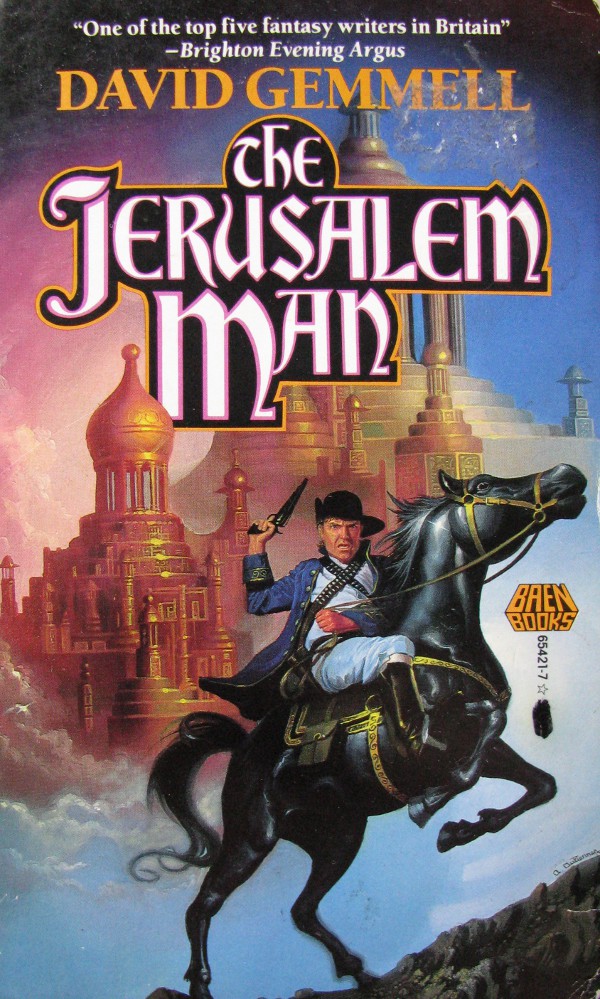
The Jerusalem Man by David Gemmell

The old world is dead, destroyed by nuclear fire.  The old ways are long forgotten–except by one man in search of the Holy City.  He wanders the Earth with two guns and a Bible, leaving a trail of death and ancient prophecy in his wake.  Brigands fear him, honest men pity him, and the Hellborn hunt him.  He is John Shannow–the Jerusalem man.

This is some vintage David Gemmell.  In fact, I think this particular edition has been reprinted as Wolf in Shadow, and can no longer be found except in used bookstores and book trading sites.  Regardless, the book is awesome, right on par with Gemmell’s other work.

David Gemmell has the uncanny ability to suck you in almost as soon as you open the book, making you emotionally invested in the characters and conflicts to the point where you can’t stop thinking about it.  My favorite part of this book was in the first few chapters, when John Shannow found a frontier woman and briefly settled down.  It only lasted a handful of pages, but it was so powerful and moving that I felt compelled to read almost nonstop until I’d finished the book.

The later half gets a little outlandish, with magic stones, the lost city of Atlantis, and a Satanic cult bent on world domination.  It was a fun adventure, but not as compelling for me as the personal story of John Shannow.  In fact, it seems as if Gemmell unconsciously fell back on all the old tropes of the Drenai series, turning his post-apocalyptic western into a sword and sorcery romp, like Waylander with guns.  It wasn’t bad, but at times it did feel a little over the top.

This might have to do with my own personal tastes, however.  I tend to enjoy stories that have more to do with the personal lives and intimate struggles of the characters than grand quests to save the world.  I don’t know if it’s always been like that, or if it’s just something that’s changed as I’ve gotten older.

Regardless, The Jerusalem Man was a great book, and I thoroughly enjoyed it.  If you’re a fan of fantasy-western mashups, or post-apocalyptic fantasy in general, then this is a must-read.  And even if that’s not your usual fare, if you’re drawn to loner heroes who don’t pull any punches, you’ll almost certainly love this book.

On the eve of publication

First, some housekeeping: I recently did an interview over on Slava Heretz’s blog, which you can find here.  I talk a little bit about Desert Stars, as well as how traveling has influenced my writing and how I overcome writer’s block.

In other news, I got smacked upside the head with the flu yesterday and slept in today until 1pm.  I feel marginally better, but I’ll probably do the same tonight.  Productivity: shot in the face.

However, I did manage to run through the copy edits for Desert Stars and format it for publication.  Finished the author’s note today, so as soon as I get the cover art, it’s good to go.

For the cover art, I’ve commissioned Hideyoshi again, the same artist who did the cover for Genesis Earth.  He sent me the initial sketch the other day, and it looks good!  It comes from a scene toward the beginning, when Jalil and Mira share an intimate moment while overlooking the planetary domes on the edge of the desert:

That night, Mira couldn’t sleep.  The wind roared past the window in her room, making an eerie whistling noise as it shook the windowpanes.  That wasn’t all, though.  Perhaps it was the woody, foreign smell of the room, or the perfect straightness of the walls, or the uncomfortable softness of the bed.  Whatever it was, she tossed and turned for what felt like hours, trying to find some firmness that would let her sleep.  Eventually, she gave up and lay on her back, staring at the ceiling.

The stars, she thought to herself.  If only I could see them, maybe I could forget how far I am from home.

She quietly rose from the bed and threw her cloak over her shift.  The sound of the wind made her shiver, and she stepped carefully in the darkness, groping her way through the room until she came to the door.  Once out, the stairwell was only a short distance down the hall.  The night air was cold, the breeze stiff.  The familiar stars and satellites stared down at her from the sky, though with all the light from the streetlamps, they were noticeably muted.

Wrapping her arms around herself for warmth, she made her way to the edge and stared out across the valley at the glass mountain—the world in a bottle.  White and yellow lights shone through the glass, too fuzzy to make out with any clarity.  It was a strange sight, and Mira stared at it for some time.

“You couldn’t sleep either?”

The sound of Jalil’s voice gave her a start.  She turned quickly and saw him sitting on an old, weathered couch facing the valley.  The upholstery was torn, and stuffing was falling out in places.

“Oh,” she said softly. “I—I didn’t see you.”

“That’s all right; I could use some company.  Here, have a seat.”

He scooted over and made some room for her.  When she sat down, the couch gave way underneath her until she was practically sitting on the ground.  The wind picked up, and Mira shivered.

“Are you all right?” Jalil asked. “You look cold—here, take this blanket.”

He leaned forward and pulled off the blanket that he’d brought up from his bed.

“That’s okay,” she said. “You don’t have to—”

“No, here,” he said. “You need it more than I do.”

Mira tried to protest, but Jalil draped the blanket over her shoulders without another word.  She had to admit, the added warmth felt surprisingly good against the chill night air.

Man, I’m so looking forward to getting this book out!  It’s been a long time in coming.   I started the first draft back in 2008, but some elements of it have been bouncing around my head since 2005.  More on that in the author’s note.

In any case, we’re definitely on schedule to get Desert Stars out before the end of the year, probably before Christmas.  So keep an eye out for it!

Trope Tuesday: Space pirates with Kindal Debenham

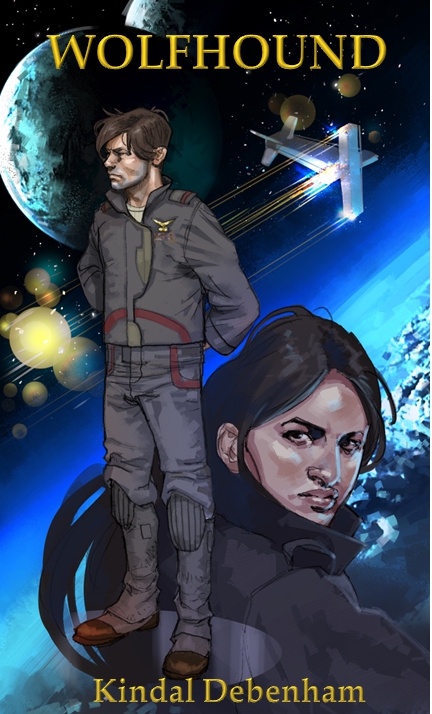
For today’s Trope Tuesday post, I thought it would be fun to bring on my friend Kindal Debenham to speak about one of the tropes in his new book, Wolfhound.

Kindal and I were in the same writing group in college, and attended Brandon Sanderson’s English 318 class together.  I just picked up a copy of his book, and it’s pretty good–definitely the kind of science fiction that I love.  You can currently find Wolfhound on Amazon, as well as Kindal’s self-publishing site.

So anyhow, here’s Kindal’s discussion of space pirates in Wolfhound.

==============================

Space pirates are kind of a staple in science fiction. We’ve seen them in all sorts of different forms since the genre came into being. As the trope states, though, there are basically two main classes. The first class is basically a bunch of violent criminals on a spaceship, kind of mirroring the behavior of modern day pirates in Somalia or Southeast Asia. The second are a corny recycled in space variant of the eighteenth century Caribbean pirate with robotic peg legs and a space parrot. Obviously one is a bit more realistic than the other. 🙂

The version I went for leans a lot more heavily on the first class of space pirates rather than the second. I wanted a smaller scale conflict in order to introduce my main character, and pirates seemed to be a good opponent to use for that purpose. Since the ship that Jacob Hull is on was partially based on the USS Constitution, I decided that I could use some of the pirates that ship fought during its history: the Barbary pirates.

These pirates weren’t your clichéd corsairs with parrots and a desire for plunder. The Barbary pirates were a collection of raiders that operated out of northern Africa. Their motivation was to support their nations by taking ships and capturing crews, which they then added to their fleet and put to work as slaves. In addition to raiding ships, the Barbary pirates also went on slave raids throughout southern Europe. They would accept tribute to ignore the ships of certain countries (think ‘protection money’ for a mob equivalent). The US had to pay about a fifth of the early national budget in tribute to these pirates until the politicians decided that guns were cheaper to buy—which led directly to the creation of the USS Constitution.

Building off of those ideas, I created the Telosian pirates. Vicious, more interested in valuable ransom for prisoners and well armed ships than simple cargo, and willing to do just about anything to satisfy their greed. With an utter ruthlessness only matched by their subtle plots, they made quite a good enemy for Jacob Hull and the rest of Wolfhound’s crew, and they were a much more interesting enemy to fight than a stereotypical Pirate-with-an-Eyepatch would have been. In my opinion at least, though I’m a little biased.

So those are the bad guys of Wolfhound—at least, they’re the majority of the bad guys—and believe me, they live up to their reputation as nasty pieces of work. Hope you guys enojoyed the background, and I hope I didn’t get too history nerd on you guys. See you around!

Why I won’t be signing up for KDP Select

In the last couple of weeks, there’s been a lot of discussion about Amazon’s new Lending Library program.  Just a few days ago, Amazon opened it up to indie writers with the KDP Select program.  By signing up, writers gain access to Amazon Prime members (US only), where readers can borrow the book for free and Amazon still reimburses the writer.

The catch?  Two, actually: writers agree to make their books exclusive to Amazon for 90 days, and payment for all KDP Select authors comes out of a monthly “fixed pot” of $500,000, where every writer gets a cut according to what percentage of the Lending Library downloads were for their books.

Reactions from the indie community have been mixed.  Within only a few hours, several thousand enthusiastic writers had signed up (the current number of participants is ~50k), but many others remain cautious and aloof.

The full range of reactions can be seen in the Kindle Boards thread.  Guido Henkel does a good job pointing out how the numbers don’t add up, while David Gaughran offers a compelling analysis that likewise dampers enthusiasm for the program.  On the Smashwords blog, Mark Coker pleads with writers to keep their options open, while at Writer Beware, A.C. Crispin points out some disturbing language in the terms & conditions that essentially amounts to a non-compete clause.

I’m sure that many others will weigh in on KDP Select in the coming days, and I look forward to reading their analysis, but I’ve already decided that I won’t be signing up with the program.  Even if no one else signs up, with 50k writer splitting a $50,000 pot, the average monthly paymentis only going to be $10.  Unless you’re one of the lucky bestsellers, you’ll probably make even less than that.

But the real reason I’m not signing up is because I don’t feel that it serves my readers.  If I put any of my titles through KDP Select, I’d be giving Amazon a 90 day exclusive, which means that my readers would be forced to either buy through Amazon or wait three months to buy my books.  I don’t feel that that’s fair to my readers, especially in territories where Amazon levies a $2 surcharge.

At this point in my career, my goal is to build up a dedicated fan base that looks forward to each new release.  To do that, I want to make my books available in as many places as possible.  Even if I’m not selling all that well right now at Barnes & Noble or the smaller retailers, it’s not worth it to cut those readers off and tell them to go to Amazon or wait.

However, the KDP Select program does foreshadow the next big phase of the ebook revolution, and that is the move to subscription services.  I expect that in the mid- to near-future, we’re going to see a lot of ebook lending models arise, kind of like Netflix for books.  The big question in my mind is how the writers are going to be compensated.

Like David, I have a lot of concerns with KDP Select’s “fixed pot” model.  Besides the lack of any guaranteed or minimum rate of compensation and the general opaqueness of the system, it fundamentally pits writers against each other in a zero-sum game, where one writer’s gain is another one’s loss.  To me, this represents a giant step backward.

When a reader finds something they like, they’re more likely to try out another book just like it.  This is how readers have historically found new writers, and it fosters a sense of community, where writers work together to reach out to new readers and expand the scope of the genre.  The “fixed pot” model disincentives all this and replaces it with a Machiavellian system that, at its worst, works against the natural advantages of the medium and undermines the genre community.

For all these reasons, I won’t be signing up for Amazon’s KDP Select.  The exclusivity hurts writers and readers, the numbers just don’t add up, and the “fixed pot” model represents a fundamental shift in bookselling that I cannot support.