Joe Vasicek is the author of more than twenty science fiction books, including the Star Wanderers and Sons of the Starfarers series. As a young man, he studied Arabic and traveled across the Middle East and the Caucasus. He claims Utah as his home.
Some of you asked for a writing update, so I figure I might as well do a quick post on my current projects and where they are. I’ve also been experimenting with my daily schedule a bit, so it would probably be good to blog about that as well.
Right now, the main project taking up all of my attention is the 3.0 draft of Heart of the Nebula. It’s a direct sequel to Bringing Stella Home, and continues the story from James McCoy’s point of view, five years later. I’m making a lot of changes, toning down the romantic subplot and emphasizing the more interesting social and ethical issues. When I’m through, I think it will be completely different from the first couple of drafts, but in a way that’s truer to the spirit of the first book.
I’ve only been managing about 500 to 1,500 words per day, though, which is abysmally low compared to my usual word count. Part of that is because I’m throwing out entire sections and drafting new ones from scratch, but the more significant part is that I don’t have as much mental space for writing as I did back in the States.
Basically, moving to a foreign country and starting a new career has taken a lot more out of me than I thought it would. I teach 18 lessons per week, some with as many as 30 or 35 kids, across grades 1 through 12. Culturally, everything is completely different too. So far, the shock hasn’t been too bad–I really love it out here in Georgia–but it’s made the writing a little bit more difficult than I’d expected.
I have a lot of free time, though, so that’s not a problem: the problem is clearing my mind and keeping the creative juices fresh. Here’s how I’m going to do it:
Limit internet time. As tempting as it is to turn to the familiarity of the internet, it’s a huge time-suck and doesn’t really do anything for the culture shock. A much better thing for that would be to spend more time reading. From now on, I’m going to limit myself to one internet session per day, no longer than 2 hours (more if there’s something I actually need to do).
Get out more. I get cabin fever very easily, and it’s only gotten worse now that I’m in a foreign culture. Fortunately, there are tons of places to explore, and in my local neighborhood I’m kind of a celebrity (hey look, it’s the American! Let’s chase him and shout ‘hello’!). The prime time for this is the late afternoon, when everyone’s out and things are still open. If I check the internet right after school and get out immediately after, I think that will help me better to focus.
Get up early to write in the morning. I tried this last week, and it was a great way to get focused and build more momentum. Even if I only manage a couple hundred word, it gets me thinking about the story for the rest of the day, which makes it easier to pick up in the afternoon and evening.
So that’s the plan for now. My goal is to finish Heart of the Nebula before the end of May, which is going to require a significant change of pace. It should be pretty straightforward, though, and after this draft it shouldn’t need too many more revisions before it’s ready to publish. If all goes well, I foresee a publishing date sometime in the fall or winter.
Do you have any other ideas for ways to manage creativity in a totally foreign culture? If so, I’d love to hear it–that’s my biggest struggle right now.
I have some interesting news. My first quarter submission to the Writers of the Future contest has been put “on hold,” following the untimely passing of the contest’s coordinating judge, K.D. Wentworth. Here’s the email I received this morning:
Dear Entrant,
I wanted to let you know that we have a delay in the handling of the 1st quarter due to the loss of our coordinating judge, K.D. Wentworth to cancer last week. Please bare with us while we get over this difficult time and organize the continuance of the contest. We do have another judge that is taking over and will make that annoucement soon.
Your story was placed in the hold category while K.D. was reading the hard copy submissions. You will be notified in the next month where you stand.
I’m sure you can understand the delay and thank you for being patient.
Best,
Joni Labaqui- Contest Director
From what I understand, this means that K.D. read my story and didn’t assign it a rejection or honorable mention, but put it in a pile of stories to read leader. It’s possible, of course, that the story could still receive a flat rejection, but it appears that most of the rejections have already gone out, so that’s probably unlikely.
The story I submitted is the first part of a novel which I hope to publish as soon as I hear back from the contest. If it wins or makes published finalist, however, those plans might be put on hold. I’ll let you know more as it happens.
If I do win, I’ll probably end up spending all the prize money just to come back to the States to accept the award. My Georgian co-teachers think that’s hilarious.
Orthodox Easter is April 15th, and in Georgia, most places take off four or five days for vacation. In typical Georgian fashion, we didn’t know for sure how many days we had off until a couple of weeks before the break came up, but fortunately that was time enough to find out where some of the other TLGers in Kutaisi were going and tag along with them.
Our group consisted mostly of TLGers and embassy staff from Tbilisi, friends of my friends in Kutaisi who came out at the same time last year. For 300 GEL (about $185 USD), we got a private marshrutka and tour guide for four days, 3- and 4-star hotels each night, breakfast and dinner, and tickets to some of the more interesting sights between Reza and Trabzon. Multiple entry visas were $20 USD each, and the exchange rate in Turkey was quite favorable.
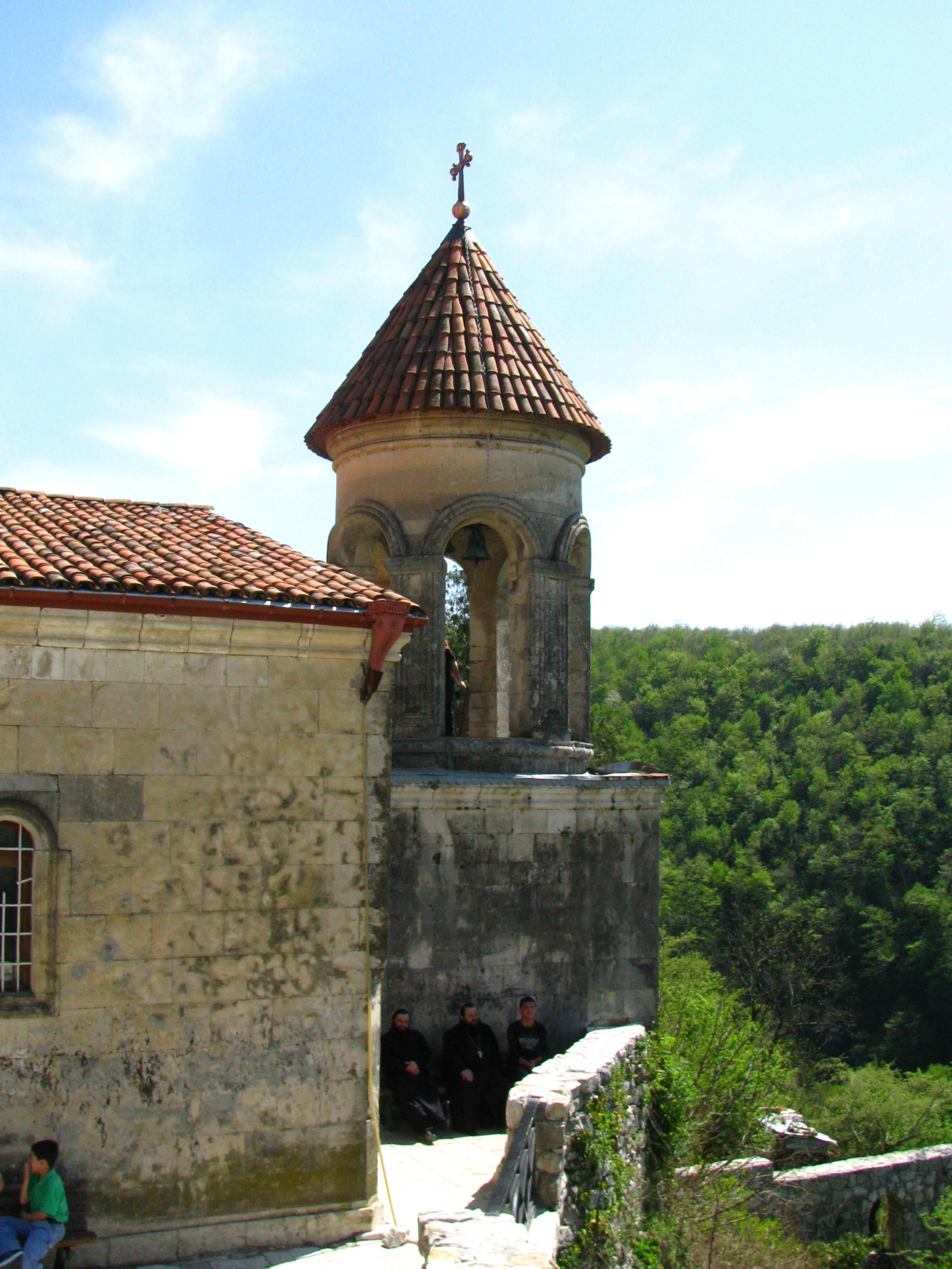
We met up at the McDonalds on Tchavtchavadze Street at noon and went up to see Motsameta Monastery. In spite of the fact that it’s so close to Kutaisi, this was my first time going up there, and I must say I was quite impressed! The monastery is situated on the top of an imposing cliff where the Tsqaltsiteli River makes a sharp bend. The English translation of the river is “red water,” named for the two Christian martyrs who were executed on the site of the monastery by the Muslims shortly after their conquest of the region.
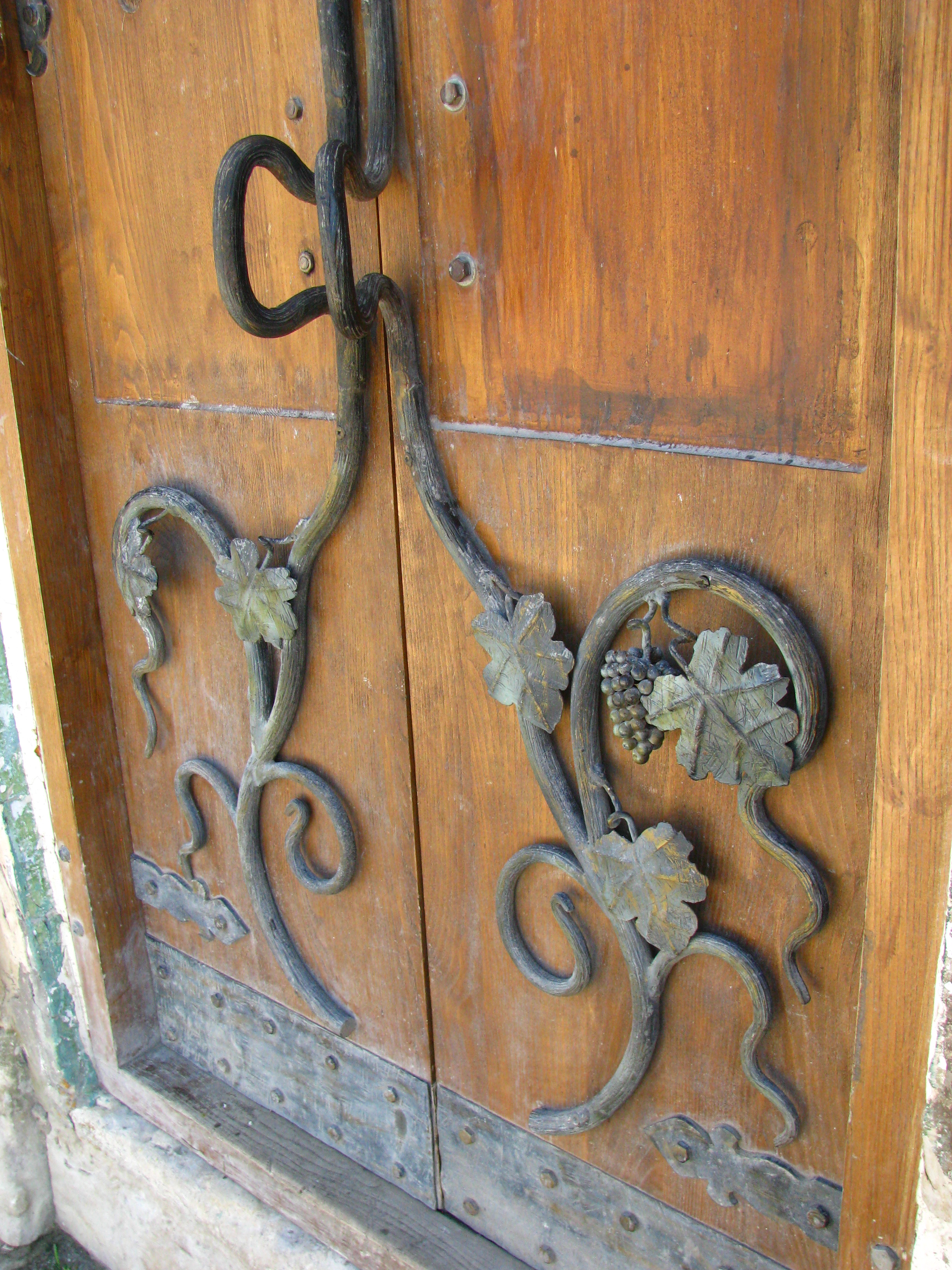
Some priests hanging out by the chapel on Easter Sunday.Detail on the door handles to the monastery chapel. Georgians take their grapes quite seriously.
I spent most of the vacation relaxing, so I didn’t take many spectacular photos. But Motsameta was really fantastic–I’ll have to go back sometime to do it justice. There’s a forest trail that goes between Motsameta and Gelati Monastery, where David the Builder is buried, and I’d like to hike that before I come back to the states.
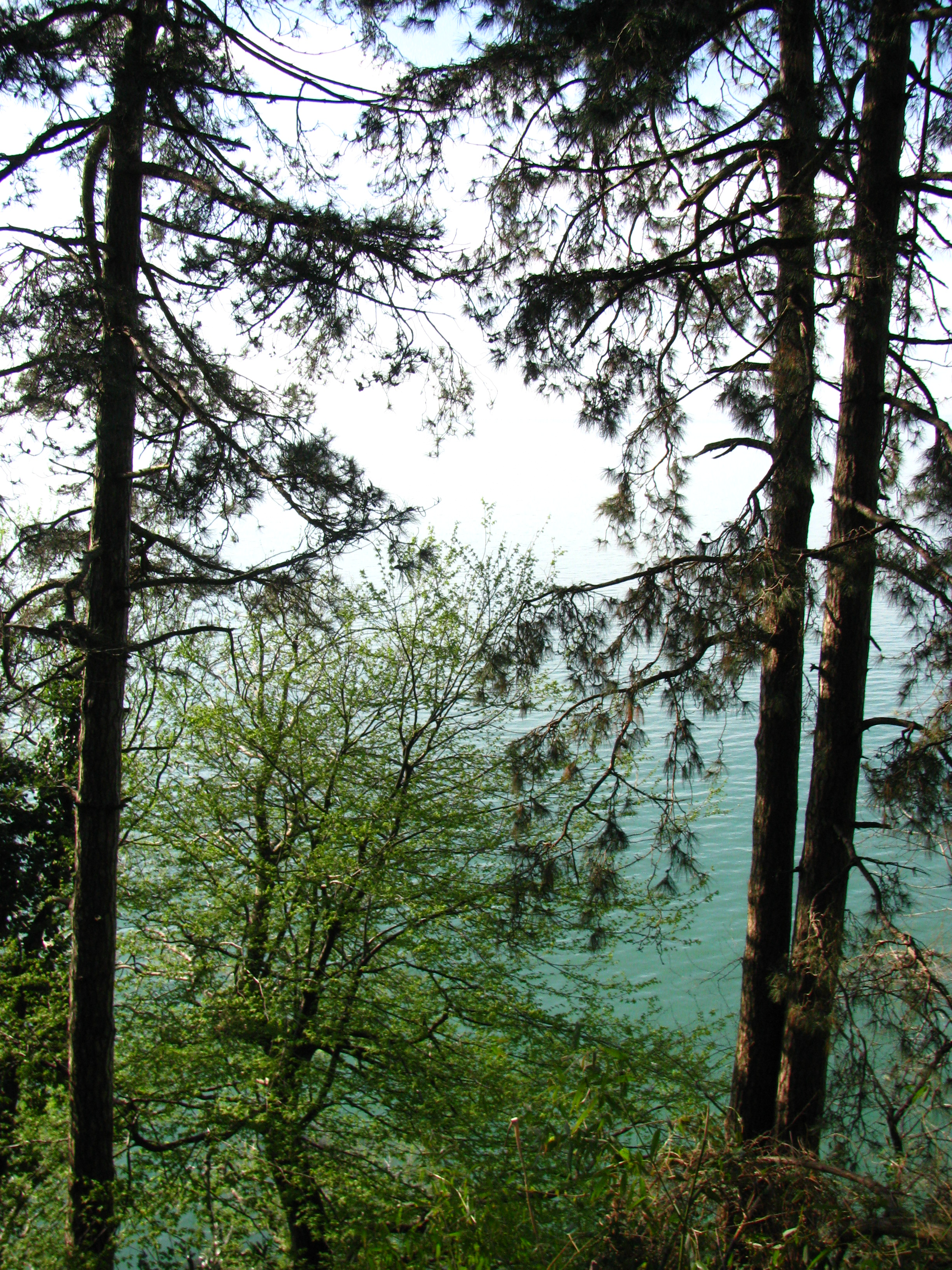
Next, we drove down to Batumi on the Black Sea, where we spent some time wandering the Botanical Gardens. It’s a really nice place, with trees and plants from all over the world right up against the seashore. Very peaceful. It’s pretty big, though–I walked for almost an hour along the main road without getting to the end. And of course, there are many places along the way where you can stop and wander around for a while.
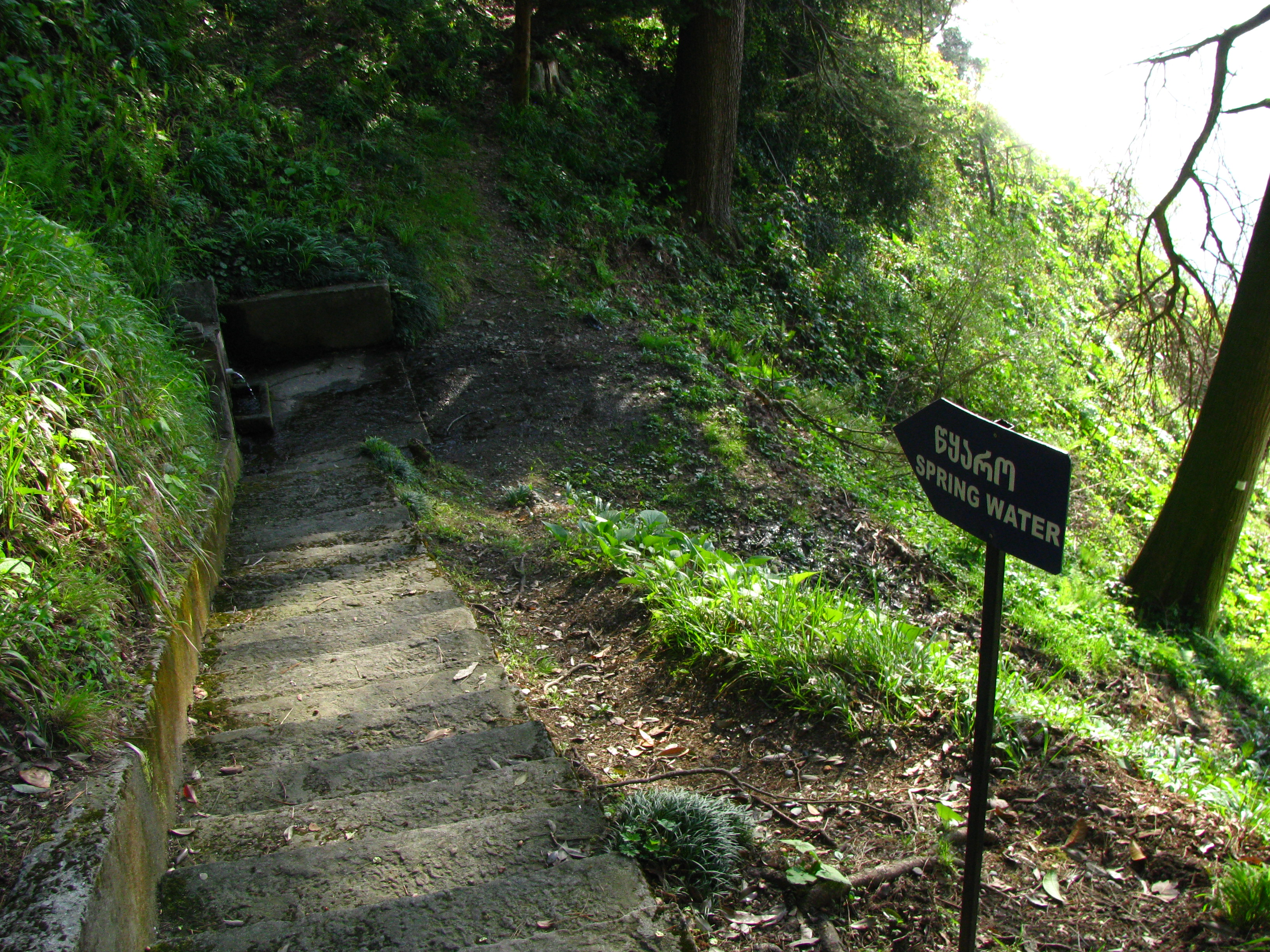
The Black Sea, visible through the trees of the Batumi Botanical Garden.Some red and white rose bushes. There are tons of flowering plants in the gardens, so spring is a really great time to see the place.A small spring in the middle of the Batumi Botanical Gardens. There are springs like this scattered across Georgia.
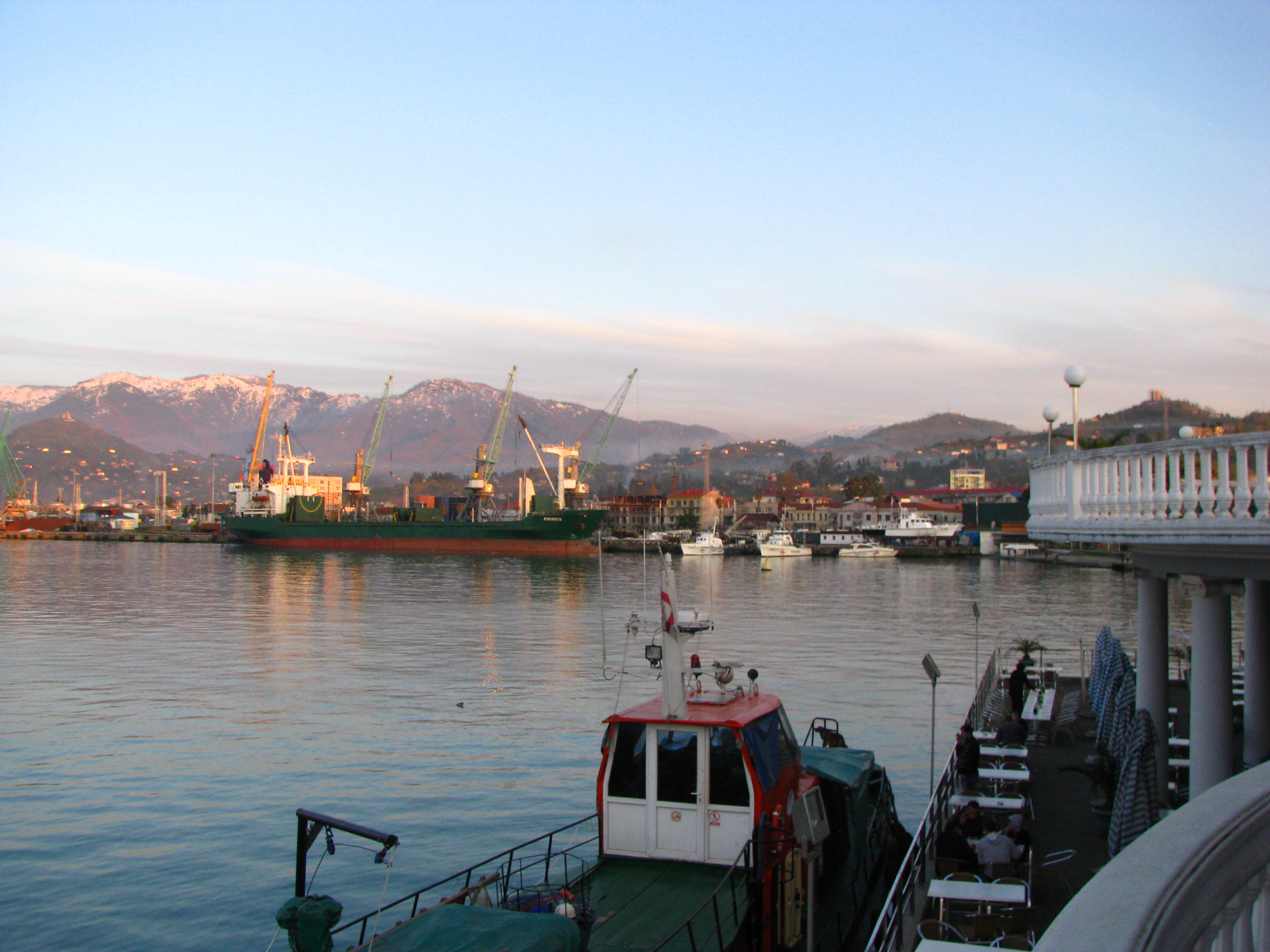
Batumi is an interesting place–not as big a city as Kutaisi, but with more money, hotels, casinos, and resorts. It’s right on the Black Sea, but the snow-capped mountains of the Lesser Caucasus range are right behind it, so you’ve got a big mix of climates and landscapes all within a short drive.
Batumi, Adjara Republic, Georgia.
The other TLGers were impressed to see that the roads are actually paved–apparently, there’s been a lot of construction in the past year or so. It’s not completely finished, but walking around downtown is quite pleasant. We hunted for ice cream and eventually settled on a smoke-filled cafe on some random street corner. Good times.
We spent the next morning crossing the border, a process that was surprisingly disorganized. The system on the Georgian side was pretty straightforward, but on the Turkish side we had to wait on the curb for a long time, with giant eighteen-wheelers driving past us and the sun beating down. It wasn’t too bad, though–definitely not worse than the Allenby crossing.
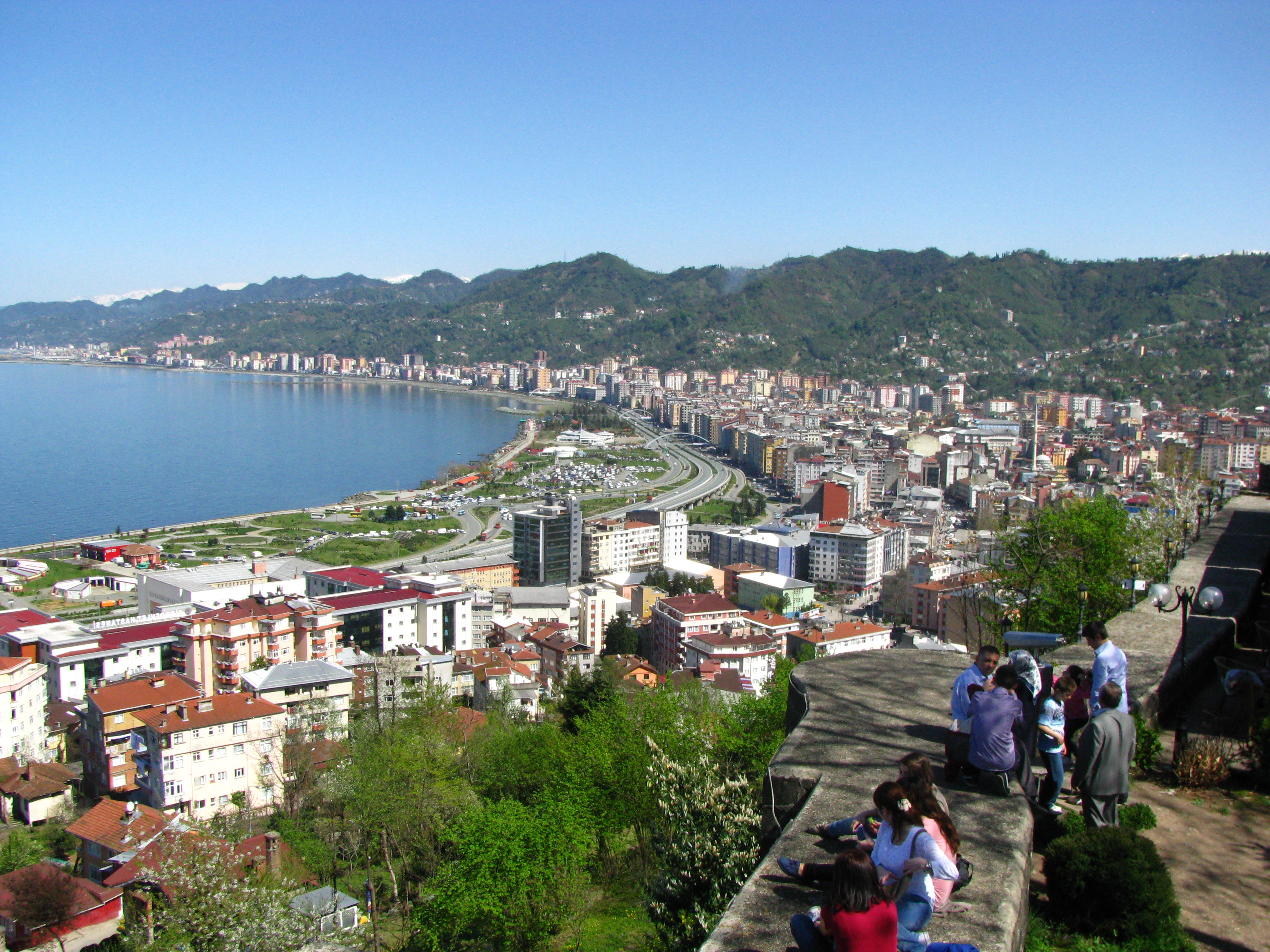
We drove for an hour, stopped in Reza for tea and lunch, then went on along the seashore to Trabzon. In Reza, I stood at the edge of a garden overlooking the city when the call to prayer started up. It brought back a lot of fond memories. 🙂 Turkey is definitely a Muslim country, with mosques everywhere, pencil minarets dotting the cityscape like steeples, and women dressed in colorful hijabs.
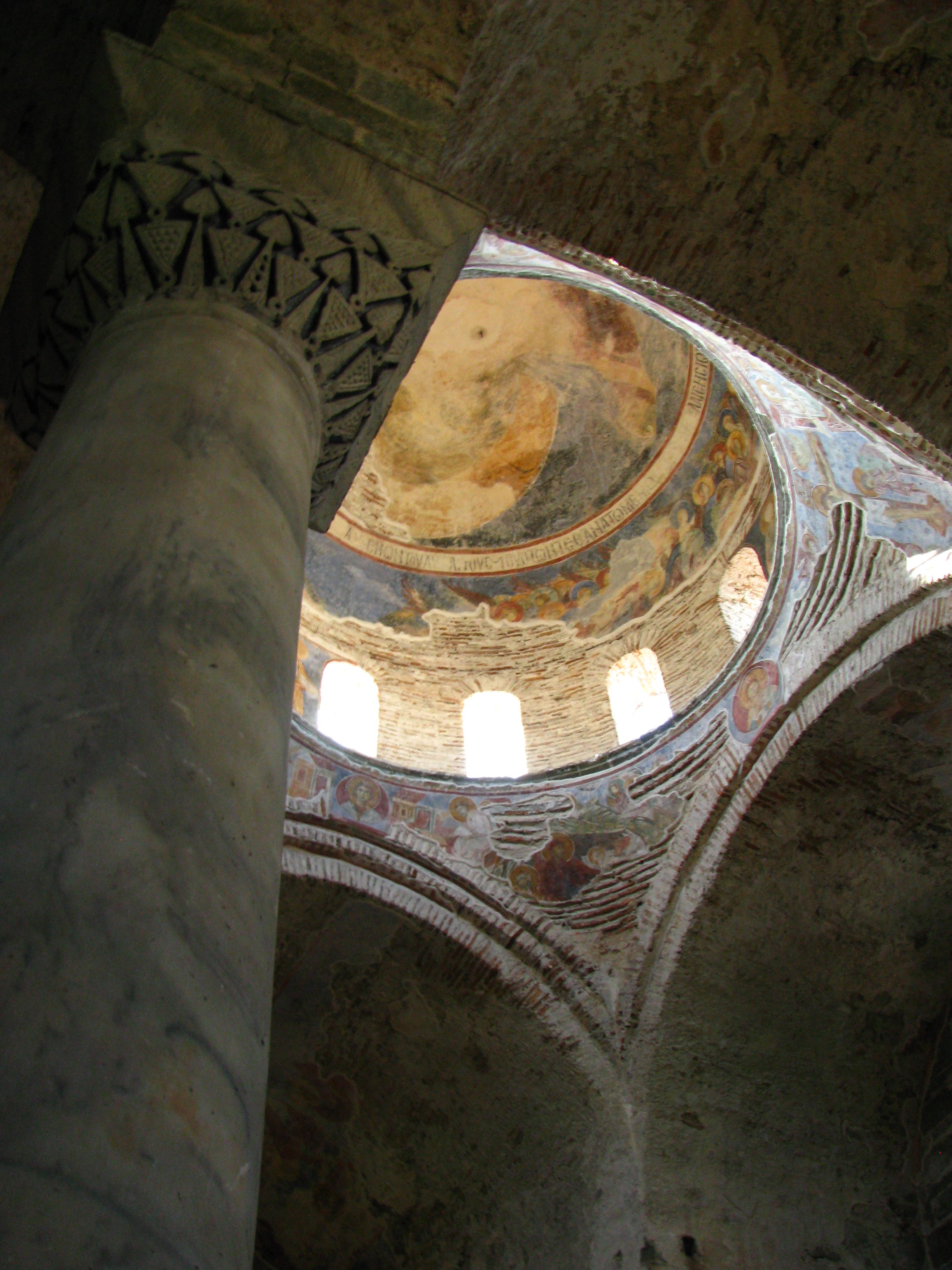
View of Rize from Rize Castle.Interior of the Little Haggia Sophia at Trabzon. It’s a pretty modest sized basilica, now a “museum” which basically means it’s not used for religious services. It needs renovation.
Compared to Kutaisi, Trabzon is a large and well-developed city. The downtown marketplace was packed, but the streets were well-paved, the shops were quite nice, there weren’t any beggars and basic amenities weren’t hard to find. Almost no-one spoke English, which made communication difficult since I don’t speak any Turkish, but it was surprisingly easy to make friends. We stopped for lunch at one place, and after a very difficult time trying to explain that we didn’t want any meat in our sandwiches (most of the girls in our group were vegetarian), the restaurant owner actually let us eat for free!
Some of the other volunteers had asked that we go to an American style mall, so we spent a few hours there before going to the hotel. I must confess, I was bored out of my mind. Nothing but clothes stores and Turkish fast food restaurants–it was identical to an American mall in almost every way. I suppose that that’s why the others wanted to go there–after spending a year in Georgia, they probably craved someplace that feels like home. But I’m not there yet, so that particular excursion was kind of boring.
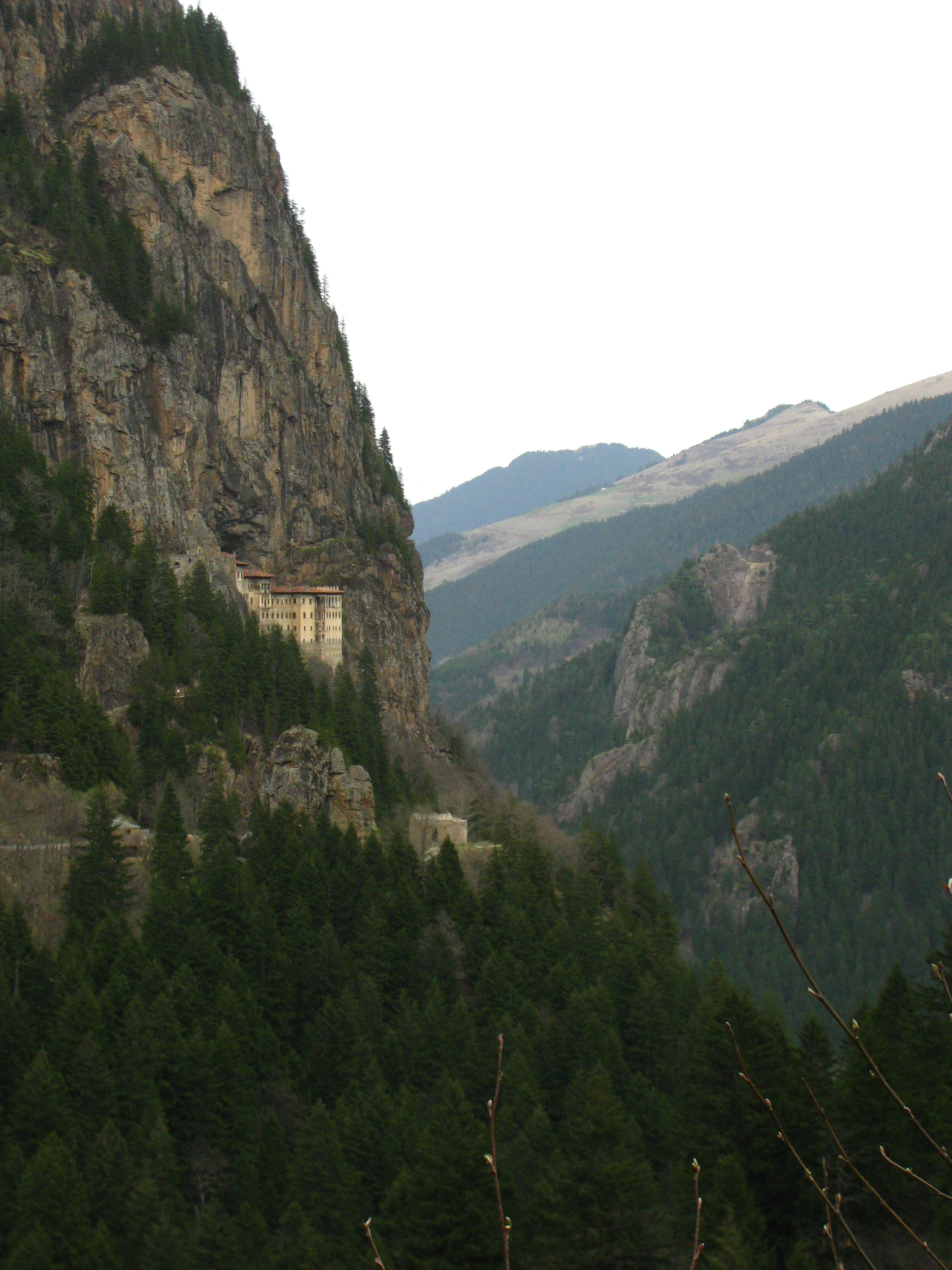
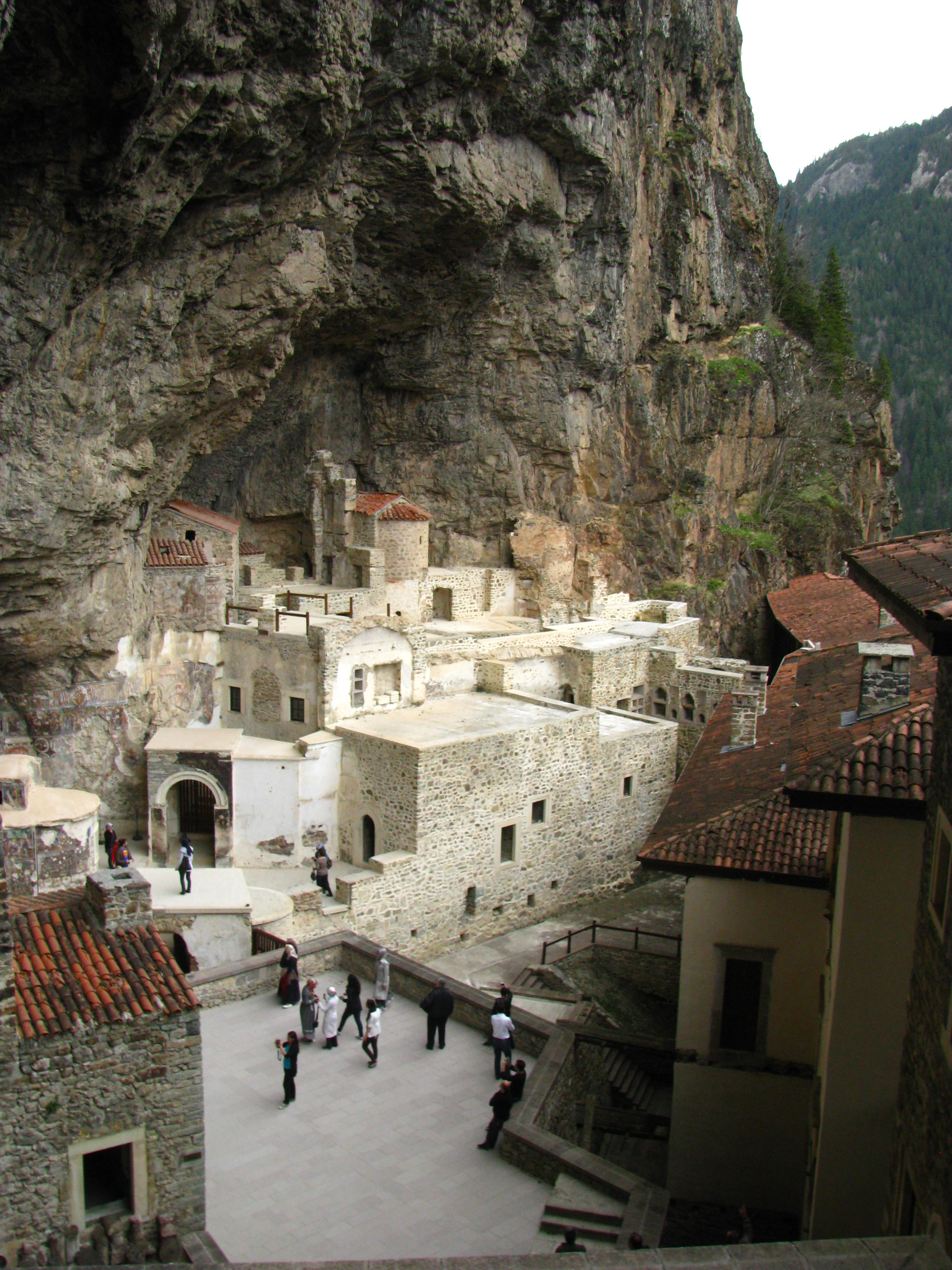
The next day, we went up to Sumela Monastery in the mountains, and from there to Lake Uzungol. The monastery was quite cool, because it’s perched literally on the side of a cliff, almost 500 meters above the valley floor. Unfortunately, the friezes and other artwork was quite damaged, so I didn’t feel compelled to take many pictures, but it was fun to hike up there and see the view. A bunch of Turks laughed at the way I ran up the path, and the fountain at the top had some FREEZING cold mountain runoff. It was a lot of fun.
Sumela Monastery from the top of the canyon. The surrounding countryside is absolutely gorgeous.Inside the monastery complex itself. Many of the buildings are new additions, but there are some original structures.
At the lake, I bought a piece of Turkish silverware for my host mom that ended up being a huge hit. A lot of the shops were really touristy, but it was fun anyway and the landscape was quite beautiful. Reminded me a bit of Colorado. We stayed in a mountain cabin and the bedsheets smelled like cigarettes, but otherwise it was quite comfortable.
Adjaruli khatchapuri. If you eat this every day, you will have a short and happy life.
On the way back, we stopped in Batumi for dinner and had Adjaruli khatchapuri. Khatchapuri is the main Georgian go-to food–it’s basically cheesy bread with a thick, doughy crust. In Adjara, though, they take it a couple of steps further.
Immediately after taking the bread out of the oven, they crack an egg in the center, which gets cooked a little by the heat but otherwise remains raw. They then take a huge slab of butter and plop it right in the center of the yolk, where it melts in and gets everywhere. To eat it, you stir the egg around and work your way inward from the crust, dipping the bread in the molten gooey center. Between the cheese, the egg, the butter, and the bread, you get a pretty heavy meal–delicious, but heavy.
After that, we took to the road again, talking about all sorts of stuff and having a generally good time. Our tour guide was a great guy, and we had a lot of fun racking his brain. The other lady from the company was quite delightful, and talked with me a lot about Racha, growing up in Kutaisi, her experiences living in the Persian Gulf, etc. It was a long ride, but it went by pretty fast, and we pulled into Kutaisi around 9pm.
All in all, a fun, relaxing vacation, and a good chance to get out and see a little more in this part of the world. Turkey was nice, but I have to admit, I felt a bit like I was coming home when we crossed the border back into Georgia. It’s not as clean or developed, but it’s got a feel to it that isn’t quite like anything else. I like it.
Sorry, but no Trope Tuesday post this week. Long story short, more internet problems–I’m blogging right now from the McDonald’s on Tch’avtch’avadze Street. Since my battery’s running out, this is going to have to be a quick post.
I suppose I should ask, though: what tropes do you want me to cover in the future? I’m open to pretty much anything, as long as it’s got a tvtropes page. Together, we can enable our addictions have some productive story research.
In other news, I finished part III of Star Wanderers, and I’m putting that project on hold for a while. Writing a novel in serial parts is proving to be a lot more difficult than writing it straight. Not only do I hit a wall at the 2/3rds mark, but I have difficulty moving on to the next part until the part before it is free of major problems. Because I have to take a break and distance myself before I can really address those problems, I think it will be better to move on to something else.
On the upside, it only takes two or three weeks to knock out each draft, so I’m not too concerned about finishing this project before the end of the year. Part I is already set to go, and Part II just needs some vetting before I feel it’s ready. If you’re one of my first readers and you’re up for a quick novella-sized work, let me know.
That’s about all for now. I also signed up to do a couple of blog interviews, so those should be up in a couple of weeks. And I’ve also got some more posts coming about Georgia and Turkey, so that should be interesting. Stay tuned!
Sorry about missing the Trope Tuesday post yesterday. My internet was sporadic, and I didn’t think it was worth it to keep refreshing every time I wanted to access tvtropes. I’ll make it up next week with a good one.
The rest of the week is going to be pretty busy. We have a make-up class on Saturday and I’m going to Tbilisi on Sunday for church, so things might be a little sporadic on this blog. However, I’m making good progress on Star Wanderers, even if it is a bit slower than I would like. I should finish up Part III this week and Part IV sometime in early May.
I haven’t heard anything from Writers of the Future yet, but judging from the forums, neither have most of the others who submitted this quarter. The official results should come out in May, though, and as soon as they do, I’ll publish the first part of Star Wanderers (provided it doesn’t win).
I’m really excited about this one; it’s one of those stories that came when I least expected it, and practically wrote itself. The first part, which stands completely on its own, is about 17k words, or 60 print pages–basically, a very short novella. It’s a science fiction romance set within the same universe as my other Gaia Nova novels; in the next few days, I’ll post a blurb and the first couple chapters for you guys to check out.
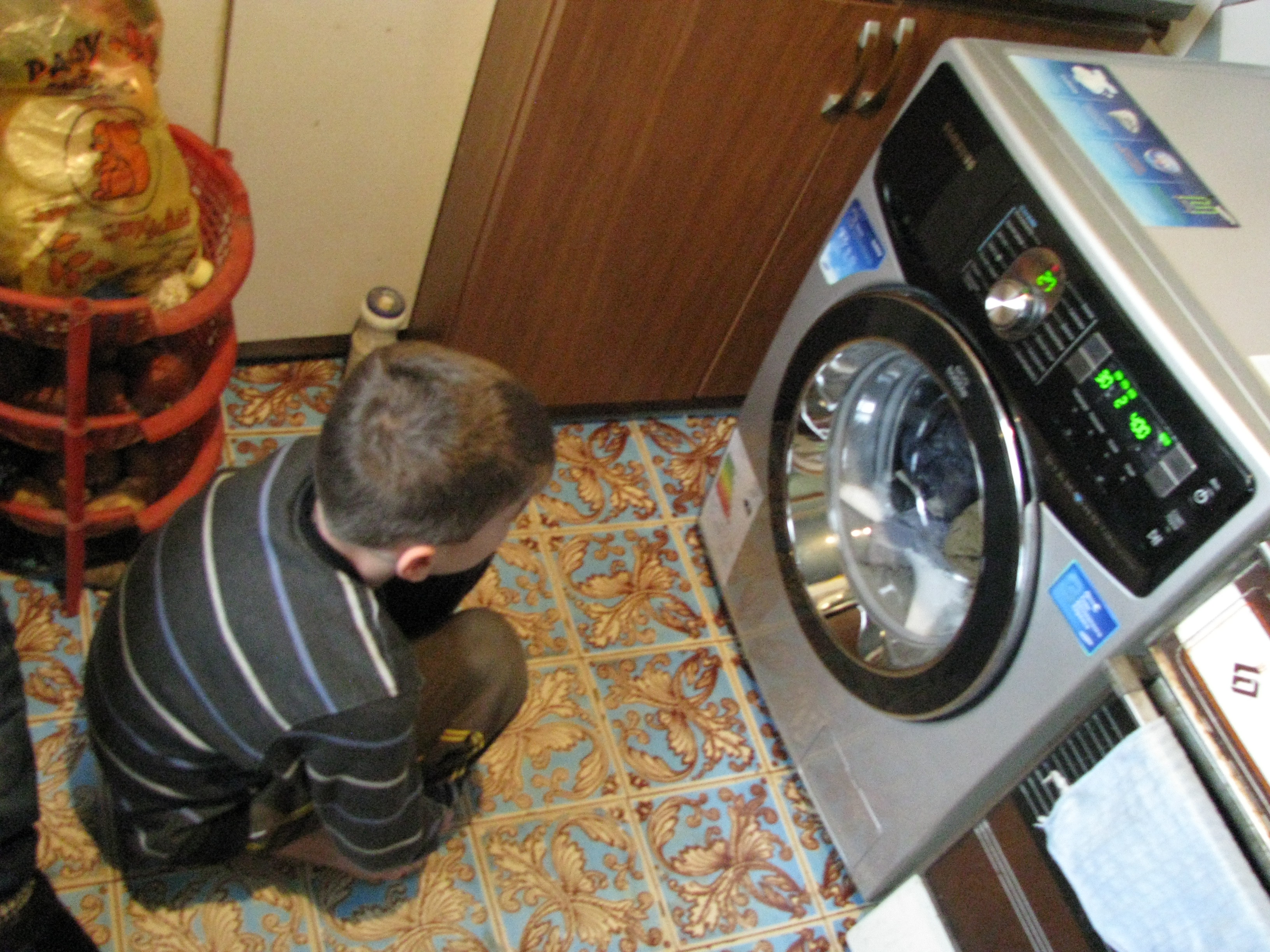
So that’s what’s going on out here. In other news, my Georgian host family just got a washing machine, and the excitement it generated reminded me of that scene in Fiddler on the Roof when the village gets its first sewing machine. Here’s the youngest son watching it go round and round:
Between this, internet TV, and the hot water heater they installed a few months ago, they seem to be moving steadily up in the world. Hopefully I’m not putting too much of a burden on them. I buy fruit from time to time and got the host mom a piece of silverware from Turkey. From what I could tell, she was really happy with it.
Anyhow, it’s getting late and I’d better go. ღამე მშვიდობის!
So I just got back from Easter vacation in Turkey, at Trabzon and Lake Uzungöl. It was pretty awesome–I’ll definitely be blogging about it in the next couple of days! First, though, I wanted to share something interesting that happened on the way back.
While I was hanging out in Batumi with some other TLG volunteers eating Adjarian khatchapuri (an experience in itself), we got to talking about what we’re going to do with our lives after we get back to the States. Most of them didn’t really want to think about it, which surprised me, so I asked why.
They told me they didn’t want to have to figure out the rest of their lives–that coming out to Georgia to teach English was a way of putting off those major life decisions. Fair enough. They then asked me if I’ve figured it out. I said yes: that I want to be a full-time writer, and that I’m out here to see the world and get some cultural experience as I try to make that dream a reality.
One of the girls then asked what my backup was if that didn’t work out. To be honest, I had no idea what to say. My plan at this point is to just keep teaching and traveling until the dream becomes a reality. Am I confident that it will? Eventually, yeah–as long as I keep writing, which I certainly will.
I thought about it a bit on the way back, and realized that my mindset has shifted tremendously in the past few years. When I was back in college, and to some extent for the first year after I graduated, I used to worry a lot about my “backup plan.” It was a way of addressing the fear of failure, of creating an illusion of safety by having a “fallback.”
I’m sure there are careers where that’s a good idea. Generally, those are careers with definite paths, where if you don’t pass a certain number of checkpoints, you’re basically screwed. With writing, though, there is no set path that everybody follows–especially now with ebooks and epublishing. Because of this, it’s impossible to really fail–either you keep on trying until you make it, or for one reason or another you give up.
Ever since I graduated in 2010, I’ve been structuring my life in such a way that I can continue to pursue my writing. Every job I’ve taken has just been a stepping stone, a bridge to allow me to keep pursuing this dream. Have I made it yet? No, but I haven’t given up yet either, so I haven’t had to fall back on my backup–whatever that would mean at this point.
From the outside, it probably looks like I’m being hopelessly responsible–that, or willfully oblivious to a hundred things I should be worried sick about. However, I’m actually quite confident that I’m on the right path and things will work out–and that surprises me. It’s like that moment when you realize you’re actually swimming, not just kicking and thrashing about the pool.
Worst case scenario, I fall head over heels in love with an awesome, wonderful girl, and after a few heady months filled with blissful romance, I wake up one morning and realize that I’m married. If that happens, I might have to put my writing on hold for a while until I get things sorted out so that I can support both myself and my wife–but then again, with her help, I might be able to do twice as much, or even more. Perhaps that will help my writing career even more than trying to go it alone.
So really, there is no back up plan or worst case scenario–just the future. And as Georgians are so fond of saying, “no one can know what will happen in future.”
მოტაცება (pronounced mot’atseba) is the Georgian word for bride kidnapping, as opposed to regular kidnapping, which takes a different word. It’s an ancient practice in the Caucasus region that doesn’t happen as much as it used to, but still happens, especially in the rural areas. Today, most Georgians condemn it, but there’s still a whole slew of lingering cultural subtexts that can be very difficult for a Westerner (like me) to understand and navigate.
The video clip at the top is from a Georgian comedy program (named, aptly enough, “Comedy შაუ”), and does a pretty good job illustrating how mot’atseba works. Of course, the genders have been reversed–50% of Georgian humor is cross-dressing, and the other 50% is cross-dressing with slapstick–but everything else is pretty accurate. Like I said in a previous post, it’s like a weird game of capture-the-flag involving sex and arranged marriage, where the flag is the girl.
This is how it works: boy meets girl. Boy decides to marry girl. Boy gets his friends together and kidnaps the girl (with or without her consent), holding her captive overnight. The next morning, boy contacts girl’s parents to ask for girl’s hand in marriage.
Since the girl has been held overnight, the implication is that she’s been raped (which may or may not be true). Therefore, to avoid a scandal which could tarnish the family’s reputation, the parents will usually marry their daughter off as quickly as possible. However, if the girl can escape, or the girl’s brothers can rescue her before nightfall, the crisis can be averted.
I first heard about mot’atseba from this post on Georgia On My Mind, back when I was looking into TLG about a year ago. It disturbed me a little, but not enough to dissuade me from coming to Georgia. A couple of weeks ago, however, I learned that that was how my host parents got married.
Here’s the thing, though: they both seem to remember it kind of fondly. In fact, when my host mom saw the clip from Comedy შაუ, she couldn’t stop laughing. Her mom lives with them now, and from time to time they go out to visit his family in the village, so it looks like everyone’s on pretty good terms.
So what the heck happened?
Here’s the story, as best as I can piece it together. They were introduced by his sister, who was her coworker at the hospital. After a month, he got together with some friends and took her without violence to his family’s house out in the village. She was surprised and upset at first, of course, but her parents gave their consent, and so they were married the next day by a magistrate. Now, they’ve got four kids–a huge family, by Georgian standards–and seem to be pretty happy together.
As a Westerner, it blows my mind that a strong, healthy family can come out of something as violent as an act of kidnapping. Indeed, I have yet to be convinced that that’s a normal outcome. However, after asking around and doing some research, I’ve come to realize that mot’atseba isn’t a black and white issue: there are all sorts of cultural subtexts that make the issue much more complicated.
The key to understanding how all this works is the following proverb, which underscores the entire Georgian concept of gender roles and the differences between men and women:
If a woman says no, she means maybe. If she says maybe, she means yes. If she says yes, she is not a woman.
From this, two things follow:
1: Women are fickle, therefore men should be assertive.
As a man, I see this all the time. All three of my co-teachers are women, and all of them constantly defer to me, even though they have far more professional experience than I do. When I had some pretty serious differences over teaching methodologies with one of them, she suggested that I take over the next lesson and teach it without her interference, so that she could get a better idea that way. This isn’t the case with the female volunteers–many of them complain about how hard it is to get anyone to take their suggestions seriously.
2: A woman can never say no.
If “no” is constantly interpreted as “maybe,” then it follows that no one (or at least, no man) is going to believe that a woman is even capable of saying “no.” This turns the whole concept of rape into a nebulous gray area, unlike the United States, where women have a lot more power at least in terms of the law.
This is not to say that in Georgian culture, women are doormats or property (even though that’s what some TLGers claim). Women have a number of support networks, such as family, friends, and other women, and can use these networks to ward off unwanted attention. When I asked my host sister if she’s worried that a mot’atseba would ever happen to her, she said no, because if it did, her three brothers would kick some serious ass.
On top of all this, Georgians have no real concept of casual dating. If a girl and a guy are seeing each other, they’re either married or about to be married. This shows up in the way they use Facebook and other social networks: instead of listing themselves as “in a relationship,” the girl will give her password to the guy she’s dating. And they don’t just do it because the guy demands it–when my host sister was seeing someone, he asked her if she wanted to give her password to him, as if that was the natural next-step in their relationship. From the way she told me, she seemed to be worried that she’d made a mistake by telling him no. Of course, I told her she’d made the right decision!
Combine all of these together, and you should start to get a clearer picture of some of the subtext surrounding mot’atseba.
When I asked my first co-teacher about it, she said it was only an ancient practice and absolutely didn’t happen anymore. When I brought up rape and asked if that was also a part of it, she was horrified and didn’t want to talk about it. However, when I asked if it’s possible for a happy marriage to come of it, she kind of smiled a little and said that if the woman likes it, then why not?
My second co-teacher was much more straight with me. Yes, it happens occasionally, though it was a lot more “fashionable” about twenty or thirty years ago. No, it’s not romantic. Yes, a lot of the marriages aren’t very happy, which is why so many of them end in divorce. She told me that one of her friends from college was married through mot’atseba, and that she knows of at least one case in our school where an 8th grader was kidnapped and married. However, under President Sakashvili, mot’atseba is now a serious crime, so it’s not as common as it used to be.
My third co-teacher’s answer was a lot sketchier. The first time I asked about it was in passing, as she walked in on the conversation I was having with my first co-teacher. When I asked her about rape, she laughed and said “well yes, of course it happens!” as if that wasn’t a big deal. Later, however, she sat me down and said quite seriously that mot’atseba is a horrible thing, that it’s a criminal act, that it doesn’t happen anymore, etc etc.
However–and this was perhaps the most illuminating thing–she said that sometimes, when a guy and a girl are in love, but she’s being wishy-washy and non-committal, he’ll sweep her off her feet and carry her off. In fact, that was what happened with her: her boyfriend wanted to marry her, but she kept putting it off, so one day he tricked her into getting in the car and told her “all right, enough is enough–we’re getting married this weekend.” And they did.
When I asked her if that was mot’atseba, she said no, but I think the subtext was similar. A real man knows how to assert himself and take what he wants. Since a real woman will never say yes, sometimes you just have to man up and tell her how it’s going to be. And don’t worry if she says no at first–she only says that because she doesn’t really know what she wants yet. She’ll come around eventually.
It sounds pretty horrible, but that seems to be how it works. And really, there are gradations of it. Most Georgians will agree that it’s wrong for a guy to kidnap a girl he doesn’t know so that he can rape her and force her to marry him. But if the guy and the girl know each other, and are already pretty serious (ie seeing each other at all), and he wants to speed things up–or, alternately, if she knows her parents would never say yes otherwise–that’s when everyone speaks of it with a wink and a nod.
And really, can we say that our culture’s problems are any less abhorrent? What about teenage pregnancy? Secret abortions? Date rape? At least with mot’atseba, the guy is trying to marry the girl, not just sleep with her and walk away. If it’s just sex that the guy is after, there are a lot more easier ways to get it than risking a prison sentence.
So is it “wrong”? I don’t know if it’s possible to say yes or no, except on a case by case basis. My host sister knows a girl who was kidnapped at age 12 and had a baby the year after. I’m pretty sure that’s wrong. But when I told her what would happen to that guy in the states–that he would go on the registered sex offender list and spend the rest of his life ostracized and unable to find work–she thought that that was wrong too. And as for my host parents, well, it seemed to work out well for them.
I don’t know. But either way, it’s definitely an interesting anthropological experience.
That’s okay, though: through the power of love, the two of them will somehow find a way to understand each other. Whether through touch, music, math, or a montage filled with magical sparkles, they come to discover that love itself is a language, one which they know fluently.
To be honest, I was a little disappointed in the page for this trope. It’s pretty dang sparse, though it does make a couple of good points. The main one is that this type of story almost always has the male character speak the language of the audience, with the female character being the foreign or exotic one. That might be because the seductress is such a powerful character archetype…but then again, it might just be because everything sounds sexier in French.
My favorite example of this trope is in the film Jeremiah Johnson, where the hero unwittingly stumbles into a marriage with–you guessed it–the chief’s daughter. What starts out as an awkward pairing, to say the least, turns into a wonderfully endearing love story, as Jeremiah builds a cabin for the two of them (and the mute boy he picked up earlier…long story) and together they become a family.
Because this is a major driving element in Star Wanderers, the novel I’m currently writing, I’m especially conscious of this trope right now. However, I can’t think of many good examples where this trope came into play. Do you have any ideas that you can share? Favorite stories where love overcame a major language barrier? If so, I would love to hear about it. Because in spite of my tongue-in-cheek comment about the sparkles, I think this trope has some really awesome potential.
Actually, this last quarter wasn’t quite so bad as the title might make it seem. For the first part, I was on roll, writing almost 25k new words a week. But then I finished that project, started a new career, moved to the other side of the world…yeah, my writing took a hit. Or at least, that’s how it feels.
In January, I was working on Stars of Blood and Glory, and was really on a roll. The application process for TLG was still pending, but I pretty much knew I was getting in, and since I was staying with my parents until it went through, I didn’t have to worry much about money issues. With lots of writing time, I finished SBG in about 6 weeks and published Journey to Jordan. Life was good.
After Stars of Blood and Glory, I went back to Star Wanderers, finishing up Part II and starting Part III. However, something felt wrong, and I didn’t really know what it was. With my TLG departure date imminent, it was really hard to focus, and I wasn’t in much of a position to move on to anything else. That’s when the angst began.
I flew out to Georgia on February 15th, did a week of training in Tbilisi, and then was whisked about 220 kilometers away to Kutaisi. As a consequence, I didn’t get any real writing done for almost a month. However, I didn’t have any major challenges navigating the new culture, and was soon settled pretty comfortably.
The trouble was, nothing was working. Star Wanderers was broken, and I was too close to the project to fix it. But after putting it on the back burner, I didn’t know what to do. For most of March, I switched from one project to another. Nothing seemed to stick, though, and by the end, I was getting pretty antsy.
What if I’d made a mistake to come to Georgia? What if that was the reason nothing was working? It sounds silly now, but that was what was going through my mind. I still worry about it a little, but I think it has to do more with my creative process than anything here in Georgia.
I have a very non-linear way of writing first drafts. After starting the revision for Heart of the Nebula and making some good progress on that, I got an idea for Star Wanderers and moved back to that. At this point, I think the only way to get productive again is to finish that project, even if it sucks. I’ve got a lot of great ideas for other stories, but until I can close the book on this one, I don’t think I’ll be able to make much progress.
So that’s where things stand right now. All in all, it wasn’t a bad quarter, but I’ll be happy when I’ve actually finished something for a change. Hopefully, that’ll only be a couple of weeks. In the meantime, I’ll keep writing.
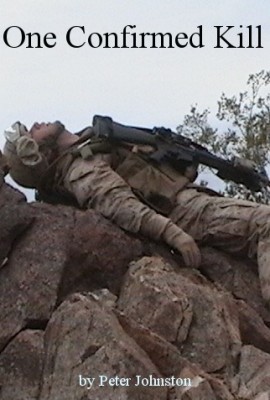
The best description of this book that I think I could give is the disclaimer at the front:
The following is not fiction. The characters and events described are closely based on real life, and any resemblance to real persons, organizations and events is purely intentional, and should be construed in the most negative light the text will support. Some names have been changed to protect the author from violent reprisals from the real people thus depicted, in the unlikely event that any of them have learned to read.
Thus begins a darkly cynical account of one soldier’s experience (or lack thereof) in Al-Anbar Province during the Iraq War. At times hilarious, at times surprisingly moving, this book made me laugh out loud and kept me engrossed all the way to the end.
Full disclosure: the author is a friend of mine from the Leading Edge slushpile, and I was one of the beta readers for this book. That said, I really enjoyed this novel, both the earlier draft that I read and the finished version that I bought as soon as it came out. It’s a lot like Catch 22, except I actually liked this one (whereas I could hardly get through the first chapter of Catch 22). The writing is witty and sarcastic, and the story, while far from honeycoated, ends on a note that makes the read worthwhile.
If you’re happily employed by the military, this book will probably make you livid with rage…or it’ll send you roaring on the floor laughing your ass off. I can see my military friends taking it either way. But one thing is for sure: you won’t find it boring.
One Confirmed Kill is an indie published ebook, and you can currently pick it up in all formats for $.99 on Smashwords. Disclosure: as a Smashwords affiliate, I get about $.10 from the sale. However, even if I didn’t get anything for it, I’d still recommend it, because it’s a great read.