Writing log results

For the last month or so, I’ve been keeping track of my daily writing habits to look for patterns that might give me some insight on how to improve my creative process.  I’ve amassed somewhere around 65 data points, and I think the results are clear enough to notice some trends.

Just some preliminary background information: for most of this time, I’ve either been on vacation or at my parents’ house, waiting to start an English teaching job in another country.  I haven’t had school or a full-time job, so my schedule has been pretty open and flexible.  Also, the numbers track progress on the first drafts for Star Wanderers and Stars of Blood and Glory, and do not count revisions of any kind.

Here are the results:
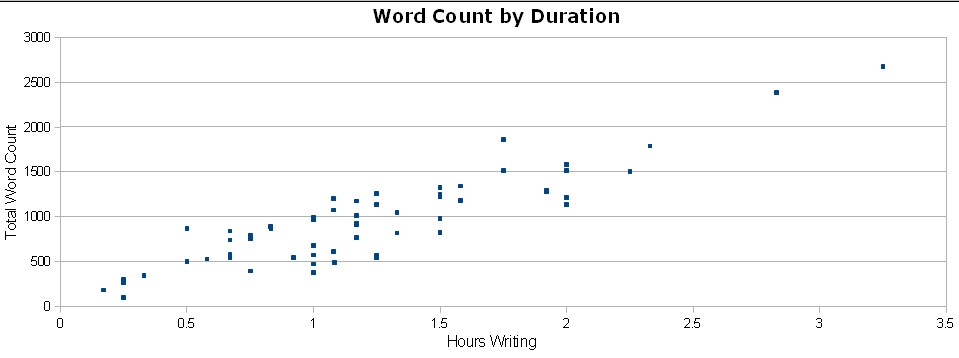
The first graph plots word count by duration spent writing.  As you can see, there’s a definite trend: the longer I write, the more I tend to write.  No surprises there.  Most writing sessions are somewhere between 45 and 90 minutes, or 500 and 1,500 words.
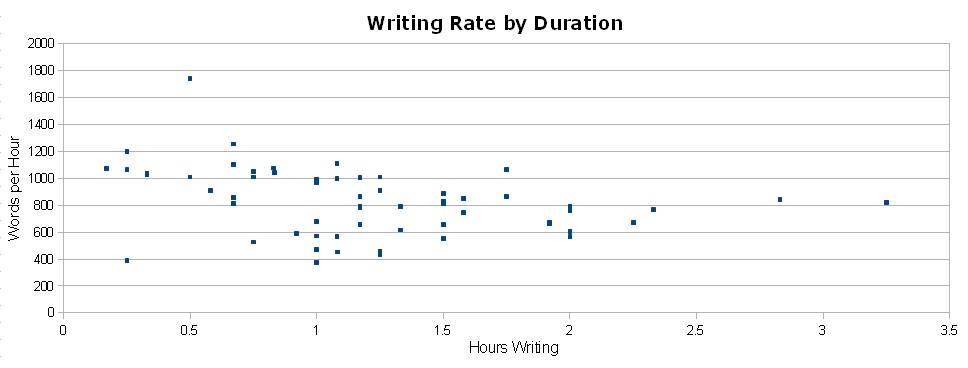
The second graph plots the average writing rate (in words per hour) per session by hours spent writing, and it’s a little bit murkier.  In writing sessions of less than 45 minutes, I tend to average a little over 1000 words/hour, but things get murkier between 45 and 90 minutes, and after 90 minutes, I tend to be around 600 and 800 words/hour.

The overall trend appears to be down–that is, the longer I write, the slower I tend to write–but there appears to be a counter-trend, too, where if I start off slow I can increase the pace by writing for a longer amount of time.  Is that true, or is that simply a sharper downward trend line?

I think it’s a genuine counter-trend, and here’s why:
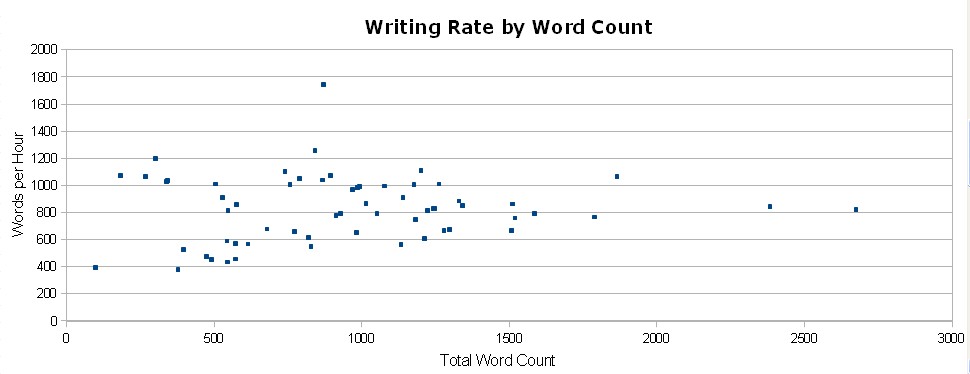
This graph shows writing rate plotted against word count, and it pretty clearly shows two trend lines: one starting at 1,000 to 1,200 words/hour and going slightly down, the other starting at 400 to 600 words and going up.  At about 1,500 total words, they converge at around 800 words/hour and appear to remain flat, though there isn’t really enough data to be able to say.

What I think this shows is that I have two different writing styles.  The first is to start off slow and gradually write my way into the story, picking up the pace but never really going over 800 words/hour.  The other is to start off at a sprint of 1,200 words/hour or so, but to slowly drop off to 800 words/hour at around 90 minutes or 1,500 words.
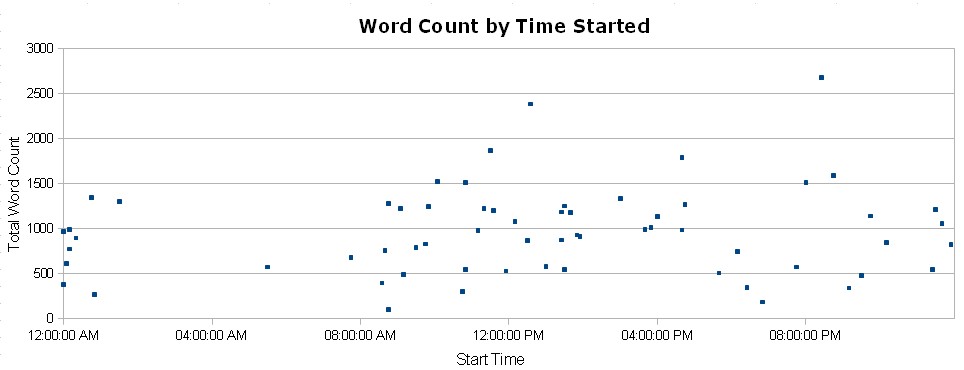
The next graph plots the total word count of each writing session by the time of day in which I started the session.  Interestingly, there is no trend; the points are all over the map.  This tells me that there is no “best time” for me to write.  Other time-related factors might influence how much I can write, but time of day itself does not.
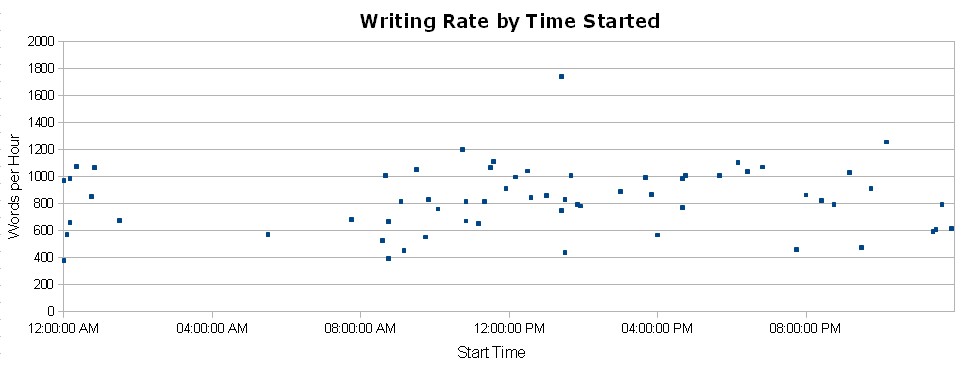
A quick glance at the next graph confirms this.  It plots writing rate by time of day, and the results are much the same as the graph for word count.  I tend to write at a more consistent pace in the afternoon–around 1,000 words/hour–but really, there is no consistent trend.

This tells me that my first session of the day tends to be slow and gradual, but that once I’ve written myself into the story, the writing comes a lot faster.  In other words, if I wake up early and hit the ground running, I tend to write more and write faster throughout the day.  If I get lazy and sleep in, the whole day tends to be shot.
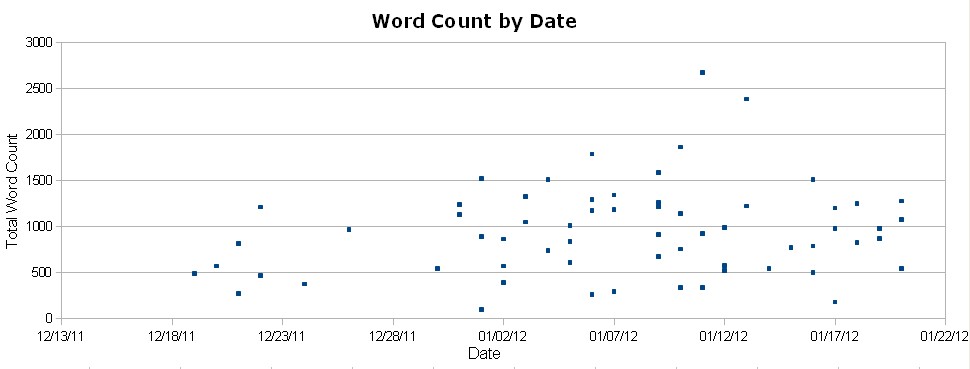
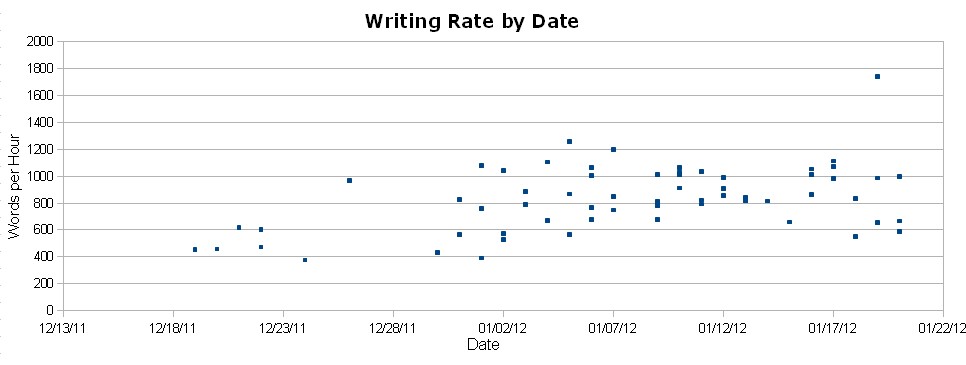
The last two graphs plot word count and writing rate by date.  Before January 3rd or so, I was either spending time with family or on the road / traveling cross-country by train.  Even so, there wasn’t a whole lot of variation, though my writing rate converged around 800-1,000 words/hour for a while before fluctuating again.

What this tells me is that stability and momentum tend to lead to more consistency in my writing habits.  If I’m constantly on the road, it becomes more challenging to keep up the pace.  Even so, as long as I can find make at least 45 to 90 minutes to write, I can pound out about the same number of words per session.

So in conclusion, it seems that the best way to improve my writing habits and streamline my creative process would be to:

  1. Get up early and start the day writing.
  2. Write in short, condensed sessions of 45 to 90 minutes each, with periodic breaks in between.
  3. Don’t worry about time of day when planning time to write; just do it whenever time can be made available.

However, unless I can get to the point where I’m regularly averaging +1,000 words after two hours, it’s going to be really hard to put in 10k words or more per day.  At 800 words/hour, it takes 12.5 hours to hit 10k, and after about four or five sessions at 1,000 words/hour, the well starts to dry up.

A much more practical goal, for now at least, would be to shoot for a consistent 5k words per day.  The week before last, I hit about 5.5k on Monday, a little less than 4k on Tuesday and Wednesday, and back around 2.5k for Thursday, Friday, and Saturday.  My running 7-day total for the entire week was above 20k, which is pretty good, but if I could get to stay between 25k and 30k for some time, that would be an accomplishment.

I haven’t totally given up on hitting a 10k/day average, but at this point, it seems that I need to set some stepping stones first.  5k/day seems like a much better goal for now–especially since I don’t know how things are going to change once I’m traveling again.  But at least I have a better idea of how my own process works.  I expect I’ll be writing a lot more in the weeks and months to come!
Halfway to 10k

I was going to post my ebook numbers for December and a report for the last quarter, but then I got caught away in my latest novel, Stars of Blood and Glory and wrote over 5.6k words for the day.

This is probably the most new material I’ve written in a single day since 2009–perhaps ever.  Revising tends to come a lot easier for me, so I’ve spent a lot of time in the past doing that, but this indie publishing gig is making me up my game.  I’m working my way up each day; hopefully I’ll be able to write even more tomorrow and keep up the pace until the book is finished.

Of course, it helps that I’m hanging out at my parents’ place without any obligations or time commitments.  I finished my application to the TLG program last week, and they just sent it out today; with luck, I’ll hear back that I’ve been accepted within the next five days, and then I’ll have a definite idea of how much time I have left before I’m off on the next adventure.  It probably won’t be much longer than two or three weeks at that point.

My (rather lofty) goal is to finish the rough draft of Stars of Blood and Glory while I’m here in Massachusetts, seeing as I have nothing else to compete for my time.  Once I’m overseas, it’ll be a flurry of activity and I’ll probably be lucky just to manage one or two thousand words per day, at least until things settle into some kind of routine.

So that’s the plan for the next few days.  In order to finish this book by the end of January, I’ll have to average over 3k words per day, but I think I can do it.  This story is so much fun–the characters are practically leaping off the page at me, and I’ve got some awesome twists planned.  Space battles, mercenaries, a runaway princess, and opposing princes who are determined to prove themselves men–it’s going to be a clash of epic proportions!  I can hardly wait to write it!

Writing Resolutions for 2012

As I write this post, I’m riding on the California Zephyr through western Colorado, going to my parents’ house in Massachusetts before heading out overseas on an adventure that I have no idea where it will take me before the end of the year. It’s an interesting time to make New Year’s resolutions, because so much is up in the air at this point, but two things are for certain: I will continue to write, and I will continue to publish.

A lot has changed for me since 2010. Around this time last year, I was still in query-writing mode, looking for an agent, and getting a little desperate for work. I eventually found work at an alarm company, which lasted through the summer until I realized it wasn’t helping me advance towards my long-term goals. And as for the query-go-round, I made the tremendous paradigm shift into indie publishing around the same time, eventually publishing three novels, three short stories, and one novella. Sales haven’t been spectacular, but they have been earning me a trickle of money that amounts to a few hundred dollars by now. Not quite a living yet, but if I keep at it, it might just become that.

My dream since 2009 has been to make a full-time living telling stories that I love. With all the opportunities made possible through ebooks and indie publishing, I have great hopes of accomplishing that within the next few years. However, I do think it’s going to take time, which is why I’ve decided to go abroad to teach English for a while. It’s the perfect kind of career for young people going through a transitional time in their lives, and I think I’ll find it a lot more enriching than bouncing around dead-end warehouse jobs until the writing starts to take off.

I can’t foresee exactly where this path will take me, but I can take accountability for the things within my control. So with that in mind, here are my resolutions:

1: Independently Publish At Least Two Books in 2012.

This shouldn’t be too hard. Journey to Jordan is already in the queue; all I have to do is make a final self-editing pass and figure out how to insert the photos. Besides that, I have the direct sequel to Bringing Stella Home, Heart of the Nebula, which I should be able to revise, polish, and publish before the end of the year, perhaps as early as summer.

Besides these projects, though, the queue is conspicuously empty, which is why I’ve come up with the following resolution:

2: Constantly Work on Producing New Material.

This is a big one–in the past, I’ve taken time off from new projects to work on major revisions, and as I mentioned in this post, it’s slowed me down a lot more than I would like. I’ve never been able to juggle two projects for more than a week, but this is a skill I should probably learn if I’m going to do this professionally.

I hesitate to put a concrete number like “four completed novel drafts before 2013” because this is an aspect of my writing process that I still need to explore. If I peg myself to a number, I could as easily find that I’ve set it too low as that I’ve set it too high. The important thing at this point is to learn the self-discipline.

3: Read and Review a New Book Every Week.

This is a tricky goal that I’ve tried and failed at before, but I really feel that reading voraciously is going to help my writing more at this point than working on craft or attending conventions. Those are good too, of course, but there’s something about reading and analyzing other works, both inside and outside of your chosen genre. I’ve been slacking off on this a lot lately, and if I’m not careful, my writing will get worse because of it.

With my Kindle ereader and low-priced ebooks, I have a lot of reason to be optimistic about this goal, even though I’ll be on the go for most of the year. It’s like having an iPod for books–and with the sampling system, I don’t have to worry so much about whether or not it’s worth buying the book. Simply download the free sample, and if I’m still interested by the end, click and continue.

4: Experience at Least Three 10k Days.

This ambitious resolution comes from a post I wrote earlier in reaction to this post here. Basically, I want to boost my productivity and break through some mental barriers that have been in place for the past few years, and pushing myself to do a couple 10k sprints will hopefully help to reset my stride at a much higher rate.

At first, I was going to say “three consecutive 10k days,” but with all the uncertainty accompanying my travels and new TEFL career, that doesn’t seem like a good idea at this point. If/when I’ve saved up enough money to take a few months off from everything else, then I’ll set a goal like that.

5: Attempt to Write a Novel in a Week.

This is more of something I want to do for fun, just to see if I can. Apparently, Michael Moorcock used to write novels in three days, and while I’d like to try that too, a week seems like a more realistic goal. At 40,000 to 50,000 words minimum, I don’t even have to break 10k/day to do it. 🙂

So those are my writing resolutions for the next year. As always, I’ll continue to write for this blog, hopefully with a lot more book reviews in the coming months. In the meantime, though, this post is getting long, and I’d better get back to writing.

Happy New Year everyone! Here’s to 2012 and all the possibility it brings!

Desert Stars is now published!

Desert Stars, my third novel (and second in the Gaia Nova series), is now available as an independently published ebook from Amazon, Barnes & Noble, and Smashwords.  Within the next couple of weeks, it’ll be available through Kobo, iTunes, Diesel, Sony, and Xinxii as well.

It’s been a long journey, and I’m thrilled to finally see it come through.  I started the first draft back in the fall of 2008, but had been working on ideas for the world since 2005, when I returned from my LDS church mission in California.  Spending the summer of 2008 in Jordan was a major catalyst for my imagination, and I soon was bursting with ideas for a far-future story on a desert world.

I got stuck in the winter of 2009, however–right before taking Brandon Sanderson’s English 318 class.  Since he encourages all of his students to work on something new, I decided to write a book in the same universe in order to work through some of the world-building things that were holding me up.  That book became Bringing Stella Home, which was a thrill to write all of its own.

The strategy worked; by the time I’d finished that one, I had a much clearer idea where to go with Desert Stars, and an awesome ending that was nothing like anything I’d planned in the first draft.  And so, after graduating in April 2010, I soldiered through and finished the rough draft that summer.

It still had a lot of problems, though.  Fortunately, my first readers were extremely helpful both in pointing those out and in giving me fantastic ideas for other things I could do.  In the second draft that winter, I completely scrapped a major subplot in the second half of the book and focused on perfecting the character arcs for the two main characters: Jalil and Mira.

Around this time, I made the paradigm shift from traditional to indie publishing.  Other projects like Genesis Earth and Bringing Stella Home took my attention for a while, as I learned the basics of the new world and prepared those books for publication.  However, I always kept coming back to Desert Stars: I knew I had a good story there, and I was just itching to bring it to its full potential.

In the fall of 2011, I finally had that opportunity.  The last draft flew by in three weeks, and was one of the funnest writing experiences I’ve had since I started writing seriously in 2007.  By the end, I knew it was ready.  I sent it out to my editor, Josh Leavitt, and started to prepare it for publication.

In writing any book, there are always moments that stand out; experiences where things come together in an unexpected yet memorable way.  One of those came to me in Jordan, while I was walking down Queen Rania street from the University of Jordan to Al-Dustour, and the phrase “Temple of a Thousand Suns” flashed into my mind and sparked the whole novel.  Another of those moments happened while I was driving from Salt Lake to Provo, and Mira’s final words in the last chapter came to me; I literally could not stop screaming for two or three minutes.

I could share more, but if I did, I’d find it difficult to maintain the illusion that I’m not a loony psychopath. 🙂

In any case, it’s just awesome to see the story come to maturity and embark out into the world.  I’m sure this isn’t the end of the journey, but it’s definitely entering a new and exciting phase.  I sincerely believe that this is my best book yet, and I hope you find it as worthwhile to read as I have found it worthwhile to write.  If you do, I would appreciate it greatly if you took the time to post a review, or share it with a friend.  Every little bit helps, and I’m grateful for whatever support you can give!

In the next couple of days, I’m going to send out a newsletter with some freebies including desktop backgrounds of the cover art.  If you’d like to get in on that, be sure to sign up for the email newsletter via the form on the sidebar; you’ll also receive notices for other giveaways, as well as new releases.  It costs nothing and you can always unsubscribe, so there’s no pressure or obligation.

And that just about wraps it up.  Now: on to the next book!

Climbing the 10k mountain

Many Bothans died to bring you this.

I recently read an amazing blog post by Rachel Aaron, in which she explains how she went from writing about 2k words per day (about what I’m doing) to routinely breaking 10k.

This is something I really want to do with my own writing.  As I noted a couple of weeks ago, I need to pick up the pace if I’m going to keep up with my professional goals.  If I could go from 2k to 10k, and make 10k the standard…holy cow, that’s a 500% jump in productivity.  Who wouldn’t want that?

From Rachel’s blog:

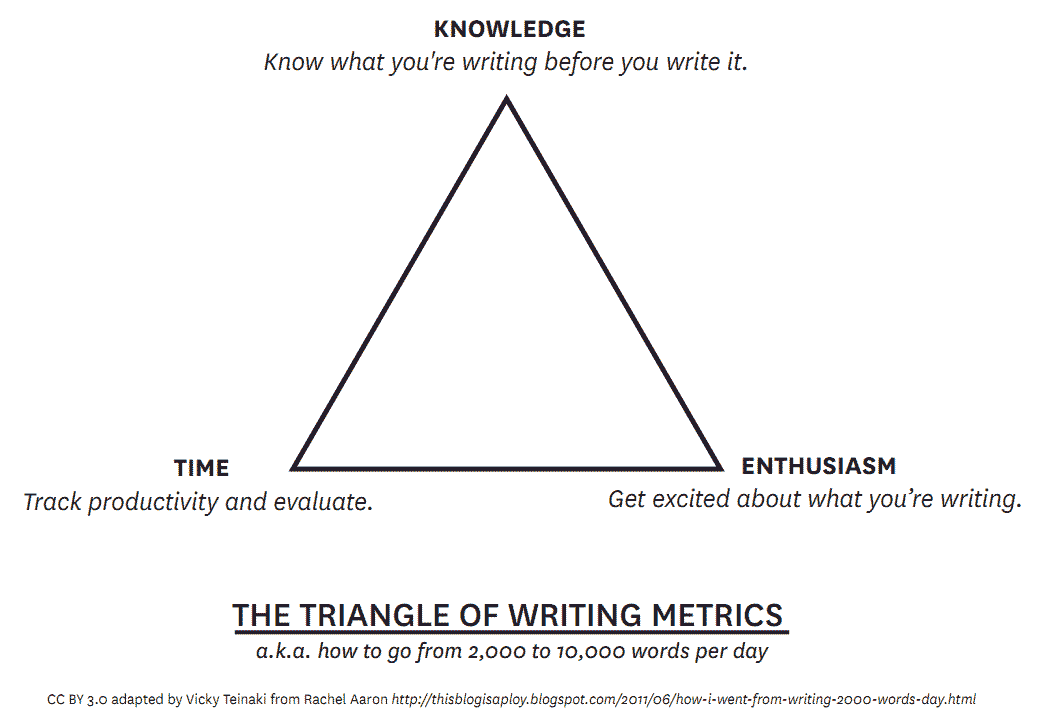
Drastically increasing your words per day is actually pretty easy, all it takes is a shift in perspective and the ability to be honest with yourself (which is the hardest part). Because I’m a giant nerd, I ended up creating a metric, a triangle with three core requirements: Knowledge, Time, and Enthusiasm. Any one of these can noticeably boost your daily output, but all three together can turn you into a word machine. I never start writing these days unless I can hit all three.

The point that I probably need to work on the most is time: I tend to start off the day slow, checking Facebook and blogs and other stuff before getting into the writing, then write for a little while before running off and doing some chore or allowing myself to get distracted again.  Sometimes, I don’t really buckle down until a couple of hours before I should go to bed, and that’s bad.

But really, I think the main obstacle is just thinking that writing is difficult.  If everything comes together in the right way, there really isn’t any reason why 5k or 6k or even 10k should be too difficult–and yet we naturally think that if 2k is hard, anything more should be that much harder.

I’m in a weird state of limbo right now between moving and preparing to go overseas, but I’m going to start a daily writing log so that I can figure out what time of day is most productive.  You can’t wait for life to settle down before you get to work; you have to roll with what you’re given.  Also, I’m going to put a lot more effort into outlining and planning, so that I don’t get hung up by research when I should be writing.  Even discovery writers need a little bit of time to ponder things before putting words to the page.

Also, after considerable thought and effort, I’ve decided to put Star Wanderers on the back burner again.  I finished the novelette last week and submitted it to Writers of the Future; I think it’s quite good, and stands a good chance of finding a home in one of the short markets.  But the full length novel, for various reasons, just isn’t coming to me.  I don’t know if it’s because I lack the life experience to write it, or because I’m too close to it to see what’s broken, but regardless of the reason, I need the break.

I’m not sure whether to do Edenfall or Stars of Blood and Glory next, but I’m leaning towards Stars of Blood and Glory.  This is a novel set in the Gaia Nova universe, with characters from Desert Stars, Bringing Stella Home, and Heart of the Nebula.  I’ve been itching to write it since this summer, but never got around to it because other projects got in the way.  Well, hopefully now that will change.

I know from emails and other correspondence that some of you are really looking forward to Edenfall, but don’t worry, I’ll get around to it soon.  In order to do it justice, I feel I need to reread Genesis Earth and immerse myself in some Carl Sagan, but right now I’m still running on a sci fi adventure trip.  If I can implement some of these metrics and push my daily word count upwards of 10k, it shouldn’t be long before Edenfall gets my attention again.  My goal is to finish it before the end of the year, so there’s a very good chance it’ll be published sometime in late 2012.

As for Star Wanderers, I’ll shop the novelette around after I hear back from Writers of the Future.  I think it has a good chance at winning the quarter, but of course I can’t count on it.  At this point in my career, I should probably be playing both the traditional markets as well as the indie field.

That’s just about it.  Now, if you’ll excuse me, I need to write…

Picking up the pace

I’m writing this post from somewhere in Iowa, riding the California Zephyr from Chicago to Salt Lake City. Since I hate sleeping on the train, I figured now is as good a time as any to write a blog post.

One of the good things about traveling by train is that you have lots of time to just sit and think. Yesterday I took a long, hard look at my writing over the course of the last year, and was surprised at what I found. Long story short, I think it’s time for a major recalibration.

As you know, my main writing goal is to produce a minimum of two novels per year, fully polished and of publishable quality. Desert Stars will be my third this year, if I can get it up before January. But after that, I don’t have a whole lot lined up in the queue. Heart of the Nebula is a finished rough draft, but it’s the only one; everything else is either incomplete or just an idea floating around in my head.

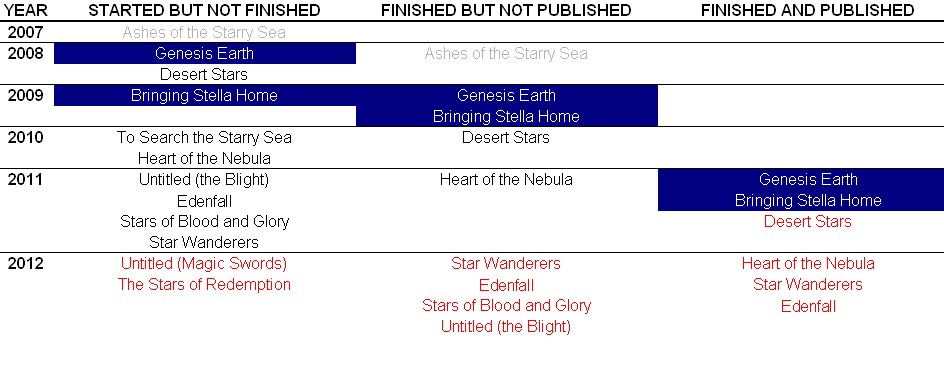
Perhaps the best way to see it is to look at this chart. It lists all of the novels that I started, finished, and published by year. The titles highlighted in blue are novels that I’ve epublished. Ashes of the Starry Sea was a practice novel, so I’ve grayed it out, but everything else is a project I intend to carry to completion.

While 2011 was a great year for me in terms of starting new works, it was a downright horrible year in terms of actually finishing anything new. I’m worried that unless I can force myself to buckle down and produce new material at a much faster rate, this handicap is going to bite me in the butt next year.

Here’s another way to think about it: if I want to write two novels per year, and I can only focus on one novel at a time, I should be able to complete any project in no more than 26 weeks. And yet, when I look at my word count spreadsheet (which only goes back to May 2009), here’s what I see:

  • Genesis Earth: 22 to 26 weeks
  • Bringing Stella Home: 50 to 54 weeks
  • Desert Stars: 52 to 56 weeks
  • Heart of the Nebula: 18 weeks (unfinished)
  • Edenfall: 2 weeks (unfinished)
  • Star Wanderers: 9 weeks (unfinished)

What this tells me is that my current writing method is unsustainable. Either I need to learn how to juggle two projects at once, or I need to learn how to produce quality material in half the time–and in all reality, I should probably learn how to do both.

For those of you who might be worried that I’ll sacrifice quality for speed, let me assure you that I don’t intend for that to be the case. Dean Wesley Smith makes a very compelling argument on this subject, how speed and quality are not mutually exclusive. The more I write, the more practice I’ll get, which will hopefully improve the quality of my writing.

One thing I really ought to do is write something new every day. For most of 2011, I was revising something I’d originally written in 2008 or 2009, maybe throwing out a couple of scenes to start from scratch, but overall simply revising an older work. It’s made me a little rusty, and I can feel it. I can say right now, that needs to change.

My biggest concern is that once I’m overseas, it will be much harder to balance these writing goals with everything else going on. However, this isn’t 2008; I don’t have all the obligations of a student. As for whether the obligations of a teacher are any worse, we’ll have to see.

What I really want to do is write a novel in a week–preferably, in three days. Even if the first draft isn’t very good, just the act of doing it will break down some major barriers, I feel. If I finish Star Wanderers by mid-January, I’ll turn it around and write a novel with the same events from Noemi’s point of view, all in a weekend if possible.

In short, this is what I want to do:

  • Produce a minimum of 2 publishable novels per year.
  • Reduce the time for each draft to 6 weeks average.
  • Write a minimum of 500 new words each day.
  • Learn to juggle two projects when revising.

This isn’t going to be easy; I have the feeling that it’s going to involve a fundamental shift in the way I approach writing. However, if I can pull through it, I think this might just transform my career in the way that I need in order to take things to the next level.

In the meantime, I’d better get some sleep. I’ve got a long day of travel ahead tomorrow, and I’ll need all the energy I can get if I want to get some serious writing done.

Heinlein’s rules for the digital age

I’ve been thinking a lot about Heinlein’s rules and how they apply to my own writing career.  While a lot of newer writers like to debate Heinlein, all of the long-time professionals tend to agree with him.  For that reason, I think it’s worth taking a serious look at his rules and doing my best to follow them.

The trouble is that Heinlein formulated his rules before the digital age, when self-publishing was non-viable and writers sold to editors, not to readers.  While I wouldn’t go so far as to say his rules are outdated, I do think that they need to be tweaked a little in order to apply to today’s aspiring professionals.

As a disclaimer, I should say that I’m only a beginning writer without much authority or experience.  However, my goal is not to debate Heinlein, but to explore ways in which his advice can be adapted to myself and writers in my position.  If any of you have any thoughts or input, I would very much like to hear it.

So anyhow, here we go:

Rule One: You Must Write.

Pretty straightforward: if you want to write for a living, then the bulk of your time should be spent writing.  Too many indie writers spend all their time and energy promoting their one book when they should be writing others.  If promotion gets in the way of writing, then you should stop promoting and just go write.

Personally, I could probably spend a lot more time writing new material as opposed to revising stuff I’ve previously written (yes, that’s the infamous third rule; I’ll get to it in a minute).  I tend to spend a month writing something new, then take a couple of months to revise old works without producing new material.  If I want to be strict about following Heinlein’s rules, I should probably change that.

Rule Two: You Must Finish What You Write.

Another straightforward rule, but you’d be surprised how hard it is when you know you can publish whatever you write.  Kris Rusch calls these ideas “popcorn kittens,” after a popular youtube video that embodies what goes on in our minds when we have the freedom to create anything.  The problem with too much freedom is that it’s a struggle not to flit from one idea to another, dabbling in all of them but carrying none to completion.

I myself had this problem over the summer, and to some extent I’m struggling with it now.  The key is just to buckle down and have the discipline to finish what you start.  Pretty straightforward.

Rule Three: You Must Refrain From Rewriting, Except to Editorial Order. 

This is Heinlein’s most controversial rule, especially for new writers.  However, I think he has a good point.  If a story is fundamentally broken, revising it is no more effective than stirring around a pile of crap; and if the story works, revising it without first getting a trusted second opinion could actually make it worse.  After all, writers are often the worst judges of their own work.

The key question, then, is where to go for that second opinion.  In the old days, money flowed from the editors to the writers (or at least from the publishers, who employed the editors), but in the new world of publishing, it’s exactly the opposite.  Most of us can’t afford to hire editors for extensive developmental edits, especially when we’re just starting out, and while it’s possible to publish a rough draft, for most of us it’s probably not a good idea.

My approach is to share my unpolished work with a network of trusted first readers, and use their feedback to guide me in the revision process.  I don’t always adopt all of their suggestions, but I carefully consider each one.  Most of the time, I use them to see where the problems are, then use my creative mind to come up with a solution, sometimes taking the book in an entirely new direction.  And if something works well for some but doesn’t for others, I figure it’s not a problem but a judgment call that requires my attention.

Using this method, it currently takes me about four or five drafts before I feel confident enough to publish something.  If I really wanted to follow Heinlein’s rules, I would probably try harder to nail it on the first draft, but I’ve found that my creative process works better in revision mode than while writing new material.  So long as I can revise efficiently enough to produce at least two novels each year, I think I’ll be in good shape.

Rule Four: You Must Put Your Story on the Market.

In the old days, this meant submitting your manuscript to contests, magazines, and publishing houses, not self-publishing.  For short stories, contests and magazines are probably still the best place to start.  However, with novels, indie publishing is generally much better.

The trouble is that publishing your own work is as scary as hell, especially when it’s close to your heart.  This is probably the main thing keeping most new writers from going indie: the need for external validation which grows out of a lack of much needed self-confidence.

The key, I believe, is to get some emotional distance between yourself and your work.  As a rule, I don’t respond to reviews, good or bad.  As for external validation, I don’t seek it at all.  I only publish the stories that I believe in, and even if I’m nervous about sending them out into the world, I figure it’s better to suck it up and do it anyway.  It was the same with writing queries; the only difference is that the market is now the readers, not the editors.

Rule Five: You Must Keep It On The Market Until It Has Sold.

This is especially challenging for indie writers.  When weeks go by without a single sale, it’s easy to believe that your work is crap and that you should just take it down.  It’s even worse when your book isn’t selling and you get a bad review.

Just like with queries, however, the key is to keep your work out there until it finds its natural audience.  With indie publishing, you have all the time in the world, provided you don’t lose confidence.

The key question in my mind is whether to take down your old, crappy stuff as your writing improves, or to leave it up alongside your newer, better work.  Personally, I think it should come down to the readers; if the old stuff is consistently getting bad reviews, it’s probably better to take it down, but if not, might as well keep it up.

So there you have it.  From Heinlein’s rules, I’ve more or less crystalized the following approach:

  1. Always make time to write, even at the expense of promotion.
  2. Only chase new ideas if you know you can finish what you start.
  3. Don’t revise without first getting feedback from trusted readers.
  4. Don’t wait for external validation before you publish.
  5. Keep your work up, even if it doesn’t sell.

Not quite as pithy as Heinlein’s rules, but they seem pretty reasonable.  I don’t have the experience to say whether they follow his, however, so if you have any comments or suggestions, please chime in.

Managing excitement and an idea for an epic fantasy novel

After getting about 40% through Star Wanderers 1.0, I hit a wall and decided to put the project on the back burner for now.  The beginning part, which I’m hoping to shop around as a novelette, has some issues with it and those are keeping me from making any real progress in the rest of the story.

I wish I could just wave my hand and pretend as if I’ve already fixed those problems, but my creative process just doesn’t work like that.  I guess I’m more of a discovery writer in that way, because I can only build on stuff that I’ve already written.  I have to figure out my characters as I write, otherwise they just fall flat.

It’s discouraging, because I feel like I don’t have enough control or discipline over my creative process.  Other writers seem to be able to pick up a project and finish it, even when that project is commissioned by someone else (editors, franchise owners, etc).  But with me, if I can’t get excited about a project, I can’t finish it.

Fortunately, even if I can’t always control which project I’m excited about, I always seem to be excited about something.  After finishing the last revision for Desert Stars, I felt this unusually strong urge to work on Into the Nebulous Deep (which, after the last post, I’ve tentatively decided to rename Heart of the Nebula).  I totally didn’t see that coming, but I’m glad that it did, because that project is getting due for its first major revision.  It’ll probably be a quick one, just to fix some major known issues before sending it off to first readers.

As for new projects, I’m not quite sure what to pick up next.  I’ve got a feeling I could give Edenfall another shot, though it’s dubious at this point, and I still have a bit of lingering excitement over the untitled Gaia Nova novel that involves Roman, Danica, Rina, and Stella’s son.

At the same time, though, I have a really cool idea for a fantasy novel involving magic swords.  The idea is that the swords are actual characters, with the ability to think, feel, remember, and communicate with those who wield them.  They can only be wielded by those whose minds have been melded to them, however, kind of like the Dragonriders of Pern.

As the swords get passed down from generation to generation, they pass on their skills and memories, so that those who wield them become legendary warriors.  However, all but one of the swords goes insane, turning their wielders to evil.  The one sword that remains has refused to take on a new master, even though war and destruction sweeps the land.  A prophecy states that the one who wields this sword will eventually defeat the evil of the others, but when the good sword finally does take on a new owner, it ends up being a farmgirl / tavern wench (I haven’t really decided).

I don’t have a lot of experience writing fantasy, but this story is starting to really excite me.  If I can combine it with a few other ideas and read some good fantasy novels to get into that mood, I think I can make some good progress on it.

So yeah–I have plenty of projects to work on, so things aren’t that bad.  I just need to find one that I can really get into for the next couple of months; if I keep bouncing around from project to project without finishing any of them, that’ll be bad.

Decisions suck, writing is awesome

Whew!  I just finished revising through almost 9k words in Desert Stars.  I’ve only got three more chapters and an epilogue to go, and man, I am so excited about this story!  I have no doubt it’s my best work yet.

Of course, I might be biased. 😉

Star Wanderers is also coming along very well.  I’ve only got a few more scenes to write/revise before it’s ready to send off to the next round of first readers.  Part of me wants to send it off to Writers of the Future right now (and according to Dean’s sage advice, that’s probably what I should do), but I want to get some feedback first just to make sure there isn’t something I’ve missed that would make it better.  If all goes well, I’ll probably send it off by the end of the month.

This is the best part of writing process: finishing up a project that you know is good.  This is one reason why I love rewriting so much.  If I could do this all day, every day, and get paid enough for my work to make ends meet, I’d be living the dream.

Until then, however, I’ve got to figure out another way to make ends meet.  One option I’m considering very seriously is selling my contract and driving across the country this Thanksgiving to spend a month or two with my parents before going overseas.  My mom was the one who suggested it, and I have to admit it makes a lot of sense; if I’m going to go abroad to teach English anyways, why not spend some time back home?

If this is something I need to do, I’m going to have to make the decision very soon, possibly before the end of next week–and if you know me, you know that I’m terrible at making decisions.  However, I have been thinking about it enough to make a couple of lists, and this is what I’ve come up with so far:

Reasons to go to abroad:

  • To start a new career.
  • To have adventures.
  • To experience another culture.
  • To gain TEFL experience.
  • To support myself as I write.
  • To have a change.
  • To see the world.
  • To have something to write about.

Reasons to stay in Utah:

  • To get married.
  • To focus on writing.
  • To pursue a graduate degree.
  • To stay in a predominantly Mormon community.

I decided to list only the positive reasons for making either decision, and not to consider any of the creeping doubts or fears (and there are many!).  So let’s break it down:

To start a new career: This seems prudent, especially if it takes a while for my books to really take off.  Specifically, a TEFL career seems like something I could juggle with my writing career, and it would certainly offer a lot more satisfaction than a grunt day job.

To have adventures: Perhaps not the most responsible reason, but hey, you’ve got to remember to have fun.

To experience another culture: One of the perks of traveling, for sure.  It would probably improve my writing considerably as well, though culture shock and distance from family would certainly pose a challenge.

To gain TEFL experience: In other words, to find out if teaching English as a foreign language is something I want to build a career around, or whether I’m just not suited for it.  This is why I’d want to do the TLG program first, before heading off somewhere like Cairo or Amman.  And if it doesn’t work out…well, at least I’d know.  Right now, I don’t.

To support myself as I write: This is huge.  I hear that most TEFL jobs only take up about 20 hours per week, and that if you’re living in a local apartment, it’s not hard to make time to write.  In the past two years, I haven’t had any success balancing writing with full-time work, and working part time probably wouldn’t earn me enough to support myself here in the states.

To have a change: Not quite as tangible a reason, but important nonetheless.  I can’t quite explain it, but if I stay where I am now, in my current life situation…it’s just not going to work out.

To see the world: I could probably lump this under “to have adventures.”

To have something to write about: Also huge.  My experiences in Jordan and the Middle East were a huge inspiration for Desert Stars, and if I’d never gone over there, the novel wouldn’t be nearly as rich.  Who knows what else my imagination would produce if I spent some time traveling the world?

Now, for the other side:

To get married: Honestly, this is more of a negative reason than a positive reason.  I’ve already decided that I’m only going to marry someone who’s a practicing Mormon, and since Utah is predominantly Mormon, I’m worried that if I leave Utah, I won’t be able to find someone.

Trouble is…I’ve been here for almost six years, and still haven’t found anyone.  I could probably put more effort into dating, but the truth is probably that finding a marriage partner is more about your mindset than where you physically live.

Besides, I could always spend a year or two abroad and come back.  I’d be pushing thirty and well beyond “menace to society” status, but at least I wouldn’t be a loser who spent all his twenties in Utah.

To focus on writing: This was why I decided last year not to go teach English in Korea.  The ebook revolution was just getting started, and I felt that I needed to stay in the states to learn how the market was changing and focus on building my indie writing career.

Now, however, I feel like I’m high enough on the learning curve that I can afford to work on other things.  Besides, with the current state of the economy, I don’t think I’m going to find balance if I stay in the states.

To pursue a graduate degree: I’ve largely ruled this one out.  I don’t see how an English degree would help me at this point, and I don’t currently have any career aspirations that would justify pursuing an advanced degree.  The only reason I’d go back to school is to postpone facing the real world, and that’s probably the worst reason I could possibly have.

To stay in a predominantly Mormon community: Kind of the opposite of “see the world” and “experience another culture,” and it gets at the very heart of the matter.  Would it be better to establish myself among people who are more like me and share my values, or should I venture out of the “bubble” and see what else is out there?  I have a much stronger support group here in Utah than I’d probably have as a global nomad, but do I really need it?  Am I independent enough to strike out and bloom wherever I’m planted?

I don’t know.  My thinking is so muddled with doubts and second thoughts that this whole exercise has probably been futile.  If I had to make a decision RIGHT THIS SECOND, however, I’d probably choose to go.

If nothing else, it would give me a good two months of writing time. 🙂

Q3 Report, 2011

Before I move on to other, more interesting subjects, I want to take a little bit of time to review how my writing went in the past three months.  For those of you who may be new, this is something I like to do at the start of each new quarter.  Keeps me honest, I guess.

Anyhow, here goes:

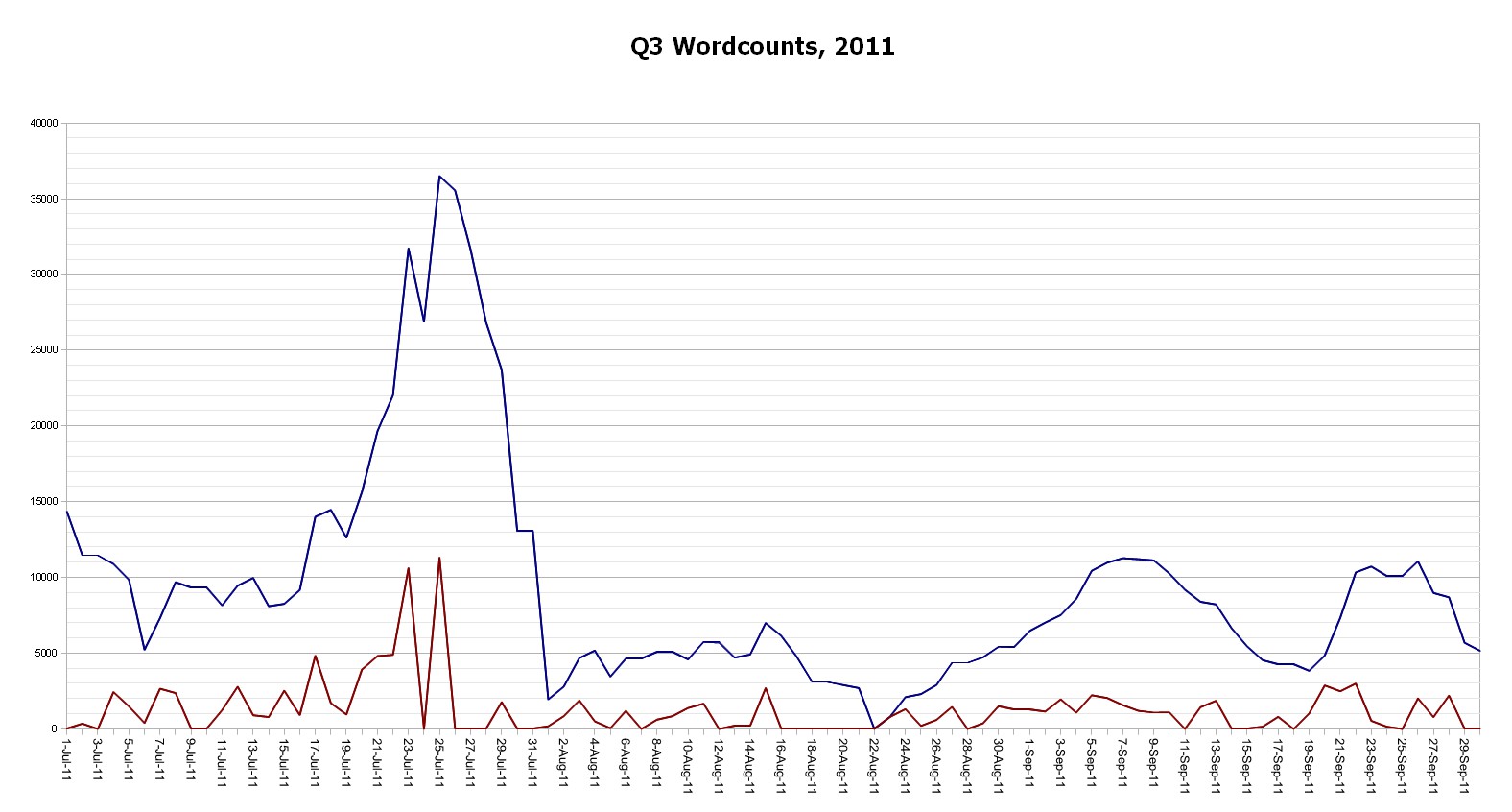
This is a graph of my word count totals for the past quarter.  The red line shows how many words I wrote each day, while the blue line shows a running seven day total.  I include substantive revisions in the totals, but if all I’m doing is proofreading or running through copy edits, I don’t count it.

For the first half of July, I was finishing up the third draft of Desert Stars while working 40 hours per week.  I wasn’t writing as much as I’d have liked, but still managed to keep some good momentum.

The HUGE peak at the end of the month represents my first draft of Sholpan, which I finished in only a week.  I spent the next week in a weird writerly limbo, not sure what else to work on, then picked it up again and made some substantial changes before sending it to my editor in in mid-August.  Then Worldcon happened, and I didn’t get any writing done while I was out at that.  Should have, but oh well.

After Worldcon, I had maybe three or four different projects I wanted to do, but since I wanted to do the final draft of Desert Stars in October, I wasn’t sure which project to pick up.  After several false starts, I ended up writing the first part of Star Wanderers, which is that hump you see at the beginning of September.  The second hump is the second draft; my writing took a dip in between because I didn’t know what else to do with only a couple weeks before October.

Overall, though, my personal word counts were a lot lower than I’d like.  Part of that was due to the effort I put into publishing Sholpan (it takes a lot of time and energy to publish something, which can eat into your writing if you aren’t careful); part of it was because the project I was most excited about was Desert Stars, and I had to wait until October to hear back from my first readers; but another major part was that I was trying to balance a 40 hour job on top of everything.

This is the dilemma: I want to build up my writing career to the point where I can support myself on it, but to do that I have to work a day job to make ends meet, which makes it very difficult to work on the writing career.  When I was in school, I used to think a 9-5 job would make things easy, since I wouldn’t have any homework or papers to bring home.  Now, though, I think school was easier, because I was only in the classroom 15 to 20 hours per week, and could allocate the rest of my time as I saw fit.  Working full time is a lot harder, because half of your waking time doesn’t belong to you.

What I’d really like to find is a part time job, maybe 30 hours per week, where I earn just enough to get by but don’t feel drained when the workday is over.  A lot of TEFL jobs are only about 20 hours or so per week, so I’m thinking very seriously about doing that.  Then again, all the attendant difficulties of adjusting to a new culture might be even more draining than grunt labor.

I guess there’s only one way to find out…

In any case, now that October is here, I’m back to work on Desert Stars, hopefully the final draft before publication.  I know I said I’d finish Star Wanderers, but since I’m going to come back to it anyway after I get the feedback from my first readers, I figure it will be better to finish Desert Stars and move on.  Also, I can revise a lot faster than I can write new material, so it makes a lot more sense to get the revisions out of the way instead of pushing a rough draft harder than it wants to come.

And after that?  Who knows!  I’ve so many half-finished novels and projects I want to start, all I can really say is I’d better throw this up on the blog and get back to writing.  So on that note