Crunch time

Sixty six percent!  I’ve officially passed the two thirds mark in the fourth revision for Mercenary Savior–and not a moment too soon.  With only a week and a half until World Fantasy 2010, it’s crunch time.  I’ll probably quit my temp job a week early in order to devote the last few days of the month to finishing it.

As I’ve been working on Mercenary Savior, though, a fascinating idea for a sequel has been stewing in my head.  It was sparked by an online conversation with one of my first readers:

Reader: I was never fully convinced that James felt he had closure
Me: I see
Reader: but I was satisfied with the thought that he would get it sometime after the story ends
he’s still young, so he’s still maturing
even at the close of the novel
Me: yeah
hmm
interesting

It’s true; James does have a lot of room to grow and mature after the events of Mercenary Savior. In that book, his character growth arc (without giving away spoilers) is about him learning to accept change and stop running from adulthood.

Nothing in that arc has much to do with the kind of person James grows up to be, however, or the significant other with whom he comes to share his life.  In other words, there’s a whole lot of untapped potential for building James’s character and giving him a romantic interest.

The question that immediately rose to my mind was: what’s the story?

Now when it comes to sequels, I think the best ones take a long, hard look at the first installment and answer the question: therefore, what? Thus, in Star Wars IV, V, and VI (which I believe to be one of the best examples of a trilogy in any medium), the Rebels defeat the first Death Star in episode IV, but find themselves on the run in episode V because the Empire knows the location of their base.  Luke uses the force to pull off a last-minute victory in episode IV, but finds in episode V that becoming a true Jedi takes a lot more discipline and self-mastery than he thought.

So I applied that principle to my own work and came up with the following overarching conflict: the Hameji occupation of Karduna is devastating the people of the Colony to the point where they collectively decide to depart en masse and establish a new community somewhere else.  It’s a logical conclusion taken from the ending of Mercenary Savior; the people are well enough off to survive, but too poor and oppressed to do much of anything else.

You may not know this, but the first story I wanted to set in this fictional universe was about a group of starfaring pioneers traveling into the heart of a nebula to escape religious persecution and establish a thriving community on the fringes of settled space.  That’s right–I basically wanted to set the Mormon pioneer exodus in space.

For various unrelated reasons, that never worked out, but the desire has always been there in the back of my mind.  What can I say–I think that pioneers are cool, and stories about colonizing unsettled new lands just fascinate me.  I’ll probably write a massive Utah pioneer epic someday.

But anyways, I started playing around with this old idea to see whether I could recycle it.  Right now, I think that I can.  The idea is that James becomes the leader for one of these emigrant groups, and has to see them safely through to a young planet in the heart of this nebula.  They decide to fly into the nebula in order to isolate themselves from the Hameji, since the FTL tech in my universe doesn’t work within a Nebula.

And then something really crazy happened.  This scene popped into my head, stronger than any other idea I’d had so far.  I imagined that a group of pirates had captured the expedition and refused to let them go unless they gave the pirates three young women to keep as slaves.

Pretty standard conflict, right?  But then, I thought: what if three young women of their own free will stepped forward and offered to sacrifice themselves to save the others?  What would James do then?

Well, it wasn’t hard to figure that out at all.  James would never let them go.  He’d fight the pirates, even if it meant risking all the lives of those he’s trying to protect.

This raises some interesting questions of morality.  Is it right to risk the lives of everyone in the community when three individuals have already offered to sacrifice themselves for the good of the whole?  Is it right to deny someone the opportunity to give their own life to save others?  Or is James just being stubborn and reckless?

At a first glance, that’s the way it looks.  But then I imagined what James would say to justify himself.  After what he learns from the events of Mercenary Savior, James would argue that the community needs to stick together–that in order for the whole to survive, everyone has to know with absolute certainty that no-one will be left behind.  Once the leader shows that he’s willing to sign his followers over, how can any of them trust him with their lives?  Under such conditions, trust breaks down and the community falls apart.

From that, a whole host of other ideas started gradually coming to mind.  How does this event tie into James’s romantic interest?  Does it tie in at all?  What would the people’s reaction be to this decision?  Coming from the background of the Colony, would they want to put the issue to a vote instead?  Is it ever right to suspend democracy when facing a crisis, and if so, under what conditions? 

So anyway, I won’t tell you what I have in mind, but I have a lot of really interesting ideas.  It’s gotten to the point, in fact, that I may just write the sequel after I get back from World Fantasy.

In closing, let me leave with this excellent track from one of ocremix’s latest albums, a rearrangement of Donkey Kong Country 2.  Believe it or not, this song could be the main theme of this novel.  Listen to it and I think you’ll see why.

Good night!
Danger: difficult plot ahead

Just a quick post before I turn in and try to catch up on the sleep that I didn’t get last night (insomnia sucks).

I’m entering a very difficult part of the revision for Mercenary Savior. I’m a little more than a third of the way through the story (as you can tell from the status bar to your right), which is usually where my writing starts to get iffy.

Up until now, most of the work has to do with revising or rewriting individual scenes.  That’s no too difficult; it’s very easy, for me at least, to focus on the page itself and fixing problems on the sentence and paragraph level.

The problem now, though, is that some of the chapters aren’t working as coherent units.  Some of them feel slapped together, as if scenes that don’t really have much in common have been thrown in the same chapter merely because I didn’t know where else to put them.  That doesn’t make for good chapters.

So now, I need to take a few steps back from the page and look at the forest instead of the trees.  I need to figure out which events need to be clustered into which chapters, in order for the scenes to resonate with each other and build up to the climax without bumbling on each others’ toes.

I’m going to try out a few new tools to help with the plotting, most notably Dan Well’s 7 point system.  I’ve already worked out the essential plot points for about a dozen of the conflicts in the story; now I just need to see which ones go in which chapter.

I wish I had time to use it now, but dagnabit, it’s 1:30 in the morning, and I have to get up at 7:00 tomorrow.  Dang.  Well, at least I have work–and it’s good work for an aspiring writer in my position.  More on that in a later post.

Anyway, good night.

Confessions of a delinquent blogger

Man, so much has been happening, but now that I’m working an eight to five job, I never have the time to blog about it.  It’s 2am and I’m running on only four hours of sleep from the previous night.  Oh well, it’s a weekend.  Here goes.

I passed the 50k mark for the rewrite of Mercenary Savior. I’m surprised how much I’m changing the draft.  I’m especially finding a lot of slow chapter beginnings and thinly veiled expository lumps–not of scene descriptions so  much as  worldbuilding.  Gotta remember the iceberg concept (to only include about ten percent or less of your worldbuilding in your story’s narrative).

I interviewed a few more people for the article on the “class that wouldn’t die.” Good stuff, all around.  I met with Cara O’Sullivan today, and she had a very interesting comment about why there are so many LDS writers of science fiction and fantasy.

In her opinion, Mormon literary culture tends to push the more talented writers into sf&f because of the extreme lack of freedom in other genres of LDS writing.  In mainstream and literary LDS fiction, there are so many expectations for the writers: for example, that the story will have a clear message, or that it will contain a certain brand of Mormon sentimentalism, etc.  In science fiction and fantasy, OTOH, there’s much more freedom; therefore, LDS writers tend to gravitate that way.

I also had a phone interview for the wilderness job last Thursday.  I think it went well, but we’ll find out at the end of the month, I suppose.  Questions that caught me off guard include: “how do you define success?” and “how would you respond to something you heard secondhand about an employee from another shift?”

Finally, I recently got hooked on an old abandonware DOS game called Princess Maker 2. It is so freaking awesome. Basically, you are the father of this ten year old girl, and you have to raise her from childhood to adulthood.

There are so many possible ways to do this: build her fighting skills and send her on adventures, build her artistic skills and have her win dancing/painting contests, build her refinement and send her to court to build her social reputation, etc etc.  There are over 70 different possible endings, including some really weird and crazy ones!

And yes, I know, it seems strange that I’d go for a game this girly–but dude, you have no idea until you try it out.  It’s like being a father, but with magic and knights and dragons and stuff!  So totally awesome!

The flipside is that I spent almost the entire day playing this game.  Yeah…still got in 2.5k words, but I was hoping to put in somewhere around 6k or 7k.  Man, I haven’t been this addicted since Alpha Centauri. Will it last?  I don’t think it will, but then again, I don’t know.  The bigger question is whether this is a game I can play in moderation (like Star Control II).  I certainly hope it is, but I don’t know.

In the meantime, I’ve got five weeks to write 70k words.  Lets go!

Braving the unexpected rough spots

Right now, I’m going through this unexpected rough spot in my novel, where I know what’s supposed to happen (or at least I have enough of an idea to wing it fairly well), but the writing just isn’t coming.  This happens every time I hit the two thirds mark, and it really sucks.

Currently, I’m using two methods to get through it: 1) keep a running chapter-by-scene outline of the next few scenes, and 2) use a loose adaptation of story theory models (such as the hero’s journey) to keep perspective on things.  Right now, this is what my chapter-by-scene outline looks like:

Chapter 14
14.1: Jalil
Jalil meets LARS, who with Michelle shows him the ship. Jalil learns that Lars has a connection with the Farlen family and that the Stewarts are from his parents’ home.
14.2: Mira
Mira returns home an outcast. Sheila rails at her for failing to seduce Jalil, while Sathi pulls her into his quarters to tell her that he’s arranged for her speedy marriage.
14.3: Jalil
The Bridgette launches from GN-2 using a gravity whip maneuver. The ship heads out for the L2 point, using a second gravity whip around GN-2b. Jalil realizes this is goodbye.

Chapter 15
15.1: Mira
While Mira prepares herself to get ready to meet her cousin Ibrahim, Tiera approaches her in private to apologize for calling her a whore. Tiera advises her to stand up for herself.
15.2: Mira
IBRAHIM’s convoy arrives. As Sathi and Ibrahim’s father conduct negotiations, Mira meets him and is surprised to find that she’s attracted to him.
15.3: Mira
Mira, Surayya, Amina, and Tiera discuss Ibrahim in the women’s quarters. Tiera advises Mira not to pursue him, but Surayya and Amina convince her to go ahead with it.

Chapter 16
16.1: Jalil
Lars and Michelle tell Jalil about the Colony. They show him pictures, and he has flashbacks.
16.2: Jalil
While making maneuvers around GN-2a, the Bridgette receives news of Hameji movements near Karduna. Jalil learns a bit of the Hameji.
16.3: Jalil
The Bridgette arrives at the L2 station and enters the starlane. Jalil’s first experience as an adult making the jump.

Chapter 17
17.1: Mira
???

As you can see, I’ve broken down each chapter by scene, with the viewpoint character indicated as well as a short one or two line description of what happens. When a new character comes along, I mention them by name in ALL CAPS. I use the auto font color for story that I’ve already written, and the stuff that remains to be written in red. Also, I only outline a handful of scenes ahead of my current position.

That’s the method that works for me.  I have no idea if it will work for you, but feel free to give it a try or let me know what methods you’re using.

I’m finding that even though I’m more of a “discovery writer,” certain methods of outlining give me much greater flexibility to discovery write than simply winging it all on the fly.  In particular, I find that outlining my characters and keeping a running scene-by-scene map for the next couple days helps to keep me on track.

I ran into this problem earlier in the week: without any kind of outline, and no previously written material to fall back on, I had no idea what to do.  Instead of sitting at my keyboard doing nothing, though, I plotted out the next few scenes to give me some idea what to do.

That helped me out for a while, but now…man, it’s still rough.  I did 3,251 words yesterday, but today I only hit 1,555.  It’s a lot, I know, but with all my free time, I should be hitting more.  Much more.

I suppose the only way out of this slump is to write–and write I certainly must.  I seriously need a real job, and right now I’m looking into the field staff position at Wilderness Quest.  If they hire me, I’ll need to finish this novel before I start work, since I’ll be out in the wilderness for three weeks at a time and the last thing I want is to pick up a half-finished project after it’s gone cold–especially when I’ve got to rewrite Mercenary Savior for World Fantasy 2010.

So that’s what I’m looking at right now.  Three weeks, inshallah, and Worlds Away from Home 1.2 will be finished.  Hopefully by then, I’ll have a real job too.

To close, check out this awesome version of the Corridors of Time song (Zeal theme) from the Chrono Trigger soundtrack.  I’ve heard maybe twenty or thirty different arrangements of this excellent composition, and this one takes the cake.  Beautiful.

Thoughts on the convolutions of discovery writing

It’s been forever since I posted, so I figured I’d put something up and let you guys know what I’ve been up to.

I’m happy to say that Worlds Away From Home is going well; I wrote just under 20k this week, which is more than I’ve written in a long time.  I hope to keep a steady 15k to 20k for the next three weeks as I finish this draft.

I think I’m through the roughest parts (famous last words, right?), and I’ve got a fairly clear idea where I want to take this.  That is, I have a target ending that’s both specific enough to give me direction and vague enough to give me some flexibility.  If I’m doing things right, I expect these characters will surprise me before the end.

When I first started this novel almost two years ago, I hit a bad rough patch right around my current spot and had to put it on hold for a while.  At the time, I thought it was because of a particularly difficult scene (which I just rewrote), but now I see that the problem was much bigger.

I thought that I was telling a story about a guy who nearly falls for the wrong girl and ends up with the right one in the end, when really the first girl was the right one.  Once again, I found myself telling a very different story than the one I set out to tell.

Interestingly, in order to see what I needed to do to fix the problem, I had to write a completely unrelated novel in the same world about the same overarching world events.  My problem, I think, was that I spent so much time world building that I stopped paying attention to what the characters were doing.

With the current draft, I’ve discovered that this story is very solidly a science fiction romance.  There’s plenty of sf action, but it’s the romance that drives the plot.

While this discovery comes as a pleasant surprise, it also worries me because the potential audience may be very small.  Traditionally, science fiction has been anathema to romance, and while that may be changing (as evidenced by this interesting post at tor.com), I wonder how well this book will sell, especially because it’s not your typical romance.  In some ways, it’s actually a critique of our typical ideas of romance.

Oh well.  I suppose there isn’t anything I can do about it except finish the damn thing and worry about selling it later.  These types of thoughts tend to be counterproductive to the creative process, especially when you’re more thank 50k into the draft.

Overall, though, I’m optimistic.  I like this story that I’m telling, and while I may cringe at the mistakes I make as I go along, I know that I need to resist the urge to fix them until the rough draft is complete.

Writing for me is like wandering around blindfolded with a Polaroid camera and taking a picture of something that sounds cool.  When I take off the blindfold and check the picture, it takes a while before I can see the coherent whole.  Usually, though I have some idea what to expect, the end result surprises me.

I love it, though.  That element of surprise and spontaneity is well worth the lack of control, because usually (if I handle things right) it helps to give the story depth, meaning, and honesty that my conscious mind simply could not give it.

I’m very optimistic about this novel.  Now that the world is solidly built, I can focus everything on the characters, and that’s where the true story lies.  I’m currently having a lot of fun torturing them, but I know where their headed with their growth arcs and how all of this ties together (well, most of it, anyway).  If I can pull it off, it should be quite satisfying.  In the meantime, I’m excited to seeing where it takes me.

Falling back into the groove

Today I surprised myself and wrote nearly 4k words, some of which might actually be good enough to keep.  Huzzah!

The novel is coming along very nicely, and I’m starting to get really excited with where it’s going.  That’s huge, because up to this point, the nagging “this is crap, what are you doing with your life?” voices have been getting me down.  Yeah, the draft I’m writing will need a lot of work, but the story’s got potential, and I can see it.  That’s the most important part.

The interesting thing was that after pounding out the first thousand words, the writing started to really flow.  The right words and phrases started coming quite naturally, almost on their own, instead of waiting for me to mercilessly hunt them down.

An example:

The weather was perfect–sunny, clear, and neither too hot nor too cold. Upset by the sound of their engines, flocks of pretty white birds took to the air, filling the sky around the green banks like noisy, low-flying clouds. Down in the cabin, Kariym began to sing a lilting ballad about a young boy in love with his brother’s betrothed. His deep bass voice bellowed over the roar of the engine, lifting Jalil’s spirits. It was a very good day to be alive.

They rode upstream over the river for the next hour. Almost immediately they left the main body of the convoy far behind, taking the reconnaissance position for the advance guard. Occasionally, they passed a town or a bridge–magnificent works of steel and stone that soared over their heads, spanning the entire vast width of the river. Mostly, however, the banks were empty and unsettled–nothing but long, straight stretches of thick green bush, with the occasionally rocky outcropping to break the monotony.

Of course, the writing’s not perfect–I’ll be the first to say that it needs considerable work–but at least it’s decent.  Decent for a rough draft.

One of the most annoying things about writing is when I unconsciously break into alliteration.  I’ll write a sentence, only to realize that I can’t let it stand as it is because every noun, verb, and adjective starts with the same sound.  Like that last phrase: “starts with the same sound.” Augh!

I’m finding, though, that when used in moderation, that tendency towards alliteration can be somewhat helpful.  There’s nothing quite as pleasurable as reading a good story with delicious, flowing prose, like Ursula K. Le Guin’s The Dispossessed or Robert Charles Wilson’s Spin. Excellent books.  I’d be more than happy if I could write as beautifully as them someday.

In the meantime, though, I’m just plugging away, trying to make the next chapter, scene, paragraph, and sentence better than the last.  Fortunately, now that I’m excited about the story again, things are going very nicely.

Oh, and happy fourth on the fifth.  I spent most of the day with family (not writing), bouncing around Provo and doing various stuff.  I’ve got a ton of chores to do tomorrow, though, so I’d better get to bed.  Night!

Second Quarter 2010 report

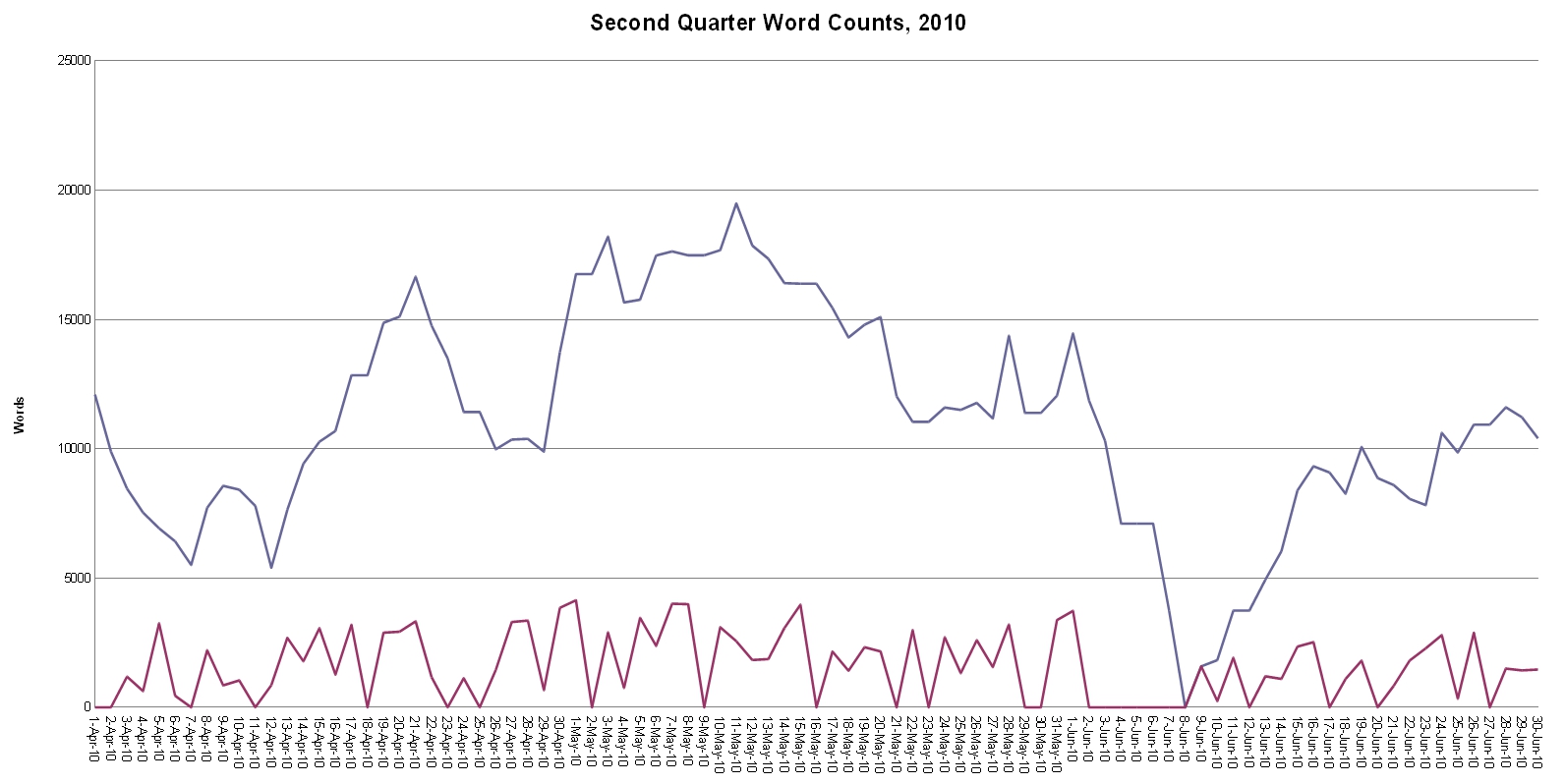
As you may or may not know, I keep a spreadsheet of my daily word counts.  Nerdy, I know, but you’d be surprised how helpful it can be with keeping goals and staying motivated.  As part of that, I’ve decided to do a quarterly report here on my blog.  Here’s my report for April 2010 through June 2010:

The red line shows my daily word count, and the blue line shows a running 7-day total.

At the beginning of April, I was somewhere in the middle of writing Mercenary Savior 3.0. I was also in the middle of a long and strenuous debacle with BYU’s Washington Seminar.  Long story short, I got kicked out under disputed circumstances.

Anyway, that explains the sharp dip in the first couple of weeks.  I returned to my parents’ house in Massachusetts on April 6th and spent a week there before moving out to Utah; that explains the short lived bump from April 6 to April 12.

So three weeks before graduation, I came back to Utah with no job, no apartment, no transportation besides my own feet–nothing.  Fortunately, some friends helped me out, and for the rest of April and most of May I at least had transportation (bike) and a roof over my head.

Without a job, I had lots of writing time, and I used it well, as you can see.  The sharp dip at the end of April corresponds with graduation, when all the family was over and I was spending most of my time with them.

Things dropped off the second half of May, though, and I’m not sure why.  Perhaps it was writing fatigue?  I was coming up on the end of Mercenary Savior, and as I remember, the revision was fairly tough.  Also, I was stressed out about not having a job, and spent much of my free time looking for work.  I found my current part-time job at the end of May, and had a few spikes, but my output never totally recovered.

As an experiment, I took a week off from writing after finishing Mercenary Savior on the first of June.  I thought that this would help me recharge my creative batteries and get off with Worlds Away from Home on a good start.  Instead, I found that taking the time off made it harder to get back into creative writing mode, and so I struggled for the first week or two to really get that project off the ground.

Lately, I’ve been trying to bump up my output above 10k per week, without much success.  For some reason, I seem to have fallen in a rut where I can’t write more than 2k per day.  2k is good, but it’s not the level where I want to be.  I want to finish Worlds Away from Home in the first couple weeks of August, so that I’ll have plenty of time to polish Mercenary Savior for World Fantasy in November.

I think that part of the problem lies in the nature of the work.  Mercenary Savior was all straight up revision, with very little new content.  Worlds Away from Home, however, involves a ton of new content.  Yes, I’ve got all that stuff I wrote back in the fall of 2008, but I’ve also added a new viewpoint character and significantly changed the basic storyline.  Only about half of the old stuff is recyclable, and I’ll run out of it in 100 pages, roughly at the midway point of the novel.

After revising for so long, it’s hard to get used to writing a first draft.  I’m not sure how to describe it, except that it takes a lot more mental energy–a LOT more.  Plus, there’s always the nagging voices that tell you what you’re writing is crap–and when you’re writing your rough draft, the voices are usually right!  Tuning them out is starting to be a challenge.

Overall, though, I’m very optimistic.  My main goal is to produce one solid, polished novel a year, and I’m still on schedule to accomplish that.  Mercenary Savior requires AT LEAST another revision before it’ll be good enough to send out to editors and agents, but I’ve got half a year to do that.  As for 2011, I’ll almost certainly have the first or second draft of Worlds Away from Home before January 1st.  Things are going well.

And on that note, I think I’m going to take a shower and go to bed.  Night.

Take me to Arabia

Recently, I’ve found myself nearly overwhelmed by the sudden urge to run away to the Middle East and go totally and irrevocably native.  It may pass, but I still want to go back there–really bad.
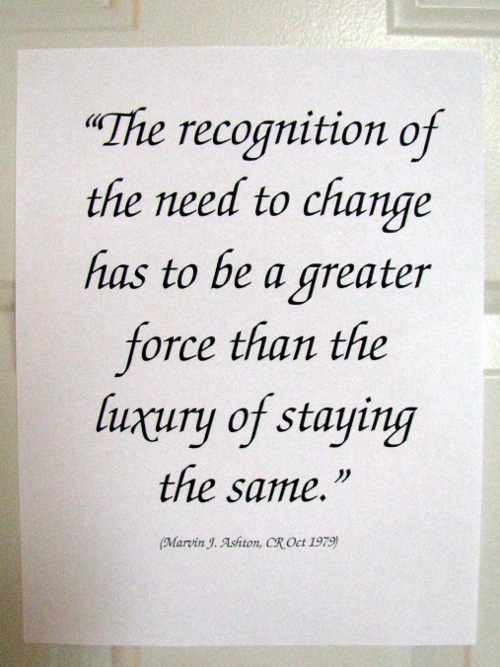
So I looked up BYU’s TESOL certification program, and figured I could apply in January, start fall of ’11, and be on my way to an Arabian adventure in ’12.

Or…I could bypass the whole certification thing altogether, but I’d probably get a crappier job.  Besides, the certification could lead to other things, like perhaps an actual stable day job.  Who knows?

Regardless, I should probably find some way to actually use my Arabic degree.  After all, why did I get it in the first place?  Better put it to use!

So why am I tripping out on Middle East stuff?  Interestingly enough, I think it has a lot to do with the current novel I’m writing, Worlds Away from Home. I started it in fall ’08, just after getting back from BYU’s 2008 Jordan study abroad program, and the influence is definitely very visible.

Sometimes it makes me cringe a little, though; the fictional culture is patterned after my understanding of and experiences with Arab culture, but…it’s very pseudo Arab, if that make sense.  Kind of like it looks Arab, but it feels more Western.  I don’t know–I guess what I’m saying is that it’s bad (or maybe I just think that because I’m in the middle of the rough draft, when everything I write is utter and absolute crap.  Blegh).

But the thing is, if I try to make the culture truly foreign, I’m worried it will be more of a barrier to the reader than a gateway.  In other words, it’s the classic science fiction problem of aliens: the more you succeed in making your aliens truly alien, the harder it is for the reader to understand or sympathize with them.

But then again, isn’t that why we read?  To be transported to different times and places, experience other people and cultures, and be exposed to new ideas?  To expand our minds and enrich our understanding?  If that’s the case, there’s got to be something good and healthy about immersing the reader in a totally foreign culture.

Unfortunately, that doesn’t make it any easier.

Oh well.  I’m up for the challenge.  In the meantime, I’ll keep reading T. E. Lawrence’s The Seven Pillars of Wisdom and continuously loop all my Arab pop.  Not familiar with Arabic music?  Here’s a really good one:

Track 5

(ps: I’d tell you who wrote/performs the song, but frankly I have no idea.  Unfortunately, copyright doesn’t really exist in the Middle East.  Oh well.  Enjoy!)

The need to change

I picked up this sign at institute last Wednesday. The lesson was on our desires; specifically, how the thing that we truly desire deep down is often the thing that we get.

The main reason I posted this sign on the door was to motivate me to get a better job than my current one.  However, it applies to so many other things as well.

Take writing, for example: if I’m going to actually turn this writing thing into a full time career, I’ve got to bust my butt to make it happen.  Writing a paltry 250 words each day on a novel you’ve been working on for the past twenty years just isn’t going to cut it.

I got two form rejections today, and that made me realize that I need to be more serious about submitting my work.  So instead of working of working on Worlds Away From Home, I researched a slew of agents, rewrote my query letter for Genesis Earth, and sent out four carefully prepared and researched submissions.  I don’t want to spend any more time bouncing around from job to job than I have to–I want to break in and make this writing career take off.

So far, I’ve gotten approximately 14 rejections for Genesis Earth: ten form rejections, one personalized rejection, one rejection after the partial was requested, and two that I haven’t heard back on but have been out for so long they’ve probably been rejected.  Interestingly enough, rejection itself is not that hard for me to deal with: it’s building the motivation and nerve to submit to the next place that’s tough.

But I’ve got to do it.  I feel kind of like Hachimaki from the anime series Planetes, who quits his job without taking the severance package when he applies for the Jupiter mission.  If he has the safety net, he knows that he’ll get lazy, so breaks goes out on his own, even sleeping on the streets for a while during the initial tryouts.

I haven’t quite fallen that low yet–I’ve got an apartment, a bike, and a job, even if it’s only a subsistence level one.  But when it comes to long term careers, I’m putting everything into my writing right now–there isn’t anything else.

It’s still discouraging to get rejected, but I’m still very optimistic that things will work out.  Even if everyone rejects Genesis Earth, I’ll have Mercenary Savior ready to submit before the end of the year.  It’s just a matter of time–I just hope it happens soon.

In the meantime, here’s the opening sequence from Planetes.  Such an awesome series–I’d take a job with Debris Section in an instant!  Even garbage collecting is cool when it’s IN SPAAACE!!

An interesting concept

Last night, I was hanging out with a friend of mine and a couple of girls in the apartment complex where I currently live.  We got to talking about books, and one of the girls said something really interesting:

Every book needs to have one thing that the main character knows that the reader doesn’t know, and one thing that the reader knows that the main character doesn’t know; otherwise, it’s too boring.

That’s a fascinating concept.  I know that both things are important, but I’ve never connected them together.

When the reader knows something that the main character doesn’t, it can make for great suspense.  A good example of this is this scene from Xenogears, when the characters are trying to hunt down a monster in the sewers (skip to 6:37):

It’s harder to pull off having the characters withhold information from the readers, but it can be done. I think a good example of this is the scene from Star Wars V: The Empire Strikes Back when the Millenium Falcon arrives at Bespin and C3PO gets shot:

Granted, nothing really vital is withheld here, since by this point Master Yoda has seen Luke’s friends in danger, and Bobba Fett has clearly followed them to Bespin–but the audience still doesn’t know exactly what’s going on, and so it creates suspense.

In terms of Orson Scott Card’s MICE quotient, this would definitely fall under the “information” component of stories. In Brandon Sanderson’s class (and in my own reading), I’ve focused a lot on character, setting (milieu), and plot (event), but I haven’t thought a lot about information.

I wonder how my own novels measure up to this principle. Let’s see…

In Genesis Earth, there are a lot of things that Michael and the reader doesn’t know, but not much that one knows and the other doesn’t. There are, however, quite a few things that Terra knows that the reader doesn’t. Those all come out in the middle, though. In terms of information withheld from the reader, I suppose you could count Terra’s feelings for Michael, in the buildup before the climax, but that’s about it.

In Mercenary Savior, the reader knows a TON of stuff that James doesn’t know–it’s a major source of the suspense in that novel. In terms of things the characters know that the reader doesn’t, there’s much less, but I can think of a few things Danica knows that are kept mysterious until a key climax. Those aren’t foreshadowed until maybe 50 or 100 pages before the reveal, but I suppose it still counts.

Thinking WAY back to my first practice novel, Ashes of the Starry Sea (which I will probably never publish), there is, again, a TON of stuff the reader knows that the characters don’t. Basically, every character is clueless in some crucial way, and the resulting comedy of errors drives the plot. In terms of information withheld from the reader, though, there’s not as much. There is a point where Ian runs off without an explanation, but I’m not sure if that’s just my own poor writing. I could probably pull it off in a revision, but I don’t know when or if that will ever happen.

So yeah, I suppose I’ve done that in my own writing. I suppose it’s much easier to do this in third person, however–Genesis Earth is entirely in first person, and there isn’t anything Michael thinks about that the reader doesn’t see. He is an unreliable narrator at times, but he’s not the character withholding the information–and if he was, I don’t think it would have worked very well.

In any case, it’s a very interesting principle. I’ll have to keep it in mind.