Story Notebook #5 (part 2)

For those of you who don’t know (or can’t remember, since it’s been so long), I’ve been doing this ongoing thing where I go through my old story notebooks.  Last time, we covered my last semester of classes at BYU; this time, we’ll cover my time in Washington DC, when I was trapped in an internship from hell.

Now, you may be wondering: “why is this guy just giving away his ideas for free?” Well, last week at dinner group, the conversation turned to story ideas, so I pulled out my current story notebook and started going down the list.  This quickly turned into a game of “name that tune,” where we managed to show that EVERY SINGLE IDEA had already been done. 

And you know what?  That’s perfectly okay!  There are no original ideas anymore, just new ways of executing them, and maybe a handful of combinations that haven’t yet been tried.  The purpose of keeping a story notebook with you at all times isn’t to come up with something new, it’s to keep track of the stuff that really turns you on.

Enough with that.  On to the notebook.

In a spacefaring culture, the custom will be for the males to leave the station and depart in search of a wife at another port, either to capture or win over in some way.  The women will tend more to running off with the travelers.  This preserves genetic diversity.

This is actually something I want to talk about in a longer post.  The problem of inbreeding in a space-based society is something that many science fiction authors have wrestled with, from Robert Heinlein to C. J. Cherryh.  Their solutions are quite inventive, but while I was in Washington DC working on To Search the Starry Sea (my escapist retreat from a hellish internship), I managed to come up with a few of my own, and used them in Star Wanderers.  More on that later.

What if one of the founders was a time traveler, sent on a mission to ensure that the US constitution made it through?

Hehe…in other words: James Madison, Time Traveler.  It has a certain ring to it, no?

The human mind is like a congress–so many people at extreme odds, arguing constantly but holding together somehow.

Oh boy.  If that were true, the US congress today would be like a paranoid schizophrenic.

A subway haunted by patrons from the past–maybe you will become one when it goes back in time.

Who hasn’t been creeped out by the subway at some point or another?  Except the New York subway system is way creepier than the Washington DC Metro–I swear, some of those rats are man-killers.

A magic system where the cost is your unborn children.  If you don’t have children within a certain period of time, you die.

Sounds like some of the Arab short stories I’ve read.  Families and children are much more important to them than to us in the West.

When the Developed World develops instantaneous transportation devices, it will essentially merge into one super country, while the developing world will be left out.  The only sense of distance will be in the developing world, and terrorism will be an issue.

Kind of like Larry Niven meets dependency theory.

A government where the Supreme Court is a super-intelligent robot.

Hopefully this would rid the country of activist judges…or would it??

A character who believes, at his core, that there is no such thing as a genuine surprise, simply a lack of information–and that if we had perfect information, there would be no surprises.

Sounds a lot like the platonic 19th century ideal of a scientist.  What with quantum physics and such, there aren’t a whole lot of those left.

There are two kinds of shame: shame from loss of honor, and shame from not following the herd.  Don’t mistake the one for the other.

This one isn’t so much a story idea as an observation.  I learned a lot in my hellish Washington DC internship, most of which had very little to do with my area of study and everything to do with the less-than-honorable ways in which the world works.  And on that note:

____ always felt that the world around him was somehow less than real; an illusion.  While staring out the window of the train, he wondered if the window wasn’t just a video screen, like the car windows of old movies–or when looking out at the view of the mountains beyond his house, with the picturesque clouds and too-blue sky, if it wasn’t just an elaborate painting on a wall at the end of the world.  In moments like these, ____ longed to peel back the video screens–to break down the pretty painted wall at the end of the world–and see what lay on the other side of reality.

If my hellish internship on K street taught me anything, it taught me that I would rather be a writer than have all the connections or political influence in the world.  I got out of Washington DC as fast as I could, and haven’t looked back since.
More thoughts on indie publishing

Since my last post on indie publishing, I’ve been thinking a lot about this subject.  I haven’t decided to take the plunge into self published ebooks yet, but I have decided to make some changes in my writing and my career strategy, in order to position myself more favorably if/when I choose to do so.

Basically, my new strategy is something like Japan or Saudi Arabia’s approach to nuclear weapons: they don’t have an explicit nuclear program (since that would violate the nuclear non-proliferation treaty), but they have gathered the equipment, resources, and expertise together so that if they decided to go nuclear, they could do it in a year or less.

First, though, I attended Brandon Sanderson’s class lecture this Thursday, in which he had some very interesting things to say about ebooks and the publishing industry.  This was part I of his “how to get published” lecture, and here are some of the more interesting points he made:

  • Almost all the indie writers who are making it big have at least one loss leader ($.99 or less) on their list.
  • No one really knows whether indie publishing will be viable for large numbers of writers, or whether authors like Amanda Hocking and Joe Konrath are outliers.
  • Successful indie published books are typically:
    1) short (70k to 80k words)
    2) written in a pulp genre (thriller, romance, paranormal, sword & sorcery, etc)
    3) promoted very well through social networking
  • We have not yet seen any indie successes in epic fantasy, young adult / middle grade, historical fiction, or non-fiction.
  • The produce model vs. unlimited shelf space argument for going indie doesn’t apply as much to science fiction & fantasy as other genres, because:
    1) sf&f stays on the shelves in bookstores longer than other genres
    2) sf&f series grow better with a big push on the first book
    3) sf&f makes a lot of money on hardcover, unlike other genres

A lot of these points tend to mesh with what I’m hearing from my other sources–and Brandon really represents the last of the successful writers to make it big on the old model, before the ebook revolution began to take off.  He doesn’t make as big a deal on the current 25/75 split on net ebook sales as I would make, but then again, he’s making most of his money through print.

So anyways, here is what I plan to change about what I’m doing in order to better position myself to best take the ebook plunge, if/when I decide to do so:

1) Write at least 2 polished novels per year

Kris Rusch and Dean Wesley Smith make very good arguments about how being able to write well quickly is a huge asset for a writer these days.

There are many good reasons for this:

1) Writing faster gives you more practice with craft, which tends to improve quality.
2) The best way to promote  your books is to constantly write new books.
3) The limited shelf space argument against writing quickly is now moot with ebooks.

In particular, I want to increase my writing speed in order that I can have a larger list to put out if/when I decide to go with indie publishing.  It’s much harder to be successful if you’ve only got one book available for sale; if/when I decide to take the plunge, I want to have at least three.

So far this year, I’ve finished one (Bringing Stella Home), but that’s because it was already sitting in the queue and only needed a quick touch up.  I would like to get Worlds Away from Home polished before the end of the year, and possibly one other project, such as Edenfall.

2) Reduce production time to as close to one year as possible

Right now, it takes me on average about two years to write a polished, salable novel.  That’s not a problem, because I have a lot of projects in the queue, but it’s not as fast as I would like.  I wrote Genesis Earth and Bringing Stella Home while I was still a journeyman writer, figuring out my craft.  I should be able to produce a lot faster.

Towards that end, I’m going to try to get Edenfall finished and polished within a year.  Since it’s already March, that might mean getting it polished by February of next year, but I still want to try.

My biggest weakness is first drafts; I always tend to get stuck midway and drop the project for a while before I feel ready to finish it.  That’s something I would like to change.  Then again, that might just be part of my writing process, and shouldn’t be forced.  However, I certainly could go through my revisions much faster.

3) Write out the direct sequels while the first book is still unpublished

Previously, I thought it was a bad idea to write out all the books in a series or trilogy before the first one is ever picked up.  After all, a rejection from a publisher on the first book is a rejection on all the other books in the series as well.  Using this reasoning, it was much better to write the first book of another trilogy, in order to maximize how much I could submit at any given time.

With indie publishing, however, it’s much better to release the whole trilogy all at once, so that readers who finish the first book can immediately pick up the others.  Again, the paradigm here is that the best way to sell books is with other books; if they loved the one, they’ll buy the others, especially to find out what happens next.

Of course, the best model is probably to have an open series with several indirect sequels with recurring characters in the same world.  With the Gaia Nova books, that’s exactly what I plan to do: Worlds Away from Home is set in the same universe as Bringing Stella Home, but with different characters and different story arcs.

However, Genesis Earth has serious trilogy potential, and with Edenfall I’ve decided to actually write the other books.  If/when I decide to take the plunge, I want to be able to release at least the first two books in that trilogy at the same time.  In fact, Genesis Earth is perhaps the biggest reason why I’m thinking so seriously about going indie, but that’s a subject for a whole other post.

4) Experiment with pulp genres such as space adventure stories

When Brandon said that the pulp genres tend to do better, I wasn’t sure whether that includes what I write.  I write primarily science fiction, but not the kind of stories you’d read only for entertainment and promptly forget once you’re finished.  If anything, I want to write more like Ursula K. Le Guin, whose stories are so meaningful they stick with you long after you’ve finished them.

Then again, there tends to be a lot of overlap in science fiction between the thoughtful, meaningful stuff and the pulps.  Ender’s Game and Starship Troopers immediately come to mind as awesome, entertaining stories that also have a lot of depth.  In his lecture, Brandon made it clear that “pulp” does not necessarily conflict with high art–just that the primary purpose of the story is to entertain.

I can live with that–and I actually have several story ideas that would translate well with the pulp mentality.  I’d like to do a novel (or a series of novels) with Danica from BSH and her mercenary team, perhaps as a sort of origin story for Roman, Anya, Artyom, and the others.  I’d like to revisit the Hameji as well, with a sort of “Ain Jalut in space” involving Sholpan’s son (BSH was basically the Mongol conquest of Baghdad in space).  I’ve already started an “Odyssey in space,” as told from a female Telemachus character–that’s To Search the Starry Sea.  All of these are, at their core, space adventure stories, and might translate well as pulps.

5) Commit to releasing one book every 6 months if/when I take the plunge

This is related to the first strategy on the list, but it’s more of a business plan than a personal writing goal.  Basically, if/when I take the plunge, I want to:

1) have at least 3 finished, polished books to put out at first,
2) know that I can put out one book every six months at least.

This not only means developing a backlist, it means doing some soul searching as a writer to find out how difficult it is to keep up with this pace–and adjusting my writing habits accordingly.  I’m optimistic that I can, but it’s something of a paradigm shift, and I want to make sure I’ve made that shift before I take the leap.

Anyhow, these are my thoughts on how to alter my current writing strategy.  I haven’t yet decided to go indie, but when the time comes, I think that these things will help me to maximize my potential if/when I decide to do so.

Of course, what do any of us really know?

Quarterly report

So I figure that since I want to write professionally, it would be a good idea to keep track of my writing and do quarterly updates on my blog.  Here’s the first one for this year:

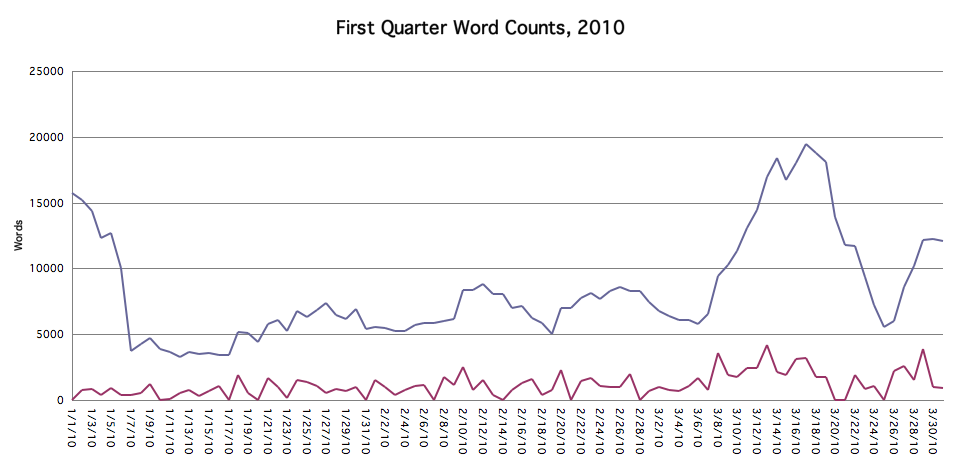
The red line shows my daily writing word count, the blue line a running seven day total.  The graph starts January 1st and goes to March 31st.

For the first part of January, the seven day total was high for a week because I’d just finished Bringing Stella Home 2.0. It dropped down way low for a while because I was busy moving into the Barlow center, starting my internship, and starting a new novel at the same time.  Combining all three of those things at the same time made for very little progress, until about the middle part of the month.

Things progressed at a moderate rate (about 1k words per day) from the middle of January until snowmageddon, which hit us in the second week of February.  I got a lot of writing done while snowed in, and my work in progress at the time, To Search the Starry Sea 1.0, got a lot of momentum behind it.

That momentum started to taper off, as I realized that the story I was writing was different than the story I had in my head.  I swear, this happens EVERY time I try to write a novel.  I tried to stick with the story in my head, but the gap got wider and wider until I realized the story just wasn’t working.

At the end of February, I decided to put it on the back burner and let my ideas simmer for a while.  I’ll probably pick it up again at some point in the future, but not in the short term–I need to put it away for a while.  I’m sure I’ll finish it someday, though.

So then, in the beginning of March, I went through all the comments I’d received on Bringing Stella Home.  The HUGE spike you see right around the middle of the month represents all the revision notes I put together for the 3.0 draft.  I read through the entire manuscript in about a week and a half, made a detailed scene by scene outline, and figured out my strategy for the revision.

Things dropped off again pretty sharply the last couple weeks of March because that was right around when I was fired from my internship.  That was one hell of a stressful week.  They picked up pretty quick after that, though, because 1) I had a lot more free time, and 2) I’m REALLY excited about this project.

Looking ahead, I think if I push myself, I can finish Bringing Stella Home 3.0 by the end of April.  It will be difficult because I’ll be looking for an apartment and a job at the same time, but after next week I won’t have to worry about schoolwork anymore (potentially for the rest of my life…whoa).  Definitely, I’ll have it done in time for CONduit 2010.

One thing I need to work on a lot more is submitting.  I’ve got a list of agents to submit Genesis Earth to, I just haven’t got around to sending it to them all.  The responses I’ve received have been generally encouraging: all rejections, but about half form rejections, half personalized in some way.  I do think this book will find it’s way in print, though it may not be my first to be published.

Even though Bringing Stella Home will probably need at least one more major revision before the full manuscript is ready to be sent out to editors/agents, I can probably polish the first three chapters enough to shop it around sometime in May.  I’m not sure if that’s what I’ll do, but it’s an option.  It depends on whether I jump right in to the 4.0 revision after finishing the current draft, which I probably won’t do; better to let it sit for a while.

Instead, I think I’ll jump right in to finishing that novel I started in late 2008, Hero in Exile.  The title will have to change (as always), but I’ve got a lot of fresh ideas for it, plus the enthusiasm to pull it off.  In many ways, Hero in Exile is a non-linear sequel to Bringing Stella Home, so if I get a deal with the one, I can always pitch the other as the next in the series.  That’s a huge plus–and a major reason why I’ll be enthusiastic about the project, since the two novels build off of each other.

Anyway, that’s what things are looking like from here.  Somewhere in the middle of all that, I’ll read a couple of friends’ novels (I haven’t forgotten about you, Jakeson and Drek!), graduate, get an apartment, get a job (inshallah), write an article for Mormon Artist, go to a con or two, and maybe even get a girlfriend and/or figure out what to do with my life.

Old story notebook–found!

Guess what?  Last night, when I was looking through old boxes at my parents house (looking for my old ratty copy of On My Way to Paradise, specifically) I found my very first story notebook–the one I thought I’d lost on the Jordan study abroad two years ago!

Wheeeeee!!!

This notebook is a real gold mine–not just of story ideas, but of some of my oldest thoughts on writing.  I started keeping it back in the 90s, long before my mission.  I kept it up sporadically for a little while, but it really took off in 2007 when I decided I was going to pursue writing professionally.

For the 07-08 school year, I kept this notebook with me all the time.  I had a huge burst of story ideas as I finished my first novel, and I wrote the majority of them in here.

When the summer came around, I got a couple new notebooks in preparation for the study abroad.  Later, when I was established in the homestay, I searched everywhere for this notebook and couldn’t find it.  I thought it was lost.  The whole time, it turns out, it was in my shoebox of momentoes in Provo.

Wheeeeeee!!!!!!!!!!!

Ahem.  So now, without any further ado, let’s go through this thing.

A boy learns how to consciously control his dreams and visit other people in theirs.

For a long time, this was my one big idea–the one that I was sure would turn into a fantastic book and make my entire career, if I could just keep it secret long enough to write it. It’s a pretty good story idea, but I’ve got so many other, better ideas by now that I’m not too concerned about making it public.

A girl falls overboard from a colony ship and is stranded on an island.

Kind of like a female Robinson Carusoe, I guess. I actually wrote the first fifty pages of this story, in the summer before I left for my mission. Never finished it, but at least I ran with it.

A secret organization of warriors fights to keep a mysterious enemy from taking over the land.

Hehe, sound familiar? I think every other fantasy story has some kind of subplot like this.

A kidnapped girl fights to make her way home.

Kind of like the Odyssey, but with the genders reversed. Hmm, maybe I haven’t changed all that much…

A band of foreign, elite warriors sells their services to a population, then slowly begins to corrupt the society’s morals to satisfy their lusts.

Kind of like Seven Samurai meets Ibn Khaldun.

Two brothers find themselves fighting for opposing armies.

Already done: Gettysburg, the movie.

A general fights to save his people and then his daughter is kidnapped by asymmetrical terrorists.

I’m not sure what the significance is with the terrorists–maybe conventional warfare vs. asymmetrical warfare or something like that.

The next few are all ideas for non-science fiction stories; I tried to brainstorm as many of them as I could, in case (for some absurd reason) I decided to write mainstream fiction. I’ll give them all at once:

A guy finds a girl and they click, but he has to convince her that the people she dates are bad for her (which is true).

A guy and a girl go on a road trip to find out more about themselves.

A guy tries to improve himself to attract a girl, then discovers he’s not interested.

A boy is chauffering people around and doing errands, then finds a life-changing thing.

A homeless runaway is taken in by a wise truck driver and learns to reconcile himself with the world.

A boy goes on a road trip to do research to reunite a dying relative with an old friend.

Moral of the story: If it’s not science fiction, it’s got to involve a road trip. Otherwise, it’s dead boring.

A soldier away from home makes his way back to his country, which has fallen into warlordism, and tries to rebuild his life and his homeland.

This was the novel I tried to write the year after my mission. It tanked really bad, but it got me to the point where I could write Ashes of the Starry Sea and actually finish it. If I were to try this idea now, I would take it in a completely different direction than I did then.

That concludes all the ideas in the notebook before October 15, 2003. The notebook then took a hiatus until the summer of ’07, which is where I’ll pick up next time.

Major project shift

I’ve got this goal to finish my current work-in-progress, To Search the Starry Sea, by May 1st 2010.  However, the deeper I get into the story, the more I realize how many problems it has–how much it sucks, in other words.

Normally, this wouldn’t keep me from dropping the project or putting it on hold.  It happens with every rough draft (or second or third draft, for that matter); midway through every project, I start to get all angsty and worry that the project sucks, that it’s beyond saving, that I’m wasting my time, etc.

However, this time it’s different for a number of reasons.

First of all, the story itself doesn’t suck. However, it does have a weak beginning and a poor setup, which makes it very difficult to develop the middle section.  With better conflict foreshadowing and character introductions, I could tear right through this section, but without that, I’m floundering more and more.

A couple months ago, I started to realize this, so I started a set of revision notes for the next draft.  My thought was “if I know the story needs changes, rather than going back and changing them, I can just make a note of them and move on.”

However, that approach isn’t working because the unwritten changes aren’t impacting the story as fully and completely as they would if I’d write them out.  If the changes were minor, I could let them go–but when they have to do with something fundamental, like setting up a romantic subplot, or turning a minor character into a major character into a major viewpoint character, I can’ t just make a note of the change and move on–I need to write the thing to see what it changes.

In other words, I need to restart this project from the beginning.  But if I do that while I’m still angsty about it, it’s going to end up like crap.  I’ve got to let it sit for a while.

It’s frustrating, because I really want to finish a straight draft from start to finish.  For both Genesis Earth and Bringing Stella Home, I only finished the rough draft after dropping the project for a while and restarting it at the beginning.  If it works, I guess it works, but it would be nice if the creative process were more linear.  Blegh.

All is not lost, however.  Most of my first readers for Bringing Stella Home have gotten back with their feedback, and it’s been extremely helpful.  I’ve got a clear direction and lots of ideas for where I want to take that story, and now that I’ve spent some time away from it, I can honestly say that it doesn’t suck all that bad.  In fact, after a lot of work, it might actually be decently good.

There are several reasons why it makes sense to work on Bringing Stella Home right now.  For example,

  1. I’m excited about it.  Better to capitalize on that now than wait until after the enthusiasm has died.
  2. I’ve got lots of ideas flowing to me now.  I could try to write them all down for later, but why not try them out now, while they’re still fresh?
  3. I’m sending Genesis Earth out to a bunch of places, and the rejections are starting to come in.  If I can respond to a rejection by sending out a second book in a timely way, I will look much more like a professional, and the agents/editors will take me more seriously.

My goal was to have To Search the Starry Sea done by May 1st.  Let’s see if I can do Bringing Stella Home 3.0 (and yes, the title will change) by that day instead.  And if that proves too difficult, what with graduation, internship, looking for work, and figuring out life, at least I can reach the halfway mark by then.

So that’s my new goal: Finish Bringing Stella Home 3.0 by May 1st, 2010 (or at least be halfway finished). To do that, I’ll have to read through all the comments by the end of this week and have the revision notes all figured out.

Better get started!

Gah! It sucks

I’m about a third of the way through To Search the Starry Sea, and my greatest fear at this point is that it isn’t as good as the last novel I wrote.  Because if it isn’t as good, that means that I’m getting worse, not better, and if I’m getting worse, that means I’m never going to make it as an author, because I’m not even published yet, and if I’m not going to make it as an author, that means I’m going to have to do what I’m doing NOW for the rest of my life, which means that I’m going to be miserable and life is going to suck…

<pant> <pant> <pant>

Seriously, though, sometimes I wonder if I’ve really made the right choice.  To Search the Starry Sea is much more of a happy adventure story, but sometimes I feel that it lacks depth and meaning.  I’m starting to get feedback from my alpha readers for Bringing Stella Home, and their reactions to it are surprisingly encouraging.  That story moved people–but this one?  I don’t know.

Then again, Bringing Stella Home is dark, gritty, and very tragic.  I remember feeling depressed by the story even as I wrote it.  Is that the kind of story I want to be known for?  If I can write something deep and meaningful and have it be optimistic and adventuresome, that would be a lot better.

I’m discovery writing it hardcore, which means that side characters often come to play a much more central role than I’d thought, and events that I thought I could cover in a chapter, I have to cover in two.  I have an idea where the story is going to end up, though, and it’s going to be awesome. How awesome?  Let me show you:

Yeah, it’s going to be awesome.

I think the key to keeping it meaningful is 1) to keep in mind the main character’s inner conflicts, framing them in a way that the readers can relate to their struggles, and 2) keeping the overall growth arc constantly in mind.  How does what’s happening affect how the character is changing?  That kind of stuff.

I hope I can finish this in two months.  I’m mired in the middle of it right now, and the end is far from sight.

In the meantime, I think I’ll get some sleep.

Snowmageddon! Hooray!

So for the past week, a series of crazy snowstorms has been pelting the Mid-Atlantic.  President Obama has dubbed it “snowmageddon,” and it’s so bad that all federal government offices have been closed since Friday.  With another storm hitting us tonight, it looks like we’re going to have the whole week off! Yay!!!

So, for the past couple of days, I’ve been hanging out around the Barlow Center, watching movies, doing random stuff with my friends here in the program, taking naps in the middle of the day, and writing.  Lots of writing!  It’s awesome–I haven’t had this much free time since Christmas (which wasn’t all that long ago, but still…)!

Today I didn’t write quite as much.  I got in about 1.1k words, a decent amount, but if I’d pushed myself I could have finished the current chapter.  Monday went much better, because I sat down and forced myself to write in the morning.  Once those initial hundred or so words were out, the rest came much easier.

On the first day of snowmageddon, when we were snowed in at Valley Forge, I got in over 1,000 words before noon.  It was rough going, though–nothing was flowing, and everything took a lot of effort.  I hate it when that happens–blegh.

But I think it was necessary, because now, the scenes are flying by pretty easy.  Sometimes, when I’m struggling with momentum, I find it helps if I take a day to focus and push myself through it.  Get rid of all distractions, put my butt in the chair, close all internet browsers, and just write, no matter how difficult.

My next novel, To Search the Starry Sea, is going to be a lot of fun.  It starts out almost exactly like Homer’s Odyssey, with the same basic conflict and setup.  Beyond that, however, I have nothing solid planned–I’m just following where the story takes me.  And boy, is it taking me to some crazy places!

For example, one of the first places Katriona (the Telemachus character) goes is a nearby world, ruled by a friend of her father’s.  To liven things up, I decided to have him live on a giant rotating space station, where the inside is covered by forests and jungles–scenery that Katriona has never seen.

This got me wondering, however: how did the jungle get there?  The answer: thousands of years ago, before superluminal space travel, a group of colonists set out for this world, freezing themselves in cryo.  When they got there, they found that a solar flare-up had rendered the planet uninhabitable, so instead they built this massive station, hoping that it would serve as a second ark for humanity.

Instead, a raiding party of space barbarians took them over, enslaved the colonists, and built their palace in the midst of the carefully maintained artificial biosphere.

This opened up a series of new possibilities for subplots, which shapes my protagonists interactions with the people here, which points her in new directions for the main plot–the next few places that she’s going to go.

This is discovery writing at its best.  Even though I have no clue where she’s going to go next, things are unfolding very nicely, and I’m excited to find out!

Quick worldbuilding question

For To Search the Starry Sea, I’m writing from the point of view of a far future starfaring culture completely independent of Earth. They’ve preserved our concepts of “hour,” “day,” and “year,” but these units of time do not correlate in any way with the revolutions of the worlds on which they live (basically, a set of tidally locked moons orbiting a gas giant planet several AUs from its sun).

The people of this culture use terms like “morning,” “evening,” “day,” and “night” to describe their waking and sleeping cycles, but having been cut off from Earth for so much time, they don’t associate these times with the position of the sun.  In order to convey that this is different, I’m thinking of spelling “afternoon” like “afternune,” to show that there’s been some cultural drift since the migration from Earth.

Does that work?  Or if  you had to read “afternune” instead of “afternoon,” would it completely throw you out of the story?

Or am I just not making any sense at all?

Stuck in a scene

I’ve been stuck in the same scene the whole week, and I really wish I could get it over with so that I could move on to other stuff.  What that other stuff is, exactly, I don’t know, but I’m eager to find out.

I don’t plan things out much when I write.  Usually, when I do think about where I want the story to go, I think ten or twenty steps down the road, painting in broad strokes where things are going to end up.  It’s like Paul Atreides’ foresight in Dune; time is like an ocean where you see a few isolated events like cresting waves, but you can’t see all the stuff in between.

I’m really annoyed because this scene is so long, but in some ways it has to be long.  I’m introducing some of the major characters, the major story conflict, introducing setting and cultural elements, etc etc.  Most of what I’m writing is crap and will probably be significantly edited,  but I’ve got to at least get it out there first.  But it’s hard to do that when you’re only averaging 500 words a day.

I’m going to take advantage of the holiday tomorrow by finishing this scene, no matter what it takes.  Hopefully that will build some momentum that will carry for the rest of the week.

Also, I sent out Bringing Stella Home 2.1 to a bunch of first readers.   I wasn’t originally going to do it, since it’s pretty bad…but Kindal kept begging me to read it, so I figured what the heck and sent it out to half a dozen other people as well.  It’s probably for the best…though, after reading over some of the more violent scenes, I hope the girls I sent it to don’t think less of me after reading it.  Holy crap, it needs a lot of work.

Anyways, in tribute of MLK day, I’ll end with this awesome tribute to Martin Luther King by U2. Happy MLK day!

Trading old hangups for new ones

So I started my internship with the Washington Institute for Near East Policy last week, and it’s been quite interesting.  Trying to figure out the new routine while starting a new novel has been quite challenging, but somehow, I’ve written at least something every day (except Sunday–I try not to write Sundays now).

I can tell, though, that it’s going to be just as difficult to juggle writing and work as it’s been to juggle writing and school.  There is NO room for procrastination–when I succumb to other things on my to do list instead of forcing myself to pound out the next scene, the day goes by and nothing gets written.

There is one thing I’ve been putting off for almost a month, though, and that’s the query letter for Genesis Earth. I recently received a very encouraging rejection letter from Eddie Schneider, where he basically said “this is good, but I’m not the right agent for it because it doesn’t excite me enough.”

I’ve written the book, polished it, made the writing solid–now, all I have to do is find an agent who’s passionate enough about it to take the project on.  That’s the last hurdle–most of the difficult work is already finished!  All I have to do is write a solid query letter and send it to the dozen or so agents I’ve researched…but yeah, I’ve been putting it off.  Query letters are…difficult.

For that reason, I’ve decided to set a new goal: submit Genesis Earth to at least 12 agents/editors by February 1st.

The only way that’s ever going to happen is if I write a query letter in the near future–as in, sometime this weekend.  When I do, I’ll post it up here and ask what you think.  Queries are very tricky–they are extremely different from novels, and otherwise good writers often botch them up.  We’ll see how this one goes.

So look out for an “I need your help!” post here in the near future!  Thanks!