For several years, I would publish a new, free short story every month, keeping about six of them up at a time and unpublishing an old one every time I published a new one. I was able to do this because I was constantly writing short stories, in order to submit to the traditional short story markets (Asimov’s, Analog, Clarkesworld, etc). Typically, each story would go on submission for a year or two, and if it didn’t get picked up by a professional or semi-pro market, I would just publish it myself.
All of that changed in 2023 when I decided I was done trying to pursue the traditional short story markets. When I landed a story in the conservative (or at least anti-woke) anthology Again, Hazardous Imaginings, and that story (“The Promise of King Washington”) was reviewed favorably on the conservative review site Tangent Online, I saw a marked rise in my rejection rate—and all of them form rejections, too (about 10%-15% of my rejections were personalized before this, which typically indicates that an editor likes your writing but doesn’t want that particular story).
It was at that point that I realized that every professional short story market (and most of the semi-pro ones) is ideologically captured, and that my odds of getting published as a straight white male conservative were essentially zero. So I stopped writing short stories, and in 2025, after cycling through the last story from the submission queue, I unpublished all but one or two of my free short stories and discontinued the series.
The free short stories used to make up the backbone of what I like to call the “Vasicek Free Library.” I patterned it after the Baen Free Library, and it’s basically a list of all of my free books, including permafree first-in-series like Brothers in Exile and, of course, the free short stories. It’s basically a way for readers to sample my writing, and hopefully go on to buy some of my other books.
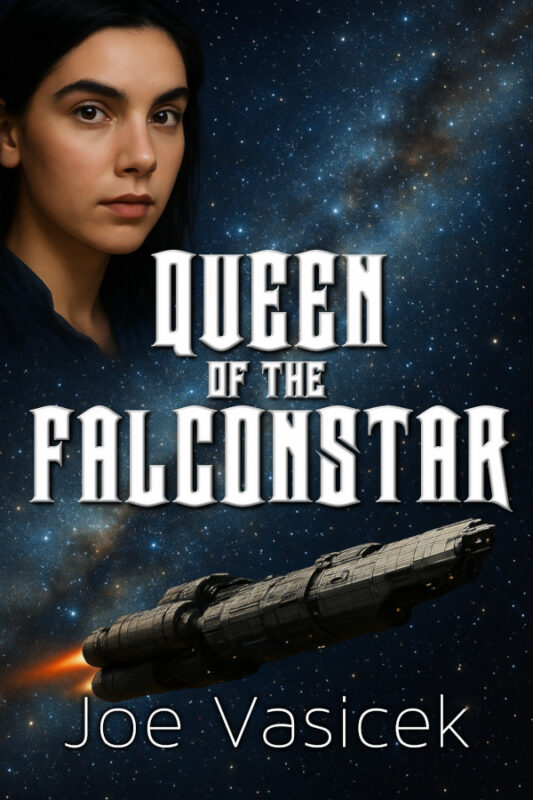
Long story short, I have decided to bring back the Vasicek Free Library, this time not just with short stories, but with a rotating selection of standalone longer works, too. I’ve got about half a dozen standalone novellas and novelettes, plus a couple of novels like Queen of the Falconstar where I’m currently writing the sequels. I’m going to rotate slowly through those, keeping each one free for a few months, and also rotate through my back catalog of 60+ short stories similar to how I was doing it before. And I plan to do this for the foreseeable future.
They say that authors should never respond to one-star reviews. That’s generally good advice, and for most of my career, I’ve studiously kept it. However, I’ve recently begun to get a new kind of one-star review that baffles me—reviews that essentially say: “the book was good, but it was written with AI so I hate it.”
Here’s an example:
This book is written with AI. Incredibly disappointing as a reader to give a book/author a chance and then to get to the end of the book only for the “author” to then announce the AI card. If I could give zero stars, I would for this alone. I also didn’t appreciate that this use of AI was not announced until the ending Author’s Note. If “authors” are going to cut corners and put their name to computer-generated mush, they should be willing to put that information on the front cover. The book struggled to find its pace, and some parts read as though they were written for a child’s short story competition while others felt as though the writer was snorting crushed up DVDs of Pirates of the Caribbean as they wrote.
Let’s break it down:
This book is written with AI. Incredibly disappointing as a reader to give a book/author a chance and then to get to the end of the book only for the “author” to then announce the AI card.
Yes… but I can’t help but notice that you got to the end of it. In other words, you finished the book. Also, from the way you tell it, it seems that you didn’t realize the book was written with AI until you got to the very end. So based on your own behavior, it doesn’t seem that quality was the issue.
I also didn’t appreciate that this use of AI was not announced until the ending Author’s Note. If “authors” are going to cut corners and put their name to computer-generated mush, they should be willing to put that information on the front cover.
Okay… but if my book was just “computer-generated mush,” why did you finish it? And why were you surprised when you learned that it was written with AI-assistance?
I can understand the objection to books that were written solely with AI, with little to no human input. But that’s not how I write my AI-assisted books. Instead, I outline them thoroughly beforehand, write and refine a series of meticulously detailed prompts (usually using Sudowrite), and generate multiple drafts, combining the best parts of them to make a passable AI draft. And then I rewrite the whole thing in my own words, using the AI draft as a loose guide with no copy-pasting.
Why would I go through so much trouble? Because of how the AI drafting stage gives me a bird’s eye view of the book, allowing me to identify and fix major story issues before they metastasize and give me writer’s block. Before AI, that’s where 80% of my writer’s block came from, and it often derailed my projects for months, so that it took me well over a year to write a full-length novel. But with AI, I’m no longer so focused on the page that I lose sight of the forest for the trees. So even though generating and revising a solid AI draft adds a couple more steps to the process, it’s worth it for the time and trouble that it saves.
That’s the way I use generative AI in my writing process. But there are many other ways—and I hate to break it to you, but most authors use AI in one way or another. If an author uses Grammarly to fix their spelling and grammar, should they disclose that on the cover? If they use MS Word? What if they used a chatbot to brainstorm story ideas, but went on to write it entirely themselves? Should that also be disclosed?
The book struggled to find its pace, and some parts read as though they were written for a child’s short story competition while others felt as though the writer was snorting crushed up DVDs of Pirates of the Caribbean as they wrote.
Yes… but again, I can’t help but notice that you finished the book. And after you finished it, you were surprised to learn that it was written with AI. So with all due respect, I’m going to call BS on your objections here. I think you only decided you hated the book after you learned it was written with AI, and you came up with these objections after the fact. Whatever.
I think a lot of the people who object to AI are really just scared and angry. They claim to have principled, ethical objections to the technology, but few of them follow through to implement that principled stance into every area of their lives. After all, if you use Grammarly, Google Docs, or MS Word, you are using generative AI just as surely as I am using ChatGPT and Sudowrite. For most people, the ethical objections are just a smokescreen for their general fear of change. They’re fine with embracing the convenience the technology offers them in their own personal lives, but they insist that everyone else—including me—live according to their principles, no matter how inconvenient or difficult it may be.
As an example of that, check out this one-star review:
The arts! Whether visual, performance, or literary—my haloed experience has been the act of creating and sharing a connection to the profound or sublime. Why, then, would any artist—musician, dancer, sculptor, painter, or author—offload (abdicate) the act of creation to AI? Process versus product. Mr. Vasicek included an afterword for this volume, describing his workflow and the efficiency of collaboration with AI: a 6,624-word day! another volume completed! Mr. Vasicek obviously owns the skills to weave rich character development and scenes. Perhaps Mr. Vasicek’s AI collaboration explains why these characters, the plot, the narrative—and subsequently, the entire story— are so flat and undeveloped. Although his lead male shows some undeveloped promise, the mother’s too-oft used “dear” and “my love,” and the daughter’s clutching at her mother’s apron are cringe-inducing. Perhaps Mr. Vasicek might eschew AI-assisted writing, seeking a future of quality over quantity.
Let’s break it down:
The arts! Whether visual, performance, or literary—my haloed experience has been the act of creating and sharing a connection to the profound or sublime. Why, then, would any artist—musician, dancer, sculptor, painter, or author—offload (abdicate) the act of creation to AI?
Because for some of us, writing is more than a “haloed experience”—it’s an actual job. It’s what we do for a living. And if you want to do your best work, you need to use the best tools. We used to build houses with plaster and lath and wrought-iron nails, using hand tools and locally-sourced lumber. But today, you’d be a fool not to use power tools and materials sourced from a building supply store, or your local Home Depot. If that makes your building experience less profound or sublime, so be it.
Process versus product. Mr. Vasicek included an afterword for this volume, describing his workflow and the efficiency of collaboration with AI: a 6,624-word day! another volume completed!
I’m not gonna lie: there is a certain degree of tension between art-as-product and art-for-art’s-sake. But the two are not mutually exclusive. A house can still be a beautiful work of art, without taking as long as a cathedral to build it. Likewise, a book can still be a beautiful work of art, without taking as long as Tolkien’s Lord of the Rings.
Again, you’re trying to pidgeon-hole me into your “haloed” idea of what a “true artist” should be. Which would make it absolutely impossible for me to make a living at this craft. If all of us writers followed that path, there are a lot of wonderful books that would never get written. And I doubt that the overall quality of the books that do get written would rise.
Mr. Vasicek obviously owns the skills to weave rich character development and scenes.
Now we get to the interesting part. I checked this reviewer’s history, and this was the only review they’ve written for any of my books. Therefore, I can only assume that this is the only book of mine that they’ve read. But if that’s the case, how do they know that I have “the skills to weave rich character development and scenes”? If the book I wrote with AI was pure trash, why would they say that I obviously have some skill?
Once again, we’ve got a case of “I enjoyed this book, but it’s written with AI so I hate it.” In other words, it’s not the book itself that you hate, so much as the way I wrote it. You object to the idea of authors using AI, not to what they actually write with AI.
Perhaps Mr. Vasicek’s AI collaboration explains why these characters, the plot, the narrative—and subsequently, the entire story— are so flat and undeveloped. Although his lead male shows some undeveloped promise, the mother’s too-oft used “dear” and “my love,” and the daughter’s clutching at her mother’s apron are cringe-inducing.
Finally, some specific and legitimate criticism. And while I do think there’s a degree of retroactively looking for faults after enjoying the book, I’m totally willing to own that these criticisms are valid. This particular book (The Widow’s Child) was one of my first AI-assisted books, and I was still learning to use these AI tools as I was writing it. I did the best I could at the time, but if I were to write it today, I could probably do a lot better, smoothing out the annoying AI-isms that you’ve pointed out here.
But the book is currently sitting at 4.4 stars on Amazon (4.1 on Goodreads). And the other readers do not share your objections. Here is another review, pulled from the same book:
Since waiting a year or more to read the next book in a sequel is hard on my stress levels, I’m liking this AI. It means talented authors like Joe Vasicek can churn out an outline faster. Then he can bring in his talented ideas, such as the content of this heart-stopping adventure of The Widow’s Child, to fill out the nitty gritty in record time.
Clearly, it’s not the case that all (or even most) readers feel the same way about AI as you do.
Perhaps Mr. Vasicek might eschew AI-assisted writing, seeking a future of quality over quantity.
Why can’t we have both? Why can’t we have quantity with quality? Why can’t AI make us more creative, instead of replacing our human creativity?
This is all giving me flashbacks to the big debate between tradition vs. indie publishing, back in the early 2010s. Back then, the debate was between purists who said that indie publishing would destroy literature by flooding the market with crappy books. Indies argued that removing the industry middlemen would create a more dynamic market that would give readers more choices and allow more writers to make a living. Both were right to some degree, and both were also wrong about some things. In the end, we reached a middle ground where “hybrid publishing” became the norm.
The same kind of debate is happening right now between human-only purists and AI-assisted writers. The biggest difference is dead internet theory. In the early 2010s, the ratio of bots to humans on the internet was still low enough to allow for a lively debate. Today, there’s so much bot-driven outrage on the internet that most of us are just quietly doing our own thing and avoiding the debate.
That same bot- and algorithm-driven outrage is driving a lot of peole to be irrationally angry or afraid of AI. With that said, I can understand why so many people are upset. And I do think there are a lot of valid criticisms about this new technology, including its environmental impact, copyright considerations, how the models were trained, and the societal impact it’s already starting to have. But if we don’t have an honest and good-faith debate about these issues, we can’t solve any of them. And we can’t have a good-faith debate if one side is coming at it from a place of irrational anger or fear.
In any case, I find it super annoying when readers who clearly found some value or enjoyment in my books turn around and give it a one-star review merely because they don’t like how I used AI. And at the risk of going viral and soliciting more one-star anti-AI reviews, I think its worth voicing my views on the subject and opening that debate. So what are your thoughts on the subject? How do you feel about using AI as a tool to help write books? Can we have quantity with quality? Can AI help us to be more creative, not just more productive? What has been your experience?
What sort of books are fantasy readers looking for today? What are the expectations that readers have for the genre?
Overall, the fantasy genre is growing. Sales are up, both in traditional and indie publishing, and the big names in the field (like Brandon Sanderson) are doing quite well. It’s clear that the fantasy genre as a whole is robust and healthy.
When you break it down by publishers and subgenres, however, things start to look a little different. Romantasy is dominating the traditional publishing world, but most of it is little more than pornography for women, dressed up with fantasy trappings. And because of how traditional publishing now relies on a few big blockbusters to make most of their earnings, romantasy is sucking all of the oxygen out of the room, making it much more difficult for debut and midlist authors in the other fantasy subgenres.
In the world of indie publishing, litRPG has begun to demonstrate some staying power. It was the new hot thing back in the early 2020s, but it’s attracted enough attention and developed enough of a following that it has become a major subgenre that is likely to endure for some time. I could be wrong about that, but from what I see, that’s where most of the innovative authors and whale readers (ie >1 book per week) are focusing their attention these days.
But because of the way that the algorithms tend to govern the indie publishing cycle (and the way that indie publishing has unfortunately turned into a zero-sum, pay-to-play game with online advertising), the rise of litRPG in the indie publishing world may very well be sucking all of the oxygen out of the room in the same way that romantasy is sucking it out of the traditional publishing world.
Both subgenres are also very gender-biased, with women gravitating toward romantasy and men gravitating toward litRPG. This reflects the broader social and political trend of men and women going separate ways, across a whole host of different metrics. So as the gender divide continues to widen in society generally, that will probably reinforce the divide between romantasy and litRPG, creating a positive feedback loop (or death spiral, depending on how you look at it).
Sword and sorcery continues to do okay, and has probably been given a boost by the recent release of Conan the Barbarian into the public domain. But most of sword and sorcery got siphoned off into grimdark back in the 00s—in fact, you could say that sword and sorcery reinvented itself as grimdark. And while grimdark has resisted the feminization of literature, standing as one of the few remaining bastions where male readers continue to feel at home, I think grimdark has already passed its peak. In a post-pandemic, post-Trump world, I think most readers are hungry for books that are less nihilistic and more uplifting.
Which brings us to epic fantasy. While Brandon Sanderson continues to dominate this subgenre, with his massive kickstarters and huge book releases, it’s debatable whether his readers are hungry for more epic fantasy, or just for more Brandon Sanderson. He’s kind of a subgenre all to himself. Recent streaming adaptations like Wheel of Time and Rings of Power have failed miserably, and Game of Thrones has fallen almost totally out of cultural significance, with George R.R. Martin’s failure to finish the last book (and Patrick Rothfuss’s failure to finish his own series) becoming something of a meme.
In fact, the failure of these two big-name authors to finish writing their books may have struck epic fantasy a mortal wound. Because of how they have been burned, a large number of epic fantasy readers are now unwilling to commit to a series until after it is complete. But very few authors can afford to write a truly epic series and release the whole thing at once. It takes several years to write a series like that—and what are authors supposed to do if the first one flops?
In other words, debut epic fantasy authors are damned if they do, and damned if they don’t. If they release the first book by itself, it will probably sink into obscurity before they can write and release the next book. And if by some measure of hard work and tenacity they manage to write a whole series and hold back from publishing until they’re ready to release it all at once, if the first book still fails to sell, they’re SOL and all that hard work was for nothing.
This is also why traditional publishers are so unwilling to publish a new epic fantasy series from a debut or a midlist author. A bestseller like Larry Correia might be able to dip his feet in that pond (and do quite well—I highly recommend his Sons of the Black Sword series), they won’t do that for anyone else. Which is fine, except that indie publishing epic fantasy is just as hard—arguably more so.
For these reasons, I don’t think it’s an exaggeration to say that Patrick Rothfuss and George R.R. Martin have done more to kill epic fantasy than they have to grow it.
But this may actually have created an opportunity for those authors who are willing to drive into the smoke. After all, there’s much less competition if you can manage to break in and build a decent following. But how much hunger is there for epic fantasy, compared to other fantasy subgenres? And how can a newer/midlist author reach them, without a big push from a publisher or the algorithms?
Really interesting take on the publishing industry. This is politically incorrect, but I think it’s related to the way that publishing has become dominated by liberal women. The Nonsense-Free Editor has a lot of great videos about that.
There are lots of great books in the indie publishing scene that are not “Potempkin villages,” as this BookTuber calls them… but how is one to find them? When we finally solve that question, there will be a resurgence of great writing and great art.
So it’s been almost exactly two and a half years since I posted my first “Navigating Woke SF” blog post, where I demonstrated an anti-conservative bias in the responses I was getting to my traditional short story submissions, and predicted a cultural backlash against the woke moral panic of our times. Those predictions are now playing out all around us, from the Bud Light boycott to the last few Disney/Pixar bombs to the unlikely success of movies like The Sound of Freedom, which is still showing in theaters in my area.
To no one’s surprise, the institutions like Disney that have already been captured by the woke intersectional left have been tripling- and quadrupling-down on their woke insanity, as we see in movies like The Marvels and Disney’s live action Snow White. Which has opened up some wonderful opportunities for conservative-minded publishers and creators to outflank them, as we see with the Daily Wire’s competing release of Snow White:
Indeed, the anti-woke backlash in the mainstream culture has gotten so bad that South Park recently lampooned it with an episode where all of their characters were replaced by “diverse women.” I didn’t watch the full episode, but the clips I saw from it were absolutely hilarious—and directly over the target.
So with all of that brewing in the cultural mainstream, where do things stand in our particular little corner of it? Namely, science fiction publishing and the traditional short story markets?
Well… let me tell you a story. It begins earlier this year, when I decided that I wanted to take some of the money I’ve been earning with my indie-published book sales and subscribe to one of the traditional science fiction magazines. For a writer like me, it’s a legitimate business expense, and it seemed like a nice way to support the genre, as well as build my science fiction collection.
I decided to go with Clarkesworld, because even though they are woke, they seemed to be less woke than most of the other major magazines. The particular brand of diversity they like to emphasize is on publishing non-US authors, especially Chinese authors, who tend to write stories that are neither woke nore anti-woke, which can be a real breath of fresh air. Seriously, there is some really fascinating science fiction coming out of China these days, which is definitely worth checking out, and Clarkesworld, to their credit, tends to publish a lot of good Chinese authors.
So I subscribed to Clarkesworld magazine and began to receive a physical issue each month, which I added to my currently-reading pile and slowly read through. But I began to notice something disturbing with each issue: namely, that even if the story itself wasn’t particularly woke, there would always be some woke element thrown into it. For example, the story might be a weird western adventure tale, but one of the characters would randomly mention their LGBTQ wife. Or the story would be a far future space opera, and one of the characters would casually drop that they were trans, even though it had nothing to do with the story.
At the same time as all of this was happening, I discovered this interesting podcast where a former Dreamworks animator discusses how he left the company after learning that the Dreamworks executives were explicitly trying to use their movies as a form of social engineering for the woke agenda. The mechanism for this social engineering was what I found particularly interesting: namely, that they would associate the movie’s villain with some specific aspect of culture/religion that they were trying to villify, and associate the good guys with those aspects of the woke agenda that they were trying to push. In the example given in the podcast, they literally had the villain shout “the family is the basic unit of society!” at the climax of the story.
According to the former Dreamworks animator, this is especially true of sequels for popular franchises and IPs. For example, Wreck-it Ralph is a really fun and well-told story about a “bad guy” from a video game trying to become a hero, and becoming one when he sacrifices himself to save a misfit character from another video game, who turns out to be that video game’s queen. Really charming, really good story. But Wreck-it Ralph 2 throws all of that out of the window, turning Ralph into a simp and Venelope into a liberated girl boss, and crapping on all the traditional Disney princesses at the same time. The message was laid on pretty thick, and the result was a garbage movie.
Which made me wonder about Clarkesworld, because that particular social engineering technique is EXACTLY what I was seeing in almost all of the Clarkesworld stories. The thing is, I couldn’t tell if it was deliberate or unintended. I can totally believe that the Clarkesworld editors would tell their authors “we love your story, but we want you to add just this small woke element to it, and then we’ll publish it.” There are enough desperate authors out there who would probably do exactly that, if it meant receiving an acceptance from a pro-paying market after getting so many disheartening rejection letters.
But personally, I think it’s more likely that the authors are throwing in these elements themselves, without any explicit direction from the editors. That is, the authors are so desperate to be published by these woke traditional magazines that they’re not only self-censoring the stuff that they don’t think the editors will like, but they’re adding woke elements just because they know it will increase their odds of getting accepted. Which to me, is just sad.
Honestly, I wish that the more conspiratorial option were true, and that Clarkesworld has a devious social engineering agenda that they push onto their stories. That would be better than the alternative, which is that the literary science fiction field has been so thoroughly captured by the left that authors are adding woke elements to their stories without getting any feedback, direction, or urging from the editors and publishers, just because they know these stories won’t go anywhere without them.
So how is a conservative (or at this point, even a non-leftist liberal) supposed to navigate the field? At this point, I really don’t think there’s any way to do it except to go indie, or to go with Baen (which is itself independent of the Big 6Big 5Big 4+1Big 3+1 whatever the New York book publishing establishment is called these days, after the Simon & Schuster sale). There may be some other small publishers that, like Daily Wire, are driving into the smoke of our cultural institutions’ Götterdämmerung, but within the science fiction field, I don’t think any of them are big enough to offer much more than what you’ll get by going indie—except, perhaps, with the opportunity to get in early with the up-and-coming next generation of editors and publishers, who will eventually replace the dinosaurs that currently dominate the field.
But that’s a big gamble that may never pay off, because the science fiction field has been dominated by leftists since at least the mid-60s, to the point where most subgenrese of science fiction are now synonymous with woke. After all, if the authors themselves are inadvertently telling stories that use social engineering techniques, not because the editors are making them, but because that’s the only way to get published, the rot runs very, very deep. And even during the “morning in America” moment in the 80s, when science fiction pulled back from the leftist crap to give us classics like Ender’s Game, there was still a thread of the wokeism in stuff like the sexuality in the Vorkosigan books, or the environmentalism in Hyperion (which I love, don’t get me wrong… but yeah, Dan Simmons is a bit of a tree-hugger).
The point that I’m trying to make with all of this is that, when it comes to the woke agenda, science fiction is a thoroughly captured field. That’s what this last episode in navigating woke SF says to me. If that ever changes, it will be after most of the traditional markets like Clarkesworld collapse and the major awards like the Hugos and Nebulas go defunct, because until that happens, everyone in this particular field is still going to be in denial about the anti-woke cultural backlash. That’s just how deep the woke goes. So until then, if you’re a non-woke author like me, the only way to navigate the field without compromising your values is to go full indie, at least when it comes to short stories.
What about supporting the arts? At this point, instead of subscribing to a particular publication or magazine, I’ve decided to make a short list of non-woke authors I want to support, and to buy their books as soon as they come out. One of those authors is Andrew Klavan, who writes more in the mystery/thriller genre than science fiction, though his Another Kingdom trilogy is quite good. I’m reading his latest Cameron Winter mystery right now, and it’s quite good. I highly recommend it.
Back a few years ago when indie publishing was a new thing, I remember there was a blog that would take the worst self-published covers and make fun of them. It was a popular site for a while, though a lot of the indies whose covers were shamed didn’t think it was all that fun.
Thing is, it’s not just self-published books that have horrible covers. In fact, some of the worst covers probably came out of traditional publishing, partially because tradpub has simply been around longer, and partially because in tradpub, cover design is often done by a committee, as opposed to just one guy. And while it’s true that some people have a unique talent for creating some truly hideous art, the IQ of a committe is the lowest common denominator of all of its members, and if one of them happens to have that talent, God bless the poor author who got stuck with that cover art.
If you go back 50-60 years, you can find some truly hideous covers, especially in science fiction. Such as:
Ah, Farnham’s Freehold. Such an awesome book—one of my all-time favorite Heinlein novels—but such a terrible, terrible cover. What is that? A giant egg with some Salvador Dali clocks, and Polynesian war chief holding court in the lobby of the hotel from The Shining? Also, why is everything a hideous tint of fuchsia? And of course, you’ve gotta have a random 60s chick in a summer dress (though to be fair, that might be one of the actual characters).
But the thing that really gets me is how dark everything is. Seriously, if you pick this book up in a used bookstore, it’s usually so faded and time-weathered that you can barely make out any of the details at all. That was certainly true of the copy that I read, back when I was working delivery for the BYU Bookstore and snatching a couple of pages here and there between drops. Good memories, seriously.
Believe it or not, this actually isn’t the worst cover of this book. I’m so glad I picked up a copy with this cover, because the cover of the Baen edition gives away the ending! It’s not even subtle about it, either! The Baen edition features the sign to the entrance of Farnham’s Freehold at the end, and it’s totally full of spoilers for the whole book. Seriously, what kind of an idiot thought that was a good idea? See my comment about the IQ of committees up above.
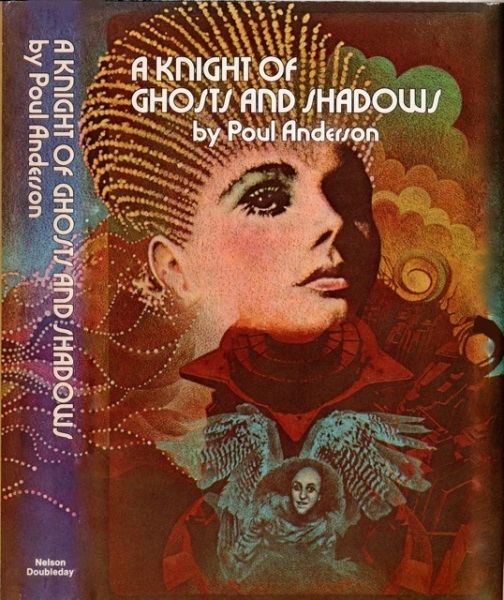
I recently picked up A Knight of Ghosts and Shadows by Poul Anderson from the library and DNFed it: too much opera, not enough space. But the cover… it takes the meaning of “hideous” to an entirely new level. In fact, this was the cover that gave me the idea of writing this blog post.
So what have we got here? There’s a psychadelic 70s chick with some hair that makes her look like Princess Leia’s grandmother, and a creepy little goblin dude in a spacesuit with random owl wings, who looks like he wants to peep on her. Also, some weird sci-fi cityscape in the background, I guess? It’s difficult to tell, because elsewhere the background looks like one of my Mom’s first-grade art projects. And of course, if that didn’t make it dated enough, you’ve got the funky 70s typography that died along with disco.
I picked up this book because 1. it was a Poul Anderson book that was at my local library, and 2. it made the Locus recommended reading list for 1975 without being nominated for the Hugo or the Nebula. Many of the other covers are surprisingly NSFW, because apparently Princess Leia’s grandmother is a futuristic sex slave—and yet, I found even the parts with her in it to be surprisingly dull. Like I said, too much opera, not enough space.
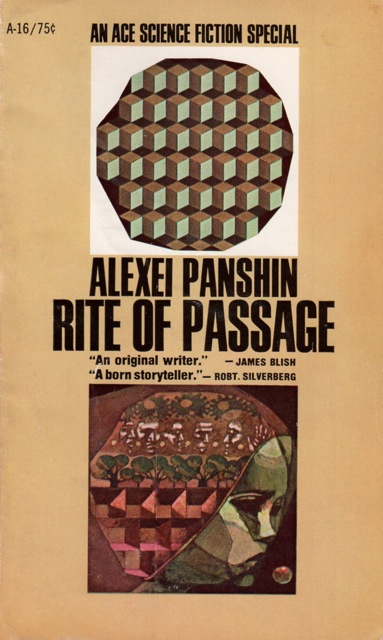
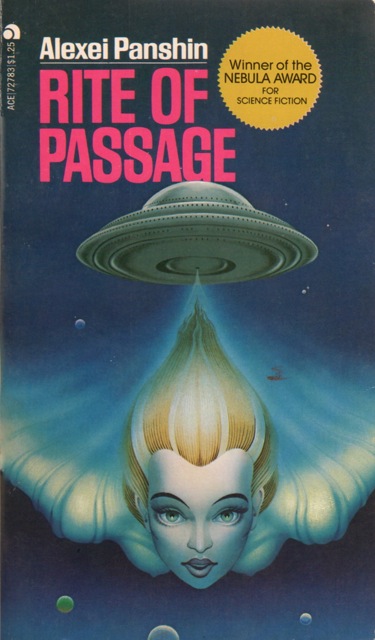
Speaking of mildly NSFW book covers that make reading in public super awkward, here is the cover of the copy of Rite of Passage by Alexei Panshin that was at the BYU Library, of all places. It’s not the cover above: I was going to post it, then thought better because it’s uncomfortably pornographic—especially when you consider that the main character is a minor. Yech. When my wife saw it, she said: “that’s a weird looking spaceship… oh wait, that’s not a spaceship!”
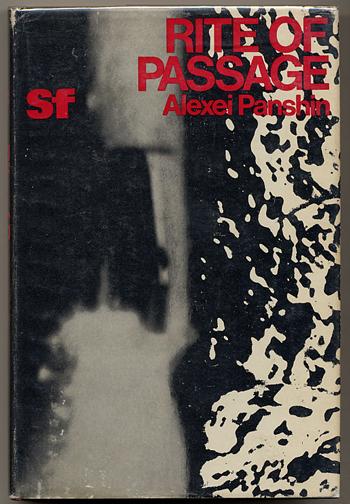
But even more hideous than that one (though perhaps not as terrible as this one), the cover above makes me think of nothing so much as the fact that communism ruins everything. Seriously, this cover has all the charm and aesthetic appeal of a Kruschev-era Soviet housing project in Eastern Ukraine, or maybe a ruined bus stop somewhere in the Kazakh steppes.
Seriously, when I lived in Georgia (the country, not the state), we would see old public art pieces from the communist era all over the place, in the soul-destroying style of socialist realism. This particular cover brings back a lot of memories of the Tbilisi subway. Which isn’t too surprising, because from reading this book, I’m pretty sure that Panshin was a socialist. In fact, it was right around this time that the entire science fiction genre swung super hard to the left, and with a few notable exceptions (David Weber, John Ringo, Larry Correia), it’s never really swung back.
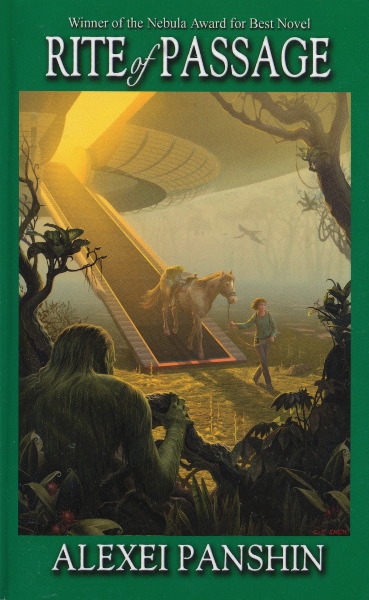
…and looking at Alexei Panshin’s Wikipedia entry, it appears that he passed away less than a month ago. RIP. Fortunately, he got at least one good cover for Rite of Passage before he died.
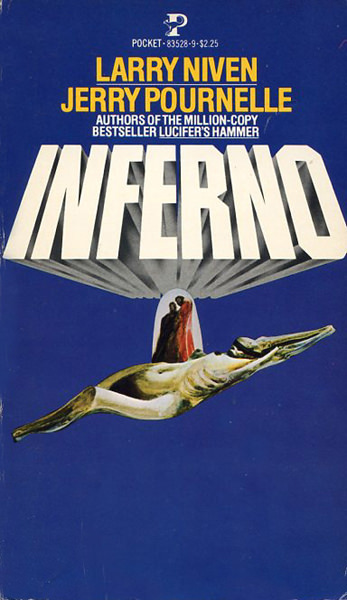
My wife recently read Inferno by Larry Niven and Jerry Pournelle, and she really enjoyed it. Based on her recommendation, I picked up a copy (not this one, thank goodness!) and I’m reading it now. It’s pretty good, but what the heck is going on with this cover? Seriously, it’s like someone puked up a mummy on the blue screen of death from Windows XP, except without any text. And what’s with the two monks standing on the mummy’s belly? Like, who saw the preliminary sketches of this cover art and thought “yup, that’s going to attract the right kind of reader and sell a bunch of books.” Thankfully, the book sold reall well in spite of this cover, not because of it.
So much for retro cover fails. What are some of your personal favorites that still stand out after all these years?
Back at the end of August, I blogged about how I was going to do a writing challenge in September to produce more short stories to fill out my publishing queue. At the time, I had a couple of stories that looked like they were going to be picked up by one of the major magazines: the editor had expressed interest in buying them, and we were going back and forth with an editorial discussion about the series.
Well, to make a long story short, all of that fell through, and it looks like I’ll be self-publishing those stories after all. I’m not really sure what changed, but to give you an idea of what kind of a short story market this is, it’s been around for decades and regularly gets written up in Locus Magazine’s year-in-review. The editor said that things had gotten crazy on his end, then didn’t respond for about a month, and when I sent a polite followup email asking for an update on the status, he gave me the standard “I’m going to pass on this one, but send me your next story.” Which strikes me as kind of weird, given how our previous correspondence led me to believe that the contract was just a formality and he’d be sending one over soon, but whatever.
So now that these stories are back in the publishing queue, I no longer need to write a bunch more to fill it out. In fact, I’ve actually got enough stories to publish one a month through next April, and after I finish the third Christopher Columbus story, I’ll have enough to get through June (one of my older stories comes out of exclusivity in May 2023). Here is the schedule as of right now:
OCT 2022: “Blight of Empire”
NOV 2022: “Christopher Columbus, Wildcatter”
DEC 2022: “The Freedom of Second Chances”
JAN 2023: “The Body Tax” (needs to be revised, but it’s already been workshopped)
FEB 2023: “Christopher Columbus, Treasure Hunter”
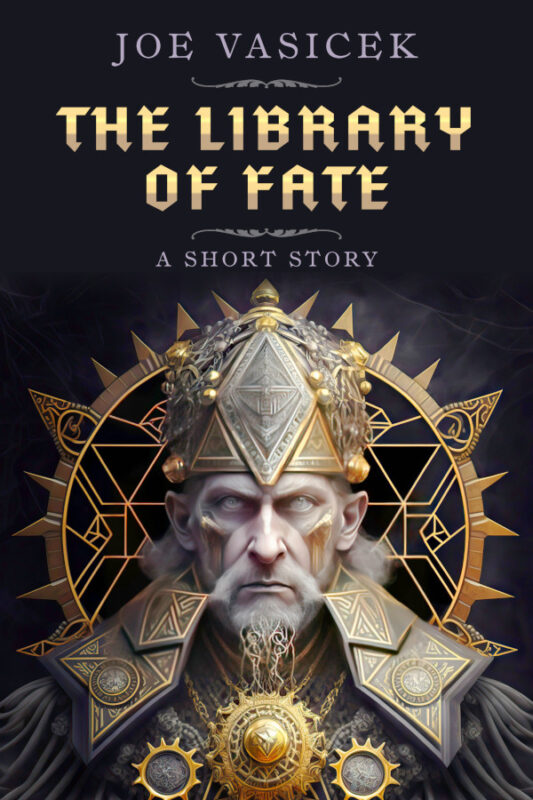
MAR 2023: “The Library of Fate”
APR 2023: “Hunter, Lover, Cyborg, Slave” (needs to be workshopped and revised)
MAY 2023: “Christopher Columbus, Wormhole Mechanic” (partially written, needs to be finished)
JUN 2023: “In the Beginning” (still under exclusivity, though I got a special exception to publish it in my third short story collection, The Stars Our Destination.)
Given that I have enough stories to fill out the next nine months, I’m going to bow out of the September Shorts challenge. This is really good for two reasons: first, it allows me to focus more attention on my current novel WIP, the sequel to Star Wanderers; and second, because I’ve fallen really behind on the Zedekiah Wight stories for my J.M. Wight pen name, and this should give me some space to work on the next few of those.
So that’s the plan: refocus on Children of the Starry Sea and work on Zedekiah Wight stuff on the side.
So a couple of days ago, I finished revising “The Freedom of Second Chances” and started looking for places to submit it. That was how I found this anthology call, for a pro-abortion anthology titled Aseptic and Faintly Sadistic: An Anthology of Hysteria Fiction. The guidelines were so unbelievable that I just have to fisk them on this blog. Here we go!
Hysteria
Interesting title for an anthology. I’m sure this will feature only the most thoughtful and enlightening stories that the speculative fiction field currently has to offer.
Irrational.
Okay.
Frenzied.
Uh, okay.
Unreasonable.
Oookay.
Unable to speak their own experiences.
One of those things is not like the others. One of those things just doesn’t belong.
Seriously, if you are free to be as irrational, frenzied, and unreasonable as you wish, then what exactly is preventing you from being able to “speak [your] own experience”? If you are still free to do this:
…then you are not being silenced by the pro-life crowd.
(As a side note, you would not believe how difficult it was to find that video. YouTube search would not bring it up, no matter how many combinations I tried. Even Brave search mostly brought up music videos and disgusting sex tapes. I had to go to The Comments Section by Brett Cooper, look up the video where she briefly reacted to it, freeze the frame, and scroll through a couple pages of search—not on YouTube, or on Google, or on Duck Duck Go (all of which are “curated” now), but on the Brave browser’s native search engine.
But tell me again how your side is the one that is “unable to speak their own experiences.” I’m sure that’s why this hilarious and eminently meme-able video about a story in the current news cycle has only received 10k views in the four days of its existence, and no mention on Know Your Meme at all. After all, it’s not like conservatives are the ones being censored and shadowbanned.)
In the case of abortion specifically, we have been told for decades in the United States that Roe v. Wade was safe
No, I’m pretty sure that was just something that you people told yourselves.
and that we were overreacting, illogical, needlessly aggressive—hysterical.
Actually, “safe, legal, and rare” was pretty much the majority viewpoint until Trump became president and all of the masks came off. So tell me, was “safe, legal, and rare” a lie from the very beginning?
Now look. We were none of those things.
Then why is the title of your page literally “Hysteria Submission Call”? Because it seems to me that all of those words—”overreacting,” “illogical,” “needlessly aggressive,” and “hysterical”—describe you people perfectly. As further evidence:
Aseptic and Faintly Sadistic:
It is so wonderfully fitting that the title of your anthology invokes the Marquis de Sade, the man who asked why everyone else’s pain should be more important than his pleasure. After all, why should 60 million dead babies—a death count that would make Hitler blush—be more important than your freedom to have promiscuous, irresponsible sex?
An Anthology of Hysteria Fiction,
I have literally never considered the combination of those two words until I saw them in your anthology call.
which is presented by CHM and will benefit the Chicago Abortion Fund, is seeking dark speculative fiction from anyone directly at risk as a result of the Supreme Court’s ruling on Roe v. Wade, defined inclusively.
But exclusively of, you know, actual women. After all, I noticed that you never mentioned the word “woman” in that sentence. Pretty weird, considering that Roe v. Wade was supposed to be about “a woman’s right to choose.” Or was that always a lie, too?
Guidelines
Genre: Dark speculative, widely defined. Don’t self-reject!
Oh no, honey. It’s not me that I’m rejecting when I say that you people will never see any of my work. Though I was tempted to troll you by submitting “The Freedom of Second Chances,” since it’s the most pro-life story I’ve written so far in my career. But I decided to fisk your anthology call instead.
Theme:
Hysteria.
Interpret the theme broadly. You don’t have to beat me over the head with the connection.
But how can it be “hysteria” if we aren’t beating you over the head? After all, that’s what the Trump years were all about: beating the narrative over all our heads until morale improved.
I am willing to look at everything from retellings of “The Yellow Wallpaper” to sci-fi space opera rockstars. Feel free to take on one of the many faces of the monstrous patriarchy directly.
Isn’t it curious how “the Patriarchy” totally isn’t a crazy conspiracy theory, but the Wuhan lab leak theory, or the efficacy of ivermectin in treating covid, or the reports of alarming menstrual irregularities and increased rates of myocarditis in people who took the covid vaccine all were. But since the pandemic, the difference between conspiracy theory and conspiracy fact has been between 4-6 months—except for the truly crazy conspiracy theories, like the idea that the moon landing was a hoax. Or the Patriarchy.
Because if you can’t now, when the heck can you?
Well, your anthology call is certainly taking this “hysteria” theme seriously. So points for consistency, I guess.
Open To: Anyone directly at risk as a result of the Supreme Court’s ruling on Roe v. Wade, defined inclusively
But once again, defined exclusively of actual, you know, women. And by “women,” I mean adult female humans, because those are, you know, the only people who can actually get pregnant (emojis notwithstanding) and therefore, you know, the only people who can actually get abortions.
Seriously, though, it is amazing what sort of knots these people will tie themselves into in order to avoid having to answer the question “what is a woman?”
(Also, this is a knitpick, but it’s worth pointing out that there’s a typo in that sentence, since it ends without a period. Pertinent because the anthology call was supposed to be written by a professional editor.)
Word Count: Maximum 5,000 words, no minimum.
Reprints: No.
Multiple Submissions: No.
Simultaneous Submissions: Yes! But please alert us immediately if the piece is accepted elsewhere and needs to be withdrawn.
In all fairness, I have to give these people credit for allowing simultaneous submissions. In this era of digital publishing, it is insane for publishers to expect writers to give them exclusivity when deciding whether or not to purchase publishing rights. It’s also inconsiderate, but that was true before digital publishing.
Simultaneous submissions are one of my industry hobby horses. Maybe I’ll write a blog post about that, though it may get me blacklisted from a few of these magazines. Then again, I’ve probably already been blacklisted for writing stories that are pro-life. Remind me how Dobbs v. Jackson makes you “unable to speak [your] own experiences” again? Oh, right.
Pay:
6 cents/word (USD)
As this is a charity anthology, authors who would like to contribute more and who are safe to do so may waive pay. This is completely optional, and we will never ask you to do this; you can only request it upon acceptance.
Except you kind of just did ask, in a passive-aggressive sort of way.
Date Open: July 18
Date Closed: August 1
Format:
Shunn-ish. I don’t need your home address or phone number, we haven’t even met.
No need to stress about the cover letter, but if you are a member of a marginalized community underrepresented in discussions of reproductive justice, feel free to note that if you are comfortable.
Notice again that they never actually mention the word “woman.” Which is incredible, because in the very act of discussing “marginalized” and “underrepresented” groups, they are literally erasing and marginalizing half of the people on this planet. Never forget: accusation = projection = confession 100% of the time with these people.
Submissions: AsepticAndFaintlySadistic@gmail.com
Please use this format for the subject line of your submission email.
Last Name; Story Title; Word Count
Other Stuff
The Editor Likes:
Forward-thinking,
Translation: pro-trans propaganda that refuses to acknowledge the existence of women.
expertly crafted
Translation: the sort of thing an English major would write.
speculative fiction. Work that uses innovative forms,
Translation: the sort of thing that wouldn’t appeal to people who like fun, entertaining stories. Because that would be wrongfun.
original voices,
Translation: “We’re looking specifically for a previously unpublished writer who checks all the right intersectional boxes, so that when xe becomes an award-winning darling of the field, we can say that we were the first ones to publish xer.”
broken timelines,
I actually had to look this one up. Apparently, they want to publish the next “Unknown Number,” because if an artist can duct tape a banana to a wall in a gallery and call it fine art, then a writer who checks all the right intersectional boxes should be able to win the Hugo with a Twitter thread. Or something.
metafiction,
Translation: post-modern garbage.
etc, but is still legible.
But will you accept my submission if it’s written in crayon?
Think Carmen Maria Machado, Nadia Bulkin, Mona Awad, Rivers Solomon, Angela Carter, Emily M. Danforth, Caitlin R. Kiernan.
The only one of those writers I’ve actually heard of is Rivers Solomon, and from what I can tell her faer main claim to fame is that she fae checks all the right intersectional boxes.
Absolutely Not:
TERF-y, gender-essentialist fiction.
Lest you think I exaggerate when I say that these people want to erase and marginalize women, we have it right here, straight from the horse’s mouth. No trans-exclusionary radical feminist stories, aka anything that defines “woman” as an adult human female, no matter how feminist it might otherwise be.
Trans activists talk big about how everyone who opposes them treats them like they “don’t exist,” but that is exactly what they are doing to women: erasing them. Once again, accusation is ALWAYS projection is ALWAYS confession with these people.
Gratuitous sexual assault, gratuitous violence, and unchallenged -isms and -phobias (body horror welcome).
I’m not surprised. Abortion is the ultimate body horror.
The Title Comes From: Margaret St. Clair’s fantastic short “Brenda” (Weird Tales 1954).
Thanks for the tip. I will certainly avoid that one.
Why the Chicago Abortion Fund: It looks like, for the foreseeable future, Illinois is going to be the only state with abortion protections in place serving a very large section of the country.
And by “protections,” of course they mean that there will be no protections in Illinois for the unborn.
Abortion funds are especially critical at this time, as they provide financial assistance to directly cover the costs of abortion.
Because those abortionists really need their lamborghinis!
The Chicago Abortion Fund provides grants from between $100 to $300 dollars to those seeking abortion services, and they attempt to provide this grant for 100% of the people who contact them. They also provide assistance in locating additional funding, as well as with travel and associated expenses.
From their website: The mission of the Chicago Abortion Fund is to advance reproductive autonomy and justice for everyone by providing financial, logistical, and emotional support to people seeking abortion services and by building collective power and fostering partnerships for political and cultural change. We envision a world where everyone has the freedom and autonomy to create lives, families, and communities that are healthy, safe, and thriving and where the full range of reproductive choices, including abortion, are accessible and affirmed.
If these people are truly “pro-choice,” why are they so obsessed with shutting down crisis pregnancy centers? Just look into the crazy eyes of Elizabeth Warren as she talks about it, and then ponder on the fact that dozens of crisis pregnancy centers have been firebombed and vandalized by the left-wing terrorist group Jane’s Revenge in just the past month. Why?
Because the “pro-choice” crowd only really believes in one choice: abortion. But having only one choice means that you have no choices at all, meaning that “pro-choice” is actually a lie. Just like “safe, legal, and rare.” Just like “a woman’s right to…”
Which brings me back around to the most incredible thing about this anthology call: the fact that the words “woman” and “women” do not appear anywhere, even though this is supposedly a pro-abortion anthology. In fact, the anthology call goes out of its way to discourage submissions that are “gender essentialist,” meaning that they affirm the scientific, biological nature of sex. In a pro-abortion anthology call!
It is impossible to satirize these people. They are so possessed by their radical ideology that they satirize themselves without realizing it. In a sane and healthy world, the anthology would be a failure, the publisher would go bankrupt, and the stories themselves would quickly fade into cultural irrelevancy—
—which may happen yet. The cultural tides are turning, and these people are so devoid of self-awareness that they are totally blind to it. That is precisely why the overturning of Roe v. Wade caught them so flat-footed. And instead of responding to this setback with introspection and reflection, they immediately jump to hysteria, not realizing that doing so wins no converts and turns away many who would otherwise be sympathetic.
They are losing.
They are losing HARD.
Moreover, they have no idea how hard they are losing.
In their arrogance, they will fall.
And after they do, future generations of readers will look back in wonder and bewilderment at anthologies like this one that were products of their insane (and interesting) times.
I don’t usually do these fisking articles, but in my efforts to find more traditional markets to send my short stories, I’ve come across some truly insane submission guidelines. Since none of these markets is likely to publish anything by a conservative straight white cisgender Latter-day Saint Christian male such as myself, I don’t see much harm in fisking a couple more of them. What do you guys think?
This was a fun one to write, even if it did go a little dark at first. The idea for it came from this article about a couple in San Francisco who received an outrageously huge warning fine ($1,500) for parking their car in their own driveway. In the comments to the article, I wrote:
This is why property taxes are evil. If the government can seize your house for non-payment of taxes, was it ever really yours to begin with?
But here’s the thing: every possible answer to that question is terrifying.
If you answer “no, I guess it wasn’t ever really my house,” you’re acknowledging that Mao was right and all power (and with it, ownership) flows from the barrel of a gun.
If you answer “yes, it’s still my own house,” then you have to answer the question: does the state have the right to issue property taxes?
Answer “yes, the state is within its rights,” then congratulations, you’ve just given the Maoist approach to property ownership a veneer of legitimacy and revealed yourself for a boot-licker and a coward.
Answer “no, the state is not within its rights,” then you’ve just acknowledged that you live under a tyrannical regime. It might be a relatively benign regime, but a petty tyrant is still a tyrant, as we saw during the covid lockdowns.
But you’ve still got one more question: do you pay the property taxes, or don’t you?
Answer no, and the state seizes your property and/or throws you in prison.
Answer yes, and you’ve just put yourself in the same position as the landlord who pays protection money to the mob. The only difference is that this mob wears uniforms and has a geographic monopoly on the use of deadly force.
This is why the Roman farmers welcomed the barbarians. Perhaps we should as well.
Later, as I thought on it, I wondered if perhaps I couldn’t write a short story that gets across everything I hate about the property tax. I came up with an idea where the thing that’s being taxed isn’t your property, but your time and your body—literally.
Once a quarter, you are required to voluntarily submit your body to the state, who uses a chip in your brain to turn you into a mindless zombie and exploit you for manual labor. If you have no record and a clean social credit score, it’s typically only for a couple of days. Otherwise, you’ll be a mindless zombie slave of the state for a couple of weeks, or maybe even a couple of months. If you’re a criminal, you may spend more of your life as a zombie slave than as a free man.
To make it even more outrageous and controversial, the story is about a young woman who wakes up from the body tax and finds that she’s pregnant. She was used as a sex worker, and the birth control failed. But the twist is that she’s pro-life, and wants to keep the child. Yay for controversy!
Like I said, it was a really fun story to write. And even though it goes to some pretty dark places, it actually has a happy ending, oddly enough. But the way I’ve currently written it, I think it’s a bit too sappy, so hopefully my writing group can help to smooth that out and make it end on the right note.
This will probably be my last short story for a while. I’ve decided to turn “Christopher Columbus, Wildcatter” into two stories: “Christopher Columbus, Wildcatter” (which I’ve already written) and “Christopher Columbus, Treasure Hunter.” That will probably turn into a wild and zany series of short stories. Also, based on the feedback from my writing group, I will probably turn “The Freedom of Second Chances” into two short stories (one of which will also be very pro-life, oddly enough).
But I may have to come back and write more short stories soon. “Blight of Empire” and “Christopher Columbus, Wildcatter” are both out on submission to the traditional markets, and both of them have received some surprisingly favorable responses from the editors. No contracts yet, but they are on hold for consideration. If they do get picked up, then I’ll have to write a couple more short stories (probably in the Christopher Columbus series) to fill out my publication schedule. Got to keep a solid buffer of short stories to publish.
In the meantime, I’ve resumed work on Children of the Starry Sea and hope to have it done by Thanksgiving. That should be enough time to finish the rough draft and cycle through all the necessary revisions, barring some unforeseen hangups like another major writing block or a difficult life event. But that’s the plan.
That’s all for now. I’ll leave off this post with an excerpt from “The Body Tax,” where Ellie (the protagonist) confronts the terrorist leader who has kidnapped her:
“If the state can throw you into prison—or worse, turn you into a robota—for failure to pay the body tax, was your body ever really yours to begin with? Be careful, because every possible answer to that question is terrifying.”
I sighed heavily. “All right. Suppose I say that you’re right, and it means that I don’t own my own body?”
Mav leaned forward, grinning manically from ear to ear. “Then you’ve just admitted that Mao Tsedong was right, and all power—as well as ownership—flow from the barrel of a gun. But consider the implications if your answer is no—that in spite of the body tax, you do still own your body. Then you have to ask yourself: does the state have the legitimate authority to levy such a tax, or does it not?”
“I don’t know,” I said, growing tired of these rhetorical games.
“If you answer that the state is acting within its authority to issue such a tax, then congratulations, you have just legitimized the Maoist philosophy of property and ownership. Might makes right, the strong always take what is theirs, and possession is the whole of the law. But if you answer contrarywise, that the state does not have legitimate authority to issue the body tax, then why do you pay it? Is it not simply because you fear what the state will do to you if you do not pay? In that case, your position is no different than the man who pays protection money to the mob—only this mob wears uniforms and calls itself the law. In which case, the state is simply the dominant criminal enterprise—or dare I say it, terrorist organization—in the area in which you live. Terrifying, yes?”
“Yes,” I agreed, more to get him to drop the subject than anything else. “It’s terrifying.”