Familiar vs. original vs. WTF?

In writing, you’ve always got to strike a balance between things that the readers find familiar and things that might be original or new to them. Every genre has its own standard set of tropes, plot twists, character archetypes, and other such story elements, and even if the readers can’t explain them all to you, they know them well enough to tell when something is off.

Different genres strike different balances between the original and the familiar. Romance tends to lean more toward the familiar, with happily-ever-after (or happy-for-now) endings a fairly ironclad rule. Fantasy tends to have a little more originality, depending on the subgenre, but there’s still a host of familiar tropes and world-building elements that you can usually expect to find. Anime tends to go pretty crazy with the original elements, but even in a wacky show like Hetalia there are still a bunch of anime-specific tropes that ground the story in a degree of familiarity.

A great way to introduce originality is to pull a common trope or story element from a different genre and adapt it to a genre in which the readers are much less familiar with it. This is what Suzanne Collins did with The Hunger Games: she borrowed elements from suspense and thriller, and combined them in a novel that was solidly grounded in YA. As much as I hated the book, I have to admit she did a very good job blending those elements into another genre.

So combining familiar elements in unfamiliar ways is one way to create originality. But another way–and potentially a much more risky way–is to throw in something that the reader has probably never seen before.

I don’t know why, but as a writer I seem to be drawn to these stories–much more so than I’m drawn to them as a reader. As an example, when I wrote Star Wanderers, this weird polygamy element got woven in, with the best friend of the female protagonist trying to convince her to share her husband. I have never read a story where anything like that happened, but that was where the story wanted to take me, so I followed it as best as I could.

The danger in throwing in something that is so far outside the realm of familiarity is that the readers will go “WTF?” and get thrown right out of the story. With Star Wanderers, I tried to do my best to develop the characters and convey their motivations in order for it all to make sense, but it was still really hard to write because I didn’t know if the polygamy thing was something that they’d swallow. And when you’re worried how the readers are going to respond to you story, it can be very hard to write it.

I suppose I should give more credit to my readers, though. Their experience is probably a lot broader than I think it is, and their hunger for strange new experiences may actually be stronger than I can ever fulfill. With Star Wanderers, I got a handful of reviews saying that I should have taken the polygamy thing further, or that I should have paired up characters in ways that I’d never even considered. I’m sure there were others who were disgusted by the whole thing, but the books are still selling, so it’s clear that I didn’t alienate everyone.

Right now, I’m writing Strangers in Flight (Brothers in Exile: Book III), and I’ve got another element in there that you don’t really see very often in any genre–at least, not in the way I’ve chosen to play it. It flirts with the taboo a bit and I’m sure it will make some people uncomfortable, though probably not as uncomfortable as it will make me to know that people are actually reading it.

For that reason, writing this book has put me in a weird mental headspace that’s making it very difficult to finish the thing, no matter how many deadlines I give myself. I’m still going to write it, and unless an unforeseen disaster happens I’ll finish it in time to publish it before the end of the summer, but it won’t be easy.

That said, this is a really fun story. Aside from all my fears about how readers are going to respond to it, I’m having a blast writing it. So maybe I should just put that other stuff out of my mind and focus on what I enjoy about the story. Because if I enjoy the story, then you probably will too.
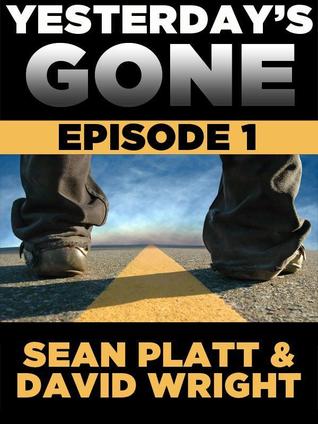
Yesterday’s Gone: Episode One by Sean Platt & David Wright

Imagine you wake up tomorrow, and find out that everyone around you has vanished.  Well…not everyone.  But the ones who are still around claim to see strange things that you can’t see.  And then, you get an eerie feeling of a presence…something dangerous, something coming at you right now.  And then, things get really weird…

Yesterday’s Gone is a post-apocalyptic serial thriller: basically,  a novel divided into six parts or “episodes,” the first of which is free.  Since I’m interested in doing something similar with my next project, I decided to check it out.

From the very start, I was hooked.  The conflict was intriguing, the pace was fast and gripping, and the characters were interesting, with reactions that were spot on.  I wasn’t intending to finish the whole thing in one sitting, but once I’d started, there was no way I could put it down.

A couple of things jolted me out of the story, though.  The first was the sheer immensity of the cast of characters.  Literally, the first half of the episode was just introducing new ones, and none of them got more than two viewpoint scenes in the whole ebook.  I was on board for the first three or four of them, but around number six or seven, I just wanted to skip them and get back to the first guy.

Two of the later characters were just painful to read–not only did I not care about them, I vehemently hated who they were and wanted them to die or get out of the way so I didn’t have to read their viewpoints anymore.  The first was an eight year-old boy who had some mystical connection with animals…I just couldn’t sympathize with him at all.  The other one was a serial rapist and/or murderer who saw the apocalypse as just an opportunity to run around raping and killing the other survivors.  I skipped his scenes, but then had to go back because there were some clues hidden there and I didn’t want to miss them…ugh.

The other thing that really bothered me was the very last scene in the episode, where the authors made the mistake of showing the monster.  I won’t spoil it for you, but the image on the page clashed so strongly with the image in my mind, it deflated almost all the tension for me.  What was supposed to be a cliffhanger instead turned out to be a big “huh?”

Your mileage may vary, however, so if you’re into post-apocalyptic fiction, I think it’s definitely worth checking out.  Just like the happy pills in the empty lot behind the school, the first one is free: you can pick it up on Amazon or Smashwords.  And in spite of its problems, there was a lot in this story that I really liked.  Maybe you’ll enjoy it more than I did.

In terms of the serial format, I think it worked very well, except for those two problems: too many characters to keep track of, and an ending that booted me out of the story.  Otherwise, I think it’s a great way to publish, and I’ll probably experiment with something similar in the future.

Trope Tuesday: Xanatos Speed Chess

Well, I can’t say any of this mess was part of my original plan, but it’s all working out so beautifully that I can’t complain.

Tarvek, Girl Genius.

The Xanatos Gambit is when a character plans out a scheme such that all possible outcomes (including abject failure) ultimately benefit that character.  Named after David Xanatos from Gargoyles, it is most often used by villains who are very good at evading karma.

Xanatos Speed Chess, on the other hand, is when the character relies not on setting up an only-win scenario from the beginning, but on being able to adapt and change their plans quickly enough to pull off a victory even after their first few attempts inevitably fail.  For this character, the important thing is not to keep everything from falling apart, but to outsmart their opponent even after everything already has.

Both heroes and villains can play at this game, but the heroes generally tend to be better at it.  Part of the reason for this is that try-fail cycles are much more conducive to Xanatos speed chess than the Xanatos gambit.  The heroes might lose a pawn or two, or even the queen, but that doesn’t stop them from turning defeat into victory.  In fact, depending on the story, it may provide exactly the sort of dramatic tension that makes the ending so awesome.

A good example of this in recent cinema would probably be the new Mission: Impossible movie.  Over and over, the mission falls apart–and the characters respond either by changing the mission or by crafting a new one.  It’s one of the things that makes it such a great spy thriller: the tension is always high, because you never know how they’re going to pull it off.

The opposite of this trope is the Indy Ploy.  This is because Xanatos speed chess is still chess; even though the plans are dynamic, they are still plans, and involve a large degree of calculation and forethought.  With the Indy ploy, the character is just wingin’ it, jumping into the thick of things and making it up as they go along.

The main reason I’m interested in this trope is because my current project, Stars of Blood and Glory, has a strong military plot, and I want one of the characters to be a magnificent bastard.  Let’s just say that if Bringing Stella Home is the Mongol conquests in space, Stars of Blood and Glory is the Battle of Ayn Jalut.  It’s going to be challenging to pull it off, but that’s part of what makes writing so much fun…

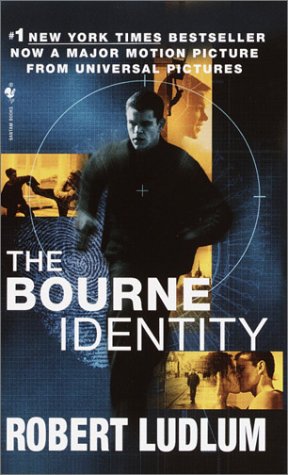
The Bourne Identity by Robert Ludlum

On a stormy night off the coast of Marseilles, a local fishing trawler recovers a man with a gunshot wound to the head.  The local doctor patches him up, but when he recovers, he has no knowledge of his past life.  Even his name is a mystery.

Fortunately, he has a clue to help him get started: a microfilm surgically implanted in his hip containing an account number for a bank in Switzerland.

When he arrives in Switzerland, he finds that the account contains millions of dollars, as well as a name: Treadstone 71.  Before leaving the bank, however, a squad of hitmen attack and nearly kill him, for no reason that he can possibly understand.

On the run from people he doesn’t know for things he doesn’t remember, Jason Bourne finds himself in a struggle, not only for his life, but to find his true identity.  But the answers, he fears, are much, much darker than he can possibly accept.

Okay, to start things off, let me say that this book is NOTHING like the movie.  NOT AT ALL.  The two are completely separate stories.  The beginnings of both are similar, with the whole amnesia thing and the bank account number implanted in his hip, but after Jason leaves Marseilles, everything gets different.  EVERYTHING.

For that reason, it’s difficult to say which is better, because they both try to do very different things.  The movie is more about the action and suspense; the book is more about the intrigue and character development.  Both succeed quite well at what they respectively set out to do.

That said, I enjoyed the book at least as much, if not more than the move.  Ludlum’s writing is quite good, and he paints an excellent picture of both the exotic European setting and the complex psychological portrait of his main character.  Unlike Crichton, whose characters often fall flat, Ludlum does an excellent job creating characters who stand up on their own right.

The suspense lagged somewhat in the middle for me, when the details about Cain and Medusa came to light (that’s one thing I’ve got to say about Crichton–he’s a master of suspense), but it wasn’t enough to keep me from finishing.  The ending, however, was atrocious–not in a clumsy way, but in a too-many-loose-ends kind of way that meant that the story wouldn’t truly be resolved until the sequel.  I hate stories that do that, but oh well, what can you do?

Overall, though, the book was quite good–better than I expected.  I can see why Ludlum was such a successful writer: he created interesting, capable characters and put them in exotic, foreign settings to fight ruthless, evil villains in a desperate zero-sum struggle for survival.

Interesting characters + exotic setting + high stakes conflict + good writing = win.  Oh, and Bourne is way more awesome than Bond. Just sayin’.

Holy crap! 5,373 words in one day

That’s right–5,373. And I was only going for 4k! How did this hapen?

Well, I was revising a couple of powerful, gripping scenes. The way I’d had them before, they worked okay, but when I followed the suggestions from the writing group, it made them ten times better. By midafternoon, I was hooked in my own book–I just wanted to keep writing.

The funny thing is that I never got hyperfocused while I did it. I would write a paragraph, check email, write a few more sentences, delete them, write a few more, cut to google images to do some research, get distracted, come back, etc. At the same time, it all seemed to pour out, so I must have been doing something right.

If only the rest of the book would go like this. Maybe it can! Bringing Stella Home is a lot more like a thriller than anything else I’ve written, so if there isn’t a hook on every page (or at least something to raise the stakes and keep the reader reading), I’m probably not doing it right. And if I’m hooked while writing it, chances are the reader will be hooked while reading it.

In totally unrelated news, check out this awesome Mega Man remix!

I Am Not a Serial Killer by Dan Wells

John is a weird kid. When he isn’t helping out his mother at their small-town mortuary, taking intense, morbid pleasure from opening up the dead bodies and exploring their insides, he’s researching serial killers, devouring every book he can find on the subject. If he had his way, he would open bodies all day–dead and living bodies, exploring them, savoring the addiction. That’s why he must constantly work hard to stop himself.

But when a demon comes into town, killing off members of the small community one by one and hiding in plain sight by posing as a normal human being, John is the only one who can stop the monster from killing again. To do this, he unleashes his own demon–the one urging him to kill. As the monster inside of him starts to take over his life, he starts to lose control and sink deeper and deeper toward his destiny.

Will he return from the dark side, having fought fire with fire? Or will he give in to fate and become a serial killer?

This book was a surprisingly fast read. I borrowed it from a friend and finished it only a couple of days after I started it. Part of this was because it’s a short book, but part of it was because the story and characters were so interesting.

The character development in this book is awesome. Dan Wells does a wonderful job making a morbid sociopath into a genuinely likable character. I felt like I knew him–and liked him–after only a couple chapters. Even though he’s got a disturbing, dark side, he’s constantly trying to fight it and keep himself in check. From almost the very beginning, I found myself rooting for this character.

The book had some sick, disturbing stuff in it, but it wasn’t nearly as violent or fundamentally disturbing as some of the other books I’ve read (Neuromancer, On My Way to Paradise). It was more of an “eww…cool!” kind of thing for me than a heart stopping, I-can’t-believe-what-I-just-read kind of thing. Still, the book definitely made me squirm. I’m glad none of my family works in a mortuary, I’ll say that much.

For a story so engaging, the writing was surprisingly simple. Unlike a lot of the fantasy and science fiction that I read, Dan Wells includes very few concrete details–just enough to keep you in scene–and tends to be a little adverb heavy. None of this was an obstruction to reading–on the contrary, the sparseness and simplicity is part of what makes this book a quick, enjoyable read. As an aspiring writer, it helped me to see that story trumps the minor, sentence level stuff, like using excessive adverbs with said bookisms (not that that’s a problem with this book–the writer part of my brain noticed it, but the reader part didn’t care).

The book reads very much like a thriller (…probably because it is one) and reminded me of a lot of the Michael Crichton stuff I used to read when I was in high school. While it isn’t as gripping as Sphere or Jurassic Park, it has about ten times the character development of any of Crichton’s works. Although the plot is definitely engaging, I read as much for the character as for the plot, if not more.

If you’re looking for a good, squeamish read with interesting, believable characters, this is a good one to pick up. It doesn’t come out in the US until 2010, but if you check out Dan’s website, you can probably find a way to get it. Check it out!