If it kills me

I will finish this novel if it kills me. At the rate things are going, it just might.

Things are kind of tough for me right now.  I desperately need a new job–the one I’ve got is slowly sucking away my soul without even paying enough to get by–and job rejections are way worse than rejections from publishers (I’ve been getting a lot of both, by the way.  Not that I’m looking for pity, but yeah.).

As if that weren’t bad enough, my current novel, Worlds Away from Home, is turning out to be a train wreck.  There are all sorts of problems with character motivations, improper foreshadowing and plot set up, etc etc.  That makes it REALLY hard to get motivated to write each day.  Yesterday, I wrote only 245 words (youch).  Today, I did about 2.2k, but that’s still way less than I need to be doing.

The thing that worries me the most is the thought that the audience for this particular story may be slim to nonexistent.  It’s solid space opera, but with a romantic element that challenges a lot of the mores of our modern, sex-saturated society, as well as many of the conventions of romance within science fiction.

The main female protagonist is something of a pushover–but she has to be, in order for her growth arc to have any umph.  The main male protagonist is an orphan on a quest to discover his own origins, kind of like a cross between Mogli and Pip.  His quest, combined with her parents’ manipulative attempts to get them physically intimate too soon, are the main things keeping them apart.

But in a genre where physical intimacy usually marks the romantic climax, how do you make it out to be the obstacle against that climax?  Will science fiction readers go for that, or will they hurl my book across the room because of it?

Well, if they hurled my current draft, I wouldn’t blame them one single bit.  So many plot holes and awkwardly written scenes–ugh.  I’ve got to seriously rethink so much about this story.  But a later draft?  I don’t know–maybe it would work.  It would probably need other hooks to keep them engaged, such as cool world building elements, but I think I could make those work.

Anyway, I suppose it’s nothing unusual.  For every book I’ve written, I’ve come to a point in the rough draft where I thought the story was completely unworkable and should be scrapped.  It’s a tortuous, masochistic process, but I suppose it’s normal.  That’s some comfort, at least.

My goal is to finish this abomination by August 15th, then move on to polish Mercenary Savior and make it really shine.

Another goal is to get a decently paying job (at least $8/hr at +25 hours per week) in order to afford to go to DragonCon in September.  Another goal is to reteach myself algebra and calculus through the math books my dad (who is a geometry teacher) is letting me borrow.  Another goal is to actually get a social life.  BLARG.

Wolverton interview and more

The interview with Dave Wolverton was a resounding success!  We had a fascinating conversation about science fiction and the gospel, his latest book In The Company of Angels, self-publishing, the English 318 class at BYU and the profound impact it’s had on the LDS writing community, and much, much more.
On that, I suppose I should disclose my full reasons for going down to St George and meeting with Dave.  I’m putting together an article for the December 2010 issue of Mormon Artist, where I hope to give a brief history of BYU’s “class that wouldn’t die” and explore the impact that it’s had on both the LDS writing community and on mainstream sf&f.

The “class that wouldn’t die” was the group of students who signed up for the first English 318R science fiction creative writing class at BYU, back in ’78 (I think it was ’78…gotta check that).  After the semester was over, the students banded together through forming a writing group, which they called “Xenobia.”

They didn’t stop there, however.  As Xenobia grew and matured, the students decided to form other organizations designed to help new writers (especially sf&f writers) improve their craft and build their writing careers.  Specifically, they founded Quark, BYU’s science fiction and fantasy club; Leading Edge, a student-run magazine that gives written feedback to every story submitted; and LTUE, an annual science fiction and fantasy symposium (like a convention, only no costumes).

These organizations, as well as the 318 class, led directly to the explosion of LDS writers in science fiction and fantasy.  Several bestselling LDS authors, including Stephanie Meyers, Brandon Sanderson, and Dan Wells (among many others) can trace the launch of their careers back to this class.  In turn, these authors are having a tremendous impact on mainstream sf&f literature.

The article is slated to come out in next December’s issue of Mormon Artist Magazine, just in time for LTUE 2011 (which I hope to attend).  Right now, I’m in the research phase, meeting with some really amazing people and gathering some fascinating stories.  This article is going to be awesome.

In parting, let me share one of the more interesting things Dave said in the interview.  As we talked about all these amazing resources available for sf&f writers in Utah valley, I asked him why this happened in this community and not elsewhere.

His answer was extremely insightful: for many writers, the mentality is that once you break in, you have to close the gate behind you.  It’s something of a zero-sub game, where people horde their ideas, compete with each other to break in, etc.

Not so in the LDS community.  As Latter-day Saints, we have a deep-set mentality of helping each other and building each other up.  That’s exactly what happened with the “class that wouldn’t die”–they did everything they could to foster other writers.  The proliferation of Latter-day Saints in mainstream sf&f is a direct result of this.

That’s Dave’s take on it, anyway.  It will be interesting to hear what others think.

Oh, and FYI, Mormon Artist is 100% volunteer run and free, so when the article and interview come out, you won’t have to pay anything to read them.  I’ll certainly provide links on this blog–stay tuned!

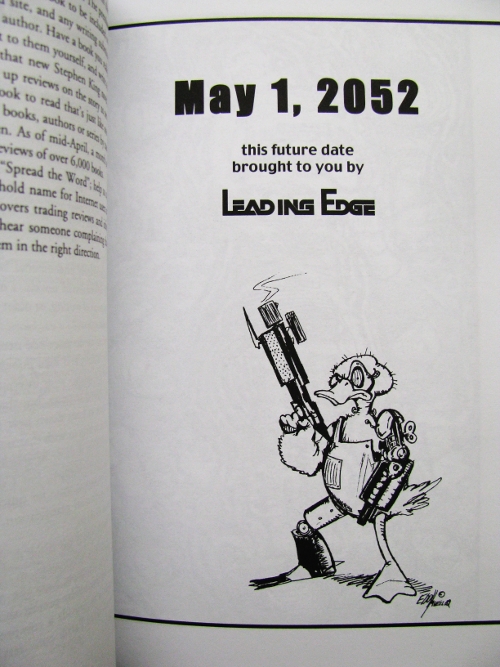
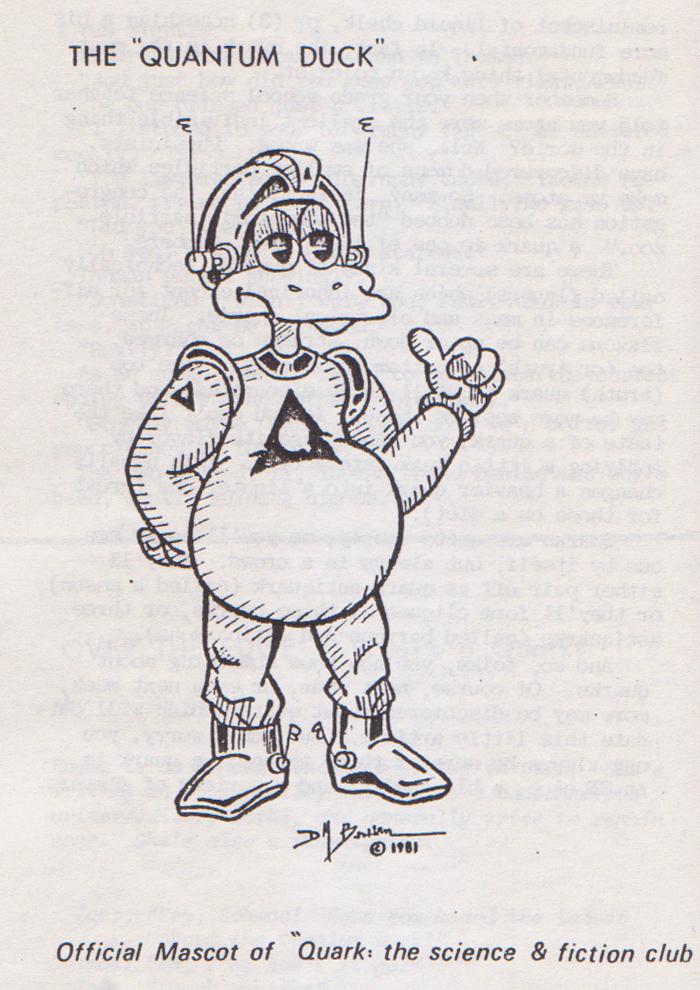
And as one final note, check out this piece of Xenobia history: the original Quantum Duck, as featured in the first issue of The Leading Edge.  Why a quantum duck, you ask?  Because that’s where the club’s name came from: a bumper sticker that said: BEWARE THE QUANTUM DUCK THAT GOES ‘QUARK,’ ‘QUARK’!

Slogging through to the bitter happy ending

Oh man.  I was hoping to hit 5k words today, and even though I must have spent five or six hours writing, I only managed half of that.  It’s progress, I know, but it’s not as much progress as I’d like; the words just aren’t coming, no matter what I do.  Blarg.

The worst part is that I know that most of these words are just crap.  I’ll get to the end of a chapter and think “oh yeah, shouldn’t these characters be doing/thinking this?” And I’ll make a couple of notes in the revision guide, or touch up what I’ve written just a little bit, but one thing compounds on another until everything’s got problems.

But you know what?  I’m almost three quarters of the way through, so it’s probably better just to write on through these problems and finish the @#$! thing.  At this point, I’ve got a good enough story that I can carry things through to the end, as horrible as it may be, and just fix everything in the next draft.

It’s frustrating, though, because I know that most of the changes I’m going to make will seem obvious.  Why can’t I just get it right the first time?

Is it because I failed to outline things enough?  I know from experience, however, that outlining too much can be fatal for me.  Is it because I didn’t take the time to immerse myself in my story?  But then again, I’ve been spending so much time on my writing, everything else seems to be suffering, including my social life…

BLARG.

I’m probably just missing the forest for the trees.  Once I get out of these woods, though, I’m sure things will fall into place.  One way or another, in two weeks this abomination will be FINISHED! …at least until the next draft.

Looking for work (and possibly an adventure)

Ever since graduation in May, I’ve been doing my best to support myself and be 100% financially independent.  I haven’t gotten a steady, well-paying day job yet, but fortunately summers in Utah are cheap and I’ve more or less been able to make ends meet.

That’s not to say it’s been easy, though.  I’m operating under an extremely limited budget, and things are only going to get worse in August.  My current employment is more or less a dead end job, and I’m going to need to find something else if I want to stay in the black (and keep myself mentally sane).

Here’s what I’m trying to do to change that, in order of priority:

1) Apply for full/part time positions at BYU. My ideal job at this point would be to use my writing/editing/mentoring skills as a BYU employee in some capacity. Not only would I be able to stay in Utah Valley where all my writing contacts are, I’d be able to take classes at BYU for free! Besides, BYU is an organization behind which I can completely throw myself. Having graduated from there, I believe 110% in the university’s mission and the value of a BYU education.

The trouble is that there are probably hundreds of other graduates in my position trying to do that right now. More spots might open up quickly if the economy improves, but the competition is still going to be fierce.

2) Apply for a bookstore job in Utah Valley. Working in a bookstore might mesh very well with my aspirations to become a full-time writer. It would give me a chance to see a useful side of the publishing/bookselling industry, as well as opportunities to network with authors, readers, and booksellers. The pay might not be great, but as long as it’s full time and pays at least minimum wage, it would be enough.

I hear that a lot of local venues are going to be making hiring decisions later in August, as the summer term at BYU comes to an end and the students start moving back to Provo. For that reason, I’ve been holding out contacting places like Chapters (formerly Pioneer Books) and Barnes and Noble–the last thing I want is for my resume/application to get swamped under a huge pile of other applicants.

3) Apply for a Wilderness Therapy job. There are a lot of these in Utah, and I hear that they’re always looking for new staff. The work is strenuous–one to three weeks out in the wilderness with a bunch of troubled teens, living in survivalist conditions–but the life experience may well be worth the extended time commitment. Besides, considering how much it will cut down my living expenses (since I won’t be spending money in the wilderness), the pay should be pretty good. I may be able to save up a sizable amount.

The main reason I’d want to do this is because of the adventure. I feel that at this point in my life, I need to do something big–something I can look back and point at as a major milestone or accomplishment. For this reason, I almost want to take a wilderness job more than a BYU or bookstore job, but the tradeoffs are pretty serious. My social life will probably suffer, as well as my daily writing schedule.

Redcliff Ascent has their next staff training session in September. If I’m still looking for work by then, I’ll probably take it.

4) Try to find some opportunity in the Middle East. When I came back from Washington DC in April, I decided to hold out for a year before returning to the Middle East to see how the tensions between Iran, Israel, and Lebanon play out. While I still think there will be a war, however, I’m less worried about getting caught up in a bad situation if I’m in, say, Jordan or Egypt.

This would also be an awesome adventure. The trouble, though, is how it may cut into my writing career here in the states. I’ve already bought tickets to World Fantasy 2010 in October, so I probably won’t be leaving before then. Besides, most Middle East jobs only pay enough to cover living expenses–not enough to save up, or even buy a ticket back. Getting stranded in a developing country might not be so fun.

5) Take any part-time retail/labor job I can find in Utah Valley. This is the last option, because I don’t want to end up with a job that, for all intents and purposes, isn’t going to lead to anything bigger and better. If it pays the bills, though, might as well take it.

That’s what I’m currently trying to do to improve my employment situation. In the meantime, I’m looking up part time jobs and gigs on craigslist and trying to be as resourceful as I can. It’s not fun being poor.

Inshallah, though, something big will come my way. I have every confidence that things will work out for the best, whatever happens.

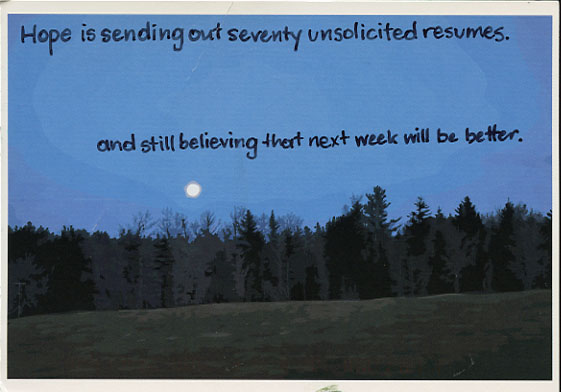
Image courtesy Postsecret.

Story notebook #2

A while ago I rediscovered my first story notebook and wrote a few posts on it.  I promised I’d do the same for my other story notebooks, so here’s the next one.

For those of you who may be surprised that I’m sharing all my story ideas, let me explain why I’m doing this.  First, ideas are cheap, especially in genres as imaginative and inventive as science fiction and fantasy.  What really matters is the execution, and any two people’s take on the same idea is going to be different. For that reason, I’m not too worried about anyone “stealing” my ideas.

Second, and more importantly, I believe that the only way for ideas to grow in value is for them to be shared.  Ideas that get horded only worsen with age, because they’re not being explored. Only by exploring ideas can they come into their full potential, and the best way to explore ideas is to share them.  When we fail to share our ideas, we inevitably fail to explore them from all angles, because working alone in a vacuum, we’re so much more likely to miss something crucial.

Enough of that.  Here are the story ideas from my second notebook, roughly covering the fall of ’08, right after I finished my first novel and got back from Jordan.

How will myths arise in the space exploration age? Previously, myths formed perhaps because people had very limited means of communication and limited means of world awareness. Now, technology allows much better spread of information and science, but in isolated spacecraft, will [the conditions of isolation that lead to myth formation] return?

An interesting and somewhat complicated thought. How do myths form, anyway? I suppose that at the very least, the extreme isolation of space will lead to a proliferation of wildly different cultures and worldviews.

Just as the Catholic monks set up a monastery in Iceland, so people will go beyond the explored universe in the age of space travel and set up a religious order there.

Fascinating–and I think it runs somewhat counter to the grain, too. Most people tend to see space explorers as either adventurers or absolute believers in pure science–but what about the devoutly religious? If the Catholic monks set up a monastery in Iceland, is it possible that the monks of some other religious order may set one up on Mars, or Alpha Centauri, or Gliese?

And…that’s all I’ve got in this notebook. Sorry–there’s lots of scribbling and calculating for Genesis Earth, as well as library call numbers for books about Saladin and the Crusades, but not too much else in the way of story ideas. For more, you’ll have to wait until story notebook #3.

Forward to new ground

A couple days ago, I finished writing through the material I’d written for Worlds Away From Home back in 2008 before I dropped the project.  For the first time since March, I find myself drafting entirely new material.

It’s a little bit unnerving; I’m a much better reviser, I feel, than straight up writer.  Revising is awesome because I know that the book is getting better, whereas drafting is frustrating because the written story never turns out as awesome as it was when it was in my head.

At the same time, it’s really fun to play fast and loose with your book.  Need a new character?  Throw him in!  A new romantic subplot?  Go for it!  A new planet for the characters to visit?  Sure, why not?

I will say, though, that it’s much harder to keep up a steady writing rate when you’re drafting new material.  My daily word count has fallen to about 2k, give or take a few hundred words.  In order to finish this by August 15, I just need to do 2.2k per day, but I’m sure something will come up and I’ll find myself in a crunch by the end.

One thing that might throw a kink in the works is getting a new job.  Being underemployed really sucks, and I want to move on to a new job by the beginning of August.  Easier said than done in this economy, right?  Well, there are some options open to a young, single college grad in my position: namely, a wilderness job.  I’ve been holding out on that because eight days in the wilderness for every six days off seems like a lot of time away from other pursuits, but the more I look at it, the more appealing it seems.  Six days completely off, with no money problems…hmm…

Which reminds me: would it be lame to put up a donate button on this blog?  One that said “buy me a (non-alcoholic) drink” or something like that?  I don’t want to ask for money, but if you guys feel like throwing it at me, who am I to hold you back?  I don’t expect it to earn much, but something is better than nothing, especially these days.

Thoughts on the convolutions of discovery writing

It’s been forever since I posted, so I figured I’d put something up and let you guys know what I’ve been up to.

I’m happy to say that Worlds Away From Home is going well; I wrote just under 20k this week, which is more than I’ve written in a long time.  I hope to keep a steady 15k to 20k for the next three weeks as I finish this draft.

I think I’m through the roughest parts (famous last words, right?), and I’ve got a fairly clear idea where I want to take this.  That is, I have a target ending that’s both specific enough to give me direction and vague enough to give me some flexibility.  If I’m doing things right, I expect these characters will surprise me before the end.

When I first started this novel almost two years ago, I hit a bad rough patch right around my current spot and had to put it on hold for a while.  At the time, I thought it was because of a particularly difficult scene (which I just rewrote), but now I see that the problem was much bigger.

I thought that I was telling a story about a guy who nearly falls for the wrong girl and ends up with the right one in the end, when really the first girl was the right one.  Once again, I found myself telling a very different story than the one I set out to tell.

Interestingly, in order to see what I needed to do to fix the problem, I had to write a completely unrelated novel in the same world about the same overarching world events.  My problem, I think, was that I spent so much time world building that I stopped paying attention to what the characters were doing.

With the current draft, I’ve discovered that this story is very solidly a science fiction romance.  There’s plenty of sf action, but it’s the romance that drives the plot.

While this discovery comes as a pleasant surprise, it also worries me because the potential audience may be very small.  Traditionally, science fiction has been anathema to romance, and while that may be changing (as evidenced by this interesting post at tor.com), I wonder how well this book will sell, especially because it’s not your typical romance.  In some ways, it’s actually a critique of our typical ideas of romance.

Oh well.  I suppose there isn’t anything I can do about it except finish the damn thing and worry about selling it later.  These types of thoughts tend to be counterproductive to the creative process, especially when you’re more thank 50k into the draft.

Overall, though, I’m optimistic.  I like this story that I’m telling, and while I may cringe at the mistakes I make as I go along, I know that I need to resist the urge to fix them until the rough draft is complete.

Writing for me is like wandering around blindfolded with a Polaroid camera and taking a picture of something that sounds cool.  When I take off the blindfold and check the picture, it takes a while before I can see the coherent whole.  Usually, though I have some idea what to expect, the end result surprises me.

I love it, though.  That element of surprise and spontaneity is well worth the lack of control, because usually (if I handle things right) it helps to give the story depth, meaning, and honesty that my conscious mind simply could not give it.

I’m very optimistic about this novel.  Now that the world is solidly built, I can focus everything on the characters, and that’s where the true story lies.  I’m currently having a lot of fun torturing them, but I know where their headed with their growth arcs and how all of this ties together (well, most of it, anyway).  If I can pull it off, it should be quite satisfying.  In the meantime, I’m excited to seeing where it takes me.

Falling back into the groove

Today I surprised myself and wrote nearly 4k words, some of which might actually be good enough to keep.  Huzzah!

The novel is coming along very nicely, and I’m starting to get really excited with where it’s going.  That’s huge, because up to this point, the nagging “this is crap, what are you doing with your life?” voices have been getting me down.  Yeah, the draft I’m writing will need a lot of work, but the story’s got potential, and I can see it.  That’s the most important part.

The interesting thing was that after pounding out the first thousand words, the writing started to really flow.  The right words and phrases started coming quite naturally, almost on their own, instead of waiting for me to mercilessly hunt them down.

An example:

The weather was perfect–sunny, clear, and neither too hot nor too cold. Upset by the sound of their engines, flocks of pretty white birds took to the air, filling the sky around the green banks like noisy, low-flying clouds. Down in the cabin, Kariym began to sing a lilting ballad about a young boy in love with his brother’s betrothed. His deep bass voice bellowed over the roar of the engine, lifting Jalil’s spirits. It was a very good day to be alive.

They rode upstream over the river for the next hour. Almost immediately they left the main body of the convoy far behind, taking the reconnaissance position for the advance guard. Occasionally, they passed a town or a bridge–magnificent works of steel and stone that soared over their heads, spanning the entire vast width of the river. Mostly, however, the banks were empty and unsettled–nothing but long, straight stretches of thick green bush, with the occasionally rocky outcropping to break the monotony.

Of course, the writing’s not perfect–I’ll be the first to say that it needs considerable work–but at least it’s decent.  Decent for a rough draft.

One of the most annoying things about writing is when I unconsciously break into alliteration.  I’ll write a sentence, only to realize that I can’t let it stand as it is because every noun, verb, and adjective starts with the same sound.  Like that last phrase: “starts with the same sound.” Augh!

I’m finding, though, that when used in moderation, that tendency towards alliteration can be somewhat helpful.  There’s nothing quite as pleasurable as reading a good story with delicious, flowing prose, like Ursula K. Le Guin’s The Dispossessed or Robert Charles Wilson’s Spin. Excellent books.  I’d be more than happy if I could write as beautifully as them someday.

In the meantime, though, I’m just plugging away, trying to make the next chapter, scene, paragraph, and sentence better than the last.  Fortunately, now that I’m excited about the story again, things are going very nicely.

Oh, and happy fourth on the fifth.  I spent most of the day with family (not writing), bouncing around Provo and doing various stuff.  I’ve got a ton of chores to do tomorrow, though, so I’d better get to bed.  Night!

Second Quarter 2010 report

As you may or may not know, I keep a spreadsheet of my daily word counts.  Nerdy, I know, but you’d be surprised how helpful it can be with keeping goals and staying motivated.  As part of that, I’ve decided to do a quarterly report here on my blog.  Here’s my report for April 2010 through June 2010:

The red line shows my daily word count, and the blue line shows a running 7-day total.

At the beginning of April, I was somewhere in the middle of writing Mercenary Savior 3.0. I was also in the middle of a long and strenuous debacle with BYU’s Washington Seminar.  Long story short, I got kicked out under disputed circumstances.

Anyway, that explains the sharp dip in the first couple of weeks.  I returned to my parents’ house in Massachusetts on April 6th and spent a week there before moving out to Utah; that explains the short lived bump from April 6 to April 12.

So three weeks before graduation, I came back to Utah with no job, no apartment, no transportation besides my own feet–nothing.  Fortunately, some friends helped me out, and for the rest of April and most of May I at least had transportation (bike) and a roof over my head.

Without a job, I had lots of writing time, and I used it well, as you can see.  The sharp dip at the end of April corresponds with graduation, when all the family was over and I was spending most of my time with them.

Things dropped off the second half of May, though, and I’m not sure why.  Perhaps it was writing fatigue?  I was coming up on the end of Mercenary Savior, and as I remember, the revision was fairly tough.  Also, I was stressed out about not having a job, and spent much of my free time looking for work.  I found my current part-time job at the end of May, and had a few spikes, but my output never totally recovered.

As an experiment, I took a week off from writing after finishing Mercenary Savior on the first of June.  I thought that this would help me recharge my creative batteries and get off with Worlds Away from Home on a good start.  Instead, I found that taking the time off made it harder to get back into creative writing mode, and so I struggled for the first week or two to really get that project off the ground.

Lately, I’ve been trying to bump up my output above 10k per week, without much success.  For some reason, I seem to have fallen in a rut where I can’t write more than 2k per day.  2k is good, but it’s not the level where I want to be.  I want to finish Worlds Away from Home in the first couple weeks of August, so that I’ll have plenty of time to polish Mercenary Savior for World Fantasy in November.

I think that part of the problem lies in the nature of the work.  Mercenary Savior was all straight up revision, with very little new content.  Worlds Away from Home, however, involves a ton of new content.  Yes, I’ve got all that stuff I wrote back in the fall of 2008, but I’ve also added a new viewpoint character and significantly changed the basic storyline.  Only about half of the old stuff is recyclable, and I’ll run out of it in 100 pages, roughly at the midway point of the novel.

After revising for so long, it’s hard to get used to writing a first draft.  I’m not sure how to describe it, except that it takes a lot more mental energy–a LOT more.  Plus, there’s always the nagging voices that tell you what you’re writing is crap–and when you’re writing your rough draft, the voices are usually right!  Tuning them out is starting to be a challenge.

Overall, though, I’m very optimistic.  My main goal is to produce one solid, polished novel a year, and I’m still on schedule to accomplish that.  Mercenary Savior requires AT LEAST another revision before it’ll be good enough to send out to editors and agents, but I’ve got half a year to do that.  As for 2011, I’ll almost certainly have the first or second draft of Worlds Away from Home before January 1st.  Things are going well.

And on that note, I think I’m going to take a shower and go to bed.  Night.

The need to change

I picked up this sign at institute last Wednesday. The lesson was on our desires; specifically, how the thing that we truly desire deep down is often the thing that we get.

The main reason I posted this sign on the door was to motivate me to get a better job than my current one.  However, it applies to so many other things as well.

Take writing, for example: if I’m going to actually turn this writing thing into a full time career, I’ve got to bust my butt to make it happen.  Writing a paltry 250 words each day on a novel you’ve been working on for the past twenty years just isn’t going to cut it.

I got two form rejections today, and that made me realize that I need to be more serious about submitting my work.  So instead of working of working on Worlds Away From Home, I researched a slew of agents, rewrote my query letter for Genesis Earth, and sent out four carefully prepared and researched submissions.  I don’t want to spend any more time bouncing around from job to job than I have to–I want to break in and make this writing career take off.

So far, I’ve gotten approximately 14 rejections for Genesis Earth: ten form rejections, one personalized rejection, one rejection after the partial was requested, and two that I haven’t heard back on but have been out for so long they’ve probably been rejected.  Interestingly enough, rejection itself is not that hard for me to deal with: it’s building the motivation and nerve to submit to the next place that’s tough.

But I’ve got to do it.  I feel kind of like Hachimaki from the anime series Planetes, who quits his job without taking the severance package when he applies for the Jupiter mission.  If he has the safety net, he knows that he’ll get lazy, so breaks goes out on his own, even sleeping on the streets for a while during the initial tryouts.

I haven’t quite fallen that low yet–I’ve got an apartment, a bike, and a job, even if it’s only a subsistence level one.  But when it comes to long term careers, I’m putting everything into my writing right now–there isn’t anything else.

It’s still discouraging to get rejected, but I’m still very optimistic that things will work out.  Even if everyone rejects Genesis Earth, I’ll have Mercenary Savior ready to submit before the end of the year.  It’s just a matter of time–I just hope it happens soon.

In the meantime, here’s the opening sequence from Planetes.  Such an awesome series–I’d take a job with Debris Section in an instant!  Even garbage collecting is cool when it’s IN SPAAACE!!