Why boycotting Ender’s Game is stupid

First of all, let me just say that I don’t think there’s anything wrong with making a personal decision not to read a book or see a movie because you disagree with the views of the author.  We all should be free to consume (or not consume) the media we choose, and if a certain author offends for any reason, I think it’s perfectly fine to cut that author’s work out of your life–as a personal decision.
But with Orson Scott Card and Ender’s Game, there’s a group of people who are taking it a step further and organizing an all-out boycott.  They want the movie to fail, because Orson Scott Card holds some views about morality and homosexuality that they find offensive–views that have nothing to do with the movie at all.  The idea is that Orson Scott Card is a homophobe, and as such everything he creates should automatically be rejected out of hand.

There are a number of reasons why this idea is stupid, many of which have been discussed elsewhere.  There are those who agree with Card’s views and make their arguments on that basis.  I don’t care to go there, because he has been a controversial and divisive figure, and I do think there are legitimate reasons for disagreeing with his views.  There are views he holds that I disagree with very strongly.  However, I do think there is something to be said about the way his opponents have twisted his words.

Laying ideology aside, there are those who say the boycott is stupid because it will send the wrong message.  If the boycott is successful (which I doubt it will be), then all that filmmakers are going to take from it is that the public doesn’t want to see sci-fi movies of this type.  There’s nothing whatsoever in Ender’s Game that has anything to do with Card’s views on homosexuality, so boycotting it isn’t a very effective way to protest his views.

Those are all valid reasons, but none of them are the main reason why I think the idea of this boycott is flawed.  I’m not concerned with the impact this boycott will have on Orson Scott Card, but the impact it will have on the writers who follow after him.

Frankly, Ender’s Game is such a phenomenon, I doubt that this boycott is going to do any real harm, no matter how loudly some corners of the internet rage against him.  If anything, it’s just more publicity, and perhaps an opportunity for him to get back into the public arena to bring attention to some of his views. As of now, it seems he’s content to ignore the boycotters, which he can easily afford to do since he’s successful and well-established.

But the message it sends to budding writers is a lot more powerful, and much more dangerous.  For science fiction writers who are in the early stages of their careers, this boycott sends the message that there is an ideological orthodoxy in the science fiction community that will do everything it can to destroy you if you challenge the beliefs that they hold sacrosanct.  It sends the message that some beliefs should never be challenged, not even in a genre that is famous for challenging beliefs and ideas.  And finally, it sends the message that if you challenge the new orthodoxy, they will not engage your ideas in an intellectually honest debate, but do everything they can to marginalize and dismiss you.

I could understand this boycott if Orson Scott Card had actually done something illegal like committing hate speech–something that clearly crosses a line that we as a society have collectively agreed upon.  But he hasn’t.  He just holds some views that a lot of people, perhaps even a majority, find hateful and offensive.  But if that’s just a way of saying that he opposes the new status quo, how is it not regressive and reactionary to attack him for that?

If you disagree with Card’s views, engage him.  Make him eat his words.  Use the movie as an opportunity to bring up these old debates and point out just how wrong and offensive he was.  Don’t use something he said fifteen years ago to sabotage what is arguably the best sci-fi movie of the year, if not the decade.  And for the sake of all the books that are yet unwritten, don’t threaten the writers who dare to challenge the beliefs you hold sacrosanct.  Don’t replace one rigid orthodoxy with another.

There was a time when science fiction was known as the genre of ideas, where writers were free to question anything, even our most basic assumptions about humanity.  Let’s do what we can to bring those days back, not shut them off forever.

3am thoughts, or why everyone says to be an accountant

I’ve been reading in bed on my smart phone recently, which is probably a bad idea because it makes it harder to go asleep.  At the same time, though, it tends to get my mind rolling, and when 3am comes around my thoughts tend to go some really interesting places.  Sharing those thoughts is probably going to get me into trouble, but hey, you might find them interesting, so why not?

When I was eight years old, I knew I was going to be a writer.  There was never any question about that.  I spent all my free time making up stories, and my favorite stories were the ones I found in books.  However, I knew I never wanted writing to be my job, because 1) everyone hates their jobs, and I didn’t want writing to ever become something I hated, and 2) everyone knows that writers can’t make a decent living.  Even at the young age of eight, I had bought into some of society’s most pervasive myths about jobs, careers, and how to make money.

Americans are generally horrible with money–we struggle to keep budgets and put all sorts of things on credit, and pay more than twice what our houses are worth by signing mortgage contracts we barely even read.  Because we’re so horrible with money, we tend to see it as a sort of magical force, something that can solve all our problems and make us happy.  Rich people are like powerful wizards or sorcerers, so far above the rest of us that we can hardly fathom their ways.

Nowhere is our stupidity about money more apparent in the fact that most of us spend our lives acquiring it by working for some sort of hourly or salaried wage.  Wages and salaries are basically the same, in that they convert time into money.  That’s why we all measure income in terms of dollars per hour, or salary per year.  But for anyone who understands how money works, that is stupid, stupid, stupid, stupid.  Money comes and goes, but time?  Time is one of the most finite and precious resources known to man.

All of us are going to die someday.  Most people are scared shitless by that fact, so we try to ignore it or put off thinking about it until some unspecified time in the future, like when we’re retired.  But not all of us get the opportunity to put our affairs in order after retiring comfortably from the workforce.  In fact, any of us could die tomorrow, or the next day, or at any other time.  And even if we do all live to be centenarians, our time on this Earth is still finite.  It’s non-renewable, too–you can’t go back and relive that day or that hour or that minute once it’s passed, no matter how much you regret it.

Converting time into money is basically trading gold for lead, or wine for water.  Yet that’s exactly what we do, because money is this strange, magical force that so few of us understand.  And the machines that do all the converting for us are businesses and corporations.

Questions like “where do you work?” “what is your job?” and “what do you make?” are much more common than “what do you do for a living?” That’s because most of us have bought into this idea that money comes from working for someone else, exchanging your time directly for a salary or paycheck. Sure, we do stuff with that time, but we don’t actually own it–the company does. While we’re on the clock, the company owns us and anything we produce. That’s the pact we make in exchange for this magical substance we call money.

It wasn’t until college that I started to become disabused of the childhood notion that I shouldn’t pursue writing as a career path. For one thing, I came to realize that plenty of people love their work–that just because you do something as a job doesn’t necessarily mean that you’ll come to hate it. But it wasn’t until I graduated unemployed in the middle of a recession that I realized how much of a myth it is that writers can’t make a living.

You see, people say that about every career choice–every career, that is, except accounting. That’s because accountants are the ones who work for the businesses and corporations, counting the magical money. Since we all get our money from businesses and corporations, exchanging our time for money, the only career with complete security is the one that the businesses and corporations will always need. After all, they’re not going to go belly up, are they? Not the big ones, anyway. They can’t–they’re the magical machines where all the money comes from.

Of course, anyone who knows anything about money knows that the only real way to make a lot of it is to produce something of value that can scale. It’s not about time at all–it’s about producing something that people want, and producing it in such a way that the more you sell, the more you make. At no point in that equation does time become a variable. It’s certainly a variable in the production equation, but even there, it’s not necessarily the most important one.

The most important thing, though, is that you have to really own what you produce–and that means owning all the failures as well as the successes. When you work for a corporation, it’s easy to shift the blame. It’s a rare case where one person is solely responsible for bringing down the whole collective enterprise. But when you work for yourself, you can’t blame anyone else when things go wrong. You’ve got to be ready to take the risk, and the bigger the payoff then chances are the bigger the risk.

That’s why everyone says that you can’t make a living as a writer. They say the same thing about making a living as a sports caller, or a musician, or a political activist. I’ve even had people tell me that there’s no money in math or in Arabic. They say that because they think that money is supposed to come from corporations, and corporations only really need people who can count their money. Every other part of the business they can either figure out how to do it with robots or outsource the work to India. They might not outsource all of the jobs, but there’s always a risk that they’ll outsource yours (unless you’re an accountant, of course, because corporations always have money).

In the end, though, it’s all just silly. Money isn’t some sort of vague magical force, and it doesn’t come out of the void from businesses or corporations–it comes from making something that people are willing to pay you for. It comes from producing something of value, or at least convincing people that you have something of value. And you don’t need to sell your time at $7.25 an hour or $24,000 per year to do that. You just need hard work, a great idea, and the opportunity to succeed as well as fail.

So can you make a living as a writer/artist/blogger/activist/global nomad/whatever your dream happens to be? Of course! It won’t be easy–you’ll probably fail a lot, perhaps even spectacularly–but it is possible. So why not give it a try? At the very least, you shouldn’t buy into the myth that accounting is the only career path guaranteed to make you any money.

Novella woes and farmers markets

Today I wrote about 2.6 words in my current WIP (Sons of the Starfarers), which didn’t really feel like it because I was constantly getting distracted.  Still, 2.6 words is pretty solid–it’s about mid-range for me.  If I can hit that every day from here on out (which is doubtful, but hey), the rough draft should be finished before the end of the month.

The crazy thing is that I just hit the inciting incident at the end of today’s writing session, after passing the 6k word mark.  For a mid-sized novella, that’s pretty late.  In the classic three act structure, the inciting incident usually hits between the 12%-15% mark, but this one is well past 20% for a 30k word novella–and just barely at 16% for a 40k.

So in layman’s terms, how long is this book going to be?  Probably longer than any of the Star Wanderers stories, but not quite as long as Genesis Earth.  It probably won’t turn into a full-fledged novel, since there’s only one viewpoint character, but I can already tell that it’s going to flirt with the line between novella and novel.

We’ll see how it turns out.  I’m still really excited about this story, and even though I don’t have a clear idea how to write the ending, I do know exactly how it’s going to end, if that makes any sense.  I’ve got a clear idea of the series arc that this book is going to set up, but I don’t yet have a clear idea of the book’s self-contained arc.  Once I figure that out, maybe I’ll be able to trim it down to a 30k novella after all.

============================================================

I visited the Stadium Farmer’s Market in Provo for the first time today.  It was pretty neat–lots of great produce, a nice community atmosphere, and a few quirky things like Jalapeno Jelly and tie died baby jumpers that you can’t really find in a mainstream grocery store.  I came away with some excellent peaches and a hankering to come back next week for more.

Anyhow, the trip got me thinking how indie publishing is kind of like a farmer’s market.  You’ve got everything from the guys who sell their produce out of unmarked paint buckets (writers who toss their books up to amazon with hardly a thought) to the local farm operations with pretty banners, pretty baskets, and laminated fact sheets drilling down on every possible difference between Elberta and Briscoe peaches (writers who go to great lengths to organize their own small presses and become Facebook/Twitter/Blogging personalities).

Almost everyone gives away free samples, which actually does a lot to drive sales.  In a similar way, most indie writers either have a couple of perma-free titles or free-pulse their books.  Everyone at the farmer’s market tries to be friendly and reach out to the customers (kind of like authors on Facebook and Twitter), but for me personally this kind of drives me away.  A good entertaining sales pitch, though, can be quite interesting.  I listened to the guy selling honey for almost twenty minutes, going on and on about his wares.  It’s clear he’s in a business that he loves.

Even though the fruit in the farmer’s market tends to have more blemishes than the stuff you find in the mainstream store, it is WAAAY more fresh and delicious.  Similarly, the stuff from the mainstream presses might be a lot more edited and polished, but the true innovation and formula-breaking stuff is happening in the world of self-publishing.  Publishers want things to be more predictable and formulaic so that they can have a better idea how something is going to sell, but indies are free to try almost anything.

Those aren’t the only parallels, either.  The more I think about it, the more it seems that being a self-published indie writer (or “author-publisher,” a newer term that I think I actually prefer) is a lot like being a local small farmer.  I’m sure there are differences, but the similarities are quite striking.

And now I’m really wishing I’d bought some of that honey.

Things I’ve learned from STAR WANDERERS

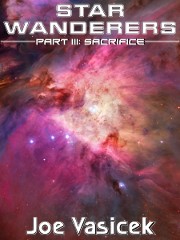
Star Wanderers I (thumb)Star Wanderers II (thumb)Star Wanderers III (thumb)Star Wanderers IV (thumb)SW-V Dreamweaver (thumb)SW-VI (thumb)SW-VII Reproach (thumb)

When I published the first couple installments of Star Wanderers, it represented both an experiment with a new publishing format and a departure from the more long-form styles that I was used to.  Now, a little over a year later, I can say it’s been a success.  The series isn’t finished, and I’m still learning as I go, but here are some of the big lessons that I’ve picked up:

Novellas are surprisingly well-suited to series. They read fairly quickly, contain enough focus to sustain an episode of a larger story, and yet at the same time contain enough space to develop a wider arc.  Plus, they are a lot quicker to write than novels and generally don’t require as much editing, since it’s easier to get the story right on the first pass.  This means that you can put out novellas faster and more regularly than long-form novels, maintaining good momentum for the series as a whole.

It’s hard to write anything shorter than a novella without leaving readers unsatisfied.  By far the biggest criticism I’ve received for Outworlder (which is really more of a novelette than a novella) is that the story feels too short.  If the novella (17,500 to 40,000 words, or 80 to 150 pages) has all the benefits of the novel and the short story, then it seems that the novelette (7,500 to 17,500 words, or 30 to 80 pages) has all of the drawbacks.  Then again, it could just be that I have yet to master the form.

The satisfying element in a series is at least as important as the returnable element.  Every successful episodic story has some sort of returnable element–something about the story that makes the audience ravenous for more.  Often, this takes the form of a cliffhanger, leaving something unresolved.  However, it’s not enough just to string readers along, holding back whatever your story has promised them.  In every installment, you have to deliver.

It’s a delicate balance, to be sure, but the advantage of erring on the side of satisfaction is that the satisfaction can actually become a major hook in itself.  If readers know that they’re going to be satisfied whenever they pick up one of your books, you don’t have to ratchet up the tension to eleven in order to keep them coming back.  Several Star Wanderers reviews mention that it’s more relaxing and not as fast paced as other space opera, but sales of parts III through VI are almost 1:1.

Readers love to revisit a good story from another character’s point of view.  Some of the most glowing reviews I’ve received for this series are for Dreamweaver, which is basically a parallel novella to Outworlder but from Noemi’s point of view.  In Outworlder’s Amazon also-boughts, it sometimes even appears ahead of Homeworld, which actually comes before it in the series order.  This tells me that readers love to revisit a story, or to hear the same story again but from a different point of view.  Head-hopping from episode to episode can be a great way to add variety and depth.

Plenty of readers are willing to pay $2.99 per book for a series they enjoy.  When I published the omnibus for Star Wanderers I-IV, I wondered if sales of the individual novellas would taper off since I priced the omnibus much lower than their sum.  To my surprise, sales for both the omnibus and the individual installments have actually remained about even.  Since the omnibus clearly shows up on Amazon’s recommendations, this tells me that $2.99 is not too high of a price, even for a novella.

Perma-free works; however, free and $.99 attract some bad apples.  Do not underestimate the power of free, especially perma-free for the first book in a series.  I credit that strategy for at least 90% of the Star Wanderers sales, since the series itself has boosted my total sales numbers by more than an order of magnitude.  However, there are people out there who never fail to find something to complain about.  These are usually the same people who don’t like to pay for anything, and when they realize that the rest of my series is not free, they tend to leave unhelpful and/or incomprehensible reviews.

I priced Fidelity at $.99 to try to give readers more of a hook from part I to part II, but the sales ratio between part II (Fidelity) and part III is about 2.5:1–in other words, pretty bad.  Judging from some of the reviews, it seems that a fair number of the people who are dropping out are the bad apples.  I haven’t decided whether to raise the price, but if things keep going the way they have been, I probably will.

Series don’t usually take off until the third or fourth installment.  Do you know how many sales Outworlder had in the month when I first published it?  About 10–and that was actually a surprise.  When I published Fidelity, I had even fewer, and Sacrifice hardly sold anything until Outworlder went perma-free.  When it did, sales of the other two novellas picked up, but it wasn’t until after I’d published Dreamweaver that the sales of Fidelity started hitting triple digits.  The lesson to me is clear: it takes time for a series to pick up steam, so don’t be like Fox.  Give it a chance to grow.

Nothing sells a book like writing and publishing more books.  This is probably the main driving factor behind the last point.  I’ve done almost no promotion for Star Wanderers, other than putting out new books on a fairly consistent basis.  Amazon’s algorithms have probably done their part (sales on other outlets haven’t been growing nearly as much), but at the end of the day, there is no substitute to writing more and better books.  Any sort of promotional or marketing activity that takes away from my writing time is just not worth it–not when I’ve got stories to tell.

Right now, I’m getting ready to start a new spin-off series, which hopefully will be even more successful.  I’ll to try out a few new things (mostly along the lines of better covers and meatier novellas), but mostly, I’m going to try to replicate the success I’ve achieved with Star Wanderers by keeping these lessons in mind.  I have no idea how this new series is going to go, but I figure I know enough about the publishing side now that I can focus my attention on writing an awesome story, which is the most important thing after all.

Why I don’t like George R.R. Martin

I was thinking today about George R.R. Martin’s A Game of Thrones and the fact that I’ve more or less given up on the series after reading the first book.  A lot of my friends are rabid-at-the-mouth crazy about it, both the books and the TV miniseries, but I’m just not all that into it.

Don’t get me wrong—I can see why other people like it so much.  The story is engaging, the political intrigue is deliciously complex, the world building is wonderful and immersive, and the fantasy tropes are played quite well.  I enjoyed a lot of things about the first book, and intended to read the rest of the series after finishing it.  After all, it’s one of the most important works of epic fantasy to come out in the last few decades, with people calling George R.R. Martin an American Tolkien.

But the truth is, I just wasn’t all that into it.  And the more I think about it now, the more I’ve realized that this isn’t the kind of series I would enjoy at all.

The strange thing is, I’m a HUGE fan of David Gemmell, who writes almost the exact same sort of thing.  Immersive fantasy worlds, dark and gritty characters, shades of gray, lots of fighting, lots of sex, lots of brutality, the realization that anyone can die off at any time … the list goes on and on.  And yet, there’s something about David Gemmell’s books that turns me rabid-at-the-mouth and has me squeeing like an otaku fangirl, whereas with George R.R. Martin, all I can manage is “meh.”

I think the reason for this is that Martin’s characters basically fall into one or both of two camps: victim or victimizer.  There isn’t any middle ground—at least, none that anyone can stand on for long without dying in some horrific and brutal way.  The story requires the characters to all become monsters, and anyone who isn’t willing to do that meets a horrible, tragic end.

There were only two characters in A Game of Thrones that I really cared about: Arya and Ned Stark.  Ned was the only character who really tried to stand for something, and Arya was just a spunky little girl who resisted all the stupid girly stuff in favor of more practical stuff like street smarts.

<spoilers ahoy>

The trouble was that Ned was a complete idiot, trusting in the honor of a guy who explicitly said “do not trust me” and making stupid decisions that ended up getting half of House Stark killed or captured.  It’s almost as if Martin purposefully set him up to be a straw man character—that he wanted this one character to represent all the goody-goodies of the world, and knocked him off in the most brutal way possible.  It’s like Martin killed him off to make a point, and had the story drive the character rather than the character drive his own story.

And Arya … I forget exactly what happened to her, but she basically became a victim in such a horrible, twisted way that I could tell she’d be scarred for the rest of the series.  If she didn’t die off herself, she’d probably become a dirty street rat—the slit-your-throat-for-a-copper kind, not the Disney version.  So yeah, I pretty much gave up on her.

Jon Snow was okay, but he was so far removed from everything else in the story that I just got bored with him.  Tyrion was funny, but he was also a pervert, and all the reasons to sympathize with him basically revolved around “I’m a dwarf, everyone mistreats me”—again, the victim vs. victimizer thing.  Lady Catelyn was pretty cool, but I always saw her as more of a supporting character, and while I found myself rooting for Daenerys at the end, it was only out of frustration with all of the other douchebags in Westeros—I just wanted her to come over the sea and claim the throne so that everyone else would die.

It was a pretty good book, I’ll admit—other than the fact that I didn’t really like any of the characters, everything else was quite enjoyable.  It certainly held my attention long enough to finish the thing.  But I didn’t really feel compelled to read the next one because I frankly didn’t care what happened to any of the characters.  You could give me a list of all of the ones who die off, and I would just shrug and say “oh well.”

In contrast, with every David Gemmell book I’ve read, I fall in love with the characters after reading just a paragraph or two in their viewpoint.  Drenai or Nadir, civilized or barbarian, I not only like the characters, I fall deeply in love with them.  I care about them right from the outset, even the ones with a dark past, like Skilgannon or Waylander.  In fact, Waylander is probably my favorite of them all.

The fact that I know that some of these guys are going to die only makes me more invested, because even though Gemmell kills of most of his characters in any given book, the main characters’ deaths almost always mean something.  Maybe they have some awful secret that they finally are able to give up, or maybe they’ve been running from a fate that they finally gather the courage to face.  Or maybe they just happen to be in a circumstance that requires them to give up their lives, and they rise to meet the occasion.  Not every death is cathartic, but Gemmell never kills off a character merely for the sake of killing off a character, whereas with Martin, I get the sense that that’s sometimes the only reason.

But the biggest difference between the two is that with Gemmell, the victim vs. victimizer paradigm just doesn’t exist.  Gemmell’s books are all about unlikely heroism—characters in situations that require them to be something more, or do something beyond looking out for just themselves.  Anyone can be a hero, because a hero is nothing more than someone who does something heroic.  No matter your past, no matter your fears, no matter your weaknesses, when the chips are down, we’re not all that different.

The counter argument I’ve heard is that all of this heroism stuff is superfluous, and Martin is trying to get beyond it, kind of like the 19th and 20th century philosophers who were trying to get beyond morality.  The thing is, if that’s the case, then Martin has to have the darkest and most depressing view of human nature of almost any fantasy writer alive.  If his point is that there’s nothing intrinsically heroic about anyone, that being a hero is just a matter of rising to a role and becoming a figure in one of the stories that people tell to make sense of the world—if his point is to show that every hero is really just a douchebag, there’s something about the world that he’s really missing.

In Gemmell’s books, there are douchebags who rise to the heroic roles required of them—but in the act of filling that role, something about them changes, and you see that they’re really not as evil as you thought they were.  Because in Gemmell’s view, people are essentially good and everyone is redeemable, even the rapists and murderers.  One of his darkest characters, Skilgannon the Damned, learns at the end of his story that the difference between salvation and damnation is allowing yourself to receive the light—that the only thing damning you is yourself.  Whether or not you agree with that, you have to admit that’s a pretty optimistic way of seeing the world.

In the end, that’s why I love David Gemmell’s books so much—not just because anyone can die, but because anyone can be redeemed too, sometimes at the very same time.  From what I’ve read of George R.R. Martin, it seems that he redeems no one—that to the extent I’m rooting for any one character, it’s only because I can’t wait for them to kill or brutalize all the other horrible monsters in the book.  And frankly, I find that pointless and tiresome.

There are moments in almost every David Gemmell book I’ve read that stand out to me with great clarity, so that sometimes while I’m standing in line at the grocery store, or walking down the street to the library, they pop into my head completely unbidden.  With George R.R. Martin, that has never happened to me, even for the books of his that I’ve enjoyed.

I dunno.  Everyone is different.  Maybe George R.R. Martin really strikes a chord in you, so that you feel for him like I do for David Gemmell.  Maybe you actually like some of the characters whom I’ve dismissed as douchebags.  Or maybe you don’t read fantasy for the same things I do.  This post isn’t to knock you for that, it’s just to point out and analyze why I don’t like George R.R. Martin’s stuff as much as most other fantasy fans seem to.  And if you do feel about this the same way that I do, then my point is to declare that that’s all right.  You can still be a fantasy geek and not like A Sword of Ice and Fire or anything else by George R.R. Martin, no matter how much it’s hyped.  That’s perfectly okay.

I’m writing an epic fantasy right now, and it’s not going to be anything like A Sword of Ice and Fire.  It’s probably not going to be much like any of David Gemmell’s books either, but Gemmell is certainly a bigger influence on me than Martin.  We’ll have to see how it turns out.

When something you’ve written moves you

SW-VI Benefactor (thumb)So I had an interesting experience today as I was revising Star Wanderers: Benefactor (Part VI), and I’m not sure how to describe it without sounding like “that guy” who gushes far too much about his books.  At the risk of being “that guy,” here goes.
As writers, it’s far too easy for us to write something in the heat of a creative passion, only to dismiss it later.  Perhaps we’re so afraid of screwing up that we yearn to fall back on the story that’s safe rather than the story that rings true, or perhaps we realize just how much of ourselves we’ve put into it that it scares us to death that someone might actually read it.  Too often, something else that’s broken about the story distracts us from the stuff that’s actually good, so we end up throwing it all out together.  Our critical minds work so differently from our creative ones that when the fires of creative passion turn to smoldering embers, it’s not unusual to feel like we’ve been left completely naked and need to scramble desperately to cover ourselves.

For that reason, I’ve made myself a rule not to revise a story without first making a set of bullet points, chapter by scene, of what I’m going to do.  My critical mind has full domain of that list of bullet points, but I will not let him carve up my story.  The list contains a series of instructions for my creative mind, who can actually revise quite well when given a little direction.  But when he thinks that the direction is wrong, he’s not afraid to push back.

The revision notes for my books always read like a back-and-forth argument between my critical and creative minds.  Once I’m finished writing up the bullet point list of revisions, I turn on track changes and cross them off one by one as I complete them.  But whenever I get to a point where my creative mind disagrees, I’ll cross it off and write down the reasons why it’s better to go in a different direction.  Some of the more recent notes for Benefactor include:

It’s not as much of an issue as you think.

Eh, the dialog works pretty well.

Already there.  Better to keep it subtle.

Why?  This is good.

No, it works very well with what’s already here.  Don’t change it.

So with that as a preface, I got to a scene in Benefactor today where one of the characters has a major life crisis upon learning that his wife is pregnant.  The pregnancy catches him completely by surprise, and makes him wake up and wonder if his life is really heading in the direction that he wants.  He feels like he’s stumbling into his future blindly, tripping over his feet without knowing where he’s going, and that frightens him.

I’d made some notes to add some stuff for clarification at the end of the scene, but I must have only been skimming it when I made the revision notes because all of that stuff was already there, and expressed more poignantly than I think I could have done.  Basically, the character comes to peace with the life he’s giving up by realizing that he will one day lead his son to follow in his footsteps, just as his own father did with him.

My critical mind completely missed that, because he was only looking for problems that needed to be fixed.  But when I read it again today, I was actually kind of shocked that this was something I’d written.  I don’t want to say that it’s the best thing that’s ever been written, because certainly I have lots of room for improvement, but the passage really moved me, and I wasn’t expecting that.

So yeah, revisions for Star Wanderers: Benefactor (Part VI) are coming along swimmingly.  It might be a bit tough to get the final draft proofread in time for a July release, but I’ve got some friends who might be able to help.  Just like I don’t trust my critical mind to meddle with the story, I don’t trust my eyeballs to catch all the typos and grammatical errors.  But I think that the substantive revisions will be finished by Tuesday, and after that, it’s time to get the publishing wheels grinding.

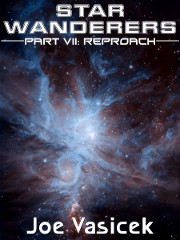
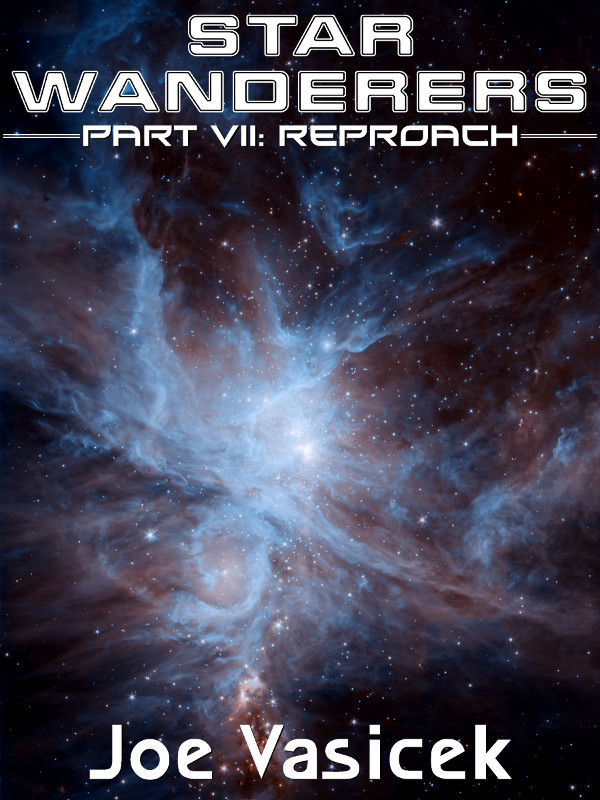
In the meantime, I was playing around with The Gimp today, and I came up with a cover for Star Wanderers: Reproach (Part VII).  Check it out!

SW-VII Reproach (cover) The image is the Orion Nebula, as imaged by the Spitzer Space Telescope.  You can find the original here.

I thought it was fitting, considering how Reproach is a parallel novella to Sacrifice, and Sacrifice also features an image of the Orion Nebula on the cover.  But the important thing is just that it looks cool and is sufficiently eye-catching.

So that’s about it.  I’ve got a lot of heavy revisions to do tomorrow, but even my critical mind agrees that chapters 4 and 5 are actually pretty good.  There’s at least one scene missing and a couple of other things that need to be added, but I’m actually looking forward to writing those.  Also, a couple of characters need some more fleshing out, but that shouldn’t be too difficult.  The Tuesday deadline is quite doable.

Have a good night, and thanks as always for reading!

Thoughts on writing advice generally

I’m working a swing shift job at a bakery outlet right now, loading and unloading trucks for the next day’s shipment.  It’s a great job because 1) the pay is higher than most warehouse jobs, 2) it’s only 20 hours a week, 3) I’m the only guy there, so there’s lots of autonomy, and 4) I can listen to music and podcasts while I work.

Anyway, I was listening to a panel from this year’s LTUE last night, and at one point I actually got so mad with the panelists that I almost swore.  In particular, there was one panelist who doesn’t really have any books out or any publication credits to speak of, but she was constantly (CONSTANTLY) chiming in with writing rules and writing advice, to the point where she started clashing with some of the big name authors on the panel.

The reason that made me angry is because I’ve been on the receiving end of a lot of bad advice.  Not just advice about the craft of writing, which might be good individually but in the aggregate tends to feed your inner editor and kill your creative drive.  I’ve heard a lot of really bad career advice, both from established professionals who have no clue how the industry is changing, and (more frequently) from unwashed newbies who spend more time promoting their last book than writing their next one.  It’s gotten to the point where whenever anyone starts to give advice, I just roll my eyes and skim over whatever it is they’re trying to say.

This is not to say that I think I know everything and that now I can stop learning.  I have no illusions about that.  Just this past week, for example there was an excellent thread on the KBoards about cover design, with several designers chipping in with their insights.  I admit, I skimmed a lot of the stuff the writers were saying, but the designers I stopped and paid attention to.  There’s still a lot I have to learn when it comes to covers, as well as hiring the right kind of artists to do the job.

When it comes to the craft of writing, I’ve found that the best way to learn is to read a lot of really good books and pay attention to the things the authors do.  For example, Louis McMaster Bujold has some really colorful ways to describe her characters’ mannerisms, such as having Lord Vorkosigan simultaneously smile at one character and frown at another.  Jane Austen is a master of giving the one or two details that you need to feel like you know exactly what kind of a person each character is.  David Drake can write action sequences that really make you feel like you’re there in the character’s head, and Orson Scott Card’s dialog is peerless.

And as for career advice, honestly, the best approach I’ve found is to just say “screw you all–I’m doing it my way!” The industry has changed so much in the past three years that no one–absolutely no one–knows anything.

Four years ago, I snubbed my nose at self-publishers and would have been horrified to learn I’d become one.  Two years ago, I hated the term “self-publishing” and avoided it like the plague, using terms like “indie publishing” instead.  Now, I don’t really care.  I’m reaching readers, growing a fan-base, and making money, and that’s all that really matters.

Everyone seems to have an opinion, but the only way to have an informed opinion is to actually go out there and find out what works for you.  So basically, I treat everyone’s advice with contempt unless they can demonstrate unequivocally that it’s worked for them.  Even then, I pick and choose what I adopt for myself, based on what sits best with my own personal philosophy.  In the end, I learn a lot more by rolling up my sleeves and getting my hands dirty than I do from following someone else.

All of this has combined to make me really loathe to give any advice.  At Leading Edge, I’ve taken recently to reading ARCs and writing book reviews, rather than writing out those scathing story critiques like I used to.  I rarely comment on blogs or message board communities, and when I do, I always feel like I have to include a disclaimer that this is my opinion, or this is what’s worked for me, or this has been my experience (and therefore may not apply generally).  Sometimes, I see writers who are so caught up in stupid myths that I want to reach out and help them, but even then, I feel like there’s something restraining me.

The point is, if/when I succeed in this business, it will be in spite of the advice I’ve received, not because of it.  I’ll consider almost anything, but whether I actually follow it … yeah, don’t hold your breath.

Thoughts on serials and ebook pricing

I’m going to do something potentially dangerous and discuss pricing strategies in a rather candid way.  I may risk turning off some of my potential readers, especially the ones who don’t like shorter works, but I want to be as open and transparent as I can, since I figure it’s only fair, especially to someone who’s just getting started with my books.

First of all, let me just say that if I could, I would make all my books free and write for love instead of money.  The trouble, though, is that I have to eat, and at some point in the (hopefully) not too distant future I’m going to have to feed a wife and children as well.  If I made all my books free right now, I would have to spend all my time and energy doing something other than writing, and as a result there would be far fewer books for you to read.

In the last year, I’ve discovered that the best way to make money self-publishing is to write in series, preferably at a short enough length that you can release a new installment every other month.  A lot of other writers are discovering this, which is why there is such an explosion of series and serials.

I know a lot of readers don’t like this.  And when a writer takes a perfectly good novel and splits it arbitrarily into parts, each one without a solid arc or story structure to hold it together, I get a little bit ticked as well.  But the reality is that if you can tell a story in a series of short, self-contained novellas rather than a single novel, it will probably meet with better commercial success.

The price points for novellas are kind of tricky, though.  For anything priced below $2.99, Amazon takes 65%, whereas from $2.99 to $9.99, the self-publisher takes 70%.  To give that some perspective, you would have to sell 10x the number of copies at $.99 to earn as much on one sale of a book at $4.99, and 6x for a book at $2.99.

The trouble, of course, is that for a series where each installment is priced at $2.99, the readers may end up paying a lot more, depending on the lengths of the story arcs and the size of each installment.  Novellas are kind of in a gray area, where $.99 seems kind of cheap for that much story, but three or four installments at $2.99 really add up–especially with so many other ebooks priced at $5 or below.

Now, I’d like to believe that most readers judge the value of a story by its quality and not by its word count, or by how much they have to pay per word.  There are books like City of the Saints that I don’t mind buying in $2.99 increments at all.  At the same time, though, I think there’s something to be said about keeping prices fair.

This is all on my mind right now because I’m getting ready to release the first Star Wanderers omnibus and expand that series considerably over the next year.  It’s the series that sells best out of any of my books, and the one with the most potential to make it so that I can go full time.  Plus, I really love writing in this universe, and have a lot more stories in it to tell.

Right now, this is the pricing structure I’m following:

  1. Outworlder — free (15,000 words)
  2. Fidelity — $.99 (17,000 words)
  3. Sacrifice — $2.99 (19,000 words)
  4. Homeworld — $2.99 (20,000 words)
  5. Dreamweaver — $2.99 (19,000 words)

Parts I through IV make a complete story arc, though of course each individual novella is a self-contained story on its own.  With Part I at free and Part II at $.99, I figure readers have a good way to figure out if these are the kinds of stories that they’ll want to read.  But if I keep pricing the stories at $2.99, at some point this series is going to get really expensive.

So here’s what I plan to do to alleviate that:

1) Make new releases free to newsletter subscribers.

For every Star Wanderers story up to this point, I’ve made it free for the first two weeks on Smashwords and given that code out through my email newsletter.  I did that originally as an incentive to get people to sign up for my newsletter, but I think it’s a good series strategy as well.  This way, if someone discovers Star Wanderers now, they can buy all the previous installments at the higher $2.99 price point and look forward to receiving any future installments for free.

Some may question the business sense of giving away free books to readers who are willing to buy them, but the way I see it, the fans are the ones who are selling these books, not me.  I’m willing to put a free book in the hands of someone who already loves the series, and is more likely to write a glowing review or to share it with a friend.  And since sales of this series continue to grow, that strategy would seem to be paying off (or at the very least, it’s not biting me in the ass).

2) Try to put more story into each individual installment.

If $2.99 seems a lot for a short novella, then maybe I need to expand on them, with things like extra subplots and viewpoint characters.  Of course I don’t want the stories to feel like they’re padded, but if I can enrich the story in a way that really adds to it, then that’s certainly something that I should do.

For all of the Star Wanderers series so far, each novella is told from the point of view of just one character.  This sort of focus can be good, because it really gets me into the head of that character.  However, sometimes it’s also good to play things off of another character’s story, both to act as a foil and to provide contrast.

That’s what I’m doing with Reproach (Part VII) right now.  It’s not just from Mariya’s point of view, but Noemi’s as well, and that adds a lot to the tension as you see their competing motives and the way their views of the world really clash.  It’s delicious.  Benefactor (Part VI) is just from Jakob’s viewpoint, just because I wanted the story to really focus on his character, but most of the other stories kicking around in my head have room for at least another viewpoint character without taking away from the spirit of the series itself.

3) Price the omnibus editions less than the sum of their parts.

For someone who is just getting started with Star Wanderers, $2.99 might seem like a lot to pay to get caught up.  That’s only going to get more daunting as the series gets longer.  For that reason, I’m inclined to price the omnibus editions much lower–at least $4.95, which is the price of one of my novels.  At 70,000 words or so for Parts I-IV, that seems only fair.

I am a bit worried that sales of the individual novellas will drop off once I release the omnibus, but I figure if I’m constantly releasing new ones, those should cover the slack.  Since Dreamweaver (Part V) is already out, and Benefactor (Part VI) will be out in another month or so, new readers who come in through the omnibus will have more than enough to keep them coming back.

The other benefit of doing it this way is that it reduces the chance that readers will drop out midway through the story arc.  It seems that a few of them are doing that, or at least taking a while to get from Part II to Part III to Part IV, etc.  By having them all in one omnibus and encouraging readers to buy that instead of the individual parts, hopefully they’ll have more of a chance to get hooked, making it all the more likely that they’ll keep coming back.

So that’s my plan, at least for now.  When The Jeremiah Chronicles comes out next week, I’ll price it on parity with my other novels, even though that’s somewhat less than all the individual parts.  I’ll make all new Star Wanderers novellas free for my newsletter subscribers, and do what I can to enrich them with extra viewpoints and subplots (without just padding them, of course).  This way, I hope my readers won’t feel like I’m ripping them off, and I’ll still have a good shot of making a decent living at this.

With the way things have been going, I’m actually really excited.  The slow build approach is working, and if it keeps up then I think I may be making enough to go full-time by this time next year.  I’ll be sure to keep you posted as things come along.

In the meantime, if you have any thoughts or comments, please don’t hesitate to share.  I’m still thinking this issue through, and there’s a lot I have left to learn.  In fact, I feel like I’m only just starting to figure it out, so any other perspectives on this topic would be much appreciated!

Thoughts on making a living as a writer

As many of you know, my biggest life goal (besides obtaining a signed first-edition copy of David Gemmell’s Legend) is to make a living telling stories that I love.  Accomplishing that goal is no small task.  For the last five years, I’ve been focused on that goal like a hellfire missile, and as of right now it continues to elude me.

I’m getting closer, though.  I’ve got 14 ebooks out, hopefully 18 by the end of the summer, and they’re actually selling.  I won’t go too much into specifics, but my gross income is about 30% to 40% of what I’d need to cover all my expenses without another job.

Granted, I’m a young single guy with good health and no dependents, living on a shoestring budget in the cheapest housing in one of the cheapest states in the US, but that’s not an insignificant accomplishment.

Right now, I’m reinvesting all of that into the business, in order to boost sales and to avoid self-employment tax.  But if I have a difficult month and need something to fall back on, my books are generating a fair amount of passive income, and that income is growing.  If I keep doing what I’m doing, and things stay on more or less the same trajectory, I expect that I’ll be making enough to support myself in one or two years.

That’s actually a little better than the timetable I set a year ago, where I determined to go full-time by 2016.  Then again, I also set a goal to be married by then, and I have no idea how that will change things.  I suppose my spouse’s income would be able to supplement my own, but then there’s insurance and taxes and all sorts of other expenses that I can expect to go way up.

(At the same time, I have this wild dream of running off with my wife to some remote part of the world and spending a couple of years on some crazy-insane adventure, like trekking across Mongolia, or joining a Bedouin tribe, or couchsurfing across Europe.  The world is a very different place outside of the US, and the cost of living in much of the world is significantly lower.  Especially in the developing world, people know how to make do and be happy with much, much less.)

Even if I suffer a major setback, like an irreversible drop in sales or a technological shift that made my current business model obsolete, making a living is no longer a pie-in-the-sky sort of dream.  It’s within reach, and I think I have a pretty good idea how I’ll get there.

First of all, it’s probably not going to be a sudden, earth-shaking event.  It’s much more likely that I’ll ease into it gradually, first as a fallback for months when work is slow, and then as a way to pay off my bills while I keep a part-time job for spending money.  One day, I’ll wake up and realize that it’s been five or six weeks since I’ve done anything but write, and then I’ll open up my budget and realize that I’ve arrived.

As I get married and start a family, my expenses will no doubt rise, and I or my wife may have to take another job for a while to make ends meet.  Then again, if book sales continue to snowball with each new release, then we might be able to time it so that the kids start arriving just as the writing income really starts to take off.  Even then, book sales fluctuate so much from month to month that until we have a significant amount of money in savings, we’re always going to feel like we’re a couple of weeks away from having to find another job.

And then, with the writing bringing in a comfortable six-figure income, we might finally be able to afford a house.  It’s almost impossible to get a mortgage as a self-employed freelancer, so I fully expect to pay for most of the house up front.  Good thing I don’t want to live in a city.

Of course, it’s also possible that the writing will never bring in a six-figure income.  Science fiction is a relatively small genre, and the only stories I really care to tell are the ones that take place on other worlds.  But that’s okay–as long as I’m able to support myself and my family, I’ll be happy.  Anything above that, and it’s not about the money.  In fact, it’s really not about the money right now.

The point of all this is that I don’t expect there to be a moment where I’ve suddenly “arrived.” If anything, it’s just going to be a continuation of what I’m doing right now, scaled up to meet life’s changing demands.

And you know what?  I’m okay with that.

My resume might look a bit checkered, and job interviewers may raise their eyebrows when they see that I’m a college graduate, but these odd jobs give me a lot more flexibility than a stable “day job” with insurance and all that.  I like being able to take a week or two off to do nothing but write, even if the off-time is unintentional on my part.  I know how to be flexible, and I’m quite comfortable living a lifestyle where I don’t know where I’ll be getting my next paycheck.

And to friends and family who are concerned because I’m almost thirty and don’t have a full-time job … don’t be.  I’m following my dream, and my dream is within reach.  Everything else is just a stepping stone.  I have a career, I’ve taken full responsibility for it, and I’ve turned it into something profitable.  If making a living as a writer is a bit like making grizzly bear soup, I’ve already killed the bear.

In related news, I learned this week that I’ve been pirated in Japan.  I’m not sure whether to be flattered or alarmed, but since my books are 1) available from multiple retailers 2) relatively inexpensive, and 3) DRM-free (on all the sites that allow it, anyway), I’m not too concerned about it cutting into my income.  I am worried about people downloading my books from an unsafe site that might give them a virus or something, but people will be people and there’s not much I can do about that.

If anything, it’s just another sign that I’ve arrived–or rather, that I’m exactly where I’ve wanted to be all along, and it’s just a matter of making things work.

Z is for Zenith

pioneer_book_scifiHas space opera passed its zenith?

Sometimes, it certainly looks that way.  All the major stuff seems to be reprints of past series and reboots of decades-old franchises.  Star Trek, Star Wars, Stargate, Battlestar Galactica, Ender’s Game, Dune, Babylon 5–all the big names seem to have had their start at least a generation ago.  At any science fiction convention, you’re likely to see more gray-haired men than kids in their teens and twenties.  And if you go to a publishing conference, new adult, urban fantasy, and paranormal romance are ascendant.

I’ve noticed that people are using the term “science fiction” increasingly to describe stories that don’t have anything to do with space.  Dystopian, post-apocalyptic, steampunk, even time travel–all of these subgenres are certainly part of the fold, but they’re very different from the stories about starships and alien worlds.  And then you have all the markets for short fiction that have been forced out of business–and even a few larger publishers, like Night Shade Books which is now selling off all its assets (read: authors) to avoid bankruptcy.

I remember going to World Fantasy 2010 in Columbus, Ohio, and feeling dismayed at the complete lack of science fiction.  World Fantasy is (or was, at least) the premier professional conference for speculative fiction literature, but all of the attention was going to urban fantasy and steampunk.  On the freebie table where publishers often dumped ARCs and review copies of their books, the only space opera stuff I really saw were a couple of titles by Glen Cook and one other guy–and I watched that table hawkishly for the full three days of the conference.

Sometimes, it seems as if it would be so much better if I had grown up in the 80s.  That’s when science fiction really had its heyday.  But all through the 90s, the genre seems to have been on the decline, much like NASA and the US space program.

So is space-centered science fiction on the way out?  Have we passed the glory days, and it’s now just a long decline until it becomes an obscure niche, beloved by some, but enigmatic to others?

In spite of everything I said above, I actually don’t think so.  In fact, I think we’re on the cusp of a science fiction renaissance, and that sci-fi geeks like myself will look back twenty years from now and wish that they were born in our era.  Here’s why:

1) Scientific discoveries are transforming the way we see the universe.

The day I posted P is for Planets, NASA’s Kepler mission announced the discovery of three Earth-like worlds orbiting in the habitable zones of their stars.  The existence of alien Earths is not conjecture–it’s a confirmed fact.  As our ability to study these worlds improves, it’s only a matter of time, IMO, before we find a world that has life.

We’ve discovered the Higgs-Boson.  We’re unraveling the fundamental building blocks of the universe.  We’ve built telescopes to look back to the dawn of time itself, and we’re learning more about the cosmology of the universe every year.  Perhaps even more remarkably, we understand now how little it is that we actually know–that the entirety of the observable universe is only about 5% of it, and even that’s optimistic.

All of this will take time to trickle down to the popular consciousness, but with all the new discoveries that are happening, I think that’s already in the process of happening.  In particular, I think the recent discoveries in the realm of exoplanets and astrobiology are going to shake things up in a major way in the next five or ten years.

2) The privatization of space travel is paving the way for a rapid expansion into space.

The US space program has been plagued with funding problems since at least the end of the Cold War space race.  Since the space shuttle program was retired just last year, the only way for our astronauts to get into space is through the Russian Soyuz spacecraft at Baikonur.  If NASA had to put a man on the moon, they do not currently have the knowledge or technology necessary to do it.

In the private sector, though, it’s been a very different story.  SpaceX has had a number of successful launches recently, most notably sending the first unmanned resupply capsule up to the International Space Station.  And just a couple days ago, Virgin Galactic had the first successful test flight of its rocket-powered spacecraft.

It’s sad to see the space shuttle go, but there are a lot of reasons why the program was flawed and inefficient to begin with.  By handing things off to the private sector and turning space exploration into a viable business venture, we can hopefully overcome those inefficiencies and eventually make space accessible to the general public.

And then you have the organizations like Mars One that are looking even further ahead to the colonization of Mars.  There’s a groundswell of excitement for Martian colonization that is starting to get some real money behind it.  Will it go anywhere?  It’s hard to say right now, but even if it suffers another decade or two of setbacks, it’s getting public attention, especially from the younger generation.

3) Video games are bringing a fresh new look and feel to the genre.

Not all of the big sci-fi series hail from 70s and 80s.  Halo started up as recently as 2001, and it’s a multi-billion dollar franchise with games, books–even Legos.  In fact, there are lots of sci-fi video game franchises right now, many of them right on par with other classic space opera.  Just look at Starcraft, for example, or Mass Effect, or Eve Online and Sins of a Solar Empire.  The number of sci-fi games has been exploding.

In fact, this explosion has been happening for some time.  While literary science fiction may have suffered something of a decline back in the 90s, that was the heyday of games like Master of Orion and Sid Meier’s Alpha Centauri.  Flight simulators like Flight Commander and X-wing proliferated like crazy, while even some of the classic RPGs like Final Fantasy borrowed heavily from science fiction tropes.  And those are just a few of the games that I can list off the top of my head!

Whether or not literary sf is on the decline, a whole new generation has been introduced to the genre through the medium of video gaming.  This is not just a small niche audience playing this stuff, either–in the US at least, Halo is as mainstream as Monopoly or Settlers of Catan.  In fact, you could say that science fiction is more mainstream now than it ever has been, and a lot of that is due to sci-fi video games.

4) The e-publishing golden age is giving us thousands of new voices.

But what about the world of literary sf?  Are we in a decline?  Do people just not read science fiction anymore?  How bright is the future for science fiction literature?

Actually, this is the area where I’m the most optimistic of all.

The publishing industry is changing at the speed of light, much in the same way that the music industry changed about a decade ago.  Just as the MP3 revolution allowed all sorts of eclectic yet entrepreneurial artists to thrive without the oversight of record labels, the epublishing revolution is opening all sorts of doors for the enterprising author.  And while the changes are driving publishers (such as NSB) out of business, they are enabling authors who only sell in the mid-list range to make a respectable living.

At Worldcon 2011, Ginger Buchanan (senior editor at Tor) asserted that there has never been a runaway science fiction bestseller.  In the eyes of New York publishing, that may be true–but New York has a notorious record for missing the catch in pursuit of one big fish.  Because of epublishing, whole new genres like New Adult that publishers thought would never sell are now going mainstream.

And even the niches that stay niches are becoming quite lucrative for the authors who can build a decent following.  When author cuts out the middlemen and develops a direct relationship with the readership, it only takes a thousand true fans or so become a financial success.  As Kris Rusch pointed out so aptly, those numbers may bring only scorn from New York, but for the writers who actually produce the content, that’s a vein of pure gold.

I can’t tell you how many success stories I’ve heard from fellow sci-fi writers over on the Kindle Boards, who started just for the grocery money and ended up quitting their day jobs.  But as Hugh Howey pointed out, the runaway bestsellers are not the true story of the epublishing revolution–it’s the little guys who only sell a few hundred copies a month but are earning enough to support themselves writing what they love.

Indeed, we’re already starting to see an explosion of new science fiction, thanks largely to the ease of electronic self-publishing.  I’ve only read a few of them so far, but Nathan Lowell stands out among them, as well as my good friend Kindal Debenham.  These guys and so many others are bringing a fresh new voice to space opera, revitalizing the genre in ways that simply weren’t economical back in the days of Big Publishing.

So even if space opera as a literary genre isn’t quite large enough to go mainstream, it is large enough to support a wide range of new voices under the emerging business models.  And as the epublishing revolution continues to mature, I think we’re going to see a new golden age comparable to the era of the pulp adventure stories.

I’ve been publishing my own work since 2011, and I can attest that there’s never been a better time to be a writer.  I’m not quite making enough to go full-time yet, but at the rate things are going, it will only be a  year or two before I realize my dream of making a living telling stories that I love.  And if they’re the kind of stories that you love too, then that’s great news for all of us!

So has science fiction reached its zenith?  I don’t think so.  It went mainstream about a generation ago, which was definitely a huge moment, but for the last few decades it’s been in the process of branching out and rediscovering itself.  Right now, I think we’re on the verge of a wonderful new renaissance that is going to blow us all away.  As a lifelong reader and writer of science fiction, I certainly hope that’s the case.  And because of the reasons listed above, I sincerely believe that it is.