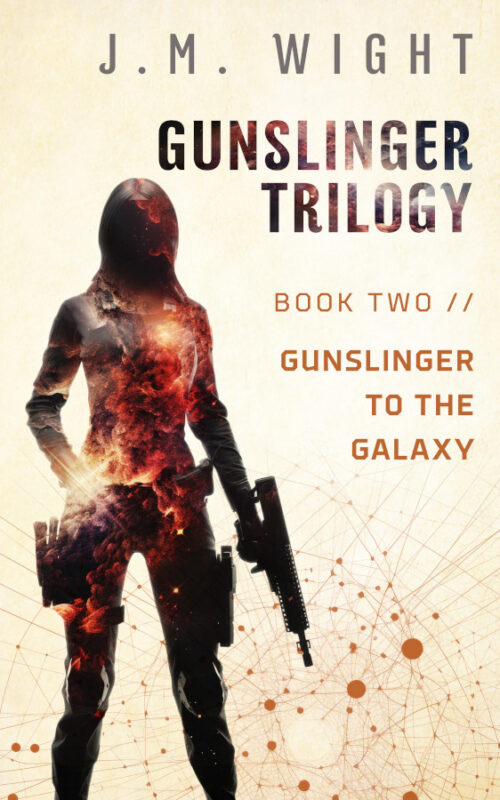
At its core, Gunslinger to the Galaxy is a space-opera story built around a deceptively simple question: what does it mean to be equally yoked when the universe is coming apart at the seams? Jane Kletchka isn’t just trying to save Earth; she’s trying to build a marriage, a family, and a vocation that all matter in an honest, eternal way. The story keeps circling back to this tension: how do you stay true to your gifts, your faith, and your partner when war, politics, and Immortal-sized crises keep demanding more?
Where the Idea Came From
When I wrote Gunslinger to the Galaxy, I was working part-time at a warehouse in Iowa and later grinding through a 40+ hour per week construction job in Utah. I wasn’t married yet, but it was something I definitely wanted in my life, and I poured that into my writing, forcing myself to write a few hundred words a day even when I was exhausted and everything around me felt like a dump.
That experience of trying to build something meaningful in the middle of chaos is baked into Jane and Sam’s story. At its heart, Gunslinger to the Galaxy is about two people trying to be a force for good while the universe keeps trying to knock them flat. I kept that theme close even through the difficult circumstances surrounding its writing—and, fittingly, around the time I finished the book, I also met the woman who would become my wife.
How Being Equally Yoked Shapes the Story
“Equally yoked” isn’t just a passing phrase in this book; it’s the backbone of Jane’s entire arc. From the early garden conversation with her mother—where Mom worries that Jane will end up standing in Sam’s shadow instead of using her own God-given talents as a xenolinguist—the story keeps pressing on a single pressure point: is this marriage helping both partners become what they’re meant to be, or is one being swallowed by the other’s path?
When the jumpgate network collapses and the Immortal civil war throws the galaxy into crisis, Jane has every excuse to curl up and let events happen to her. Instead, the story turns when she realizes she can’t just be “the gunslinger’s wife.” Drawing on Sam’s blunt insight about control and trauma, she chooses to use her training, her languages, and her brain to actually shape events—digging into logs, mapping networks, and turning her grief and fear into concrete action that can save lives and maybe bring Sam home. Being equally yoked here means more than just sharing a last name; it means each partner brings their full self to the fight, and the marriage becomes a shared mission instead of a sacrifice of one person’s calling to the other’s.
By the end, when Jane and Sam are sealed in the temple and begin building a family, the book circles back to that original fear: will motherhood and marriage erase Jane’s larger purpose? The answer is no—but not because the galaxy gets easier. Instead, the story shows her finding ways to balance remote work for the Andromedans and the Intergalactic Council with raising John Moses, weaving vocation, faith, and family into a single, hard-won whole. The adventure isn’t over; it’s just moved into a new phase where “equally yoked” means building a life that can withstand both warp drives and diapers.
What Being Equally Yoked Says About Us
In science fiction, we often see lone-wolf heroes or solitary saviors, but Gunslinger to the Galaxy takes a different path by centering a married-couple partnership in a space-opera setting. Under all the jumpgates and Immortals, this is a story about something very human: the fear that love will cost us our calling—or that our calling will cost us love. Most of us aren’t piloting starships, but we know what it feels like to worry that marriage, family, career, or faith will pull us in different directions until something breaks. Gunslinger to the Galaxy suggests a different model: the people we love most should help us become more ourselves, not less. Being equally yoked doesn’t mean never struggling or never disagreeing; it means pulling the same direction when the load gets heavy, and trusting that God can turn two flawed people into a team that does more good together than either could alone.
Why Being Equally Yoked Matters to Me
I wasn’t married when I wrote Gunslinger to the Galaxy, but it was definitely something I was looking forward to. I wrote it during a season of my life that was chaotic, exhausting, and frankly not very glamorous, but I pushed forward anyway, trusting that the kind of woman I hoped to marry someday would value that dedication. And sure enough, when I finally met her, one of the things that drew her to me was my hard work and dedication to my writing—a dedication that I have also channeled into our marriage and family life.
For me, Gunslinger to the Galaxy is a story about faith, marriage, and the stubborn belief that ordinary people can still choose to do the right thing together, even when it hurts. If this book resonates with you, I hope it’s because you see a bit of your own struggle to be “equally yoked” in a world that always seems on the brink—and you feel a little more hope that it’s worth the fight.
Where to Get the Book










Related Posts and Pages
Explore the series index for the Gunslinger Trilogy.
Return to the book page for Gunslinger to the Galaxy.