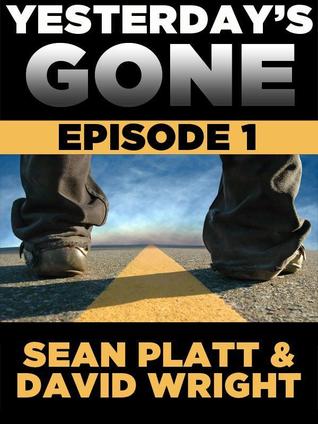
Yesterday’s Gone: Episode One by Sean Platt & David Wright

Imagine you wake up tomorrow, and find out that everyone around you has vanished.  Well…not everyone.  But the ones who are still around claim to see strange things that you can’t see.  And then, you get an eerie feeling of a presence…something dangerous, something coming at you right now.  And then, things get really weird…

Yesterday’s Gone is a post-apocalyptic serial thriller: basically,  a novel divided into six parts or “episodes,” the first of which is free.  Since I’m interested in doing something similar with my next project, I decided to check it out.

From the very start, I was hooked.  The conflict was intriguing, the pace was fast and gripping, and the characters were interesting, with reactions that were spot on.  I wasn’t intending to finish the whole thing in one sitting, but once I’d started, there was no way I could put it down.

A couple of things jolted me out of the story, though.  The first was the sheer immensity of the cast of characters.  Literally, the first half of the episode was just introducing new ones, and none of them got more than two viewpoint scenes in the whole ebook.  I was on board for the first three or four of them, but around number six or seven, I just wanted to skip them and get back to the first guy.

Two of the later characters were just painful to read–not only did I not care about them, I vehemently hated who they were and wanted them to die or get out of the way so I didn’t have to read their viewpoints anymore.  The first was an eight year-old boy who had some mystical connection with animals…I just couldn’t sympathize with him at all.  The other one was a serial rapist and/or murderer who saw the apocalypse as just an opportunity to run around raping and killing the other survivors.  I skipped his scenes, but then had to go back because there were some clues hidden there and I didn’t want to miss them…ugh.

The other thing that really bothered me was the very last scene in the episode, where the authors made the mistake of showing the monster.  I won’t spoil it for you, but the image on the page clashed so strongly with the image in my mind, it deflated almost all the tension for me.  What was supposed to be a cliffhanger instead turned out to be a big “huh?”

Your mileage may vary, however, so if you’re into post-apocalyptic fiction, I think it’s definitely worth checking out.  Just like the happy pills in the empty lot behind the school, the first one is free: you can pick it up on Amazon or Smashwords.  And in spite of its problems, there was a lot in this story that I really liked.  Maybe you’ll enjoy it more than I did.

In terms of the serial format, I think it worked very well, except for those two problems: too many characters to keep track of, and an ending that booted me out of the story.  Otherwise, I think it’s a great way to publish, and I’ll probably experiment with something similar in the future.

Trope Tuesday: Big Damn Heroes

You know the drill.  The clock is ticking down to zero, the evil hordes are swarming through the gates, the virgins are about to be sacrificed and the damsel in distress is about to be lost forever–and then the  heroes show up in all their glory to save the day.

This happens all the freaking time, which means that if you want to make a living telling stories, this is not a trope that you should ignore.  And with good reason.  Not only does it give the writer ample opportunity to play with suspense and action, but it arguably lies at the very core of what makes a hero a hero:

David Gemmell, according to this interview with Ian Graham, defined a hero simply as “someone who does heroic things.” They might not always take the right side, or they might not even care about doing what is right, but when the universe conspires to bring them to a moment of decision, they make the choice that all of us would like to think that we would take and do something extraordinary.

I like this definition of a hero.  It strikes me as a lot more honest than the perpetual do-gooder whose only motivation is Truth, Justice and the American Way (though those characters can–and do–have Big Damn Hero moments of their own).  Also, it means that true heroism is not contingent upon actually winning.  History may be written by the victors, but that doesn’t cheapen the experience of those who actually lived it.

Of course, if the heroes don’t save the day, it’s pretty hard to pull off a crowning moment of awesome without bringing in the Bolivian Army.  Either the heroes find out that they’re too late, or they make things worse, or (as is so common with Othar Tryggvasson of Girl Genius) they just prove that their ego is too big for its own good.  When taken to the extreme, the heroes may even be in danger of turning to the dark side.

The biggest danger with this trope is turning it into a Deus Ex Machina.  The thing that makes Big Damn Heroes so incredibly satisfying is the sense of climax when they show up to save the day.  Thus, proper foreshadowing is key.  Yes, the rule of cool still applies, but if that’s all you rely on, you’re not going to be able to pull it off to maximum effect.

One of my favorite examples of this trope is Liam Neeson in Taken.  Plenty of action movies are more violent, but few are more satisfying.  It’s the perfect pick-me-up after a long crappy day at the office–not that I work in an office anymore.  I wonder why…

In any case, this is a great trope to look out for, and definitely one to master, especially if you’re writing any sort of action-adventure story.

Ira Glass on storytelling

I just listened to this awesome presentation by Ira Glass, host of This American Life, on the art of storytelling and narrative, and I wanted to share it because it’s that good. 

If you haven’t ever heard of This American Life before, do yourself a favor and check it out.  You may or may not love it, but it’s one of the best produced radio shows out there, with fascinating stories from all walks of life that will completely blow you away.  My favorite is probably the one about the department of the LAPD that exists entirely to identify the next of kin of people who live and die alone–and how many people in this world have essentially no connections with the people around them.  It was an incredibly sad and incredibly moving story.

Anyhow, Ira makes some very good points about how stories work, and how we as humans are wired to see the world around us in terms of story.  It’s not enough to simply convey facts–you have to hook your audience by making them feel emotionally involved, and creating suspense by giving them the sense that the events in your story are leading up to something.

He finishes the lecture by recounting the basic frame story of the Thousand and One Arabian Nights: how Scheherazade saves the kingdom from the sultan’s madness through the power of story.  It’s a wonderful tale, one that has a lot of bearing on why we write and why fiction matters.

That’s one of the reasons why I decided to name this blog “One Thousand and One Parsecs”; it implies a combination of the magic of the Arabian Nights with the science fiction elements that I love so much. Like Scheherazade, I hope to tell stories that have the power to transform individuals and ultimately change the world for better.

That’s enough from me. Here’s Ira Glass:

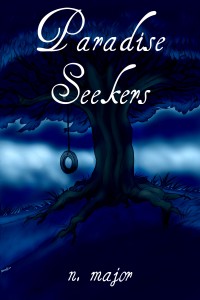
Paradise Seekers by Nathan Major

Haven–a land where no one knows who they are, where they’re from, or how they got there.  A place where everyone has a different recurring dream every night, which gradually grows in intensity until it drives them to madness.  A place where everyone has only a short amount of time to find Paradise, before they perish.

When Sam first comes to Haven, he thinks he’s found an idyllic utopia.  However, as he slowly uncovers the gruesome secrets of the place, he realizes he’s in a race against time to make Atonement and escape.

But how can he do that, when he can’t even remember who he is?  And how can he save the girl he loves, when she has only days before her dreams drive her into madness?

A few weeks ago, I said I’d start reviewing indie books on this blog.  This is my first one.  As a disclaimer, Nathan Major is a fellow Utah writer and a friend of mine, and I received a copy of the book for free, with the agreement that I would review it.

I genuinely enjoyed this book.  It’s a very compelling story, with a mysterious dystopian world and an intriguing premise.  Nathan is very good at building suspense and keeping the reader hooked, and the ending fully lived up to its potential.

As far as editing goes, I noticed only minimal spelling and grammatical errors.  However, the copy I read had some major formatting issues, such as wacky indents and an auto-generated table of contents that missed a few chapters.  Nathan assures me he’s fixed those issues, but I can’t vouch for the most recent copy.

As for the story, while I enjoyed it, it did feel as if it had been published too early.  More than once, I wanted to scream at the characters for doing something stupid, and the romance was occasionally over-the-top sappy.  The level of melodrama was on par with most anime, which is great if you can stand it.  Still, the story kept me hooked, and while I occasionally had to put the story down just to cool off, I always came back to it, right up to the very satisfying end.

If you like dystopian YA, I think you’ll like this book.  It reminded me a little of The Giver, with the urgency and sense of danger of a thriller.  Like I said, it also had a bit of an anime flair to it, so if you’re a fan of anime and manga, the issues I had with it probably won’t be as bad for you.

Overall, I rate Paradise Seekers at 3.5 stars.  If the formatting issues were fixed, I would rate it at 4.  Nathan has a natural talent at good storytelling, and I expect we’ll see many good things from him in the future.

Paradise Seekers is available for .99c from Amazon and free on Smashwords.

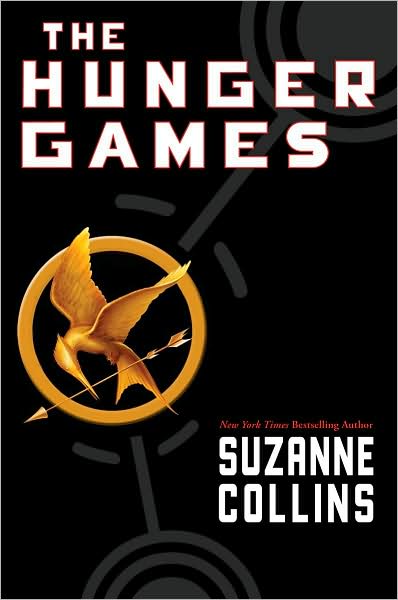
The Hunger Games by Suzanne Collins

This book review is going to be a bit unconventional, so please bear with me.

Normally, I only review books on my blog if I feel I can recommend them.  They might not be perfect, but overall, the praise outweighs the criticism. However, for me personally, The Hunger Games was a huge disappointment.

I’m not going to do a little book blurb like I usually do, because I want to spend all the available space on this post explaining the reasons why I was so disappointed.  Also because of that, this post will be full of spoilers.  Consider yourself warned.

First, let me say that I don’t think this book was all bad.  Suzanne Collins is very good at plot and pacing, and she knows how to keep a reader hooked.  In that way, this book reminded me of the old Michael Crichton thrillers that I devoured as a kid.

However, two crucial things killed about half of the suspense for me: the fact that this book was the first in a series, and the first person viewpoint.

From the very beginning, we know that Katniss isn’t going to die.  We know it, because she’s narrating the story to us directly (in present tense, which personally irks me, but I won’t go into that).  Unlike other gladiator-style heroic fantasies, where the major draw is to see who lives and who dies, we have that spoiled for us.

Of course, the argument in favor of the first person is that it helps the reader feel a closer connection with the viewpoint character.  The problem is, I never did.  At the end of the book, Katniss still feels like an outsider to me; I never felt like I got inside her head well enough to know who she really is.  When I try to imagine her, all I can envision is a wide-eyed mannekin.  She just didn’t come alive to me.

Why? Because the whole time, she’s only got one thing on her mind: survival.  I don’t see anything but fragmentary glimpses of her other motivations, and those are never fully fleshed out.  Her experiences growing up were just so traumatic that I can’t relate to her, and Suzanne Collins never provides a reference point outside of the awfulness of Katniss’s crapsack world.

Which is another thing that got to me: the setting.  Every time I opened the book, I dreaded going back to Collins’ world–and not in a good, “ooh, this world is so creepy/frightening” way, but in a “man, this place just makes me depressed” kind of way.  It wasn’t even that original–Panem is basically the USA as North Korea (though it could take place anywhere, for all the details Collins gives us).

What’s more, the setting is full of inconsistencies.  The people are starving to death, but the forests are full of game and wildlife.  In North Korea, people raze the forests for fuel and timber, driving all the game out.  Yes, I know the people of District 12 mine coal, but all of it presumably goes to Capitol, just like in District 11 all the grain goes to Capitol and the people still starve. Which makes me wonder: why are all the districts specializing in only one commodity?  That’s just stupid.

Which brings me to another thing: the sheer idiocy of the rulers of Panem.  If the Hunger Games are supposed to remind the people of how subjugated they are, why allow the tributes the opportunity to do something like pull a romance stunt?  Why spend all that time primping and preening them, interviewing them, and giving them an opportunity to manipulate the crowds?  When the people of District 11 sent Katniss the bread, why didn’t a government censor stop that from happening?  And finally, when Katniss and Peeta were the only ones left standing, why give them the opportunity to upstage the games by falling on each others’ swords?

Seriously, that last point got to me more than any of the others.  When they announced the rules change, that Peeta and Katniss were supposed to kill each other after all, why couldn’t the GM see the potential for things to go wrong?  Seriously, having them both kill each other–or refuse to kill each other–was such a blatantly obvious choice, I saw it the moment the rule change came into play.  The fact that the villains didn’t just threw me out of the story.

But that wasn’t the first thing that threw me out of the story.  The first thing was the parade, with Katniss and Peeta marching into the arena with their flaming cloaks.  All this time, Katniss has been set up as the underdog–she isn’t pretty, she isn’t strong, she’s mildly sympathetic for volunteering in place of her sister, but the audience in that arena is looking for blood, not sympathy.  So when the crowd goes wild for her and Peeta, I just didn’t buy it.

It only got worse as things went along.  When the tributes did the skill check, Katniss–who, from the beginning of the story, has been set up as the underdog–scores higher than anyone else.  Every time she’s in front of an audience, everyone is oohing and ahhing.  It made me want to gag.

Honestly, you know what it seemed like?  It seemed like Suzanne Collins fell in love with Katniss so much that she wanted to spoil her, even though the story required her to keep up the pressure.  She made sure to torture Katniss in the games–so much so that it felt downright melodramatic at times–but while they were still in Capitol, waiting for the games to start, Katniss felt like a spoiled Mary Sue.

And as for the romance, it fell completely flat from the beginning.  Katniss was nothing but a manipulative faker from the beginning–granted, because she needed to in order to stay alive, but the least she could have done was coordinate that with Peeta.

And that’s another reason why I had such little sympathy for her–she’s a callous, manipulative, lying little heartbreaker, like far too many women in this world.

So yeah, The Hunger Games was, in my opinion, a huge disappointment.  I can partially see why it did so well (strong female protagonist, excellent plot structure and pacing, lots of hooks and cliffhangers), but personally, I don’t think it deserves half the praise it’s gotten.  And after what friends have told me about the rest of the series, I can guarantee that I won’t be reading them.
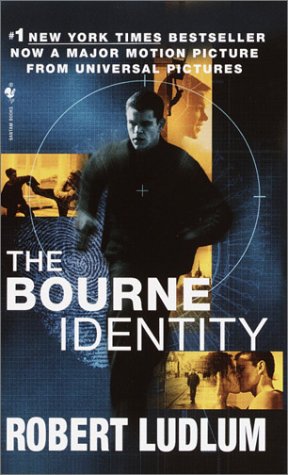
The Bourne Identity by Robert Ludlum

On a stormy night off the coast of Marseilles, a local fishing trawler recovers a man with a gunshot wound to the head.  The local doctor patches him up, but when he recovers, he has no knowledge of his past life.  Even his name is a mystery.

Fortunately, he has a clue to help him get started: a microfilm surgically implanted in his hip containing an account number for a bank in Switzerland.

When he arrives in Switzerland, he finds that the account contains millions of dollars, as well as a name: Treadstone 71.  Before leaving the bank, however, a squad of hitmen attack and nearly kill him, for no reason that he can possibly understand.

On the run from people he doesn’t know for things he doesn’t remember, Jason Bourne finds himself in a struggle, not only for his life, but to find his true identity.  But the answers, he fears, are much, much darker than he can possibly accept.

Okay, to start things off, let me say that this book is NOTHING like the movie.  NOT AT ALL.  The two are completely separate stories.  The beginnings of both are similar, with the whole amnesia thing and the bank account number implanted in his hip, but after Jason leaves Marseilles, everything gets different.  EVERYTHING.

For that reason, it’s difficult to say which is better, because they both try to do very different things.  The movie is more about the action and suspense; the book is more about the intrigue and character development.  Both succeed quite well at what they respectively set out to do.

That said, I enjoyed the book at least as much, if not more than the move.  Ludlum’s writing is quite good, and he paints an excellent picture of both the exotic European setting and the complex psychological portrait of his main character.  Unlike Crichton, whose characters often fall flat, Ludlum does an excellent job creating characters who stand up on their own right.

The suspense lagged somewhat in the middle for me, when the details about Cain and Medusa came to light (that’s one thing I’ve got to say about Crichton–he’s a master of suspense), but it wasn’t enough to keep me from finishing.  The ending, however, was atrocious–not in a clumsy way, but in a too-many-loose-ends kind of way that meant that the story wouldn’t truly be resolved until the sequel.  I hate stories that do that, but oh well, what can you do?

Overall, though, the book was quite good–better than I expected.  I can see why Ludlum was such a successful writer: he created interesting, capable characters and put them in exotic, foreign settings to fight ruthless, evil villains in a desperate zero-sum struggle for survival.

Interesting characters + exotic setting + high stakes conflict + good writing = win.  Oh, and Bourne is way more awesome than Bond. Just sayin’.

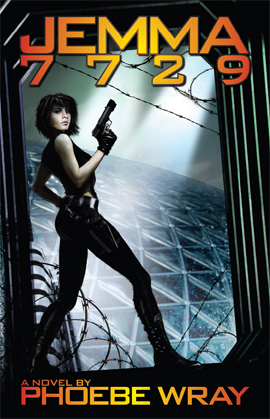
Jemma 7729 by Phoebe Wray

The following is a book review I wrote for The Leading Edge. It will be coming out in the November issue, along with my short story Decision LZ150207.  The editors gave me permission to post the review here.  Be sure to pick up a copy of the magazine when it comes out!

Jemma is a rebel, fighting against a system that teaches women to be obedient and submissive and “alters” those who refuse to assimilate.  After escaping the giant dome cities of a post-apocalyptic California, Jemma joins with a band of rebels known as the Movers in the free, uncultivated country.  But as her reputation grows and the people in the domes begin to take up arms, the government stops at nothing to hunt Jemma down and silence her for good.

With images reminiscent of Brave New World, 1984, and A Handmaid’s Tale, Jemma7729 is a dystopian, post-apocalyptic novel with a YA feel.  The first half of the book details Jemma’s childhood and her transformation from daughter of two mid-level government workers to a rebel fighting to overthrow the system.  I enjoyed the first part of this novel, with its intimate human drama and its resourceful, sympathetic viewpoint character.  The story was paced well and kept my interest.

The second half of the book, however, was somewhat disappointing.  Once Jemma escapes the domes and begins her campaign as a rebel terrorist, the story loses a lot of tension.  Even though she is barely a twelve year old girl, she still, without any outside assistance, manages to blow up almost a dozen government facilities without getting caught or killed.  The villains’ reasons for creating such an oppressive, anti-feminist regime are never adequately explained, and when Jemma starts to fight back, the government is too weak to put up a believable resistance.  The middle of the novel lags considerably, with very little real action or suspense.

When the pace finally does pick up again, about forty pages from the end, the action is so confusing and happens so quickly that I felt completely lost.  The main character’s voice gets lost in a blow-by-blow account of impossibly rapid events, as if the author was trying to compress two hundred pages of story into less than a quarter of that space.  I fount it disappointing and inconsistent with the tone of the rest of the book.  However, the twist at the end caught me by surprise and gave me some degree of satisfaction as I finished the book, though I would have been more satisfied if the last half of the book had been as good as the first half.

Review of JEMMA7729
Joe Vasicek
Jemma is a rebel, fighting against a system that teaches women to be obedient and submissive and “alters” those who refuse to assimilate.  After escaping the giant dome cities of a post-apocalyptic California, Jemma joins with a band of rebels known as the Movers in the free, uncultivated country.  But as her reputation grows and the people in the domes begin to take up arms, the government stops at nothing to hunt Jemma down and silence her for good.
With images reminiscent of Brave New World, 1984, and A Handmaid’s Tale, Jemma7729 is a dystopian, post-apocalyptic novel with a YA feel.  The first half of the book details Jemma’s childhood and her transformation from daughter of two mid-level government workers to a rebel fighting to overthrow the system.  I enjoyed the first part of this novel, with its intimate human drama and its resourceful, sympathetic viewpoint character.  The story was paced well and kept my interest.
The second half of the book, however, was somewhat disappointing.  Once Jemma escapes the domes and begins her campaign as a rebel terrorist, the story loses a lot of tension.  Even though she is barely a twelve year old girl, she still, without any outside assistance, manages to blow up almost a dozen government facilities without getting caught or killed.  The villains’ reasons for creating such an oppressive, anti-feminist regime are never adequately explained, and when Jemma starts to fight back, the government is too weak to put up a believable resistance.  The middle of the novel lags considerably, with very little real action or suspense.
When the pace finally does pick up again, about forty pages from the end, the action is so confusing and happens so quickly that I felt completely lost.  The main character’s voice gets lost in a blow-by-blow account of impossibly rapid events, as if the author was trying to compress two hundred pages of story into less than a quarter of that space.  I fount it disappointing and inconsistent with the tone of the rest of the book.  However, the twist at the end caught me by surprise and gave me some degree of satisfaction as I finished the book, though I would have been more satisfied if the last half of the book had been as good as the first half.

Revision, revision, revision

I finished revising chapter 6 of Genesis Earth today. It took a lot more time and effort than I’d expected. Even though I’d revised half the chapter yesterday, I started from the beginning and changed a lot of the other revisions I’d made. I think this version is stronger, but I’m not sure how it’ll fit in with the other chapters.

The thing about revising is that if you change something fundamental about the character / setting / plot early on, it changes everything that happens later, meaning that you have even more revisions to make. It’s like ripples on a pond, or switching tracks at a railroad junction hundreds of miles before your destination. Right now, a lot of the changes I decided to make earlier are making much larger changes necessary later on. That’s one reason why this chapter took so long to revise.

Another reason is because I felt I’d told it wrong the first time. A lot of my alpha readers said that my novel was weakest on conflict; they didn’t feel that it had enough conflict to carry them through the longer parts in the middle. I realized, when I reread it, that the conflict was mostly there, it just wasn’t emphasized properly.

A lot of these revisions had to do with connecting the events better, starting late and exiting early, creating more of a build up to the climax. They also involved changing the order in which I explained certain things–it created more tension to bring up certain things earlier, before the action. Tension and release.

I think I failed to do all that in the rough draft because I’m more of what Sanderson calls a “discovery writer.” The middle sections are always the hardest for me, because I have to figure things out as I go along. I’ve tried planning everything out from the beginning, but when I did that, the story that came out was completely different than what I’d planned.

Trouble is, if I’m discovering my story as I’m going along, the middle sections are going to be much more choppy and rough. I can write a pretty good beginning, and I think I can pull off a decent ending, but the stuff in the middle is just all over the place, every time I write.

Fortunately, I think the revision process is going well. It takes a lot of time and effort, but it’s producing results. I think chapter 6 works much better now, though it could probably use a little more tweaking just to fit it into the context of the story as a whole. Better finish the 2.0 revision before I do that, though.

For a while, I thought that with school out and all this free time on my hands before I really go anywhere, I could finish the 2.0 revision before the end of the week. Now, I’m thinking it will probably take more time. I could probably be about 75% done by the end of the week, though. Even with all these deep revisions, I’m plugging along at a healthy pace. And honestly, this is the kind of work I enjoy. It’s a challenge, but not an unpleasant one at all.