Passengers, rearranged

I didn’t see this movie when it came out (even though I’ve been told it’s very similar to a lot of my early science fiction), but this analysis of the story structure is really amazing. And I have to admit, it makes it a MUCH more interesting movie if it starts with Jennifer Lawrence waking up, and focuses on her as the main character.

Starting with Chris Pratt is safe, but also boring, because it unambiguously makes him the good guy. But is he really? What if he’s not? What if that question is what drives the tension through most of the movie? What if she decides he’s the bad guy, and lets him die to save the ship, only to find herself alone in the end, contemplating the very same choice—whether to wake up another one of the passengers so that she doesn’t have to spend the rest of her life alone?

“Not gonna lie, the ending where she is contempating the exact same decision hits so good.” That’s one of the top comments, and I have to agree. But that gives the movie a little too much of a horror vibe for me. Instead, if I were writing it, I would have them separate long enough that she realizes, on her own, that she would have done the same thing that he did, even if she doesn’t admit it. So that when the accident happens and he has to sacrifice himself to save the ship, she decides to save him after all, not because she loves him, but because she forgives him (and also doesn’t want to be pushed to make that decision herself).

Or what if there never is an accident, and she decides she can’t forgive him, but since they can’t stand to be alone together the enter into a pact to wake up two more people: she wakes up another girl for him, and he wakes up another guy for her. That way, the bad guy is the other person, and the love interests can… maybe I’m overthinking this.

In any case, it’s a great thought experiment (though speaking from experience, it really does suck when you write half a book only to realize that most of it should be relegated to backstory).

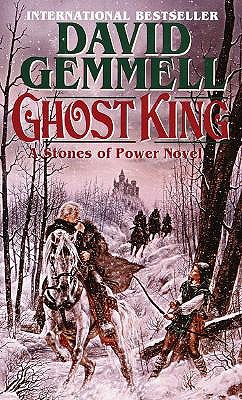
Ghost King by David Gemmell

Ghost KingAnother review of a David Gemmell book?  Yes, because I’m just that much of a fanboy.

With the Drenai series finished, I decided to sink my teeth into the Stones of Power series.  This series confuses me, because I’ve read The Jerusalem Man, which was retroactively put in as book three, but that’s a post-apocalyptic tale of the gunslinger Jon Shannow, but the series actually starts in Arthurian England.  As soon as I got a couple chapters into the first book, though, I began to see the connection.

Ghost King is an alternate history tale of King Arthur (Uther, in the book), and how he rises to become the Blood King of Britannia.  His grandfather, Culain, takes him into the mountains after the Brigantes assassinate his father, and there trains him to become a leader and a warrior.

Culain, of course, is one of the immortal Atlantians, just like his friend Maedhlyn (Merlin).  After the fall of Atlantis, they have wandered the Earth as gods, using the powers of the Sipstrassi stones to accomplish wonders.  Worshipped in turn by the Greeks, the Romans, the Hittites, and the Babylonians, Culain has tired of immortality and now wants to live out a mortal life.  But his jilted lover, the Ghost Queen, wants revenge on him for leaving her.  She was the one who killed Uther’s grandmother and mother, and who now wants to kill him and rule all of Brittania.  But her son Gilgamesh has corrupted her, so that in a parallel universe she must kill twenty pregnant woman every month just to replenish the magic of her Sipstrassi …

Okay, I might as well give up trying to explain the plot, because it only gets crazier.  Somewhere in this parallel dimension, a lost Roman legion has been wandering for hundreds of years, consigned to the void by Culain.  Also, Gain Avur (Guenevere) is in there too, as well as the Lance Lord (Lancelot), though he doesn’t come in until the epilogue.  There are also demons and vampyres, all sorts of battles, and lots of other crazy stuff.  It’s pretty freaking dang awesome.

I really enjoyed Uther’s transformation from the weak, bookish boy to the warrior king, as well as the budding of his relationship with Gain Avur (what can I say, I’m a sucker for romance).  My favorite character, though, was Prasamaccus, a crippled Brigante peasant who becomes one of Uther’s close advisors.  He’s basically a regular guy who gets sucked up into the whole adventure, but he’s level-headed and practical enough that he manages pretty well.  He’s also just a good person, which was quite refreshing in a world full of death and drama.

At one point, after rescuing Uther, he’s a guest in Uther’s chief general’s villa.  The general gives him a servant girl for the night, since in this world most men think nothing of bedding a slave.  Prasamaccus is a peasant, though, and he’s kind of shy.  The girl was actually captured in a raid in Germany, where she was raped, and this is her first time bedding someone since those traumati not the monster she’s afraid that he’ll be–they actually share a really tender moment of intimacy that heals much of her trauma and introduces him to the love of his life.c events.  She’s absolutely terrified, but so is Prasamaccus–he’s a cripple, and assumes that women just don’t want him.  He spends the night with the girl but doesn’t force her to sleep with him, and when she realizes how gentle he is–that she holds the power, and that he’s not the monster she’s afraid that he’ll be–they actually share a really tender moment of intimacy that heals much of her trauma and introduces him to the love of his life.

It’s poignant, story-rich moments like that that make me such a David Gemmell fanboy.  Usually they happen in the midst of war, between battle-hardened friends who are forced by circumstance to do something heroic, but they also happen in the quiet moments between characters who carry other scars.  That whole thing in the previous paragraph only happened in three pages or so, but it was still so incredibly powerful and moving.  Every moment of a David Gemmell book is like that, sometimes from the very first paragraph.  It’s awesome.

As far as David Gemmell books go, I’d put this one in about the middle of the pack.  It’s not quite as powerful as Legend or Wolf in Shadow, but it doesn’t meander as much as White Wolf or have such an anti-climactic ending as Ironhand’s Daughter (which was probably split by the publisher–more on that when I review The Hawk Eternal).  The characters aren’t quite as memorable as Druss, Skilgannon, or Waylander, but they are pretty awesome nonetheless.  I’d rate this book a 3 compared to Gemmell’s other books, but a 4.5 out of fantasy overall.  Definitely worth a read.
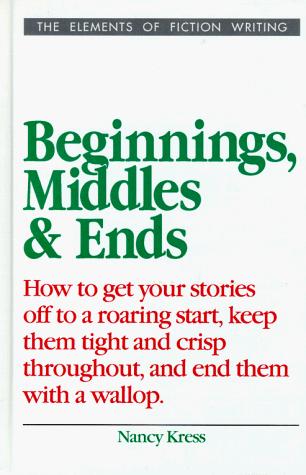
Beginnings, Middles, and Ends by Nancy Kress

I finished last week’s book a couple of days late, but I’m still going to count it.  It’s a book on writing by Hug0-award winning science fiction author Nancy Kress, and for anyone interested in writing stories in any genre, I’d highly recommend it.

Kress wrote this book back in the early 90s, after publishing six novels and a handful of short stories.  She also taught creative writing, and from the calibre of her writing advice, that’s abundantly clear throughout the book.  She tackles just about every aspect of story creation in a straightforward, methodical way, with a calm, almost motherly tone that is reassuring without being too heavy-handed.  She picks apart just about every element that is essential to a good story, and explains how it all works in a way that is clear and makes sense.

Because this was written back in the 90s, there are some artifacts of traditional publishing that make the book feel dated.  For example, the first few chapters focus on how to construct a beginning that will sell to an over-stressed, over-worked editor, with less of an emphasis on how to hook general readers.  Aside from that, however, much of her advice is still quite applicable to today’s indie writers.  The book’s main focus is on story, and good storytelling is important no matter which market you’re writing for.

The section on beginnings was a bit overwhelming, with so much “you must do this, you must not do this” kind of advice that it would probably kill my creativity if I were reading it as I was just starting a new book.  However, the sections on middles and ends were quite insightful, and sparked a ton of great new ideas for my current project.  Either way, her advice is spot on.

If you’re a new writer, I would recommend picking this book up after you’ve written a practice novel, or after you’ve finished a couple of short stories.  If you’re already an experienced writer, I would still recommend it, because even if most of the advice isn’t new, it will help you see much more clearly how a good story comes together.  It’s a short, easy read, but it’s so packed with good information that I’ll definitely reread it.  Highly recommended.

Ira Glass on storytelling

I just listened to this awesome presentation by Ira Glass, host of This American Life, on the art of storytelling and narrative, and I wanted to share it because it’s that good. 

If you haven’t ever heard of This American Life before, do yourself a favor and check it out.  You may or may not love it, but it’s one of the best produced radio shows out there, with fascinating stories from all walks of life that will completely blow you away.  My favorite is probably the one about the department of the LAPD that exists entirely to identify the next of kin of people who live and die alone–and how many people in this world have essentially no connections with the people around them.  It was an incredibly sad and incredibly moving story.

Anyhow, Ira makes some very good points about how stories work, and how we as humans are wired to see the world around us in terms of story.  It’s not enough to simply convey facts–you have to hook your audience by making them feel emotionally involved, and creating suspense by giving them the sense that the events in your story are leading up to something.

He finishes the lecture by recounting the basic frame story of the Thousand and One Arabian Nights: how Scheherazade saves the kingdom from the sultan’s madness through the power of story.  It’s a wonderful tale, one that has a lot of bearing on why we write and why fiction matters.

That’s one of the reasons why I decided to name this blog “One Thousand and One Parsecs”; it implies a combination of the magic of the Arabian Nights with the science fiction elements that I love so much. Like Scheherazade, I hope to tell stories that have the power to transform individuals and ultimately change the world for better.

That’s enough from me. Here’s Ira Glass:

Back in Mass

Mass = Massachusetts = “back east,” for all you unwashed Utahans!

My sister’s wedding is this weekend, so I’m back at my parents’ place helping them get everything set up.  It’s going to be a busy day tomorrow, but I’ve got my netbook and will probably get a couple good hours of writing in.

I managed to write a bit on the plane today, but not as much as I was hoping.  My goal is still to finish Into the Nebulous Deep 1.1 by May 14th; I’ve got about 15k-20k left to go, and since I’m taking the next few weeks off to work on writing projects, I shouldn’t have any problems meeting that deadline.

Yesterday, I took the unedited manuscript of Genesis Earth and formatted it nice and pretty so my friend Laura could read it on her Kindle, and…man, it looks like a real book!  There’s something about seeing your work in the actual form that people are going to read it in that is just…well, for lack of a better word, magical.  It’s definitely motivated me to get GE up quickly, as well as Journey to Jordan.  More on that in the next few days and weeks to come.

It’s getting late out here and I’d better get some sleep, but before I do, I want to put a plug in for my new favorite webcomic, The Zombie Hunters.  Ross Wolfe, Quark’s renowned zombie expert, introduced me to the comic a couple months ago, and I have been totally hooked ever since.

The comic is set in our world after the zombie apocalypse, where a band of five thousand survivors struggles to rebuild civilization on an island that was previously the site of a major research campus.  The zombie plague has a dormant phase, where the infected can live normal lives, but turn into zombies when they die.

The infected live in segregated barracks as second class citizens, but teams of them regularly venture out into the wastelands to salvage supplies from the zombie-infested ruins.  The comic basically centers around one of these teams of zombie hunters; their struggles and challenges, their relationships with each other, and their hopes and dreams for the future.

The storytelling is fantastic, the characters are engaging and real, the post-apocalyptic setting dark, gritty, and yet totally immersive and frighteningly believable–man, it’s just awesome.  And the longer it runs, the better it gets!  I can’t wait to find out how Charlie the half-life fits in with his ability to communicate with the zombies, or to get the full backstory with Jenny and Milo.  And I love the banter between Jenny and Sammie, her alcoholic sociopath best friend.

Right now, though, the main storyline is on hold while the author works through some business problems, but the short story is absolutely fantastic.  I love her fantastic use of point of view–how she gets into the little boy’s head and shows the apocalypse unfold from his perspective.  And the kid’s grisly end…man, zombies are even freakier when you never see their faces!  I wouldn’t be surprised if I have nightmares tonight about it–I have in the past.  Crazy awesome zombie nightmares, heh.

As a side note, may I point out what may quite possibly be the perfect weapon for the zombie apocalypse, the AA-12 shotgun.  All it needs is a bayonet and like a bajillion clips of ammo.  A must-have for any zombie contingency plan.

But yeah, let me just say I am in awe of The Zombie Hunters.  Awesome, awesome story–every time it updates, I get immersed again in the post-apocalyptic world, and it is amazing.  If I ever end up writing a zombie apocalypse story (which will probably involve starships and space travel in some fashion), I would be tickled if it’s even half as good as this excellent webcomic.

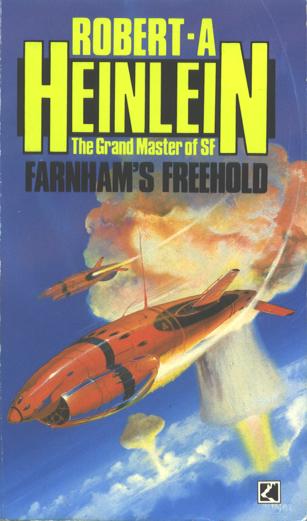
Farnham’s Freehold by Robert Heinlein

Bomb warning.  Third bomb warning.  This is not a drill.  Take shelter at once.  Any shelter.  You are going to be atom-bombed in the next few minutes.  So get the lead out, you stupid fools, and quit listening to this chatter!  TAKE SHELTER!

Thus begins the wild and crazy story of Hugh Farnham, a middle aged suburban American, with his alcoholic wife Grace, his law student son Duke and daughter Karen, their black house servant Joseph, Karen’s sorority sister Barbara, and the cat Mr.-Livingston-I-Presume.  When the Russians nuke the peaceful town of Mountain Springs into oblivion, only the uncanny foresight and resourcefulness of Hugh keeps them alive.  When they open their bomb shelter and climb outside, however, they find themselves in a world that defies anything they could ever imagine.

This book was incredible. I finished it at 4:00 am on a Sunday night, and honestly I wouldn’t have it any other way.  The characters are memorable and engaging, the plot face-paced and thrilling, the world fantastically imaginative, and the story both entertaining and thought provoking.  Wow.

Heinlein is an unparalleled storyteller, and I think he does it by creating worlds that are innately fascinating and imaginable and populating them with characters who act like real people, with the full range of reactions and motivations that real people have.

Consider the basic premise: who hasn’t wondered what World War III would be like?  No one who grew up during the Cold War, certainly.  And as for surviving and colonizing an uncivilized wilderness, people of all ages have been enthralled with that idea since Robinson Carusoe and The Swiss Family Robinson.  Heinlein capitalizes on this urge by telling us a story that we love to tell ourselves.

But the thing that really drew me in was the characters.

I’ll confess, when I got to the part where they open the bomb shelter and find themselves in a pristine, virgin wilderness instead of a blasted city, I threw the book across the room.  Up to that point, everything about the nuclear attack had been so realistic that the cross-dimensional time travel element totally threw me out.

However, even after I put the book down, I couldn’t stop thinking about Hugh Farnham.  The down to earth, no nonsense resourceful man who took the Boy Scout motto “Be Prepared” to a whole new level–who had the chutzpah to draw a gun on his own son when his rebellious behavior threatened to unravel the group–his undying attitude of “never surrender”–I just couldn’t stop thinking about him.  So I picked the book back up and finished it, and am I ever glad I did!

But it wasn’t just Hugh Farnham.  Grace, with her debilitating alcoholism and irrational outbursts, was a character I really loved to hate EVEN THOUGH she reminded me of people in my own family.  Joe, the longsuffering polite servant who changes so frighteningly with the reversal of fortune in the second half of the book; Duke, whose dysfunctional relationship with his father leads to so many problems; Barbara, the 60s era divorcee who goes from outsider to one of the closest members of the group–man, there were some memorable characters.  And NONE of them were caricatures; all of them had strengths and weaknesses, and while some fell prey to their flaws, others rose above them and triumphed magnificently.

I suppose that Farnham’s Freehold is a good example of pulp science fiction at its best: an imminently entertaining story that is also meaningful and thought provoking.  If so, then this is definitely the kind of stuff I want to write.  The descriptions may be sparse and the prose rather unremarkable–but man, the story…what a wild and crazy ride!