Of pioneers and politics

Today is Pioneer Day here in Utah, where we celebrate the achievements and heritage of the Mormon Pioneers. One hundred and sixty-eight years ago today, Brigham Young looked over the Salt Lake Valley (a barely hospitable desert at the time) and declared “this is the place.”

I feel a great deal of pride for my pioneer heritage. My ancestors walked across the plains in the Willie Handcart Company, they organized one of the most successful cooperatives of the United Order, they fought in the Utah Wars, and they built numerous cities across the Intermountain West. Before the pioneer exodus, they built and later abandoned the Nauvoo Temple, endured the horrible conditions at Winter Quarters, and left trails of bloody footprints as they fled their homes and lands during the Missouri persecutions.

One of my direct-line ancestors was Lyman Wight, leader of the Mormon Militia. When the Missouri mobs captured the Mormon leadership and a kangaroo court sentenced them all to death, Lyman Wight’s reputation was so fierce that the mob hesitated to execute him. They offered to let him free if he would renounce Joseph Smith.

Lyman Wight looked the Missourians in the eye and said “Joseph Smith is the best friend you ever had.”

The leaders of the mob asked him why he said that.

He told them: “if it weren’t for Joseph Smith, I would have slit all your throats years ago.”

The mob then threatened to execute him. Lyman Wight answered without hesitation:

“Shoot, and be damned.”

None of the members of the mob dared to execute him, fearing that his ghost would haunt them to the end of their days.

There are tons and tons of stories like that in my family, and even more that belong to my friends. History is alive here in Utah, where monuments to our pioneer heritage are scattered throughout the state.

The Mormon corridor has a very unique subculture compared to the rest of the United States. It’s a unique and sometimes paradoxical blend of individualism and collectivism, of self-reliance and communal spirit, of libertarian ideals and obedience to moral authority. To an outsider, I’m sure it must be extremely perplexing, but there’s nowhere else in the United States where I feel so totally at home. These are my people. This is my home.

upinarms-map-largeThat’s why I found this map of the “eleven American nations” so fascinating. According to the corresponding Washington Post article, almost all of the battles in the culture wars can be explained by the lines on this map. Furthermore, the mobility of American society is causing these regional differences to grow sharper as Americans pick up and move to the places where the dominant culture best suits them.

A further explanation can be found here, where the author of the map (and the book American Nations) states:

The borders of my eleven American nations are reflected in many different types of maps—including maps showing the distribution of linguistic dialects, the spread of cultural artifacts, the prevalence of different religious denominations, and the county-by-county breakdown of voting in virtually every hotly contested presidential race in our history. Our continent’s famed mobility has been reinforcing, not dissolving, regional differences, as people increasingly sort themselves into like-minded communities, a phenomenon analyzed by Bill Bishop and Robert Cushing in The Big Sort (2008). Even waves of immigrants did not fundamentally alter these nations, because the children and grandchildren of immigrants assimilated into whichever culture surrounded them.

The thing that I find most fascinating about this map is how closely the borders of the Far West “nation” parallel the State of Deseret, first proposed by Brigham Young and the Mormon pioneers. The Mormons didn’t get along very well with Congress, and the territory was eventually pared down to the current boundaries of the state of Utah (the name “Deseret” was also replaced). But cultural boundaries cannot be declared by presidents or kings.

According to the author, the development of this region “was largely directed by corporations headquartered in distant New York, Boston, Chicago, or San Francisco, or by the federal government, which controlled much of the land.” I’m not so sure that’s the case, however. Corporations certainly became important players after the railroads crossed the country, but culturally, I would argue the pioneers had a much deeper and more lasting impact.

The Intermountain West is remarkably conservative, with Utah ranking as one of the reddest states in the nation. With the government expansion under President Obama and the Tea Party revolt in the Republican party, the politics in this part of the country have taken a decidedly libertarian turn. As issues like healthcare, gun control, gay marriage, and late-term abortion have each swept the nation in turn, my positions have changed to reflect the libertarian attitudes of the culture in which I live.

In 2008, I considered myself “agnostic” as far as politics were concerned. Perhaps there was a greater truth out there as far as politics were concerned, but I wanted nothing to do with it. Now, however, I believe very strongly that individuals and families should be free to live their lives as they see fit, without being subject to Leftist schemes to redistribute their wealth or bloated, self-serving government that overreaches its constitutional bounds.

I think this view would resonate very deeply with the pioneers. They came to the West to practice their religion freely, and emphasized self-reliance and thrift. Their industriousness was a means of guarding their independence from the governments that had oppressed them in the east, and continued to oppress them as they sought to build their Zion. Though they could be quite collectivist at times, it was local and voluntary, a far cry from State-enforced socialism. And while they cared for the poor and needy, they did all they could to keep them from becoming dependent on welfare.

These are interesting times we live in, and interesting cultures we hail from as well. As I look back on my own pioneer heritage, I can’t help but look forward as well. The “shoot and be damned” independent streak of my ancestors is still with me today, and I have no doubt that pioneer spirit will continue to guide me in the future.

The Self-Sufficient Writer: First Steps Toward Food Storage

For various reasons, after a year I decided to come home from overseas and move back to Utah. A lot had changed in that year, and my books were starting to earn enough that I could cover all my publishing expenses and pay myself a small salary. It wasn’t much, but the cost of living in Utah is much cheaper than it is elsewhere in the US, so I figured I’d make it work.

Right away, I started looking for ways to cut my expenses. When you’re self-employed doing what you love to do, cutting expenses is the difference between living the dream and working a dead-end job that you hate. I realized very quickly that one of my biggest expenses was food.

Backtrack a little bit. For most of my life, I’ve been a huge fan of breakfast cereal. In fact, my parents tell me that that was my very first word: “breakfast cereal.” But the thing about breakfast cereal is that it’s expensive. When I graduated college and my dad told me I was financially on my own, I realized very quickly that my cereal habit was making me broke. So I switched to oatmeal.

At first, I bought my oats in tins like this. The price was reasonable, and it lasted much longer than a box of cereal. But then I started shopping at a whole food store, and I realized that oats were much cheaper if you buy them by the pound. Some stuff you don’t want to buy that way, but oats are oats, so it really doesn’t make much of a difference where you buy them. So I switched.

Fast forward to 2013. While browsing through the grocery store looking for ways to cut my food expenses, I found one of these:

A fifty pound bag of anything is prone to give you sticker shock, but when I calculated the price per pound, I realized that the value was almost twice as good as the stuff I was buying at the whole food store. And since I had completely switched to oatmeal by this point, I knew that I would eat it.


I stood there and thought about it, checked the price again and thought some more. Then I threw caution to the winds and loaded the 50 lb bag into my cart.

The great thing about oats is that if you store them right, they will keep for decades. When food goes bad, it’s usually because something else (mold, fungus, bugs, etc) is eating it. That’s all mold is: a really disgusting organism that’s eating your food while it sits there in the fridge. In order to live, these organisms need water and/or oxygen. Since rolled oats are a dry food, if you store them in a sealed container without any oxygen in it, you can keep out the mold and the bugs practically forever.

After I hauled this giant cement-bag sized thing of oats to my third floor apartment, I realized very quickly that I needed to figure out a way to store it. Fortunately, my dad knew exactly what to do. He told me to get some dry ice, put a 1 lb. chunk of it in the bottom of a lidded bucket, and fill up the bucket with oats. Dry ice is carbon dioxide in a solid form, which sublimates (turns to gas) at room temperature. Since carbon dioxide is denser than oxygen, as the ice sublimates it will fill up the bucket from the bottom up, pushing out all of the oxygen. Put the lid on the bucket but leave it partially open, to allow the gas to escape. When you can seal the lid without the bucket starting to bulge, that means the ice has all sublimated and the bucket is ready for long-term storage.

So that’s what I did. I bought a bunch of cheap 3-gallon empty ice cream containers from the BYU Creamery, a small local grocery store owned and operated by BYU. They sell the buckets for $.50 each, so I got five and sealed up four of them after removing the oxygen with the dry ice. I then took the internet for more oatmeal recipes and came across The Oatmeal Artist, where I discovered all sorts of great recipes. Who knew you could do so much with oats?

That was how I got started with food storage. Though I have to backtrack again in order to explain.

I grew up in a devout Mormon household, where we practiced our religion as faithfully as we could. One of those principles is food storage. The idea is that in order to best help others, you first have to help yourself. Self-reliance enables you to provide for yourself and others through times of hardship and trial. By keeping this principle, the Mormon pioneers were able to thrive in a desert wilderness more than a thousand miles from civilization.

Food storage is an important component of self-reliance, not only for the major emergencies like the zombie apocalypse, but for the personal emergencies like declining book sales and a stalled career. If you only buy your food one or two weeks in advance, you’re living hand-to-mouth—literally. If you can learn how to store some of that food long-term, then even if your income streams dry up, you know that you’re still going to eat.

The #1 principle of food storage, though, is to eat what you store and store what you eat. These days, it’s pretty typical in a faithful Mormon household to have a couple buckets of rancid wheat in the basement that no one has opened in decades. We keep food storage because our religion teaches us to, but we don’t really know what to do with it because we never actually eat from it. The principle becomes just another empty practice—another rote tradition.

I knew right from the start that I didn’t want to do it that way. For one, I couldn’t afford to. But as I learned to store food that I actually liked to eat, I found that it reduced my food expenses significantly. Instead of buying oats every couple of weeks, I just gradually ate through what I already had. Since I ate oatmeal every day, and since buying in bulk cost roughly half as much as buying it by the pound, I came out ahead.

From oats, I expanded to other dry foods like rice and beans. Both of those are also easy to store long-term, and a 20 lb bag give you a significantly better value than the smaller bags (especially if you buy it on sale). I also expanded into wheat, which deserves a whole blog post of its own. And later on, I got a slow cooker to help with cooking the beans. If you’ve never cooked beans in a slow cooker, you don’t know what you’re missing. More on that in another post.

The best prices you will ever find for bulk dry goods is at an LDS Home Storage Center. It’s part of the religion, after all—many of the people who work there are volunteers doing missionary service. The last time I went there, it was $10.00 for a 25 lb. bag of oats—that’s only $.40 per pound. Beans, rice, wheat, and pasta is similarly cheap. Most of the Home Storage Centers are located in the western United States, but you can also order the products online. Or if you prefer, you can also find most of this stuff at your local grocery store.

Through food storage alone, I was able to cut my monthly food expenses by 25%. I also had the peace of mind of knowing that I would never have to starve for my art. Even if times get tough, I now have enough of a food security buffer to ride it out.

The Self-Sufficient Writer (Index)

The most unmarketable story every conceived

I have an awesome idea for a story that absolutely, completely, 100% unmarketable. It blends two completely unrelated genres in such a way that it will almost certainly offend large numbers of readers in both. The best way to blend genres is usually to label it clearly as one and don’t let the others know that they’re invited. Well, with this particular story, that’s impossible.

The story blends Mormon religious fiction with Space Opera. It takes place in the Millennium, hundreds of years after Jesus Christ’s second coming to the Earth. The lamb has laid down with the wolf, and the lion eats straw like the ox. There are no more wars or armed conflicts: the swords of the Earth have been turned into plowshares, and the spears into pruning hooks. Satan has been bound, that he has no power over man, and Christ reigns in power and glory upon the Earth. People live to the age of a tree, and when their time comes, they are changed from mortality to immortality in the twinkling of an eye without tasting death. Resurrected beings regularly come down to visit the Earth.

All is not well, however. The events that launched the Millennium set off a thousand-year chain reaction that will turn the Earth to a sea of glass. At that time, it will become a great Urim and Thummim and be rendered uninhabitable for mortal beings. For that reason, Christ descended in power and glory to unite the nations of the Earth so that they could pool their resources and build a generation ship that will take the last remnants of humanity to the stars. This Millennial ark, the Starship Lachoneus, now represents the last hope for the continuation of humanity.

By now, you can probably see why this story is completely unmarketable. Science Fiction fans will be turned off by all the overtly religious stuff (I plan to make Jesus Christ an actual character), and Mormons will be turned off by all the Science Fiction mixed with their religion. There’s no doubt that I’ll offend large numbers of people in both genres if/when I ever write it.

At the same time, though, the concept really fascinates me. The Mormon version of Christ’s Millennial reign is completely different from most other Christian flavors, in ways that make for some very interesting story possibilities. For example, we believe that there will still be unbelievers in the Millennium–that people will still be free to reject Christ and deny the existence of God, even though He lives and walks among them. What kinds of life experience would lead a person to do that? And how would they react if Christ Himself took the time to have a personal chat with them?

Then there’s the question about which audience the book should be written for. Clearly, it’s meant for people who have at least a passing familiarity with Mormonism. It would be far too tedious for both myself and the readers if I had to stop and explain every religious reference. At the same time, though, I don’t feel that it’s right to limit the audience exclusively to Mormons. The Left Behind series was written almost exclusively for Evangelical Christians, and if you try to read those books, it readily becomes apparent that there’s a wide gulf between the gentile unbelievers and the faithful–not only in the books themselves, but in the eyes of the authors as well (full disclosure: I have only read parts of the first book). I don’t want this book to be that hostile or alien to anyone, whether they’re part of the intended audience or not.

By far, though, the most difficult issue is going to be the world building. What the heck is the Millennium supposed to be like? The last time any Mormon General Authority spoke in-depth about it was sometime in the 70s–not because we’re any less fervent in our Millennialist beliefs, but because whenever a church leader talks about it over the pulpit, people tend to freak out and think that the world is about to end (literally!). And aside from the issue of research, there’s the practical difficulties of fitting it all together in a way that doesn’t strain incredulity. If the lions, wolves, and other carnivorous animals no longer hunt or kill for their food, how can the Earth have a functioning ecosystem? If resurrected beings regularly visit the Earth, what’s to stop them from doing all our work for us?

In spite of all these challenges, though (or indeed, perhaps because of them), I really, really want to write this book. In some ways, I even feel like it’s something I’m supposed to write. I already have the title picked out: Starship Lachoneus, based off of a story from the Book of Mormon about a prophet who saved his people by gathering them all together for a lengthy siege that starved out their enemies and brought his people closer to God. I also have the first chapter planned out in my head, though as for the rest of the story, I have no idea.

For now, it’s probably just going to be another side project of mine. It might take years to get it done in a way that I find satisfactory. But it’s definitely something I plan to write, starting now.

J is for Jedi

Ben_KenobiAs much as science fiction looks to the future, it also of necessity looks to the past.  And as much confidence as it places in the scientific method, it often turns to religion, simply because of the scope of the great cosmic questions that such stories inevitably pose.

For these reasons, it should come as no surprise that the best science fiction stories often include knights and shamans, priests and warrior monks.  Far from degrading our view of the future, they greatly enrich and humanize it, bringing a sense of meaning and destiny to an otherwise cold and lonely universe.

The best example of this is probably the Jedi from the original Star Wars trilogy.  I still get shivers when I hear Yoda explain the force:

Size matters not. Look at me. Judge me by my size, do you? Hmm? Hmm. And well you should not. For my ally is the Force, and a powerful ally it is. Life creates it, makes it grow. Its energy surrounds us and binds us. Luminous beings are we, not this crude matter. You must feel the Force around you; here, between you, me, the tree, the rock, everywhere, yes. Even between the land and the ship.

There are plenty of other examples too, of course–harsh ones like the creeds the Cylons follow in the re-imagined Battlestar Galactica, which they use to justify their genocidal war against the humans.  And then there are the quaint and simplistic ones that happen when a primitive race makes first contact with humanity … as well as the ones from a race so advanced that they make us look like barely evolved monkeys.

So why is religion so prominent in science fiction?  Probably because the best science fiction stories act as a mirror that allows us to see ourselves better.  Throughout history, religion has been one of the most important parts of any human civilization.  Even the modern secular cultures still grasp at the same cosmic questions, striving to find meaning beyond the animal drives of food, sleep, and sex.

At its core, every religion is about telling a cosmic story.  There’s a reason why the Bible starts with the words “in the beginning,” and why the first sura of the Qur’an names Allah “The Merciful and The Compassionate.” Since the best science fiction also tells a cosmic story, is it any surprise that there should be overlap between the two?

The best science fictional religions are the ones that make you want to believe.  The Force in Star Wars was definitely like that to me (the original trilogy, of course–before all that midi-chlorian nonsense).  Orson Scott Card’s philotic web also turned me into a believer, at least for the duration of those books.  Even Eywa from the movie Avatar had some deep undertones that made me wish I was a part of that world.

Religion plays a huge role in my own books, not just the stuff that I believe in real life (though I’m sure that influences my writing), but the stuff that I think the characters would believe.

In Star Wanderers, for example, most of the outworlders are pagans who pray to the stars.  In that universe, astrogation is an act of worship.  The Deltans subscribe to a fusion of pagan and Christian beliefs, which in turn affects how much they value families and children.  I won’t spoil it, since it comes as something of a reveal in Homeworld, but it definitely drives the series.  And of course there’s Jeremiah’s New Earther background, with its guilt complex that leaves him emotionally scarred.

My favorite religion to write so far was the faith of the desert tribesmen in Desert Stars.  I wrote that book just after spending a summer in the Middle East, and my experience of the Muslim culture definitely was a huge influence.  The tribesmen pray to the Temple of a Thousand Stars, the temple erected to the memory of Earth soon after the first colonists made planetfall.  The first half of the book follows Jalil’s pilgrimage to the ancient temple, through the domes filled with strange and decadent people.

When I started the Gaia Nova series, I wanted to create a science fictional universe where any of our real-world religions could still plausibly be true.  The way I got around all the conflicting prophecies of the end times was to have a human colony mission leave Earth soon after our time.  When the colonists woke up, they’d lost the location of Earth, so naturally all the religions developed around the idea that Earth had received its prophesied glorification and become a heavenly paradise.

That’s the short explanation, anyways.  But the books themselves aren’t so much about that as they are about the characters.  If religion is important to them, then that becomes an important part of their story.  And since religion is so important to us here on Earth, I can’t help but believe that it will follow us to the stars.

Out of the Silent Planet by C.S. Lewis

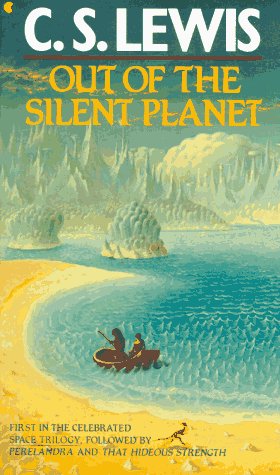
out_of_the_silent_planetWhen Doctor Elwin Ransom went on a spontaneous walking tour of rural England, he wasn’t expecting to be kidnapped by a mad scientist and taken to Mars.  He soon escapes, only to find himself lost without any way to return home.

Fortunately, the native Martians soon take him in, teaching the otherworldly stranger of their peaceful, utopian ways.  They are just as astonished to have a visitor from Earth as Ransom is astonished to be their guest.  To them, Earth is a silent planet–the only world with no spiritual connection to the rest of the universe.

The more Ransom learns about the gentle people of Mars, the more he realizes that something evil lurks in the heart of our world–and that contact between the worlds can only hasten the showdown between the forces of good and evil.

I decided to read this book after chatting with Norman Cates at Worldcon 2011, following the “When Faith and Science Meet” panel.  Some fascinating questions had popped up toward the end, especially regarding science fictional universes that are not incompatible with millenialist religions.  Norman asked if I’d read C.S. Lewis’s Space Trilogy, and when I said that most people had told me it isn’t as good as Lewis’s other work, he kind of rolled his eyes and said that it was worth checking it out and deciding for myself.

Well, I didn’t get around to reading it until this summer, but I’m glad I did.  It’s a short read, no more than 180 pages or so, and I finished it in a couple of days.  The world it describes is quite fascinating–a fantastical version of Mars that I’d actually like to visit, perhaps even more than Bradbury’s and Burrough’s.  The kidnapping in the beginning was compelling enough to hook me, but it was the immersive feel of the world that really made the book for me.

This being C.S. Lewis, the more spiritual and allegorical elements of the story lie fairly close to the surface, but it didn’t detract much from the reading experience for me.  It became fairly obvious towards the end that the whole story is basically an attempt to incorporate the Christian millenialist mythos into a mainstream science fictional setting, which is probably where most of the criticism comes from.  If you know that up front, however, and are willing to go along with it, it shouldn’t take much away from the story.  In fact, that might just be what draws you to it.

It’s interesting, because Orson Scott Card tried to do something very similar with the story of Lehi in his Earthbound series, and I think he actually failed where Lewis succeeded.  When I read A Memory of Earth, I felt that Card actually lost the best parts of both the Book of Mormon mythos and his own science fictional world by trying to force them together.  In contrast, Out of the Silent Planet feels much more coherent and compelling, and not artificial at all.

I do feel like things sped up a bit too much at the end, though.  The experience became a little less immersive for me when Lewis went from describing the alien world to bringing the millenialist themes to the forefront.  It’s almost as if the focus of the book itself shifted, and that was a little bit jarring.  I’m a big fan of metaphor, but allegory is a more difficult pill for me to swallow.

That said, I enjoyed the book, and am definitely interested in finishing the rest of the trilogy.  It’s got a lot of merit to it, and is definitely worth checking out no matter what the critics may say.

მე ♥ ქუთაისი (I ♥ Kutaisi)

Medea Cafe & Bar, a popular expat hangout in downtown Kutaisi. It’s also something of a landmark because of the conspicuously English street sign.

That’s Georgian for “I ♥ Kutaisi.” Like the New York City ad campaign on which it’s based, it’s become a part of the local culture.  You can see it on billboards, street signs, stickers, t-shirts–unlike the US, where it’s uncool to wear a band’s t-shirt at their own concert, everyone was wearing their “I ♥ Kutaisi” shirts at Kutaisoba last week.

So since I’ve been living here in Kutaisi for almost three months, I thought I’d give you all a virtual tour of the city–or at least the downtown area, since Kutaisi is really more like a very big village with a city in the middle.  But that’s why I love it.

Tsitelikhidi, or Red Bridge Station.

Our tour starts at the main marshrutka terminal downtown, Tsitelikhidi, or Red Bridge Station.  The place is a wonderfully chaotic mess of taxis, buses, and marshrutkas, while their drivers pass the time by smoking cigarettes and yelling at each other.  Old women wander around the crowds selling khatchapuri and lavash, while people are constantly coming and going.  Interestingly enough, this is also where you can find one of the largest concentrations of apothekas (pharmacies) in the city.

I bought an earwax removal kit from this apotheka, along with a bulb syringe obviously meant for babies. The pharmacist thought that was hilarious.
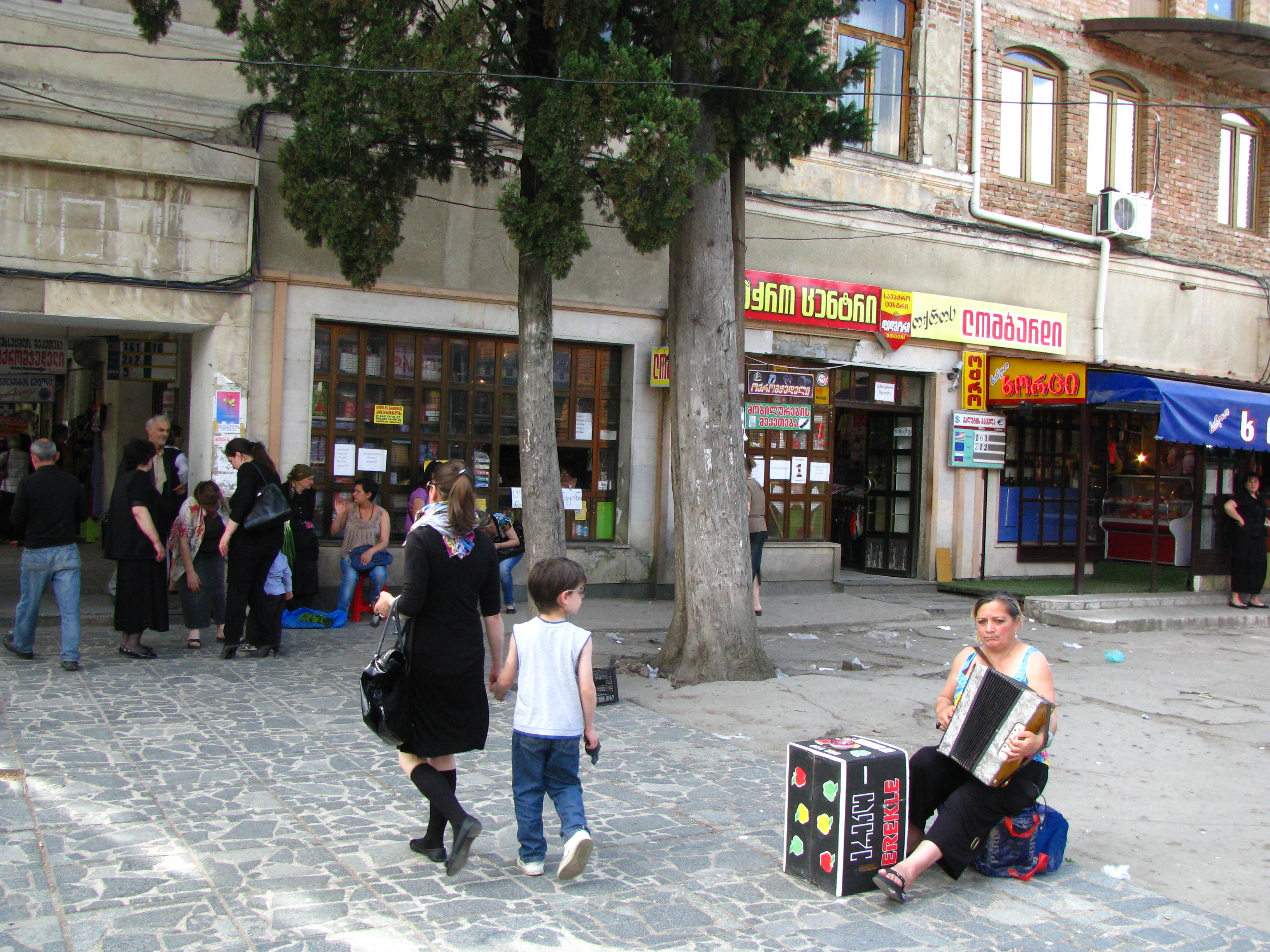
For street performers in Kutaisi, the accordion is the instrument of choice.

The sidewalk leading away from the station leads into a long narrow corridor typical of most Georgian street markets, with stalls and vendors packing every available space.  Here you can find cookies, ice cream, and cold drinks, both soft and hard; candles, religious icons, and other “souvenirs,” as the vendors like to call them; cheap plastic goods from China, wrapped in dusty plastic; freshly killed meat hanging from butcher’s windows; and all sorts of other random things.  But as busy as this place seems, it’s nothing compared to the main marketplace.

I have no idea what’s all on this frieze, but it looks pretty cool.  Also, bangs are very much in fashion.
This is actually a pretty good place to buy a belt.

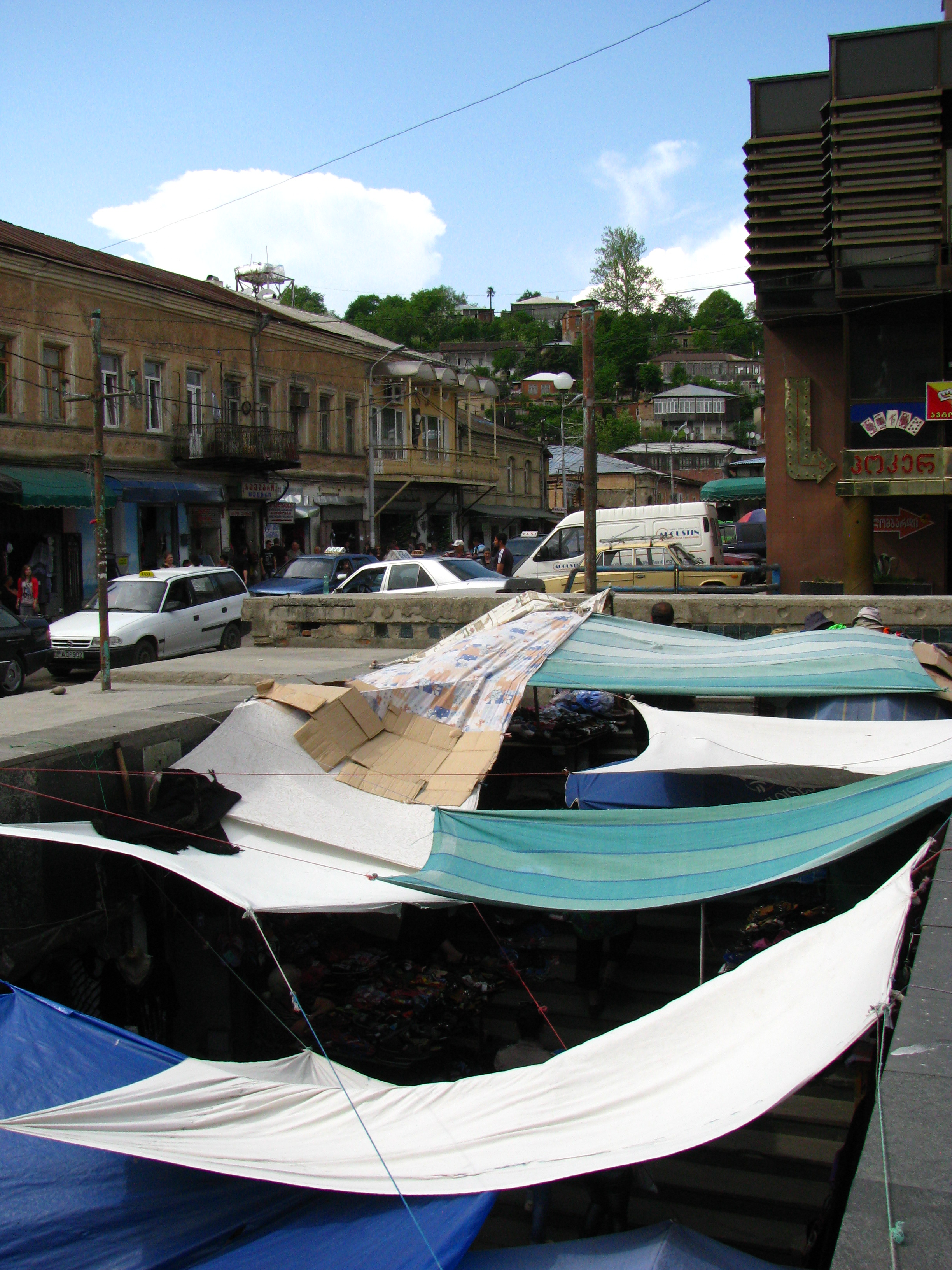
The corridor opens up at the end of the block, to a tunnel which leads underneath the main road (Rustaveli, named after the great medieval Georgian writer) to Mirzani restaurant on the far side.  At the mouth of the tunnel, tarps and blankets stretch haphazardly over vendors selling clothes, cheap shoes and cigarettes.  Further down the tunnel, you can find more clothes, belts, brassieres, more shoes, and all sorts of fabrics.

We continue past an old building with a giant frieze, presumably depicting scenes from the history of the city.  There’s a lot of history to choose from–Kutaisi was the capital of ancient Colchis, and a major regional center throughout the Middle Ages, when locally-born King David the Builder united all of Georgia, turning it into a “land between two seas.”

Alas, no hot peppers.
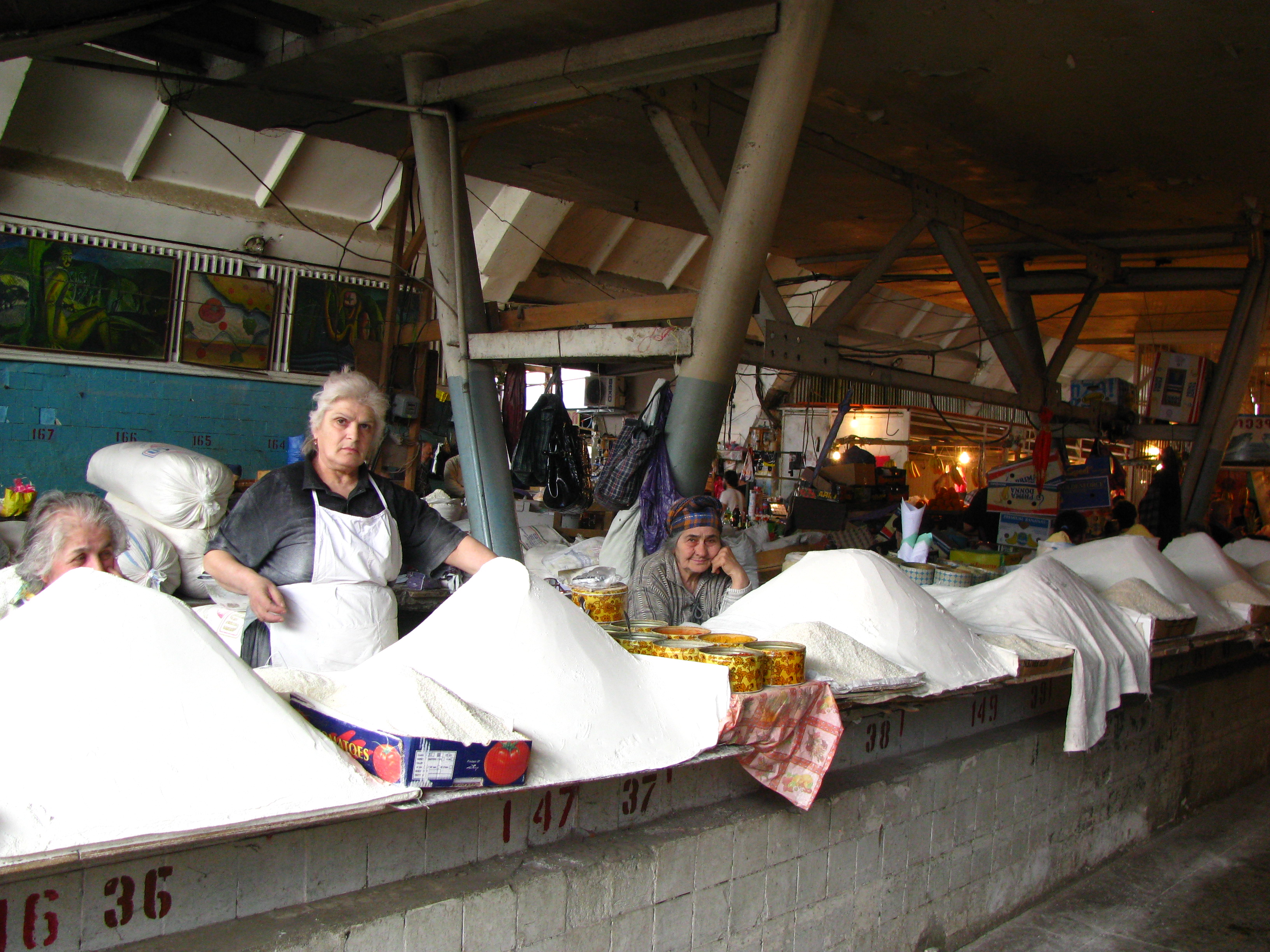
This is where you come to buy flour.
The candle-like stuff hanging from the top is churchkhela, strings of hazelnuts dipped in congealed grape extract. I assume the jars immediately beneath them contain wine.

Next, we take a left and promptly get lost in a giant bazaar.  Here, you can find all sorts of fruits and vegetables, beef and chicken, bread and cheese, wine and beer–basically, anything that you would usually get from a grocery store in the US.  Georgians have grocery stores too, but the bazaars are usually cheaper and fresher.  Plus, they’re a whole lot more fun.  I’ve heard that you can haggle with the vendors, though the prices are so low (1.5 GEL for a kilo of apples) that I’ve never felt a need.

Rustaveli Avenue.
Las Vegas casino. Gambling is big in Georgia.
The book market. If I could read Georgian, this is where I would spend most of my time.

We spend a little bit of time wandering around before going to the main city park.  Heading up towards Jatchviskhidi, you can find all sorts of pawn shops, casinos, and money exchanging places, while near the library (at least, that’s what I think it is) there’s a mini-bazaar with all sorts of books.  Of course, that’s one of my favorite places to check out!

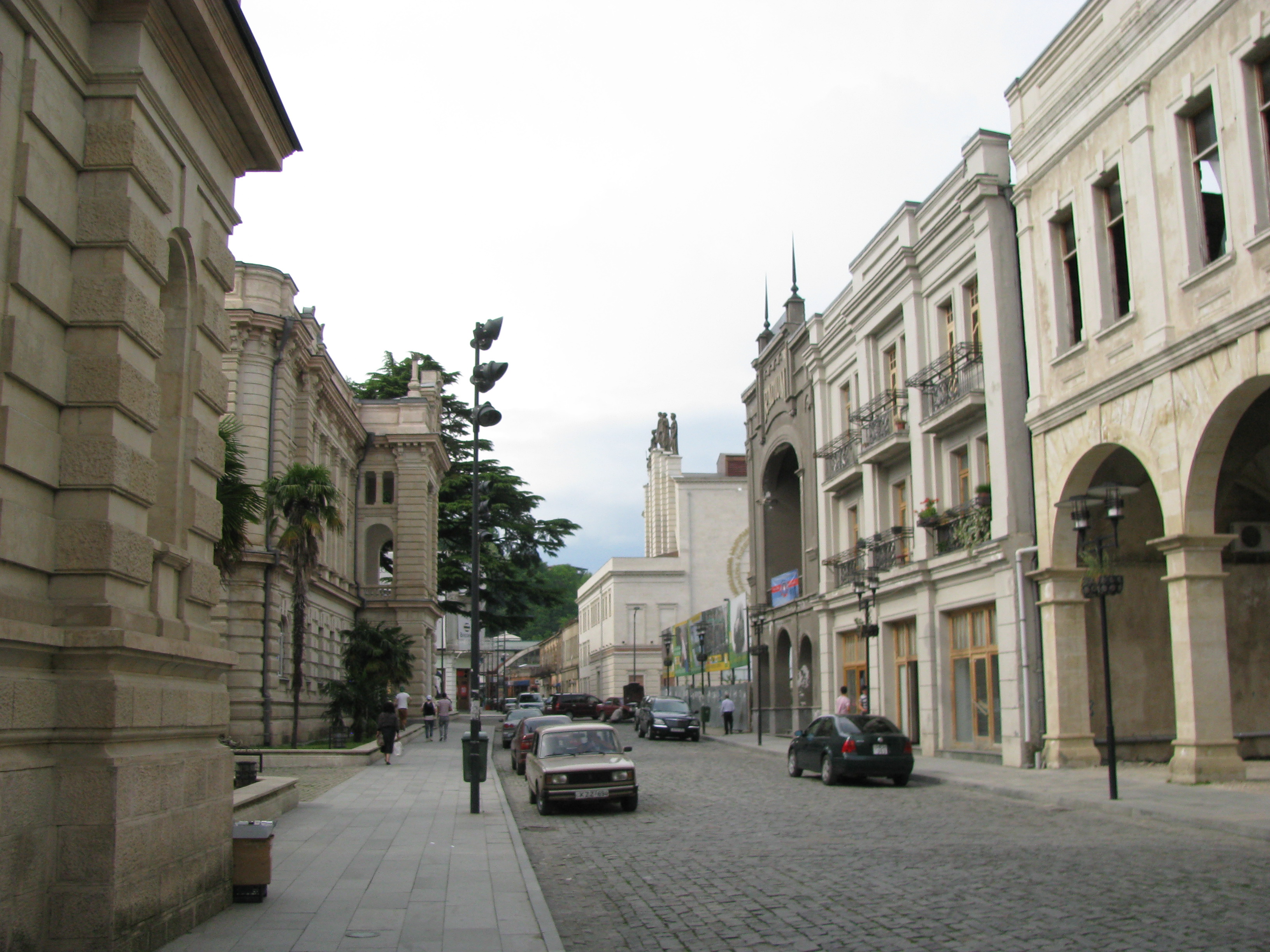
Along Rustaveli Avenue, however, the city takes on a pleasant European feel, with attractive cobblestone streets, wide boulevards, and Napoleonic architecture.  Here, you’ll find the opera house, the mayor’s mansion, and the central school (of 44 public schools citywide).

The view from just outside Medea Cafe.
One of the many flower gardens in central park.
One thing Georgians (or at least, Kutaisians) know how to do right is their public parks.

Next we come to Bulvari, the main central park of Kutaisi.  On a hot, muggy day, this is the perfect place to relax, with shady palm and pine trees, attractive public fountains, and plenty of benches to go around.  Vendors sell balloons, candy, and ice cream, while at the center, old men with cheap plastic cars take children for a ride around the main circle.

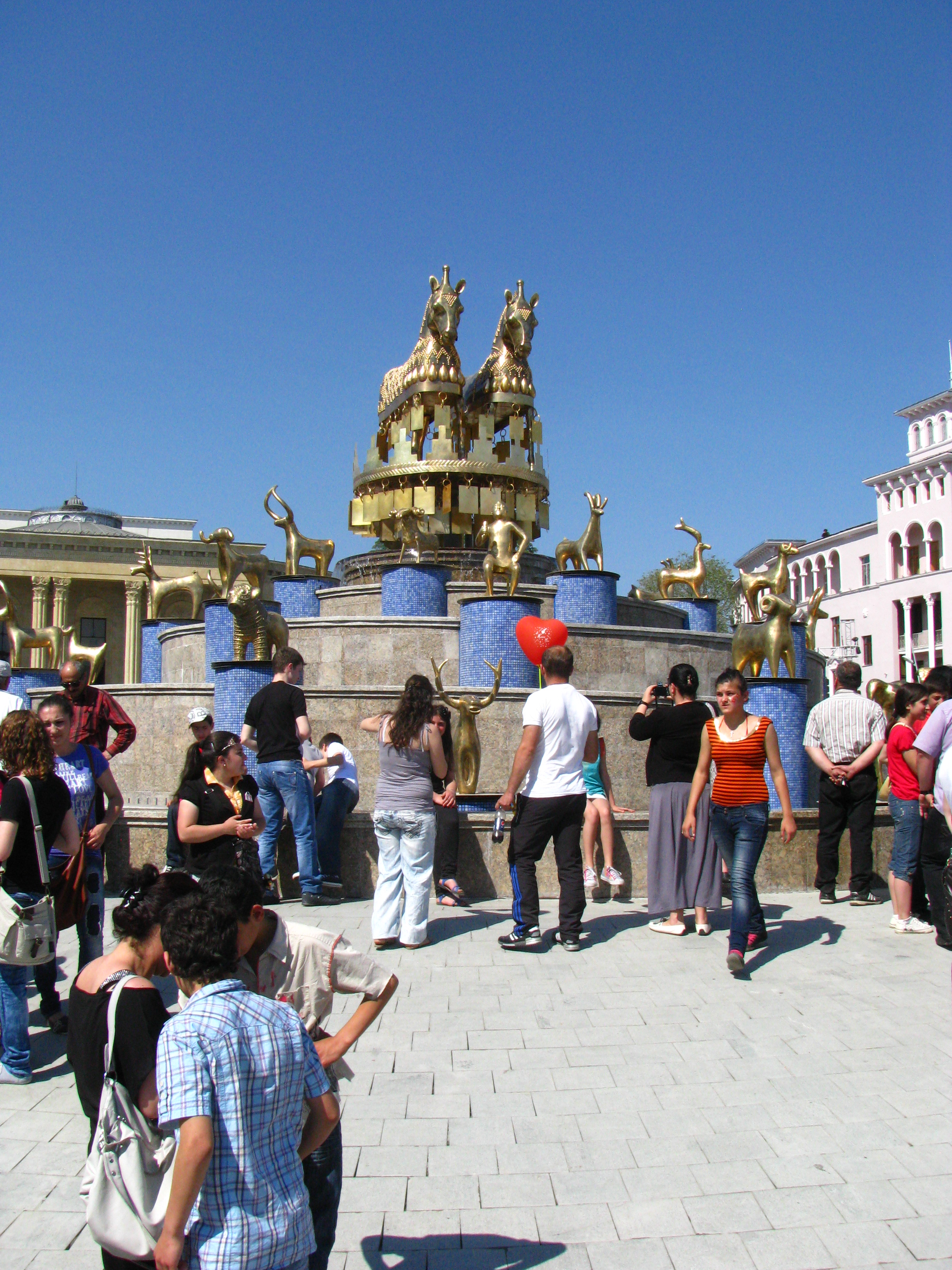
The new fountain at the main square. Some TLGers think it looks kind of tacky, but I think it’s a pretty good attempt to capture some of Kutaisi’s ancient heritage. There’s certainly plenty to choose from.

The main city square is on the other side of the park, with the theater on the left, the banking district on the right, and a giant fountain in the center depicting replicas of ancient Colchian artifacts found in Imereti province.  It’s one of the many interesting ways the city has been trying to reinvent itself since the end of the Soviet Union.  The statue of David the Builder that once graced this square now stands in front of the train station, at the end of the boulevard that bears the same king’s name.

You can see the back of Mirzani’s across the river. It’s probably the best restaurant in town.
Tetrikhidi (White Bridge), with a wedding party posing for photos.
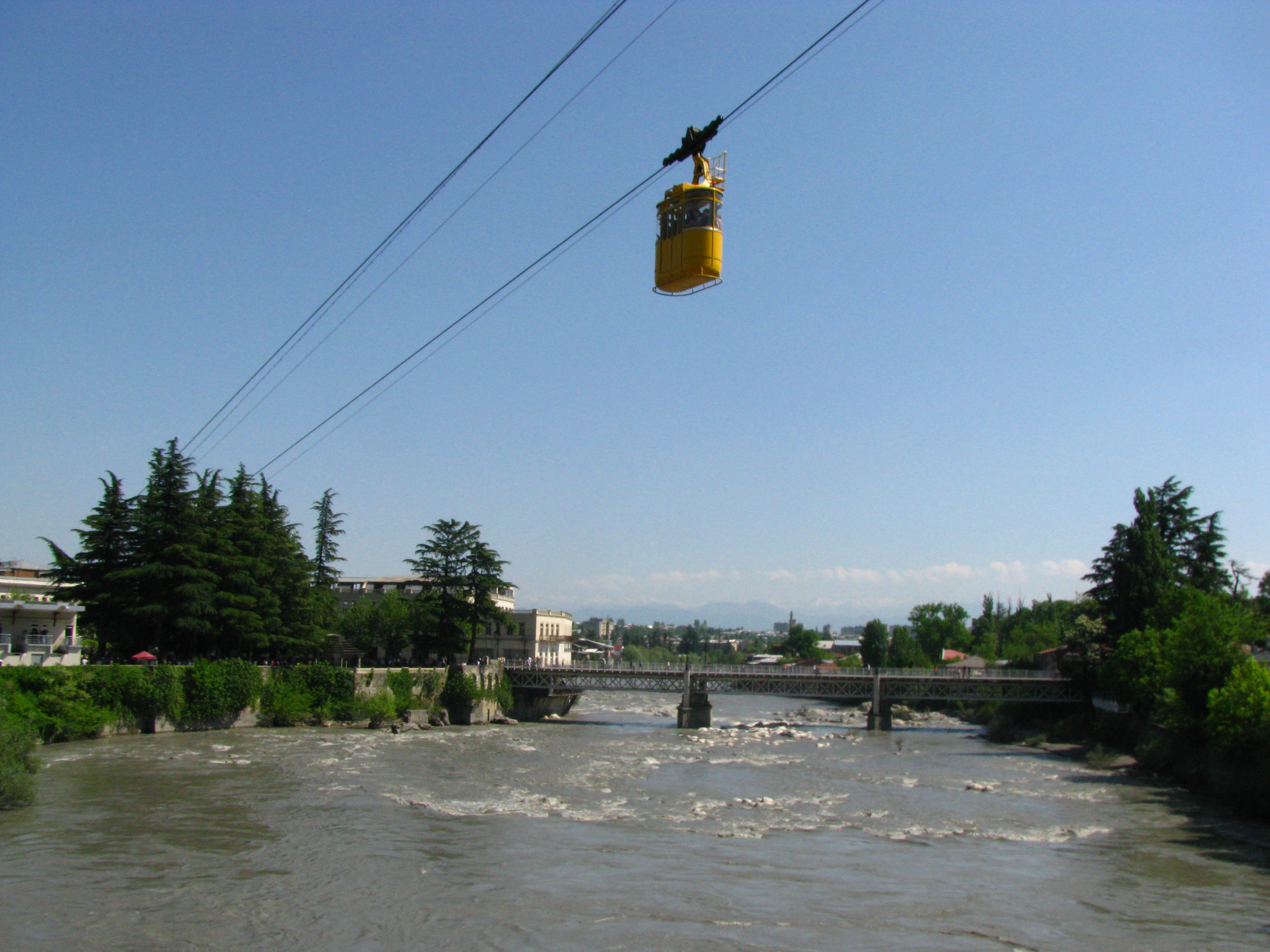
The Kutaisi gondola. I don’t know why, but Georgians seem to have a thing for gondolas.

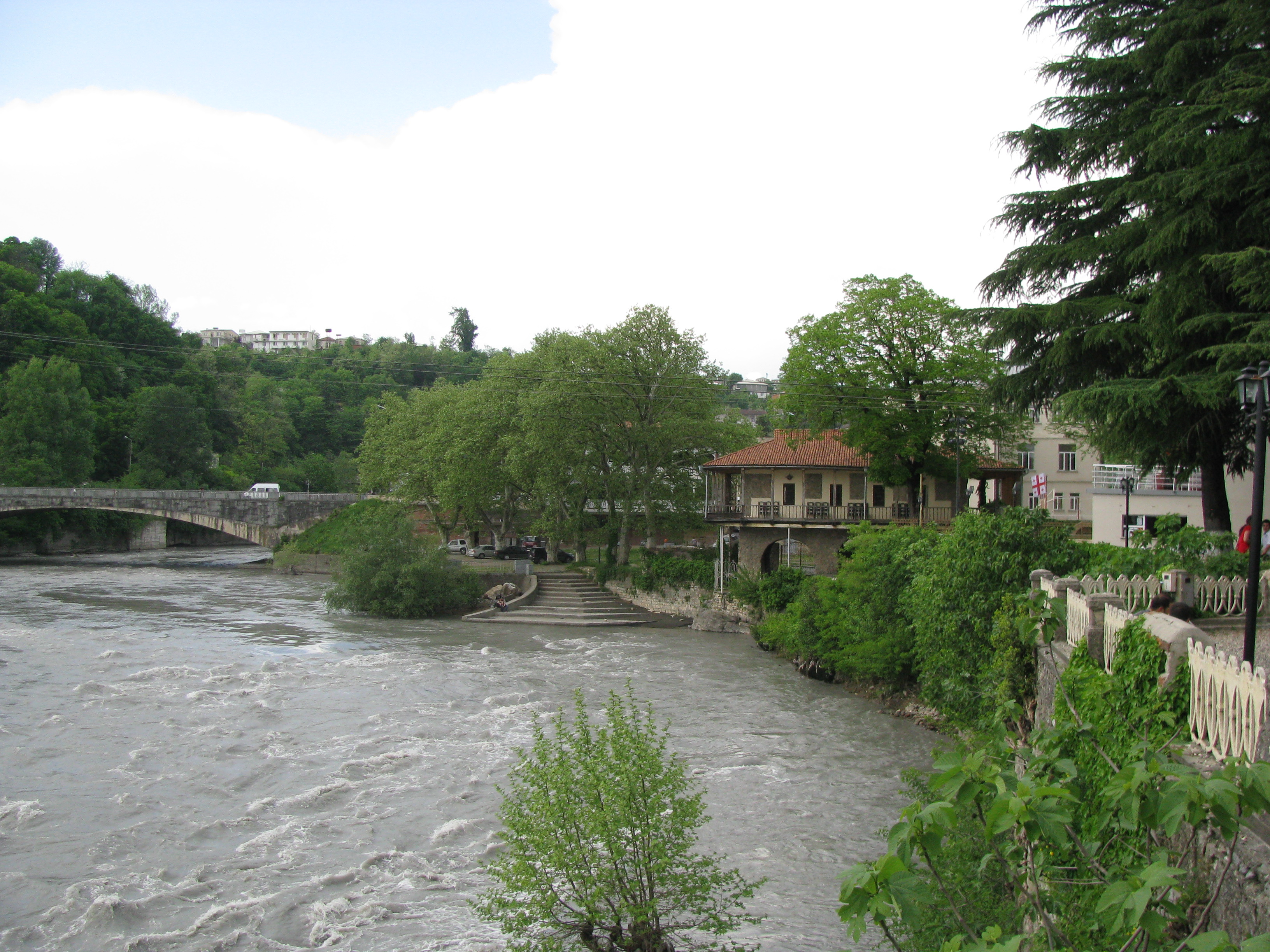
Looping back around, we return to the Rioni river and the neighborhood immediately surrounding Tsitelikhidi.  There are actually three bridges here: Tsitelikhidi (Red Bridge), Rustaveliskhidi (Rustaveli Bridge), and Tetrikhidi (White Bridge), a pedestrian bridge next to another attractive garden.  From here, a gondola takes visitors over the river to an amusement park at the top of a hill.  On the weekends, wedding parties often stop here to take pictures, then speed around the city honking their horns and making noise.

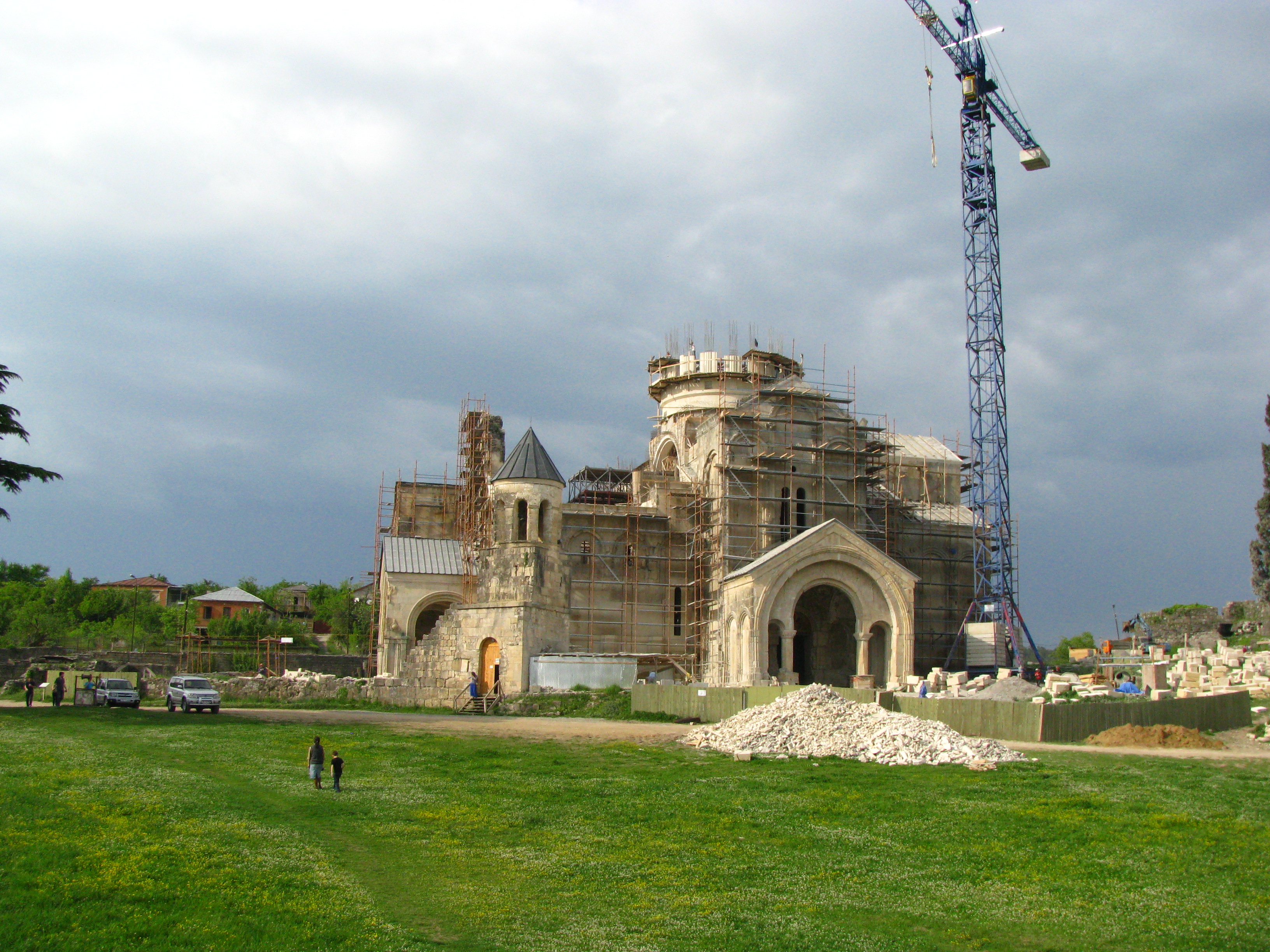
Bagrati Cathedral in the spring.
Close up of Bagrati. The reconstruction is actually progressing fairly rapidly.

Heading north, we pass through the markets again and cross over Jatchviskhidi (Chain Bridge) to the right bank of the Rioni.  After passing another curbside station–this one for marshrutkas heading to the northern villages–we climb a 200 step staircase and find ourselves at the foot of Bagrati Cathedral.

Bagrati is a thousand year-old Georgian Orthodox church, the largest and most important in the city.  After the Turks razed it in the 18th century, it lay in ruins for hundreds of years.  But now, with Georgia’s newly-won independence and the economic boom fueled by the IMF and other foreign investors, the historic cathedral is under reconstruction.  I probably won’t be here when it’s finished, but I definitely want to come back and see it when it is.

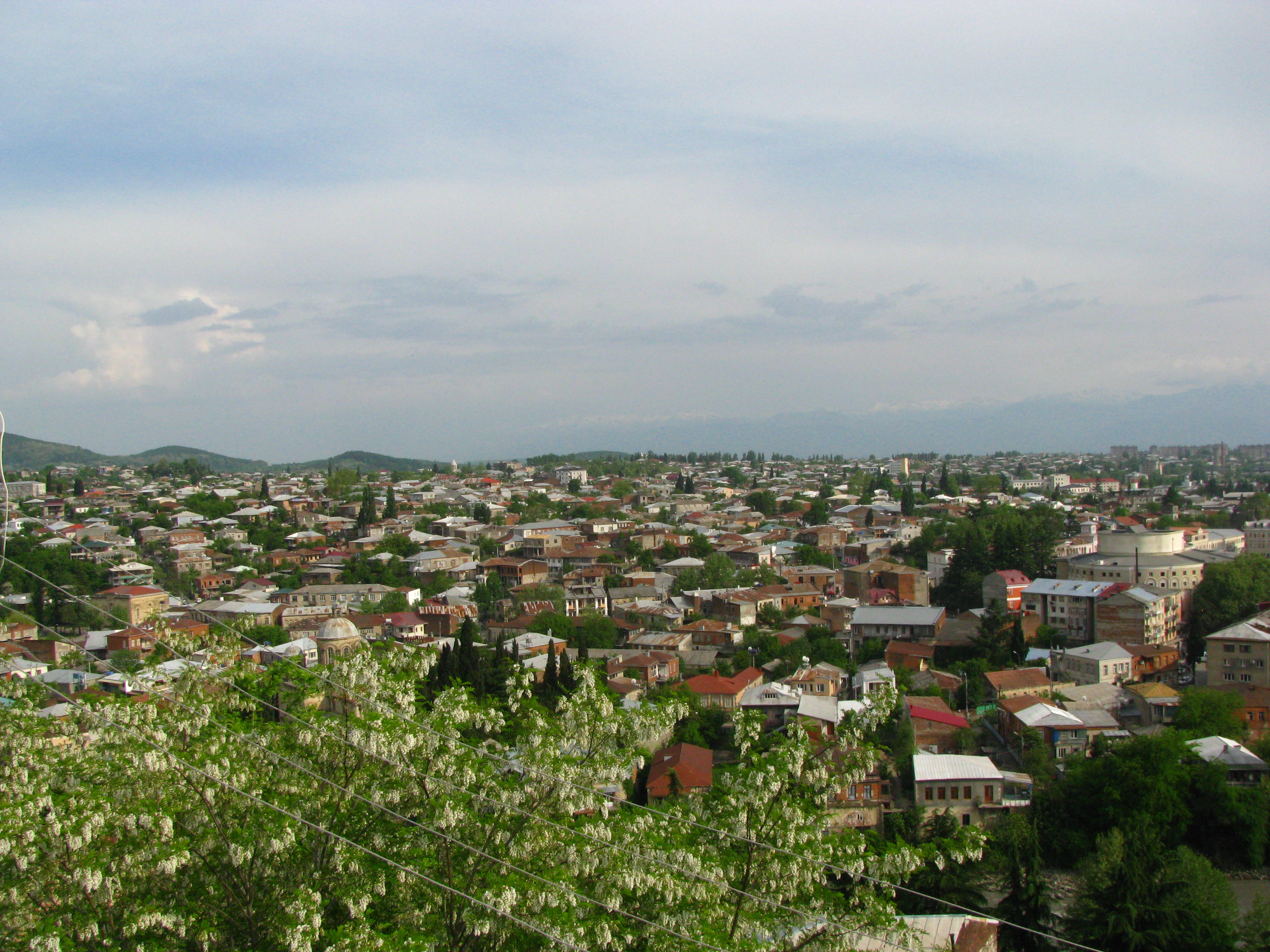
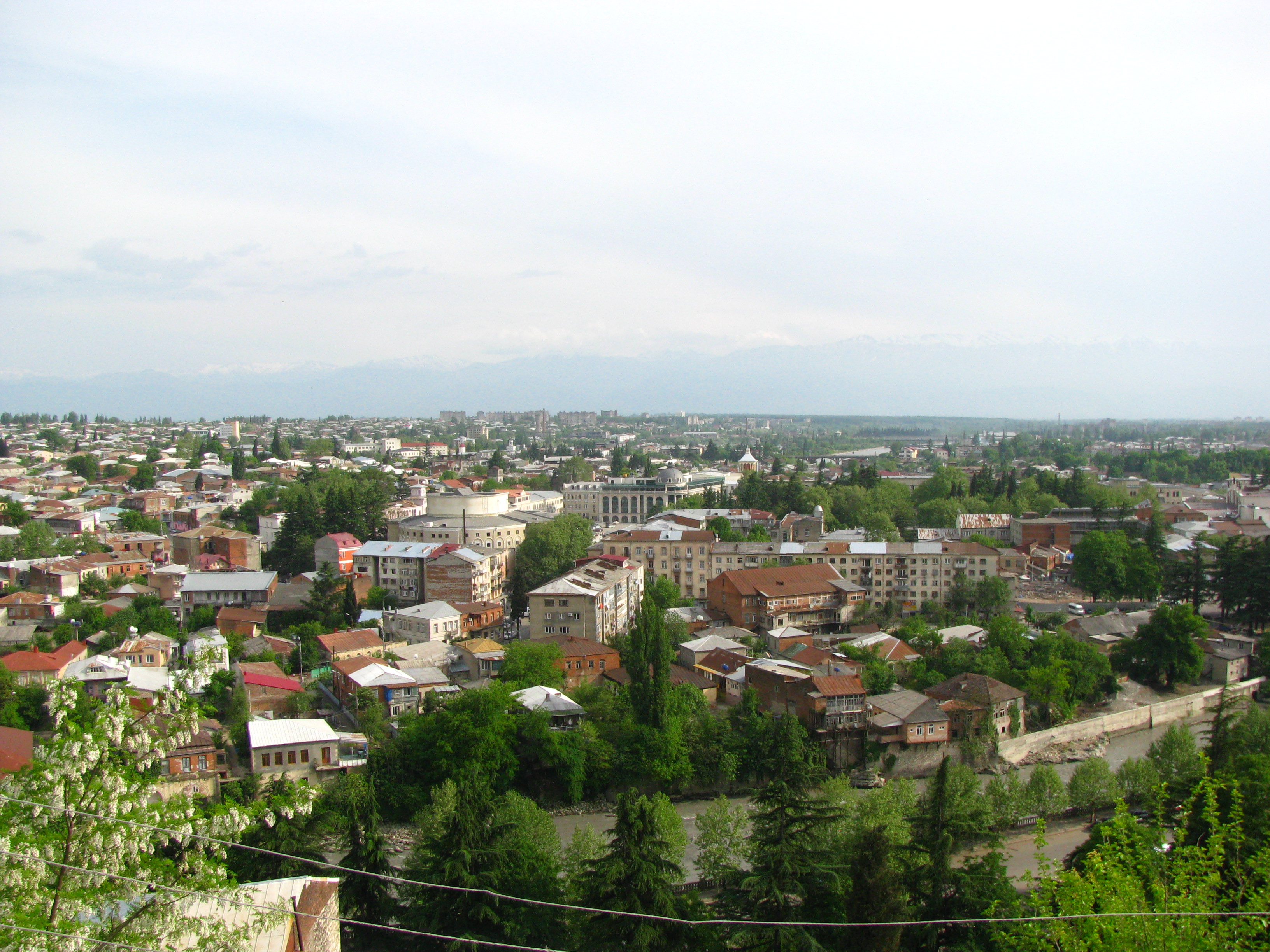
The view looking southeast.
The view looking southwest. The mountains in the distance are the Lesser Caucasus, about 4000 meters above the elevation of the city.
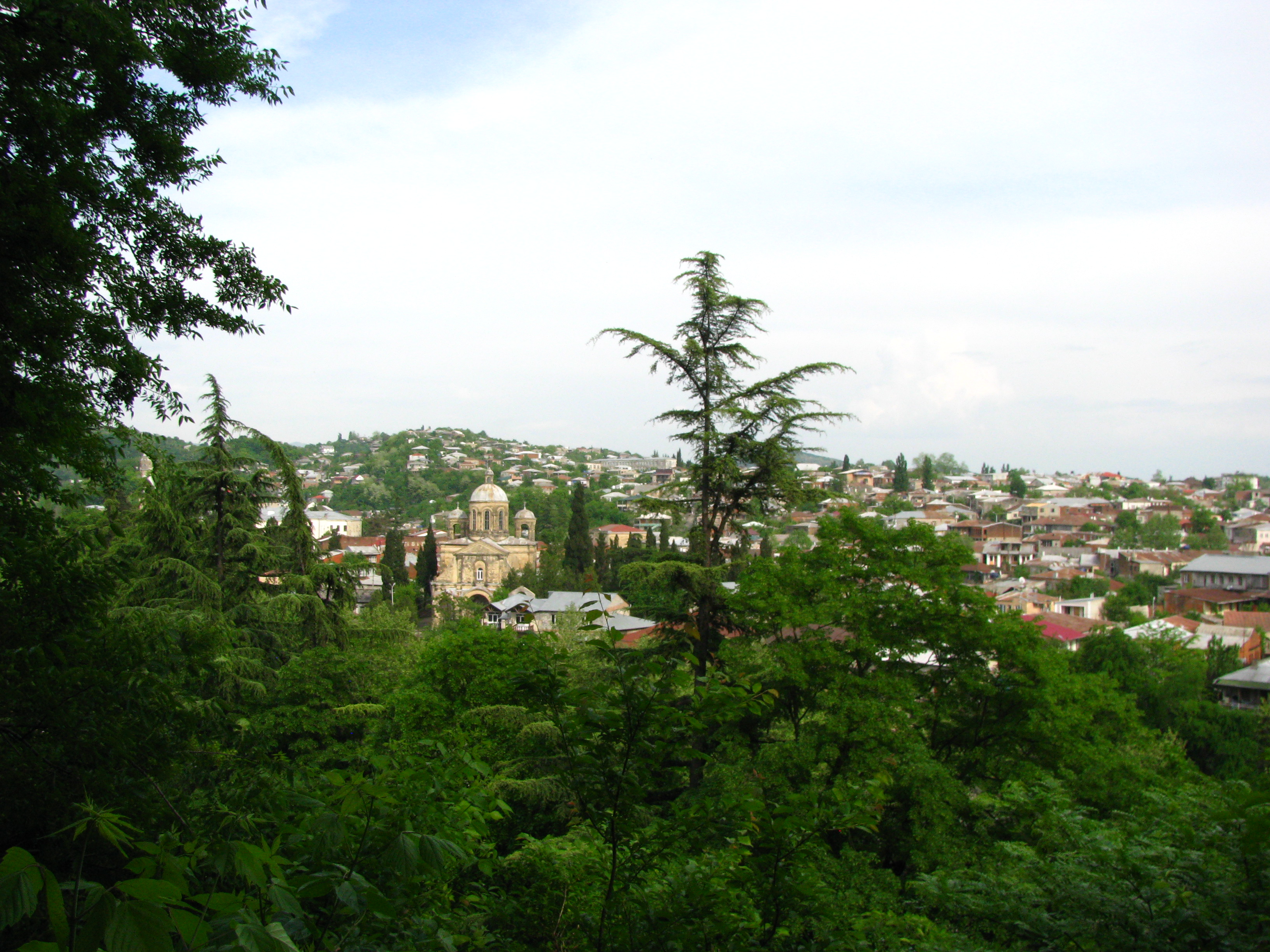
View from the steps leading up to Bagrati. Kutaisi has a lot of churches.

Bagrati Cathedral sits on an imposing hill with a magnificent view of the whole city.  Here, you get a sense of just how big Kutaisi really is.  It’s not a tall city, or a particularly busy city, but compared to the rest of Georgia outside of Tbilisi, it’s pretty huge.

Unlike Tbilisi, however, the city has had very little exposure to the West.  People still stop to stare curiously at foreigners, and hardly anyone speaks English.  It’s much quieter than Tbilisi, too, with fewer cars, more parks, and lots of gardens and orchards, even in the more crowded districts.  People live closer to the land, and travel often to the outlying villages where they still have friends and family.

Perhaps the best way to put it is that Kutaisi still possesses that sense of rustic Caucasian innocence that Tbilisi has since lost.  You can hear it in the way people laugh and see it in the way they kiss and are kissed by their children.  For a city that was legendary long before the maps showed America as a separate continent, that’s no small thing.

მე ♥ ქუთაისი


Decisions suck, writing is awesome

Whew!  I just finished revising through almost 9k words in Desert Stars.  I’ve only got three more chapters and an epilogue to go, and man, I am so excited about this story!  I have no doubt it’s my best work yet.

Of course, I might be biased. 😉

Star Wanderers is also coming along very well.  I’ve only got a few more scenes to write/revise before it’s ready to send off to the next round of first readers.  Part of me wants to send it off to Writers of the Future right now (and according to Dean’s sage advice, that’s probably what I should do), but I want to get some feedback first just to make sure there isn’t something I’ve missed that would make it better.  If all goes well, I’ll probably send it off by the end of the month.

This is the best part of writing process: finishing up a project that you know is good.  This is one reason why I love rewriting so much.  If I could do this all day, every day, and get paid enough for my work to make ends meet, I’d be living the dream.

Until then, however, I’ve got to figure out another way to make ends meet.  One option I’m considering very seriously is selling my contract and driving across the country this Thanksgiving to spend a month or two with my parents before going overseas.  My mom was the one who suggested it, and I have to admit it makes a lot of sense; if I’m going to go abroad to teach English anyways, why not spend some time back home?

If this is something I need to do, I’m going to have to make the decision very soon, possibly before the end of next week–and if you know me, you know that I’m terrible at making decisions.  However, I have been thinking about it enough to make a couple of lists, and this is what I’ve come up with so far:

Reasons to go to abroad:

  • To start a new career.
  • To have adventures.
  • To experience another culture.
  • To gain TEFL experience.
  • To support myself as I write.
  • To have a change.
  • To see the world.
  • To have something to write about.

Reasons to stay in Utah:

  • To get married.
  • To focus on writing.
  • To pursue a graduate degree.
  • To stay in a predominantly Mormon community.

I decided to list only the positive reasons for making either decision, and not to consider any of the creeping doubts or fears (and there are many!).  So let’s break it down:

To start a new career: This seems prudent, especially if it takes a while for my books to really take off.  Specifically, a TEFL career seems like something I could juggle with my writing career, and it would certainly offer a lot more satisfaction than a grunt day job.

To have adventures: Perhaps not the most responsible reason, but hey, you’ve got to remember to have fun.

To experience another culture: One of the perks of traveling, for sure.  It would probably improve my writing considerably as well, though culture shock and distance from family would certainly pose a challenge.

To gain TEFL experience: In other words, to find out if teaching English as a foreign language is something I want to build a career around, or whether I’m just not suited for it.  This is why I’d want to do the TLG program first, before heading off somewhere like Cairo or Amman.  And if it doesn’t work out…well, at least I’d know.  Right now, I don’t.

To support myself as I write: This is huge.  I hear that most TEFL jobs only take up about 20 hours per week, and that if you’re living in a local apartment, it’s not hard to make time to write.  In the past two years, I haven’t had any success balancing writing with full-time work, and working part time probably wouldn’t earn me enough to support myself here in the states.

To have a change: Not quite as tangible a reason, but important nonetheless.  I can’t quite explain it, but if I stay where I am now, in my current life situation…it’s just not going to work out.

To see the world: I could probably lump this under “to have adventures.”

To have something to write about: Also huge.  My experiences in Jordan and the Middle East were a huge inspiration for Desert Stars, and if I’d never gone over there, the novel wouldn’t be nearly as rich.  Who knows what else my imagination would produce if I spent some time traveling the world?

Now, for the other side:

To get married: Honestly, this is more of a negative reason than a positive reason.  I’ve already decided that I’m only going to marry someone who’s a practicing Mormon, and since Utah is predominantly Mormon, I’m worried that if I leave Utah, I won’t be able to find someone.

Trouble is…I’ve been here for almost six years, and still haven’t found anyone.  I could probably put more effort into dating, but the truth is probably that finding a marriage partner is more about your mindset than where you physically live.

Besides, I could always spend a year or two abroad and come back.  I’d be pushing thirty and well beyond “menace to society” status, but at least I wouldn’t be a loser who spent all his twenties in Utah.

To focus on writing: This was why I decided last year not to go teach English in Korea.  The ebook revolution was just getting started, and I felt that I needed to stay in the states to learn how the market was changing and focus on building my indie writing career.

Now, however, I feel like I’m high enough on the learning curve that I can afford to work on other things.  Besides, with the current state of the economy, I don’t think I’m going to find balance if I stay in the states.

To pursue a graduate degree: I’ve largely ruled this one out.  I don’t see how an English degree would help me at this point, and I don’t currently have any career aspirations that would justify pursuing an advanced degree.  The only reason I’d go back to school is to postpone facing the real world, and that’s probably the worst reason I could possibly have.

To stay in a predominantly Mormon community: Kind of the opposite of “see the world” and “experience another culture,” and it gets at the very heart of the matter.  Would it be better to establish myself among people who are more like me and share my values, or should I venture out of the “bubble” and see what else is out there?  I have a much stronger support group here in Utah than I’d probably have as a global nomad, but do I really need it?  Am I independent enough to strike out and bloom wherever I’m planted?

I don’t know.  My thinking is so muddled with doubts and second thoughts that this whole exercise has probably been futile.  If I had to make a decision RIGHT THIS SECOND, however, I’d probably choose to go.

If nothing else, it would give me a good two months of writing time. 🙂

“Who would have thought…”

I would like to address this post to my fellow Mormon readers.

A couple of days ago, I got a discouraging message from some old mission friends of mine.  It said, more or less: “who would have thought that the missionary that taught us the gospel would write such a lurid book?” They were referring to my latest release, Sholpan.

To be honest, it’s been very difficult for me to publish it, because I knew that this sort of thing would happen.  I worry that my friends and family will think that I’ve done something inappropriate, or violated some moral standard, or made myself unworthy in some way.  It’s very difficult to put your writing out there under normal circumstances, much less with complications like these.

However, I would like you to know that I have prayed about this, and that the answer I’ve received is that this is a story worth telling.

Sholpan is about a girl who lives essentially LDS moral standards and falls into what may be the worst situation any of us could imagine for such a girl: slavery in the harem of a powerful warlord who has the power not only to rape her, but to kill her.  By refusing to compromise her values–and risking death to do so–she makes friends in unexpected places and gains a whole lot more power than she ever would have if she’d taken the easy path and compromised.

In other words, it’s a little bit like the story of Esther.  Yes, there are sexual themes, but they aren’t there to be gratuitous or titillating; they’re there to show that even in the face of such horrible immorality, you don’t have to compromise your values.

I know this kind of story isn’t for everyone, which is why I’ve put up warnings in the book descriptions and made it abundantly clear that this book has adult content.  And if you decide you don’t want to read it, I won’t be offended at all.  But please, don’t assume that I’ve gone off the deep end or betrayed my faith, because that’s not the case at all.

It’s a difficult position to be in; I’m sure that Stephanie Meyer’s and Orson Scott Card’s bishops get a lot of mail from fellow Latter-day Saints who feel that they ought to be excommunicated.  But these are the kinds of stories that I feel driven to write: stories that address difficult moral issues and don’t shy away from portraying evil for what it really is.

I appreciate your concern on my behalf, but my faith and spirituality are still quite strong.  You may or may not believe that after reading my books, but please don’t feel like you have to save me.  The best thing you can do is continue to be a positive influence, and let me be a positive influence for you.

How do you know when you’ve succeeded?

With books and publishing changing so quickly, a lot of writers are wondering how they can tell when they’ve actually “made it.” It’s a valid question, one that I think we all need to answer if we want to write seriously.  For myself in particular, as an indie writer, how will I know when I’ve achieved success?

The question made me think about my experience as a Mormon missionary in California, and the definition of success that my mission president (the ecclesiastical leader and father figure for the missionaries) often quoted:

Success is peace of mind which is a direct result of self-satisfaction in knowing you did your best to become the best you are capable of becoming.

— John Wooden

This definition taught me that success isn’t just about external things that may or may not be in your control (for example, the number of convert baptisms per month), but is more about doing the things that are in your control to stretch yourself and reach your full potential.  To be sure, external factors are important measures of success, but at the end of the day, it’s not just about the numbers.

That said, for a writer like me who hopes to make a living at it, the numbers are pretty dang important.  At my current standard of living, I need to sell between 550 and 750 ebooks per month priced at $2.99 and $3.95 to accomplish that goal.  Right now I’m doing about 30 to 50, so I still have a ways to go.

But is that the best measure of commercial success?  If I have 10 titles selling around 55 to 75 copies each per month, will those books be hitting their full potential?

Probably not.  For that reason, I’ll probably end up signing a deal with a publisher at some point in my career; there’s only so much that I can do by myself.  However, in order for me to do that, the terms have to be right; I’m not going to sell myself short just to see my name in print.

(This is one thing that bugs me whenever I hear writers discuss whether traditional or indie publishing best fits their goals.  If all you want is “to see my name in print,” or “to see my book in a bookstore,” how is that any different from vanity publishing?  If that’s really your goal, fine, but don’t think it somehow puts you above indie writers–many of whom have goals that are much more pragmatic than yours.)

Artistically, I think the best way for me to achieve success is to take on a new challenge with every project and still feel like each book is better than the one before it.  Contests and reviews have their place, but going back to the definition, success is all about self-satisfaction and peace of mind.  I don’t want to tie any of those to someone else’s opinion about my work–that way lies madness.

But really, I think it all comes down to the readers.  Unless you stuff your manuscript in the closet, writing is never a solitary act: it is an act of collaboration with the reader.  If I have any measure of success, it will be because someone took the time to read my words.  To be sure, I can’t please everyone, but that doesn’t matter; it only takes one person to make a story come alive.

When I was a missionary, I constantly asked myself whether I was doing the will of God in the life of every person that I met.  That’s how I knew that I had succeeded: when I felt the peace of mind that came from knowing I’d made that personal difference in someone’s life.

I expect it to be similar with my writing.  Commercial success is great, but numbers aren’t everything.  What really matters is telling a story that connects with people on a deep and personal level, transforming them in some meaningful way.  If I can do that and make a living at it, that’s how I’ll know I’ve succeeded.

Worldcon 2011: Thursday

Wow, the last couple days have been packed with awesome con-stuff, but I’ve got a short break so I thought I’d blog about it.

Thursday was great, attended a few panels but mostly just wandered around meeting people.  I’m a little surprised with how many people read this blog.  Got Brandon to sign my Kindle, and he was really supportive about my decision to epublish.  I seem to be one of the only Utah writers going full-steam with indie publishing, but a handful of others are considering it, though for now they’re in the minority (which surprises me).

Anyhow, Thursday had a couple of really notable panels.  The first was on faith and science fiction, and had both Eric James Stone and Moshe Feder on it, among others.  Excellent discussion, though a couple of the commenters tried to derail it.

I found it surprising that the panelists didn’t have a good answer to my question: how do you reconcile far future sf with millenialist religions?  That’s exactly what I’m trying to do with my Gaia Nova universe–create a far future epic that isn’t incompatible with the major western religions (Islam, Christianity, Judaism, etc).  From the after-panel discussion, I got a strong recommendation to read C.S. Lewis’s space trilogy, so I’ll definitely be checking that out soon.

The other notable Thursday panel I attended was on ebook art, and featured John Picacio and Lou Anders, among others.  John feels pretty strongly that indie writers are seriously devaluing cover illustration, and within the first ten minutes someone in the audience literally told him to f___ off!  Wow, talk about tension–but even though it almost fell apart, the panel turned out to be very enlightening.

Let me just take a moment to say that I’m very impressed with what Lou Anders is doing over at Pyr.  While the rest of the publishing world seems to have their heads in the sand when it comes to the ebook revolution, Lou is one of the few who sees it more as an opportunity than a threat.  I’m not currently looking for a publisher, mostly because I’m waiting to see how things shake out, but I would be very surprised if Pyr is one of the publishers that goes under.

The parties in the evening were pretty good–as always, the Tor party was literally packed.  Brandon saw a group of us clustering together, so he broke us up and sent us off to talk with editors and agents.  He tried to point me out to an agent, but…you know, I’m not really looking for one right now.  Brandon keeps telling me not to believe DWS when it comes to agents, and while I’m certainly not fundamentally opposed to them, I feel that I can better build my career by going in other directions.  At some point in the future, maybe, but for now…not so much.

Speaking of Dean, I spent the whole evening hunting for him, then gave up around midnight only to find out the next day that he showed up at the SFWA suite fifteen minutes after I left (nooo!). And now that it’s 9pm in Reno and the parties are just getting started, I think I’ll cut this blog post here and recap Friday sometime later.

See you around!