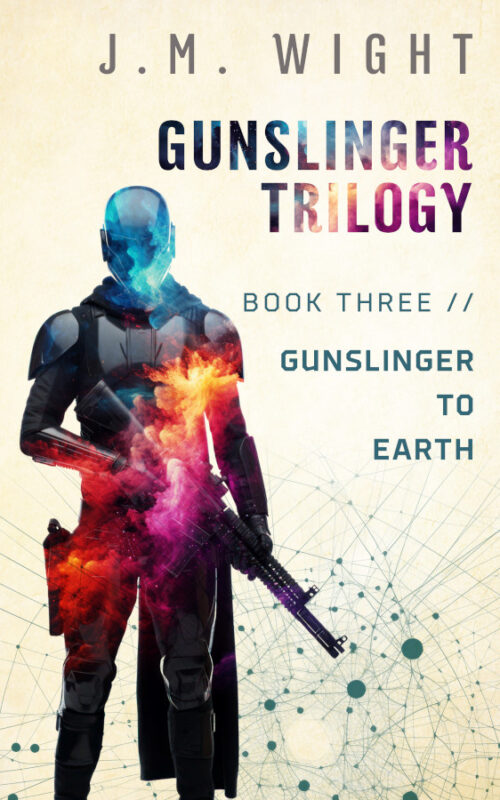
At its core, Gunslinger to Earth, the space-opera finale of the Gunslinger Trilogy, asks a simple but lifelong question: What do you choose to believe when the universe refuses to give you certainty? When Earth vanishes into an impossible anomaly—and later reappears transformed—no one can prove exactly what happened. The characters must decide for themselves what is true, what is worth fighting for, and who they will become in the face of the miraculous.
Where the Idea Came From
The theme grew out of a major turning point in my own life. I started this book just after I began dating the woman who would become my wife and while I was reinventing my writing process to tell better stories. It was a season of uncertainty, hope, and change, full of questions I didn’t know how to answer. That personal crossroads naturally shaped the theme of the story into one about faith, conviction, and choosing a future even when you can’t see what comes next.
How the Choice to Believe Shapes the Story
Throughout Gunslinger to Earth, every major character is confronted with a moment where proof is impossible, but a choice is required. Rex must decide whether to trust Charlotte, whether to follow Sam and Jane, whether to cross the wormhole, and ultimately whether to stay in paradise or return to a mortal life with someone he loves. No one can make these choices for him—not Sam, not Jane, not Charlotte—because the heart of his journey is learning to choose his own truth instead of waiting for certainty that will never come.
On a cosmic scale, the entire plot turns on the same dilemma—an end-times science fiction mystery wrapped in the language of prophecy. The anomaly that swallowed Earth may be the fulfillment of ancient prophecies, or it may be an alien event we don’t yet understand. Mahijah may be exactly who he claims to be, or something else entirely. No lab test or political briefing can answer those questions. Sam, Jane, Rex, the empaths, and the remnants of Earthfleet all have to decide for themselves what they believe—and those choices lead them to the endings they earn. The story isn’t about proving the miracle; it’s about how people respond when the miraculous breaks into their lives—the heart of the choice to believe.
What the Choice to Believe Says About Us
We all live in a world where certainty is rare, where conflicting stories demand our loyalty, and where the most important truths—love, faith, family, hope—are things you commit to long before you can prove them. Gunslinger to Earth reflects that deeply human reality in a character-driven science fiction way. It suggests that belief isn’t about having perfect evidence; it’s about having the courage to choose who you’re going to be and what kind of future you want to build. At the end of the day, the world is shaped not just by what happens to us, but by what we decide to believe about ourselves, about others, and about the meaning of our lives.
Why This Theme Matters to Me
When I wrote Gunslinger to Earth, the closing volume of the Gunslinger Trilogy, I was learning to make those kinds of choices in my own life—about faith, about love, and about the kind of writer and person I wanted to become. It was a moment when I had to step forward without seeing the whole path. That experience shaped the story in ways I couldn’t fully articulate at the time, but I can see clearly now. This book matters to me because it’s ultimately about hope: the hope that even in chaos, even in uncertainty, we can choose what we believe—and those choices can lead us somewhere good.
This is what you get when you get a religious revival in a collapsing postmodern culture that has lost its ability to create good art. As the revival takes root, the artists embrace it and give it voice in ways that we haven’t seen before.
As the Great American Revival continues to spread, we’re going to see a new wave of creative dynamism in the arts, driven by this new influx of religious conservatism. It’s going to produce some really wild and interesting stuff. This is just the beginning.
What would fantasy be without religion? Probably much the same as us, when we don’t have religion: aimless, drifting, and lost.
Religion is more than just a useful aspect of worldbuilding. It’s something that lies at the very core of what makes us human—and thus, it’s something that any story needs to at least touch on if it is to be meaningful or important. Most likely, it won’t be meaningful at all unless the religious aspect is incorporated deeply within its bones.
But what is religion? For our purposes, religion is how we, as humans, relate to the powers that are higher than ourselves. It’s not about painting a cross on your cover, or a star of David, or a crescent, or an omh, or whatever else. It’s about how we act in regards to the cosmic and the transcendent. It’s about how we understand how to orient ourselves in this vast and terrifying universe, and find our own place within it.
I grew up in a time when religion was one of those taboo subjects that you never brought up in polite society. Politics, religion, and sex were all taboo like that. Granted, those taboos were already beginning to fray by the time I was old enough to hold an uninformed opinion on any of that, but even in the 90s, the post-war liberal consensus still held.
What was the post-war liberal consensus? It was the set of rules and norms that we all (or those of us in polite society, at least) agreed to live by, after the tumultuous catastrophe of the World Wars. From 1914 to 1945, more than a hundred Europeans died from political causes—and that was just in Europe. For thirty long years, the whole world was drowned in blood.
The wars ended with the invention of the world’s most devastating superweapon, which for the first time in the history of this planet gave us the power to literally annihilate our own species. So at the end of all that, our grandparents felt a very strong need to keep those weapons from ever being used again. Hence, they developed the post-war liberal consensus.
The greatest value of the post-war liberal consensus was tolerance—but they didn’t think of that as a value in itself. The idea was that instead of elevating the values of any one group over another, they would create a world where everyone tolerated each other. Everyone could keep their own culture and religion, along with their own unique (and often contradictory) cultural and religious values, so long as they didn’t try to impose those values on anyone else.
The trouble with that, of course, is that tolerance itself is a value. Which means that in order to maintain the post-war consensus, they had to be intolerant toward any culture or religion that threatened it. Which meant that they had to push their globalism and multiculturalism on everyone, superseding all of their own cultural and religious values. This gave rise to the global urban monoculture, which ultimately gave us the clown world we now live in. Which is currently falling apart.
Religion should not be off-limits, especially for good storytelling. At the same time, that doesn’t mean that stories should bash you over the head and try to convert you to whatever church the author happens to belong to. Indeed, some of the most religious stories aren’t about any particular church or creed at all.
An example of this is Epic: The Musical. Beyond the old Greek mythology that runs through the story, the religious view is that the universe is utterly unpredictable, the gods (or higher powers) are arbitrary and capricious, and that the ends (getting home to Penelope) always justify the means. Indeed, any means that aren’t justified by the ends are immoral and wrong. Ruthlessness is mercy upon ourselves. How do we sleep? Next to our wives.
Those aren’t the religious views that I subscribe to, but those are deeply religious views. How? Because they show us how we stand in relation to powers that are higher than ourselves. In the 19th century, it became fashionable to throw out religion, and reverence man himself as the highest power in the universe. Where did that get us? It gave us the 31 years that killed 100 million Europeans and drowned the whole world in blood.
G.K. Chesterton said: “When men choose not to believe in God, they do not thereafter believe in nothing, they then become capable of believing in anything.” Now, more than ever, the world needs religion.
Of course, one of the nice things about writing fiction is that you can explore all sorts of religious ideas that may or may not have a direct counterpart in our world. Indeed, that’s part of what makes fantasy so rich. Tolkien created a whole race (the elves) that is bound by magic and immortality to this earth, contrasting with us humans, who are “strangers in a strange land.” In fact, Tolkien’s entire oeuvre is rich with religious elements, not just in the worldbuilding and the mythology, but in the Christian symbology—and he does it so subtly and so deeply that it draws you into his world, rather than kicking you out. It’s all in service to the story.
There’s a reason why the best stories in the world are in the Bible (and most of those are in the Book of Genesis). Which is one of the reasons why I’m drawing on the life of King David for the fantasy epic that I’m currently writing (The Soulbound King). But I’m also drawing on symbology and mythology as well, to make sure the religious elements aren’t just skin-deep. There is so much fascinating tree-related symbolism within the Jewish/Christian tradition. So much rich and wonderful stuff to draw on for creating a fantasy world.
Don’t be afraid to play with religion in your own fantasy stories. After all, on the deepest level, creativity itself is something of a religious act.
Immortality is one of those fantasy tropes that shows up everywhere once you start looking for it. Vampires, elves, gods, liches, ancient dragons hoarding gold through the centuries—we’re fascinated by the idea of beings that can’t die. Sometimes they’re terrifying, sometimes noble, sometimes weary and wise. But always, they strike a chord.
Why? Because they brush up against one of our deepest human anxieties: death.
Death is one of those universal aspects of the human experience. Everybody dies. And compared to the lifespan of things like mountains, or forests, or stars, the human lifespan is remarkably short and fleeting. Some of us live a long and a full life, and are ready to go when the time comes, but many of us are not. Tragedy can strike us at any time. No one knows when the reaper will come for them.
This is why, in fantasy fiction, immortality often comes wrapped in awe and mystery. It’s a mark of otherworldliness, a symbol of something beyond the ordinary cycles of birth and death. Sometimes it’s a gift. Sometimes it’s a curse. Often, it’s a little bit of both.
Personally, my favorite fantasy author who captured this complexity is J.R.R. Tolkien. His elves are perhaps the most iconic immortal race in all of fantasy. They don’t age or grow frail. They don’t die of disease. They are not eternal in the divine sense, but their lives are bound to the life of the world. When they are slain, their spirits travel to the Halls of Mandos, where they can eventually be re-embodied. But they are still bound to the world. They don’t pass beyond it. They don’t get to move on.
That’s the heart of their tragedy.
Elves in Tolkien’s legendarium aren’t happy fairytale creatures dancing in the moonlight. They are ancient beings with long memories, deep sorrows, and wounds that don’t always heal. They remember battles and betrayals that happened millennia ago. They carry the weight of history like a cloak that can never be removed. And for all their beauty and wisdom, they are fading. Slowly, subtly, inevitably. Their time is passing, and they know it.
In contrast, humans are mortal and thus are not subject to this curse. As Tolkien writes in The Silmarillion:
“And the Doom of Men, that they should depart, was at first a gift of Ilúvatar. It became a grief to them only because coming under the shadow of Morgoth it seemed to them that they were surrounded by a great darkness, of which they grew afraid.”
That’s a remarkable insight. Mortality, which we so often view as a curse, was originally a gift. The elves envy us not because we die, but because we get to leave. To move beyond the world. To have an end.
And yet, we don’t often treat it like a gift. In fact, we go to absurd lengths to avoid it.
You don’t have to look far to see that our obsession with immortality isn’t limited to fantasy stories. In Silicon Valley and other corners of the tech world, there’s a growing movement of wealthy futurists who are pouring money into the dream of defeating death. Some want to reverse aging at the cellular level. Some are working on brain-uploading technology, convinced they can digitize the human soul. Others are experimenting with biological “enhancements,” anti-aging therapies, or even transfusions from younger people in an effort to extend their lifespans.
This hunger for immortality is as old as the Epic of Gilgamesh, but today it wears a lab coat and calls itself “biohacking.” The names have changed, but the impulse remains the same. We want to stay. To cling to life. To hold onto what we have, no matter the cost.
But is that really such a noble goal?
Fantasy offers us a counterpoint. Again and again, stories show that immortality comes at a price. Vampires lose their humanity. Liches surrender their souls. Gods become detached from the world of mortals. Even the elves, for all their grace, are caught in a long decline.
Immortality often brings with it a kind of existential exhaustion. Without death, there is no closure. Without loss, there is no growth. Without time running out, nothing truly matters.
Mortality, by contrast, sharpens everything. Because we are mortal, our choices matter. Because time is a scarce resource—indeed, perhaps the only resource in our world that is truly scarce—our relationships carry weight. Because we will one day die, every act of love, courage, sacrifice, or faith becomes immeasurably precious.
And that’s something that fantasy, at its best, understands better than any philosophical treatise or TED Talk ever could. Again, Tolkien writes:
“But the sons of Men die indeed, and leave the world; wherefore they are called the Guests, or the Strangers. Death is their fate, the gift of Ilúvatar, which as Time wears even the Powers shall envy.”
The elves call us guests. Strangers. Not because we are lesser, but because we do not belong to the world in the same way they do. We are pilgrims passing through this world—strangers in a strange land. Our road leads elsewhere, and that elsewhere—whatever lies beyond the circles of the world—is part of the hope that makes us human.
In my own fantasy, I like to play with this idea. My characters all live in the Mortal Realm, but there is an Immortal Realm that lies beyond the bounds of their current existence, and the veil that separates the two can sometimes grow quite thin. In The Sword Keeper, there is a Void between the two realms that Tamuna must cross in order to confront the evil that afflicts her world, and to find the lost spirit of her father. In Bloodfire Legacy, when Lord Arion is assassinated in the first chapter, he temporarily gives up the indescribable glory of the Immortal Realm in order to linger as a ghost and help guide his orphaned daughter.
All of these characters are bound, in time, to pass from this Mortal Realm, but that isn’t a curse—it’s a gift. There is far more to this life than the bounds of our material existence. There are more things in heaven and in earth than we can comprehend with our mortal understanding.
In the end, fantasy doesn’t just explore our fear of death. It teaches us how to find meaning in the brief time we’re given. So the next time you read about some deathless sorcerer or ageless elf queen, remember: you have something they never will. An ending, and a beginning. A home beyond this world. A story that can reach its conclusion.
By his own admission, in his latest blog post: On Renarin and Rlain. He says the post is addressed “toward my more conservative readership.” However, he also calls himself “an ally to LGBT+ people” and boasts about writing the “first openly gay men [in] the Wheel of Time.” When discussing Christianity and his own Latter-day Saint faith, he makes repeated appeals to “empathy” and “respect,” without addressing the Bible’s clear condemnation of sexual sin. He also does not mention the Family Proclamation, which clearly lays out his own church’s position on homosexuality, transgenderism, and gay marriage.
In other words, Brandon basically told his conservative readers “I hear you, but you’re wrong.” He implies that any conservative Christian who has concerns with the gay romance in Wind and Truth is lacking in empathy and respect. He also implies that by voicing their concerns, they are dividing the world into “us” vs. “them” and betraying a key tenet of their own Christian faith.
If Brandon genuinely wanted to allay the concerns of his conservative readers, he would have acknowledged the Family Proclamation and Biblical standards of sexual morality. He would have discussed the gay romance of his latest book in the context of such standards. Then, he would have presented an argument similar to Andrew Klavan’s: that conservative art is not the same as conservative life. Good art must provide an honest and truthful representation of life. It should not glorify or promote those aspects of life that are evil. Brandon starts to make the first half of that argument, in discussing how Tracy Hickman portrayed gay characters in his books, but he fails to follow it up. He doesn’t explain how making a gay romance essential to the plot of Wind and Truth serves the good, the true, and the beautiful.
Brandon doesn’t seem to trust his conservative Christian readers to be able to separate the sin from the sinner. He also refuses to acknowledge the lived experience of his gay and lesbian readers who have chosen to live morally pure and faithful Christian lives. Like Brandon, I am a member of the Church of Jesus Christ of Latter-day Saints. Some of the most inspiring members of the church for me are those who struggle with same-gender attraction but still live true to their testimonies. I imagine it must feel pretty lonely at times like this, when their brother in Christ has chosen to side with those who preach the false gospel of pride, equity, and self-worship, instead of the gospel of the One who declared “Father, Thy will be done, and the glory be Thine forever.”
Has Brandon denied his faith? I’m not Brandon’s bishop, nor am I his eternal judge. It’s important to remember that the church is not a place for perfect people. I do think there ought to be a place in the church for self-described LGBT+ allies, so long as they sustain the leaders—and the doctrine—of the church. But if he hasn’t crossed the line, he’s certainly standing a lot closer to it than I ever would.
My personal testimony is that the Family Proclamation is inspired of God, and that the men who wrote and signed their names to it are prophets, seers, and revelators. It teaches true principles about the family and sexual morality. We are all children of God, gays and lesbians included, and that makes us all brothers and sisters regardless of how we choose to live. At the same time, Christ didn’t suffer and die for us so that we could continue in our sins. If the Family Proclamation is true, affirming homosexuality is not an act of love, no matter how empathetic it may be. Christ had empathy for the woman caught in adultery, but because He loved her, He also commanded her to “go, and sin no more.”
On a personal level, I feel frustrated and disappointed by Brandon’s recent turn. I count Brandon as an early mentor—in fact, it was Brandon’s class that inspired me to pursue writing as a career. I haven’t spoken with Brandon in years, but I do still count him as a friend. If I could sit down with him I would ask him about the people he’s surrounded himself with. They seem to be leading him in a bad direction, since he seems to have grown out of touch.
Has he betrayed his conservative readers? Yes, I think he has, and that he’s making a big mistake by doing so. One of the things that set him apart until now was the fact that his books are very clean. His fans may argue that Renarin and Rlain’s romance is also clean, but as a conservative reader, it feels more like a camel’s nose peeking under the tent. In a world of drag queen story hour, pornographic gay pride parades, and genital mutilation of children, is it even possible to have a clean gay romance? I think not. To paraphrase Brandon, as much as we may long for the days where there was no slippery slope, maybe that world never existed. Maybe there will always be an instinct to divide the world into the “clean” and the “queer.”
So let me just say this: whatever the stories that Brandon wants to tell, I can no longer trust that they’ll be the kind I’ll want to read. He could still turn around, of course, and I genuinely hope that he does. But reading between the lines, it seems that this turn toward the woke is not a new direction from him. It seems to be something that he’s contemplated for some time. I’ll still read the rest of his secret projects and keep my signed copies of the original Mistborn trilogy. But I’m going to DNF the Stormlight Archive, and probably won’t buy his future books.
Brandon ends his blog post by saying that one of his primary goals in life is to be more empathetic. This is what motivates him to write: because it’s how he explores the world. I, too, feel compelled to explore the world through my stories, but my primary goal is to pursue the truth. Those two goals aren’t always in conflict, but when they are, I think the pursuit of truth should be higher. The pursuit of truth ultimately leads us to love one another more fully and more meaningfully than the pursuit of empathy does. It saddens me that Brandon disagrees.
So it’s November 6th, 2024, the day after election day. President Trump has won an astonishing election victory, marking the greatest political comeback in US history. For those of us who feel like we’ve been gaslit and abused for the last four years, it really does feel like things are starting to look up for the country.
At least, for most of us, that is the case. For others of us, the black pill has been so bitter that we’re almost scared to hope again. Last night, I was up until 2am, just because I didn’t want a repeat of 2020, where we all went to bed convinced that Trump had a lock on the election, only to wake up to burst pipes, boxes of uncounted ballots, voting machines behaving strangely, windows and doors boarded up against Republican observers, and other sorts of “election fortification.” So frankly, I don’t blame anyone for being on pins and needles until Trump actually puts his hand on the Bible and is officially sworn in as the 47th (or possibly 48th) President.
I’m seeing that reflected right now in my blog stats, where in the last 24 hours, I’ve seen hundreds of hits on my old post This Scenario Would Fulfill Ezra’s Eagle, which I wrote several years ago. For some strange reason, that post is now the #2 Google search result for the query “Ezra’s Eagle,” which makes me feel like it’s my duty to offer periodic updates to the situation.
But first, a quick explanation of the Ezra’s Eagle prophecy:
This video is a very good explanation of the prophecy, as interpreted by Michael B. Rush. The part I find most compelling about it is the sequence of rulers, which really does line up uncannily well with our last 16 presidents. Whenever Biblical prophecies start going into numerology, I always raise my eyebrows a bit, because there are lots of ways to twist numbers to make them appear to fit your own personal interpretation. But if you read the original source material in 2 Esdras 11 and 12, it actually lines up very well with what has (so far) transpired.
However, it’s where we get to Rush’s interpretation of the last two short feathers and the lion that I tend to think it goes off the rails. This may come as a surprise to some of you, but I am not convinced that there will be a singular Anti-Christ figure in the end times. I know that a lot of Evangelical eschatology revolves around this figure, but the way they get there is through a rather selective reading of Daniel, Ezekiel, and Revelation that leaves me scratching my head. When I read the Bible, I see a lot of passages talking about a spirit of Anti-Christ, but not a singular figure—and certainly not one with Godlike powers.
But the big thing is the lion, which Rush connects (correctly, I believe—assuming of course that the prophecy is true, which it may very well not be) with the remnant of Jacob in 3 Nephi 20 and 21. Latter-day Saint eschatology draws not only from Daniel (where we get the stone cut out of the mountain without hands), Ezekiel (where we get the stick of Joseph), and Revelation, but also from Isaiah, which goes into great depth about the scattering and gathering of Israel, and the return of the lost 10 tribes. There are also several other prophecies in the Book of Mormon that describe the latter-day gathering of Israel, which is central to the Latter-day Saint understanding of the end times.
Regarding the lost 10 tribes, within the Latter-day Saint tradition there are basically three possible views about what happened to them and where they are now.
The first is that they were taken to the north pole and currently live under the polar ice. This view was very popular in the 19th century, but almost no one believes it seriously now.
The second is that they were taken into space, and currently reside on another planet or in another dimension. While this may sound crazy, it does resonate with the scriptures we have that talk about how Enoch was taken into heaven, with the original city of Zion. This is the view that Michael B. Rush espouses, and he believes that the prophecies in 3 Nephi (as well as Ezra’s Eagle) will be fulfilled when the ten tribes come back down from space and liberate us from the Anti-Christ.
If that sounds a little too science fictional to you, you’re not the only one. Personally, I would love to read a novel where that’s how things turned out, but I don’t think those prophecies are actually going to be fulfilled that way—and here’s why.
The third view is that after the ten tribes passed out of our historical records, they migrated to the northern reaches of the Eurasian landmass, probably in what is now Siberia. There, they established a civilization, which was apparently still extant when the resurrected Christ visited the Americas, because He referred to them explicitly in 3 Nephi 17:
4 But now I go unto the Father, and also to show myself unto the lost tribes of Israel, for they are not lost unto the Father, for he knoweth whither he hath taken them.
This civilization probably continued for a while, perhaps for several centuries after the resurrection of Christ, but it eventually fell, probably due to a combination of the changing global climate (which was much warmer during Roman times, but went into a little ice age during the medieval era) and political upheaval on the Eurasian steppes. When China fell apart after the Three Kingdoms period, there was a massive depopulation as the survivors of those wars migrated westward onto the steppes, creating a cascade of violent displacement that ultimately culminated in the rise of the Hunnic confederacy and the migration period in Europe, which brought about the fall of the western Roman Empire. The ten tribes could easily have been conquered during this period, and their survivors assimilated into the Hunnic or Turkish tribes. Or perhaps they survived this era, only to be conquered by the Mongols in the 1200s. Either way, their culture was wiped out, and their descendants were assimilated into the cultures that conquered them and settled on their lands.
There’s quite a bit of evidence for this theory, including DNA evidence. There’s also some spiritual evidence from the patriarchal blessings of people from this region, where most of the people are have been blessed to belong to one of the ten tribes. The guys at Ward Radio discuss this at length in the episode above—Jonah Barnes actually served his mission in Siberia, so he has firsthand experience with this. Also, there is some pretty solid scriptural evidence in Jacob 5 and the allegory of the olive tree. When the branches of the natural tree are first scattered throughout the vinyard, there is a location that is mentioned once in verse 24, and never mentioned again. If this represents the lands of the lost ten tribes during Christ’s time, that makes sense, since their culture had not yet been wiped out—but after it was wiped out, and the survivors assimilated into the culture that conquered them, they were no longer a “branch” within the context of the allegory.
So how does this relate to Ezra’s Eagle? If the ten tribes are actually among us, and not in space as Michael Rush believes—indeed, if the descendants of the lost tribes are currently being gathered into the Church of Jesus Christ of Latter-day Saints, through the missionary work currently happening in central Asia—then the “remnant of Jacob” that will go forth as a lion is the members of the Church of Jesus Christ of Latter-day Saints who gather to the New Jerusalem, either to build it or to migrate there after it has been built. Third Nephi 20 and 21 go into great depth about this.
But what does it mean that they will tread down their enemies among the gentiles? Does it mean that the Church of Jesus Christ of Latter-day Saints will go all nationalistic, organize a militia, and go to war directly against the United States? Almost certainly not. After all, the twelfth article of faith states: “we believe in being subject to kings, presidents, rulers, and magistrates in obeying, honoring, and sustaining the law.”
But I could see a scenario where the United States collapses and becomes a failed state on the national level, with cartels, gangs, and local warlords stepping into the power vacuum under the veneer of what’s left of our democratic republic. Under that scenario, the church would step into the gap and help its members to organize and develop a strong, self-reliant community that could not only survive in such a post-collapse world, but actually thrive in it. In many ways, we’re already set up to do exactly that. And if the call comes during this time of chaos to build up the New Jerusalem, I could see us making a modern pioneer trek to Missouri, and prevailing over the gangs and warlords who try to stand in our way.
Under this scenario, the last two feathers of Ezra’s Eagle aren’t the Anti-Christ and the Beast, but the last two presidents of the United States, who attempt to restore the nation after the catastrophic fall of the deep state (represented by the three eagle heads) but who ultimately fail to do so. This is when the nation collapses, and we become a failed state on the federal level. Then the Church of Jesus Christ of Latter-day Saints rises up to fill in the gap, standing against the gangs and warlords in the ensuing power vacuum, until we are called to build the New Jerusalem and fulfill the end-times prophecies contained in 3 Nephi.
To me, this is a much more plausible interpretation of Ezra’s Eagle than Rush’s view that the lost ten tribes will liberate us in some sort of extraterrestrial invasion of our planet, while a godlike Anti-Christ rules the whole world. But frankly, I don’t think any of this is going to happen—at least, not on the timeline of Ezra’s Eagle. President Trump won the election with a clear mandate, and I believe he will become our 47th president. With the way things are currently unfolding, I no longer believe that the Ezra’s Eagle prophecy is true in a literal sense. It may have been an authentic vision of a possible series of events, but I do not believe we are on that timeline. After all, there is a reason why Joseph Smith never translated the Apocrypha—or canonized it, for that matter.
But I guess we’ll find out soon. After all, if anything happens to Trump between now and January 20th… let’s just pray for our country during this very uncertain time.
(And for the record, if the Ezra’s Eagle prophecy is true, I still totally believe that Janet Yellen is the first eagle’s head.)
Remember the time before the pandemic, when “conspiracy theory” was still a dirty word? It still is in some quarters, but for many of us the term is now closer to “spoiler warning.”
After all, what are we supposed to believe: that Epstein hung himself with a bedsheet that couldn’t hold his weight, from a height that couldn’t kill him, at exactly the moment when the guards had abandoned their posts and all of the surveillance equipment had mysteriously and inexplicably gone dark? That is still the official story—just like Ghislane Maxwell, Epstein’s Madam, was thrown in prison for trafficking sex slaves to… well, nobody, at least officially.
Or are we supposed to believe that a novel coronavirus whose genetic profile shows clear evidence of artificial manipulation jumped species from a bat to a pangolin to a human, in a Chinese wet market (which the CCP destroyed before any investigation could be launched) more than 900 miles from the bat’s native habitat, which also just happens to be down the street from the Wuhan Institute of Virology where gain-of-function research was being conducted with bat coronaviruses? I’m not generally a fan of Jon Stewart, but I think he hit the nail on the head with this one:
Of course, this isn’t to say that all conspiracy theories have weight and value. By no means do I believe that the moon landings were fake—there are just too many people who would have to be in on the thing to keep it secret for long, and also, we can see the tracks of the moon landingsfrom Earth. But conspiracies do happen, and often have tremendous impact on the course of history. For example, the United States constitution was born out of the Philadelphia Convention, which conspired to throw out the Articles of Convention and replace them with something entirely different, which was technically an act of treason at the time.
Conspiracies are real, though not all conspiracy theories are true. The challenge is separating conspiracy theory from conspiracy fact.
Which brings us to the old aphorism: “never attribute to malice that which can be attributed to incompetence.” For the last two years, when I look at the direction my country is going and all of the harm that the Biden Administration has done, I find myself constantly asking: “is this malice, or is this incompetence?” After all, if my goal was to destroy this country, I could hardly do better than what this administration has already done (Victor Davis Hanson has an excellent article about that, and he says it better than me). And yet, every time the press secretary opens her mouth, I am reminded of just how staggering is the incompetence of these people. Or is it?
And then I had a realization: if you go up high enough, all of these people are useful idiots to a force of pure malice that is striving to bring about our spiritual enslavement and destruction. I am speaking, of course, of Satan himself.
Now, perhaps you don’t believe that the devil is real. Laying aside the aphorism that “the greatest trick the devil ever pulled was convincing the world he doesn’t exist,” you don’t have to believe in a literal fallen angel and his hordes of demonic followers in order to follow this particular rabbit hole. The devil is an archetype for a reason, after all. Personally, my own experience has convinced me that demonic forces do indeed exist, but that’s all I care to say on the subject, and I’ll leave you to draw your own conclusions.
But my point is that it’s not like the forces of evil are monolithic: there is a hierarchy of conspirators and useful idiots, and some who may be conspirators on one level are useful idiots on another. At the bottom, it’s almost all useful idiots wreaking havoc by their own incompetence, but at the top, it’s all driven by malice.
Because here’s the thing: when we attribute a particular action to incompetence, we are making an implicit assumption about the motive behind that action. If we assume that Biden’s motive is to serve the interests of the American people, he’s doing a piss-poor job of it—but if we consider that he may have been compromised by China (as the Hunter Biden laptop implicates), or that he only cares about the Biden crime family’s interests, then his actions no longer reak of so much incompetence.
In the game of chess, there’s a thing called a gambit, where the player sacrifices a piece in order to gain an advantage of tempo or position. To the inexperienced player, a gambit often looks like a mistake. Some of the most brilliant chess moves involve a gambit that seems, at first, to be an act of utter incompetence, but that in fact make winning inevitable if the opponent falls for the gambit.
So even though “never attribute to malice” is a good rule of thumb, it’s clearly not sophisticated enough to explain all the insanity we’ve seen in the last two years. But neither is it sufficient to explain this insanity in terms of pure conspiracy—indeed, falling into that trap makes us susceptible to becoming infected by that insanity ourselves. Mattias Desmet points this out in chapter 8 of his seminal work, The Psychology of Totalitarianism. He also says:
In the whole process of exercising power—i.e., shaping the world to the ideological beliefs—there usually is little need to make secret plans and agreements. As Noam Chomsky put it, if you have to tell someone what to do, you’ve chosen the wrong person. In other words: the dominant ideology selects who ends up in key positions… Consequently, all people in positions of power automatically follow the same rules in their thinking and in their behavior and are under the influence of the same attractors.
One of the main points that Desmet makes in this chapter is that when people are driven by an evil ideology—or, in the words of Jordan Peterson, become ideologically possessed—their actions often appear, to someone on the outside, as if they are all part of a grand conspiracy. And yet, none (or at least, very few) of these people have actually entered into a clandestine agreement to support a deliberate plan: they are all just playing the part that they find themselves in, most of them unwittingly.
And yet, even though there is no “conspiracy” in the classical sense, the people who get caught up in the insanity all end up working to advance the purposes of something much bigger than themselves. Indeed, explaining this phenomenon is the entire purpose of Mattias Desmet’s book. He does a brilliant job of it, but mostly from a psychological perspective.
What I want to do is look at this phenomenon from a spiritual and an archetypal perspective, not as a scientist but as a storyteller. That’s why I’m calling it the “grand conspiracy,” even though I recognize that on most levels, it’s not a conspiracy so much as a confluence of interests (or more accurately, a confluence of lusts). I do think that there’s a lot that can be gleaned by looking at it this way, because there is a spiritual dimension to our lives—as Mattias Desmet emphatically points out—and stories and archetypes have been absolutely essential to our understanding of the world since prehistoric times. I happen to believe that Satan is more than just an archetype, but you don’t have to believe that in order for this grand conspiracy to be useful and make sense.
I’ve planned this series out in twelve parts, listed here. From now until the end of February, I’ll post about once a week. Since Christmas is coming and I don’t want to be thinking about all this diabolical stuff over the holiday itself, I’ll post part 2 next Tuesday, and part 3 the week after that, then go back to posting on Saturdays. The first three parts will outline the general theory that I’ve come up with, and the next eight parts will examine each piece of the theory in detail. In the end, I’ll share some concluding thoughts about how this grand conspiracy can—and indeed, ultimately will—be defeated.
I hope you find this series interesting, and I look forward to hearing what you think about it!