Fantasy from A to Z: L is for Love

What is love? (Baby don’t hurt me…)

Seriously, though, what counts as “love” in fantasy these days? The romantasy subgenre is taking the field by storm, but much of it seems to be outright pornography, at least to me. Back when Twilight was all the rage, I at least understood the romantic angle, even if I didn’t particularly care for it. But now, there’s all this stuff about mate-bonding, consent/non-consent, something called “the omega-verse,” and a weird hierarchy of various forms of bestiality that I frankly cannot follow at all.

I should take a few steps back, and perhaps abandon romantasy altogether. I’m sure there are plenty of non-pornographic books in that subgenre—in fact, I’m fairly certain that one of my old college friends, Charlie Holmberg, was a pioneer in it. Everything of hers that I’ve read is pretty good, and also quite understandable, even to a dopey guy like me. 

Outside of romantasy (and paranormal romance, which it appears that romantasy has more or less cannibalized), the love stories are pretty straightforward. Epic fantasy in particular tends to have at least a couple of romantic subplots in every book—which makes sense, considering how expansive the subgenre is trying to be. After all, if you’re writing a story where the world itself is a major character, you’ve got to have at least a few good love stories in there too.

But as the internet has continued to spawn narrower and narrower niches and subcultures, all existing in their own little subcultures, things on the extremes have gotten… weird. And as the gender divide appears to be widening with each subsequent generation, especially in areas like politics and culture, it’s beginning to seem like we aren’t even speaking the same language, even when it comes to something as basic and essential as love.

Now, male-coded romances are pretty easy to understand (though I could be biased… I am a man, after all). It starts with a boy who really wants a girl. Like, really, really, really wants a girl. He likes her so much, he spends the whole book trying to get her—and by the end, he either wins her, or he realizes that he doesn’t actually want her, he wants this other girl he met along the way. If things get spicy, it’s all very straightforward and everyone generally has a good time. If there are issues with rape or non-consent, those are generally separate from the romantic subplot

And often, male-coded romances don’t even include much spicy content at all. Even Robert E. Howard’s original Conan the Barbarian stories were pretty mild, in terms of spiciness. Yes, there was usually a scantily-clad female love interest, described in such a way as to increase Howard’s chances of getting his story featured on the magazine cover (and thus earning double the pay). But when it came to the actual, you know, kissing and stuff, Howard never went into graphic detail. The most he would do was hide behind euphemisms like “he crushed her in his arms.” All of the ejaculations in his stories were saidisms—as in, “look out!” he ejaculated, waving his hands wildly (and you would be shocked how often he used “ejaculated” as a saidism—seriously, I think there’s at least one in every classic Conan story).

(Side note: just because Robert E. Howard’s Conan stories were pretty mild on the spiciness scale, that does not mean that subsequent authors kept it mild. Lin Carter and L. Sprague de Camp tended to keep it more in the vein of the original, but Robert Jordan’s Conan was… let’s just say, it was too much for me.)

And it used to be that female-coded romances were pretty simple, too. An ordinary, boring girl somehow finds herself the object of attraction between two incredibly powerful (and incredibly sexy) men from the other side of fairy, who are positively obsessed with her. However will she choose between them both? Oh, look—now they’re fighting each other to determine which one gets her. Stop fighting, you sexy fairy men! But seriously, however will she choose?

Somewhere along the line, that morphed into a thing called “reverse-harem,” which (as I understand it) is where the girl throws up her hands and decides that she can’t possibly choose between them, so she chooses them all. Which meant, of course, that the love triangles quickly turned into love dodecahedrons—since if you’re going to have a harem, you might as well fill it up with as many sexy fair men as you can. 

And then somehow, things got really weird—and also, really toxic. According to Malcolm and Simone Collins (who know more about this subject than I do), some of the more toxic behaviors that romantasy normalizes include:

  • Fated or “mate-bond” relationships that override consent,
  • Extreme male possessiveness portrayed as genuine love,
  • Drugging and public humiliation portrayed as romantic tension,
  • Huge age and maturity gaps between partners,
  • Serial betrayal framed as female empowerment and playing hard-to-get,
  • Intentional miscommunication, with heroines refusing to talk through their problems—again, often framed as female empowerment,
  • Violence rebranded as safety, since the love interest will never really hurt the heroine, 
  • Wish-fulfilment with serial partners, often framed as a justification for serial betrayal mentioned above, and
  • Lazy trope stacking (eg “rich-fey-boyfriend,” scent/marking, etc) without confronting the darker implications of coercive and non-consenting relationships.

Sadly, it seems that all of these toxic aspects of romantasy are reflections of the current state of modern dating and relationships. For example, in a world of online dating where ghosting and fading is all-too common, serial betrayal is a bit of a power fantasy, as is wish-fulfillment with serial partners, since if “true love” doesn’t work out, there’s always another one just a swipe away. Similarly, because women who have taken multiple sexual partners find it difficult to pair-bond with any of the later ones, the concept of “mate-bonding” may have arisen as a way to recapture that lost sense of bonding that comes with the “first time.”

Call me old fashioned or out of touch, but I preferred it when things were simpler, and the traditional boundaries around sex and relationships were still very much in force. There’s something charming about the love stories that were written before birth control and the sexual revolution, where men had to woo their women and get them to say “I do” before any of the bedroom gymnastics became a factor. Of course, I’m totally biased, because my wife and I both have a “body count” of exactly one.

I think romantic love is one of the greatest things in the world. I think that sex is also a wonderful and a beautiful thing, especially when it is used to fulfill its primary purpose: to facilitate lifelong pair-bonding between a man and a woman. In my experience, this is an even more important purpose of sex than procreation, though of course that is a very important (and very fulfilling) secondary purpose.

I don’t read or write romantasy, so you won’t find any of those tropes in my books. You will find a lot of romantic love, though, especially in my sea mage cycle books. Rescuer’s Reward is probably the closest thing I’ve written to a straight up romance, at least in the fantasy genre. The Widow’s Child also has a strong romantic subplot, though it goes a little further than fade-to-black. And of course, the Soulbond King books are going to have a lot of romance, since the magic system requires a man and a woman to become bonded in love in order to unlock their unique magical powers. Those books are going to be a lot of fun to write.
Trope Tuesday: The Three Faces of Eve

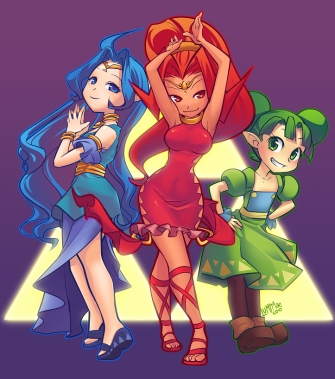
Why do so many character combinations come in groups of three?  Unlike love triangles, where the combo is primarily a way to build conflict, the characters in power trios all build on each other in some way.  They might be foils for each other, but as complementary archetypes, they do far more to drive the story together than they ever would apart.

One of the most interesting all-female power trios is the Three Faces of Eve, which combines the archetypes of child, seductress, and wife:

The “child” (who does not have to be a child literally) will be seen as innocent, perhaps to the point of naïveté. The wife, the wiser, calmer aspect, someone around whom one could build a home life. The third, the seductress, is sexually experienced and independent.

Roughly speaking, the characters in the trio correspond to:

  • The Ingenue: A naive, innocent, childlike girl who is just setting out into the world.  In a Freudian Trio, this would be the Ego.
  • The Femme Fatale: A seductive, alluring, mysterious woman who is experienced in the ways of the world.  Unlike the Vamp, she may or may not use her feminine wiles for evil.  In a Freudian Trio, this would be the Id.
  • The Yamato Nadeshiko: A calm, steady, faithful wife, who provides the kind of marital stability and maternal strength that is ideal for settling down and raising a family.  In a Freudian Trio, this would be the Superego.

You’d be surprised to see how often this trope shows up, even in works of science fiction.  In Star Wars, Leia was the child in A New Hope, the wife/mother in Empire Strikes Back, and (what else?) the seductress in Return of the Jedi.  Just about every Star Trek series featured some alignment of these archetypes.

Squaresoft played with this trope a lot in their Final Fantasy series, which may be illustrative to examine in greater depth.  I’ve only played through FF IV, VI, VII, and Chrono Trigger, but each  of these titles features some interesting variations (warning: spoilers!).

Final Fantasy IV: Porom (child), Rydia (seductress), Rosa (wife).

Porom is pretty solidly the child, though Rydia starts out as this and later grows up into the seductress role.  She doesn’t get the guy in the end, though: that would be Rosa, who pretty much starts out with him as well.

In terms of story, the characters don’t really seem to build much on each other, though in terms of gameplay you definitely want to have Rydia and Rosa/Porom in your party (though not Rosa and Porom together–you only need one white mage, after all).

Final Fantasy VI: Relm (child) , Celes (seductress), Terra (wife).

This is my personal favorite in the series.  Unlike IV and VII, which both center around male protagonists, Final Fantasy VI revolves around Terra (world of balance) and Celes (world of ruin) as the central protagonists.  Because they also play a role in the power trio, their characters are quite complex, especially in the second half of the game.  Relm is arguably more of a Mary Sue, but her relation to the other characters, especially Shadow, also makes her role more complex and interesting.

In the end, the romantic subplot is fulfilled by Celes, not Terra, which was something of a surprise to me in my first playthrough.  It works really well, though, because of Celes’s heel face turn and subsequent reformation (in which Locke is arguably a Manic Pixie Dream Girl Spear Counterpart).  Does that also translate into a shift from seductress to wife as well?  I’m not sure, but I’d probably say no–after all, it’s Terra who takes on the mother role in the world of ruin.

Final Fantasy VII: Yuffie (child), Aeris (seductress), Tifa (wife).

The main twist with this one is that visually, you’d think Tifa is the seductress and Aeris is the wife.  In terms of story archetypes, however, it’s just the opposite: Tifa is the one whom Cloud depends on, the one who helps him work through his problems, while Aeris is the shifty, mysterious one.

Unlike IV, where Rosa and Cecil are set up from the very beginning, for a while it actually looks like Aeris and Cloud are going to end up together.  But then, in perhaps the most tragically gut-wrenching moment in all of video game history, Aeris dies (and doesn’t come back).  Since Yuffie is kind of, well, crazy, Tifa and Cloud are pretty much garanteed to get together after that point (and as for Sephiroth…I don’t even want to go there).

Chrono Trigger: Marle (child), Ayla (seductress), Lucca (wife).

Chrono Trigger is interesting because the girl who ends up with the guy in the end (Chrono) is actually the one who fulfills the child archetype, Marle.  It works, though, because of the childlike feel of the story.  Unlike FF VI and IV, Chrono Trigger is not a dark or an edgy tale–it’s heartwarming innocence at its best.  I always did feel that Lucca got the short end of the stick, though–but she did get a cameo in Xenogears, so perhaps the last laugh was hers after all.

Ah, Xenogears. <sigh>

Anyhow, long story short, the Three Faces of Eve power trio is a fascinating way to play with feminine archetypes.  Recently, I’ve become quite interested in it because it showed up quite inadvertently in my current project, Heart of the Nebula.  It’s funny how tropes can sneak up on you like that, especially some of the more archetypal ones.

Anyhow, in its current form the novel is a piece of trash, but now that I’ve recognized the potential to set up this particular power trio, I think I can really make it shine.  If you have any insights, please share–I’m very interested in this trope right now!

Trope Tuesday: Celibate Hero vs. The Fettered

Yes, there are still good men out there...and they tend to know who's boss.

I’m mashing up two tropes this week because I’m not satisfied with the one.  There are a bazillion tropes about characters who are sexually active, but very few about sexually chaste characters that don’t portray them as weak, clueless, or socially inept.

According to tvtropes, a celibate hero is a main character who “doesn’t do the romance thing.” Unlike the chaste hero, who is just clueless, the celibate hero has made a conscious decision not to engage in sexual relations or get tied down in a relationship.  There may be any number of reasons for this, but it usually comes down to some combination of Love is a Weakness, Love Hurts, and It’s Not You, It’s My Enemies.

(As a hilarious example of this: TESLA!!!)

But what about the character who isn’t necessarily opposed to romance, but feels that they should wait until marriage to have sex?  Unfortunately, this trope is pretty rare nowadays.  I can only think of two mainstream examples: Edward from Twilight and Reverend Theo from Schlock Mercenary.

Theo in particular is a great example of this, because he’s not clueless, he’s not weak, and he not only gets the girl, he gets the girl that everyone wants.  The only reason he holds out is because his religious order forbids sex before marriage.  It does permit priests to marry, however, so Theo does manage to balance the two.

So why are characters like this so rare?  Unfortunately, I think it comes down to the widespread notion that a true man isn’t a virgin, and that sex makes people cool.  If we accept these tropes as true, then that means that men who exercise self-restraint are actually weak and pitiful, and couples who choose to wait are pathetic losers.

It’s worth pointing out that both Edward and Reverent Theo were created by writers who are practicing Mormons–people who belong to a religious community where it’s still the norm to wait until marriage.  If literature is the way that the culture speaks to itself, then this goes to show just how unrestrained the rest of Western society has become.

This is why I think that the better trope for this kind of character is The Fettered.  Unlike the celibate hero, who usually gives up sex for some kind of external reason, the fettered gives it up as a matter of principle.  Living by his ideals isn’t easy, and he’s constantly tempted to give in and break his moral code.  However, by resisting these temptations, the fettered gains great strength, and can stand like a beacon of light in an otherwise disillusioned world.

This is actually something that I tried to do with my latest novel, Desert Stars.  The main character, Jalil, is a man who believes in honor, and follows a code of abstinence before marriage.  However, to manipulate him into staying at the camp, his father charges Mira, the female protagonist, to seduce him.  Since the fettered’s strength is also his greatest weakness, if Mira can get Jalil to sully her honor, then out of shame he will return and marry her.

The catch?  She actually has feelings for him, and doesn’t want to manipulate him in this way.  In this way, merely persuading him to have sex isn’t a win condition–in fact, if done in the wrong way, it could be a very serious “game over.”

Whether or not I actually pulled it off well is up to the readers to judge.  But one thing I was definitely shooting for was to write a character who fulfills this trope in an unconventional yet powerful way.  And if you’ll permit me to step onto my soapbox for a little bit, I think our culture desperately needs more heroes like this–heroes who show that real men are capable of self-restraint, and that following a moral code is still cool, even if it means waiting to consummate a relationship.

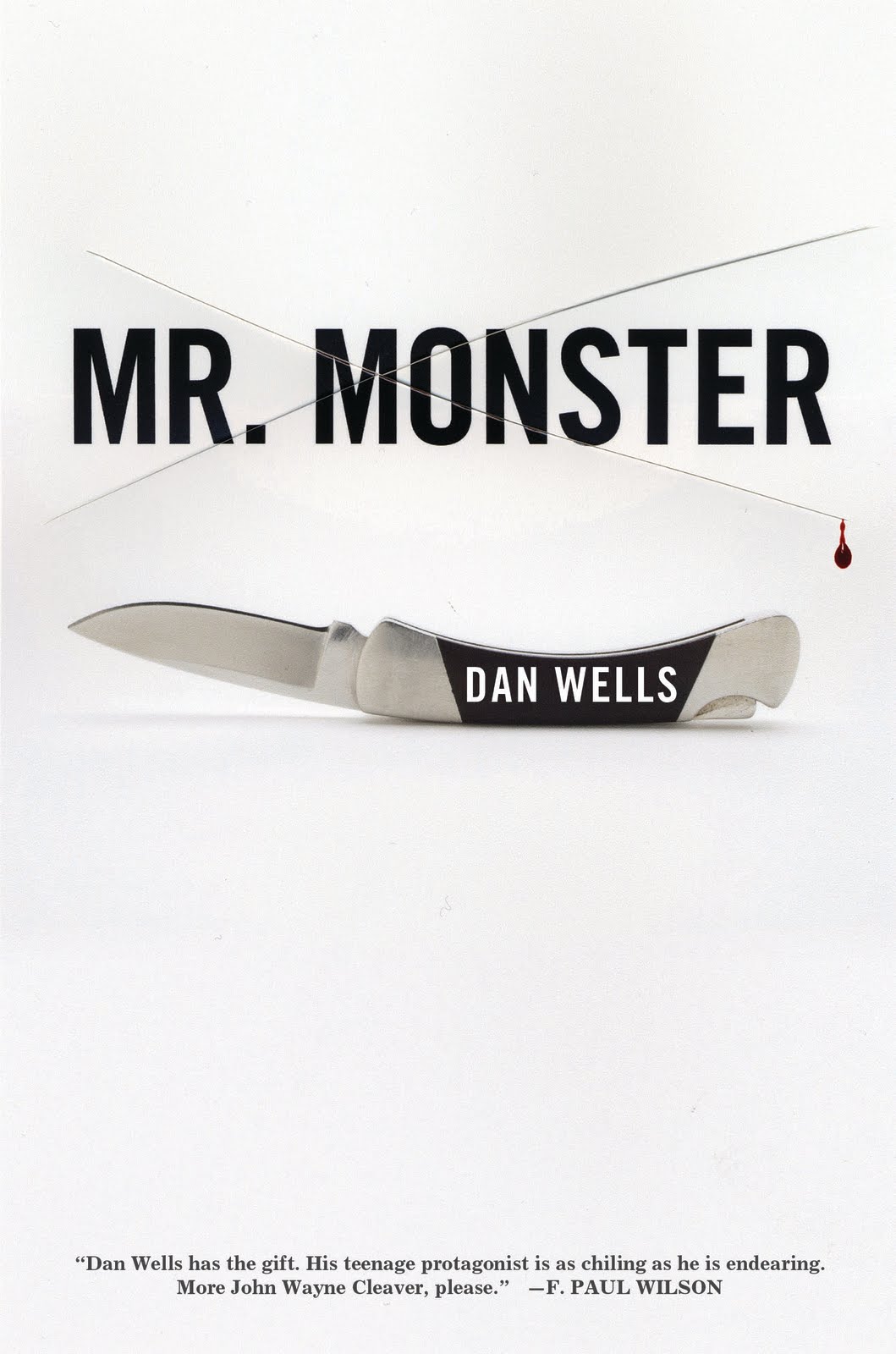
Mr. Monster by Dan Wells

John Wayne Cleaver wants very much not to kill you.  He wants it so much, in fact, that he’s made up a host of rules to keep his inner monster from taking over.  The way he complimented your shirt, for example–he said that to counteract the delicious thought of you tied to a wall, screaming in terror while he skins you alive.

It’s nothing personal.  He doesn’t hate you.  He just has a need–or rather, his inner monster has a need–to take your life.

You see, John Cleaver is a sociopath with all of the psychological tendencies of a serial killer.  Now that he’s killed once (albeit to save his community from an ancient demon), it’s getting very difficult for him to tell who he really is.  Is he his addiction?  Or is that a separate persona–one that he can control, suppress, and eventually overcome?

He’d better find out quick, because a new killer has arrived in town–a demon, just like the first–except this one is in touch with the Brotherhood.

This was a good book.  I enjoyed it as much as I enjoyed the first, perhaps a little more so.  The ending was awesome–excellent lead-in to the last book in the trilogy.  Too bad we have to wait a year to read it. <shakes fist at the universe>

Dan Wells is very good at writing strong, well-developed characters, especially with his main character, John Cleaver.  This might sound bad, but as a Mormon I can relate with John’s personal rules to keep his stray thoughts under control.  Not that I have a secret desire to murder people, but I’d be lying if I said that it’s easy to live a celibate, porn-free lifestyle as a twenty-something young man.  But I digress.

The best part of this book was the way the romantic tension compounded the basic conflict of John vs. his need to kill.  It’s not easy to date a girl when you have passionate dreams every other night of killing her.  That tends to make things a little awkward (just a little).  In spite of how sick that might sound, John and Brooke’s relationship is quite compelling, and I found myself instantly drawn to them because of it.  Again, it makes it easy to relate–not that I, uh–yeah.  Whatever.

Overall, the book is great.  However, I do have one criticism, which may be more personal, but I’m sure it applies to others as well.  When John confronted the killer, things got a little too disturbing for me–not the tense, wide-eyed, “oooh, what happens next?” kind of disturbing, but the “this is just wrong–why am I reading this?” kind of disturbing.  It didn’t make me put the book down, and the resolution was quite satisfying, but I did step back and ask that question at one point.

The ending, though, is pure awesome.  The last page–man, I’m looking forward to see what happens next!  And if there are only three books in this series, John Cleaver has to come to terms somehow with his inner monster–he can’t continue in this way all his life.  He just can’t. He’s got to find some kind of equilibrium.  And him and Brooke–well, let’s just say I’m very eager to see how the series wraps up.

Mr. Monster comes out in the US at the end of September (I borrowed the UK edition from my sister).  Like I said, it’s probably not for everyone, but if you can stomach a particularly gruesome episode of Law and Order: SVU, you shouldn’t have a problem with this book.  Or should you?  Guilt!  Guilt!

When taking a break is not enough

So these past few days, I’ve been taking an unofficial break from writing.  After I finished Mercenary Savior 3.0, I didn’t feel that the time was quite right to start my next project.  Plus, I figured that after working so hard, I kind of deserved a break.

It’s been kind of weird, though.  In some ways, it’s kind of relaxing not to be writing every day, but in other ways, it’s unsettling.  I don’t feel like I’m recharging the well–I just feel like I’m being lazy. Writing is hard work, but it’s satisfying work, and I miss that sense of satisfaction.

I hope to get it back soon, though.  I’ve got a rough outline and a ton of ideas for my next project, and I kind of know where I want to start.  The trouble is, I still feel that something is missing, and I’m not sure what it is.  Maybe the best way to overcome that is to blog about my ideas and see what happens.

So for this next project, I want to recycle the story and characters from Hero in Exile, which I left unfinished back in winter of 2009 (right around the time when I finished Genesis Earth).  It takes place on Gaia Nova, a planet that is half desert/wilderness, half densely settled urban arcologies.  The main character is a boy named Jalil who became separated from his parents when their ship was destroyed in orbit; they threw him into an escape pod with his mother’s ID pendant, and he crashed into the desert.  A local tribe of Bedouin-type nomads took him in and raised him, but he’s always wanted to get back to his biological family and find out who he really is.

Things get complicated, though, because the sheikh of the tribe has no sons, and therefore wants to marry Jalil off to one of his daughters in order to keep the tribal holdings in the family.  He’s so desperate that he orders one of his daughters, Mira, to seduce Jalil by any means necessary.  Since chastity and virginity are highly valued within the tribal society, Mira feels very uncomfortable about doing this.  She has feelings for Jalil and would like to marry him, but not in that way.  At the same time, however, she doesn’t want to disobey her father.

The story starts right around the time when Jalil sets out in quest to find his biological family and learn of his true origins.  He decides that the best way to do this is to go on a pilgrimage to the Temple of a Thousand Suns, deep in the urban arcology side of the planet.  The sheikh of the tribe sends Mira with him, under the pretense that she’s making the pilgrimage.  The real reason she’s going, however, is to catch him in a moment of weakness and seduce him, thus forcing him through the stain on her honor to marry her and return to the tribe.

Jalil, however, is completely oblivious of all this.  He is totally naive to the ways of the world, and believes very strongly in honor, virtue, and other high moral ideals.  As he and Mira leave the desert and descend into the morally corrupt world of the arcologies, however, Jalil finds himself becoming more and more disillusioned.  He and Mira become closer and closer physically, yet further apart in the ways that really matter because of the poison of deception and manipulation that has come into their relationship.  Eventually, they both find themselves forced to make some defining decisions, just as everything they’ve known and believed is shattered and destroyed.

That’s the general idea, at least.  I suppose you could call it a romance where the main obstacle to them getting together is the intense pressure on them to have sex. It’s probably been done before, but hopefully my sci fi take on the idea will make things interesting.

I still feel like I have a lot of prewriting work to do, though.  I want to make Mira and Jalil both viewpoint characters, and to do that I need to have their backstories and motivations worked out very well.  With Jalil, I think I’m ready to start, but I’m not so sure about Mira.

Anyways, that’s where things stand.  Do you like the idea?  Don’t like it?  See something interesting that I haven’t seen?  Let me know–please let me know.

Oh, and I need a new title.  Hero in Exile is way too cheesy.