Sholpan, or The Great Novella Experiment

So now that I’m finished with Desert Stars, the next project I’m working on is a companion novella to Bringing Stella Home titled Sholpan.  While Bringing Stella Home is about James and his quest to rescue his brother and sister, Sholpan is entirely from Stella’s point of view and traces her rise in Hameji society, from prisoner and slave to…well, I won’t ruin it for you.

I started writing it on Monday, and so far it’s been a lot of fun.  In some ways, it’s kind of a break for me, since I already know the story (most of the material is lifted straight from Bringing Stella Home, with a few extra changes to make the viewpoint tighter and build more character development).

At the same time, though, it’s a challenge because I’ve never written in the novella format before.  The definition as given by SFWA, has mostly to do with length:

For the purposes of the Nebula Awards, the categories are defined as follows:

  • Novel — 40,000 words or more
  • Novella — 17,500–39,999 words
  • Novelette — 7,500–17,499 words
  • Short Story — 7,499 words or fewer

However, I can’t help but feel that there are many other artistic elements to consider.  For example, the Oxford Dictionary of Literary Terms gives this definition:

novella [nŏ‐vel‐ă], a fictional tale in prose, intermediate in length and complexity between a short story and a novel, and usually concentrating on a single event or chain of events, with a surprising turning point.

Other sites I’ve browsed (including this post from The Galaxy Express, this review from 2009 of several small press novellas, and another interesting post on short stories vs. novellas vs. novels) leave me with the impression that novellas typically

  • can be read in one long sitting, such as a train ride,
  • center around one major conflict, idea, or issue,
  • have more room for rich settings and lavish descriptions,
  • tend to focus more intimately on character,
  • are compact enough to take risks with voice and theme, and
  • can end without a definitive conclusion to the central idea or conflict.

I must confess, I’m not an avid reader of novellas.  I’ve read some of the classics, of course: Dr. Jekyll & Mr. HydeThe Time Machine, Animal Farm, etc, but in terms of modern sf novellas, all I’ve really read is I Am Legend (and a few golden/silver age “novels,” if you count them).  Point is, I’m not an expert on novellas by any means.

However, the novella seems like a very promising format for epublishing, especially in conjunction with a novel.  Readers can pick up the novella for $.99 and get both a sample of the writer’s longer novel-length stuff, as well as a complete story in itself.

That’s what I want to do with Sholpan.  I want to write a less-expensive derivative work that’s artistically sound in its own right, while also driving interest in the full length novel.  Besides, it’s just fun to experiment with new styles and formats.

If this is successful, I can see myself writing a companion novella to most, if not all of my novels.  And who knows?  Maybe I’ll be able to sell some of those to more traditional print and electronic markets.  It’s worth a shot, and no matter what happens, I’m bound to learn something new.

So yeah, that’s my current writing project.  If all goes well, expect to see it out sometime this fall.  And if you have any comments or suggestions regarding novellas, please share!  I’m very interested to learn anything I can.
Thoughts on outlining

I’m on track to finish my fifth novel in a couple days, and surprisingly, the writing has been going very smoothly.

Usually by this point, my eyes are bleeding and I feel as if I have a hundred caltrops in my pants.  Finishing a rough draft is still the hardest part for me, since by the end everything seems to suck and I just want to trash the whole project.

I still feel a little bit of that with Into the Nebulous Deep, but not nearly as much as with my previous stuff.  Part of that is probably because I feel confident that I can fix whatever I screw up, but the other part probably has to do with the way I’ve learned to outline.  In one short sentence, here’s what I’ve learned:

An outline is simply the story you tell yourself to help you tell the story.

I don’t think there’s any mortal writer on this planet who can keep a whole novel in their head at one time.  Scenes, yes; chapters, maybe; novels, absolutely not.

However, since everyone’s creative mind works a little differently, everyone has to find the process that works for them.  Brandon Sanderson, for example, writes story bibles that are almost 100k words long.  If I were to try to do that, I’d get bored halfway through and spend the rest of the day dorking around on youtube.  Other people prefer to fly by the seat of their pants, and while there’s something to say about trusting your subconscious, I need a little structure to keep from getting totally lost.

It took me a while to figure out the process that best works for me, but based on how ITND has been going, I think I’ve hit my stride.  Breaking it down into plot, setting, and character, here’s how I basically do it:

Plot

For me, the basic plot of the story comes in a flash of creative insight once all the ideas in my head have reached a critical mass.  It’s like watching a fissure shoot across a smashed window pane, or lightning arcing from the ground to the sky.

If I don’t have time to start the project right away, I’ll let the plot mull around in my head for a couple days, then open up notepad and free write the basic structure of the story in an unedited stream of consciousness.  When I do start the project, I’ll look back to the free write to refresh my memory, but otherwise work out of what’s in my head (which may have changed).

While the project is ongoing, I’ll divide the whole novel into parts, chapters, and scenes.  For the chapter I’m currently working on, I’ll have the various scenes listed in bold with their corresponding point of view character (eg: “1.1: James“), followed by a brief one or two line description of the action and plot significance.  If I introduce a new character in that scene, I’ll write their name in ALL CAPS (I believe that’s a screenwriting convention I picked up from my old college roommate).

For chapters I haven’t written yet, I just write a few lines of description for what I envision happening in them.  When I first start out, I usually have a clear idea where I want the story to end, but I don’t bother outlining all the stuff in the middle since that usually changes based on stuff that comes before.  I only keep my outline a few chapters ahead of where I currently am, and may change things completely if something new comes up.

This process works very well for me.  I use it for every draft, and refer to it often.

Character

I’ve found that I need to do a lot more outlining to figure out my characters than I do with my plot.  However, it’s like Tracy Hickman said with the marbles: don’t hold onto your outline too tight, or all the marbles will slip out between your fingers.

The things I absolutely need to know about my characters are:

  • back story
  • motivations
  • first impressions
  • flaws & handicaps
  • strengths & advantages
  • why the reader should care about / sympathize with them

For some odd reason, I find it most helpful to write this out longhand, usually while taking a walk.  For additional help, sometimes I’ll take a personality test on behalf of my character and get a handle on them through their personality type; for that, I prefer the Meyers-Briggs typology.

But once I feel I have a solid handle on a character, I’ll throw everything out if it feels instinctively right for a character to do something completely different.  Thing is, I need the outline (especially the motivations and back story) to get to the point where I know the character well enough to let them take over.

And for some reason, all my main characters feel too…generic.  I’m not sure why, but that’s something I’ve got to work on.

Setting

Setting, for me, is all about discovery writing.  I’ve tried using wikidpad to worldbuild my universe before I start, but that’s never worked.  Instead, I daydream a lot and trust my subconscious to give me what I need when I need it.

That’s not to say I don’t do research–just that most of my research is on the fly.  If I only stay on wikipedia and the footnotes and references, no problem; if I get sidetracked on facebook, however…

Often, when I’m doing setting descriptions, I’ll run a quick google image search to pull up pictures to give me a better visual idea of what I’m describing.  I especially use this for clothing; that’s why, if you check my search history (please don’t), you’ll find all these weird, girly terms like “ottoman dress,” “jumpsuit,” “leather jerkin,” and “full frontal snogging” (whoops, where did THAT come from??).

The big problem is when I figure something at the beginning of the book and then forget about it halfway through.  For that reason, I should probably invest in a good copy editor when I start to publish.  I should also take the time to draw out a starmap, since it’s getting REALLY hard for me to remember where the Belarian system is in relation to Tajjur and Karduna Prime…hmm…

I should probably figure out a better system to keep track of my settings, but as far as outlining them goes, the less the better.  I love waving my hand and creating stuff–it’s one of the main reasons why I’m a science fiction writer.

So anyways, that’s more or less the outlining system I currently use.  I might end up outgrowing certain aspects of it, or finding a better system, but this is what works best for me now.

Of course, I still have a lot to learn.

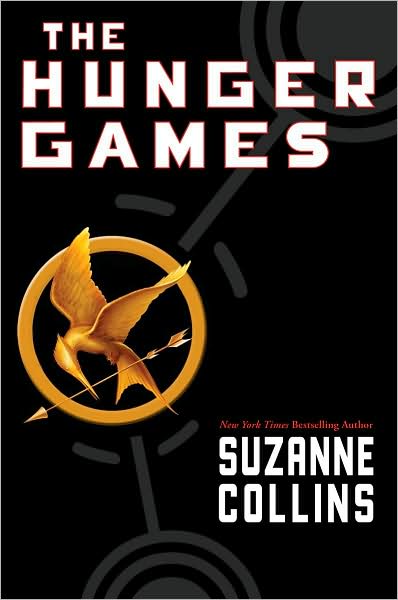
The Hunger Games by Suzanne Collins

This book review is going to be a bit unconventional, so please bear with me.

Normally, I only review books on my blog if I feel I can recommend them.  They might not be perfect, but overall, the praise outweighs the criticism. However, for me personally, The Hunger Games was a huge disappointment.

I’m not going to do a little book blurb like I usually do, because I want to spend all the available space on this post explaining the reasons why I was so disappointed.  Also because of that, this post will be full of spoilers.  Consider yourself warned.

First, let me say that I don’t think this book was all bad.  Suzanne Collins is very good at plot and pacing, and she knows how to keep a reader hooked.  In that way, this book reminded me of the old Michael Crichton thrillers that I devoured as a kid.

However, two crucial things killed about half of the suspense for me: the fact that this book was the first in a series, and the first person viewpoint.

From the very beginning, we know that Katniss isn’t going to die.  We know it, because she’s narrating the story to us directly (in present tense, which personally irks me, but I won’t go into that).  Unlike other gladiator-style heroic fantasies, where the major draw is to see who lives and who dies, we have that spoiled for us.

Of course, the argument in favor of the first person is that it helps the reader feel a closer connection with the viewpoint character.  The problem is, I never did.  At the end of the book, Katniss still feels like an outsider to me; I never felt like I got inside her head well enough to know who she really is.  When I try to imagine her, all I can envision is a wide-eyed mannekin.  She just didn’t come alive to me.

Why? Because the whole time, she’s only got one thing on her mind: survival.  I don’t see anything but fragmentary glimpses of her other motivations, and those are never fully fleshed out.  Her experiences growing up were just so traumatic that I can’t relate to her, and Suzanne Collins never provides a reference point outside of the awfulness of Katniss’s crapsack world.

Which is another thing that got to me: the setting.  Every time I opened the book, I dreaded going back to Collins’ world–and not in a good, “ooh, this world is so creepy/frightening” way, but in a “man, this place just makes me depressed” kind of way.  It wasn’t even that original–Panem is basically the USA as North Korea (though it could take place anywhere, for all the details Collins gives us).

What’s more, the setting is full of inconsistencies.  The people are starving to death, but the forests are full of game and wildlife.  In North Korea, people raze the forests for fuel and timber, driving all the game out.  Yes, I know the people of District 12 mine coal, but all of it presumably goes to Capitol, just like in District 11 all the grain goes to Capitol and the people still starve. Which makes me wonder: why are all the districts specializing in only one commodity?  That’s just stupid.

Which brings me to another thing: the sheer idiocy of the rulers of Panem.  If the Hunger Games are supposed to remind the people of how subjugated they are, why allow the tributes the opportunity to do something like pull a romance stunt?  Why spend all that time primping and preening them, interviewing them, and giving them an opportunity to manipulate the crowds?  When the people of District 11 sent Katniss the bread, why didn’t a government censor stop that from happening?  And finally, when Katniss and Peeta were the only ones left standing, why give them the opportunity to upstage the games by falling on each others’ swords?

Seriously, that last point got to me more than any of the others.  When they announced the rules change, that Peeta and Katniss were supposed to kill each other after all, why couldn’t the GM see the potential for things to go wrong?  Seriously, having them both kill each other–or refuse to kill each other–was such a blatantly obvious choice, I saw it the moment the rule change came into play.  The fact that the villains didn’t just threw me out of the story.

But that wasn’t the first thing that threw me out of the story.  The first thing was the parade, with Katniss and Peeta marching into the arena with their flaming cloaks.  All this time, Katniss has been set up as the underdog–she isn’t pretty, she isn’t strong, she’s mildly sympathetic for volunteering in place of her sister, but the audience in that arena is looking for blood, not sympathy.  So when the crowd goes wild for her and Peeta, I just didn’t buy it.

It only got worse as things went along.  When the tributes did the skill check, Katniss–who, from the beginning of the story, has been set up as the underdog–scores higher than anyone else.  Every time she’s in front of an audience, everyone is oohing and ahhing.  It made me want to gag.

Honestly, you know what it seemed like?  It seemed like Suzanne Collins fell in love with Katniss so much that she wanted to spoil her, even though the story required her to keep up the pressure.  She made sure to torture Katniss in the games–so much so that it felt downright melodramatic at times–but while they were still in Capitol, waiting for the games to start, Katniss felt like a spoiled Mary Sue.

And as for the romance, it fell completely flat from the beginning.  Katniss was nothing but a manipulative faker from the beginning–granted, because she needed to in order to stay alive, but the least she could have done was coordinate that with Peeta.

And that’s another reason why I had such little sympathy for her–she’s a callous, manipulative, lying little heartbreaker, like far too many women in this world.

So yeah, The Hunger Games was, in my opinion, a huge disappointment.  I can partially see why it did so well (strong female protagonist, excellent plot structure and pacing, lots of hooks and cliffhangers), but personally, I don’t think it deserves half the praise it’s gotten.  And after what friends have told me about the rest of the series, I can guarantee that I won’t be reading them.

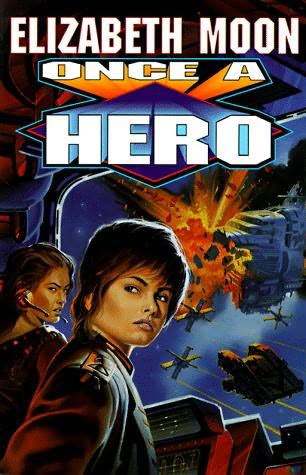
Once a Hero by Elizabeth Moon

Esmay Suiza never asked to be a hero.  All she wanted was to leave her dysfunctional home and join the navy.  But after surviving a mutiny and leading her spaceship to a most unlikely victory, everyone seems to be showering her with unwanted attention–or worse, examining her files for signs of command potential.

No, all she wants is to disappear–and now that her family has offered her a generous inheritance on her home world of Altiplano, she finds herself tempted to leave the stars behind and settle down for a while.

Little does she know, her family has hidden secrets from her–secrets from her past, which have the power to undo and destroy her.  Unfortunately, being a hero has a price–and the trauma of combat has already unearthed things from her subconscious than she cannot keep buried any longer.

This was my first time reading Elizabeth Moon, and I enjoyed it quite a bit.  Moon is extremely good at portraying a complex, believable military culture; she was a Lieutenant in the Marines, and definitely knows how to do military SF right.

My favorite part of the book was the descriptions of Altiplano, and Esmay’s experience returning to her homeworld of Altiplano.  Elizabeth Moon does an excellent job of creating a captivating world and transporting the reader there.  I fell in love with Altiplano almost instantly–not only with the planet itself, but the culture and the people, the whole society.  Excellent job.

Elizabeth Moon also does an excellent job developing her characters and giving them believable internal conflicts.  The way she portrays Esmay’s PTSD is quite striking, and very interesting.  Her struggles feel very real, and important too.  I think this novel helped me to better understand those who suffer from similar traumatic experiences, and that was very meaningful.

Storywise, however, I had a few minor issues, most of them having to do with the plot.  Things dragged a bit in the middle; when Esmay left her homeworld, I lost a sense of progression and felt that she was just wandering around.

When the antagonists came in–basically, a hostile army trying to capture her ship–I felt that Esmay solved her problems too easily, without any real try-fail cycles.  It gave me the sense that Esmay was some kind of superhero girl–not quite a Mary Sue, but toeing the line.

And Esmay’s love interest…I didn’t really get into him at all.  He seemed like a stereotypical damsel in distress, except with the sexes reversed.  I heard once that in good romance stories, the girl readers want to be the female protagonist, and the guy readers want to be the male protagonist.  Yeah…call me a chauvinist, but I never really wanted to be that guy.

I hate to be too critical, though, because Elizabeth Moon’s writing is quite good.  She has an excellent grasp of character, and her ability to transport her readers to another time and place more than makes up for her shortcomings with plot and story structure.  Also, I get the sense that this isn’t her best work.

In any case, if you’re a fan of military SF, you’ll probably enjoy this book.  I enjoyed it, and I will certainly be reading more Elizabeth Moon in the future.

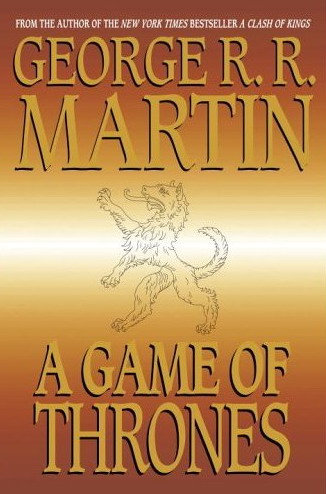
A Game of Thrones by George R. R. Martin

Almost twenty years have passed since the fall of the Targaryen dynasty–twenty years since the last of the dragons was seen in the Land of the Seven Kingdoms.  Now, the libertine Robert Baratheon sits on the Iron Throne, blind to the conspiracies and secret combinations that surround him.

In this dangerous time, Ser Jon Arryn, the King’s Hand, dies of mysterious causes.  Most of the realm accepts the official story that the death was natural, but when Arryn’s wife Lysa sends a letter to her sister, Catelyn and her husband Ser Eddard Stark immediately suspect that the death was orchestrated by the Lannisters.  Only one thing remains: to travel to King’s Landing and uncover the proof.  Soon, King Robert calls on Ser Eddard to become his new Hand, giving them the perfect opportunity to do this.

Little does Ser Eddard know, the intrigue goes much deeper than any of them realize.  For the Lannisters are gathering an army, and Queen Cersei and her brother, Ser Jaime, harbor a secret that would tear the realm apart.  Meanwhile, the last of the Targaryens bears a child prophesied to rule the world, while far to the North, an ancient evil bides its time, waiting to sweep the seven kingdoms with horror the likes of which has not been seen in a thousand years.

Winter is coming–and the people of the Seven Kingdoms are ill prepared to face it.

Everyone seems to be talking about George R. R. Martin’s Song of Ice and Fire series these days–next to The Wheel of Time, it’s probably the biggest epic fantasy line of the last ten or fifteen years.  Martin is well known for killing off his characters and writing in shades of gray, so I thought it would be good to give this series a try.

As soon as I picked up the book, I was hooked.  Martin knows how to craft a beautiful, engrossing fantasy world.  In order to leave no doubt on that point, observe:

Yeah, that pretty much sums up what Martin did with his Land of the Seven Kingdoms. It’s an awesome fantasy world, and I found myself lost in it from the first page.

I must admit, however, after hearing so much about the Song of Ice and Fire series, I was surprised at how few characters died in this book. That’s not to say everyone survived–in fact, Martin killed my favorite character, which made me feel HORRIBLE–but I was expecting there to be more. However, this is the first book in the series, so I assume that the really crazy stuff happens later.

While overall I loved A Game of Thrones, I admit I did have a few misgivings about the book. Martin really does write in shades of gray, and while that makes the story unpredictable and surprising, it also makes things very dark and austere. Martin seems to have no interest in redeeming his characters, and when any of them try to be noble, he cuts them down at every turn.

Personally, I don’t care for that. Flawed characters may be more relateable, but seriously flawed characters (or characters with no interest in overcoming their flaws) turn me off. In this way, Martin is practically the antithesis of David Gemmell; whereas Gemmell makes you love his characters despite their flaws, Martin keeps you reading in spite of the fact that you hate all his characters.

How does he do it? By creating a beautiful, wondrous world. By crafting a masterful story full of intricate twists and turns. By making you hate some of the characters so #%$^! much that you have to stick around and see how they die. It’s all entertaining and extremely engrossing, but at the end of it all, I didn’t come away with any real love for Martin’s characters–except perhaps for a couple of Eddard’s kids, who are still young enough to be somewhat innocent.

I suppose it’s all a part of this new non-conciliatory movement in fantasy. Don’t get me wrong; A Game of Thrones is an EXCELLENT book, but it’s very…non-conciliatory. If that’s your thing, more power to you, but I personally prefer stories about redemption, where romance still lives and even the most unlikely character can be a True Hero, if only for a few fleeting, glorious moments.

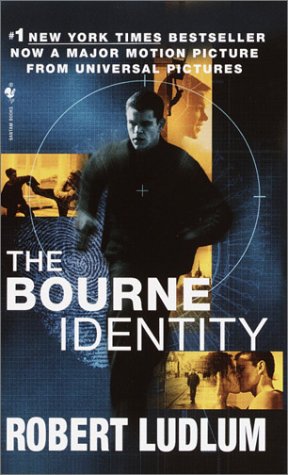
The Bourne Identity by Robert Ludlum

On a stormy night off the coast of Marseilles, a local fishing trawler recovers a man with a gunshot wound to the head.  The local doctor patches him up, but when he recovers, he has no knowledge of his past life.  Even his name is a mystery.

Fortunately, he has a clue to help him get started: a microfilm surgically implanted in his hip containing an account number for a bank in Switzerland.

When he arrives in Switzerland, he finds that the account contains millions of dollars, as well as a name: Treadstone 71.  Before leaving the bank, however, a squad of hitmen attack and nearly kill him, for no reason that he can possibly understand.

On the run from people he doesn’t know for things he doesn’t remember, Jason Bourne finds himself in a struggle, not only for his life, but to find his true identity.  But the answers, he fears, are much, much darker than he can possibly accept.

Okay, to start things off, let me say that this book is NOTHING like the movie.  NOT AT ALL.  The two are completely separate stories.  The beginnings of both are similar, with the whole amnesia thing and the bank account number implanted in his hip, but after Jason leaves Marseilles, everything gets different.  EVERYTHING.

For that reason, it’s difficult to say which is better, because they both try to do very different things.  The movie is more about the action and suspense; the book is more about the intrigue and character development.  Both succeed quite well at what they respectively set out to do.

That said, I enjoyed the book at least as much, if not more than the move.  Ludlum’s writing is quite good, and he paints an excellent picture of both the exotic European setting and the complex psychological portrait of his main character.  Unlike Crichton, whose characters often fall flat, Ludlum does an excellent job creating characters who stand up on their own right.

The suspense lagged somewhat in the middle for me, when the details about Cain and Medusa came to light (that’s one thing I’ve got to say about Crichton–he’s a master of suspense), but it wasn’t enough to keep me from finishing.  The ending, however, was atrocious–not in a clumsy way, but in a too-many-loose-ends kind of way that meant that the story wouldn’t truly be resolved until the sequel.  I hate stories that do that, but oh well, what can you do?

Overall, though, the book was quite good–better than I expected.  I can see why Ludlum was such a successful writer: he created interesting, capable characters and put them in exotic, foreign settings to fight ruthless, evil villains in a desperate zero-sum struggle for survival.

Interesting characters + exotic setting + high stakes conflict + good writing = win.  Oh, and Bourne is way more awesome than Bond. Just sayin’.

Red Mars by Kim Stanley Robinson

For eons, sandstorms have swept the barren, desolate landscape of the red planet.  For centuries, Mars has beckoned to mankind to come and conquer its hostile climate.  Now, in the year 2026, a group of one hundred colonists is about to fulfill that destiny.

I first picked up this book two and a half years ago, when I was still trying to read a novel a week.  I’ve got to be honest; this was the book that made me break that new years resolution.  It is freaking huge, and some points are more interesting than others.

That said, this is an awesome piece of hard science fiction.  Lots of people have written about Mars, but very few have done it believably.  Kim Stanley Robinson does an job here–you can tell that he put in a ton of research, both into Martian geography (areology?) and feasible technology.

When I read science fiction, however, that’s not what I generally read for.  I’m more interested in characters, conflict, and thematic elements–in other words, the stuff that makes for a good story.  As far as that stuff goes, my opinion of Red Mars is somewhat mixed.

For example, the first chapter starts out with a murder, as seen from the point of view of the murderer.  Right away, I’ve got a reason not to sympathize with the main viewpoint character.  When we get into his mind and I see his motivations for killing the character, I like him even less–and he’s one of the main, driving characters.

Some of the characters are more sympathetic, and I enjoyed the sections in their point of view.  Others, however, were just plain boring–I neither loved them nor despised them.  Because of this, a lot of the character drama early in the novel didn’t engage me much; stuff was happening, but I didn’t really care.

When it comes to setting, Red Mars is also somewhat mixed.  Robinson goes to great depths to describe the Martian landscape, and several of his setting descriptions were quite interesting and wonderful.  At the same time, he explains everything in a very clinical, scientific way–his imagery is never as poetic and captivating as Ray Bradbury’s, or Ursula K. Le Guin’s, or George R. R. Martin’s.  I came away with a lot more knowledge about Mars, but not quite as much of a sense of wonder.

Things did get interesting once the political tensions started to come into play.  Robinson’s portrayal of the colonization of Mars raises a lot of interesting questions about the political relationship between Earth and Mars once those colonies start to become self-sufficient.  He follows things through right to the war for independence, and the implications of the conflict are quite interesting.  I finished the last hundred pages or so at a sprint.

All in all, I wouldn’t recommend this book unless you’re already a fan of hard science fiction.  Like most hard sf, character and conflict plays second string to scientific plausibility.  Within its sub-genre, however, Red Mars is awesome.  Let’s just put it this way: even though I got bored with it the first time, I knew I would one day pick it up and finish it.  I don’t regret that I did.

Dying of the Light by George R. R. Martin

Worlorn is a planet without a sun, wandering on the fringes of the galaxy where the skies are starless.  Though it came to life briefly as it passed the red giant Fat Satan, those days are over, and the world is slowly dying.
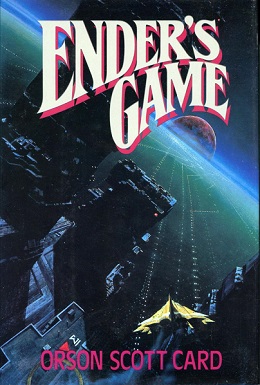
Dirk T’Larien never thought he would find himself on such a forsaken world. But when his onetime lover, Gwen Delvano, sends him a plea for help, he realizes that more than anything, he wants to have her back.

It will not be easy, however.  Gwen is betheyn to two men: Jaantony Vikary, whom she loves, and Garse Janacek, whom she hates.  Both are from Kavalar, a warlike planet where offworlders are considered subhuman.  And even though Worlorn is slowly dying, a colony of extremist Kavalars has taken root, planning to bring back the old ways when offworlders were hunted like beasts.

I picked up this book at Pioneer Books a couple weeks ago; I saw that it was by George R. R. Martin and decided to give it a try.  I was very much impressed.  For the last hundred pages, I couldn’t put it down, and the story haunted me for a couple days after I’d finished it.

The strongest element of the story was definitely the setting.  The story may be set in a grand galactic empire with spaceships and alien worlds, but make no mistake, this beautiful piece of space opera reads more like fantasy than science fiction.  There’s even a thirty page glossary of terms in the back, for ease of reference.

The effect of Martin’s grandiose worldbuilding is a haunting sense of wonder that keeps you, as the reader, hooked.  The more you read, the more you immerse yourself in the world; and the more you immerse yourself, the more you want to read.  After the story ends, you still find yourself thinking about the fantastic worlds, as if you’ve actually been there.  It’s awesome.

Another thing that kept me hooked was the basic premise of the plot.  The main character, Dirk T’Larien, is trying to win back the affection of an ex-girlfriend and get back together.  That’s something with which I can definitely relate–the ex even has the same name (roughly) as a girl I once chased after (quite unrequitedly, may I add).  Because of this, I was drawn into the story right away.

Martin is known for his plot twists, however, and though the story began as a basic love triangle, it very quickly became… something else.  I’m not entirely sure how to describe it without giving major spoilers, but I will say that I found it impossible to predict how this story would end.  I found that a lot more annoying than enjoyable, however–just when I thought things were headed in a certain direction, something happened to nullify everyone’s efforts and turn things completely around.

Despite this, however, the story…worked.  I don’t know quite how to describe it.  The basic markers were all there, even though they were jumbled in unpredictable patterns.  No death was meaningless, no success was insignificant; there was no excess baggage in the story that didn’t somehow belong.

All around, it was a very good book.  Kind of dark, but not nearly as edgy as I was expecting.  This is definitely the kind of science fiction that a fantasy reader would go for–and probably most science fiction readers as well.

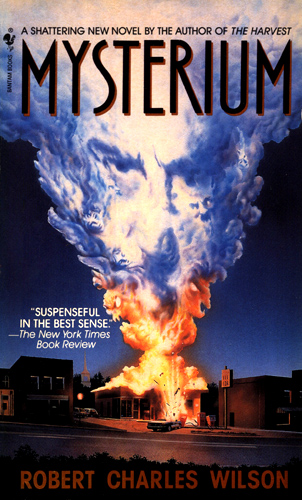
Ender’s Game by Orson Scott Card

“I’ve watched through his eyes, I’ve listened through his ears, and I tell you he’s the one.  Or at least as close as we’re goign to get.
“That’s what you said about the brother.”

“The brother tested out impossible.  For other reasons.  Nothing to do with his ability.”

“Same with the sister.  And there are doubts about him.  He’s too malleable.  Too willing to submerge himself in someone else’s will.”

“Not if the other person is his enemy.”

“So what do we do?  Surround him with enemies all the time?”

“If we have to.”

“I thought you said you liked this kid.”

“If the buggers get him, they’ll make me look like his favorite uncle.”

“All right.  We’re saving the world, after all.  Take him.”

Thus begins one of the greatest SF classics of all time, Ender’s Game. With such a spectacular beginning, it only keeps getting better.

I decided to reread Ender’s Game because a friend of mine in Washington was reading it.  I read this book back in high school in only two sittings–the first twenty pages in the library, and the rest back home, where I finished it wide-eyed at three in the morning.  I didn’t regret a single moment of it, then or now.

One of the most fascinating things to me about this book is the way that Orson Scott Card breaks almost all of the rules of writing.  On every page, he “tells” much more than he “shows”–some of the battles he glosses over in only a couple of paragraphs.  He gives only minimal setting details, and very few of these are visceral or concrete–it’s very hard to “get into” the world of Ender’s Game the way you would with a fantasy novel.  Most of the characterization consists of “navel gazing”–Ender thinking to himself about how bad things are, rather than taking action.

Breaking these rules, however, is exactly the thing that makes this a good book.  The story isn’t in the setting, or in the nitty gritty of the battles–it’s in Ender’s mind, how he reacts to the forces around him, and how those forces change him. “Telling” rather than “showing” allows him to keep the pace at a breakneck, thrilling speed while cutting out unnecessary details, and the “navel gazing” allows us to get an intimate picture of Ender’s mind.

It goes to show that good writing isn’t just about knowing the rules, but knowing how to break them.  And when it comes to plot, character, pacing, foreshadowing, thematic elements, and the hero cycle, Orson Scott Card proves his masterful brilliance in this work beyond a doubt.

One of the most fascinating things about this book is that it hits all eight points of the Campbellian monomyth.  This excellent article (originally published in Leading Edge) explains how.  The most incredible thing to me is that the year after Ender’s Game came out, Orson Scott Card did it all again–wrote a blockbuster book hitting all eight points of the monomyth–with Speaker for the Dead, which I think is a superior book.

Ender’s Game is a true classic of the science fiction genre.  Not only is it a highly entertaining story, it is deeply meaningful and insightful as well.  It’s one of those books you can reread multiple times, and it only keeps getting better.  Whether or not you’re a fan of science fiction, this is a book you will deeply benefit from reading.

Mysterium by Robert Charles Wilson

Nobody knows why the government chose the small town of Two Rivers, Michigan, as the site for a top secret military project.  Even most of the people involved in the project don’t know what it’s really about.  That’s alright, because most of the denizens of this backwoods community are used to minding their own business.  But after a mysterious explosion bathes the entire city in light, that becomes impossible.

On the outskirts of town, all the roads and power lines dead end in ancient virgin forest.  It’s as if a perfect circle has been drawn around the town on the map, and everything within the circle has been transported to a parallel world.

A very unfriendly parallel world.

Robert Charles Wilson’s writing is awesome.  I could eat up his prose all day.  It not only flows beautifully, it’s clear and transparent, to the point where I forget that I’m reading and feel as if I’m there.  He always uses the right expression, the right metaphor, and yet his prose never attracts so much attention to itself that it distracts from the story.

I noticed several similarities between Mysterium and Wilson’s other novels that I’ve read.  All of them start in our modern world and move into a mysterious, unfamiliar milieu.  All of them involve strange religions and religious conflicts.  All of them involve male and female characters struggling to face personal relationship problems and eventually coming together.  In these ways, this story felt very much like Spin.

At the same time, I can definitely tell that this is one of Wilson’s earlier works.  The story flows like a thriller, but lags in certain points.  After the town is transported into the parallel dimension, the story seems to meander without any clear direction.  For several chapters, I lost the sense of progress that usually accompanies a good plot.  The resolution receives very little foreshadowing–the “surprising yet inevitable” element was only “inevitable” three or four chapters from the end.  If it weren’t for Wilson’s beautiful writing, I would have put this book down in the middle.

<spoiler alert>

Unlike Spin, I found the milieu of this story somewhat depressing–not necessarily because of the setting itself (though it’s not the kind of alternate present that I’d want to live in), but because the people of Two Rivers never go back.

According to Card, there are two basic types of milieu stories: stories where the protagonist returns profoundly changed, or stories where the protagonist “goes native” and becomes assimilated.  But…if the new world isn’t the kind of place you’d want to live in–in other words, if it’s dystopian (and Wilson’s alternate world in Mysterium is fairly dystopian)–then there’s this tension of “will the protagonist make it back?  Will they return?” And if they don’t return, the story is emotionally disappointing.  That was the case for me with Mysterium.

</spoiler alert>

From this review, it probably sounds like I hated this book.  That wasn’t the case–not at all!  This was a good story, and I enjoyed it.  I finished the last hundred pages at a sprint at 1:30 in the morning–it was definitely that kind of a book.  I couldn’t put it down.  And at the same time, it was thoughtful and profound (as you can tell from my previous post, “Why I love Robert Charles Wilson“).

I’ve probably said enough.  If you like thrilling, parallel world adventure stories with a contemplative, thoughtful “what if?” element, read this book.  Even with all the misgivings I’ve mentioned here, it’s good SF.  Very good.