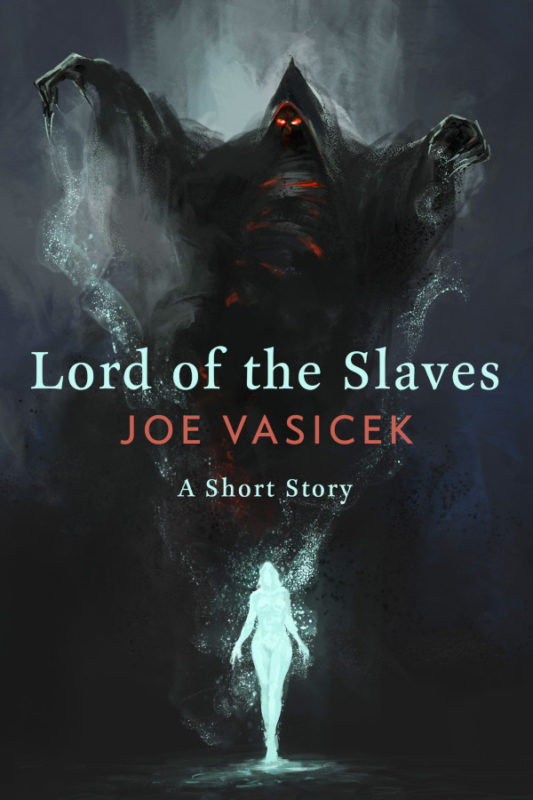
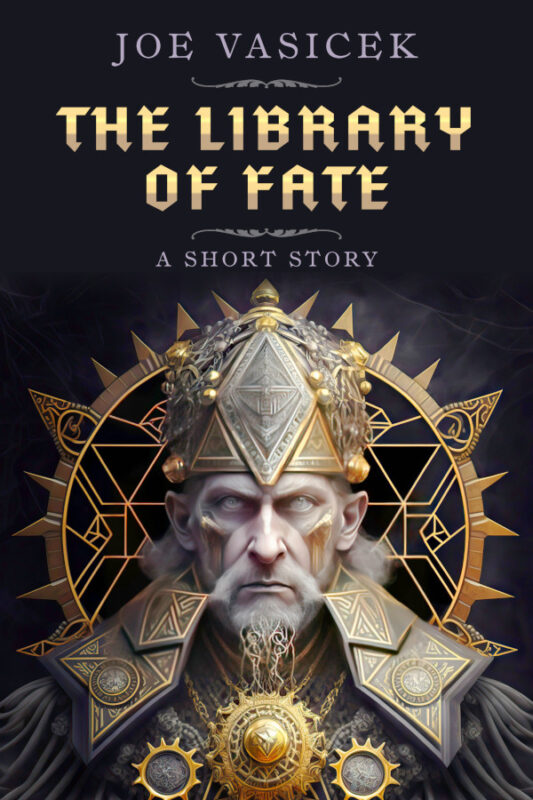
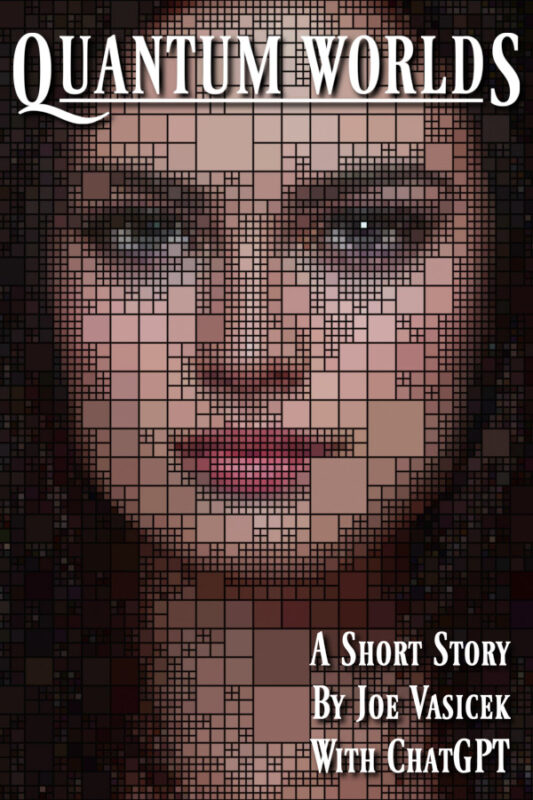
The New (and Improved) Vasicek Free Library

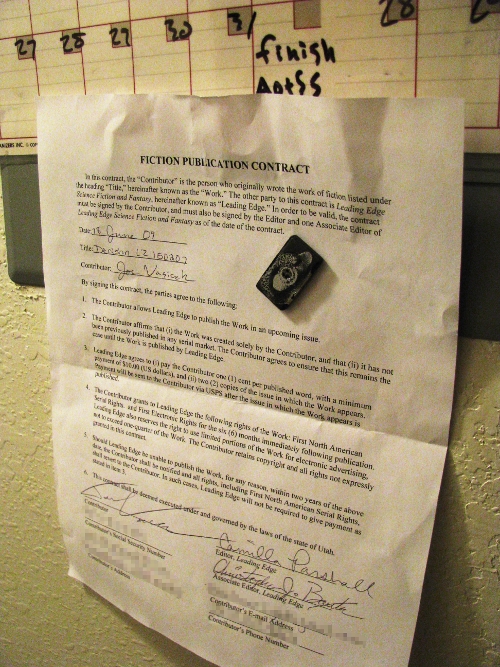
For several years, I would publish a new, free short story every month, keeping about six of them up at a time and unpublishing an old one every time I published a new one. I was able to do this because I was constantly writing short stories, in order to submit to the traditional short story markets (Asimov’s, Analog, Clarkesworld, etc). Typically, each story would go on submission for a year or two, and if it didn’t get picked up by a professional or semi-pro market, I would just publish it myself.

All of that changed in 2023 when I decided I was done trying to pursue the traditional short story markets. When I landed a story in the conservative (or at least anti-woke) anthology Again, Hazardous Imaginings, and that story (“The Promise of King Washington”) was reviewed favorably on the conservative review site Tangent Online, I saw a marked rise in my rejection rate—and all of them form rejections, too (about 10%-15% of my rejections were personalized before this, which typically indicates that an editor likes your writing but doesn’t want that particular story).

It was at that point that I realized that every professional short story market (and most of the semi-pro ones) is ideologically captured, and that my odds of getting published as a straight white male conservative were essentially zero. So I stopped writing short stories, and in 2025, after cycling through the last story from the submission queue, I unpublished all but one or two of my free short stories and discontinued the series.

The free short stories used to make up the backbone of what I like to call the “Vasicek Free Library.” I patterned it after the Baen Free Library, and it’s basically a list of all of my free books, including permafree first-in-series like Brothers in Exile and, of course, the free short stories. It’s basically a way for readers to sample my writing, and hopefully go on to buy some of my other books.

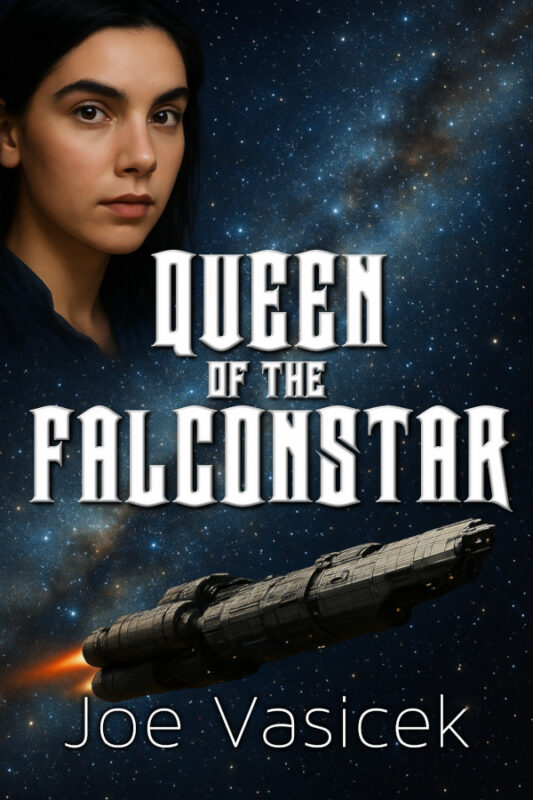
Long story short, I have decided to bring back the Vasicek Free Library, this time not just with short stories, but with a rotating selection of standalone longer works, too. I’ve got about half a dozen standalone novellas and novelettes, plus a couple of novels like Queen of the Falconstar where I’m currently writing the sequels. I’m going to rotate slowly through those, keeping each one free for a few months, and also rotate through my back catalog of 60+ short stories similar to how I was doing it before. And I plan to do this for the foreseeable future.

Here is the current selection:


Check back each month for new stories!

Navigating Woke SF, Part 3: Toward a New Short Story Strategy

So I really love how China Mike Glyer cherry-picked the excerpts that he quoted from my last blog post, leaving out how I said that it’s important to give people the benefit of the doubt, or how you can’t take diversity statements at face value because of all the elitist signalling language. But the thing that I especially love is the way he characterized all of what I said as an “opportunity to learn from a professional why he’s self-rejecting from these short fiction markets.”

No, That’s Not Self-Rejection

There are so many things wrong with the phrase “self-rejection.” On its face, it sounds empowering, but the underlying assumption is that submitting your short stories to the traditional markets is your best/only option, and therefore you’d be a fool not to follow that path. Is that really an empowering message? Or is it actually more empowering—not to mention, straightforward—to say that it’s not you rejecting yourself, but you rejecting them?

For a long time, though, I really did believe that choosing not to submit a story to a high-paying market was tantamount to rejecting my own story. Even as an indie author, I still believed that for a short story to be successful, it had to be traditionally published first.

That was the thinking that informed my old short story strategy. Submit to the traditional markets first, and don’t self-publish until all of the high-paying professional markets have been exhausted, or (hopefully) until the exclusivity period of your contract wears off. You might spend years sending your story out to the markets, only to find that self-publishing is the only way to get it out into the world, but at least you have the moral victory of knowing you didn’t “self-reject.” Except, in a world where it’s possible to be your own publisher, you did reject your own story all those years, simply by choosing to keep it on submission instead of publishing it yourself!

To be fair, when it comes to short stories, self-publishing and traditional publishing are not mutually exclusive. And years of experience with self-publishing short stories has taught me that it’s very difficult to earn significant money with them. As I put it a couple of months ago:

…short stories can be useful to do just about every other thing except make money selling them directly. If you price the singles at $2.99, you might sell as many as one or two per year, making less than $5. If you price them at 99¢, you may sell as many as a dozen per year, if you’re lucky—again, making less than $5. I didn’t have much luck getting bundles of 3-5 to sell, but larger collections of 10 to 12 stories do occasionally sell, and at a decent enough rate that I’m earning more on those stories than I would if I’d sold them individually as singles. But short story collections don’t sell anywhere near as well as novels.

So if you can expect to sell a short story to a high-paying market in a reasonable period of time, it certainly makes sense to put it out on submission instead of self-publishing it first. But as I’ve established in the last two posts, when most of the high-paying markets have gone totally woke, that changes the equation—especially if you are a straight white male who refuses to bend the knee.

To review, here are the potential benefits of submitting to the traditional short story markets first:

  • The pay.
  • Marketing.
  • Prestige and reputation.
  • Networking.
  • Awards and SFWA membership, if you care about that. I don’t.

And here are the potential drawbacks:

  • Lost time.
  • Lost time in exclusivity.
  • Lost time in submission.
  • Lost time not submitting simultaneously.
  • Lost time running out of open markets.

In short, the biggest potential drawback is all of that lost time where you could have self-published that story, but didn’t. Tell me again how that isn’t self-rejection?

Costs and Benefits of Self-Publishing (and How Wokeness Changes the Equation)

So if you can’t really expect to make any money self-publishing short stories, what good are they anyway?

In my previous post, I compared short stories to pawns in the game of chess. The pawn is the weakest piece in the game, but many chess masters still consider it the “soul of the game,” not because of what each piece individually can do, but what they can accomplish when taken together. A strong pawn structure is key to both openings and midgame strategy, and in the endgame, pawns become critically important as they threaten to advance to the final rank, where they can be queened.

Short stories are similar to pawns in this way. Taken individually, they’re not particularly significant, and if you’ve only written or published one or two of them, they’re probably not going to have a huge impact on your career. But when you have a bunch of them and get them to work together, they can build your career (not to mention, help you develop your craft) quite effectively. And there’s always the chance that you can get one optioned for film, just like advancing a pawn to the back rank.

About a year ago, I did something very unconventional and made all of my short story singles free. Here was my thinking behind that decision:

As a short story reader, I’m already used to paying for anthologies—and I’m more likely than other readers to buy them, since I’m the kind of reader who seeks out short stories. So if I pick up a handful of free short stories from an author and come to really enjoy her work, I’m already primed to buy her collections when I finish each story—and that makes the backmatter of each free single the best place for her to advertise her collections.

It’s a bit like first-in-series free, except instead of the one free book pointing to the rest of the series, there’s a bunch of free short stories all pointing to the same one (or two or three) collections. The typical reader is probably going to need to read a few of an author’s short stories anyways to really become a fan, so making all of the stories free could really be the way to go.

Of course, the big downside to this as an author is that you probably can’t sell reprint rights to the stories that are available as free singles. Why would an editor buy your story for their publication if it’s already available for free? So you would have to make the singles free for a limited time, if selling the stories to the reprint markets is part of your strategy.

But if you’re going to eventually bundle those stories into a collection, that’s not really a problem. Publish them as free singles as soon as the rights revert back to you, and then take down the singles when you have enough of them to put into a collection.

In the past several months since embarking on this experiment, I’m happy to report that it’s been a success! Not only have these free short story singles brought in new readers by giving them a wider sample of my work, but they’ve also been quite effective at building engagement among my newsletter subscribers and driving sales of my other works.

So here are the benefits I’ve seen by publishing free short story singles:

  • Marketing. The free short story singles are great marketing tools because the cost to try them out is minimal, not only in terms of price but in terms of time.
  • Discoverability. Nothing is quite as good at getting your name out there as a free story.
  • Name recognition. They say the average person has to see your brand at least seven times before it starts to stick. By putting a bunch of short stories out there that readers can pick up for free, it helps my name to stick with them.
  • Engagement. My short story singles are some of my most—and best—reviewed ebooks. This is something I genuinely didn’t expect, but it’s helped to boost the effectiveness of everything else.
  • Converting casual readers into fans. This has also been a pleasant surprise. Every time I send out a newsletter plugging one of my free short story singles—even one that’s been out for a while—I see an uptick in sales of my other books, as well as an uptick in fanmail from readers who credit the short stories for really turning them onto my work.
  • Regularly putting out new work. This is potentially huge. At the end of the day, nothing else is as good at selling your books as publishing the next book. Ideally, all those books would be novels, but since I’m not the kind of writer who can put out a new novel every month, short stories can pick up the slack—especially if they’re free.

There are still a lot of things that I still want to tweak, both to drive organic newsletter subscribers and to drive sales of my short story collections, but in terms of overall strategy I think I’ve got the self-publishing end down pretty good. So what are the drawbacks?

Because most of the high-paying short story markets only purchase first publication rights, the cost is that you give up what you could have gotten by going with the traditional markets first. But if all of those markets have gone too far woke, that changes the equation considerably:

  • The Pay. If all but a handful of the higher paying markets have gone woke and are therefore off the table, it doesn’t make sense to hold out for the money—nor does it make sense to make pay rates the deciding factor in whether or not to submit. If you have the time on your publishing schedule to send it out, great! Go for it! But don’t let the hope of a couple hundred bucks keep you from putting it out yourself.
  • Marketing. If a market has gone woke, then it’s reasonable to assume that its readers and supporters have also gone woke. Since that’s not my target audience, it doesn’t make sense to hold out for getting published, no matter how large their readership or subscriber base. In fact, publication with a woke market may actually hurt me by turning off the very non-woke readers that I’m hoping to reach.
  • Prestige and reputation. Same as above. If a market has gone woke, their reputation precedes them for both good and ill. Better to know my target audience and stay true to them than to seek honors from those who insist I bend the knee.
  • Networking. If my predictions are correct and the culture is starting to shift decisively against everything woke, then the writers and editors I ought to be networking with are largely working on passion projects and semi-pro startups, not the established markets.

Revised Short Story Strategy

With all of that in mind, here is my new short story strategy:

Stage Zero: Put the Story on the Self-Publishing Schedule

The goal here is to publish something new consistently every month. Every time I write a short story, I immediately put it on the publishing schedule for a month where I don’t have a novel or a bundle already scheduled.

At a minimum, I should have enough stories to fill out the publishing schedule for at least the next six months. That way, if one of them sells to a traditional market, I can bump all the other ones forward, or have time to write something new. And ideally, I should fill out the schedule for the next 12 to 18 months, in order to have more time to put new stories on submission.

But unlike before, I’m not going to wait until a story exhausts all the potential markets before I self-publish it. If the story hasn’t sold yet to a traditional market and it’s slotted to be self-published next month, self-publishing takes precedence.

Stage One: Submit to the Traditional Markets

Before, my plan was to submit to all of the available markets that paid at least 5¢ per word, starting at the highest paying ones and working my way down until all of them were exhausted. But since most of those markets have gone incurably woke and it no longer makes sense to hold out for the pay, I’m now willing to submit to any market that pays at least 1¢ per word.

Since time is the key factor here—and the most relevant cost—instead of starting with the highest paying markets and working my way down, I’ll prioritize markets that allow simultaneous submissions and hit them all up at about the same time. Of course, if the story sells, I’ll promptly inform all of the other markets and withdraw my story. The same holds true if the story is still out for submission when I self-publish it.

For markets that allow simultaneous submissions, I’ll submit to any market that has an average wait time of 90 days or less, but for markets that do not allow simultaneous submissions, I’ll only send my story to them if their average wait time is 45 days or less. Again, time is the key factor here, and the most relevant cost. If a market can’t turn around my submission in less than six weeks, and still demands that I give them the exclusive right to consider my story, free of charge, I’m probably better off submitting elsewhere.

Stage Two: Self-Publish as a Free Short Story Single

This part of the plan remains exactly the same as before. But since ideally I’m turning around stories faster, that means I can put out short story collections faster as well. I’m not sure when I should decide to keep the short story single up while it’s also bundled in a collection, but that’s a publishing decision that has little to do with navigating the woke SF markets, so I’ll mull it over for now.

Stage Three: Bundle in Collections and Submit to the Reprint Markets

Again, this part of the plan is largely unchanged, with the caveat that I won’t be submitting my stories to any market that’s gone totally woke. Because of this, there may be times when my previously published stories aren’t on submission at all, but since that’s already the case, I’m not too worried about it. Besides, submitting to the reprint markets isn’t a high priority.

Conclusions

Thank goodness we live in a time when independent publishing is a viable option! If not, there’s a very good chance that none of my stories would have an avenue for getting out into the world, simply because I’m a straight white male who refuses to bend the knee to the woke establishment’s lies. In spite of all the insanity—and in spite of the fact that most of the major SF&F short story markets have gone completely woke—this is still the best time in history to be a writer and a reader.

Are short stories worth publishing?

Every couple of years, I get the short story bug and write maybe half a dozen short stories in the span of just a few months. Then, I get really excited about putting them up on submission, and for the next couple of years I systematically send them out to all the professional markets… and then the semi-professional markets… and then, when only a couple of them actually sell, I self-publish them. My enthusiasm gradually dies down, until I catch the short story bug again, and the cycle repeats.

When I caught the short story bug last year, though, it was immediately after NaNoWriMo, where I wrote 50k words of short stories instead of 50k words of a novel. That was so much fun that I think I’m going to do it every year. In fact, I may try out Camp NaNoWriMo too, just for the fun of it.

But this post isn’t about whether short stories are worth writing. That’s an artistic question, and the answer for most writers is probably some version of “yes, but…” The big question on my mind, however, is whether short stories are worth publishing—that is, are short stories worth it from a career/business perspective?

Several years ago (during one of those times when I’d caught the short story bug again), I wrote a blog post about whether it’s possible to make a living as a short story writer. I speculated that if you spent a year writing two short stories a week, that would give you a hundred stories by the end of the year. Keep it up, and after a few years you would have so many stories that by sheer numbers alone, you could do it.

Dean Wesley Smith came to a similar conclusion back in 2016, and again in 2018. The basic idea is to write like a madman out of hell, keep each one on submission for a couple of years, and self-publish them on a shoestring budget so that even if each one only brings in a few extra dollars, by sheer numbers alone, you make a decent living.

There’s just one problem.

There’s a site called The Submission Grinder that crowdsources writers’ rejection letters and acceptances to produce a lot of useful data on all of the various short story markets. After crunching this data, I discovered there are between 30-50 science fiction and fantasy markets that pay better than 5¢ per word. Most of them are temporarily closed at any given time, and very few of them accept multiple or simultaneous submissions. Furthermore, they all average about 25-30 days to respond to submissions.

What this means is that if you write faster than one short story a month, after only about a dozen stories or so, you will start to run out of available markets. Unless you write under multiple pen names or across multiple genres, you will very quickly develop a backlog of stories that won’t get submitted, simply because there aren’t enough places to submit to. So instead of taking one or two years for each story to work their way through the markets, it will take several more years or perhaps even decades, during which time those stories aren’t making any money for you at all.

As for self-publishing, I am currently experimenting with a lot of different ways to publish short stories, but what I’ve generally found is that short stories can be useful to do just about every other thing except make money selling them directly. If you price the singles at $2.99, you might sell as many as one or two per year, making less than $5. If you price them at 99¢, you may sell as many as a dozen per year, if you’re lucky—again, making less than $5. I didn’t have much luck getting bundles of 3-5 to sell, but larger collections of 10 to 12 stories do occasionally sell, and at a decent enough rate that I’m earning more on those stories than I would if I’d sold them individually as singles. But short story collections don’t sell anywhere near as well as novels.

So if you’re going to publish short stories, the best way to maximize earnings is to submit them to all the professional markets first, and to work your way through those markets as quickly and efficiently as possible. But that requires throttling your output, otherwise you’ll soon end up with a massive backlog of stories waiting for a place to send them. And self-publishing them all isn’t a panacea, because it’s very difficult to make money selling short stories directly. They can be useful for other things, like building your email list, converting readers to fans, and marketing your author brand, but all of this requires making those stories free—at least the singles, if not the collections.

But when you think about it, that makes sense, because most short stories are published for free anyways. When you sell a story to a professional or semi-pro market, it usually ends up on a podcast feed or a website somewhere, available for free in some form. These days, an avid short story reader doesn’t need to spend a dime to find high quality stories produced very well. If they do spend money, it’s usually because they’ve made a conscious choice to support an author, or a magazine, or an anthology that they love.

So is it worth publishing short stories? If you can break into the professional markets, probably yes, otherwise I’m not so sure. And while the best career writing advice is “be prolific,” I do think there’s a point at which the marginal cost vs. marginal benefit of writing another short story really doesn’t make any sense. I suspect that threshold lies somewhere around the point where the submissions backlog starts to build.

I’ll still keep writing short stories, because I do want to crack into those professional markets, and I do think the ancillary benefits of self-publishing short stories makes it worthwhile. But at best, it’s going to be a sideshow compared to everything else I do. Most likely I’ll reserve short stories to NaNoWriMo or Camp NaNoWriMo, and not even bother writing them for the rest of the year.

A New Short Story Plan

So I’ve been thinking a lot recently about how best to leverage my short stories, not just from the traditional publishing angle, but from the indie publishing side as well. The problem is that self-published short stories really don’t sell much, so after you’ve sold them to a traditional market, what are you supposed to do?

I’ve tried all of the following things, with varying levels of success:

  • Publish single short stories and charge only 99¢.
  • Publish single short stories and charge $2.99.
  • Bundle 3-5 stories together and charge $2.99 to $4.99.
  • Bundle 10-12 stories into a collection and charge $4.99.
  • Give the singles away for free.
  • Turn the singles into newsletter magnets to gain new subscribers.

Taken individually, there are problems with all of these strategies. Short story singles don’t earn very much at any price, and while they garner a lot of downloads if you make them free, they don’t really lead to sales of other books unless they’re part of a larger series. Even then, not so much.

The bundles and collections don’t do much better. Dean Wesley Smith says you can bundle 3-5 short stories together just fine, (or at least, he used to say that) but I tend to think that readers prefer collections with at least 10-12 short stories in them. At this point, I don’t self-publish a collection unless it has at least 40,000 words.

Short stories can be useful as newsletter magnets, but I’ve found that first-in-series books get a higher CTR than standalone shorts. Besides, it’s much more useful to send a follow up email to a first-in-series book (“Have you read ____ yet? Here’s what comes next.”)

So what’s the best way to self-publish short stories?

Let’s take a look at this from a reader’s perspective for a moment. These days, most short stories from the magazines are available for free. They’re either available on a podcast feed, like Uncanny or Escape Pod, or they’re published on a website for a limited time (sometimes for an unlimited time.) There are a handful of magazines like Asimov’s and F&SF that put their content behind a paywall, (usually a subscription of some kind) but there are also magazines like Clarkesworld that put their content up for free on the podcast AND offer an optional subscription. In fact, I believe it was Clarkesworld that discovered that revenue actually went up when they put everything out for free.

So as a short story reader, there’s really no need for me to purchase single short stories, since so many of them are available from the magazines for free. In fact, I would probably prefer to get my stories from a magazine, since I know they’ve been vetted by an editor. If I like a particular author, I may pick up some of their short stories, but I’m more likely to wait until they’ve bundled them into a collection of some kind, just to maximize the value.

Anthologies are a different story (sorry for the pun.) I have yet to see a short story anthology that isn’t priced like a regular book—no free or 99¢ ebooks. That’s probably because, as a short story reader, I know I’m getting a bunch of stories for that price. It’s kind of like buying an album, back in the days before Spotify: I know I’m going to get a couple of stinkers, but I also know that I’ll get some really great ones too. But if there are only 3-5 stories in that bundle, I’m going to think twice before buying it unless it’s at a super deep discount price. After all, I can always get my short story fix for free.

So if there are enough high-quality short stories availabe from the magazines for free, and self-published singles don’t really earn much at all, what’s the best way to go indie? Here’s my thought: sell anthology-sized collections at full price and make all the singles free, with the backmatter in the free stories pointing to the collections.

As a short story reader, I’m already used to paying for anthologies—and I’m more likely than other readers to buy them, since I’m the kind of reader who seeks out short stories. So if I pick up a handful of free short stories from an author and come to really enjoy her work, I’m already primed to buy her collections when I finish each story—and that makes the backmatter of each free single the best place for her to advertise her collections.

It’s a bit like first-in-series free, except instead of the one free book pointing to the rest of the series, there’s a bunch of free short stories all pointing to the same one (or two or three) collections. The typical reader is probably going to need to read a few of an author’s short stories anyways to really become a fan, so making all of the stories free could really be the way to go.

Of course, the big downside to this as an author is that you probably can’t sell reprint rights to the stories that are available as free singles. Why would an editor buy your story for their publication if it’s already available for free? So you would have to make the singles free for a limited time, if selling the stories to the reprint markets is part of your strategy.

But if you’re going to eventually bundle those stories into a collection, that’s not really a problem. Publish them as free singles as soon as the rights revert back to you, and then take down the singles when you have enough of them to put into a collection.

So under this hybrid publishing system, the typical lifecycle of a short story would look something like this:

Stage One: Submitting to the Traditional Markets

The goal of the first stage is to sell first publication rights to a professional or a semi-pro market (typically a magazine or an anthology.) So before self-publishing, you would submit to all of the traditional markets, and keep the story on submission until it has sold. But you would have to limit yourself to the markets with a pay rate that you’re willing to accept, otherwise you might as well just self-publish.

If my goal is to be a 6-figure author, I should value my time at $50/hour at least (since $50/hour X 40 hours/week X 50 weeks/year = $100,000/year.) That means I can use my writing speed to calculate my minimum pay rate. If I can write 2,000 words in an hour, then that’s $50/2,000 words, or 2.5¢ per word. Round that up to 3¢ per word, and that’s the minimum pay rate that I should be willing to accept.

Once the story has sold, the contract will dictate when I can self-publish. Most contracts have an exclusivity period of a few months to a year. Every contract is different, so how long the story remains in this phase depends on each contract.

Stage Two: Self-Publishing as Free Singles

This is where you start to implement the strategy that I discussed above. As soon as the rights revert back to you, you self-publish them as short story singles—but rather than trying to make money with them, you give them away for free in order to point readers toward your collections.

In other words, after a short story has been traditonally published, it goes through a temporary period where it’s used as a free loss leader. This period ends as soon as the author has enough shorts to bundle into a novel-sized collection—but since there are always at least a few free singles floating around, it serves as an effective way to attract new readers and win over new fans.

Stage Three: Collections and the Reprint Markets

This is the final stage, where you take down the free singles and bundle them into collections instead. Once that’s done, you update the backmatter in all of the other free singles to include links to buy the new collection, and the story starts to earn money for you again.

Because the story is no longer a free self-published ebook, it makes sense to start submitting to the traditional markets that buy reprint rights, since why not? At this point, it’s free money. I generally don’t accept anything less than 1¢ per word, since I’ve found that the token-paying markets don’t make an appreciable dent in any of my stories’ lifetime earnings, but that’s just me.

I think this three-stage lifecycle may be the best way to extract the maximum value from my short stories. Like pawns in the game of chess, it’s not what each story individually is doing, but how they’re working together. A self-published single that sells only a dozen copies (if that) per year isn’t doing much for me, and while I can use them to gain new subscribers, there are more effective tools for that than standalone short-stories.

In any case, I’m going to give it a try. It will be interesting in a few months to see how it turned out!

SW-VI: BENEFACTOR is now out on Amazon, Smashwords, and Kobo!

SW-VI (thumb)That’s right!  My latest book, Star Wanderers: Benefactor (Part VI) is now available on Amazon, Smashwords, and Kobo!  It’s $2.99, but for the next couple of days until the end of June, you can get it for $1.49 from Smashwords with the summer promotion code.

This one took a long time to write, especially for a novella, but I’m very satisfied with the result.  It shows the events of Fidelity from Jakob’s point of view, really diving into his character and exploring his background as a star wanderer who settled down and now struggles to take care of his family.  There are overtones of an impending conflict between the Outworlders and the Gaian Empire, which I plan to make a major part of the overworld story arc, and some new characters introduced as well.

Here’s the teaser:

IN A COLD AND LONELY UNIVERSE, A SIMPLE ACT OF GRACE CAN RESONATE ACROSS WORLDS.

An outworlder is nothing if not fiercely independent, and Jakob is no exception. But ever since he brought his family of starbound refugees to Alpha Oriana, he’s felt increasingly powerless. With the recent Imperial takeover and rumors of job cuts at the dockyards, it’s only a matter of time before they’re forced to move on—again.

When a young man and woman with an unusual story show up from his wife’s homeworld, he takes them in, if for no other reason than that they remind him of a time when he was young and still in love. Ever since he sent his sons away, his marriage has been a nightmare—but all he wanted was to give them a chance at a better life out among the stars. Whether or not that was a mistake, his wife has never forgiven him for it.

In the face of so many challenges, it’s not clear how long the family can hold together, but Jakob will sacrifice everything before he asks for help—even if the only way out lies through an open airlock.

Star Wanderers: Benefactor (Part VI) should be up on Barnes & Noble shortly, as well as Drivethru Fiction and All Romance eBooks.  In a couple of weeks, it should be out on iTunes, Sony, and Diesel as well.  If you want to add it to your Goodreads library, you can find it here.

Thanks guys!  I’m heading out on a short backpacking trip this weekend, but I’ll be back in a couple of days with more updates.  Later!

What does it mean to be “published”?

One interesting thing about making the shift from traditional to indie publishing is that it changes your perspective on what it means to be “published,” and not in ways that you might expect.

Before I made the shift, I felt as if I were at the base of a giant mountain, where climbing to the top meant getting published and that was all I could see.  Sure, I knew there was more to it than getting that first book deal, but I figured I’d learn all about that at some point later–and besides, there’d be people along the way to help me.

Once I started indie publishing, though, my paradigm changed completely.  Instead of focusing all my efforts on trying to land that lucky break, I started thinking in ways that were much more concrete and practical, like “how can I build my readership?” “how high (or low) should I price my books?” “how can I improve my ebook formatting?” etc.

All of a sudden, it was as if I were on top of that first mountain, with a whole range of even taller mountains to climb.  And while that’s a very daunting place to be, it’s also quite encouraging, because I can see what lies in front of me and figure out what path I want to take.

One of the side effects of all this is that “getting published” is no longer a big deal to me.  Whenever I see aspiring writers obsess over getting an agent or a book deal, as if that’s the single greatest thing that could ever happen to them and all their hopes and dreams hang on the balance, I have to stop and scratch my head. 

Don’t get me wrong; it’s still a big deal to get picked up by a major publisher, and kudos to everyone who is.  It’s just that that is not and shouldn’t be the end of your publishing journey; it’s only the beginning.

For this reason, I really don’t like the words “published” or “author” anymore.  People throw those terms around as if it makes you part of a select elite, one of those godlike beings who lives up in the clouds and periodically descends from On High to grant blessings to all the poor unpublished wastrel folk on the surface.  That’s complete and utter BS, and I never ever ever want to buy into it, not for an instant.

The problem is, so many people still do.  They still think that there’s some kind of a divide between them and Big Name Authors, like peasants in the face of royalty.  They labor endlessly over their manuscripts, terrified that one misplaced comma will forever their chances of fulfilling their hopes and dreams.  And whenever anyone tries to tell them that there’s a better way, that it doesn’t have to be like this, they cling to the old paradigm like battered women who refuse to get help–or worse, like religious zealots who dream of being martyrs for their cause.

It used to be that self-published writers were the ones who constantly obsessed about being “published,” but now, I think it’s the exact opposite.  Sure, there are crazies in both camps, but it seems that the balance of aspiring professionals–the ones who actually treat writing like a business–are turning to independent self-publishing.

The point is, I don’t like to think of myself as an “author,” or as an “indie published” whatever; I like to think of myself as an “indie writer”–or better still, just a “writer.” All the other terms are just too misleading and destructive.

More thoughts on indie publishing

Since my last post on indie publishing, I’ve been thinking a lot about this subject.  I haven’t decided to take the plunge into self published ebooks yet, but I have decided to make some changes in my writing and my career strategy, in order to position myself more favorably if/when I choose to do so.

Basically, my new strategy is something like Japan or Saudi Arabia’s approach to nuclear weapons: they don’t have an explicit nuclear program (since that would violate the nuclear non-proliferation treaty), but they have gathered the equipment, resources, and expertise together so that if they decided to go nuclear, they could do it in a year or less.

First, though, I attended Brandon Sanderson’s class lecture this Thursday, in which he had some very interesting things to say about ebooks and the publishing industry.  This was part I of his “how to get published” lecture, and here are some of the more interesting points he made:

  • Almost all the indie writers who are making it big have at least one loss leader ($.99 or less) on their list.
  • No one really knows whether indie publishing will be viable for large numbers of writers, or whether authors like Amanda Hocking and Joe Konrath are outliers.
  • Successful indie published books are typically:
    1) short (70k to 80k words)
    2) written in a pulp genre (thriller, romance, paranormal, sword & sorcery, etc)
    3) promoted very well through social networking
  • We have not yet seen any indie successes in epic fantasy, young adult / middle grade, historical fiction, or non-fiction.
  • The produce model vs. unlimited shelf space argument for going indie doesn’t apply as much to science fiction & fantasy as other genres, because:
    1) sf&f stays on the shelves in bookstores longer than other genres
    2) sf&f series grow better with a big push on the first book
    3) sf&f makes a lot of money on hardcover, unlike other genres

A lot of these points tend to mesh with what I’m hearing from my other sources–and Brandon really represents the last of the successful writers to make it big on the old model, before the ebook revolution began to take off.  He doesn’t make as big a deal on the current 25/75 split on net ebook sales as I would make, but then again, he’s making most of his money through print.

So anyways, here is what I plan to change about what I’m doing in order to better position myself to best take the ebook plunge, if/when I decide to do so:

1) Write at least 2 polished novels per year

Kris Rusch and Dean Wesley Smith make very good arguments about how being able to write well quickly is a huge asset for a writer these days.

There are many good reasons for this:

1) Writing faster gives you more practice with craft, which tends to improve quality.
2) The best way to promote  your books is to constantly write new books.
3) The limited shelf space argument against writing quickly is now moot with ebooks.

In particular, I want to increase my writing speed in order that I can have a larger list to put out if/when I decide to go with indie publishing.  It’s much harder to be successful if you’ve only got one book available for sale; if/when I decide to take the plunge, I want to have at least three.

So far this year, I’ve finished one (Bringing Stella Home), but that’s because it was already sitting in the queue and only needed a quick touch up.  I would like to get Worlds Away from Home polished before the end of the year, and possibly one other project, such as Edenfall.

2) Reduce production time to as close to one year as possible

Right now, it takes me on average about two years to write a polished, salable novel.  That’s not a problem, because I have a lot of projects in the queue, but it’s not as fast as I would like.  I wrote Genesis Earth and Bringing Stella Home while I was still a journeyman writer, figuring out my craft.  I should be able to produce a lot faster.

Towards that end, I’m going to try to get Edenfall finished and polished within a year.  Since it’s already March, that might mean getting it polished by February of next year, but I still want to try.

My biggest weakness is first drafts; I always tend to get stuck midway and drop the project for a while before I feel ready to finish it.  That’s something I would like to change.  Then again, that might just be part of my writing process, and shouldn’t be forced.  However, I certainly could go through my revisions much faster.

3) Write out the direct sequels while the first book is still unpublished

Previously, I thought it was a bad idea to write out all the books in a series or trilogy before the first one is ever picked up.  After all, a rejection from a publisher on the first book is a rejection on all the other books in the series as well.  Using this reasoning, it was much better to write the first book of another trilogy, in order to maximize how much I could submit at any given time.

With indie publishing, however, it’s much better to release the whole trilogy all at once, so that readers who finish the first book can immediately pick up the others.  Again, the paradigm here is that the best way to sell books is with other books; if they loved the one, they’ll buy the others, especially to find out what happens next.

Of course, the best model is probably to have an open series with several indirect sequels with recurring characters in the same world.  With the Gaia Nova books, that’s exactly what I plan to do: Worlds Away from Home is set in the same universe as Bringing Stella Home, but with different characters and different story arcs.

However, Genesis Earth has serious trilogy potential, and with Edenfall I’ve decided to actually write the other books.  If/when I decide to take the plunge, I want to be able to release at least the first two books in that trilogy at the same time.  In fact, Genesis Earth is perhaps the biggest reason why I’m thinking so seriously about going indie, but that’s a subject for a whole other post.

4) Experiment with pulp genres such as space adventure stories

When Brandon said that the pulp genres tend to do better, I wasn’t sure whether that includes what I write.  I write primarily science fiction, but not the kind of stories you’d read only for entertainment and promptly forget once you’re finished.  If anything, I want to write more like Ursula K. Le Guin, whose stories are so meaningful they stick with you long after you’ve finished them.

Then again, there tends to be a lot of overlap in science fiction between the thoughtful, meaningful stuff and the pulps.  Ender’s Game and Starship Troopers immediately come to mind as awesome, entertaining stories that also have a lot of depth.  In his lecture, Brandon made it clear that “pulp” does not necessarily conflict with high art–just that the primary purpose of the story is to entertain.

I can live with that–and I actually have several story ideas that would translate well with the pulp mentality.  I’d like to do a novel (or a series of novels) with Danica from BSH and her mercenary team, perhaps as a sort of origin story for Roman, Anya, Artyom, and the others.  I’d like to revisit the Hameji as well, with a sort of “Ain Jalut in space” involving Sholpan’s son (BSH was basically the Mongol conquest of Baghdad in space).  I’ve already started an “Odyssey in space,” as told from a female Telemachus character–that’s To Search the Starry Sea.  All of these are, at their core, space adventure stories, and might translate well as pulps.

5) Commit to releasing one book every 6 months if/when I take the plunge

This is related to the first strategy on the list, but it’s more of a business plan than a personal writing goal.  Basically, if/when I take the plunge, I want to:

1) have at least 3 finished, polished books to put out at first,
2) know that I can put out one book every six months at least.

This not only means developing a backlist, it means doing some soul searching as a writer to find out how difficult it is to keep up with this pace–and adjusting my writing habits accordingly.  I’m optimistic that I can, but it’s something of a paradigm shift, and I want to make sure I’ve made that shift before I take the leap.

Anyhow, these are my thoughts on how to alter my current writing strategy.  I haven’t yet decided to go indie, but when the time comes, I think that these things will help me to maximize my potential if/when I decide to do so.

Of course, what do any of us really know?

Thoughts on traditional vs. indie publishing

In case you didn’t know, the publishing industry is in the throes of a major revolution.  With the growing popularity of e-books and the collapse of distribution channels and chain bookstores such as Borders, traditional business models are proving simply untenable.

I’ve been perusing several internet sources to make sense of all the craziness, among them Joe Konrath’s blog (a midlister who is now making six figures via ebooks), Writer Beware (which still emphasizes caution with self-publishing), the Adventures in Sci Fi Publishing podcast (which has recently started interviewing several successful indie authors), Dean Wesley Smith’s blog, and his wife Kristine Rusch’s series on the changing business of publishing (which I highly recommend–seriously, if you read nothing else, read this).

Some of these people predict the imminent collapse of the big publishers, and have selected (ironically enough) 2012 as the predicted date of the collapse.  Others agree that many traditional publishers will collapse, but believe that most will survive and evolve into something different (the “dinosaurs evolved into birds” theory vs. the giant meteor).  All of them agree, however, that whatever new form the publishing industry takes, ebooks will dominate.

For someone in my position–a budding author looking to break in in the next few years–all of this is simultaneously thrilling and unnerving.  Should I venture into indie publishing and risk having my work lost in the flood?  Or should I spend the next five years toiling endlessly to break into traditional publishing, only to see my rights get tied up in a bankruptcy?

Thus far, my strategy has been to a reputable agent, or a new agent at a reputable agency.  I’ve been holding back from submitting directly to publishers, out of fear that getting rejected from publishers would make it difficult for an agent to do her job.

That was the orthodox model under the traditional system, when the big six (HBGUSA, HarperCollins, McMillan, Penguin, Random House, and Simon & Schuster) dominated the industry.  For the time being, they still dominate, but I’m wondering whether it’s such a good idea to go with them.

The big six have been swallowing up independent presses and imprints for years, and as a result, they’re now major corporations.  As such, they aren’t looking for moderate midlisters who sell consistently–those kinds of writers would drive them bankrupt.  No, in order to support their corporate expenses (like multimillion dollar office space and executive bonuses), they need bestsellers like Stephen King or J.K. Rowling.

Trouble is, they often lose when they gamble on new writers, which means that the next bestseller needs to be even more spectacular than the first.  And with the ebook revolution underway, they’re getting desperate.

Agent Kristin Nelson recently lambasted McMillan for claiming rights to all “derivative works” in their new boilerplate (a bad faith move comparable, IMO, with the worst scams on Writer Beware), while Kristine Rusch recently noted how the big publishers are becoming increasing hostile to new writers.  Advances as low as $1,500, or single book only contracts, or nebulous clauses that ensure publishers keep ebook rights for decades, even with the author barely making $20 per year on royalties?

How am I ever going to make it full time in a business like this?

Well, according to Joe Konrath, every day my books aren’t up as indie published ebooks, I’m losing big money.  His views are pretty extreme, but he makes a very compelling argument, especially for someone in my position.  Yes, there will be a flood of crap, but good stuff inevitably rises to the top.  Yes, sales start out slow, but that’s simply part of the new model–and they build over time.  For a minimal investment of time and money, I could launch my books and start earning an income from them now.

But money (such as I may or may not make as an indie) isn’t everything in this business.  At this point in my career, gaining prestige and making a name for myself is just as much if not more important than income.  Granted, I can build some prestige through indie publishing if my books sell enough, but I don’t want to have to depend on that, especially if it takes years for sales to build.

For the science fiction and fantasy genres, the professional standard is set by SFWA, or the Science Fiction & Fantasy Writers of America.  In order to become a member, you have to have your work published in one of their approved markets.

Last night, I did some research on those publishers.  Of those that specialize specifically in science fiction and fantasy, seven of them are affiliated with the big six (Tor, Ace, Baen, Bantam Spectra, Roc, Del Ray, and Orbit).  Thirteen others are independent presses that might conceivably be interested in my work.

Now, just because a science fiction and fantasy imprint is affiliated with the big six doesn’t mean it’s a bad idea to submit to them.  Tor, after all, is the undisputed king of the genre–the company has won the Hugo for “best publisher” every year since 1988.  I also tend to think (though I have no data to support it) that the bad contracts are more common with mainstream fiction.  Science fiction, after all, has always been small potatoes to the rest of the publishing world.

But precisely because science fiction is so small, I’m starting to wonder if it’s a bad idea to submit to agents first.  Agents go where the money is–in LDS publishing, virtually every author is unagented.  While there’s still a national market for science fiction, it’s definitely a small one, and all the agents I’ve found always tend to list it as an afterthought, focusing instead on YA/MG, thrillers, romance, or the ubiquitous “commercial fiction.”

In other words, I think that part of the reason agents have been so reluctant to pick me up, even after showing some interest, is that they just don’t see enough money to justify taking a risk on me.  Granted, it may also be the quality of my work, but the bulk of the rejections I’ve accrued seem to point more to subjective factors, like the agent’s personal tastes (the ubiquitous “I don’t feel I’m the right agent for this work”).

Which is not to say that I don’t think it’s a good idea to get agent–not at all.  Even Amanda Hocking, who has turned down several big publishing deals, has an agent.

No, what I’m saying is that in today’s market, it might be easier for a science fiction writer to attract an agent by getting picked up by a publisher, rather than attract a publisher by getting picked up by an agent.

And, of course, the only big reason to do any of this is to make a name for myself.  At some point, I will go indie, even if only with a few of my works.  The revolution has arrived, and I’d be a fool not to capitalize on it–the only question is when, and how.

(images from Postsecret)

Sick (blegh!), submitting, and thoughts on self-publishing

Sorry I haven’t been posting much recently; I came down with a nasty fever this week, and I’ve spent the last two days recovering.

It really sucks, because my two temp jobs just finished, and I was hoping to get into another writing routine.  The jobs were sucking up all my time, though it was definitely awesome to have money flowing in.

Anyhow, I caught Brandon Sanderson after his 318 class and asked him about submitting to agents while I’ve got my full ms out.  He said I shouldn’t do it; that it would look bad if I had to turn down another request because it’s already out.  So for now, I’m just going to sit on it and send out Genesis Earth to other agents.

Genesis Earth keeps getting turned down, but the vibe I get is that it’s more because of the agents’ tastes, not because of the poor quality of the book. So far, I’ve gotten one request for a full, one request for a partial, two personalized rejections, and several variations on “I don’t feel I’m the right agent.”

Even if all of the latter are just nice standard form rejections, that’s enough to tell me that Genesis Earth isn’t a crappy book.  So I’ve been thinking, if I run the rounds and fail to find an agent or a publisher, maybe I should take the plunge and publish it for $2.99 as an e-book on Amazon.

Speculation about e-publishing is rampant, and opinions are wildly mixed right now.  According to Joe Konrath, everyone (including new writers) should self publish their works–to wait even a day is to give up large amounts of potential earnings.  According to Dave Wolverton, however, new writers should definitely not self publish, but try to break in through traditional publishing with as big of a deal as they can possibly get.  Both authors have had huge self-publishing successes, so which is right?

Well, I read an interesting guest post by Lee Goldberg on Joe Konrath’s blog that takes the middle ground: start out with a traditional publishing deal, in order to build a name for yourself, but self-publish a couple of e-book lines shortly thereafter.

So far, that seems to make the most sense to me.  The science fiction and fantasy community is very tight-knit, and I don’t see myself becoming a major part of it through self-publishing alone.  At the same time, it’s very difficult to make a living through traditional publishing in these genres, so once I’ve built up something of a name and a fan-base, it would be good to start self-publishing a couple of e-book lines.

But then again, why not try it out now with Genesis Earth?  Well, a couple of reasons.  I’m worried that self-publishing would make me look bad when I submit my other stuff.  E-book sales tend to take a long time to build momentum, so even though the starting costs are low, the returns don’t start coming in until later–if they come at all.  And that’s the second thing I’m worried about–that my stuff will get buried under the flood of drivel that’s swamping Amazon and other e-publishers right now.

The main reason, though, is that I feel I need to do more research to figure out what’s going on.  Probably the most valuable thing I can do is get an e-reader and dive into the market from the consumer end, just to figure out how the system works.  Without some hands-on experience and a good working knowledge of the field, I’m probably not ready to take the leap.

In the meantime, I’ll keep trying to break in through the traditional route.  I might not make as much money as quickly this way, but I hopefully will build my name faster–and at this point, that’s more important to me than revenues.