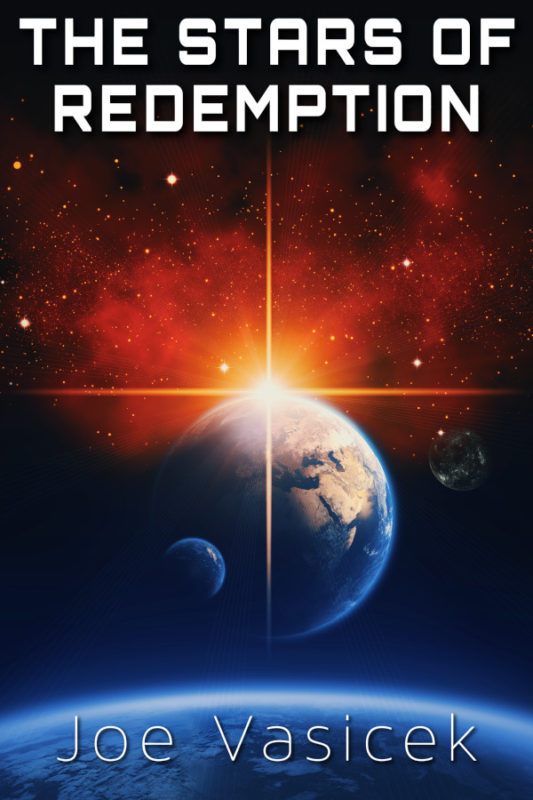
What if the deadliest threat humanity ever faced wasn’t an alien invasion or a rogue AI… but a mistake we keep repeating that always ends with the destruction of Earth? The Stars of Redemption, the last book in my young adult science fiction trilogy, explores this question.
At its core, The Stars of Redemption is about the struggle to break a closed time loop, stop a rogue superintelligence, and rewrite a future that seems unchangeable. This makes The Stars of Redemption a classic time-loop science fiction story, built around temporal paradoxes, fate-versus-free-will dilemmas, and the struggle to break a repeating extinction cycle. It is a story about escaping destructive cycles, choosing hope, and fighting for a future that isn’t predetermined.
Where the Idea Came From
The idea for this theme grew out of my long, tangled journey to finish the trilogy. As I write in the author’s note, the trilogy stalled until I became a husband and father. Holding my newborn daughter for the first time made me realize that the story needed to be about cycles—time loops, family patterns, repeating trauma—and the hope that they can be broken. Only then did I understand how to write about ending the loop and choosing a new future.
How Breaking the Time Paradox Shapes the Story
The entire plot of this sci-fi book revolves around a temporal paradox created by a wormhole, a derelict starship, and a fragmented AI superintelligence. The ghost ship is both the catalyst and the prison of a machine intelligence born from the loop—a being that believes humanity must be wiped out to prevent another cycle of suffering. Every conflict Estee and Khalil face—from warped corridors to shifting timelines—exists because they are trapped inside this repeating extinction loop.
For Estee, breaking the time loop becomes a confrontation with her family’s past and her people’s future. She must decide whether humanity deserves redemption and whether history can be changed. Khalil must confront his own emotional loop: guilt, self-sacrifice, and the belief that his fate is fixed. Together, they face a question at the heart of all time-loop fiction:
Are we doomed to repeat our worst mistakes, or can we rewrite the future?
What the Time Paradox Says About Us
Time loops are powerful metaphors because we all face cycles—personal, cultural, generational—that feel impossible to escape. The paradox in this story mirrors the real world: destructive systems repeat unless someone chooses differently. By facing a machine intelligence convinced that humanity is irredeemable, the characters confront the fear that our past defines us. The book suggests a hopeful alternative: the future changes when we do.
Why This Theme Matters to Me
I didn’t truly understand this story until I became a father. My daughter made the theme real: breaking cycles isn’t abstract—it’s something we do for the next generation. That moment of holding her and realizing this is her story now, not yours helped me finish the book. The Stars of Redemption is my way of saying that even in the darkest timelines—even in repeating loops—hope is possible, and the future can be rewritten.
Where to Get the Book









Related Posts and Pages
Explore the series index for the Genesis Earth Trilogy.
Visit the book page for Genesis Earth for more details.