#GiveThanks Day Four

(45) I’m grateful for Jordan Peterson and his courage to speak the truth as he sees it, even in the face of incredible opposition.

(46) I’m grateful for the “intellectual dark web” and how they show that there are still intelligent people who can discuss important issues with those with whom they disagree.

(47) I’m grateful for the voices in the alternative media that push back against the gaslighting of the mainstream media.

(48) On a less political note, I’m grateful for Mike Duncan and his History of Rome podcast, which taught me far more about the Romans and their impact on our world than my college education ever did.

(49) I’m also grateful for Mike Duncan’s Revolutions podcast, which has done the same thing for the history of our modern era.

(50) I’m grateful for Dan Carlin and his numerous podcasts, especially Hardcore History.

(51) I’m grateful for the Writing Excuses podcast, which was very influential in how I developed my writing craft back when I was just getting started.

(52) I’m grateful for the Six Figure Authors podcast and the Science Fiction and Fantasy Marketing podcast, and the excellent marketing and publishing ideas that they give me.

(53) I’m grateful for the Sell More Books Show and how it helps me to stay up to date with what’s happening in indie publishing.

(54) I’m grateful for the Mythulu cards that my wife got me for my birthday, and how they’ve helped me this nanowrimo to come up with some great story ideas.

(55) I’m grateful for Kris Rusch and Dean Wesley Smith, and the influence they were in helping me to decide to self publish back in 2011.

(56) I’m grateful for Life, the Universe, and Everything, and how that conference was and continues to be critical in shaping my writing career.

(57) I’m grateful for the writing group that I was fortunate enough to marry into, and the good advice and feedback that I receive from it.

(58) I’m grateful for Quark, BYU’s Science Fiction and Fantasy Club, and for how it provided me with a community of like-minded geeks and aspiring writers in college.

(59) I’m grateful for Leading Edge and the opportunity that I had to read for their slushpile, back when I was still learning my craft.

(60) I’m grateful for all of the other science fiction conventions I’ve been able to attend over the years, including Worldcon, World Fantasy, FanX, CONduit, and others.

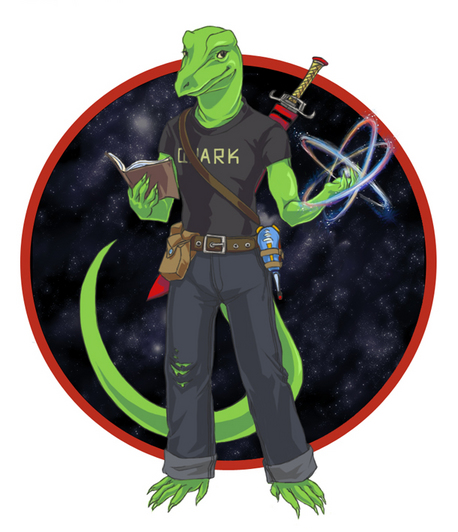
Q is for Quark

Quark_Mascot_by_OrphneIf it takes a village to raise a child, does it take a group of like-minded creative souls to raise a writer? I don’t know, but in my case, having a writing community around me really helped.  That community was Quark, BYU’s Science Fiction & Fantasy club.

I joined Quark my second semester of college.  I’d heard about the writing group, and on a whim I decided to check it out.  This was when Ben Hardin was the writing group leader, back before the current iteration of the club was really well-organized.  Aneeka Richins had basically built the writing group from scratch only a year or two before, and Kindal Debenham and Annaliese Lemmon had each spent a year as president shortly after that.  They were all still around, workshopping their stories and adding to the community.

We met on the second floor of the Harold B. Lee library, in one of the study rooms way in the back near what is now the classical music area (2520 was the room number, I think).  Looking back, it seemed like a weird place to meet, since we were always so LOUD.  However, back in those early days Quark didn’t get a lot of respect from the BYU student administration (BYUSA, known more familiarly as BYUSSR), so we kind of organized under the radar.

The spring semester of 2007 was a lot of fun!  I fit in very well with the group, and made a lot of friends.  It wasn’t until they made me the writing group president that I started attending regularly, though.  In retrospect, accepting that post was probably the best extracurricular decision I could have made.  I lead the writing group for two years, from fall of 2007 to spring of 2009, and that’s when I really became a writer.

When I first started back in 2007, I had a couple of hobby projects kicking around here and there, but the main thing I wanted to write was a Final Fantasy VI fanfic.  At the same time, I had a great idea for an original novel, but I’d never written a complete novel before, so I wasn’t sure what to do.  Aneeka convinced me to go with my own project, and that became The Lost Colony, also known as Ashes of the Starry Sea.

Around that time, I also started this blog, mostly so my writing friends could keep me honest.  I finished the first draft in 2008–a whopping 168k word manuscript that barely held together.  After coming back to the US from a study abroad program in the Middle East, I started revising it, but soon decided to trunk it in order to work on other projects.  Shortly thereafter, I finished the first draft of Genesis Earth, and the rest is history.

I later wrote up a detailed post on the origins of Quark, one that was published in a short-lived magazine called Mormon ArtistYou can find that article here.  Orson Scott Card himself commented on it, which really made my inner fanboy squee. 😀 For me, though, Quark was all about surrounding myself with like-minded friends who could foster my natural sense of creativity.  I probably would have become a writer anyway even without them, but it would have happened a lot later, and the road would have been much more rocky.

And now that we’ve all graduated and moved on, I’m happy to say we still keep in touch!  Kindal is a self-published indie writer much like me, with some excellent books out there.  He’s organized an online writing group that is mostly made up of us old-time Quarkies.  Aneeka’s got her webcomic, which seems to be fairly successful, and the others who chose to go a more traditional path are having success there as well.  But mostly, it’s just great to keep in touch.

After my time as president, Quark really exploded in popularity and became officially sanctioned by the BYUSA.  It’s really thriving right now, with a book club, a board/video gaming group, a film forum, and a bunch of other stuff.  Most of that was there when I was in the writing group, but it was floundering, and the writing group was much more autonomous.  But the guys who have carried on the torch seem to have done a great job making things even better, and that’s encouraging.

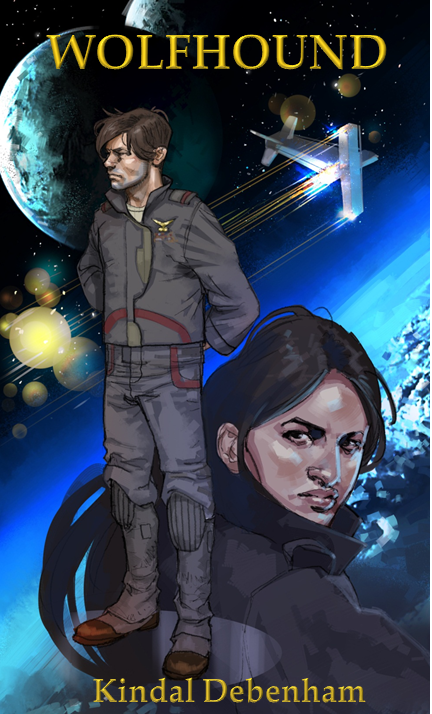
Wolfhound by Kindal Debenham

Jacob Hull may be just a spacer’s son, but he’s not afraid to dream big.  As an ensign in the Celostian Navy, his biggest dream is to pilot a destroyer like the Wolfhound, the brand new ship on which he receives his first assignment.  But when pirates attack on their training exercises and drive them far from the rest of the Celostian fleet, Hull realizes that his dream might be more than he asked for…

Full disclosure: Kindal Debenham is actually a good friend of mine–we were both members of Quark in college and still keep in touch as alpha readers for each others’ books.  That’s not why I’m saying that I loved this book, though.  I’ll admit, I had a few doubts when I first started it.  The descriptions are a little wordy, the formatting isn’t perfectly clean–but none of that really matters, because the story is AWESOME.

Why is it so awesome?  Because it’s full of characters you want to root for, facing one impossible conflict after the other, each one bigger and more daunting than the one before.  The story gets off to a decent start, but it really starts to take off after the first third or so, and just keeps getting better and better right up to the end.

Seriously, this is the kind of book I used to hunt for in the library as a kid.  It reminds me a little of the old Star Wars novels by Timothy Zahn, Kevin J. Anderson and Michael A. Stackpole.  Forget dark, dystopian futures and boring, high-concept stuff–this is some rip-roaring space opera, with stations you wish you could visit and starships you wish you could fly.

So yeah, I loved this book.  Great read; once I got into the second half, I couldn’t put it down.  If you’re a fan of space adventure stories, you should definitely check out this book.  It’s available from both Amazon and Smashwords as an indie published ebook, and it’s actually holding it’s own quite well on the Amazon bestseller lists.  It definitely deserves the spot!  Oh, and if you want to check out Kindal’s blog, you can find him here.

Why I’m not a fan of writing groups

I was listening to a recent episode of I Should Be Writing today, and it got me thinking about writing groups and how my philosophy on them has changed.  Long story short, I used to love them, but now I’m not such a huge fan.

I should probably start out by mentioning that I lead a college writing group for two years, and I don’t regret the experience at all.  The Quark writing group was extremely helpful, both in terms of my own growth as a writer, and the connections it gave me with other writerly people.  I still keep in touch with many of them.

But now…I just don’t think writing groups are all that great.  In fact, I think that they often do more harm than good, not just for experienced writers, but for the beginner who lacks the confidence to strike out on their own.  Here’s why:

The group dynamic gives inexperienced critiquers a false sense of authority.

Most writing groups consist of writers who are at roughly the same level of expertise.  For beginners, this means that the people critiquing your story might not know any better than you whether the story is broken.  However, because of the dynamics of the whole thing (captive audience, desire to impress peers, etc), these people are likely to act as if they have more authority than they really do.

To be fair, I’ve had plenty of critique partners who have managed to be modest and down-to-Earth when offering their critiques.  However, I’ve also seen plenty of others get puffed up and offer some really dumb advice.

Beginning writers often naively look for someone to show them the answers–some mentor or authority figure whose every word is true, who will light the path and show them the way.  Put a bunch of them into a writing group together, and more often than not you’ll end up with the blind leading the blind.

The weekly submission process does not simulate the reading experience.

Logistically, most writing groups have to set a limit on the size and number of submissions.  For the Quark writing group, our limit was three submissions of four thousand words each.  It worked out fine for short stories, but most of us were writing novels, which meant that we had to workshop our books in little four thousand word chunks.

The problem is that nobody reads novels at that rate.  Either they get hooked and finish the thing, or they get bored and stop reading.  Therefore, while the feedback you receive might be good for helping out with craft issues, by the time the next week rolls around either everyone has forgotten what happened already, or they remember it wrong, or they were expecting something different and are ticked off because they have to wait another week.

After I revised Bringing Stella Home a couple of times (after–see below!), I workshopped it through a writing group I’d put together after leaving the Quark writing group.  I can’t tell you how many times I heard “why are we in James’s point of view this week?  I hate James!  I want to get back to Stella!” I got this comment so often, for a while I thought the book was really flawed.  However, when I got the feedback from my first readers, no one had this problem at all.

The reason?  They read the book the way it was actually meant to be read.

Workshopping a work in progress is the surest way to kill a book.

Committees might be good at doing some things, but they’re absolutely horrible at producing anything innovative or original.  Make no mistake: if you’re workshopping something you haven’t already finished and you follow most or all of the feedback you receive, you’re writing your book by committee.

Most writers agree that when you write your first draft, you should not revise anything until it’s done.  This is because the act of revision makes you so critical of your own work that it’s very easy to get discouraged or “fix” something that was actually a good idea.

Workshopping a work in progress does exactly the same thing: it puts you in a critical frame of mind that will literally kill your book.  Even if you manage to finish it, it won’t be nearly as good as it could have been because you’ve probably nipped all your best ideas in the bud, before they had time to grow and develop.

A truly great book does not appeal to everyone.

There’s a word for something that appeals to everyone equally, that runs about middle of the road and doesn’t upset anyone.  That word is “average.”

No truly great work is loved by everyone.  This isn’t just true of controversial stuff–it’s true of everything.  For every one of your favorite books, there’s a one-star review of it on the internet somewhere.  So if everyone tells you your book is good, that might not actually be the case.  In fact, it’s a much better sign when some people hate it and others can’t stop raving about it.

The trouble with writing groups is that the group dynamic can lead to a herd mentality, where everyone goes along with the first opinion that gets expressed.  Ever played Werewolf?  The same thing happens there.  One person throws out an accusation, the vote gets called, everyone starts looking around to see who is raising their hand and before you know it, all the hands are in the air.

So unless one of the seven or eight people in your writing group loves your work enough to stand up and defend it, chances are the feedback will err on the side of being too negative.  This makes it very difficult to tell whether your story actually sucks, or whether it’s just above average.

Writing groups teach you to write to rules, not for readers.

One of the dynamics of writing groups is that they encourage people to find and latch on to certain writing rules, where people can say “this story is broken because of x” or “this writing is flawed because of y.” Over time, this becomes so ingrained that people stop reading to see whether the story actually works and instead read to see whether the story follows the rules.

The truth, however, is that there are no hard and fast rules when it comes to writing.  For example, you’ve heard of “show, don’t tell”?  Yeah, go and read Ender’s Game.  The entire book is one giant tell–and it’s brilliant.  It was the first sf novel to win both the Hugo and the Nebula awards in the same year, and has remained a perennial bestseller ever since.

Nothing hit this home for me more when the cryo scene excerpt from Genesis Earth won first place in the 2009 Mayhew contest at BYU.  Parts of the scene lapse from first person past tense to second person present tense, and the members of my writing group pointed that out as a major no-no.  However, even though it broke the rules, it worked well enough to win an award.

To be fair, there are some things that writing groups are very good for.  They can be a good way to learn the basics of craft (ie “the rules”), and they do give you a sense of community that can be very encouraging when you’re just starting out.  However, the drawbacks are so great that I don’t think I’ll ever go back.

Personally, I’ve moved from writing groups to a core group of first readers whose feedback I value and whose opinions I trust.  I finish my project, send them the entire manuscript with a deadline in which to read it, and thank them graciously for whatever feedback I receive.  Most of them aren’t even writers, in fact–but all of them are readers.  Most of them don’t know who the others are, and none of them ever see any of the feedback from the others.

Criticism is good; if you want to grow as a writer, you should welcome criticism and constantly solicit it.  But I do believe it’s possible to grow out of a writing group–or to succeed without ever being a part of one at all.
BSH blog tour and other random updates

Just a few things to get out of the way before returning to other things:

I’ve started the blog tour for Bringing Stella Home, and the first post was on my friend Kindal’s blog; you can find it here.  He asked me to blog about music and writing, so I shared some of my thoughts on that, as well as some of the songs that helped me to write Bringing Stella Home.  Kindal is an aspiring writer like me, and he’s got a lot of good stuff too, so you should definitely check him out!

Also, as part of the blog tour, I’m giving away free copies of my novella Sholpan at every stop along the way.  If you would like to pick one of those up, feel free; the coupon code on Kindal’s blog is good until next Thursday.  And for other updates and periodic giveaways, be sure to sign up for my newsletter in the sidebar.

I plan to keep more of a schedule for this blog tour, with posts going up every Monday and Thursday.  This coming Monday is at Mike’s blog, who is a frequent commenter here, and the blog after that is The Villain’s Worst Nightmare, where I’ll discuss the Hameji.  Good stuff–I’m looking forward to it!

I’m booked for the next couple of weeks or so, but I’m still looking to expand the tour, so if you would like to have me on either for an interview or a guest post, please let me know!  I’d love to come on as a guest blogger, no matter the size of your blog.

Also, for those of you who agreed to be first readers for Star Wanderers part I, I actually have a few changes I’d like to make before sending it out to you, which I’ll probably get done before the end of the month.  I’m almost a third of the way through another major revision for Desert Stars, so that’s taking up most of my energy now, but that shouldn’t take more than a couple weeks, and I want to get Star Wanderers ready to submit before the end of the quarter.

My next release, for those of you who are interested, will be a collection of journal entries and blog posts from the 2008 Jordan study abroad.  I’ll probably do it under a pen name, just to distinguish it from my science fiction stuff; how does J. Michael Waszik sound?  The original Czech spelling of Vasicek is Wasziczek, which is an insanely cool name but impossible for the average person to pronounce.  It’s the Z’s–you can’t get enough Z’s in a name, especially an Eastern European name.

In totally unrelated news, I noticed that this blog just surpassed 1,000 comments…and I was the 1000th commenter.  So yeah, I guess I owe myself a new car or something (but I’ll probably have to settle for a flashing GIF).

Anyhow, that’s it for now.  Thanks for reading, and I’ll see you around!

News, a correction, and an awesome AvB remix

Today I was supposed to finish the second draft of Sholpan, but I moved apartments this weekend, so everything got thrown completely out of whack.  I’m all moved into my new place now (with some awesome Quarkie roommates), but Sholpan is going to have to wait until Monday.

Fortunately, I’ve only got a couple of new scenes to write, then touch up the rest to make sure it fits the novella storyline.  I got in touch with my copy editor, and he should be able to have them for me by mid-September.  If all goes well, I’ll send it out to a couple of my first readers to give it a pass, make the fixes, and then send it out to Josh and have it up about a month from now.

I’ve gotten some amazing responses for “Memoirs of a Snowflake” in the past week, and it’s gotten almost 2,000 downloads on Amazon so far.  Not bad!  However, while rereading it, I noticed an error: in the author’s note, I said that I wrote the story in December of 2008, when really it was 2007.  I must have been thinking “winter of 2008” when I wrote it the first time.  In any case, I’ve made the corrections, so it should be up on Amazon in 24 hours, and all the other sites before the end of the month (since I distribute to them through Smashwords).

Also, another piece of encouraging news: the boss at the temp job I’ve been working the past few months wants to hire me!  If that works out, I should have steady work at least through into 2012.  I’m hoping they’ll let me work part time, since that would help me juggle the writing career a lot better, but this is their busy season so I might have to work 40+ hour weeks for a while.  Still, it’s better than starving.

Which reminds me: my first royalty check from Amazon comes in next month, and to celebrate, I’m going to crack open that bottle of Martinelli’s from Charlie and throw a small party.  More on that later.

Finally, I found this the other day while trawling youtube for good trance tunes.  It’s a remix of “Are We Human?” by the Killers, done by Armin Van Buuren.  Everything Armin touches seems to turn to gold, and this is no exception.  Check it out!

Character DTRs and other such stuff

Just a quick post before I go to bed.

The two main characters in WAFH just had a DTR (Define The Relationship discussion) and it was, well, kind of rough.  I don’t know what’s harder: having one in real life, or writing a fictional one that actually works.

I also don’t know which one I have more personal experience with, but that’s a subject I’d rather not get into right now.

Anyhow, even though that was an unexpected rough spot that had me down for the past few days, the end for WAFH 2.0 is definitely in sight.  I’ve got one more scene in this chapter, the big climactic end battle / rescue / whatever, and then a very short epilogue.  In all, that’s about seven scenes, two of which are already written and two others which I can probably glean from recycled material.

In unexpected news, I had a very interesting idea.  You know the Writers of the Future contest?  I always want to submit to them, but never can, because none of my stuff is short enough.  It’s acceptable to submit the first part of a novel–Dave Wolverton did that, with On My Way to Paradise–but only if the first part is a complete story in itself.

Well, as I was walking down the street, I wondered whether I could take one of my novels (like BSH) and eliminate all but one of the viewpoint characters’ scenes.  Specifically, I was thinking of doing that with Stella, who goes from prisoner to concubine to queen of a tribe of starfaring warrior nomads.  After cutting out all the other storylines and adding in a bit here or there to preserve continuity, it could make for an interesting novella.

Still, it’s going to be tough to get it down to the 17k word contest limit.  Stella is one of four major viewpoint characters, so her scenes probably take up at least 25k words in the book.  I might be able to cut out a couple of subplots, like the one with Gazan…but I dunno.  I’m open to suggestions from those of you who’ve read it.

In other news, I made the first cut for the 2011 Amazon Breakthrough Novel Award contest!  I submitted Genesis Earth in the YA category, and mine is one of 1,000 entrants that will go on to the next round of judging.  First place wins a $10k publishing contract with Penguin–yay!

I’m trying not to get my hopes up too much, but I’ll know whether I made the second cut by March 22nd.  A couple of friends from Quark also made it through the first round, so if any of us makes it to the second, that would be awesome.  Go Quarkies!

That’s about it for now; Brandon Sanderson did an interesting lecture in his 318 class on the new world of publishing, which was quite interesting.  I’ve got a LOT of new thoughts to share on indie publishing, but that will have to wait for another post.

Until then, keep being awesome…but not like this guy:

Deceptively unproductive day

Man, where did the day go?  I don’t feel like I was lazy, yet I only wrote about 1.2k words for the whole day.  And things were going so well the day before…

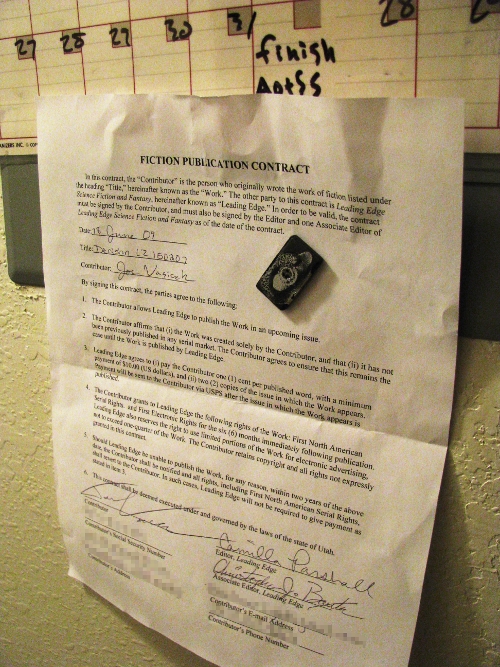
Well, I guess I was busy, just with a whole lot of other things.  Donated plasma (which took all morning), got some groceries, started GMing another round of werewolf on the quark forums, did some more research into ebooks, started the online TEFL course, went to Leading Edge and signed a contract for a poem they’re going to publish–

Oh yeah, check it out!  I signed my second publishing contract today–again, with Leading Edge.  They’re going t0 publish a short poem I wrote about Gliese 581g, otherwise known as Zarmina’s World.

(which reminds me, I’ve been meaning to blog about NASA’s Kepler mission since forever.  It’s an incredible mission which, I believe, will lead to some revolutionary astronomical discoveries–and may even rejuvenate interest in science fiction.  But more on that later…)

So yeah.  My goal is to finish WAFH before the end of February, which is going to require a lot of work.  Two and a half weeks, with LTUE 2011 sucking up one of the weekends…it’s going to be tough.

Numbers-wise, though, it’s still quite doable.  I want to keep this draft pretty close to 90k (no more than 100k), and I’m already at 53k words.  With sixteen days left in the month, I need to write between 2.3k and 2.9k words per day to make it.

In the meantime, it’s 2 am, and I’d better get some sleep. Waking up late is definitely bad for productivity, and I hate it. If I could train myself to wake up every morning at 5 am like Aneeka, that would be awesome. Actually, I’d probably just complain about how much it sucked to get up early every day, but hey–the grass is always greener…

Yet another reason why I love Quark

For those of you who may not know, quark is BYU’s science fiction and fantasy club.  I had the good fortune of being one of the club’s vice presidents for two years while I was a student, and I still keep in touch with a ton of friends from that group.

One of the funnest things about quark is the online werewolf games–currently, I’m GMing a round based on Interstella 5555.  Recently, Jerle and I decided to put together a database of all 49 rounds that we’ve played over the years, compiling player stats, setting up rankings, and other such nerdy things.

While I was going across some of the older threads, I came across this amazingly hilarious premise for round fourteen:

In the year 1815 Napoleon conquered Russia.
In 1817 he conquered China.
By 1830 he was the ruler of continental Europe, Asia, and parts of Africa that were interesting.
In 1834 he invaded Antarctica and defeated the United Federation of Penguins and Polar Bears.
His successor sent ships to conquer America and England, and succeeded, but not without a fight.

The year is 2015.
The entire world speaks either French or English, or, more likely, some mixture of two.
A great scientist has invented a Time Machine.
The only hope for penguins and polar bears is to infiltrate high-security research facility in New Paris, use the device to go back in time and present a plush toy of a penguin to young Napoleon. A rogue rebel Greenpeace group assists the penguins/polar bears.

The research facility is guarded by an elite team of 15 highly-trained frenchpeople. Through great ingenuity Greenpeace was able to replace three of them with its agents. Those three must kill everyone else and use the time machine.

There is also a rumor that one of the elite guardsmen has been replaced by a clown.

Playing:
Avulsion 7
Baggins 17
Beatobur 13
Cardasin 20
Child 10
Daen 17
Drek 5
Fezzik 11
HER0 0
Jerle 13
RamenSensei 1
SilverStorm 19
Sunstarr12 16
Thundershorts 12
Turin_Turanbar 0

3 Greenpeace members, 1 DGSE detective, 1 team medic, 1 clown.
And 9 FRENCHPEOPLE!

RULES

NIGHT.

Awaiting requests.

Hehehe…these are sooo my people!

“The Class That Wouldn’t Die” is up!

Just a heads up: the latest issue of Mormon Artist magazine is out, and my article about BYU’s “class that wouldn’t die” is in it! What’s more, Orson Scott Card himself commented on it.  Squeeeee!!!

If you’d like to read the full article, you can find it hereMormon Artist is published online for free, so be sure to check out the rest of the issue too.

A huge thanks to all the people who helped me out with the research–and an apology to those I should have gotten to, but ran out of time and space to include them.  My goal in writing this was to collect as many oral histories and primary sources as I could find, and put it in a context where the people who were there could tell the story themselves.  I hope I’ve done that without making too many factual errors, but if I have, please let me know.

Also, I would like to personally thank everyone who was a part of Xenobia and the class that wouldn’t die–the people who started LTUE, Leading Edge, and Quark, which have become the bedrock of BYU’s thriving sf&f community.  Thank you so much–all of this stuff has greatly impacted my life, helping me to connect with like-minded friends and to grow tremendously as a writer.  We really do stand on the shoulders of everyone who’s come before, so thank you!

Squeeeeeee!!!!!