2024 Predictions for the Publishing Industry

I started working on this post over the Christmas break, but then things got so busy that I never got around to writing anything more than the section headings. The year is still young, though, so I figured it was worth posting it anyway, even if only as a list of bullet points.

  • The courts will side against authors and publishers, in favor of OpenAI and generative artificial intelligence.
  • Amazon will use self-published content to create an LLM or other generative artificial intelligence.
  • We will not see an AI-assisted novel break out and become a bestseller this year…
  • …but we will see generative AI used to power a new book recommendation engine that will outperform everything currently out there.
  • Censorship and book banning will accelerate and become more flagrant.
  • The gap between bestsellers and midlisters will grow.
  • Book sales overall will decline, unless a new pandemic is declared.
  • A surprising number of authors will find success with their online stores, though we probably won’t hear about that.
  • The long, slow decline of Amazon’s prominence in the book industry will become a talking point.
  • By the end of the year, AI-assisted stories will garner public interest as more than just a novelty.

The Generational Cycles of Grimdark vs. Noblebright

A couple of months ago, I was discussing genre trends with my indie publishing mastermind group where we drew some fascinating connections between grimdark fantasy, noblebright fantasy, and Strauss-Howe generational theory. In that discussion, we came up with a theory that predicts when each type of fantasy (grimdark, nobledark, noblebright, and grimbright) will be ascendant, and explains exactly why. According to this theory, grimdark is currently in the beginning phase of a multi-generational decline, and will be replaced by noblebright as the ascendant form of fantasy by about the mid-2030s.

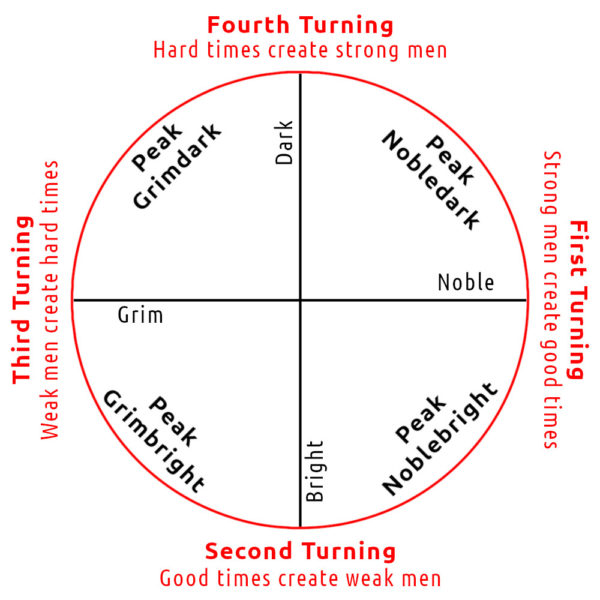
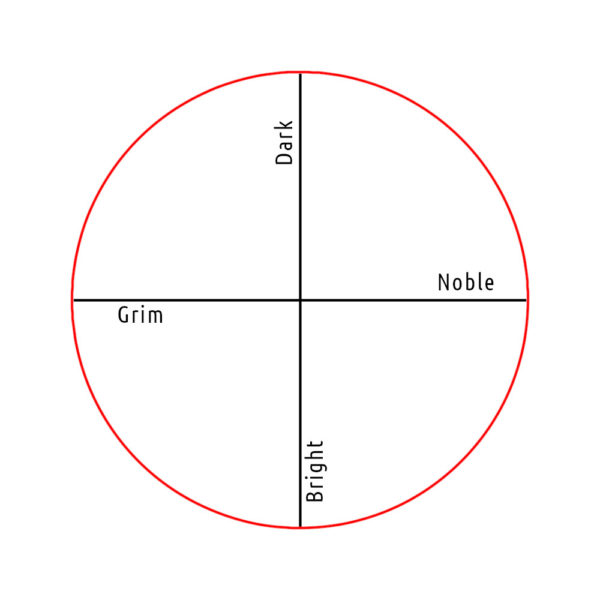
To start, we need to understand the difference between grimdark and noblebright. Both forms of fantasy exist on a field with two axes: noble vs. grim and bright vs. dark.

The bright vs. dark axis describes whether the fantasy takes place in a world where good usually triumphs over evil (bright), or a world where evil usually triumphs over good (dark).

The noble vs. grim axis describes whether the characters have the power to change the world (noble), or whether they do not (grim).

Thus, with these two axes, we get the following combinations:

  • Noblebright: A fantasy world where good usually triumphs over evil and the characters have the power to save it.
  • Grimbright: A fantasy world where good usually triumphs over evil, but the characters aren’t on a quest to save it and are usually preoccupied with smaller concerns.
  • Grimdark: A fantasy world full of moral shades of gray, where evil usually triumphs over good and the characters are either anti-heroes or otherwise fail to save the world.
  • Nobledark: A fantasy world where evil usually triumphs over good, but the characters are empowered to change it.

These categories are subjective to some degree, and fans will often disagree about which category to put each book/series. However, I think that most fans will agree on the following examples:

  • Noblebright: The Chronicles of Narnia by C.S. Lewis
  • Grimbright: The Princess Bride by William Goldman
  • Grimdark: A Song of Ice and Fire by George R.R. Martin
  • Nobledark: Lord of the Rings by J.R.R. Tolkien

Next, let’s review in the broadest possible terms William Strauss and Neil Howe’s generational theory. To really understand their work, I highly recommend that you read The Fourth Turning. I have some criticisms of the finer nuances of that book, but their ideas are really excellent, and their predictions hold up surprisingly well three decades later.

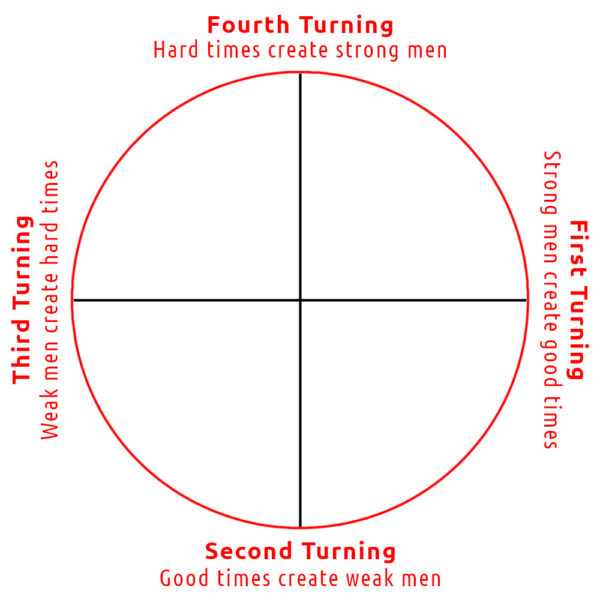
If I had to boil their theory down to one simple, easy-to-understand statement, it would be this:

Strong men create good times.

Good times create weak men.

Weak men create hard times.

Hard times create strong men.

Thus, our society and culture passes through a secular cycle that takes about 80-100 years to complete (or in other words, the length of a long human life). The cycle has four seasons, or turnings, each one corresponding to a generational archetype (since it takes about 20-25 years for people born in the one turning to start having children of their own, thus moving us into the next generational turning).

The first turning happens when the society comes together after resolving a major crisis (eg the Revolutionary War, the Civil War, World War 2) and builds a new, stable order. The second turning happens when their kids rebel against that order, seeking freedom (eg the First and Second Great Awakenings, and the various counterculture movements of the 60s). The third turning happens when the order breaks down completely and everyone goes their own way (eg World War I, the Roaring Twenties, and the culture wars of the 90s). Finally, the fourth turning happens when the society faces a major existential crisis that totally reshapes it.

According to the theory, each axis of the grimdark/noblebright field corresponds to a different generational turning. Thus, stories that are noble have the most resonance in a first turning, stories that are bright have the most resonance in a second turning, grim stories resonate most in a third turning, and dark stories resonate most in a fourth turning.

In other words, the generation that comes of age during a major existential crisis will tend to gravitate more toward fantasy where evil typically triumphs over good, whereas the generation that comes of age during a period of rebuilding will tend to gravitate more toward fantasy where the characters have the power to change the world. And so on for bright and grim stories: the generation that comes of age during a spiritual awakening will gravitate more toward stories that take place in a world where good usually triumphs over evil, and the generation that comes of age in a declining and/or decadent society will gravitate more toward fantasy where the characters are relatively powerless.

Another way of thinking about it is to consider what each generation is not going to be drawn to, or which stories are not going to resonate well. An American who came of age in the 40s and 50s, when US power was on the rise and the Pax Americana was reshaping the world, isn’t going to resonate well with grim stories about powerless characters. Likewise, a boomer who came of age during the counterculture movements of the 60s and 70s isn’t going to resonate well with a dark fantasy world where evil usually triumphs, because (as much as they hate to admit it) they grew up in a very sheltered world that generally made sense—so much so, in fact, that they couldn’t help but rebel against it.

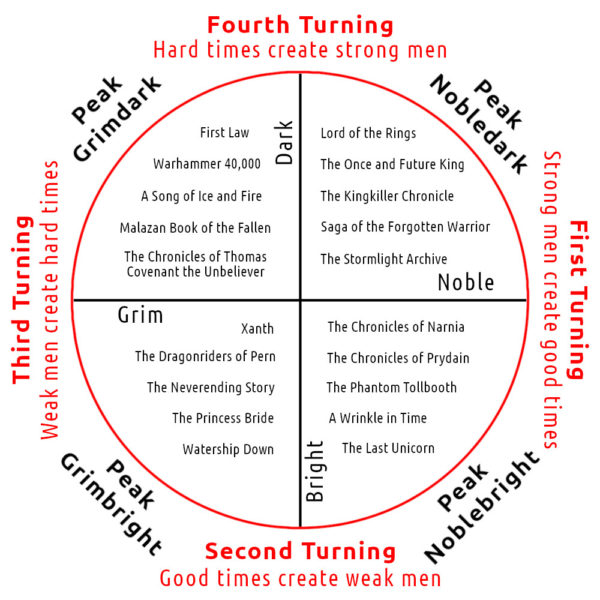
According to this theory, the next generational turning begins when one of the four forms of fantasy (noblebright, grimbright, grimdark, or nobledark) is at a peak. Over the course of the turning, that fantasy form declines until the next form in the cycle becomes ascendant, at which point the next generational turning begins.

Thus, at the start of a first turning, nobledark stories are typically ascendant, where the fantasy worlds are dark and morally gray, but the characters are empowered to save the world. As that generation successfully establishes a new order, the culture’s taste in fantasy shifts away from dark stories and toward noblebright stories, where the characters are still empowered but the world is more ordered and stable.

At the start of the spiritual awakening that characterizes a second turning, noblebright fantasy is ascendant: stories with an optimistic outlook on the world where the characters are larger than life. But as the awakening progresses, people in the society care more about freedom and individuality and less about the group, so stories about characters who sacrifice everything to save their world resonate less with them. Thus, by the end of the second turning, the ascendant form of fantasy is grimbright, which is really more of a slice-of-life fantasy about beloved characters having fun (but not world-altering) adventures.

At the start of a third turning, where the social order has started to break down and corruption begins to permeate all levels of the society, these grimbright stories start to take a darker tone. Readers find it too “unrealistic” to believe that good always triumphs over evil, and they certainly do not believe that good people have the power to change the world—at least, not the “smells like teen spirit” world that they inhabit. Their tastes shift away from the fun, adventurous slice-of-life of grimbright, and toward the dark and gritty anti-heroes of grimdark.

Finally, at the start of the fourth turning, grimdark is ascendant, but readers are starting to lose patience with it. As each new crisis in the real world compounds with all the others, they find it unbearable to read about characters that don’t have the power to change the fantasy worlds they inhabit. At the height of the fourth turning, society reaches an existential breaking point where, in the words of Strauss and Howe, “all of [our] lesser problems will combine into one giant problem, [and] the very survival of the society will feel at stake.” (The Fourth Turning, p277) At this point, readers are ravenous for books about characters who are empowered to fight back against the tides of evil and darkness. Grimdark fantasy declines and nobledark fantasy ascends.

I haven’t read all of the series in the diagram above, but I do have a pretty good sense of most of them, and I put the diagram together with the help of my mastermind group. The key thing about it is that each fantasy series came out in roughly the generational turning that corresponds with each quadrant.

Now, it’s worth pointing out that these trends aren’t absolute. In each of the secular seasons, you can find examples of contemporary fantasy that runs counter to trend. For example, David Gemmell’s Drenai Saga came out in the 80s, at the start of the last third turning when grimbright should have been ascendant, and yet the Drenai Saga is solidly nobledark. Terry Pratchett’s Discworld books had their heyday in the 90s, 00s, and arguably 10s, but they probably fall into grimbright (though you could make the argument that, as absurdist fantasy, they are more similar to grimdark: stories where good and evil really doesn’t matter, and the characters are just doing their best to go along).

But the theory doesn’t state that each fantasy form’s antithesis dies completely when that form is ascendant: only that it reaches a nadir of decline in its resonance with the culture. But without sufficient contrast, the ascendant form cannot stand out. Thus, there still has to be some noblebright Paolini to provide sufficient contrast with the grimdark of Abercrombie and Martin, some low fantasy slice-of-life Legends and Lattes grimbright to make the epic nobledark high fantasy of Sanderson stand out stronger.

According to this theory, as we continue to muddle our way through this present fourth turning, the decline of grimdark fantasy will accelerate, and the bestselling fantasy books of the 2020s will mostly be nobledark. And indeed, we can already see that happening with the meteoric rise of Brandon Sanderson (especially his Stormlight Archive series), the popular enthusiasm surrounding Larry Correia (whose Saga of the Forgotten Warrior falls squarely into nobledark), and the enduring anticipation of Patrick Rothfuss’s fans for the conclusion to the Kingkiller Chronicle. Meanwhile, enthusiasm for George R.R. Martin has waned significantly with the train wreck of Game of Thrones, and Abercrombie, though still quite popular, seems to be testing the nobledark waters with his YA books.

It would really be interesting to do a deep dive on the generational archetypes and make a study of how that affects the fantasy forms that run counter to the cycle. But that’s beyond the scope of this blog post, and frankly I need to get back to writing my own books. But what do you think of this theory? Does it resonate with you, or is there something that we missed?

Algorithms, social media addictions, and the endless churn of content

In the last 5-6 years, I’ve noticed a shift in most of the media content that I consume. Content has proliferated at an unprecedented rate, and the churn—or the rate at which new content pushes out old content—has become one of the driving factors for those of us trying to make our careers in this way.

We see it on YouTube, where three or four adpocalypses have massacred various channels, and where copystrikes have become part of the game. YouTubers who don’t put up content every day, like Tim Pool or Pewdiepie, quickly lose views and subscribers even when they do put up new content.

We see it in video games, where companies like Paradox are now making the bulk of their money on DLCs, some of which make the vanilla version almost unplayable. Back in the 90s, a game was a game was a game. You could get expansion packs for some of them, but that was just bonus content, not a core part of the gaming experience, or the business model.

It’s a huge issue in journalism, where the news cycle has accelerated so much that weeks feel like months, and months feel like years now. Remember the Kavanaugh hearings? That was less than a year ago. The Covington kids controversy happened this year. Everyone is in such a race to break the story that the quality of journalism has fallen considerably, but by the time the corrections come out, the news cycle has already moved on. Fake news indeed.

The churn has also become a major thing in the indie publishing scene. For the last few years, the established wisdom (if there is any) is that you need to publish a new book about every other month—preferably every other week—to keep your entire catalog from falling into obscurity. There’s a 30-day cliff and a 90-day cliff, at which points the Amazon algorithm stops favoring your books over new ones. And now, to complicate things, AMS ads are taking over from more organic book recommendation methods, like also-boughts. The treadmill is real, and it’s accelerating.

I’ve been thinking a lot about this, and I can think of a few things that may be driving it. I don’t have any statistics or firm arguments to back it up yet, just a couple of hunches, but it’s still worth bringing them up to spark a discussion.

First, social media has taken over our society, not only in public life, but in personal life as well. Now more than ever before, we use Facebook, Twitter, Instagram, Snapchat, and other social media to interact with each other. The problem is that these social media sites are incentivized to get us addicted to them, since we are the product they sell—our data, our time, and our eyeballs. Every like is another dopamine hit. Every outrageous headline is another injection of cortisol.

We have literally become a society of drug addicts. The drugs may be naturally produced by our bodies, but big tech has figured out how to manipulate it like never before. And as addicts, we are always looking for our next hit.

That’s not all, though. There’s a feedback loop between the end-users who consume content, and the algorithms that deliver content recommendations to the end-users. When something new gets hot on social media, the algorithms act as a force multiplier to drive it even further. But because of our addiction, and the fact that we’re constantly looking for the next hit, things can fall off just as quickly as they rise. Hence the churn.

It’s also a function of the massive rate at which content is proliferating across all forms of media. I’m not sure how many millions of English-language books are published any year now, but it’s much, much more than it was back when tradpub was the only real game in town. Same with videos, music, news blogs, etc. With so much new content coming out all the time, and so many people on social media ready to share it, the conditions for churn have never been stronger.

But there’s another, more sinister aspect to all of this, and it has to do with the biases of big tech and Silicon Valley. Yes, there is a feedback loop that governs the algorithm, but it goes both ways: the people who write the algorithm can, within constraints, use it to reprogram all of us, or even society itself.

I don’t think it’s a mistake that the churn is worse on sites that are run by big tech, or worse on content creators who depend on the platforms that big tech provides. The authors experiencing the worst burnout all seem to be exclusive with Amazon and Kindle Unlimited, and news sites that are getting hit the worst now (Vice, Buzzfeed, etc) all depended on clickbait tactics to ride the Facebook algorithm.

There are a few content creators who seem to have escaped the churn. As a general rule, they seem to be scaling back their social media usage and developing more traditional income streams, like subscriptions, sponsorships, and email lists. Steven Crowder, Tim Pool, and Pewdiepie are all examples. A few of them, like Alex Jones, Carl Benjamin, and Paul Joseph Watson, are learning how to swim by getting tossed in the deep end. Big tech has deplatformed them, but they’re learning—and showing to the rest of us—that it’s possible to make your own path, even when all the algorithms conspire against you.

I recently listened to a fascinating interview on the Jordan Peterson podcast, where he talked with Milo Yiannopoulos. Milo fell out of the public sphere when allegations of pedophilia emerged, getting him banned from CPAC in 2018. His career isn’t over, though, and his future prospects look quite bright, especially with the plan he’s been putting together. If he succeeds, big tech and the algorithms will never be able to touch him.

In my post a couple of days ago, I argued that one of the unique advantages of books over other forms of media is that they are timeless. As Kris Rusch puts it, books aren’t like produce—no matter how long they sit on the shelf, they don’t spoil. We are still reading books that were written centuries ago.

If that’s true, then there must be something about books that makes them resilient to churn. In fact, books may be the antidote to churn. That’s basically Jeff VanderMeer’s thesis in Booklife. It’s also worth rereading Program or Be Programmed by Douglas Rushkoff, where he offers some helpful rules to keep social media and the algorithms from completely taking over our lives.

So as indie writers, what’s the best way to deal with all of this? I’m not entirely sure. Back in 2011 when I first started indie publishing, slow-build and long-tail strategies seemed a lot more viable than they do now. But if there is something inherent in books that makes them the antidote to churn, then there has to be a way to take advantage of that.

I’ll let you know when I find it.

Rethinking free

I recently read an interesting blog post on Dean Wesley Smith’s blog, about how, how not, and whether to make your books free. The conclusion he comes to is this:

Free is short time, limited supply, and never on the major bookstore shelves.

In other words, no permafree, no free pulsing, and no publishing free online content on sites like InstaFreebie unless it’s for a limited time.

Three or four years ago, I probably would have pushed back pretty hard against this advice. There are still points of it that I disagree with, such as the idea that giving anything away for free devalues all your other work. Perhaps that’s true for physical product, but for digital content I think there’s a solid argument to be made that the rules have changed.

That said, a lot has happened in the last three or four years. Permafree worked really great until about the middle of 2014, at which point I noticed that it was a lot harder to generate any kind of interest in my free books. I switched to a free pulsing strategy in 2015, which was a lot more effective at giving away free books, but that didn’t always translate into more sales.

In fact, there’s a passage from Dean’s blog that sums it up real well:

A customer walks through your door and you have a wall of twenty pies in glass cases, all the smaller short story pies in a case in the center, and some specials near the cash register.

And there on your wall are three pies that say, “Free.”

And a bunch of short stories that are “Free.”

The customer can take an entire pie for free or buy one. As a customer, what would you do? Duh. You take the free pie and leave.

And pretty soon your customers start to change. The only people who come through the door are people who only want the free stuff. They would never buy something under any circumstances, but you are giving your pies away for free, so they take one.

Pretty soon there would be lines out the door to get your free pies and you would make nothing. The free takers would crowd out and devalue the pies you are trying to sell.

Now, I don’t entirely agree with Dean here. My 90-day sales chart on Amazon shows a predictable uptick in sales every time I set a book free and send out an email to my list. Most of my subscribers signed up through InstaFreebie, which means they’re probably not quite fans yet (and probably signed up for a bunch of authors’ lists).

But my long-term data tends to agree with Dean. Back in 2012 and 2013, there was a very clear correlation between free downloads and royalties / paid sales. Then, in 2014, that correlation started to become fuzzy. Over the next several months, it got progressively fuzzier (even though I was giving away more books), until today there’s really no correlation at all.

Obviously, YMMV and I can only speak for my own books. But there have been a lot of major shifts in the ebook market over the last five years. Kindle Unlimited has had a huge impact on the effectiveness of permafree, or any kind of free book strategy for that matter.

Point is, it may be personally useful to rethink my free strategy. I’m not going to stop doing the free book thing altogether, since I do think there’s still value to it (if for no other reason than that little sales bump, plus the handful of “thank you!” responses I get from my email subscribers each month). But instead of free pulsing two books each month, usually including a first-in-series novel, it may be better to do a 99¢ novel and a free short story.

The two biggest mistakes I’ve made so far in my writing career have been 1. underpricing my books, and 2. unpublishing books that were still selling. (I still can’t believe how stupid I was) Holding onto a free books strategy that isn’t working could easily become a close third. I’m not going to throw the bus into reverse while it’s barrelling down the highway at 70 mph, but some experimentation and a course correction may be in order.

Things I’ve learned from STAR WANDERERS

Star Wanderers I (thumb)Star Wanderers II (thumb)Star Wanderers III (thumb)Star Wanderers IV (thumb)SW-V Dreamweaver (thumb)SW-VI (thumb)SW-VII Reproach (thumb)

When I published the first couple installments of Star Wanderers, it represented both an experiment with a new publishing format and a departure from the more long-form styles that I was used to.  Now, a little over a year later, I can say it’s been a success.  The series isn’t finished, and I’m still learning as I go, but here are some of the big lessons that I’ve picked up:

Novellas are surprisingly well-suited to series. They read fairly quickly, contain enough focus to sustain an episode of a larger story, and yet at the same time contain enough space to develop a wider arc.  Plus, they are a lot quicker to write than novels and generally don’t require as much editing, since it’s easier to get the story right on the first pass.  This means that you can put out novellas faster and more regularly than long-form novels, maintaining good momentum for the series as a whole.

It’s hard to write anything shorter than a novella without leaving readers unsatisfied.  By far the biggest criticism I’ve received for Outworlder (which is really more of a novelette than a novella) is that the story feels too short.  If the novella (17,500 to 40,000 words, or 80 to 150 pages) has all the benefits of the novel and the short story, then it seems that the novelette (7,500 to 17,500 words, or 30 to 80 pages) has all of the drawbacks.  Then again, it could just be that I have yet to master the form.

The satisfying element in a series is at least as important as the returnable element.  Every successful episodic story has some sort of returnable element–something about the story that makes the audience ravenous for more.  Often, this takes the form of a cliffhanger, leaving something unresolved.  However, it’s not enough just to string readers along, holding back whatever your story has promised them.  In every installment, you have to deliver.

It’s a delicate balance, to be sure, but the advantage of erring on the side of satisfaction is that the satisfaction can actually become a major hook in itself.  If readers know that they’re going to be satisfied whenever they pick up one of your books, you don’t have to ratchet up the tension to eleven in order to keep them coming back.  Several Star Wanderers reviews mention that it’s more relaxing and not as fast paced as other space opera, but sales of parts III through VI are almost 1:1.

Readers love to revisit a good story from another character’s point of view.  Some of the most glowing reviews I’ve received for this series are for Dreamweaver, which is basically a parallel novella to Outworlder but from Noemi’s point of view.  In Outworlder’s Amazon also-boughts, it sometimes even appears ahead of Homeworld, which actually comes before it in the series order.  This tells me that readers love to revisit a story, or to hear the same story again but from a different point of view.  Head-hopping from episode to episode can be a great way to add variety and depth.

Plenty of readers are willing to pay $2.99 per book for a series they enjoy.  When I published the omnibus for Star Wanderers I-IV, I wondered if sales of the individual novellas would taper off since I priced the omnibus much lower than their sum.  To my surprise, sales for both the omnibus and the individual installments have actually remained about even.  Since the omnibus clearly shows up on Amazon’s recommendations, this tells me that $2.99 is not too high of a price, even for a novella.

Perma-free works; however, free and $.99 attract some bad apples.  Do not underestimate the power of free, especially perma-free for the first book in a series.  I credit that strategy for at least 90% of the Star Wanderers sales, since the series itself has boosted my total sales numbers by more than an order of magnitude.  However, there are people out there who never fail to find something to complain about.  These are usually the same people who don’t like to pay for anything, and when they realize that the rest of my series is not free, they tend to leave unhelpful and/or incomprehensible reviews.

I priced Fidelity at $.99 to try to give readers more of a hook from part I to part II, but the sales ratio between part II (Fidelity) and part III is about 2.5:1–in other words, pretty bad.  Judging from some of the reviews, it seems that a fair number of the people who are dropping out are the bad apples.  I haven’t decided whether to raise the price, but if things keep going the way they have been, I probably will.

Series don’t usually take off until the third or fourth installment.  Do you know how many sales Outworlder had in the month when I first published it?  About 10–and that was actually a surprise.  When I published Fidelity, I had even fewer, and Sacrifice hardly sold anything until Outworlder went perma-free.  When it did, sales of the other two novellas picked up, but it wasn’t until after I’d published Dreamweaver that the sales of Fidelity started hitting triple digits.  The lesson to me is clear: it takes time for a series to pick up steam, so don’t be like Fox.  Give it a chance to grow.

Nothing sells a book like writing and publishing more books.  This is probably the main driving factor behind the last point.  I’ve done almost no promotion for Star Wanderers, other than putting out new books on a fairly consistent basis.  Amazon’s algorithms have probably done their part (sales on other outlets haven’t been growing nearly as much), but at the end of the day, there is no substitute to writing more and better books.  Any sort of promotional or marketing activity that takes away from my writing time is just not worth it–not when I’ve got stories to tell.

Right now, I’m getting ready to start a new spin-off series, which hopefully will be even more successful.  I’ll to try out a few new things (mostly along the lines of better covers and meatier novellas), but mostly, I’m going to try to replicate the success I’ve achieved with Star Wanderers by keeping these lessons in mind.  I have no idea how this new series is going to go, but I figure I know enough about the publishing side now that I can focus my attention on writing an awesome story, which is the most important thing after all.

Z is for Zenith

pioneer_book_scifiHas space opera passed its zenith?

Sometimes, it certainly looks that way.  All the major stuff seems to be reprints of past series and reboots of decades-old franchises.  Star Trek, Star Wars, Stargate, Battlestar Galactica, Ender’s Game, Dune, Babylon 5–all the big names seem to have had their start at least a generation ago.  At any science fiction convention, you’re likely to see more gray-haired men than kids in their teens and twenties.  And if you go to a publishing conference, new adult, urban fantasy, and paranormal romance are ascendant.

I’ve noticed that people are using the term “science fiction” increasingly to describe stories that don’t have anything to do with space.  Dystopian, post-apocalyptic, steampunk, even time travel–all of these subgenres are certainly part of the fold, but they’re very different from the stories about starships and alien worlds.  And then you have all the markets for short fiction that have been forced out of business–and even a few larger publishers, like Night Shade Books which is now selling off all its assets (read: authors) to avoid bankruptcy.

I remember going to World Fantasy 2010 in Columbus, Ohio, and feeling dismayed at the complete lack of science fiction.  World Fantasy is (or was, at least) the premier professional conference for speculative fiction literature, but all of the attention was going to urban fantasy and steampunk.  On the freebie table where publishers often dumped ARCs and review copies of their books, the only space opera stuff I really saw were a couple of titles by Glen Cook and one other guy–and I watched that table hawkishly for the full three days of the conference.

Sometimes, it seems as if it would be so much better if I had grown up in the 80s.  That’s when science fiction really had its heyday.  But all through the 90s, the genre seems to have been on the decline, much like NASA and the US space program.

So is space-centered science fiction on the way out?  Have we passed the glory days, and it’s now just a long decline until it becomes an obscure niche, beloved by some, but enigmatic to others?

In spite of everything I said above, I actually don’t think so.  In fact, I think we’re on the cusp of a science fiction renaissance, and that sci-fi geeks like myself will look back twenty years from now and wish that they were born in our era.  Here’s why:

1) Scientific discoveries are transforming the way we see the universe.

The day I posted P is for Planets, NASA’s Kepler mission announced the discovery of three Earth-like worlds orbiting in the habitable zones of their stars.  The existence of alien Earths is not conjecture–it’s a confirmed fact.  As our ability to study these worlds improves, it’s only a matter of time, IMO, before we find a world that has life.

We’ve discovered the Higgs-Boson.  We’re unraveling the fundamental building blocks of the universe.  We’ve built telescopes to look back to the dawn of time itself, and we’re learning more about the cosmology of the universe every year.  Perhaps even more remarkably, we understand now how little it is that we actually know–that the entirety of the observable universe is only about 5% of it, and even that’s optimistic.

All of this will take time to trickle down to the popular consciousness, but with all the new discoveries that are happening, I think that’s already in the process of happening.  In particular, I think the recent discoveries in the realm of exoplanets and astrobiology are going to shake things up in a major way in the next five or ten years.

2) The privatization of space travel is paving the way for a rapid expansion into space.

The US space program has been plagued with funding problems since at least the end of the Cold War space race.  Since the space shuttle program was retired just last year, the only way for our astronauts to get into space is through the Russian Soyuz spacecraft at Baikonur.  If NASA had to put a man on the moon, they do not currently have the knowledge or technology necessary to do it.

In the private sector, though, it’s been a very different story.  SpaceX has had a number of successful launches recently, most notably sending the first unmanned resupply capsule up to the International Space Station.  And just a couple days ago, Virgin Galactic had the first successful test flight of its rocket-powered spacecraft.

It’s sad to see the space shuttle go, but there are a lot of reasons why the program was flawed and inefficient to begin with.  By handing things off to the private sector and turning space exploration into a viable business venture, we can hopefully overcome those inefficiencies and eventually make space accessible to the general public.

And then you have the organizations like Mars One that are looking even further ahead to the colonization of Mars.  There’s a groundswell of excitement for Martian colonization that is starting to get some real money behind it.  Will it go anywhere?  It’s hard to say right now, but even if it suffers another decade or two of setbacks, it’s getting public attention, especially from the younger generation.

3) Video games are bringing a fresh new look and feel to the genre.

Not all of the big sci-fi series hail from 70s and 80s.  Halo started up as recently as 2001, and it’s a multi-billion dollar franchise with games, books–even Legos.  In fact, there are lots of sci-fi video game franchises right now, many of them right on par with other classic space opera.  Just look at Starcraft, for example, or Mass Effect, or Eve Online and Sins of a Solar Empire.  The number of sci-fi games has been exploding.

In fact, this explosion has been happening for some time.  While literary science fiction may have suffered something of a decline back in the 90s, that was the heyday of games like Master of Orion and Sid Meier’s Alpha Centauri.  Flight simulators like Flight Commander and X-wing proliferated like crazy, while even some of the classic RPGs like Final Fantasy borrowed heavily from science fiction tropes.  And those are just a few of the games that I can list off the top of my head!

Whether or not literary sf is on the decline, a whole new generation has been introduced to the genre through the medium of video gaming.  This is not just a small niche audience playing this stuff, either–in the US at least, Halo is as mainstream as Monopoly or Settlers of Catan.  In fact, you could say that science fiction is more mainstream now than it ever has been, and a lot of that is due to sci-fi video games.

4) The e-publishing golden age is giving us thousands of new voices.

But what about the world of literary sf?  Are we in a decline?  Do people just not read science fiction anymore?  How bright is the future for science fiction literature?

Actually, this is the area where I’m the most optimistic of all.

The publishing industry is changing at the speed of light, much in the same way that the music industry changed about a decade ago.  Just as the MP3 revolution allowed all sorts of eclectic yet entrepreneurial artists to thrive without the oversight of record labels, the epublishing revolution is opening all sorts of doors for the enterprising author.  And while the changes are driving publishers (such as NSB) out of business, they are enabling authors who only sell in the mid-list range to make a respectable living.

At Worldcon 2011, Ginger Buchanan (senior editor at Tor) asserted that there has never been a runaway science fiction bestseller.  In the eyes of New York publishing, that may be true–but New York has a notorious record for missing the catch in pursuit of one big fish.  Because of epublishing, whole new genres like New Adult that publishers thought would never sell are now going mainstream.

And even the niches that stay niches are becoming quite lucrative for the authors who can build a decent following.  When author cuts out the middlemen and develops a direct relationship with the readership, it only takes a thousand true fans or so become a financial success.  As Kris Rusch pointed out so aptly, those numbers may bring only scorn from New York, but for the writers who actually produce the content, that’s a vein of pure gold.

I can’t tell you how many success stories I’ve heard from fellow sci-fi writers over on the Kindle Boards, who started just for the grocery money and ended up quitting their day jobs.  But as Hugh Howey pointed out, the runaway bestsellers are not the true story of the epublishing revolution–it’s the little guys who only sell a few hundred copies a month but are earning enough to support themselves writing what they love.

Indeed, we’re already starting to see an explosion of new science fiction, thanks largely to the ease of electronic self-publishing.  I’ve only read a few of them so far, but Nathan Lowell stands out among them, as well as my good friend Kindal Debenham.  These guys and so many others are bringing a fresh new voice to space opera, revitalizing the genre in ways that simply weren’t economical back in the days of Big Publishing.

So even if space opera as a literary genre isn’t quite large enough to go mainstream, it is large enough to support a wide range of new voices under the emerging business models.  And as the epublishing revolution continues to mature, I think we’re going to see a new golden age comparable to the era of the pulp adventure stories.

I’ve been publishing my own work since 2011, and I can attest that there’s never been a better time to be a writer.  I’m not quite making enough to go full-time yet, but at the rate things are going, it will only be a  year or two before I realize my dream of making a living telling stories that I love.  And if they’re the kind of stories that you love too, then that’s great news for all of us!

So has science fiction reached its zenith?  I don’t think so.  It went mainstream about a generation ago, which was definitely a huge moment, but for the last few decades it’s been in the process of branching out and rediscovering itself.  Right now, I think we’re on the verge of a wonderful new renaissance that is going to blow us all away.  As a lifelong reader and writer of science fiction, I certainly hope that’s the case.  And because of the reasons listed above, I sincerely believe that it is.

LTUE 2013

Man, LTUE 2013 was this weekend, and it was AWESOME.  One of the best conventions I’ve ever attended.  I spoke on my first panel, attended my first book signing event as an author, and got to meet up with some old friends, as well as some amazing new people.

Since I live tweeted most of the panels I attended, I thought it might be interesting to repost a few of those here, with some additional thoughts.  So…here goes!

THURSDAY

I believe this was Scott Parkin from the “What Do You Write?” panel. Good advice. Megan Whalen Turner also had some very interesting things to say on the subject of genre, which I have since forgotten. But I recorded it, and the recording will eventually be made publicly available in the LTUE conference archives, or so I’ve been told.

This one was from the “What Is ‘Punk’ Literature and Its Many Genres?” panel. David Butler and Larry Correia were HILARIOUS. Nearly got into a wrestling match right in front of us.

And when the esteemed Mr. Butler began to describe his book, I swear, a choir of steampunk angel Moronis somewhere began to sing a heavenly chorus. I mean, he had me with Edgar Allen Poe faking his death to become a secret agent, but Orson Pratt’s phlogiston guns? Eliza R. Snow as chief counterintelligence officer for the Kingdom of Deseret? I will definitely be checking out this book, City of the Saints (which is apparently a finalist for the 2013 Whitney Award).

David Butler is also a way cool guy. I hung out with him a bit in the dealer’s room, chatting about Mormon history, Lyman Wight (“shoot and be damned!”), Sir Richard Francis Burton’s expedition to Salt Lake City, and all sorts of other crazy zany stuff. And the whole time, he was playing a guitar. So yeah, definitely a way cool guy.

This discovery CHANGED MY LIFE. Also, it helped me to save immensely on lunch money, as well as join in on some way cool conversations with other panelists as they desperately tried to escape their fans. Okay, not really, but the green room was AWESOME.

Howard Taylor’s presentation on teasers was tremendously insightful. In a nutshell, he said that a teaser (aka book description on Amazon / back cover) should have or at least point to the following things:

  1. The inciting incident
  2. Character action
  3. Conflict
  4. Hook

We then went over a few examples, including some good ones that broke these rules, and finished up by doctoring a couple of teasers volunteered from the audience. Howard Taylor admitted to me later that he wasn’t entirely satisfied with the way he presented it, but I get the impression that he’s never entirely satisfied with anything less than perfection. It was a great workshop.

From “Engaging the Reader.” Great panel. Lisa Mangum described the planning / drafting / revising process for each of her first three novels, and they were all wildly different. With seven novels under my belt so far, I can definitely relate. Some, like Genesis Earth and Stars of Blood and Glory, practically write themselves. Others are like having a c-section with a hacksaw. And others…yeah, I’m not going to go there.

FRIDAY

Okay, maybe I said one useful thing: when there’s a language barrier, little things become big obstacles. One of the other panelists, Anna Del C. Dye, also had a bunch of stories about adapting to a foreign language and culture (in her case, the United States).

Overall, the panel was really, really fun! I also had some cards out for Star Wanderers: Outworlder, and a bunch of people came up afterward to get them. Guess I must have said something interesting. I hope you guys enjoy the book!


From “Current Trends in SF.” Great panel–it totally wasn’t just another over-hyped discussion about what’s hot right now. I asked how the panelists think the trend cycle will change in the age of self-published ebooks, and they had some very interesting things to say. They all agreed that speed to market, while it may give some advantages, isn’t a make-or-break game changer, or even really a good strategy (unless you really love the trend you’re writing to). Some things change, others remain the same. It will be interesting to give this one a re-listen.


From “Creators in the Community.” Probably one of the best panels of the entire convention. Tracy Hickman is really on top of the changes in the publishing world, and had a lot of interesting things to say about it in all of his panels. As for the subject of writerly communities, much wisdom and insight was shared by all of the panelists. Definitely look for this one.

Man, I’d forgotten how cool the guys at Dungeon Crawlers Radio are! They interviewed me back in 2011, when I was just getting ready to publish Genesis Earth. This time, we talked about space opera, sci-fi romance, language barriers in marriage and all the crazy things I have to look forward to, and a bunch of other stuff. I also shared some of my thoughts and opinions on self-publishing myths, especially regarding the “tsunami of crap.” We coined a new word, “nerdaissance,” to describe all the awesome new stuff that’s coming out now, thanks to the ease of self-publishing.

So yeah, it was a great interview! I’ll definitely be cross-linking once it goes live.

From “Effective Book Covers.” Great panel with some very good artists and cover designers, including Isaac Stewart who does all the maps for Brandon Sanderson. Although some parts were geared toward illustrators, most of the advice was for writers (especially self-pubbing writers) who are looking to design their own covers. Lots of great and insightful perspectives from the visual arts side of things.

FRIDAY NIGHT BOOK SIGNING

Okay, I’ve got to be honest: when I went into the mass signing with my cardboard box of CreateSpace POD novels, I didn’t expect to sell anything. I figured that was just my ticket to get a seat at a table and hand out cards for Star Wanderers: Outworlder to some of the casual book browsers.

Well, I was pleasantly surprised! An uncle of one of my old mission companions was impressed enough to buy a couple of copies. I think he’s one of these guys who likes to buy things from new authors to help encourage them. It’s great to see people like that. He told me to keep writing, and I told him I definitely would!

Lots of people snagged the card for Outworlder, and I came up with a pretty decent pitch: “it’s about a starship pilot who accidentally marries a girl who doesn’t speak his language.” That raised a lot of eyebrows! A lot of people were really happy to see a science fiction story, especially a space adventure. I get the impression that there’s a craving for this kind of stuff in the market that isn’t currently being satisfied. So yeah, that was very encouraging!

After things wound down a bit, I wandered around the signing checking out some of the other books. Saw a couple that I recognized from the Kindle Boards, which was interesting. Chatted with them, as well as a bunch of geeky guys about chain mail, Halo, Frank Herbert, and all sorts of awesome stuff. Man, the best part about sci-fi/fantasy conventions is the chance to just talk with people! So much interesting stuff. It was great.

SATURDAY


From “Write For the Market or Write What You Know?” Another great panel. Definitely will be re-listening to that one.

From the main address with Megan Whalen Turner. She talked about book censorship and the need to teach children how to make their own reading choices, rather than keeping them sheltered and making the choice for them. She pointed out how every time a New York Times article comes out bemoaning some YA book for inappropriate content, it’s kind of hypocritical because there are so many other books they miss. The Golden Compass, for example, didn’t even pop up on their radar until the movie came out. Kids don’t magically become mature, well-adjusted adults when they turn 18–we have to teach them to make these choices (and mistakes) for themselves.

From “How Does Your Story Mean?” Great discussion on the writing process. Saw a lot of other good live-tweets during this one.

Okay, I take back what I said about the best panel of the convention. THIS was definitely the best. “The Engines of Exploration,” with Howard Taylor, Megan Whalen Turner, Roger White, James Owen, Kevin Evans, and Charles Stanford–the panel was packed. It basically turned into a round-robin discussion of which commodities are most essential to modern civilization, which ones will be the most valuable in the event of a societal collapse, and which ones will take us to the stars. The eventual consensus on each of these eventually came down to goats. Seriously. GOATS!


From “Writing Romance Without Erotica.” Lots of delicious awkwardness, as well as some really interesting thoughts and perspectives on the subject of romance. One of the panelists talked about the importance of “character penetration” without realizing about halfway through the panel how hilarious that phrase sounded in this context. But yeah, there was also a lot of wisdom in there as well. There are a lot of strong opinions about sex and romance floating around in this part of the world, so it was a very spirited and interesting panel.


The last panel of the convention (technically, symposium, but whatever) was “eBook Publishing” with some highly successful indies like Michaelbrent Collings. As you can tell from the tweets, it was a bit controversial, but very, very interesting. Questions were flying all over the place, on subjects ranging from formatting to building an audience. The biggest shock to me was that none of the panelists (none of them!) are on Smashwords. It’s a wild, wild west out here in indie-land. Makes me wonder, maybe I should publish to iTunes through another venue? Hmmmm…

So yeah, that was pretty much the whole convention/symposium. I finished it out by playing Alhambra with a bunch of friends from Kindal Debenham’s writing group who came down from Seattle and Idaho. Good, good times–it was actually kind of sad to say goodbye. Definitely worth coming 11 time zones to attend.

All I can say is that I am STOKED for Conduit!

Why I won’t be signing up for KDP Select

In the last couple of weeks, there’s been a lot of discussion about Amazon’s new Lending Library program.  Just a few days ago, Amazon opened it up to indie writers with the KDP Select program.  By signing up, writers gain access to Amazon Prime members (US only), where readers can borrow the book for free and Amazon still reimburses the writer.

The catch?  Two, actually: writers agree to make their books exclusive to Amazon for 90 days, and payment for all KDP Select authors comes out of a monthly “fixed pot” of $500,000, where every writer gets a cut according to what percentage of the Lending Library downloads were for their books.

Reactions from the indie community have been mixed.  Within only a few hours, several thousand enthusiastic writers had signed up (the current number of participants is ~50k), but many others remain cautious and aloof.

The full range of reactions can be seen in the Kindle Boards thread.  Guido Henkel does a good job pointing out how the numbers don’t add up, while David Gaughran offers a compelling analysis that likewise dampers enthusiasm for the program.  On the Smashwords blog, Mark Coker pleads with writers to keep their options open, while at Writer Beware, A.C. Crispin points out some disturbing language in the terms & conditions that essentially amounts to a non-compete clause.

I’m sure that many others will weigh in on KDP Select in the coming days, and I look forward to reading their analysis, but I’ve already decided that I won’t be signing up with the program.  Even if no one else signs up, with 50k writer splitting a $50,000 pot, the average monthly paymentis only going to be $10.  Unless you’re one of the lucky bestsellers, you’ll probably make even less than that.

But the real reason I’m not signing up is because I don’t feel that it serves my readers.  If I put any of my titles through KDP Select, I’d be giving Amazon a 90 day exclusive, which means that my readers would be forced to either buy through Amazon or wait three months to buy my books.  I don’t feel that that’s fair to my readers, especially in territories where Amazon levies a $2 surcharge.

At this point in my career, my goal is to build up a dedicated fan base that looks forward to each new release.  To do that, I want to make my books available in as many places as possible.  Even if I’m not selling all that well right now at Barnes & Noble or the smaller retailers, it’s not worth it to cut those readers off and tell them to go to Amazon or wait.

However, the KDP Select program does foreshadow the next big phase of the ebook revolution, and that is the move to subscription services.  I expect that in the mid- to near-future, we’re going to see a lot of ebook lending models arise, kind of like Netflix for books.  The big question in my mind is how the writers are going to be compensated.

Like David, I have a lot of concerns with KDP Select’s “fixed pot” model.  Besides the lack of any guaranteed or minimum rate of compensation and the general opaqueness of the system, it fundamentally pits writers against each other in a zero-sum game, where one writer’s gain is another one’s loss.  To me, this represents a giant step backward.

When a reader finds something they like, they’re more likely to try out another book just like it.  This is how readers have historically found new writers, and it fosters a sense of community, where writers work together to reach out to new readers and expand the scope of the genre.  The “fixed pot” model disincentives all this and replaces it with a Machiavellian system that, at its worst, works against the natural advantages of the medium and undermines the genre community.

For all these reasons, I won’t be signing up for Amazon’s KDP Select.  The exclusivity hurts writers and readers, the numbers just don’t add up, and the “fixed pot” model represents a fundamental shift in bookselling that I cannot support.

Publishing in 2016 by David Gaughran

If you’re a writer with any interest in indie publishing at all, David Gaughran is someone you should be following right now.  He’s an up-and-coming Irish writer with a better handle on the changes in publishing than most.  I’m about halfway through his book Let’s Get Digital, and it’s quite good.

For today’s post, I asked him if he could map out some of the major competing predictions for how the ebook revolution will play out.  At this point, no one really knows, so any person’s speculation by itself isn’t all that useful.  He responded with an excellent analysis which I think you will find quite fascinating.

So without further ado, here he is!

==================================

Publishing in 2016

Predicting the future is always a mug’s game, as the historical advocates for paper clothes, jetpacks, time-travel, and hoverboards will tell you, if you can find them.

But Joe has been kind to me here. He’s not asking specifically for my predictions of what publishing will look like in five years. Rather, he wants diverging views of how things will play out, and the logic behind them.

I‘ve tried to be fair here, and made what I think are quite strong arguments for things I don’t think will happen, but the whole exercise is probably colored by my own views. Feel free to disagree in the comments. I’ll probably join the chorus of boos.

There are hundreds of potential scenarios, but here are two competing visions of publishing in 2016.

SCENARIO #1 – The Empire Strikes Back

Publishers were slow to embrace the digital future, but they learned. They stopped chaining the release of the e-book to print versions, instead releasing digital when ready (sometimes a year ahead of print), vastly reducing publishing time, and allowing them to build up an audience of fans, some of whom would also go on and buy expensive limited edition hardcovers, which proved very lucrative.

They also greatly increased the revenue split with authors which had two effects. First, they stopped losing writers to self-publishing. Second, writers became more motivated to go out and directly promote the book to readers – as the returns they got from each copy sold increased.

Finally, as most agents stopped accepting submissions for anything other than their publishing arms, instead scouring the Kindle Store for prospective clients, the gargantuan slush pile moved online. The ensuing decrease in quality of the average self-published book made readers actively avoid indies and cry out for some form of quality seal.

The publishers, keen to exploit their position as trusted tastemakers, banded together with furloughed newspaper reviewers to create “curation” sites, where readers could safely browse only “quality” works.

The online retailers, fearful of losing customers to the new, popular curation sites, started granting concessions and building storefronts for all the publishers, vastly reducing the visibility of self-published work.

The only indie authors that thrived were the expert self-promoters. As soon as they struggled out of the morass, they were co-opted by the large publishers, while the rest only sold a handful of copies to family and friends.

When enhanced e-books took off, most self-publishers couldn’t afford the initial investment to create all the extra audio, video, and gaming components that readers demanded. Ironically, the first indies to monopolize the e-book market – writers of thrillers, fantasy, and science fiction – suffered most.

Publishers, after merging with gaming companies, returned to their former position at the top of the pyramid, the retailers now cowed and forced to operate on the publishers’ terms, as they controlled all the top quality content.

WHY THIS WILL HAPPEN:

Once the format battles are settled and once the e-reader device war is over, the next fight will be over content. The large publishers still own most of the content, and are getting new content submitted to them every day, mostly by authors who would license it on pretty much any terms.

Publishers are locking down not just current rights, but lots of future potential rights, and e-books will never go out of print like books used to, meaning that authors without some kind of “sunset” clause will never get their rights back.

Some publishers are in trouble, but some are doing quite well out of the digital revolution. Some will learn the lessons, some will compete at lower prices, some will bring digital versions out first. And we shouldn’t forget that most of the major publishers are owned by large conglomerates with very deep pockets.

WHY THIS WON’T:

Any battles between agents, publishers, and authors are only a side-show. The real battle for control of publishing is between the tech giants: Google, Apple, Amazon. Apple are sitting on a cash pile of $78bn. Google have the resources to compete with anyone, in any area, once they make it a priority. Amazon have a lock on the market now and are investing most of their considerable revenue in aggressive expansion.

The notion that readers want “curated” selection is outdated. That has been chipped away at for years by the millions of books available on Amazon. The prize usually goes to the bookstore with the largest selection. Nobody can compete with Amazon here now, and it’s hard to see who can (outside of Google and Apple) in the future.

Readers are voting with their feet. Amazon are on the way to controlling over 50% of the overall US book market by 2012. Readers clearly want an uncurated selection.

This idea of a flood of terrible slush drowning out all the good work is built on a fundamental misunderstanding of how people actually buy books online. Most readers (around 80%) go to an online store with a purchase in mind (usually a recommendation, or another work by an author they have previously enjoyed).

They may add more before they pay, but these are things that caught their eye along the way (as recommended by a powerful algorithm based on their buying and viewing history). That won’t change. In fact, those recommendations will get smarter.

And I’m not convinced that enhanced e-books are the way of the future. Readers want to read a story. I think they will find those extras intrusive. Books may become like DVDs – with extras that can add to the enjoyment of a book after you are done reading, but not something that would normally make or break a purchase. Children’s books may be different, and when that generation grows up they may well have a different idea of what a book is or should be, but that’s far past 2016.

Finally, owning content is one thing, but you need somewhere to sell it. And the publishers have proved singularly unable or unwilling to develop a retail arm to compete with the giants. JK Rowling may be able to do it, but few other content owners could, and anyway, many analysts feel that she could make more by distributing to all the major retailers.

SCENARIO #2 – A Golden Age For Authors

Authors were slow to embrace the digital future, but they learned. They stopped submitting to agents that weren’t reading their work anyway, and started publishing online. Armed with sales records and a proven platform, they found publishing deals much easier to come by. Some used self-publishing as a springboard to a lucrative deal, others preferred to keep going it alone and keep reaping 70% royalties.

Publishers had to downsize rapidly to remain in business. Those who didn’t went under, with the loss of many jobs. But all those editors, designers, and publicists quickly found lucrative work as consultants, advisors, and service providers to the growing band of self-publishers who made investment in professional quality publications a priority.

The publishers themselves saw the flight of the mid-listers. Those authors saw their advances and royalties dwindle as further bookstores closed, and the surviving ones morphed into general merchandize operations which happened to have a selection of books at the back. Those stores only stocked bestsellers – many of whom remained with the publishers.

Initially, forward-thinking publishers saw great success with converting indie stars to trade deals. With a stellar sales record, and an untapped audience in print, these prolific self-publishers were as close as you could get to a sure thing in publishing, and they made a lot of money for themselves and their publishers, as their readership exploded in print.

Agents had mixed fortunes. Some made money spinning off successful self-publishers to publishing houses but, increasingly, the publishers found they could do this job themselves. Others attempted to move into publishing either as service providers to self-publishers or by launching full-blown publishing companies. Some succeeded, but most did not. By 2016, “literary agent” was an archaic term.

Authors, however, thrived. After e-books began to outsell all print in Christmas 2012, their rosy future was sealed. No longer did they have to submit to the query process or struggle to get their self-published work into bookstores. Everyone was buying e-books, and those who weren’t were buying print copies online.

By 2016, e-book growth had plateaued in the US, with print only holding on to 20% of the market. However, as new markets opened up in Brazil, Indonesia, Mexico, India, and China, authors poured in, leading to a boom in translation and local language marketing services.

This was quickly co-opted by the tech companies who hired armies of translators to clean up the text that the translation software spat out. Authors uploading to Amazon, Apple, and Google began to moan about the week it would take before their books appeared in Hindi, Mandarin, and Brazilian Portuguese.

WHY THIS WILL HAPPEN

The genie is out of the bottle. More and more authors are switching to self-publishing every day. Once they get a taste of 70% royalties, complete creative control, prices they set (and their fans love), and the ability to publish whatever they like, whenever they like, they won’t go back.

Some will get tempted by a publishing deal. However, with each bookstore closure and with each group of readers that switches to e-books or starts shopping for print online, the main reason to sign with a publishing company (print distribution) becomes less and less valuable.

Savvy self-publishers may sign a one-off trade deal to expand their readership into print. And once their new publisher does all the heavy lifting, they can switch back to the more lucrative royalties of going it alone, while keeping their higher profile and new readers.

Publishers don’t seem to be learning from their mistakes. They continue to fight the digital revolution, which is like trying to hold back the tide. Instead of offering writers better terms, they are inserting rights-grabs into publishing contracts. This will come back to bite them.

E-reader ownership has doubled in the last six months. It will explode in the run up to Christmas as all those new models come out from all the major manufacturers. Readers will continue to be lured to e-books by lower prices and greater selection, and the defection of their favorite authors to self-publishing.

WHY IT WON’T

Most self-publishers saw a drop in income when Amazon ran a sale of 600 bestsellers from large publishers in June. All of John Locke’s books were knocked out of the Top 100. Amanda Hocking saw a severe drop in rankings. Joe Konrath’s sales fell by 15%. Other self-publishers reported drops of up to 50%.

Amazon covered the cost of that sale, but it was so successful that they ran another in July, with even more publishers onboard – this time sharing the cost burden. These experiments could show publishers once-and-for-all that Amazon were right, that they would make lots more money with lower priced e-books.

Publishers could drop prices across the board, removing one of the prime advantages that self-publishers have: lower prices.

And, if one of the tech companies gets a permanent lock on the retail market, and sees off all competitors, the first thing they could do is demand exclusivity and cut the royalties, leaving writers back at square one.

***
David Gaughran is an Irish short story writer and novelist. His latest book Let’s Get Digital: How To Self-Publish, And Why You Should is available from Amazon and Smashwords for $2.99. The PDF version is available as a free download from his blog, so you can try before you buy.

Copyright (c) 2011 by David Gaughran.
Shoot your fans?

Today’s issue of Dave’s Daily Kick was titled “Hooking Credibility,” and I’m not sure what I think of it.  At the end, Dave’s brother Tailspin Jim had the following to say:

What I’m about to add is so basic that [Dave] would never think to include it, but you may be like the vast majority of Kick readers who just don’t have his depth of background on this subject or who would be benefited from taking a look at it.

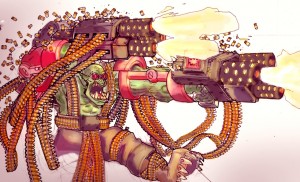
Each hook or marketing ploy is like firing a bullet at your reader. You probably won’t kill their resistance with the very first shot. You want to fire bullet after bullet until they collapse and make the decision to buy.

Not only does this statement smack of everything I hate about sales and salespeople, but it seems to fundamentally clash with the new reality of publishing.

With social networking and the internet, writers can now connect directly with their readers.  For those going the indie route, this is absolutely essential.  The key element to success, from what I can see, is developing an ongoing relationship with your fans–one in which they take the role of patron, not merely consumer.

There’s a huge difference between thinking of readers as patrons and thinking of them as consumers.  If they’re just consumers, then the end goal is to get them to buy your product, and there’s nothing wrong with spamming them or shamelessly plugging yourself if that’s what works.

But if they’re patrons, the end goal is to develop that relationship–to connect with your readers on a meaningful level, both before and after they buy your work.  And in this brave new world of publishing, that seems like the best coarse to take.  Consumers have to be sold on each individual book; patrons are sold on you, so they’ll read everything you put out.

And as a reader, that’s how I buy.  Whenever I find an Ende or a Wilson or a Le Guin in the bookstore, I rush to grab it, because those are the writers who speak to me.  I’ve bought just about every Sanderson in hardcover because I love his work and want to support him.

That’s why this comparison of bookselling to “a series of bullets being fired from an automatic rifle at the prospective buyer” rubs me in all the wrong ways.  I’m not just peddling widgets; I’m creating art and sending it out into the world, waiting patiently for it to return back a hundredfold.  And if I work hard to create the best possible art and treat my readers (aka you guys) as my patrons, I sincerely believe that it will.

So to all of you who have read my books, regardless of whether you bought them or downloaded them from Smashwords for free, I just want to say thank you!  The greatest honor any writer can have is to be read, period.

I also want you to know that I’m never going to “shoot” you with a bunch of cheap sales tricks or “hooks” that get in the way of the story.  I’m just going to write damn good books and put them out where you can find them, trusting you to rate, review, like, and share them if you feel they truly deserve it.

I will never, ever, EVER put a gun to your head to get you to buy my work.  I’d much rather you jump at the chance to read a Vasicek, because that’s what speaks to you.