Slow, but still making progress

Sorry for neglecting the blog this week.  I took a temp job to earn some cash, and that’s been sucking up most of my time lately.  Fortunately, it should be over sometime next week.

In the meantime, I found a place to live for the next few months.  I’m in the basement of an old house, rooming with a former classmate from Brandon Sanderson’s English 318 class.  So far, it’s actually been pretty awesome.  The rent is dirt cheap and you get what you pay for, but there aren’t any rats and the heater works fine.  It should be a good place to spend the winter.

Progress on Stars of Blood and Glory has slowed down somewhat, mostly due to the temp work, but it’s still coming along steadily.  If all goes well, I’ll have it polished and sent out to my editor by the end of next week, which leaves only the cover art to figure out.  I’m going all out for this one, just like I did with Desert Stars and Bringing Stella Home.

Also, I just (re)started Lifewalker, a post-apocalyptic novel previously titled The Chronicles of Lifewalker.  I know, I should be putting more time into getting Stars of Blood and Glory ready for publication, but this project has been begging to be written since 2011.  I wrote a first chapter two years ago, but the narrative voice wasn’t working too well.  Basically, I was trying too hard to imitate 19th century prose without having read enough to know how to do it well.  Instead, I decided to toss all that stuff out and write the dang story without being overly restrictive.  I think it’s going to turn out well.

Blah blah blah oh did I mention that I checked out a couple of David Gemmell books from the Provo Library?  Well, I did.  They are the last two books in the Drenai series that I haven’t read, and I am soooo excited to sink my teeth into them.  Just started The First Chronicles of Druss the Legend last night, and it is AMAZING.  Expect to see a review here soon.

Speaking of which, I should probably reread Wool and review it sometime.  Hugh Howey really took the publishing world by storm last year, and he’s doing some truly amazing things for indie writers.  His books are great, too–definitely worth picking one up.

That’s just about all right now.  I’ll probably put in another hour of writing/revising, then turn in for the night.  Later!

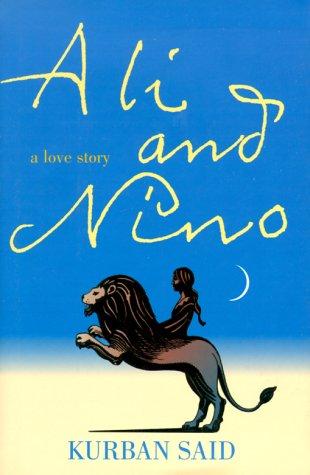
Ali and Nino by Kurban Said

At the crossroads of Europe and Asia, Christianity and Islam, the progressive West and the reactionary East, the peoples of the Caucasus lie poised between three empires and their own dreams of independence.  And at the city of Baku, where the ancient and unchangeable desert meets the oil rigs of the Caspian Sea, young Ali Shirvanshir has fallen in love with Nino Kipiani, a Georgian and a Christian.

A timeless story of forbidden love, Ali and Nino is both the Romeo and Juliet of the Caucasus and the national novel of Azerbaijan.  It is as much a romance as it is a story of the clash of cultures and identities in our rapidly changing modern world.  Above all else, it is a beautiful and haunting tale that will leave you dreaming with your eyes open and yearning for lands that you’ve never seen.

This is, quite possibly, the most perfect book I have read all year.  I picked it up in Tbilisi from another TLG volunteer on Sunday, and I finished it at a breathless sprint on Wednesday.  But while the story was good, it was the writing itself that really captivated me.  The simple yet surprisingly rich descriptions of the alien cultures, so dreamlike and yet so straightforward, often to the point of being shocking–here, let me give an example:

“Shamil’s Prayer!” called Iljas Beg to the musicians.  Immediately a wild melody arose.  Iljas Beg jumped into the middle of the hall.  He drew his dagger.  His feet moved in the fiery rhythm of the Caucasian Mountain Dance.  The blade glittered in his hand.  Nino danced up to him.  Her feet looked like small strange toys.  Shamil’s Mystery began.

We clapped to the rhythm of the music.  Nino was the bride to be abducted…Iljas put the dagger between his teeth.  Like a bird of prey, his arms outstretched, he circled round the girl.  Nino’s feet flew whirling round the hall, her supple arms depicting all stages of fear, despair, and submission.  In her left hand she held a handkerchief.  Her whole body trembled.  Only the coins on her cap lay quietly on her forehead, and that was the correct way–this is the most difficult part of the dance.  No one  but a Georgian girl can do such fantastically quick turns and not let even one coin on her cap tinkle.

Iljas raced after her.  Without stopping, he chased her round and round.  The wide gestures of his arms became more and more dominating, Nino’s defensive movements more and more tender.  At last she stopped, like a deer overtaken by the hunter.  Closer and closer Iljas Beg circled.  Nino’s eyes were soft and humble.  Her hands trembled.  A wild, short howl from the music, and she opened her left hand.  The handkerchief fluttered to the floor.  And suddenly Iljas Beg’s dagger flew onto the little piece of silk and nailed it to the floor.  The symbolic dance was finished.

By the way, did I mention that before the dance, I gave Iljas Beg my dagger and took his?  It was my blade that  pierced Nino’s handkerchief.  It is best to be on the safe side, for a wise rule teaches: “Before you trust your camel to Allah’s protection, tie it fast onto your fence.”

The whole novel is like that, and it’s awesome.  The narrative passes from one description to the next, and you feel almost like you’re caught up in a dream, reading a fairy tale.  It’s only the railroads and oil rigs, the mention of Paris and London and Moscow, that make you step back and realize that this isn’t a fantasy novel, but something set in our modern world.

And yet, even though it feels like a fairy tale, the author gets a surprising number of things right.  Georgians really do have some of the most beautiful eyes of any people.  I haven’t yet been inside the sulfur baths at Tbilisi, but everything else in Said’s description of that city is more or less correct. Kakhetian wine really is the most famous within Georgia, and probably the whole Caucasus as well.

The most gratifying thing is to see how it all comes together.  Even though the descriptions sometimes feel as lavish as a Persian rug, no word is wasted–there is a good reason for every tangent, solidly grounded in the story.  There are plenty of red herrings and Chekhov’s guns to make the plot twists thoroughly satisfying.  But never at any point did I feel compelled to try and predict what would come next.  I enjoyed the story so much, I was barely aware of the fact that I was reading.

Whether you’re looking for an exotic romance, or you just want to explore a culture thoroughly alien from your own, Ali and Nino is a book you will thoroughly enjoy.  If, like me, you have any interest in the Caucasus, you probably won’t be able to stop coming back to it.  And if you’re just looking for a good read, I can think of few books that are more perfect than this one.

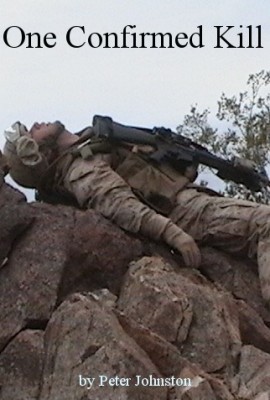
One Confirmed Kill by Peter Johnston

The best description of this book that I think I could give is the disclaimer at the front:

The following is not fiction. The characters and events described are closely based on real life, and any resemblance to real persons, organizations and events is purely intentional, and should be construed in the most negative light the text will support. Some names have been changed to protect the author from violent reprisals from the real people thus depicted, in the unlikely event that any of them have learned to read.

Thus begins a darkly cynical account of one soldier’s experience (or lack thereof) in Al-Anbar Province during the Iraq War.  At times hilarious, at times surprisingly moving, this book made me laugh out loud and kept me engrossed all the way to the end.

Full disclosure: the author is a friend of mine from the Leading Edge slushpile, and I was one of the beta readers for this book.  That said, I really enjoyed this novel, both the earlier draft that I read and the finished version that I bought as soon as it came out.  It’s a lot like Catch 22, except I actually liked this one (whereas I could hardly get through the first chapter of Catch 22).  The writing is witty and sarcastic, and the story, while far from honeycoated, ends on a note that makes the read worthwhile.

If you’re happily employed by the military, this book will probably make you livid with rage…or it’ll send you roaring on the floor laughing your ass off.  I can see my military friends taking it either way.  But one thing is for sure: you won’t find it boring.

One Confirmed Kill is an indie published ebook, and you can currently pick it up in all formats for $.99 on Smashwords.  Disclosure: as a Smashwords affiliate, I get about $.10 from the sale.  However, even if I didn’t get anything for it, I’d still recommend it, because it’s a great read.

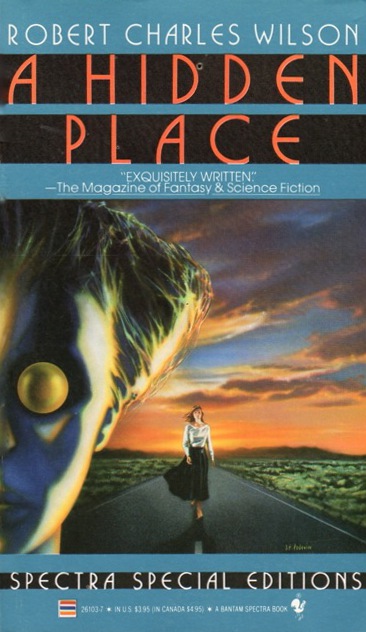
A Hidden Place by Robert Charles Wilson

Travis Fisher is an outsider in most places, but nowhere more than the small midwestern town of Haute Montagne.  But when his mother dies, leaving him parentless and jobless in the midst of the Great Depression, his stern aunt and uncle are the only ones who will take him in.

When Travis falls in love with Nancy Wilcox, the rebellious daughter of the Baptist Ladies Association president, things become worse.  With murderous transients roaming the countryside, Haute Montagne closes ranks, casting them out.

In this moment of distress, a mysterious yet hauntingly beautiful woman reaches out to them with a cry for help.  Stranded in the small midwestern town, she is a being from another world, and she is dying.  Only the two young lovers can help her, but to do so, they must find her dark, masculine half–and in so doing, confront the demons that threaten to tear them apart.

This is one of Robert Charles Wilson’s earlier novels, and I enjoyed it quite a bit.  It’s very short, yet well crafted and beautifully written.  Wilson’s prose is extremely evocative, and his descriptions of Haute Montagne brought back childhood memories from when I lived in the Midwest.  The story was also done well, and had a very satisfying ending.

While this is a good book, though, I wouldn’t say that it’s Wilson’s best.  His characters were interesting, but not nearly as compelling as those in Spin. The baptists were a little too villainous, though Travis’s aunt and uncle were individually more complex.

In spite of all this, however, the story was structured so well that the poignance of it largely overcame these flaws.  As a writer, that’s what I found most interesting about this book–how the masterful way the story was constructed made the whole greater than the sum of the parts.  Call it the monomyth, the hero’s journey, or whatever else, but something about this story made it reverberate in a powerful way.

I suppose that this is what all great stories do: echo some greater, universal story that is in all of us.  It’s the same echo that I felt when I read Spin, or Ender’s Game, or The Neverending Story, albeit a little softer.  It’s something that I hope my own stories evoke, this sense of clarity and wholeness, of returning to some great truth that we lost somewhere between birth and adulthood.

I don’t know if I’m making any sense, but those are my thoughts.  It’s a short read, and I enjoyed it quite a lot.  If you can find it, it’s a good one to pick up.

Story Notebook #5 (part 1)

Alright, time to revisit my old story notebooks and run through some of the ideas there.  This one starts in fall of 2009, my last semester at BYU,  and ends shortly after my hasty exodus from a miserable internship in Washington DC.

And now, without further ado, here goes:

A super-celibate society that holds that sex is evil and reproduces entirely by artificial insemination.

In other words, what if the Shakers had had our modern reproductive technology?  Weird, but not beyond the realm of plausibility.

I suppose that in such a society, the nuclear family would not exist, and children would instead be raised by the community as a whole–kind of like Plato’s Republic.  Question is, would this be a happy utopia, or a miserable dystopia?  I know how I’d write it…

Shattered glass sparkling in the roadside desert

Okay, that’s less of an idea and more of an experiment with prose.  I suppose I saw broken glass on some dusty asphalt and wanted to capture it with words.

The next passage is from an assignment for the wilderness writing class at BYU.  We went camping in Moab and hiked up to Delicate Arch, perhaps the most iconic natural landform in all of Utah.  Shortly after taking this picture, here is more or less what I wrote:

They say that the arches in this national park are formed by wind erosion.  The funny thing is, so is the slickrock.  The same wind that carved the gravity defying structure of the arches also wore the rock all around them almost perfectly smooth, so smooth that you feel as if you’re about to slip and fall even as you sit on the edge of a relatively flat ledge.

It makes you wonder: what was here before the wind blew it away?  What did the land look like before the wind took out the loose material, leaving behind only the strongest, most resilient bedrock?  How many other arches lie underneath our feet, waiting only for time and the wind to unearth the landscape that hides them?

Awesome class; if you ever get a chance, take it.  Professor Bennion is great.

A boy born without a name.

Not sure where that came from, but it kind of makes me think of this girl in an abusive household, who grew up to age 14 before learning how to speak.  It seriously crippled her intellectual development, so much that she never became fully independent.

Think about it: how would not having a name stunt a person’s growth?

Below them lay the alluvial plains–miles of silt and dirt vomited from the mountains over the passing of countless centuries.

I think I intended this to be a line in the first chapter of Worlds Away from Home…and unless I’m mistaken, something very similar to this passage made it into the book.

The detritus of life from which we extract the fossil record of our memories

Another passage meant to evoke something in the reader.  I think I wrote it when I was cleaning out my apartment shortly before leaving for DC.  It certainly makes me think of a dirty, junk-filled room.

And that’s enough for now.  This basically takes us up to January 2010, when I left for the BYU Washington Seminar program.  All the other ideas in this notebook have a decidedly civic/political bent to them, so stay tuned!

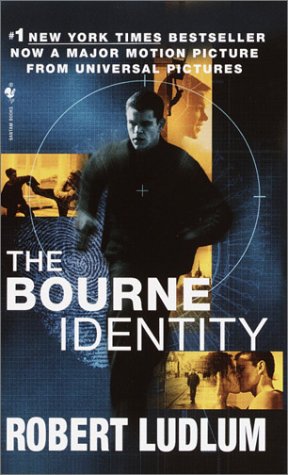
The Bourne Identity by Robert Ludlum

On a stormy night off the coast of Marseilles, a local fishing trawler recovers a man with a gunshot wound to the head.  The local doctor patches him up, but when he recovers, he has no knowledge of his past life.  Even his name is a mystery.

Fortunately, he has a clue to help him get started: a microfilm surgically implanted in his hip containing an account number for a bank in Switzerland.

When he arrives in Switzerland, he finds that the account contains millions of dollars, as well as a name: Treadstone 71.  Before leaving the bank, however, a squad of hitmen attack and nearly kill him, for no reason that he can possibly understand.

On the run from people he doesn’t know for things he doesn’t remember, Jason Bourne finds himself in a struggle, not only for his life, but to find his true identity.  But the answers, he fears, are much, much darker than he can possibly accept.

Okay, to start things off, let me say that this book is NOTHING like the movie.  NOT AT ALL.  The two are completely separate stories.  The beginnings of both are similar, with the whole amnesia thing and the bank account number implanted in his hip, but after Jason leaves Marseilles, everything gets different.  EVERYTHING.

For that reason, it’s difficult to say which is better, because they both try to do very different things.  The movie is more about the action and suspense; the book is more about the intrigue and character development.  Both succeed quite well at what they respectively set out to do.

That said, I enjoyed the book at least as much, if not more than the move.  Ludlum’s writing is quite good, and he paints an excellent picture of both the exotic European setting and the complex psychological portrait of his main character.  Unlike Crichton, whose characters often fall flat, Ludlum does an excellent job creating characters who stand up on their own right.

The suspense lagged somewhat in the middle for me, when the details about Cain and Medusa came to light (that’s one thing I’ve got to say about Crichton–he’s a master of suspense), but it wasn’t enough to keep me from finishing.  The ending, however, was atrocious–not in a clumsy way, but in a too-many-loose-ends kind of way that meant that the story wouldn’t truly be resolved until the sequel.  I hate stories that do that, but oh well, what can you do?

Overall, though, the book was quite good–better than I expected.  I can see why Ludlum was such a successful writer: he created interesting, capable characters and put them in exotic, foreign settings to fight ruthless, evil villains in a desperate zero-sum struggle for survival.

Interesting characters + exotic setting + high stakes conflict + good writing = win.  Oh, and Bourne is way more awesome than Bond. Just sayin’.

Falling back into the groove

Today I surprised myself and wrote nearly 4k words, some of which might actually be good enough to keep.  Huzzah!

The novel is coming along very nicely, and I’m starting to get really excited with where it’s going.  That’s huge, because up to this point, the nagging “this is crap, what are you doing with your life?” voices have been getting me down.  Yeah, the draft I’m writing will need a lot of work, but the story’s got potential, and I can see it.  That’s the most important part.

The interesting thing was that after pounding out the first thousand words, the writing started to really flow.  The right words and phrases started coming quite naturally, almost on their own, instead of waiting for me to mercilessly hunt them down.

An example:

The weather was perfect–sunny, clear, and neither too hot nor too cold. Upset by the sound of their engines, flocks of pretty white birds took to the air, filling the sky around the green banks like noisy, low-flying clouds. Down in the cabin, Kariym began to sing a lilting ballad about a young boy in love with his brother’s betrothed. His deep bass voice bellowed over the roar of the engine, lifting Jalil’s spirits. It was a very good day to be alive.

They rode upstream over the river for the next hour. Almost immediately they left the main body of the convoy far behind, taking the reconnaissance position for the advance guard. Occasionally, they passed a town or a bridge–magnificent works of steel and stone that soared over their heads, spanning the entire vast width of the river. Mostly, however, the banks were empty and unsettled–nothing but long, straight stretches of thick green bush, with the occasionally rocky outcropping to break the monotony.

Of course, the writing’s not perfect–I’ll be the first to say that it needs considerable work–but at least it’s decent.  Decent for a rough draft.

One of the most annoying things about writing is when I unconsciously break into alliteration.  I’ll write a sentence, only to realize that I can’t let it stand as it is because every noun, verb, and adjective starts with the same sound.  Like that last phrase: “starts with the same sound.” Augh!

I’m finding, though, that when used in moderation, that tendency towards alliteration can be somewhat helpful.  There’s nothing quite as pleasurable as reading a good story with delicious, flowing prose, like Ursula K. Le Guin’s The Dispossessed or Robert Charles Wilson’s Spin. Excellent books.  I’d be more than happy if I could write as beautifully as them someday.

In the meantime, though, I’m just plugging away, trying to make the next chapter, scene, paragraph, and sentence better than the last.  Fortunately, now that I’m excited about the story again, things are going very nicely.

Oh, and happy fourth on the fifth.  I spent most of the day with family (not writing), bouncing around Provo and doing various stuff.  I’ve got a ton of chores to do tomorrow, though, so I’d better get to bed.  Night!

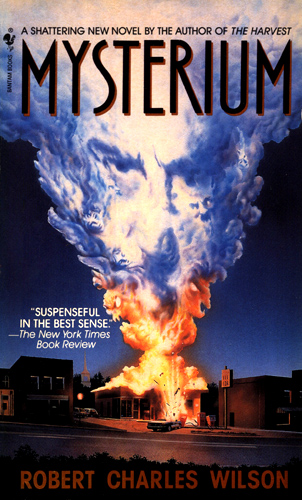
Mysterium by Robert Charles Wilson

Nobody knows why the government chose the small town of Two Rivers, Michigan, as the site for a top secret military project.  Even most of the people involved in the project don’t know what it’s really about.  That’s alright, because most of the denizens of this backwoods community are used to minding their own business.  But after a mysterious explosion bathes the entire city in light, that becomes impossible.

On the outskirts of town, all the roads and power lines dead end in ancient virgin forest.  It’s as if a perfect circle has been drawn around the town on the map, and everything within the circle has been transported to a parallel world.

A very unfriendly parallel world.

Robert Charles Wilson’s writing is awesome.  I could eat up his prose all day.  It not only flows beautifully, it’s clear and transparent, to the point where I forget that I’m reading and feel as if I’m there.  He always uses the right expression, the right metaphor, and yet his prose never attracts so much attention to itself that it distracts from the story.

I noticed several similarities between Mysterium and Wilson’s other novels that I’ve read.  All of them start in our modern world and move into a mysterious, unfamiliar milieu.  All of them involve strange religions and religious conflicts.  All of them involve male and female characters struggling to face personal relationship problems and eventually coming together.  In these ways, this story felt very much like Spin.

At the same time, I can definitely tell that this is one of Wilson’s earlier works.  The story flows like a thriller, but lags in certain points.  After the town is transported into the parallel dimension, the story seems to meander without any clear direction.  For several chapters, I lost the sense of progress that usually accompanies a good plot.  The resolution receives very little foreshadowing–the “surprising yet inevitable” element was only “inevitable” three or four chapters from the end.  If it weren’t for Wilson’s beautiful writing, I would have put this book down in the middle.

<spoiler alert>

Unlike Spin, I found the milieu of this story somewhat depressing–not necessarily because of the setting itself (though it’s not the kind of alternate present that I’d want to live in), but because the people of Two Rivers never go back.

According to Card, there are two basic types of milieu stories: stories where the protagonist returns profoundly changed, or stories where the protagonist “goes native” and becomes assimilated.  But…if the new world isn’t the kind of place you’d want to live in–in other words, if it’s dystopian (and Wilson’s alternate world in Mysterium is fairly dystopian)–then there’s this tension of “will the protagonist make it back?  Will they return?” And if they don’t return, the story is emotionally disappointing.  That was the case for me with Mysterium.

</spoiler alert>

From this review, it probably sounds like I hated this book.  That wasn’t the case–not at all!  This was a good story, and I enjoyed it.  I finished the last hundred pages at a sprint at 1:30 in the morning–it was definitely that kind of a book.  I couldn’t put it down.  And at the same time, it was thoughtful and profound (as you can tell from my previous post, “Why I love Robert Charles Wilson“).

I’ve probably said enough.  If you like thrilling, parallel world adventure stories with a contemplative, thoughtful “what if?” element, read this book.  Even with all the misgivings I’ve mentioned here, it’s good SF.  Very good.

“Why people read”

Dave Farland puts out this great e-newsletter called “Dave’s Daily Kick-in-the-Pants.” For the kick today, he suggested the following exercise:

You probably have a good idea about what you want to write—horror, mainstream, fantasy, historical, romance, westerns, religious fiction, and whatnot. Sit down for ten minutes and on the left-hand side of your paper, list five things that you feel you most like in the fiction you read. On the right-hand side of your paper, list the biggest potential danger that you see in trying to create that effect.

Doing this exercise will help you understand who your potential audience is, and some of the challenges that you may face in reaching that audience.

This was my response:

Why I read:

1) To meet interesting characters and get lost with them in an exciting fantastic world.

2) To think deeper about fundamental truths I see in my own life.

3) To feel like I understand another person and connect with them.

4) To be reassured that true heroism is real, alive, and within the realm of possibility.

5) To experience beauty in the language and metaphor, the imagery and tension.

Potential dangers:

1) Trying to write about a world without a story–all info dumps, exposition, lacking interesting characters with whom the reader can journey and experience the world.  Story IS experience, and experience does not exist independent of the person doing the experiencing.

2) Waxing allegorical or didactic in the writing–trying to force the message instead of leaving it open for the reader to discover multiple layers of meaning.

3) Focusing so hard on the character that the plot lacks the structure and tension to keep the reader interesting.  Characters do not exist separate from plot or setting; they change and grow in reaction to both.

4) Creating a hero whose struggle is so far removed from the real world or our real life experience that the reader feels that this type of person could only exist within the pages of a book.  Or, trying so hard to follow the monomyth structure that the story falls flat (ie Star Wars I, II, III).

5) Thinking that poetic license frees you from basic rules of style and grammar.  Creating metaphors that are so unusual that they are merely non sequiturs.  Writing prose so thick and “literary” that it kicks the reader out of the book.

Spin by Robert Charles Wilson

What would you do if you knew that the world was going to end in the next thirty years? That one day, before the end of your natural lifespan, the oceans will boil and the forests burst into flames, and life on this planet will come to an end? That you, your children, and even humanity itself have no future–that everything will end with you?

When the mysterious beings known as the Hypotheticals encase Earth in a temporal warp field that causes years to pass outside for every second on Earth, that is the uncomfortable question that all of mankind must confront. In five billion years–less than forty years on Earth–the sun will burn up its hydrogen and expand into a red giant star. When that happens, the sun will swallow the Earth and every living thing will die.

Some people turn to religion for answers.  Some turn to Science.  Some put off the question, living their lives as if the end will not come.  But as the years pass and the unavoidable apocalypse looms nearer, humanity begins to spiral out of control, and civilization itself looms on the verge of collapse.

The year the stars fell from the sky, thirteen year old Tyler Dupree discovers that he is in love with his best friend (Jason Lawton)’s sister, Diane.  The dynamics of the friendship between the three, however, make it impossible for Tyler to express his true feelings–and, in any case, Diane doesn’t seem interested in being anything more than a friend.

When the Spin hits, all three of them find themselves on radically different and sometimes conflicting paths.  Diane turns to evangelical Christianity and the frenzied religious outporing the Spin inspires.  Through his father, Jason rises to become one of the most influential scientists and directors in the Perihelion Foundation, the premier aerospace agency and Spin-related policy forming body in the US.  

Tyler, however, pursues the same middle class life he probably would have followed anyway–medical school, followed by a career as a doctor.  Still, his undiminished feelings for Diane and his frienship with Jason draw him into the center of the Spin hysteria and behind the scenes in the circuitous Spin-era politics.

Diane, now married to a fervent believer in a free love fundamentalist cult, comes to rely on Tyler as her only link to the outside world.  Meanwhile, Jason Lawton pursues perhaps the most grandiose and ambitious project mankind has ever attempted; the terraformation of Mars. 

With the temporal distortion of the Spin, millions of years of evolution turn Mars into a verdant green world in only one Earth year.  When Jason launches the first manned mission to the planet, barely a week passes before the the first Martian-born human returns to mankinds ancestral home–a descendant of a civilization millenia older than our own.  This small, dark-skinned, wrinkled man comes with a tantalizing message that may prove the key to finally understanding the Hypotheticals and the Spin itself.

But all of this may be too late, because the Spin membrane is finally beginning to show distressing signs of failure, and the sun has already grown hot enough to boil the oceans and scorch the planet.

I loved this book.  Honestly, I have to say it is one of the best science fiction books I have ever read.  Better even than Ender’s Game, better even than Foundation or any of the other classics.  No other book that I’ve read has done everything that I believe a good science fiction book should do.  I would highly recommend this book to anyone and everyone.

Like Clarke and a lot of the older classics in the science fiction tradition, Spin addresses some of the grand questions with which science and humanity have always wrestled.  What is the ultimate end of mankind?  The ultimate end of evolution?  Are we unique in this universe?  What is our place in the cosmos?  What is transcendence, and can we as a mortal species achieve it?

Unlike much of the older works, however, Spin addresses these questions through solid, developed, rich characters and a human drama that is as engaging as anything in any other genre.  When I read this book, I felt connected with these characters.  I genuinely cared about them.  They were real, distinct people who changed and grew based on their choices and experiences.  Furthermore, their struggles and conflicts echoed my own.  It felt true.  Tyler’s unrequited love was not only utterly believable, it kept me just as engaged as the grand ideas and the science fiction elements.

As science fiction, the ideas in this book were some of the most original and eye-popping ideas I’ve ever seen.  There was definitely a sense of wonder, as thick and beautiful as Clarke or Heinlein or Asimov.  The thing that made these ideas so great, however, was the eminent believability that accompanied them.  Robert Charles Wilson thought out the implications of everything, and showed them through concrete, human details.  His Martian landscapes were as real and believable as his picture of the New England countryside.  I not only felt that I was there, I felt that I was in this world, where the end-of-everything panic had set in, causing all sorts of bizarre, almost post-apocalyptic (pre-apocalyptic?) social changes.  It was truly fascinating.

But it wasn’t just the storytelling that engaged me: Robert Charles Wilson’s prose is among some of the best that I’ve ever read.  Reading this book really was like eating cheesecake.  The writing not only flowed, it shined, yet in a way that illuminated the meaning behind the words rather than drawing attention to the words themselves.  Wilson’s metaphors were not only rich and beautiful, they expressed the meaning behind the text so clearly that in each case, I don’t think he could have gotten across that particular impression, that feeling, in any other way.  Everything was calculated, and I would read pages and pages of text without even realizing how far I’d come.  Incredible.

I did have one issue with my first readthrough, back in July of last year: the Martian civilization, while grand, didn’t feel grand enough.  I mean, in 0nly four thousand years of history, look how far we’ve come here on Earth–all of our religions, all of our science, all of our discoveries and everything else.  We can hardly even remember what it was like, four thousand years ago–yet in Spin, the Martians know all about the reasons why Earth spawned their civilization, all of the questions that the Earthers have been asking about the Hypotheticals, etc.  I almost think that the Martians would have a more mystical view of Earth; that their understanding of us would be steeped in legend, and that they would have forgotten who we really are.

In my second readthrough, however, this was less of an issue to me.  Wilson really does make the Martians seem alien, a separate, distinct culture with a long, rich tradition.  His Martian citizen is very distinct from any of the Earthers, and notices some very small things that we always take for granted.  So, even though there could be more of a feeling of grandeur, Wilson already paints a very believable, very grand view of the Martian civilization he invents.

I am not exaggerating one bit when I say that this is probably the best science fiction book I have ever read.  I would recommend it above and beyond anything else I’ve reviewed here on this website.  If you haven’t already, pick up this book and read it.