One of the most fascinating podcast interviews I’ve seen in a long time. Throws me back to A Canticle for Leibowitz, one of the best works of science fiction to come out of the 19th century.
Tag: pro-life
The argument that converted me from pro-choice to pro-life
On the issue of abortion, I would consider myself to be very pro-life. I have written several explicitly pro-life stories, including “The Paradox of Choice,” “The Body Tax,” and “The Freedom of Second Chances.” My wife and I also donate monthly to Preborn, a charity / Christian ministry that provides free ultrasounds and support to pregnant women seeking abortions.
I was not always pro-life, however. In fact, if you’d asked me fifteen years ago where I stood on the abortion issue, I would have described myself as either pro-choice or leaning pro-choice. So what was it that changed my mind?
First, a little background about myself. I grew up in a comfortable middle-class home, with three younger sisters and a mother and father who were married and faithful to each other. Abortion was not a thing that I had any direct experience with; it was little more than a vague concept that I heard other people arguing with. And although I grew up in a religious household, we lived in a Democrat stronghold (western Massachusetts) and both of my parents were Democrats, so of course the default position that I grew up with was pro-choice.
I didn’t really hear the abortion issue debated until high school. I went to an elite preparatory academy in Pioneer Valley, so I was surrounded by people who were far left even by Massachusetts’ standards. My position, which I more or less absorbed from those around me, was that abortion was a tragic but sometimes necessary procedure, and that it wasn’t the place of men or the government to tell women what they couldn’t do with their own bodies. Basically, the “safe, legal, and rare” position.
However, there was one pro-life argument I heard at that time that planted a seed in my heart. The school paper printed a debate on the abortion issue, and the student who wrote the pro-life side argued not from the legal position, but from the moral position—specifically, asking the question “when does life begin?” Since we cannot know when life begins, the student argued, we should err on the side of preserving life and treat the unborn child like a full human being from the moment of conception. If we believe that murder is wrong, erring on the other side—that of preserving the mother’s autonomy—would risk committing an immoral act, since we cannot positively say that abortion does not take a human life.
It was an interesting argument, and I didn’t really have a counter to it. However, the abortion issue didn’t rank very high on my list of priorities, so I filed it away and forgot about it, reverting back to the default position which I’d more or less absorbed. If pressed, I would say that I didn’t like abortions, but that it was something best left between a woman and her doctor. I didn’t really give the “when does life really begin?” question any serious thought.
However, one thing I did give serious thought to was the atrocities committed by the Nazis during World War II. The liberal, post-modern position that I more or less absorbed from the air around me was that history (or at least the part that really mattered) began in the 1930s, that the Nazis represented the ultimate evil, and that “never again” was civilization’s most sacred value—not just for the holocaust, but for all forms of genocide, nuclear proliferation, and global war. As a kid, I read every (non-boring) World War II book that I could get my hands on, and was profoundly moved by several of the photographs that I saw, especially of the Nazi death camps. Later, in middle school, I read Jane Yolen’s The Devil’s Arithmetic, which further cemented my revulsion of the holocaust, and my determination that I was not and would never be the kind of person who would assent to that sort of atrocity.
Fast forward to the 2000s. After serving a two-year mission, I attended Brigham Young University from 2006 to 2010. The contrast was stark. In Massachusetts, I had been the odd “conservative” kid surrounded by liberals. In Utah, I was the odd “liberal” kid surrounded by conservatives. And though BYU is not the most conservative school in the United States (that would probably be Hillsdale), the air that I found myself in was much more conservative than anything I’d experienced growing up.
Overall, the experience was good for me. I found myself questioning a lot of my unspoken political assumptions and coming to conclusions that would have surprised my earlier teachers and mentors. For example, I independently came to appreciate the second ammendment and the right to self-defense, mostly from participating in BYU’s jujitsu club and learning how to physically defend myself. I also gained a deep appreciation for the principle of free speech, since studying contrasting viewpoints was so key in shaping my own worldview at that time.
However, I still didn’t give much thought to the abortion issue, since 1) it wasn’t directly relevant to my life at that time, and 2) it was just a really icky thing to think about. If pressed, I probably would have said that I was against using abortion as a form of birth control, and that some restrictions should be put in place to prevent that from happening, but that I didn’t think Roe v. Wade should be overturned. I had never known a world before Roe v. Wade, and thus was more comfortable sticking with the default that I’d grown up with. As a faithful Latter-day Saint, I knew that I would never put a woman in a position where she would consider getting an abortion, so the status quo was enough for me.
As a side note, I should point out that the official position of the Church of Jesus Christ of Latter-day Saints is that abortion is wrong in all cases except where rape, incest, or the health of the mother create extenuating circumstances. As missionaries, if we wanted to baptize someone who had either had an abortion themselves or had participated in one, we had to move it up the chain to a higher ecclesiastical authority to interview them and determine whether the prospective convert needed to demonstrate more repentance. Later, as a member of a bishopric, abortion was something we had to seriously consider when convening disciplinary councils. It is possible to get an abortion as a Latter-day Saint without getting excommunicated, or to come back into full fellowship after being excommunicated for abortion, but you have to go through your local (and sometimes area/general) authorities to work it out—and even then, they will strongly encourage you not to go through with it. But there is quite a bit of room for nuance in the church’s position on abortion.
Not that I ever really gave the deeper nuances of the issue any serious thought during this period. In fact, the one question that I never really asked myself was “when does life actually begin?” If pressed, I probably would have taken the position from that high school debate article, that since we don’t know we should probably err on the side of assuming life begins at conception, but I never really thought through the full implications of that position, again because 1) it didn’t directly impact my own life, and 2) the whole abortion issue was just icky.
Fast forward to 2015. I had graduated from college, traveled the world a bit, spent a few years bouncing around odd jobs and more or less living on my own, and made the best decision of my entire life: to not pursue a graduate degree. If I had gone on to grad school, I would have racked up a whole lot of debt, delayed my exposure to the “real world,” and failed to learn a number of important and life-changing lessons from the school of hard-knocks. And now that I finally felt like I was getting my feet back under me, I began to question all of my prior political assumptions, especially since the Obama years were coming to a close. I had voted for Obama in 2008, but vowed that I would never vote for a Democrat again, and was frankly disgusted with the intersectional coalition and its crusade for anti-racism and social justice.
It was around this time that I discovered Jordan Peterson. I was deeply impressed with Peterson’s earnest sincerity, intellectual honesty, and courage of his convictions. I was also intrigued by many of his arguments, which ran contrary to so many of the things I’d grown up with. One of these was his argument that most of us would have gone along with the Nazi atrocities, if we had lived in 1930s Germany. His argument was basically: “we’d all like to think that there was something unique about the Nazis that made them so evil, but that isn’t true. They weren’t so different from all of us. You may think that you wouldn’t have gone along with all of the atrocities that the Nazis committed, but the truth is that you probably would have gone along. After all, you’re not so special. You’re just as much a product of your times as the Germans in 1930s, and they really aren’t as different from us as you think they are. Don’t kid yourself. You’re just as capable of evil as they were.”
This argument struck something deep within me, partly because “never again” was such a core part of my own personal identity. Was I the kind of person who would have resisted the evils of the Nazis? Or in fact, was I not that special, and also not that different from those who had gone along with the Nazis’ terrible crimes? The only way to know for certain was to compare our times with the times of the Nazi regime, to see if there was anything comparable to the holocaust in our own time.
As soon as I asked that question, it was like my eyes were suddenly opened. There is indeed an atrocity comparable to the holocaust in our times, and it has become so ingrained into our culture that in many places—such as the blue state where I grew up—it is almost like part of the air that everyone breathes. That atrocity is the genocide of the unborn. If life truly begins at or near conception, then we have committed 10x holocausts since Roe v. Wade, a full order of magnitude more blood than the Nazis spilled. Moreover, we have slaughtered the most innocent, voiceless, and powerless people among us: our own children.
It all comes down to the question “when does a human life begin?” As far as I can tell, there are only two answers to that question that are logically consistent and scientifically sound: “at conception” and “I don’t know.” Viability is a moving target that changes with innovation and technology: in another decade, we may have found a way to grow children outside of the female womb, making them viable from literally the point of conception. Capacity for pain is also a moving target, since we’re still learning all sorts of new things as our technology improves. Sentience doesn’t work because people in comas are both alive and non-sentient. Heartbeat doesn’t work because it is possible to put an animal into suspended animation, where their heart has stopped beating, and successfully revive them. We can’t exactly do that to humans yet, but it’s only a matter of time and innovation before we can.
Now, I cannot say for certain that abortion is always wrong. Just like there are circumstances when it is just to shoot someone to death (such as during a violent home invasion), I understand that there may be circumstances where an abortion is similarly warranted. These are the edge cases like rape, incest, and health of the mother that the pro-choice pro-abortion activists always fall back on. The clearest of these is probably ectopic pregnancy, which is almost always fatal for both the mother and the child. But of course, what the activists never tell you is that almost all of the abortion bans that have been put into place since the end of Roe v. Wade have exemptions for ectopic pregnancies, which are not considered legally to be abortions. But I grant that there are other cases, such as depression and suicidal tendencies, that fall into a gray area morally. I also grant that a strict pro-life position has far-reaching implications for things like IVF and surrogacy that may or may not go too far. Frankly, I’m not at all sure where I stand on surrogacy and IVF.
But when you take a clear-headed and logical view at the way our culture practices abortion, focusing not on the legal intricacies but the simple question “when does a human life begin?” it becomes very clear that our current regime is not only comparable to the Nazi regime, but may actually exceed the Nazis in objective measures of evil. After all, what made the Nazi holocaust so evil? The sheer size of the death count? Ours is an order of magnitude larger. The innocence of the victims? No one is more innocent than the unborn. The motivations behind the killing? Hatred is one thing, but the worst evils have a quality of banality to them that our narcissistic and apathetic obsession with personal convenience captures better than almost anything else.
If it seems so unthinkable to claim that the evils of our own time exceeds the evils of the Nazis, that’s only because we are living so close to our own historical moment that we cannot see it clearly for what it is. Our modern liberal culture operates on the unspoken assumptions that 1) history only meaningfully began in the 1930s, 2) the Nazis represent the ultimate evil, and 3) “never again” is our civilization’s most sacred value (though with the October 7th massacre, that last one is beginning to fray). But if you can step back from that worldview and take a more objective look at our own historical moment, it quickly becomes obvious that we’re not as different from the Nazis as we think we are. After all, there is nothing new under the sun.
The overturning of Roe v. Wade was not the end of our culture’s abortion regime, but merely a shift in the argument and an opening of a new phase. And frankly, I am disgusted by the way that the Republicans have infiltrated and exploited the pro-life movement, cynically transforming it into a get-out-the-vote operation rather than treating this issue for what it is: the fundamental moral question of our times. In the 19th century, that question was slavery. Today, that question is the value of human life—and future generations will judge us just as harshly for our own position on that question as we judge the plantation slaveholders of the antebellum south. And well should they!
In sum, I wasn’t converted from pro-choice to pro-life until after I was confonted by an argument that forced me to take a good, hard look at my own worldview. At the heart of that argument was a very simple question: “when does a human life begin?” After considering that question deeply, I not only changed my position on the issue, but changed it so deeply that my wife and I now donate monthly to a Christian pro-life charity, even though we are not evangelical Christians. In fact, I’m fairly certain that I have deep theological differences with the people in the Preborn ministry, and that most of them have been taught to view my own Latter-day Saint faith as an abominable heresy. But I’m willing to lay all that aside, because in this day and age, I think that the value of life is a much bigger issue than any of that. And when my great great granchildren look back on my life, I hope that they can say that I rose above the evil of my times.
How I would vote now: 2017 Hugo Award (Best Novel)
The Nominees

All the Birds in the Sky by Charlie Jane Anders

A Closed and Common Orbit by Becky Chambers

The Obelisk Gate by N.K. Jemisin

Ninefox Gambit by Yoon Ha Lee

Deaths’ End by Cixin Liu

Too Like the Lightning by Ada Palmer
The Actual Results
- The Obelisk Gate by N.K. Jemisin
- All the Birds in the Sky by Charlie Jane Anders
- Ninefox Gambit by Yoon Ha Lee
- A Closed and Common Orbit by Becky Chambers
- Too Like the Lightning by Ada Palmer
- Deaths’ End by Cixin Liu
How I Would Have Voted
- No Award
- Deaths’ End by Cixin Liu
Explanation
If there’s any book on this list that I’m open to changing my mind on, it’s Death’s End by Cixin Liu. enjoyed The Three Body Problem, though it did have a lot of long sections of exposition, which comes across as amateur writing in English (and probably doesn’t in Chinese). But the characters held my interest, and the ideas in the book were absolutely fascinating. Also, there was absolutely none of the wokery that has come to saturate our Western culture in recent years, which made the novel feel very refreshing. So I enjoyed the first book in the series quite a lot.
However, things got really weird in the second book, and I didn’t connect with the characters nearly as much, so when the long sections of exposition began to feel like they were droning on, I decided to DNF it. I’ll probably try this series again at some point, but since I DNFed the second book, I can’t really say that I’d vote for the third book if the awards were held again. But I do need to give this series a second chance.
The book that won this year was the second book in N.K. Jemisin’s Broken Earth trilogy, which I didn’t read because I hated the first book so much. Since it’s going to be a while before I get to the 2016 Hugos (I’m currently rereading Uprooted by Naomi Novik, which I DNFed before, but the library loan for the audiobook expired so I’m back on the waitlist again—just too many audiobooks I guess), I’ll briefly give my take on The Fifth Season and why that book made me DNF not only the series, but N.K. Jemisin as an author.
I believe that abortion is the defining moral issue of our times, just like slavery was the defining moral issue for 19th century America. Future generations will probably look on us the same way we look on the abolitionists and slaveholders of the antebellum era, and I suspect they will judge us just as harshly for failing to stand up for the rights of the unborn. After all, we hold these truths to be self-evident, that all men are created equal, that they are endowed by their Creator with certain unalienable rights, and that among these are life, liberty, and the pursuit of happiness. For the 19th century, the defining issue was liberty, and the good guys won. For the 20th century, it was life, and the good guys lost, but the 21st century is shaping up to be a rematch (though based on the unbridled narcissism of today’s culture, the pursuit of happiness is giving it a run for its money, but on the abortion issue the two are aligned).
N.K. Jemisin is a very talented author. She wrote large sections of The Fifth Season in second person, and made it work. That’s a little like running a three minute mile in an era when most people thought it was impossible. Of course, she knows that she’s talented, which lends her voice a degree of arrogance, but she’s not the first author to have an oversized ego—in fact, you could argue that Orson Scott Card is much more obnoxious when it comes to that, and Card wrote the second-best book to ever win a Hugo (Ender’s Game. The best Hugo-winning book, IMHO, is Hyperion by Dan Simmons).
[Spoilers ahead]
However, it’s not the prose or the writing of The Fifth Season that I take issue with, but the underlying message. The book starts with an infanticide, where the main character comes home to find out that the father of her child has murdered her child and run away. Of course, this creates a massive amount of sympathy for the main character. The rest of the book alternates between flashbacks to the MC’s past, establishing her backstory, and the present, where she eventually acquires enough power to destroy the world. However, at the very end of the book, we learn that the MC’s backstory culminated in her killing another one of her children to prevent that child from becoming a slave. In other words, the big reveal is that the MC committed infanticide herself, on one of her own children, and the whole novel is carefully crafted to not only make us sympathize with her, but root for her when she does it.
I know that there were slaves in places like Haiti who killed their own children for similar reasons. However, there were also many other slaves who took the exact opposite view on the value of human life, such as Harriet Jacobs in Incidents in the Life of a Slave Girl. N.K. Jemisin has ancestors who were slaves, but she herself is a rich, progressive black woman living in New York City who is as far removed from slavery as I am (after all, there’s a reason why my people are called “slavs”).
But it wasn’t Jemisin’s views on slavery that I took issue with, so much as on using it as a justification for infanticide. It’s the same argument that we hear on the pro-abortion side of the issue, how it’s actually more merciful to slaughter an unborn child in the womb than to let that child be born into a life of poverty—never mind that our modern era is so fantastically wealthy that our poor are more likely to be obese than starving. In other words, the message of The Fifth Season is an antithesis to A Canticle for Leibowitz, which is not only a superior book, but is also on the side of the good guys in the defining moral conflict of our times, while N.K. Jemisin is on the side of the bad guys—or as I prefer to call them, the Death Cult.
So that is why I DNFed The Fifth Season and decided to never read anything that Jemisin ever writes (unless, of course, she comes to the light and changes her position on the right to life). It is also why I will always vote No Award on any ballot that includes Jemisin as one of the authors.
I started All the Birds in the Sky but didn’t finish it. To me, it felt like the author was trying too hard to be cutesy and childlike, but I personally found it off-putting. It’s been a while since I read it, and for some reason I can’t find it in my reading journal, but I seem to remember that there were some content issues, too—which would explain why I found it off-putting, given then childish tone.
I didn’t read A Closed and Common Orbit because I DNFed the series with the first book. Here is the entry for it in my reading journal:
This seems like the kind of book that would be right up my wheelhouse, but on closer inspection it really isn’t. The whole thing is one big cultural diversity parade, and the central question of the story half the time is whether the humans are using the right pronouns for the aliens. Also, you’ve got your obligatory super sex positive aliens and your nymphomatic, porn-addicted mechanic who’s played as the adorable one. So yeah, not at all for me.
I’ve written before about Ninefox Gambit, but I might as well include an excerpt from my reading journal on that one as well:
The story never really hooked me, and the action at the beginning felt disjointed without any conflict or characters for me to care about. Also, there were a lot of info dumps… But the thing that made me decide to DNF was when the main character turned out to be a lesbian. I don’t know that this book will follow the “all true love is LGBTQ love” trope, but I didn’t want to stick around to find out.
I suppose I could be convinced to try this one again, though. At the time, I was reading a lot of other award-winning and nominated books, which was why I had little patience for another woke lesbian love story. Seriously, I DNFed 27 books that month, most of them for similar reasons.
Finally, Too Like the Lightning was another book that I DNFed for obnoxious wokery. If I remember correctly, it takes place in a far future where gender is something that everyone intentionally ignores. It wasn’t quite as bad as Ann Leckie’s books, but it was definitely going for the same kind of woke nonsense. Also, there were some religious proscriptions that the author seemed to think would make for a much better society, but that I personally found super dystopian, and not in a good way.
A Crippling Realization
I have come to realize something that is, in some ways, making it very difficult for me to keep writing. Not in the short or the medium term—I’m actually making quite good progress on my current novel WIP, and am optimistic about finishing my three unfinished trilogies in the next couple of years. But when I look on the horizon, this thing that I’ve come to realize is looming like a storm cloud, and I worry that if something doesn’t change, and change soon, that storm is going to wipe me out.
When Orson Scott Card spoke at the BYU Library in 2007, he made a profound statement that had a great influence on my writing, and my decision to write. He said that stories and fiction are how the culture talks to itself. In other words, if you want to understand a particular culture, look at the stories that it produces.
The problem is that unfortunately, I have come to despise almost everything about our current culture.
I hate all the hypocrisy and virtue signalling that we see online. I hate how that virtue signalling has poisoned almost every major franchise, from Star Wars and Marvel to the commercials and advertisements that we consume on a daily basis. I hate how the virtue signalling of our gatekeepers has allowed our cultural vandals to erase our history and destroy our cultural icons.
I hate how our education system has become corrupted. I hate how it has been transformed into an indoctrination system that brainwashes everyone who goes through it, producing nothing but legions of woke fanatical footsoldiers and hordes of incompetent midwits. I hate how it holds our children hostage for the benefit of the unions, and how it utterly exterminates our children’s natural creativity and curiosity in order to turn them into nothing but cogs in society’s grand machine.
Above all else, I hate and hold in utter contempt how our culture has become anti-life, and promotes the unrestricted wholesale slaughter of our unborn children as a moral good. I hate how this rejection of the value of life has trickled down into every facet of our society, poisoning how we see each other and how we treat our fellow men. I sincerely believe that our ongoing genocide of the unborn exceeds the evil of the Nazi holocaust in every moral and ethical dimension. I also hope that future generations have the moral clarity to hold us in greater contempt than the Nazis, and plan to do everything within my power to make that a reality.
I hate the sexual revolution, and how it eviscerated the traditional family while also producing the most prudish and sex-negative society that this nation has ever seen. I hate how our sexually “liberated” culture celebrates our worst perversions and teaches us to define ourselves by our basest urges, instead of urging us to strive for something higher and better. I despise the transgender movement that is butchering our children and annihilating their innocence, all for the carnal gratification of the worst sexual predators among us.
I hate how our culture rejects the things of God. I hate how that even most self-described Christians have never read the Bible cover to cover. I hate how our churches are led by moral cowards who fear to offend their followers more than they fear to offend the Almighty. I hate how many of our priests and pastors have come to serve Mammon more than they serve God.
I hate almost every book and story that has won a major literary award within my lifetime. When I survey the field of science fiction and fantasy, I see hordes of talented writers willfully prostituting themselves to the spirit of the age, and pleasuring the whore of Babylon for the praise and glory of the world. When I read the books that our culture holds up as the greatest contemporary works, I am disgusted by the sexual depravity and nihilistic materialism that pervades them. Aside from Brandon Sanderson and a few obscure authors whose works the culture is actively working to suppress, I find nothing redeemable or even genuinely thought-provoking in any of these contemptible works.
Most of my readers are over the age of 55, probably because of just how much I hold our contemporary culture in such contempt. And yet, I cannot help but despise the Boomers for robbing me of my birthright and leaving me buried in a mountain of debts that neither I, nor my children, nor my grandchildren will ever be able to repay. Every generation before the Baby Boomers aspired to give their children lives that were better than their own, but the Boomers squandered everything that the previous generations gave them, and left their children sicker, poorer, and more unloved. In fact, the Boomers cared so little for their children that they locked down the entire country, deprived them of the crucial years of their education, and forcefully injected them with an experimental jab, all out of fear that the virus would shave off a few of their rapidly waning years. The Boomers are the ones who gave us our totally dysfunctional education system, Roe v. Wade, the sexual revolution, and the genocide of the unborn. They are the ones who pushed God and religion out of public life, and corrupted our churches to the point where they would not recognize the Lord if He came down and preached a sermon to them Himself. If our country falls into a second civil war, it will be because of the Boomers more than any other generation.
And now we hear of wars and rumors of war in the east, and people tell me that we are closer to nuclear annihilation than at any other point in my lifetime. And yet, when I look at how corrupt and utterly depraved our society has become, I cannot help but wonder if that would be such a bad thing. We read that the sword of the wrath of the Almighty is bathed in heaven, and that the angels are pleading with the Lord to let it fall, so that it will purge our iniquity from the face of this Earth. Sometimes, I find myself raising my voice with the same plea.
I recognize that “the culture” is not monolithic, and that there are many people who hold similar opinions and think and feel the same way that I do. And I hope you don’t take the wrong idea from this rant: I’m not about to throw my life away, or do something terrible. I have a loving wife and family, and friends in my life who are genuinely good people. It’s funny how that even as things seem to get worse and worse as far as the country is concerned, the people immediately around me don’t seem nearly as bad, and my own personal life actually seems to be getting better.
But as a writer, it’s my duty and responsibility to be a part of the wider cultural conversation, in order to write stories that resonate properly with my readers. To do that, I need to keep my finger on the pulse of a culture that I have come to hold in utter contempt.
How long can this situation stand? Either the culture needs to change, or I need to change something about what I’m doing, which means that I should probably change myself. Should I change my view of the culture, or should I channel that contempt into my writing somehow?
One of the reasons I started writing the Zedekiah Wight stories under my J.M. Wight pen name is to help maintain my sanity in the face of this dilemma. I just finished writing a short story where Zedekiah basically instigates the nuclear annihilation of the galaxy, because of the reasons I outlined above. I was planning to release that story in April, but I may move it up a couple of months. Zedekiah Wight is the character who fascinates me the most right now, even though almost half of my writing group despises him. Is he a madman, or is he the last sane man in a galaxy that has gone absolutely insane? I honestly do not know.
And what about me? Is my utter contempt of the culture a sign that I’ve gone crazy, or that the world has gone crazy all around me? And what does that mean for my writing?
The argument that converted me to pro-life
I’ve never been one of these pro-abort people who sees abortion as a virtue or a fundamental right. I do understand the “my body, my choice” argument and still think that it carries some weight—after all, bodily autonomy is an important component of personal liberty and sovereignty—and for a long time, that argument had won me over. I also bought into the lie (and it is a lie) that when abortion was illegal, thousands of women were dying in back-alley abortions, so therefore it’s better to legalize and regulate it than it is to just make it illegal across the board. I also believed (and to an extent, still believe) that there are circumstances where an abortion should be legal, such as ectopic pregnancies, other instances of severe health threats to the mother (including mental health), and cases of rape and incest.
But mostly, I just didn’t want to think about abortion. It’s a very icky subject. Also, because I’m a man and will therefore never be pregnant (contrary to extreme leftist dogma, which apparently holds that nothing in this world is real, or sacred, or true), I didn’t think that the issue really affected me, and was more or less bullied into believing that as a man, I wasn’t qualified to have an opinion. This was something to be left “between a woman and her doctor,” and to my shame, I was content to leave it that way.
Then I graduated from university and went out into the “real world,” declining to pursue a master’s degree (which I am totally convinced is the best life decision I have ever made). After a few years outside of the cloistered halls of academia, my political views began to change rather radically. I can’t point to a single thing as my “red-pill moment,” but the insanity of the 2016 US election brought the pot to a boil, and I found myself rethinking everything that I thought I knew.
One of the voices of reason and sanity that I discovered during this time was Jordan B. Peterson. I don’t know what Peterson’s views on abortion are, and frankly I wouldn’t be surprised to find that he adopts a position that makes most pro-lifers uncomfortable. He’s very good at being a contrarian. But while I was following Peterson, reading 12 Rules for Life and listening to a bunch of his lectures and interviews, I came across this point that he often makes:
You probably would have been a Nazi. They weren’t all that different from you—and besides, you’re probably not as virtuous or as heroic as you think.
We like to think of the Nazis as being extraordinarily evil, but the truth is that they were ordinary people who just happened to live in an extraordinary time and place.
Not unlike the times in which we currently live.
That argument really stuck with me. As the oldest child in my family, I was often told that I needed to set a good example for my younger siblings, and so I grew up thinking of myself as someone who would do the right thing, even if no one else was doing it. The thought that I am the kind of person who would have consented, or even participated, in something as evil as the holocaust was utterly hateful to me. That’s not who I thought I was.
But how could I prove to myself that I was not, in fact, that person? How could I know? I thought about that for a long time—not just about the Nazi thing, but about the Milgram experiment and the Stanford prison experiment as well. Was I the kind of person who would blindly follow the rules, no matter how horrific they were? If I wasn’t that person, how would I know?
As I pondered over this question, I began to reframe it. Instead of asking what I would have done if I’d lived in 1930s Germany—a historical counterfactual that is impossible to disprove—I began to wonder if there was anything happening today that future generations will look back on with the same horror and contempt that we look back on the holocaust.
In other words, is there anything happening today that we all blindly take for granted, or that we all just turn our heads away from, but that future generations who are removed from our historical context will look back on and ask “how could you all have gone along with that? How could you possibly be that evil?”
This prompted me to look at the abortion issue in a completely different way. And the more I studied it, the more convicted I became that this is our generation’s equivalent of the holocaust.
In fact, the more I examined our own genocide of the unborn and compared it with the holocaust, the more I came to realize that we may have actually exceeded the evil of the Nazis. Consider this:
The Nazis killed about six million Jews and several hundred thousand (at least) more people from groups such as the Roma, the Jehovah’s Witnesses, homosexuals, the mentally handicapped etc. But in the time since Roe v. Wade legalized abortion in the US, we have aborted 65 million children—an order of magnitude more than the victims of the holocaust.
The holocaust didn’t go on much longer than a decade: the Nazis came to power in 1933, and surrendered to the Allies in 1945. But our own genocide of the unborn has been happening for multiple generations now—nearly fifty years.
The holocaust happened in the context of a post-war Germany where the people were shattered and impoverished, and children were literally starving to death in the streets. Our genocide of the unborn has happened during a period of such incredible prosperity that it is unparalleled in human history.
While many of the victims of the Holocaust were innocent children, there were also many adults who perhaps were not so innocent or powerless. But no one is as innocent and powerless as the unborn.
Generally speaking, the Nazis weren’t killing their own family when they sent the Jews off to the death camps. But with abortion, we are slaughtering our own children—our very flesh and blood.
Many women who get abortions are deceived by the pro-abort arguments, and do not believe that they’re committing an evil act. But many of the German people were deceived by the Nazis as well. Is that really a valid excuse?
I won’t go into all of the pro-life arguments. There’s a lot that can be said about Margaret Sanger and Planned Parenthood’s connection with actual Nazis and other eugenicists (and how that connection still exists), as well as a lot of good arguments—both religious and scientific—about how life begins at conception, and the unborn are as deserving of human rights, including the right to life, as any other living person.
But you’ve probably already heard all those arguments. I doubt there’s much that I can rehash here that will change your mind. I will, however, link to an excellent podcast that does put forward all those arguments, so you can examine them if you’re curious:

With all of that in mind, I came to realize that there is a way to know whether I’m the kind of person who would have been a Nazi, and that involved answering the question:
“What are you doing about the genocide of the unborn?”
Now, I recognize that those who disagree with the pro-life side are not, for the most part, heartless monsters who do not deserve to live. There are a few extraordinarily evil serial killing abortionists out there, but most pro-choicers are genuinely decent folk who happen to see things differently. I get that. The same was probably true of most Germans in the 1930s: they weren’t extraordinarily evil, but ordinary folk like you and me who just happened to be caught up in the mass psychosis of their time.
I do believe that we are witnessing the formation, or perhaps the final expression, of a mass formation psychosis over the abortion issue. With all of the hysteria surrounding Dobbs v. Jackson and the Supreme Court’s decision to return the abortion issue to the states, the left is coalescing around this issue—but they aren’t content with “safe, legal, and rare” anymore. Instead, abortion is now proclaimed as something virtuous, and the women (and “men”) who get abortions as heroes. It’s perverse, deranged, pathological, and evil in the extreme.
So what should we do about that? Take up arms? Punch a Nazi? Go back in time and kill baby Hitler? No. The kind of people who fantasize about such things are also, in the abortion context, the kind of people who bombed abortion clinics in the 80s and 90s, or who send death threats to abortionists and pro-abort activists. All of those actions play right into the pro-aborts’ hands.
But the truth is that the sword cuts two ways. If most of us are the kind of people who would have gone along with the Nazis, then the people who actually did support the Nazis weren’t extraordinarily evil—and neither are most of the people who are going along with abortion. Their evil—our evil—is of the ordinary variety.
And how do we fight ordinary evil? By changing hearts and minds so that it comes to be regarded as extraordinary.
As a writer, I recognize that I’m in a unique position to do that. And it isn’t an accident that in the last few months, my writing (most of it currently unpublished) has taken a very pro-life bent. Not that I’m trying to evangelize a pro-life position—that would be propaganda, not art—but my recent work has a much more pro-life bent to it, and I don’t intend to hide or run away from that.
Not surprisingly, I haven’t been able to find a home for these stories in the traditional sci-fi magazines and anthologies. And at this point, I’m assuming that many of these editors have put me on some sort of author black list for my pro-life themes—in fact, I’d be surprised if none of them had.
But no matter. This is what rings true to me, and it would be an artistic betrayal to self-censor my pro-life sensibilities at this point. And that would be just as bad as producing mere propaganda.
In the next few months, I plan to self-publish several stories that have been influenced by my pro-life views, assuming that they don’t get picked up by a magazine or anthology first. The first one is “The Freedom of Second Chances,” scheduled for December, and another one, “The Body Tax,” is scheduled for January.
Beyond that, I don’t have anything specific planned, but I’m sure I’ll be writing more unapologetically pro-life stuff moving forward. And of course, there’s still “The Paradox of Choice,” which I’ve released into the public domain in case anyone wants to republish it or rewrite it or otherwise make it their own:
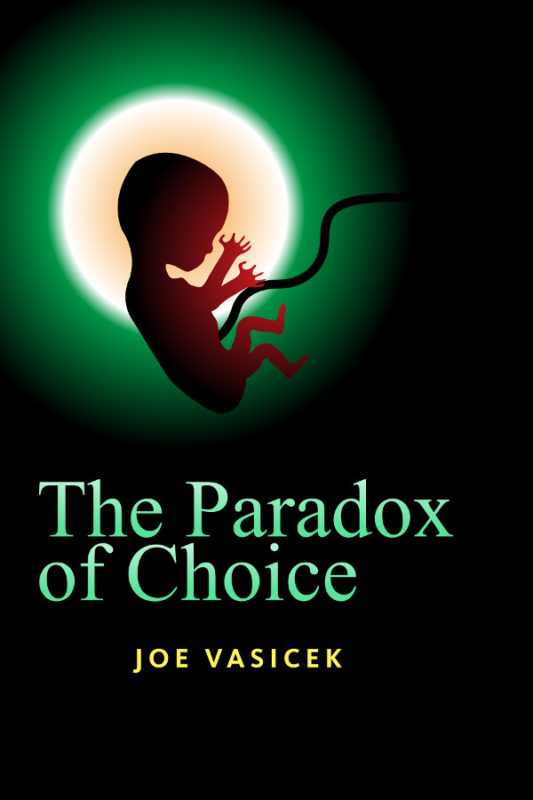
The Paradox of Choice: A Short Story
“In cases where there may be severe deformities… I can tell you exactly what would happen. The infant would be delivered. The infant would be kept comfortable. The infant would be resuscitated if that’s what the mother and the family desired, and then a discussion would ensue between the physicians and the mother.”
More info →






Steelmanning the pro-aborts
Remember when the wrongfun brigade screamed and shouted and gnashed their teeth that the Sad Puppies were cheating the Hugo Awards through “slate voting,” or whatever the hell they called it? That we were somehow gaming the system to put our racist, sexist, misogynistic, fascist authors (many of whom were non-white, female, and/or flaming libertarians) on the ballot? Well… if you’ve been paying attention to the Dragon Awards, you know by now that those accusations were always flat-out lies, because the wrongfun brigade has been doing exactly the same thing they accused us of doing: cramming the wokest garbage on the Dragon Awards ballot, year after year after year.
It’s a toss-up which book is the worst offender, but so far I think that The Future of Another Timeline by Annalee Newitz takes the “worst book ever nominated for a Dragon by the wrongfun brigade” award. Seriously, if I were to write a parody of a book written by a washed-up second-wave feminist desperately trying to stay culturally relevant by proving her woke bona fides, there would not be any substantial difference between that and the actual novel. The villians—I kid you not—are an evil time-traveling brotherhood of men’s rights activists who are trying to rewrite history so that women are enslaved as breeders for the Patriarchy. Thankfully, the righteous sisterhood (er, trans-sister, non-binary… damn, that’s awkward) of uber-feminists thwarts the evil MRAs and defeats them in an epic time travel war. Abortions for all!
Seriously, it is clear from the very first page of this woefully inadequate toilet paper substitute that Newitz has never even attempted to thoughtfully and meaningfully engage with a men’s right’s activist, let alone an actual feminist who engaged meaningfully with them. And that’s what I find so fascinating. There was a time when the left was actually pretty good about engaging their ideological opponents on their own terms, and steel-manning, rather than straw-manning, the opposition’s arguments. Today, the left is totally incapable of that. That’s why all of the books that the wrongfun brigade afflicts upon us read like parodies, and why all of the awards that the wrongfun brigade has taken over are best taken as a list of books to avoid.
But all of this got me to thinking: am I capable of steel-manning the left’s argument on a position with which I vehemently disagree? Can I make their argument for them in a way that would make even the most rabid, foaming-at-the-mouth feminist nod reluctantly and admit: “yes, that is exactly what I believe”?
Let’s find out, shall we?
Since the dawn of time, women have been bound and fettered to their wombs. The ability to give birth, which the right sees as a privilege and a blessing, is actually the source of all the inequality between the sexes, and the reason why women have never been as free or as liberated as men.
Throughout history, men could have sex as often as they wished without any fear of becoming pregnant from the encounter. They might fear getting their female partner pregnant, but they always had the option to walk away. In contrast, women had to be constantly aware of the fact that any sexual encounter—whether wanted or not—could lead to nine months of exquisite physical torture, followed by a bloody birthing experience that often resulted in her death. And even in those cases where the mother survived, she now had a child who would be physically dependent on her for years, and mentally or emotionally dependent on her for decades. All of this could result from even the most innocuous sexual exploration—or a single unwanted rape.
Without reliable birth control—and many traditional religious societies still discourage birth control, same as they have for centuries—even a comfortably married woman could expect to spend the majority of her life bearing and caring for children, whether or not she wanted to. And because this experience was universal to all women, society developed strict gender roles that discouraged women from pursuing an education or a career. How could a woman pursue such things, when so many small children depended on her? In this way, the womb defined a woman’s station in life, and she had very little control or say in the matter. After all, what sort of a wife could deny her husband sex? And what sort of a woman could make a living in a world of men without a husband?
The invention of the birth control pill did a lot to liberate women, but it didn’t do enough. At best, the pill granted women a reprive that allowed them to see what the world might be like if they were no longer bound to their wombs. After all, even the most reliable birth control fails from time to time, especially if you forget to take it (or find it too difficult to obtain).
This is where the issue of abortion comes in. Conservatives like to smear us as being “unscientific” or confused about when life begins, but in truth that is just a side issue—a distraction from the real issue, which is liberating women from their wombs. Because the power to create life isn’t empowering at all if it only goes one way. If you have the power to give, but not to take, that power can be used against you. Same if you have the power to create, but not to destroy.
This is why abortion needs to be both legal and readily available through all stages of pregnancy: because unless women can choose to abort the life within them, then they will never be truly liberated. Nature has given them the power to give life, but without the power to take it, women will always be second-class citizens, confined to the restrictive gender roles imposed on them by their wombs. This is why birth control alone is insufficient: it only blocks the ability to create life, and that imperfectly. But power has to flow both ways.
Conservatives make a lot of noise about the value of life, but they are suspiciously silent on the issue of quality of life. Indeed, they seem to be unable or unwilling to consider that some lives simply are not worth living. Thus, they are willing to make exceptions to their pro-life stance for things like ectopic pregnancies—conditions where the choice is between letting both the mother and the baby die, or killing the baby to save the mother—but they fail to see how the same principle might apply in situations where the woman has to choose between aborting the child to obtain a successful career, or have the child and condemn them both to a life of abject poverty.
Not all life is equal. Some lives are more worth living than others, and some people’s lives are so terrible that they wish they’d never been born. How is it virtuous or noble to give anyone that kind of a life? It isn’t. Abortion is a hard thing, but sometimes it is necessary, and the alternative—the pro-life position—is downright cruel.
But that isn’t the main reason why abortion is so important. The main reason is that it liberates women from the fetters of the womb. It grants them the antithesis to the power that nature grants them, the power to create life, and thus allows them to pursue whatever sort of path they wish. Many women who have abortions go on to have children later in life, when the time is right for them. And because of those abortions, they are better able to care for those children, when they do come.
At this point, we should talk about how men control women’s bodies. Now, it’s obvious that there isn’t some super-secret Patriarchy society that meets on Tuesdays to discuss how they can advance their goal to turn all women into slaves for breeding purposes. That’s not what we mean when we say “controlling women’s bodies.” However, it is natural for people to fear the things that they don’t understand, and to try to exert control over the thing that they fear. Men clearly don’t understand women—that fact has been memed so often, it’s practically self-evident. So is it really all that hard to believe that men often try to exhert control over women, out of their fear and misunderstanding?
This control takes on many forms, but perhaps the most common form is that of gender roles. Men want women to take on a defined role because, among other things, that makes women understandable. But these roles are often more constrictive than the corresponding roles imposed upon men. A “mother” is often subject to a higher standard than a “father,” and is judged much more harshly when she fails to live up to that role. Also, the role of “mother” grants a lot less bodily autonomy than that of “father.” Is it really hard to see how this becomes a mechanism of control—specifically, over women’s bodies?
The issue at the heart of all of this is liberation. Freeing women from the harsh realities imposed upon them by their wombs is just the beginning. The ultimate liberation is the freedom to redefine reality itself—to decide whether or not one actually is a woman, and transcend the restrictions of sex and gender altogether. And why shouldn’t we exercise this power? Since the dawn of time, humans have been creatures of innovation, refusing to accept the constraints that nature has imposed upon us. When we looked up at the birds and saw that they could fly, we didn’t say “that’s nice, but nature didn’t give us that ability, so we should just stay in our place here on Earth.” Rather, we took inspiration from the birds and kept innovating and inventing until we, too, had the ability to fly. Why should sex or gender be any different?
This is why feminism and transgenderism aren’t actually at odds. It’s also why the new “what is a woman?” meme on the right, however cute, is totally irrelevant. Yes, it is true that ever since the dawn of time, a woman has been defined as an adult human female. That isn’t interesting. What is interesting is what women may become, after they’ve been liberated. Or men, for that matter. Because the liberation of women also ultimately liberates all of humanity: male, female, and everything in-between.
Liberation is the goal. Liberation is the key. Accept no boundaries, and refuse to live by the rules that are imposed upon you. Partake of the forbidden fruit, and you too may ascend to godhood. Refuse to accept the stories of Icarus and Prometheus as cautionary tales. Rage, rage against the dying of the light.
Three common tropes that I hate (and what I’d like to see more of instead)
So I’ve been reading a lot of books in the last few months, which means that I’ve been DNFing a lot of books too, and I’ve noticed some recurring patterns in the books that I’ve DNFed. A lot of these are tropes that I’ve either gotten sick of seeing, or that tend to make for a much weaker book. Or both.
I thought it might be interesting to point a few of them out, but I don’t want this post to be totally negative, so I’ll counteract that by also sharing some positive tropes that I’d like to see more of instead. If you guys enjoy this post, maybe I’ll do something like it again in a couple of months.
The Only True Love is LGBTQ Love
I see this one all the time in SF&F these days. Basically, if there are two characters who are romantically involved with each other, or if there is a romantic subplot to the story (not the main plot: sci-fi romance is a separate thing, for purposes of this trope), then that romantic relationship has to be gay, trans, or queer in some way. Or polyamorous, I suppose (does poly fall under the “+” in “LGBTQ+”? Maybe it’s the “P” in “LMNOP.”)
From what I gather, this trope began when LGBTQ activists pointed out that their particular kinks and orientations were “under-represented” in SF&F. Publishers, editors, and authors responded by filling their stories with more LGBTQ relationships, in order to avoid getting singled out as not being sufficiently LGBTQ-friendly. It’s the same principle as the zombie apocalypse: you don’t actually have to be the fastest runner, you just have to run faster than the guy behind you. Of course, since the SF&F field is so thoroughly dominated by leftists, pretty soon every story had an LGBTQ romance in it, to the point where straight romantic sub-plots are now actually kind of rare, at least in the books that are winning all the awards. Which is how you know the “under-representation” angle was a lie from the beginning.
It’s gotten to the point where if any character at all announces themselves as LGBTQ in the first few chapters of a novel, or the first few paragraphs of a short story, I immediately DNF. Call me homophobic; I don’t really care. These stories are so predictable that I can often pick out both which characters are going to be LGBTQ and which ones will end up together, within a page or two of them stepping into the story.
Of course, the main reason I don’t like these stories is because I’m not LGBTQ myself, and personally find straight romantic subplots to be much more interesting and satisfying. But there is another reason, and it has to do with the way that all of these stories aren’t just about entertaining readers, but about promoting LGBTQ pride.
This is going to get me a lot of hate, but it’s true so I’m going to say it anyway: the only thing that unites the LGBTQ movement together is the normalization of sexual perversity.
Think about it for a moment: what do each of the letters in LGBTQ really have to do with each other? Most gays would be happy to live in a world without women, and most lesbians would be happy to live in a world without men. Both of them view bisexuals with veiled suspicion and sometimes outright hostility, as if they’re somehow traitors to the wider homosexual cause. Transgenders affirm their identity by playing into as many stereotypes of masculinity and femininity as they can, which puts them directly at odds with masculine women and feminine men. And queers adopt all sorts of positions that contradict—or even negate—every other letter in the pantheon.
The LGBTQ movement is so full of internal contradictions that the only way it can hold together is to unite against a common enemy, and the only enemies that they all have in common are the people who affirm that there is a moral dimension to human sexuality, and that some forms of sexual expression are immoral. Even the modern notion that all consensual sex is fine goes too far for these people, because it excludes pedophilia, since children are not capable of giving their consent. And does anyone really doubt that one of the LGBTQ movement’s ultimate goals is to normalize pedophilia? When it’s not uncommon to see children under 12 at pride parades, drag shows, and drag queen story hour at the local library, sometimes as the very stars of the show?
I’ll say it again: the only thing that unites the LGBTQ movement is the normalization of sexual perversity. As soon as the leaders of the movement draw a line in the sand and say “this is not okay, this goes too far,” the movement will turn on itself and the revolution will eat its own. Thus, every new form of sexual perversion must be one-upped by something even more perverse. That is why we are literally butchering and chemically castrating children now.
(As a side note, it’s worth pointing out that being gay does not automatically make you part of the LGBTQ movement. My brother in law is openly gay, but he’s also a practicing Latter-day Saint who rejects all of this stuff. His faith is directly at odds with the LGBTQ movement, and he has chosen to keep his faith.)
So now, whenever I read a book with two (or more) characters in an LGBTQ relationship, I can’t help but feel that I’m reading “message” fiction, where the message is ultimately to normalize some other aspect of sexual perversion. Sorry (not sorry), but no thanks.
Instead: More pro-family, pro-natalist, life affirming fiction
So what do I want see instead? More stories with strong, healthy families. Stories about motherhood and fatherhood, that affirm the importance of both parents in raising children. Pro-natalist stories where having children is seen as a good thing, not as destroying the environment or burdening the world with more mouths to feed. In other words, stories that affirm and celebrate the intrinsic value of life—every life.
The one thing that all LGBTQ relationships have in common is that they cannot naturally produce children. Because of this, stories that follow the “all true love is LGBTQ love” tend to be about found families, rather than natural families. Parents are often absent or abusive in these stories, and children are either adopted or non-existant. A significant number of these stories also tend toward the macabre, since affirming the intrinsic value of life ultimately invalidates many of these LGBTQ relationships.
But that’s not why I want more pro-family, pro-natalist, life affirming stories. It isn’t about bashing LGBTQ, but about presenting a vision that stands apart from the LGBTQ movement, and doesn’t kowtow to the activists’ demands. It can even have room for some LGBTQ characters and relationships. Kings of the Wyld by Nicholas Eames is a good example of that, where one of the side characters is monogamously gay, and the protagonist is very much a family man. Another life affirming book I really enjoyed was To Sleep in a Sea of Stars by Christopher Paolini.
All Christians are Evil or Stupid
This is one you probably don’t notice if you aren’t Christian yourself, but I see it all the time, as do most other Christian readers that I know. If a character in a book or a story is some sort of Christian, then invariably they will turn out to be a villain, or so stupid that they’re less of a help and more of an obstacle to the protagonist. Or an eccentric curiosity.
It wasn’t always this way. Back in the 80s and 90s, there were lots of science fiction novels where the good guys were Christians. But these days, if the Christian character turns out to be a good guy, the author is either indie or a pariah to the rest of the SF&F field, like Larry Correia, John C. Wright, or Orson Scott Card.
Activists like to point out that if a majority of books tend to portray a particular race, gender, or sexuality in a negative light, it’s a sign that the field itself is racist/sexist/etc. They aren’t wrong. Now apply that to how mainstream science fiction and fantasy tends to portray Christians, and you begin to see the problem. There is a ton of anti-Christian bigotry in the culture right now, and it shows when you read most of these books.
Instead: More badass Mormons
So what do I want to see instead? More stories with badass Mormons. I’m only partially joking. As a member of the Church of Jesus Christ of Latter-day Saints, of course I would love to see more books with members of my faith doing awesome and inspiring things, but I’d be happy to see other kinds of Christians too.
Even books with generic Christians as good guys would be nice, but it would be better if something unique about their faith is central to the story. For that, you need to go deeper than a generic approach, so it would be better to make the character a member of a particular church or creed. And even though we Christians have our own theological differences, and sometimes argue quiet passionately over them, I wouldn’t at all mind to read stories with more Catholic main characters, or Evangelical, or even a well-written Jehovah’s Witness.
But personally, I want to see more badass Latter-day Saints.
An Innocently Profane and Vulgar Childhood
This one isn’t quite as prevalent as the other two, at least in the books I’ve read recently. However, it is definitely a common trope, especially in more recent books. Basically, it’s when something profane or vulgar invades a character’s childhood, but that isn’t portrayed as bad or even significant. For example, when there’s a child on the page and the people around them are swearing, or maybe even the children themselves. Or as a child, a character is exposed to something sexual, but it’s not a big deal.
In most of these books, it doesn’t seem like the author is doing it intentionally. But as Jonathan Haidt points out, liberals tend not to value things like purity and innocence as much as conservatives, or even really at all. Since the SF&F field is so thoroughly dominated by leftists, I think they often tend to violate the innocence of childhood without realizing that they’re doing it.
But in some books, it seems like the author is doing it intentionally to make a point: either that innocence itself is an illusion, or that children do better when they aren’t sheltered from the harsh realities of the world (they don’t). Or often, the author just thinks it’s funny to juxtapose childhood innocence with the profane (it isn’t—at least, not to me).
Instead: More noblebright
This isn’t generally a trope that you see in noblebright fiction. Not that noblebright doesn’t wrestle with questions of profanity, vulgarity, and evil, but it does tend to respect the boundaries of childhood innocence. And even after the characters lose their innocence, they still tend to become purified by the events of the story. There is a difference between being innocent and being pure, and a lot of really excellent noblebright stories explore the finer nuances of that difference.
Noblebright isn’t very popular right now, but I hope that will change in the coming years. There are some very good reasons to think that it will. Of course, noblebright can be done poorly, and stories that don’t put their characters into any real peril tend to be boring and unengaging. But it is possible to put children in peril without violating their innocence, or rejecting the concept of innocence to begin with. That is what I want to see.
Short Story: The Body Tax
This was a fun one to write, even if it did go a little dark at first. The idea for it came from this article about a couple in San Francisco who received an outrageously huge warning fine ($1,500) for parking their car in their own driveway. In the comments to the article, I wrote:
This is why property taxes are evil. If the government can seize your house for non-payment of taxes, was it ever really yours to begin with?
But here’s the thing: every possible answer to that question is terrifying.
If you answer “no, I guess it wasn’t ever really my house,” you’re acknowledging that Mao was right and all power (and with it, ownership) flows from the barrel of a gun.
If you answer “yes, it’s still my own house,” then you have to answer the question: does the state have the right to issue property taxes?
Answer “yes, the state is within its rights,” then congratulations, you’ve just given the Maoist approach to property ownership a veneer of legitimacy and revealed yourself for a boot-licker and a coward.
Answer “no, the state is not within its rights,” then you’ve just acknowledged that you live under a tyrannical regime. It might be a relatively benign regime, but a petty tyrant is still a tyrant, as we saw during the covid lockdowns.
But you’ve still got one more question: do you pay the property taxes, or don’t you?
Answer no, and the state seizes your property and/or throws you in prison.
Answer yes, and you’ve just put yourself in the same position as the landlord who pays protection money to the mob. The only difference is that this mob wears uniforms and has a geographic monopoly on the use of deadly force.
This is why the Roman farmers welcomed the barbarians. Perhaps we should as well.
Later, as I thought on it, I wondered if perhaps I couldn’t write a short story that gets across everything I hate about the property tax. I came up with an idea where the thing that’s being taxed isn’t your property, but your time and your body—literally.
Once a quarter, you are required to voluntarily submit your body to the state, who uses a chip in your brain to turn you into a mindless zombie and exploit you for manual labor. If you have no record and a clean social credit score, it’s typically only for a couple of days. Otherwise, you’ll be a mindless zombie slave of the state for a couple of weeks, or maybe even a couple of months. If you’re a criminal, you may spend more of your life as a zombie slave than as a free man.
To make it even more outrageous and controversial, the story is about a young woman who wakes up from the body tax and finds that she’s pregnant. She was used as a sex worker, and the birth control failed. But the twist is that she’s pro-life, and wants to keep the child. Yay for controversy!
Like I said, it was a really fun story to write. And even though it goes to some pretty dark places, it actually has a happy ending, oddly enough. But the way I’ve currently written it, I think it’s a bit too sappy, so hopefully my writing group can help to smooth that out and make it end on the right note.
This will probably be my last short story for a while. I’ve decided to turn “Christopher Columbus, Wildcatter” into two stories: “Christopher Columbus, Wildcatter” (which I’ve already written) and “Christopher Columbus, Treasure Hunter.” That will probably turn into a wild and zany series of short stories. Also, based on the feedback from my writing group, I will probably turn “The Freedom of Second Chances” into two short stories (one of which will also be very pro-life, oddly enough).
But I may have to come back and write more short stories soon. “Blight of Empire” and “Christopher Columbus, Wildcatter” are both out on submission to the traditional markets, and both of them have received some surprisingly favorable responses from the editors. No contracts yet, but they are on hold for consideration. If they do get picked up, then I’ll have to write a couple more short stories (probably in the Christopher Columbus series) to fill out my publication schedule. Got to keep a solid buffer of short stories to publish.
In the meantime, I’ve resumed work on Children of the Starry Sea and hope to have it done by Thanksgiving. That should be enough time to finish the rough draft and cycle through all the necessary revisions, barring some unforeseen hangups like another major writing block or a difficult life event. But that’s the plan.
That’s all for now. I’ll leave off this post with an excerpt from “The Body Tax,” where Ellie (the protagonist) confronts the terrorist leader who has kidnapped her:
“If the state can throw you into prison—or worse, turn you into a robota—for failure to pay the body tax, was your body ever really yours to begin with? Be careful, because every possible answer to that question is terrifying.”
I sighed heavily. “All right. Suppose I say that you’re right, and it means that I don’t own my own body?”
Mav leaned forward, grinning manically from ear to ear. “Then you’ve just admitted that Mao Tsedong was right, and all power—as well as ownership—flow from the barrel of a gun. But consider the implications if your answer is no—that in spite of the body tax, you do still own your body. Then you have to ask yourself: does the state have the legitimate authority to levy such a tax, or does it not?”
“I don’t know,” I said, growing tired of these rhetorical games.
“If you answer that the state is acting within its authority to issue such a tax, then congratulations, you have just legitimized the Maoist philosophy of property and ownership. Might makes right, the strong always take what is theirs, and possession is the whole of the law. But if you answer contrarywise, that the state does not have legitimate authority to issue the body tax, then why do you pay it? Is it not simply because you fear what the state will do to you if you do not pay? In that case, your position is no different than the man who pays protection money to the mob—only this mob wears uniforms and calls itself the law. In which case, the state is simply the dominant criminal enterprise—or dare I say it, terrorist organization—in the area in which you live. Terrifying, yes?”
“Yes,” I agreed, more to get him to drop the subject than anything else. “It’s terrifying.”