An Answer…

Over the weekend, I read a really interesting post on The Passive Voice blog. It was an excerpt from a post by Dean Wesley Smith, looking at the tools and opportunities we have today and asking why we, as writers, still think that it’s difficult to write like the old pulp writers:

Yesterday, in the last chapter of the book I did about writing a novel in five days while traveling, I made a comment near the end that I found the exercise fun to be able to (just for a few days) feel like I belonged in the world of the pulp writers.

And I made a comment that I was born too late.

A reader wrote me privately with a good comment. Basically the reader reminded me that I should feel lucky to have the modern things we writers use such as computers, control of our own work instead of selling it to gatekeepers and so on.

The reader made a very good point. We do have it so easy, so much easier than the pulp writers did. I know that, I study the pulp writers and their lives.

Yet even with things being easier, it is unusual for a writer in 2017 to write a novel in five days.

So why do writers in this modern world not just write novels every week, week-after-week?

That even “Why?” question…

I knew the answer. Writer’s belief systems. Modern writers don’t believe they can.

That belief has been trained out.

Writers of the modern world have been taught to think that writing at pulp speed is different, unusual, a fantastic feat, massive work, and on and on and on…

I then realized I had done it too. And until tonight I hadn’t caught myself on it.

Look back at the last chapter I wrote. I called the entire idea of a novel in five days, “Crazy.”

Why? Writing a 40 thousand word novel should take me between 35 and 40 hours.

Sitting alone in a room and making stuff up for 40 hours in five days. What is so crazy about that????

And more importantly, what is so difficult about that?????

It’s a fair question. And it got me thinking: what are the false writing beliefs that are crippling me right now?

I can think of a few:

  • First drafts are never publishable.
  • Prewriting is not as important as butt in chair, hands on keyboard.
  • You can’t have more than one active WIP at the same time.
  • You can’t write short stories while working on a WIP.
  • Writing a short story per week is hard.

Well, it’s time to break free from these crippling beliefs, starting with the last one.

I’ve had a bunch of short story ideas recently, and I’m going to start running with them. I’ve neglected my short story writing for the past six months, so my active submissions have dried up somewhat (at least to the pro markets). But a lot of magazines have been giving me personalized rejections, which tells me that I’m not too far from a breakthrough. Trouble is, I just haven’t had anything to send them lately.

If I could write a novel per week, that would be absolutely fantastic. I’d probably write in a crazy obscure genre like Sword & Planet, except it’s not that obscure because Princess of Mars influenced everyone from Clarke, Bradbury, and Heinlein to George Lucas and the US Space Program.

But I’ll start with the short stories. And from there, who knows?
G is for Genre

Are there certain genres that indie writers should write in if they want to be successful? Are there other genres that they should avoid?

This is one of those pieces of common wisdom that really irks me, and not just because I write in a genre (science fiction) that isn’t as mainstream or popular as others. I think it’s a myth that you have to write in a “hot” genre in order to have success, especially if you’re an indie author. Here’s why:

1. You don’t have to be a bestseller to be an indie success.

This is something that Hugh Howie repeats all the time: that the true success stories in self-publishing aren’t the mega bestsellers like him or Bella Andre or H.M. Ward or Amanda Hocking, but the thousands and thousands of little guys who are carving out a comfortable space for themselves in this new world of publishing. You don’t have to be a huge bestseller to make a living as an indie writer–you can do quite well for yourself with a small but dedicated fan base.

I’m sure there are some people whose personal definition of success includes the kind of fame and recognition that comes along with being a bestseller. That’s fine–everyone has to define what ‘success’ means for themselves, based on their own personal goals and dreams. But being a bestseller is definitely not the baseline, at least for an indie writer.

2. Ebooks and epublishing have opened exciting new opportunities for niche genres.

Before epublishing, you needed a fairly extensive infrastructure to bring a book to market. Besides designing the book, you had to pay for printing, pay for shipping, pay for distribution and marketing to bookstores, pay for returns and remainders … the list goes on and on. Consequently, it was harder for niche genres to really get a foothold.

With ebooks, the economics of publishing have been flipped on their head. The marginal cost of producing another ebook is zero–digital content can be copied endlessly at virtually no cost. Shipping costs are also zero, and global distribution is as easy as uploading the book to Amazon’s servers–again, at zero cost.

Because of this, there’s room now for niche genres with much smaller readerships to actually turn a profit. And that’s what we’re seeing–an explosion of all sorts of niche, specialty, and experimental new genres. Books no longer have to be just like the Latest Big Thing (only different) in order to earn back their costs. There’s room for everyone in the new world of publishing.

3. It’s better to write what you love than to write what you think will sell.

The two aren’t always mutually exclusive, of course. Maybe you love a variety of genres, so that you’d be equally satisfied writing romance as you would writing something more niche like Amish vampire steampunk. But if all you’re doing is chasing the money, chances are that your heart won’t be in it nearly as much as it would if you were writing what you love. And if your heart isn’t in it, you won’t be able to bring that creative passion to the project that readers really love.

When I wrote Star Wanderers, I was following my passion. It was a science fiction story unlike any I’d either written or read, but I followed it where it took me without worrying whether it would sell. The genre description that best fits that series would probably be romantic frontier space opera–definitely a niche. But because I was passionate about it, the books were able to find readers who share that passion and touch them in ways that other books hadn’t. And guess what? Those are my best selling books.

There is a business side to publishing, but there is also an artistic side. You’ve got to be true to both. If your inner artist thrives on the challenge of chasing the market, great–go for it. But if doing that feels like you’re being unfaithful to your creative vision, you’ll probably write a better book if you strive to be authentic. And ultimately, I think that authenticity has a lot more to do with a book’s success than the genre it’s written in.

Readers are far, far more diverse than we give them credit. So long as you can write well and tell a good story, you can find success no matter which genre you write in.

Trope Tuesday: Curiosity is a Crapshoot

curiosity
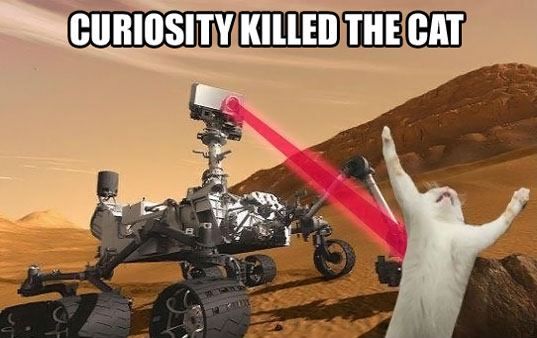
Is there life on Mars? NOT ANYMORE!

Is curiosity a bad thing?  Well, it depends how genre savvy you are.  It seemed to work out pretty well for Alice, but not quite so well for Pandora (or the rest of the ancient Greek world, for that matter).  Curious monkeys seem to come out all right, and their constantly curious counterparts also seem to do okay in the end, but anytime you run into schmuck bait you know that things aren’t going to turn out well.

The truth is, for just about every stock Aesop warning about the perils of being overly nosy, you can find another one exalting it as a virtue.  In fact, you could say that curiosity is a crapshoot.

But what is curiosity exactly?  The Merriam-Webster dictionary defines it as “desire to know,” and “interest leading to inquiry.” As you can imagine, there are situations where this could be good or bad.  Thus, what a story says about curiosity often changes depending on its genre.

For example, in most horror stories, curiosity and nosiness are usually bad, leading the protagonists to go places where they shouldn’t and uncover things that should never have been uncovered.  At the same time, a lack of curiosity can also be fatal … in fact, a lot of things can be fatal in a horror story.

In mythology and folklore, curiosity is often even worse.  From Pandora to Eve, Psyche to the proverbial cat, curiosity leads to Very Bad Things.  Perhaps this is because these kinds of stories are mostly tales of warning, passed on from generation to generation as a way to preserve our collective knowledge about the dangers of the world, rather than inspire us to go out and face them.

(As a side note, there are a few exceptions in the realm of folklore.  In the Bluebeard myth, curiosity killed off all of Bluebeard’s previous wives, but combined with cleverness, faith, and friendship, it saved the last one’s life.)

In fantasy, curiosity is often a mixed box bag.  For example, take the hobbits: most of them are perfectly content to live out their lives in the shire, but the few who are inquisitive enough to venture outside end up saving the world in a way that the elves, dwarves, and humans never could.  At the same time, it puts them through a great deal of pain, even after the world is saved–neither Bilbo nor Frodo are ever able to be content in the shire again.

Curiosity, in other words, is complicated.  It’s not just a quirk or a character flaw–it’s an underlying quality of the hero’s journey.  Without curiosity, either of the world around him or the internal struggles within, the hero would be content to live out an unremarkable life.  Certainly he wouldn’t have the capacity for the cleverness, guile, wisdom, and sensitivity that he needs in order to descend into the darkest dungeon, face his own nadir, and return with the elixir of life.  Curiosity may lead to sorrow, pain, or even death, but it also leads to adventure.

As a subgenre of fantasy, many of these issues carry over into the realm of science fiction.  And yet, as a genre unto itself, science fiction has a distinctly positive view of curiosity compared to other genres.  Science is nothing if not the primary process of human inquiry, where curiosity is not only a virtue but the virtue, one of the most important aspects of humanity.  Consider these words from Adam Steltzner, one of the leading engineers of the NASA Mars Curiosity mission:

Likewise, curiosity is a staple of science fiction.  In Star Trek, it’s the basis of the entire mission: “to explore strange new worlds, to seek out new life and new civilizations, to boldly go where no one has gone before.” In Doctor Who, it’s how the Doctor finds his companions.  In Babylon 5, it’s Delenn’s curiosity about the humans that ultimately saves all the alien races.  And in 2001: A Space Odyssey, it’s the gift from the black monolith that helps monkeys to turn bones into space stations (well, not literally, but you get the idea).

Curiosity isn’t a central theme in most of my books, but it is a major part of Genesis Earth.  If anything, that book is about the importance of balancing curiosity about our universe with curiosity about ourselves and what it means to be human.  In Star Wanderers, Noemi’s curiosity is a huge part of her story, helping her to turn around a horrible (not to mention awkward) situation.  In Desert Stars, curiosity is complicated; it leads Jalil far away from home and puts a schism between him and the girl who loves him, but it also leads him to discover the truth about who he is, giving him the strength to return.

In general, I suppose it all comes down not only to genre, but to the underlying worldview of the author of the story.  Since I have a very positive and enthusiastic view of curiosity, it usually works out for the best in the stories that I write. Then again, perhaps that’s why I’m drawn to science fiction … how about you?

Up to my elbows in book surgery

That’s probably the best term for what I’m doing with Heart of the Nebula right now.  Basically, I let some of my darlings live, and they grew some extra limbs and started drooling acid without my realizing it.  But now, I’ve put enough distance between myself and the first draft that I have no qualms about grabbing the axe and chopping off heads.

Don’t worry; this is all a normal part of my creative process.  Maybe someday, stories will burst fully formed from my head like Athena from the brow of Zeus, but for now, my ideas are a lot more like baby turtles–if I’m lucky, one or two out of a dozen will actually reach the water and survive.  Protip: don’t follow the lights.

Speaking of ancient mythology, I’m reading the Argonautica right now, and I can’t help but notice that it would make a really, really, REALLY awesome science fiction story.  No, seriously–think about it.  A group of legendary heroes sets out on an epic voyage in search of some applied phlebotinum macguffin, have all sorts of adventures on strange and distant planets, get the girl to fall in love with the captain, and bring her back with them to their homeworld.  It would also work well as a heroic fantasy, but space is so much more awesome.

Incidently, Kutaisi was the capital of ancient Colchis, where Jason and the Argonauts came seeking the golden fleece.  People still speak of Medea as if she were a real person–generally, they think she was a dirty traitor who sold out her own people.  But people still enjoy the love story, and if you keep your eyes open you can see restaurants and hotels named after her.

So yeah.  Ancient Greek mythology + science fiction = win.  You can definitely expect to see some more of that in my own writing in the future.

In other news, I recently did an interview on fellow indie author Ty Johnston’s blog.  In it, I talk a little about my travel writing, what draws me to speculative fiction, my favorite number (hint: it’s 12), and my insights into the ancient Mayan calendar and the 2012 apocalypse.  It was a lot of fun–you should definitely check it out.

If you would like to host me for an interview on your blog, shoot me an email!  I’m always up for stuff like that.  Otherwise, I’d better roll up my sleeves and get back to hacking up operating on my book.

Story notebook #2

A while ago I rediscovered my first story notebook and wrote a few posts on it.  I promised I’d do the same for my other story notebooks, so here’s the next one.

For those of you who may be surprised that I’m sharing all my story ideas, let me explain why I’m doing this.  First, ideas are cheap, especially in genres as imaginative and inventive as science fiction and fantasy.  What really matters is the execution, and any two people’s take on the same idea is going to be different. For that reason, I’m not too worried about anyone “stealing” my ideas.

Second, and more importantly, I believe that the only way for ideas to grow in value is for them to be shared.  Ideas that get horded only worsen with age, because they’re not being explored. Only by exploring ideas can they come into their full potential, and the best way to explore ideas is to share them.  When we fail to share our ideas, we inevitably fail to explore them from all angles, because working alone in a vacuum, we’re so much more likely to miss something crucial.

Enough of that.  Here are the story ideas from my second notebook, roughly covering the fall of ’08, right after I finished my first novel and got back from Jordan.

How will myths arise in the space exploration age? Previously, myths formed perhaps because people had very limited means of communication and limited means of world awareness. Now, technology allows much better spread of information and science, but in isolated spacecraft, will [the conditions of isolation that lead to myth formation] return?

An interesting and somewhat complicated thought. How do myths form, anyway? I suppose that at the very least, the extreme isolation of space will lead to a proliferation of wildly different cultures and worldviews.

Just as the Catholic monks set up a monastery in Iceland, so people will go beyond the explored universe in the age of space travel and set up a religious order there.

Fascinating–and I think it runs somewhat counter to the grain, too. Most people tend to see space explorers as either adventurers or absolute believers in pure science–but what about the devoutly religious? If the Catholic monks set up a monastery in Iceland, is it possible that the monks of some other religious order may set one up on Mars, or Alpha Centauri, or Gliese?

And…that’s all I’ve got in this notebook. Sorry–there’s lots of scribbling and calculating for Genesis Earth, as well as library call numbers for books about Saladin and the Crusades, but not too much else in the way of story ideas. For more, you’ll have to wait until story notebook #3.