DUNE!

So Mrs. Vasicek and I saw the new Dune movie in theaters last weekend, and let me just say, it was awesome in every sense of the word!

Speaking as someone who’s read the novel three times and fervently believes it to be the most perfect science fiction book ever written, this movie did not disappoint. Not only is it the best movie adaptation of the book, hands down, but it may be the best adaptation that it’s possible to make of the book. Denis Villeneuve has done for Dune what Peter Jackson did for Lord of the Rings. It’s incredible.

With all of that said, I’m not sure if the movie would make much sense to anyone who hasn’t already read the book first. Dune is really a story within a story within a story, and while the movie captures that aspect quite well, it also touches very, very lightly on the outlying stories, which could be confusing for someone who isn’t already familiar with the novel. Even in my first read, I didn’t fully appreciate the complexity: it took two rereads before I began to grasp the full significance of all of the moving parts.

At its heart, Dune is about the struggle of Paul Atreides (the Chosen One) to push back against his destiny, because he knows that his success will be far more devastating, for him and for the galaxy, than his failure. In that, it’s a brilliant subversion (in the truest sense) of the hero cycle. But all of that takes place within the story of the Bene Gesserit and their quest to create the Kwisatz Haderach, a super-human who can see the past, present, and future all at once. But the Bene Gesserit scheming is all happening within the political intrigue of the Great Houses and the Imperium, specifically with the feud between House Atreides (which presents the greatest threat to the emperor) and House Harkonnen—and all three stories converge on the planet Arrakis, amidst the struggle of the Fremen to terraform their desert world into a lush, green paradise when all of the powers of the galaxy want to exploit it for the spice that is so important for interstellar space travel.

For someone who is already familiar with all of that from the book, the movie hits on all of those nested stories perfectly, without getting bogged down or missing the most important story of all: Paul’s internal struggle with his own destiny. But for someone who is new to all of that, the movie might be really confusing. It will be really interesting to hear what my Dad thinks of it, because he’s never read the book and he plans to stream the movie over Thanksgiving break. I’ll report back when I hear his reaction.

Some people are criticizing the movie for ending at the wrong place, but I actually think it ended at the exact right spot: where Paul becomes one of the Fremen by killing his first man in a duel. It’s subtle, but the whole movie builds up perfectly to that moment, making Paul’s character arc the central driving story arc. For me, it didn’t feel at all like I’d only gotten half a movie, or that the director was drawing the story out to make it into a trilogy. It felt very natural to end the story there, and a great set-up for the sequel, which should wrap up Dune itself. The third movie will conclude Paul’s story by giving us Dune Messiah, which should be really interesting, since the first movie actually did a lot to set that up. If the second movie is as good as the first, then the third one may actually be better than the book.

It’s become very fashionable these days to cast a major character as an ethnic minority, which can be really annoying. However, I wasn’t all that bothered by the decision to cast Doctor Kynes as a black woman. It did some interesting things for the character that I thought worked really well for the story, and for Paul’s relationship with Kynes. So even though that was the movie taking license from the book, I felt like it was a really good call.

One criticism that I do tend to agree with is that the characters feel a lot more like archetypes than like real people. That’s fair, not only for the movie, but for the book. My wife says that’s the main reason why she didn’t like the book, because none of the characters felt “real” to her. But that focus on archetypes is something I really enjoyed about the book, so it wasn’t as big of a problem for me with the movie.

Another point of criticism that my wife had was that neither the movie nor the book have a whole lot of joy. That’s also fair: the movie does tend to hit the same emotional notes over and over, without much variation. The most humorous part was where the Reverend Mother tells Paul “farewell, young human. I hope you live,” which wasn’t actually meant as a joke (and Mrs. Vasicek and I are totally going to use that line on our own baby from now on).

But it really did hit the sense of wonder quite spectacularly, not just with the big things like the desert and the sandworms, but the fine details like the control systems of the ornithopters, or the grittiness of the stillsuits and the spice mining equipment. It really does stick with you long after you’ve watched the movie, and makes you want to watch it over and over.

All I can say more is that I’m really, really, really looking forward to the next one!

Gotta go fast!

So they’re making a Sonic the Hedgehog movie, and the character design for Sonic is so bad that it’s spawned a bajillion memes. Within days of the trailer’s release, it got so bad that the director said they’d redesign the animation, and suddenly thousands of nine-year-olds became drunk with power.

I have a few thoughts on the whole Sonic fiasco. The first game came out when I was seven, and even though I only ever played it at friends’ houses, stuff like the Green Hill Zone theme definitely scratches the nostalgia itch. That said, never got into it as much as some people.

The new movie actually doesn’t look all that bad. I mean, it doesn’t look great, but it’s got potential. I really like seeing Jim Carrey as Robotnik, that could be really fun. Also… well, okay, that’s pretty much all that looks good so far, but just because it’s a horrible trailer doesn’t mean the movie has to be crap. Right?

The fact that Paramount Pictures made this movie reminds me of the early 00s, when superhero movies started to get big again, and the major studios really screwed up some of the big franchises. Fantastic four, I’m looking at you. Basically, the big studios were treating these intellectual properties as cash cows instead of treating them with the passion and love of the original creators. It was also very disrespectful to the fans.

Unless I’m mistaken, that’s actually how we got the Marvel Cinematic Universe. After the failures of Hulk, Fantastic Four, and Fantastic Four: Rise of the Silver Surfer, Marvel decided to do everything in house, because the major studios kept screwing things up so badly. With Blade and X-Men in the 90s, they’d proved that movies with B- and C-list superheroes could still be profitable, so they reacquired the rights to as many characters as they could and went all in on it. Thus was born the MCU, and there was much rejoicing.

It’s particularly interesting to me as an indie writer because the pattern is very similar to what’s happening in the book industry. It basically goes like this:

  1. Technological disruption renders the legacy business models obsolete.
  2. Independent creators start to steal market share from the old guard companies.
  3. The old guard goes through a period of mergers, acquisitions, and layoffs.
  4. They start to cut corners because too much is expected of the people who are left.
  5. The old guard companies become dependent on blockbuster hits to stay afloat.
  6. The bean counters take charge, further killing the old guard’s creative spirit.
  7. Several intended blockbusters fail spectacularly, driving further downsizing.
  8. The independent creators eat the old guard’s lunch.

And that’s why I’m still indie.

Is this what’s happening with Sonic the Hedgehog? Looks like it to me. We’ll have to see how this all plays out, but I’m not expecting much. On a more positive note, though, the best way to enjoy a crappy movie is to go in with low expectations. It worked for me with Indiana Jones 4, so maybe it’ll work with the new Sonic movie.

In the meantime, here’s Pewdiepie reviewing some of the hilarious memes that have come from all of this:

Black Panther

Pay no attention to the people trying to make this movie all about race or politics or whatever. They’re all just agenda-driven media whores trying desperately to hijack whatever’s popular at the moment in order to remain culturally relevant. This movie has nothing to do with any of them.

I really enjoyed Black Panther. Good story, good characters, lots of fun action, and a couple of really interesting twists. The music was fantastic: two hours of woodwinds and African drums. It wasn’t as comedic as Thor: Ragnarok, but it didn’t take itself too seriously either. For a Marvel movie, it was also surprisingly family friendly.

I thought it did an excellent job of acknowledging race and politics without allowing itself to be taken over by either. It isn’t race that makes the people of Wakanda different from the rest of the world: it’s the magical meteorite that fell in their country, with thousands of years of isolation that allowed them to follow their own cultural path. As for politics, it’s not so much about the struggle against the colonizers as it is a question of how to open up to the rest of the world: peacefully, or violently.

Honestly, if you don’t care about race or politics, you don’t have to worry because it doesn’t beat those over your head at all.

The story is really solid, which is par for the course for Marvel. The world is also really well done. Very different from what you usually see in these kinds of superhero movies. In fact, it didn’t feel like any of the other Marvel movies, even though it hit all of Marvel’s usual high standards.

The thing I liked most about it was probably the characters. T’Chaka is a genuinely good person trying to set right the mistakes of his father, and the friends who surround him are also good people trying to do right by their own as well. But they don’t always agree on what’s best: whether to keep the magical kingdom of Wakanda secret and isolated, or whether and how to reach out to the rest of the world.

Overall, it was a really fun movie and I’d definitely recommend it. Like I said at the top, pay no attention to the attention whores on mainstream and social media trying to make this all about race and identity politics. Star Wars may have been taken overy by wankers, but Marvel has not.

12 Strong

This movie was fantastic. Every bit as good as the trailers make it out to be. A sight above Zero Dark Thirty, and on par with American Sniper. I wouldn’t be surprised if it’s the best movie I see all year.

It’s really fascinating to see how combat forges bonds between people. At the beginning, right after ODA 595 gets dropped in Afghanistan, there’s a real sense of tension as they don’t know who they can trust. That clears up after a few good battles, and by the end, it’s totally gone.

There’s also a really euphoric sense of victory that can be hard to find in Hollywood war movies. It’s easy to find movies that say “war is horrible,” and this one certainly says that as well, but it can be difficult to find a movie that portrays American forces as righteous leaders and unambiguous heroes. This one certainly does, without hamming it up or going over the top in any way, because these men really are heroes.

And the scale of the victory… I mean, Saving Private Ryan was a great movie, but the victory was less about the war and more about saving a single man. Zero Dark Thirty was about killing Osama Bin Laden, but there wasn’t a whole lot of actual combat. Hacksaw Ridge was a tremendous story about the heroism of one man, but the scope was still limited to the island of Okinawa.

In contrast, the scope of 12 Strong was the entire Taliban, and the War of Afghanistan itself. To this day, the victory marks Al Qaeda’s greatest defeat. Besides all that, there’s something awesomely badass about leading an outnumbered cavalry charge against tanks, rockets, RPGs, and truck monted machine guns, and winning.

Awesome movie. Though I have to say, I think there’s a bug on Rotten Tomatoes, because they have the scores for 12 Strong and The Last Jedi switched. In any case, this is definitely a war movie worth seeing.

Thoughts on Star Wars: The Last Jedi

What a disappointment.

I was going to avoid spoilers, but now that I’ve had some time to reflect, man oh man I’m just gonna vent about everything. Because there is so much wrong with this movie, and so many things that could have been awesome but instead turned into missed opportunities. So this post is full of spoilers. Consider yourselves warned.

First, taken entirely on its own, the story is just broken. I’m undecided whether the writers and/or director were too clever or too stupid for their own good. Half the plot of the movie turned out to be a red herring, which made Finn, Rose, and to a certain extent Poe Dameron completely unnecessary characters. It seemed like the writers were trying to play with tropes and plot conventions in an unexpected way, but it ended up completely breaking the story. The Dark Knight did something similar and pulled it off masterfully, but The Last Jedi is no Dark Knight.

The purple-haired feminazi who replaced Princess Leia for half the movie deserves a special measure of my wrath. How a woman with all the charisma of a dead fish became one of the chief leaders of the rebellion lite, aka the resistance, I don’t know. There wasn’t a single scene with her where I wasn’t screwing my face up and cringing. And her command decisions were just completely awful. If you know that you’re going to lose most of your starships anyways, why not ram the super star destroyer at light speed with the first damn one to fall?

I think my biggest problem with the new Star Wars movies is that, with the notable exception of Rogue One, they introduce a bunch of new characters and assume that you’re going to admire them simply because they show up. We’re told that Snoke is the new big bad, but we know nothing about who he is, how he rose to power, what his capabilities are, etc. So when he dies, the only thing going through my head was “well, that was interesting,” whereas when Emperor Palpatine dies, it was this big emotional moment.

We’re never made to admire the new characters, we’re simply told why we should admire them. Goggle eyes orange face is supposed to be this super well-connected smuggler type, but we never learn anything about her other than that Han Solo apparently admires her, and she ends up shooting things a lot. Who is she? Where does she come from? What’s her history? Who is she connected with, and how? Show don’t tell, dammit. Give us something to make us care.

The fridge logic really ruins this movie. Why did Luke tell Rey to go away, when he obviously left a map for them to find him? If ramming starships at light speed is a thing, why hasn’t anyone ever done it before now? If Kylo Ren truly wants to wipe out the past and start over, why is he still fighting the Resistance?

Which brings me to the greatest missed opportunity of the movie. When Rey and Kylo Ren team up, that was truly awesome. Great fight scene, great turning point. For a moment, you think that you’re going to see something new in the Star Wars universe. The whole movie has been building up to it. Luke Skywalker has already established that the Jedi deserve to die out because they’re really a bunch of zealous fanatics, and Kylo Ren has already refused to give himself to the dark side fully. He reaches out his hand to Rey, offering her the chance to join forces and create something new, something that transcends both the light and the dark sides of the force. And then they go right back to fighting each other as if none of this had ever happened, because this is Star Wars, where apparently nothing ever changes.

It’s not so much that Kylo Ren was the most interesting character in the movie, so much as that he was the only interesting character. At this point, he’s the only one I’m still rooting for. Rey is an idiot. Finn and Rose are useless baggage and dead weight, respectively. Princess Leia is apparently still around, but without Carrie Fisher playing the part I really do not care about her. Chewbacca is still alive, I guess. So are R2D2 and C-3PO. But they’re the last original Star Wars characters, and I really don’t think they can carry a story. Poe Dameron is cool, but perpetually hamstrung by the idiots running the Resistance, and that gets old real fast.

As someone who grew up with Star Wars—who ranks Empire Strikes Back as his favorite movie of all time—I hate to say this, but I’m not going to watch the next Star Wars movie to come out. Not unless it gets overwhelmingly positive reviews and all my geek friends can’t stop raving about it. Rogue One was good, but The Last Jedi? It’s crap.

Here’s my ranking of Star Wars movies from best to worst:

  1. The Empire Strikes Back
  2. A New Hope
  3. Rogue One
  4. Return of the Jedi
  5. The Force Awakens
  6. Revenge of the Sith
  7. The Last Jedi
  8. Attack of the Clones
  9. The Phantom Menace

At this point, I don’t think anything below Return of the Jedi is worth rewatching.

Thoughts on Dunkirk

This movie is fantastic. It’s so fantastic, I saw it in theaters twice.
It’s one of the best war movies I’ve seen in years, but it’s not like other war movies. There is no one main character, there is no heroic charge or last stand, no clear victory or defeat. At the same time, there are cowards as well as heroes. There are men who care only about survival, and there are others—many others—who put their lives on the line to save people they’ve never met.

There’s lots of chaos and death, but very little blood. There’s also very little gunfire for a war movie, and very few explosions. When they happen, though, they’re all the more earth-shattering for the long lulls between them. That seems a lot more realistic to me—and a lot more terrifying.

I really love the fact that you never see the face of the Germans. For the guys on the ground, they’re more a force of nature than something they can actually fight. Even the guys in the air are more worried about how the dogfighting depletes their fuel than they are about actually getting shot down.

One of the things that really fascinates me about this movie is the context in which it happens. Most World War II movies take place in the second half of the war, during or after the Battle of Britain. When the Nazis failed to invade Britain, it was clear that they were going to lose (or at least that it would end in a stalemate on the western front). But when Dunkirk happened, everyone fully expected the Nazis to invade and conquer the UK just like they’d conquered France. It appeared at that time that the Germans were going to win.

It also strikes me that Dunkirk was where World War I met World War II. In the run up to the first world war, the Germans expected to sweep across France and push the British into the sea. They expected that victory was only a matter of weeks away. In the run up of the second world war, they expected a repeat of the brutal trench warfare that bogged down the western front for years. Instead, they got exactly the scenario that the Germans had expected in the first war but never gotten.

This movie made me think a lot about the major defining conflicts of previous generations and what our major defining conflict is going to be. I don’t think we’re far from another Dunkirk. Will we rise to the level of heroism that the British civilians showed when they rescued their soldiers stranded across the channel? Will we come together in the face of the next existential threat, or will we come completely apart?

Dunkirk is a fantasic movie, and I highly recommend it. It’s definitely one of Christopher Nolan’s bests.

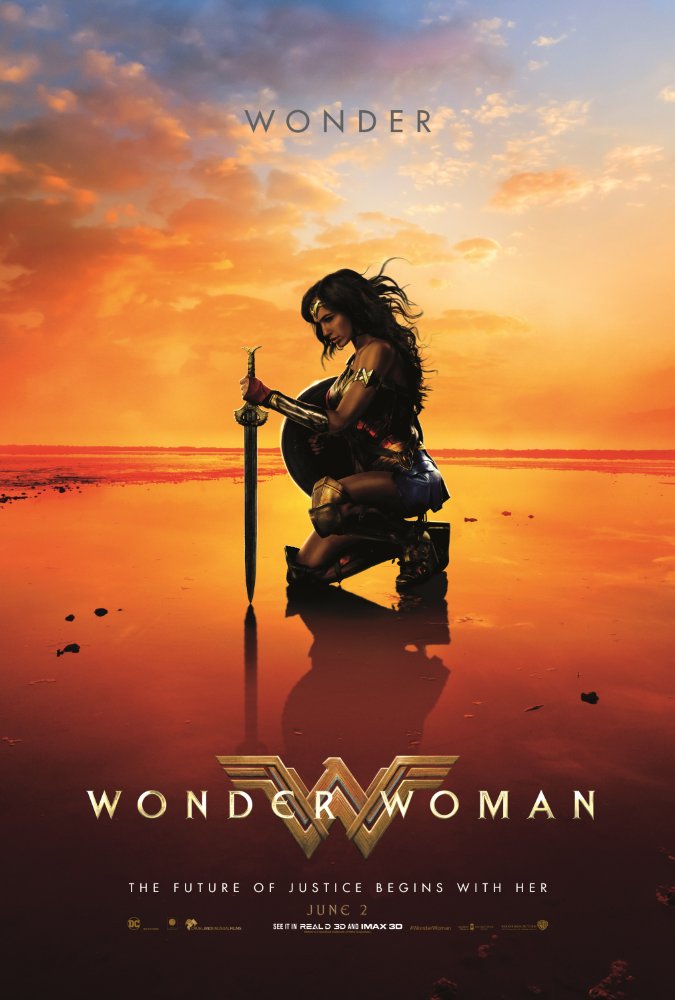
Thoughts on Wonder Woman

This isn’t going to be a review so much as a reaction post, though I’ll do my best to make it spoiler-free for those of you who haven’t seen the movie yet. Can’t guarantee that, though.

Short version: I liked it! Longer version: I liked it, with some caveats.
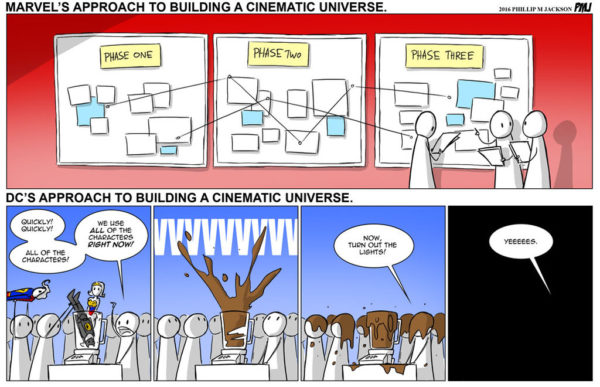
Marvel seems to do plot and characters better, especially over multiple movies. DC, on the other hand, specializes in explosions and emotional… stuff. Lots of emotional stuff.

This cartoon sums it up quite well:

By far, the weakest part of Wonder Woman was the plot. Whenever there was something that strained credulity, it invariably had to do with a missing beat or plot point, or something that wasn’t foreshadowed properly, etc.

That said, the universe itself was actually pretty coherent. And there were some interesting twists. And the plot, for all its holes, was still strong enough to hold the movie together. And the explosions were pretty cool.

By far, though, the best part of the movie was Gal Gadot.

Have you ever seen someone who was so incredibly gorgeous that they made you rethink everything you thought you knew about beauty? Normally when that happens, it takes a couple of minutes for your mind to recalibrate and for everything to return to normal. With Gal Gadot, my mind failed to recalibrate. The whole movie, I couldn’t stop thinking how gorgeous she is.

It was pretty cool. And when I say “gorgeous,” I don’t just mean sex appeal. True beauty is about so much more than that: poise, elegance, confidence, etc. She’s not a bad actress either. No wonder the feminists over at Slate hate her—she’s basically their Harrison Bergeron.

The movie also had a really good message: that people are capable of both good and evil, therefore it’s not about what we deserve, it’s about what we believe. Very empowering, and very different from all the sturm und drang we usually hear: identity politics, collective guilt, the original sin of “privilege,” and virtue signalling of the perpetually offended.

There was absolutely none of that in this movie. Just a strong female character trying to save the world while very much being a woman at the same time.

Thoughts on the new Star Wars trailer

I have a lot of thoughts on the new Star Wars trailer. But first, a little background.

Growing up in the 90s, I was a huge Star Wars fan. It’s not an exaggeration to say that Star Wars was my life. I played X-Wing every day, I watched at least one of the original trilogy movies every week, I read every Star Wars book in the library that I could get my hands on, and I daydreamed and made up Star Wars stories all the time. I was living in the golden age of science fiction (about age 9-12), and that meant Star Wars.

Then Episode I came out. Like all the other fans, I was super, super excited about it. Like all of the other fans, it was a huge disappointment. Several things ruined that movie for me, but the biggest were Jar-Jar Binks and midichloriens. The most magical aspect of the Star Wars universe, the Force, was singlehandedly ruined by the whole midichlorien thing, and as for Jar-Jar … I don’t even want to go there.

There were a lot of other little things too: like the pod racing sequence, where the sand people were thrown in for a gag, and that part where Obi Wan and Qui Gon Jinn drove a submarine through the center of the planet. My suspension of disbelief was stretched to the breaking point, and this awesome thing that I loved now felt like a little kid story. But the biggest things that broke the movie for me were Jar-Jar and the midochloriens.

But that was Episode I, and Episode II was bound to be better. After all, how could you screw up the Clone Wars? Unfortunately, I was about to find out.

To be fair, Episode II wasn’t nearly the disaster that Episode I was. Not that that’s saying much, but still, it wasn’t horrible–it was just bad. The romance was cringe-worthy, the pace was glacial, and the action sequences had too much flash and not enough substance.
Jar-Jar was gone (thank the stars!), but C-3PO and R2D2 were little better, and the fact that they were in the story at all caused a major sprain to my suspension of disbelief. The lightsaber duel with Yoda and that other guy felt like it was thrown in for a gag, and Anakin … yeah. By the time the big stadium battle happened at the end, all I could do was yawn. The battle of Hoth had a lot less flash to it, and yet was infinitely more engrossing.

By this point, I’d started to phase Star Wars out of my life. I still occasionally watched the original trilogy movies, and played stuff like X-Wing: Alliance from time to time, but I wasn’t nearly as invested in the franchise as before. I’d moved on to stuff like Tolkien and Lord of the Rings, and spent more time playing stuff like Civilization and Alpha Centauri. Star Wars did not hold the same magic as it had before.

Then came Episode III, the final nail in the coffin for me. I can sum it all up in one word: “NOOOOOOOOOOOO!!!!!
Episode III was marginally better than Episode II, but that was only because of Order 66, where all the Jedi died and the Republic transformed into the Empire. Order 66 was pretty cool. But the rest of the movie? I mean, right from the first battle, I knew that it was going to suck. When a ship in orbit tilts to one side, it does NOT cause everything to fall in that direction! Lucas might as well have shown people falling off of the south pole. From that point on, my suspension of disbelief was shattered beyond any hope of recovery.

But the worst part was Anakin’s transformation. Here’s a guy who is supposed to turn from this whiny, annoying brat into the most iconic sci-fi villain of all time … and I just wasn’t buying it. With each progressive step, he just didn’t seem any different than before. Instead of the character driving the story, it felt like the plot was shoehorning the character into a role, and all he could do was passively accept it. The slaughter of the young Jedi knights at the temple, the oath of fealty to Chancellor Palpatine–none of it felt authentic at all. And even after he put on the mask, he was still the whiny, annoying brat from before. Darth Vader, the linchpin of the entire franchise, was ruined.

At that point, I completely checked out. That’s right–the kid whose whole life was tied up with Star Wars now wanted nothing to do with it. I still went back to some of the old, pre-Episode I stuff from time to time, just for nostalgia’s sake, but I had no desire to keep up with any of the new stuff that was coming out. Books, games, TV shows–I was done.

Then Disney bought Star Wars, and rumors started to fly. My expectations at first were pretty low, but George Lucas had done so much to screw it up already that I figured Disney couldn’t do any worse. Then I realized that Disney does a lot more than princesses and fairy tales these days, and my indifference turned to curiosity. When J.J. Abrams was slated to direct it, curiosity turned to the faintest glimmer of hope.

Which brings us to this:

I have to be honest, I’m actually kind of excited. After all that the prequels did to ruin Star Wars for me, that’s saying quite a lot.

First of all, the black stormtrooper. I’ve heard a lot of griping about the fact that he’s black (or more accurately, that he isn’t one of the clones from Episode II), but come on guys–do you really expect the first generation stormtroopers to stay on active duty for fifty-plus years? Of course the Empire is going to replace the clone warriors with newer soldiers (hopefully, ones that can actually shoot).

Personally, I think it’s kind of awesome that he’s black. More than that, though, I think it’s awesome that he has a face. Imperial stormtroopers have always been quintessential mooks, and that’s always bugged me. Just once, I’d like to see the good guys face off against a bunch of stormtroopers who can actually shoot straight–it would add a whole new level of tension and danger. To feature one as an actual character is promising indeed

One of the things I loved the most about Star Wars was the grungy, dirty, second-hand feel of most of the technology. In the original trilogy, you really get the sense that you’re in a used future, especially on the planet Tatooine. From what I can see in the trailer, it looks like they’re bringing that back. Deserts + derelict spaceship wreckages + super fast hovercars that look like they’re about to break down = OMG YES.

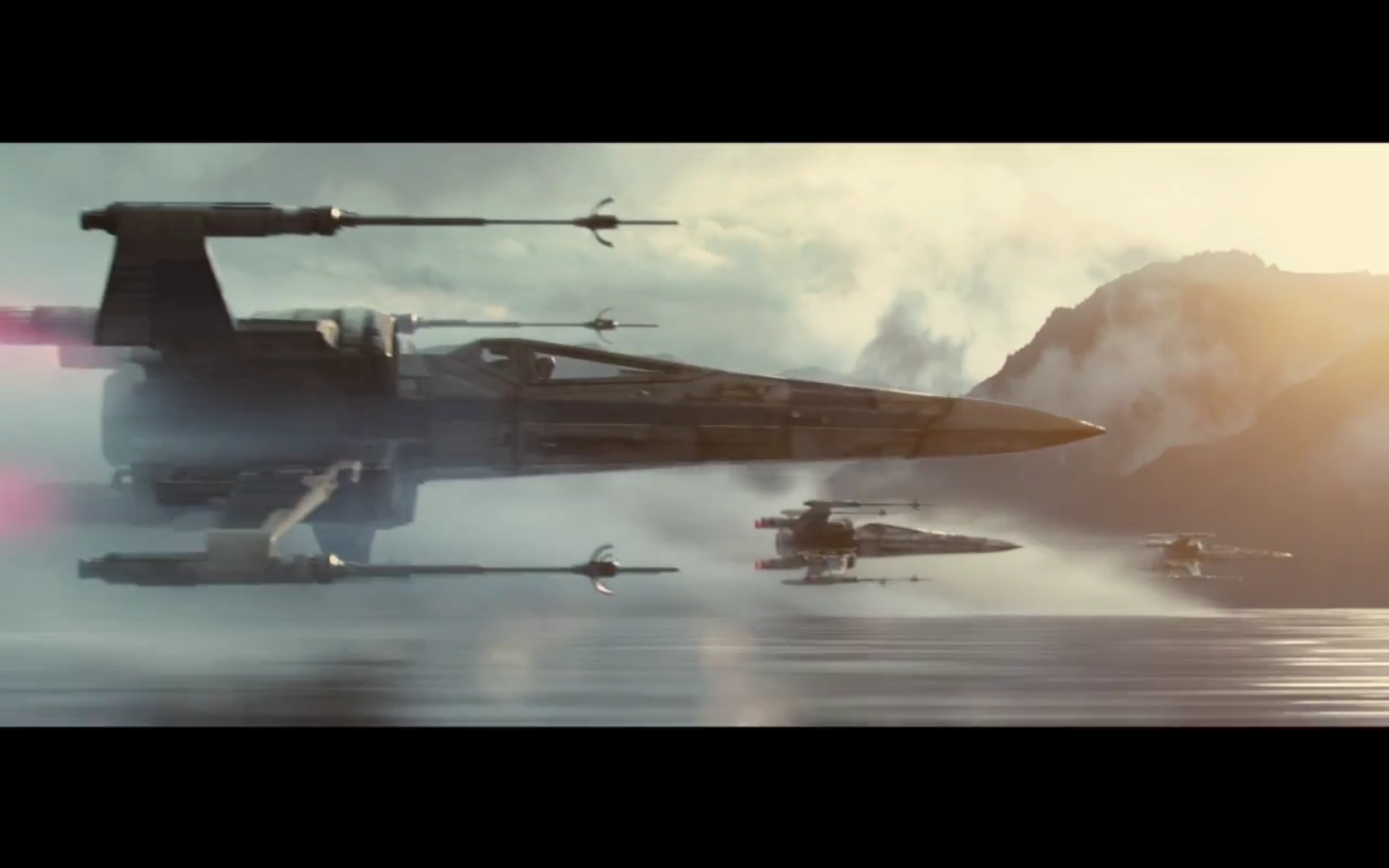
But the part of the trailer that really won me over was this part right here:Screenshot from 2014-12-12 11:12:18Specifically, how realistic the X-Wings look. The way they kick up those clouds of water as they buzz the surface of that lake–you can’t deny, that’s pretty freaking awesome. My biggest running issue with the prequels was how they constantly abused my suspension of disbelief, so the fact that these X-Wings actually look real is perhaps the most promising part of the trailer for me.

Yes, the bad guy’s lightsaber with the dinky little lightsaber spurs looks … well, dinky. No argument there. But the last part, with the Millennium Falcon doing the crazy barrel roll as the music hits you with all of its glory–HOLY CRAP YES!!!!!

There’s not a whole lot of substance in this trailer. It’s only a tease–but wow, what a tease! I’d hate to get my hopes up only to have them dashed as badly as Episode I dashed them, but I’ve got to be honest: I’m actually kind of stoked for this movie now.

Episodes I, II, and III alienated a lot of the older fanbase, but it did appeal to the younger generation that came to the Star Wars universe without any preconceptions or expectations. Before I saw the trailer, I thought that Episode VII would simply continue that trend. Now, I actually think it may turn things around–bring back the old-school fans while showing the younger generation that Star Wars can be so much more.

B is for Book Blurb

Perhaps the most important part of your book’s sales page, on Amazon or any other retailer, is the book description. More than anything else (except perhaps the cover), this is what sells your book. If done right, it will interest the reader enough to download a sample or buy the book outright. If not, they probably won’t even finish reading it before they click to the next page.

So how do you write a knockout book blurb? Honestly, I wish I knew. I don’t think mine are bad, but I’m sure there’s room for improvement, and if they seem really awesome to me now it’s probably because my blurb writing skills haven’t risen to the next level. I tend to tinker with my blurbs until I get sick of them, then I do all I can to avoid looking at them until it’s time for a revamp.

That said, it’s not like you’re writing a novel. Just the opposite, in fact. If you try to cram your whole book in the blurb, chances are that you’re doing it wrong. You’re not trying to summarize the story or convey information, you’re trying to spark enough interest to convince the reader to try out your book. The hardest part is figuring out what to mention and what to keep out. Once you know that, the rest is fairly easy–fun, even.

There’s a video I watch whenever I have a blurb to write, because it helps me to channel the kind of voice I’m looking for. It features the top five voice-over artists in the United States riding a limo together, and it’s both hilarious and awesome. Watch!

For some reason, that video always kicks the blurb-writing part of my brain into high gear. But that makes sense–a good book blurb is a lot like a good movie trailer. Both of them spark a compelling interest in the reader/viewer, and neither of them gets bogged down in too many details (or worse, spoilers) about the book/movie.

At LTUE 2013, Howard Tayler gave a presentation in which he listed four key elements of a book blurb. They are:

  1. Inciting Incident
  2. Character Action
  3. Conflict
  4. Hook

Whenever I write a book blurb, I try to keep those four things in mind. As an example, here’s the blurb to Star Wanderers: Outworlder (Part I):

HE WANDERS THE STARS IN SEARCH OF A HOME. INSTEAD, HE GOT A GIRL WITHOUT ONE.

When Jeremiah arrived at Megiddo Station, all he wanted was to make some trades and resupply his starship.  He never thought he’d come away with a wife.

Before he knows it, he’s back on his ship, alone with his accidental bride. Since neither of them speak the same language, he has no way to tell her that there’s been a terrible mistake. And because of the deadly famine ravaging her home, there’s no going back.  She’s entirely at his mercy, and that terrifies him more than anything.

Jeremiah isn’t ready to take responsibility for anyone. He’s a star wanderer, roaming the Outworld frontier in search of his fortune. Someday he’ll settle down, but for now, he just wants to drop the girl off at the next port and move on.

As he soon finds out though, she has other plans.

The inciting incident is the accidental marriage which unexpectedly brings the girl into Jeremiah’s life. That introduces the conflict–that there’s a girl on Jeremiah’s space ship, and he doesn’t know what to do about her. The character action is the second to last paragraph, which describes him as a star wanderer out to seek his fortune and not to settle down. And the last part–the zinger at the end about the girl having other plans–is the hook.

It’s not a formula though, and you can’t approach it as such. There’s an art to it that doesn’t always break down so easily. The good news, though, is that it’s a skill that can be learned–a writing skill. If you have the chops to write a novel, then with focused practice you can learn how to write a knockout book blurb, just like you can learn how to write a blog post, or a tweet, or any other piece of writing.

In my opinion, writing a book blurb is a critical skill for any indie writer. No one is going to be more excited about your book than you are, and since that’s such a critical part of writing a good blurb (it’s hard to get people excited about something that you yourself aren’t excited about), it isn’t something you can easily contract out. But since you’re already a writer, it’s definitely something that you can do.

Trope Tuesday: The Bechdel Test

The Bechdel Test is a way to measure how prominently women figure in a story.  It mostly comes up in discussions of TV and film, but can also be applied to works of literature.  To pass the test, the story must have

  1. at least two named female characters
  2. who talk to each other
  3. about something other than men.

The surprising thing, as you can see in this discussion of the trope, is that so few stories actually pass this test. Even in literature, works like The Odyssey, Romeo & Juliet, and even War & Peace fail to pass or only barely pass this test.

Closely related to the Bechdel Test is the Smurfette Principle, where only one of the major characters is female–the token chick.  Stories that fail to pass the first part of the test fall into this category.

So why does this happen?  It may be because most writers are male, but that isn’t necessarily true of books and literature.  Novel writing, after all, was originally considered a womanly pursuit, and the English major was created in the so that women could have something to study while they were in college.  Not surprisingly, 19th century works by female writers like the Bronte sisters tend to pass…

…or do they?  It’s been a while since I read Jane Eyre or Pride and Prejudice, but the impression I got was that the women in those books spend only really talk with each other about men.  And when you look to contemporary writers like Dickens and Tolstoy, the trend holds.  After all, how many female characters are there in A Christmas Carol?  Do any of them ever even talk to each other?

This isn’t necessarily a measure of how good or bad a story is, or even of how feminist it is (Aliens, after all, technically passes), but it is a measure of how independent and well rounded the female characters really are.  If the story doesn’t pass, it’s a sign that the women only play a role in relation to the men, or that the male characters are the ones who advance the plot.

I don’t usually like to bring up my own stories in relation to these tropes, but I thought it would be useful to apply this test to my own books and see how they shape up.  As a writer, I think it’s a good idea to do this periodically, to make sure my work isn’t slipping into a rut.  So here we go:

Genesis Earth

Point 1: Yes, there are two named female characters: Terra and Stella.

Points 2 & 3: No, they never talk.  However, when you apply the reverse Bechdel test (two men who talk to each other about something other than women), Genesis Earth only barely passes.  Michael talks with Tom in the first chapter, mostly about Terra, and for the rest of the book he and Terra are alone.

Bringing Stella Home

Point 1: Yes, it passes.  Named female characters include: Stella McCoy, Danica Nova, Anya Sikorsky, Tamu, Lady Borta, Lady Zeline, Sergeant Maria.

Point 2: Yes; in most of Stella’s scenes, she’s talking with Tamu or Borta or one of the other Hameji women.  Also, since Danica is the captain of the Tajji Flame and Anya is the chief pilot, they interact quite a bit.

Point 3: Yes, but just barely.  In most of their scenes together, Stella and Tamu are talking about Qasar or the harem or sex.  There are a couple where they talk about each other and their past, but it all relates back to their captivity under the Hameji.  At one point later in the book, Anya goes AWOL and Danica has to talk her down, which is probably the scene that makes the book pass, but a hardcore feminist might argue that that conversation is indirectly about a man.  Still, I’m counting it.

Desert Stars

Point 1: Yes, there are plenty of women.  In fact, as you can see from this list of non-minor characters, there are almost as many women as there are men:

Female Male
Mira Jalil
Shira Sathi
Zayne Hamza
Tiera Rumiya
Lena Gregor
Surayya Kariym
Amina Ashraf
Rina Ibrahim
Sarah Lars
Michelle Nash
Mark
Will

Point 2: Yes, plenty of these women talk to each other.  Surayya and Amina are practically joined at the hip, Tiera, Shira, and Lena all have private conversations with Mira, and the only time Rina even talks is when she and Mira are alone.

Point 3: While most of the conversations between the female characters revolve around men and marriage, Tiera talks with Mira about honor, and Rina talks with Mira about leaving home.  Without spoiling too much, there are other conversations that have nothing to do with men, though they happen off-stage and only get reported second-hand.  Either way, I’d say this book passes.

None of this is to say that a good story must pass the Bechdel test.  Lawrence of Arabia, for example, doesn’t have a single female actress–not one single actress!–and it’s an amazing film.  As a counterpoint, I’m sure there are plenty of good stories out there (most of them probably anime or manga) that do not pass the reverse Bechdel test.

However, it is a good measure of female presence and how much the story is driven by men.  And as a lens through which to view the wider culture, it offers a surprising and somewhat disturbing perspective on male-domination in fiction.