Is Bringing Stella Home for You?

Some science fiction dazzles with ideas. Some unsettles with spectacle. Bringing Stella Home is the kind that stays with you because it feels personal. It’s a character-driven science fiction novel about family loyalty, moral courage, and the consequences of refusing to abandon the people you love. It blends character-driven space opera with political science fiction and ethical war fiction, set during a brutal interstellar war fought by clashing human civilizations.

This is an emotionally grounded story where the biggest question isn’t how the war is won—but who the characters choose to be while it’s being fought.

What Kind of Reader Will Love Bringing Stella Home?

If you love…

  • Science fiction that treats war as a human and moral problem, not just a tactical one
  • Character-driven space opera focused on families, civilians, and reluctant heroes
  • Stories about siblings and loved ones who refuse to “move on” when someone is taken
  • Thoughtful, serious SF that explores captivity, occupation, and ethical resistance

…then Bringing Stella Home is probably your kind of story.

What You’ll Find Inside

Bringing Stella Home follows James McCoy after his sister Stella is captured during a catastrophic invasion that leaves entire worlds devastated. While governments negotiate and societies rebuild, others learn to live with loss. James refuses to accept that Stella is simply gone. His search forces him into political gray zones, moral compromises, and dangerous alliances—while Stella, trapped inside captivity, fights a quieter but no less difficult battle to preserve her dignity, identity, and sense of right and wrong.

The story is tense, intimate, and emotionally weighty, balancing suspense and danger with a steady focus on conscience, restraint, and the long-term cost of love.

What Makes Bringing Stella Home Different

Where many science fiction war stories focus on soldiers and commanders, Bringing Stella Home centers on civilians—families caught between invasion and indifference, and on the uncomfortable truth that compassion doesn’t end when the crisis fades from the headlines. Readers familiar with classic space opera will recognize the larger-scale setting, but this story consistently pulls inward, asking what responsibility looks like when walking away would be easier, safer, and socially acceptable.

What You Won’t Find

If you’re looking for grimdark cynicism, casual brutality, or a story where morality is treated as naïve, this isn’t that book. While the story does not shy away from darkness or injustice, it treats suffering seriously and never as entertainment. If you’re drawn to science fiction that wrestles honestly with evil while still affirming human dignity, you’ll feel at home here.

Why I Think You Might Love Bringing Stella Home

I wrote Bringing Stella Home early in my career, when finishing a novel still felt like climbing a cliff with your fingernails. The idea first took shape in a BYU history class, where studying the Mongol conquests made me wonder what a ruthless, sky-mandated expansionist culture would look like in space—and how it would collide with a radically democratic society built on shared civic responsibility. But the real heart of the story came from something more personal: my instincts as an older brother. The scariest thing I can imagine is not being able to save the people I love—and the even darker possibility of being able to save them, only to have them refuse rescue—and choosing to stay where they are.

I also wrote this book with a deliberate ethical aim: to take suffering seriously without exploiting it—to write about captivity, power, fear, and vulnerability in a way that insists the characters remain fully human and morally real. Some scenes were emotionally exhausting to write, but I didn’t want to soften them just to make the story easier. At its core, this novel reflects a belief that integrity matters most when it costs something.

If you’re drawn to science fiction that goes to dark places without becoming cynical—stories that still reach for the good, the true, and the beautiful—I think this one will stay with you.

Where to Get the Book

Related Posts and Pages

Explore the series index for The Hameji Cycle.

Return to the book page for Bringing Stella Home.

The Choice to Believe in Gunslinger to Earth

At its core, Gunslinger to Earth, the space-opera finale of the Gunslinger Trilogy, asks a simple but lifelong question: What do you choose to believe when the universe refuses to give you certainty? When Earth vanishes into an impossible anomaly—and later reappears transformed—no one can prove exactly what happened. The characters must decide for themselves what is true, what is worth fighting for, and who they will become in the face of the miraculous.

Where the Idea Came From

The theme grew out of a major turning point in my own life. I started this book just after I began dating the woman who would become my wife and while I was reinventing my writing process to tell better stories. It was a season of uncertainty, hope, and change, full of questions I didn’t know how to answer. That personal crossroads naturally shaped the theme of the story into one about faith, conviction, and choosing a future even when you can’t see what comes next.

How the Choice to Believe Shapes the Story

Throughout Gunslinger to Earth, every major character is confronted with a moment where proof is impossible, but a choice is required. Rex must decide whether to trust Charlotte, whether to follow Sam and Jane, whether to cross the wormhole, and ultimately whether to stay in paradise or return to a mortal life with someone he loves. No one can make these choices for him—not Sam, not Jane, not Charlotte—because the heart of his journey is learning to choose his own truth instead of waiting for certainty that will never come.

On a cosmic scale, the entire plot turns on the same dilemma—an end-times science fiction mystery wrapped in the language of prophecy. The anomaly that swallowed Earth may be the fulfillment of ancient prophecies, or it may be an alien event we don’t yet understand. Mahijah may be exactly who he claims to be, or something else entirely. No lab test or political briefing can answer those questions. Sam, Jane, Rex, the empaths, and the remnants of Earthfleet all have to decide for themselves what they believe—and those choices lead them to the endings they earn. The story isn’t about proving the miracle; it’s about how people respond when the miraculous breaks into their livesthe heart of the choice to believe.

What the Choice to Believe Says About Us

We all live in a world where certainty is rare, where conflicting stories demand our loyalty, and where the most important truths—love, faith, family, hope—are things you commit to long before you can prove them. Gunslinger to Earth reflects that deeply human reality in a character-driven science fiction way. It suggests that belief isn’t about having perfect evidence; it’s about having the courage to choose who you’re going to be and what kind of future you want to build. At the end of the day, the world is shaped not just by what happens to us, but by what we decide to believe about ourselves, about others, and about the meaning of our lives.

Why This Theme Matters to Me

When I wrote Gunslinger to Earth, the closing volume of the Gunslinger Trilogy, I was learning to make those kinds of choices in my own life—about faith, about love, and about the kind of writer and person I wanted to become. It was a moment when I had to step forward without seeing the whole path. That experience shaped the story in ways I couldn’t fully articulate at the time, but I can see clearly now. This book matters to me because it’s ultimately about hope: the hope that even in chaos, even in uncertainty, we can choose what we believe—and those choices can lead us somewhere good.

Where to Get the Book

Related Posts and Pages

Explore the series index for the Gunslinger Trilogy.

Return to the book page for Gunslinger to Earth.

Is Gunslinger to Earth for you?

See all of my books in series order.

Is Gunslinger to Earth for You?

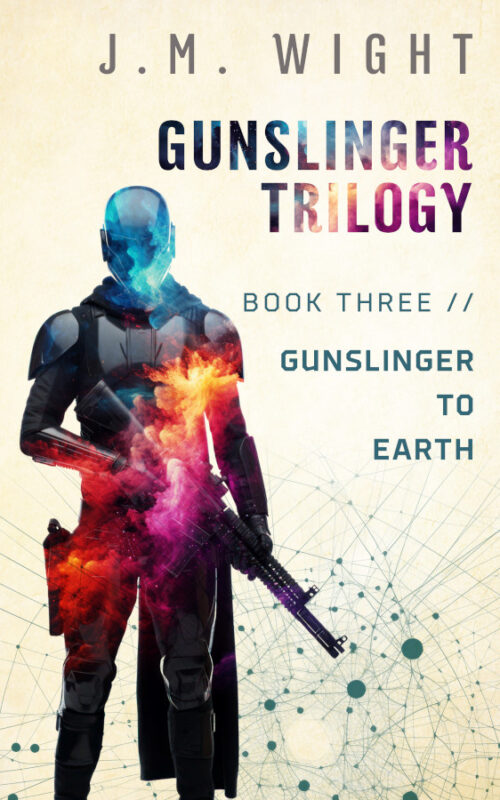
Gunslinger to Earth is a character-driven space opera adventure about crossing a cosmic no-man’s-land to discover what happened to the home you thought was lost forever. It blends gunslinger-style starship action, found-family dynamics, political revolution, and end-times mystery as Rex Carter, Sam Kletchka, and Jane Kletchka risk everything to follow Earth into an impossible anomaly. It’s a fast, hopeful, and surprisingly tender finale that wraps up the Gunslinger Trilogy with both high stakes and a genuine sense of homecoming.

What Kind of Reader Will Love This Book?

If you love…

  • Space opera that feels like Firefly meets end-times science fiction, with a gunslinger pilot, a loyal found family, and a war-torn galaxy trying to pull them apart
  • Stories where faith, prophecy, and cosmic mystery actually matter to the plot, not just as window dressing
  • Coming-of-age under fire, as Rex Carter tries to decide who he is and where he belongs while revolutions, wormholes, and vanished planets rearrange the map of human history
  • Character-focused military SF with moral clarity, loyalty, and hope, rather than grimdark cynicism

…then Gunslinger to Earth is probably your kind of story.

What You’ll Find Inside

Gunslinger to Earth is a story rooted in space opera adventure, end-times science fiction, and prophecy-driven mystery. The hero of this third book in the trilogy is Rex Carter, a cadet still reeling from the day Earth and Luna vanished into an impossible anomaly. Torn between his patriot girlfriend Charlotte, his loyalty to Sam and Jane, and his fear for his family back home, Rex has to grow up fast as he’s swept into a mission to follow Earth across the “world-bridge” and find out what really happened.

The mood balances tense, boots-on-the-deck action (derelict ghost ships in the anomaly, desperate battles near wormholes, claustrophobic escapes from Luna) with a deep, almost awe-struck sense of wonder as the crew finally confronts a transformed Earth and the fulfillment of ancient prophecies. The style is fast-paced, voice-driven, and accessible—more “frontier adventure with big ideas” than hard-science textbook—with a strong throughline of family, faith, and the search for home.

What Makes It Different

Fans of classic space opera and military SF—think Firefly, The Expanse, or David Weber—will recognize the starship battles, political tensions, and ragtag crews, but Gunslinger to Earth takes those ideas in a very different direction. Instead of treating religion and prophecy as background flavor, this book leans straight into them: the disappearance of Earth isn’t just a physics problem, it’s tied to the City of Enoch, the fulfillment of Latter-day Saint-style millennial prophecies, and a literal “new Earth” where history has turned a corner.

Where many space war stories focus on winning the next battle or installing the next regime, this one asks what happens when the war is suddenly dwarfed by something much bigger—when the homeworld itself is renewed and taken off the game board. It’s less about toppling empires and more about how ordinary, stubbornly decent people respond when God, history, and politics all collide at once. And because it’s the capstone of the Gunslinger Trilogy, it doesn’t just raise the stakes; it actually lands them with a clear, hopeful ending.

Readers who enjoy the moral backbone of Lois McMaster Bujold, the frontier grit of Firefly, and the cosmic mystery of The Expanse will find familiar elements here—but woven together in a way that feels genuinely new.

What You Won’t Find

You won’t find grimdark nihilism, graphic sex, or wall-to-wall gore here. The story has violence, war, and real loss—this is a revolution and an end-times crisis, after all—but it’s written at about a PG-13 level, with the camera panning away from anything needlessly explicit. You also won’t find a sneering, anti-religious tone; faith and prophecy are treated respectfully and sincerely, even when characters struggle to believe them. This is a cleaner-but-still-intense sci-fi adventure that focuses more on meaning, loyalty, and wonder than shock value.

Why I Think You Might Love It

I wrote Gunslinger to Earth during a major turning point in my own life—just after I started dating the woman who would become my wife, at a time when I was reinventing my writing process so I could tell better stories more consistently. In a lot of ways, this book is about that same kind of turning point on a galactic scale: the moment when old patterns break, a long-promised future finally arrives, and you have to decide who you’re going to be on the other side of it. My hope is that if you care about loyalty, about home, about the possibility that history is going somewhere meaningful, then this story will leave you with the same feeling it gave me while I was writing it: that even in the middle of chaos, there’s a way through—and it leads somewhere worth fighting for.

Where to Get the Book

Related Posts and Pages

Explore the series index for the Gunslinger Trilogy.

Return to the book page for Gunslinger to Earth.

The Choice to Believe in Gunslinger to Earth.

See all of my books in series order.

Moral Courage in Gunslinger to the Stars

What does it mean to do the right thing when the galaxy around you is chaotic, corrupt, or outright absurd? Gunslinger to the Stars takes that question and drops it squarely in the lap of Sam Kletchka—a mercenary gunslinger navigating a dangerous galactic frontier who keeps choosing responsibility even when no one is watching, rewarding, or deserving. At its heart, this space-western adventure is about moral courage: the stubborn, unfashionable insistence on doing the right thing in a universe that rarely makes it easy.

Where the Idea Came From

This theme grew out of a mashup of influences—long conversations with writer friends, a subplot from Schlock Mercenary, and the realization that a “rogue Immortal” character needed a counterweight with a strong personal code. Around the same time, I was watching Breaking Bad, fascinated by characters like Mike Ehrmantraut—tough, pragmatic men who do terrible things for complicated reasons. To push back against such a villainous force, I imagined Sam Kletchka: a gunslinger in a messy, morally gray universe who lives by a code and keeps choosing the harder path simply because it’s right, even when the galaxy doesn’t care.

How Moral Courage Shapes the Story

At every major turning point in Gunslinger to the Stars, Sam Kletchka’s choices are defined by moral courage—the instinct to protect others even when it’s dangerous, inconvenient, or unwinnable. He charges after kidnapped empaths when walking away would be safer; he shields Jane’s diplomatic idealism with his hard-won pragmatism; he survives abandonment in the desert through sheer stubborn responsibility; and he repeatedly throws himself into battles around war rigs, jumpgates, and alien war parties because no one else can or will. His personal code drives the story’s conflicts, shapes the character dynamics, and pushes this space-opera adventure toward a climax where courage isn’t about glory but about doing the right thing in a lawless, unpredictable, morally gray galaxy.

What Moral Courage Says About Us

Sam’s story reflects something deeply human: we don’t get to choose the worlds we’re born into, but we do get to choose what kind of people we become. In a galaxy run by Immortals, riddled with slavers, warlords, and manipulative telepaths, Sam’s personal code becomes his anchor—the thing that keeps him from becoming the very wolf he warns Jane about. His courage isn’t flashy heroism; it’s the uncomfortable, everyday kind that demands sacrifice, loyalty, and integrity when it would be easier to look away. In that sense, the book becomes a mirror for readers who love character-driven science fiction that asks what we stand for when the world pushes back.

Why This Theme Matters to Me

I wrote this book at a very different time in my life—years after Genesis Earth, when my own view of the world had shifted. I still believed in cultural understanding and bridging divides, but I’d also seen enough to know that evil doesn’t always yield to good intentions. Like Sam, I firmly believe in the right to defend oneself and others, and I’ve had long debates about the responsibilities that come with that. I wanted to write a character who lives at the intersection of those values—someone who understands violence, hates it, but won’t walk away when others depend on him. That tension, that conviction, is why moral courage felt like the beating heart of Gunslinger to the Stars.

Where to Get the Book

Related Posts and Pages

Explore the series index for the Gunslinger Trilogy.

Return to the book page for Gunslinger to the Stars.

Discover if Gunslinger to the Stars is for you.

See all of my books in series order.