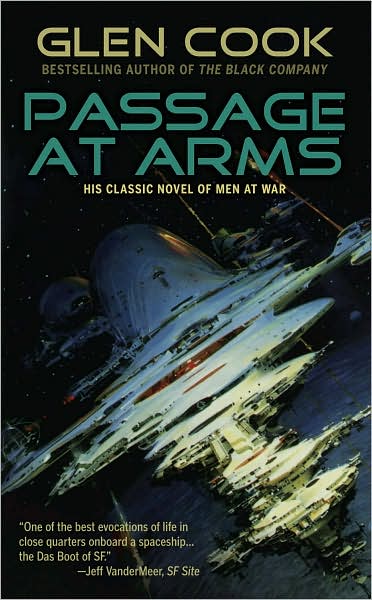
Passage at Arms by Glen Cook

Humanity is losing a long, bloody war of attrition against an alien race.  Our only military advantage lies in the climbers–small, guerrilla style gunboats that can cross into a higher dimensional plane.  Under the right conditions, this technology enables the ships to pass through space undetected.

As the war reaches a critical juncture, one former soldier, now a journalist, joins with the crew of a climber to get the inside story.  What he finds is a far cry from the brave, clean-shaven heroes portrayed by the official war propoganda; the climbers are a gritty, dirty-minded lot of soldiers, cursing the higher ups and living from leave to debaucherous leave.

When worst comes to worst, however, and crap hits the fan, everyone’s true colors come out.  When that happens, who will hold together, and who will fall apart?

I enjoyed this book a lot.  Parts of it were a little raunchy, but never too much for my taste, though your mileage may vary.  Glen Cook leans more towards flowery writing than pure storytelling, and while I had a few minor qualms with his writing style, the book was quite compelling.

Glen Cook really excels at character voice and viewpoint.  Even though the book was military sci-fi set almost entirely in space, it had a very distinct, almost noire feel to it.  Everything that happened was heavily filtered through the main character’s point of view, which made the narrative feel very intimate and personal.  When Charlie dances the foxtrot, you feel like you’re right there in the thick of it.

My favorite thing about this book, however, is the level of scientific realism in the combat systems.  Obviously, things like hyperspace and trans-dimensional drives are entirely speculative, but the orbital dynamics of the planetary siege and visual effects of the nightly bombardment gripped me from the first page.  It didn’t feel pulpy or cartoonish at all–in fact, it felt disturbingly reminiscent of news footage from the ’91 Gulf War, which haunted me for a while as a kid.  This isn’t your typical humans vs. aliens sf adventure novel–it’s like a firsthand account from someone who was there.

My biggest issue with the book was more stylistic than anything else; Cook tends to rely on one-sentence paragraphs to add extra punch–which can be effective, when done sparsely.  However, every page would have at least two or three of them, often occurring one after another.  For me personally, that was a bit too much, but obviously it didn’t keep me from finishing the book, or enjoying it.

So yeah, if you like your science fiction with a heavy dose of gritty realism, you’ll probably like this book.  Even if you don’t, it’s worth checking it out for the orbital dynamics and other interesting details.  Even though it probably isn’t perfect, it feels a lot more accurate than most of the other books out there.
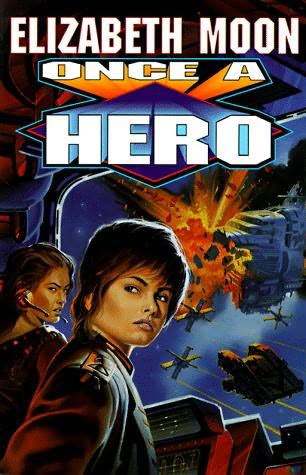
Once a Hero by Elizabeth Moon

Esmay Suiza never asked to be a hero.  All she wanted was to leave her dysfunctional home and join the navy.  But after surviving a mutiny and leading her spaceship to a most unlikely victory, everyone seems to be showering her with unwanted attention–or worse, examining her files for signs of command potential.

No, all she wants is to disappear–and now that her family has offered her a generous inheritance on her home world of Altiplano, she finds herself tempted to leave the stars behind and settle down for a while.

Little does she know, her family has hidden secrets from her–secrets from her past, which have the power to undo and destroy her.  Unfortunately, being a hero has a price–and the trauma of combat has already unearthed things from her subconscious than she cannot keep buried any longer.

This was my first time reading Elizabeth Moon, and I enjoyed it quite a bit.  Moon is extremely good at portraying a complex, believable military culture; she was a Lieutenant in the Marines, and definitely knows how to do military SF right.

My favorite part of the book was the descriptions of Altiplano, and Esmay’s experience returning to her homeworld of Altiplano.  Elizabeth Moon does an excellent job of creating a captivating world and transporting the reader there.  I fell in love with Altiplano almost instantly–not only with the planet itself, but the culture and the people, the whole society.  Excellent job.

Elizabeth Moon also does an excellent job developing her characters and giving them believable internal conflicts.  The way she portrays Esmay’s PTSD is quite striking, and very interesting.  Her struggles feel very real, and important too.  I think this novel helped me to better understand those who suffer from similar traumatic experiences, and that was very meaningful.

Storywise, however, I had a few minor issues, most of them having to do with the plot.  Things dragged a bit in the middle; when Esmay left her homeworld, I lost a sense of progression and felt that she was just wandering around.

When the antagonists came in–basically, a hostile army trying to capture her ship–I felt that Esmay solved her problems too easily, without any real try-fail cycles.  It gave me the sense that Esmay was some kind of superhero girl–not quite a Mary Sue, but toeing the line.

And Esmay’s love interest…I didn’t really get into him at all.  He seemed like a stereotypical damsel in distress, except with the sexes reversed.  I heard once that in good romance stories, the girl readers want to be the female protagonist, and the guy readers want to be the male protagonist.  Yeah…call me a chauvinist, but I never really wanted to be that guy.

I hate to be too critical, though, because Elizabeth Moon’s writing is quite good.  She has an excellent grasp of character, and her ability to transport her readers to another time and place more than makes up for her shortcomings with plot and story structure.  Also, I get the sense that this isn’t her best work.

In any case, if you’re a fan of military SF, you’ll probably enjoy this book.  I enjoyed it, and I will certainly be reading more Elizabeth Moon in the future.

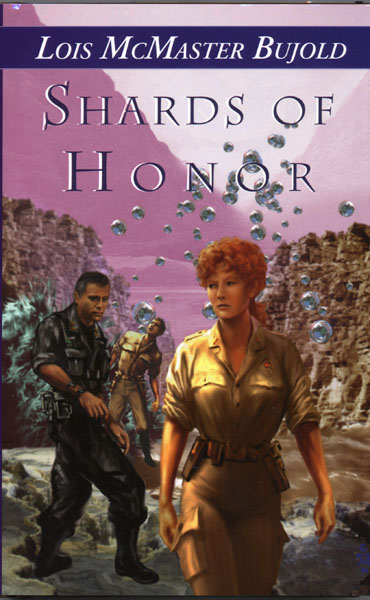
Shards of Honor by Lois McMaster Bujold

Cordelia Naismith never thought she would find the love of her life on a scientific survey to an unexplored border world, let alone that he would be a Barrayan, one of the enemy.  But Aral Vorkosigan is not just any other officer in the Barrayan Military.  He is courteous, fair-minded, thoughtful–and above all else, driven by an innate sense of honor.  To her surprise, Cordelia soon finds that she has more in common with the man than she thought possible.

But the rumors of war between Escobar, Beta Colony, and Barrayar soon conspire to drive them apart.  Though Cordelia sees Vorkosigan for the good man he is, the rest of the galaxy only knows him as the “Butcher of Komarr”–an unfortunate title which Vorkosigan does not entirely deserve.

As Barrayar goes to war and Cordelia finds herself rising through the ranks of the Betan Military, she is forced to choose between loyalty to her country and loyalty to the man she loves.  When the two are mutually exclusive, how does one preserve one’s honor while securing a degree of happiness?

I loved this book.  Unlike some romances, where the male protagonist is a complete douchbag, Aral Vorkosigan is the kind of guy I’d like to be like.  Bujold strikes an excellent balance between strong and sensitive that enhances, rather than taints, his manliness.  Besides that, Vorkosigan is extremely fascinating, with a complicated backstory and motivations that are both believable and interesting.

Though it’s technically a romance, the book reads very much like military science fiction, with deliciously tongue-in-cheek phrases like “the cadet was too young to believe in death after life” and rigorous attention to the details of military life, such as rank and chain of command.  The book definitely has enough explosions, space battles, and political intrigue to appeal to boys as well as the romance audience, but Bujold melds the space adventure elements seamlessly with the romantic elements, so that readers of either genre don’t feel left out or patronized.

There was only one thing that bothered me, and since it contains spoilers I’ll put it in black so that you don’t inadvertently see it.  To read it, highlight the text:

After Cordelia ran away from home and married Vorkosigan, why did she never think about her homeland again? You would think that as a career military officer who had dedicated her life to her country, she would at least have some lingering doubts that she’d done the right thing by running away–especially when her husband became the new Lord Regent of Barrayar! To me, this seems in-congruent with her character.

All things considered, though, this was an excellent, well-written science fiction adventure/romance. I thoroughly enjoyed it and will definitely be reading more of Lois McMaster Bujold’s work again.

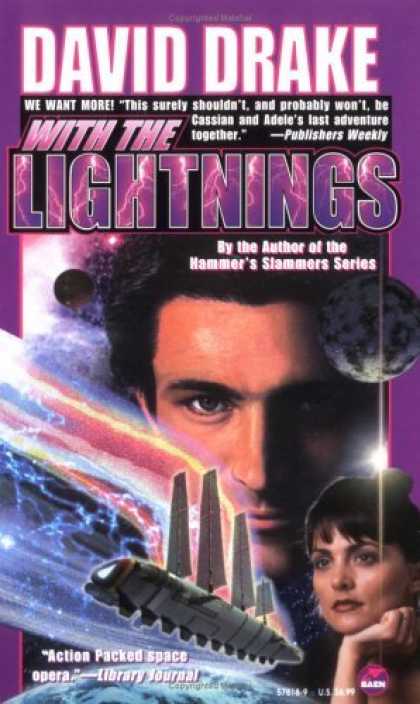
With the Lightnings by David Drake

Daniel Leary, Lieutenant in the Republic of Cinnabar Navy, dreams of commanding a military starship one day.  Unfortunately, as the estranged son of a corrupt senator, and with almost no money to his name, he has virtually no chance of ever seeing it happen.

While serving in an assignment on Kostrama, a neutral trade world between Cinnabar and her mortal enemies, the Alliance, he meets Adele Mundy, chief librarian of the Kostraman capitol.  The title is virtual meaningless, however, as the uncultured Kostramans would give the position to anyone–even a political exile from Cinnibar such as Adele.  Her whole family was assassinated by Leary’s father, and she has sworn to take revenge.

Little do they both know, the Alliance has other plans.

Ever since I met David Drake at World Fantasy 2009 in San Jose, I’ve been meaning to read one of his books.  I must say, I picked a good one.  With the Lightnings is the first book in his RCN Series, which is basically David Drake’s take on Patrick O’Brian’s Aubrey-Maturin novels.  Think Napoleon-era naval battles and political intrigue…in space.

Does it sound good already?  Yeah, I thought so.

I was a little surprised at first, because the first chapter started with a bunch of info dumps.  It took until about the halfway mark for the action to really start, but when it did, it was awesome. A bunch of navy guys marooned on a hostile planet behind enemy lines, trying to survive a planetwide coup and blowing all kinds of stuff up along the way–yeah, it was cool.

The thing I enjoyed most about this book, however, was the insight into the minds of the officers and the way the officers and soldiers interacted.  You can tell that David Drake has experience in the military–lots of experience.

It was evident in the little things the main character noticed–the colors and patterns of soldiers’ uniforms, competency among his own men and incompetency in men not under his command, leadership style and how he dealt with crises–stuff like that.  The language was colorful, but when the soldiers swore, their language had a bite to it that went beyond the actual words.  The people felt gritty, but very real.

At World Fantasy, I mentioned to David Drake that I’d read some of Joe Haldeman’s works, and knew they were both Vietnam vets.  He remarked that Haldeman’s works are very much different than his own: Haldeman’s characters are constantly stabbing each other in the back, whereas in Drake’s works, there is always a sense of teamwork and unity, even when the going gets messy.

I could definitely see that in With the Lightnings–it’s one of the things that made the book so fun to read.  Yes, things get pretty tough and a lot of people die, but there’s always a sense of loyalty within the platoon (or whatever the unit is called).

With the Lightnings is a great space opera action/adventure story.  After reading it, I really want to read more books in the RCN series.  If you want a good, fun military sf adventure story, this is a great one to pick up.

Breaking a roadblock

About a month ago, I stopped working on my novel Bringing Estella Home because I hit a roadblock.  Basically, I realized at the end of the second part that I had failed to work out all of the secondary characters and their duties and responsibilities in the mercenary group that the protagonist hires.  I had a pilot and a navigator but no engineer, no medical officer, and no difference between the officers and the enlisted men.  When I came up to a battle scene, I realized that most of the characters I’d be killing off were either invisible or nonexistent, and that didn’t help out the dramatic tension very much.

Well, after the last post, it seems that my two most interesting projects (according to my friends) are Bringing Estella Home and The Phoenix of Nova Terra.  Bottom line: as much as I want to avoid it, this is probably one of my most promising projects and I really should revive it.

So today I opened up my outline for the story (I’m not very consisten about keeping outlines while drafting a new novel, but I usually have at least a couple of notes here and there in them), and I diagrammed out the mercenary organization.  I figured out what all the important officer roles are, reassigned/added new characters to fit those roles, figured out how many enlisted men there would be and who would be in charge of them,  and figured out everyone’s responsibilities.  Here is what I’ve got:


    * Captain — Commanding officer of the mercenary unit.  Lead missions, accept contracts, look over welfare of the crew, etc.

    * Chief Petty Officer (NCO) — Provide link between officers and grunts, relay commands from the captain to the enlisted men.

    * Astrogator/Pilot — Navigate routes, pilot during combat.

    * Cybernetics and Intelligence Officer — Provide useful intelligence to captain, infiltrate enemy networks, general cybernetic espionage.

    * Chief Engineer — Maintain, repair, and upgrade the ship, keep inventory of ordinance, foodstuffs, and other supplies, maintain shipwide computer network.

    * Chief Medical Officer — Maintain the health of the crew, perform surgeries and medical operations as needed, etc.

    * Wing Commander — Remotely pilot and command fighter drones, monitor enemy movements within the field of operations.


So, that’s seven officers, including the NCO (I’m not really a military person, so I’m not sure if you’d count the NCO with the officers or the enlisted men…man, I’m so ignorant when it comes to the military).  On the enlisted side, I’ve got two sergeants commanding two squads of twelve soldiers each.

Did I miss anything?  Please let me know if I did.

I’ve got to admit, the structure of this mercenary unit comes from my own very, very limited understanding of the military, drawn mostly from 1) conversations with my military roommate over the Jordan 2008 study abroad, 2) the Schlock Mercenary webcomic (which is a lot more space opera than military  sf), 3) Joe Haldeman’s Forever War, and 4) Wikipedia.  

You know, I really should join the military before I attempt to write military science fiction (no, really, I’m only half joking–it is a temptation).  But yeah, that’s the best I can come up with…so, really, this is pseudo-military sf, or the best space opera imitation of military sf that I can come up with.

But the cool thing is that as soon as I had everything diagrammed out like this, it all clicked together and the roadblock was gone.  Gone!  A month ago, when I started hitting the rough patch, I really didn’t have a lot of motivation to keep working.  It was broken, I knew it was broken, and I couldn’t really move on until I’d fixed it.  Well, now I know exactly how to fix it, and I really want to get back to this project and do it right.

Except…this is such a dark story.  It’s so tragic.  Just as I started to come along and really like my characters…but it’s better that way.  You’ve got to torture them, cause them pain.  It makes the story much more interesting and engaging, raises the stakes.

But first, I’ve got to finish Genesis Earth.  And go to bed.  Probably not in that order.