The Nominees

The End of Eternity by Isaac Asimov
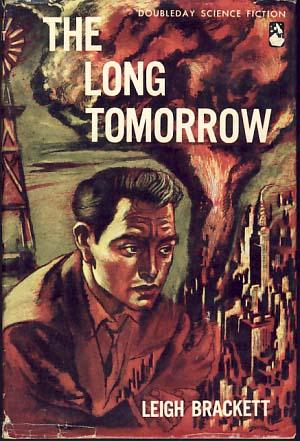
The Long Tomorrow by Leigh Brackett
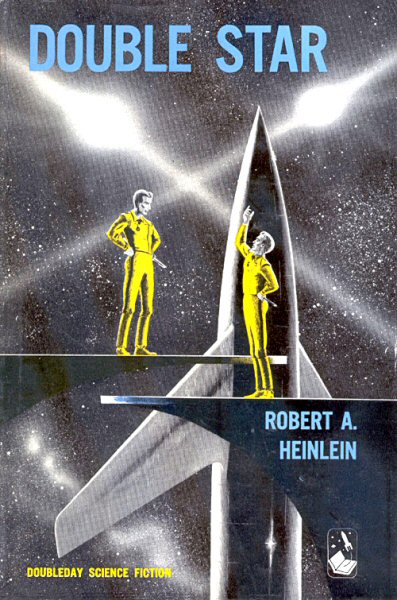
Double Star by Robert A. Heinlein
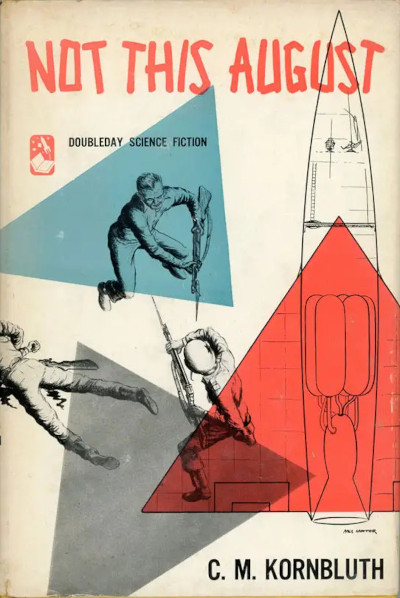
Not This August by C.M. Kornbluth
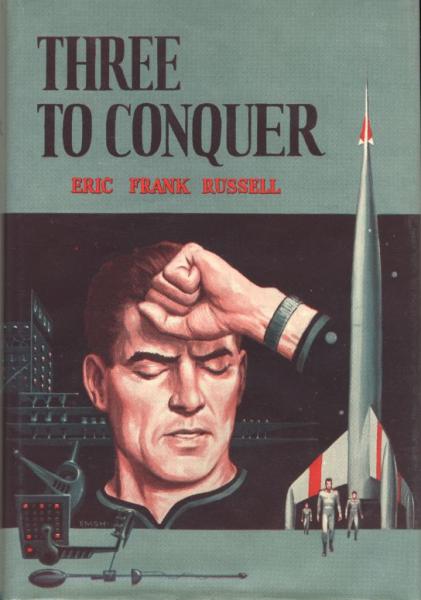
Three to Conquer by Eric Frank Russell
The Actual Results
- Double Star by Robert A. Heinlein
- The End of Eternity by Isaac Asimov
- The Long Tomorrow by Leigh Brackett
- Not This August by C.M. Kornbluth
- Three to Conquer by Eric Frank Russell
How I Would Have Voted
- The Long Tomorrow by Leigh Brackett
- The End of Eternity by Isaac Asimov
- Double Star by Robert A. Heinlein
- Three to Conquer by Eric Frank Russell
- Not This August C.M. Kornbluth
Explanation
This was a really good year for science fiction.
I’ve read every one of these books from start to finish, and I love them all. Even the lesser ones I’d put up above most of the Hugo-nominated books from the last couple of decades. And the best—well, let’s go there.
First, Not This August. This was really more of an early Cold War political thriller, with frightening near-future space technology since, at the time this was written, Sputnik was freaking everyone out in a major way. The technology itself is moderately science fictional, but if a book like this were written today, it would probably be shelved as a technothriller—which makes me wonder if the conservative science fiction writers of the 60s and 70s didn’t just migrate to the thriller genre as science fiction was increasingly taken over by the left. But that’s a subject for another blog post.
In any case, Not This August is very much a cautionary tale, kind of like 1984, but set only a decade or two after WWII. Basically, China and the USSR launch a joint invasion of the US that succeeds, but an underground resistance movements works to finish this American superweapon: an orbital military base armed with nuclear weapons that is undetectable by the surface and can bomb anywhere on the planet.
Since it was written in the early part of the 50s, it plays very much on fears that the world wars would shortly resume, and that the US would never recover economically from the wars. Such fears later proved to be unfounded, but at the time, there were very good reasons to think we were caught in a vicious cycle—and in some ways (such as with Eisenhower’s warnings of the Military-Industrial complex), perhaps we were.
In some ways, it was a difficult read, not because of the writing itself, but because of how dark it was. However, like any good thriller, it built up the suspense quite nicely, and I finished the last hundred pages at a sprint. With that said, it hasn’t aged nearly as well as 1984, and reading it from the perspective of the 2020s it seems much more like an historical curiousity than a true cautionary tale. But I enjoyed it.
Three to Conquer was much lighter, and a fun, quick read. It’s about a man who is secretly a telepath, who stops on the side of the road to help a stranded motorist and discovers that some hostile alien body-snatchers have come to Earth after infecting three returning astronauts, and are now trying to takeover all of humanity before we realize that they’re even here. It’s a race against time to find and kill all of the zombified humans before they infect everyone else, with a cute little love story thrown in for good measure, between the main character and his secretary. A fun if somewhat forgettable read. I did really like how the main character had a sharp mind and was quick on his feet.
Now, to the really good ones.
Double Star is a fantastic book, and just because I’ve put it at third place on my ballot, you should not think that means that I thought it was mediocre at all. In fact, I’d put it above probably 60% or 70% of the novels that have won the Hugo. It’s quite good, showcasing Heinlein at some of his best (though I do think Farnham’s Freehold is better). It was a really compelling story about a man who overcomes his prejudices and shortcomings to grow into the role that has (quite literally) been cast for him. It also makes me very, very glad that I’m not an actor. Highly recommended.
The End of Eternity is one of the best time travel novels I’ve ever read. It’s about this bureaucratic organization called Eternity, which exists to shepherd humanity safely through 75,000 centuries of history. Basically, the technicians of Eternity calculate all the best ways to tweak the timeline with “reality changes” in order to avoid all of the worst catastrophes, like pandemics, global wars, etc. But after the 75,000th century, there’s a long period of “hidden centuries” that are somehow inaccessible to them, followed by a world where humanity is extinct. The main character is a technician who falls into forbidden love with a woman in Time, whose existence is going to be wiped out by a reality change. He conspires to save her by bringing her into Eternity, and sets off a series of events that threaten to wipe out Eternity itself.
I really enjoyed this book. Toward the end, I wondered if this book would have a happy ending, since I couldn’t think of any way to pull that off without making it kind of sappy and cliche. Then the twist happened, and everything changed… but we still got the happy ending, which fit in perfectly with the world-changing twist. Just a really brilliant book by an all-time science fiction master. Classics like this are the reason why Isaac Asimov hasn’t been canceled yet, and hopefully never will be.
As I said above, I genuinely enjoyed all of these books. But as good as they all were, none of them blew me away nearly as much as Leigh Brackett’s The Long Tomorrow.
The Long Tomorrow is a post-apocalyptic story about a future America, after the atomic wars, where cities are a thing of the past, the Constitution has been amended to restrict the size of towns (in order to prevent them from becoming potential targets for a nuclear weapon), and most of the population has reverted back to 19th century tech and an Amish or Amish-adjacent lifestyle. But there are legends about a secret city called Bartorstown, where the old technology hasn’t been lost, and people still live lives full of wonder and wealth, just like the old days.
The story follows two boys who run away from home in order to find Bartorstown, tracing their adventures and coming of age, until they finally learn the terrible truth about what Bartorstown actually is, and grapple with what that means for all of them. It’s a pretty basic plot, but what really blew me away was the depth of character and how brilliantly Brackett’s writing and storytelling drew me into their lives, making them come alive. Consequently, the story really came alive, raising all sorts of questions that left me thinking and wondering long after I’d put it down. There are some really heavy themes in this book, but like the best sci-fi, it doesn’t feel like “message” fiction at all.
It’s a little bit sad, though, because Brackett wrote this book just as the hydrogen bomb transformed foreign policy with the threat of mutually assured destruction, thus making her post-apocalyptic future into something totally implausible. The Long Tomorrow only works in a world where total nuclear war doesn’t result in the utter annihilation of humanity. From what I can tell, that’s the main reason this book never really took off. Also, I’m guessing that Brackett didn’t have as many fans as Heinlein or Asimov, and since the Hugos have always essentially been a popularity contest (these days, among an increasingly narrow and snobbish clique), that’s probably the main reason why The Long Tomorrow didn’t win the Hugo this year, even though I personally think it’s the most deserving book on the ballot.
But as I said above, 1955 (the publication date) was a really good year for science fiction, and all of these books are really good—some of the best, in fact. I highly recommend them all!