A Much Deserved Fisking

In the November issue of Locus magazine, Cory Doctorow wrote an op-ed piece defending Jeannette Ng and the decision to strip Campbell’s name from the Campbell Award. At least, that’s how it started out, but it quickly devolved into a hatchet piece against everyone in science fiction whose politics lie somewhere to the right of Stalin.

Ever since Sad Puppies III, I’ve more or less gotten used to the gaslighting, hypocrisy, and projection that has become de rigeur in the traditional publishing side of the field. But somehow, Doctorow’s hit piece manages to hit a new high water mark for leftist insanity.

Since my own politics lie somewhere between Boadicea and Genghis Khan, I thought it would be fun to give the piece a good old-fashioned fisking. I can’t pretend to be as good at it as Larry Correia (and I sincerely hope he fisks it himself), but damn, if anything ever was written to be fisked, it was this ridiculous piece.

Doctorow writes:

At the Hugo Awards ceremony at this summer’s Dublin Worldcon, Jeannette Ng was presented with the John W. Campbell Award for Best New Writer. Ng gave an outstanding and brave acceptance speech

Translation: Ng reinforced the dominant far-left narrative in the science fiction field, telling the gatekeepers exactly what they wanted to hear and earning widespread praise for it.

True bravery is Jordan Peterson deleting his $35,000/month Patreon in protest of their hate speech policies, or Kanye West coming out as a devout Christian, producing a worship album, and announcing that he will no longer perform any of his old songs.

in which she called Campbell – the award’s namesake and one of the field’s most influential editors – a “fascist” and expressed solidarity with the Hong Kong pro-democracy protesters.

You know who else shows solidarity with the Hong Kong protests? That’s right—everyone’s favorite deplorable frog!

Now that’s a dank meme.

I’m curious: does this make Ng a white supremacist for showing solidarity with people who use such a rascist hate symbol? Does it make Cory Doctorow a dog whistler to the far right for appealing to these obviously racist deplorables?

Of course not, but that’s the level of insanity we’ve fallen to.

I am a past recipient of the John W. Campbell Award for Best New Writer (2000) as well as a recipient of the John W. Campbell Memorial Award (2009). I believe I’m the only person to have won both of the Campbells,

All red flags to deplorable readers like me,

which, I think, gives me unique license to comment on Ng’s remarks, which have been met with a mixed reception from the field.

I think she was right – and seemly – to make her re­marks. There’s plenty of evidence that Campbell’s views were odious and deplorable.

There’s that word: “deplorable.” Whenever someone uses it unironically, it’s a sure sign that they hate you. It’s also a sign that they don’t actually have a good argument.

It wasn’t just the story he had Heinlein expand into his terrible, racist, authoritarian, eugenics-inflected yellow peril novel Sixth Column.

I haven’t heard of that one. Thanks for the recommendation, Cory! I’ve already ordered it.

Nor was it Campbell’s decision to lean hard on Tom Godwin to kill the girl in “Cold Equations” in order to turn his story into a parable about the foolishness of women and the role of men in guiding them to accept the cold, hard facts of life.

Okay, I call bullshit. “Cold Equations” wasn’t about the “foolishness of women,” it was about how when our inner humanity comes into conflict with the hard realities of the universe, the hard realities always win.

Switch the genders—a female pilot and a teenage boy stowaway—and the story still works. Switch the endings—have the pilot decide to keep the stowaway, dooming himself and the sick colonists—and it does not.

In fact, it makes the girl even more of a hapless, weak feminine stereotype. Stepping into the airlock voluntarily is an act of bravery. In some ways, she’s stronger than the pilot—and that’s kind of the point.

The thing that makes “Cold Equations” such a great story is that it functions as something of a mirror. It’s the same thing with Heinlein: those who see him as a fascist are more likely to be authoritarians, while those who see him as a libertarian are more likely to be libertarians themselves. After all, fascism is “citizenship guarantees service,” not “service guarantees citizenship.”

It’s also that Campbell used his op-ed space in Astound­ing to cheer the murders of the Kent State 4. He attributed the Watts uprising to Black people’s latent desire to return to slavery.

Was John Campbell a saint? No, and I don’t think anyone’s claiming that. In the words of Ben Shapiro, two things can be true at once: John Campbell had some racist, sexist views, and stripping his name from the award is wrong. (Also, that Doctorow is full of shit.)

The Campbell award isn’t/wasn’t named after him because he was a perfect, flawless human being. It was named after him because of his contributions to the field. If we’re going to purge his name from the award, are we also going to purge all of the classic golden-age books and stories that he edited, too? Are we going to have the digital equivalent of a book burning? Because that strikes me as a rather fascist thing to do.

These were not artefacts of a less-englightened [sic] era. By the standards of his day, Campbell was a font of terrible ideas, from his early support of fringe religion and psychic phenomena to his views on women and racialized people.

What are the standards of our own day? In what ways are we less-enlightened? Are future generations likely to accuse Doctorow of being a “font of terrible ideas,” just like he accuses Campbell here?

Do unborn black lives matter? If Trump is truly a fascist, why does the left want him to take all our guns? Is it okay to be white? Is Islam right about women? Is transgender therapy for prepubescent children just another form of conversion therapy? Are traps gay?

When you free your mind to explore new ideas, a lot of them are bound to be terrible. It’s simply Sturgeon’s law. So is Doctorow criticizing Campbell for having an open mind, or for not conforming to Doctorow’s values and beliefs?

Who’s supposed to be the fascist again?

So when Ng held Campbell “responsible for setting a tone of science fiction that still haunts the genre to this day.

I’m pretty sure that taking hormone blockers and getting your balls cut off makes you a hell of a lot more sterile than anything else. Lesbians, gays, transgenders, queers—all of these tend to be sterile as a general rule. Most babies are still made the old-fashioned way.

Male.

Isn’t her word choice kind of sexist here? I mean, she could have used the word “patriarchal,” but she didn’t. She. Deliberately. Used. The. Word. “Male.”

White.

Is she saying that it isn’t okay to be white?

Exalting in the ambitions of imperialists and colonisers,

Come on, Ng. Let’s not be racist. There were plenty of imperialists and colonizers who weren’t white Europeans. After all, how can we forget Imperial Japan and the Rape of Nanking? Now that was an ambitious massacre. The Turks also ran a pretty brutal empire, as did the Zulus and the Aztecs. You can’t tell me that cutting out the beating hearts of more than 80,000 prisoners to rededicate your temple isn’t ambitious.

settlers and industrialists,”

Find me one place that was not built by “settlers.” Find me one human being on this planet who has not benefitted from “industrialists.” Who do you think makes the vaccines and antibiotics? Who do you think makes machines that harvest your food?

Just for a single day, I would like to see all of these anti-capitalist types live without any of the benefits that capitalism and modern industry provide.

she was factually correct.

And yet, so completely full of shit.

In the words of Andrew Klavan, you can’t be this stupid without a college education.

Not just factually correct: she was also correct to be saying this now.

Because it’s [current year]!

Science fiction (like many other institutions) is having a reckoning with its past and its present. We’re trying to figure out what to do about the long reach that the terrible ideas of flawed people (mostly men) had on our fields.

The best way to fight a terrible idea is to allow it out in the open while fostering freedom of speech. In the words of Andrew Breitbart, sunlight is the best disinfectant.

The reckoning that Doctorow is calling for is something that’s already built into the field. Science fiction is constantly evolving and revisiting its past. Good science fiction not only builds on the stuff that came before, it critiques it while taking the ideas in a new direction.

We don’t need to tear down the legacy of the giants in the field who came before us; we simply need to build up our own legacies for the generations that come after us. But that’s not what Ng and the social justice warriors want to do.

It isn’t a coincidence that the traditionally published side of the field is rapidly losing market share as the SF establishment seeks to purge everything that could possibly offend their progressive sensibilities. The people doing the purging can’t compete on the open market because their toxic ideologies don’t resonate with the buying public, so they’re forced to resort to the digital equivalent of burning books and tearing down statues. Meanwhile, indie publishing is eating their lunch.

Get woke, go broke.

We’re trying to reconcile the legacies of flawed people whose good deeds and good art live alongside their cruel, damaging treatment of women. These men were not aberrations: they were following an example set from the very top and running through the industry and through fandom,

Future generations will struggle to reconcile our good deeds and our good art with our cruel and inhuman treatment of the unborn.

None of this is new. All of us are flawed; every generation is tainted with blood and sins that are reprehensible to those that follow. Realizing all this, you would think a little introspection is in order. But the people today who are so eager to throw stones are completely lacking in self-introspection that they can’t—or rather, won’t—see their own blood and sins.

to the great detriment of many of the people who came to science fiction for safety and sanctuary and community.

Is science fiction a “safe space,” or is it the genre of ideas? It can’t be both at the same time. Ideas are inherently dangerous.

It’s not a coincidence that one of the first organized manifestations of white nationalism as a cultural phenomenon within fandom was in the form of a hijacking of the Hugo nominations process.

Bullshit. If you think that the Sad Puppies were white nationalists, you’re either stupid or willfully ignorant (a distinction without a difference).

Larry Corriea’s flagship fantasy series, the Saga of the Forgotten Warrior, is set in an Indian-inspired fantasy world populated entirely by brown people. Brad Torgerson has been happily married to a woman of color for decades. Sarah Hoyt is both latina and an immigrant.

If this article was written three years ago, you would have just called them all racists, but you can’t do that now because “racist” has lost its edge. You’ve cried wolf far too many times, and no one pays attention to those accusations anymore. That’s why you use words like “fascist,” “white nationalist,” and “white supremacist” to describe your enemies—not because you actually believe it, but because those accusations haven’t yet lost their edge.

While fandom came together to firmly repudiate its white nationalist wing, those people weren’t (all) entry­ists who showed up to stir up trouble in someone else’s community. The call (to hijack the Hugo Award) was coming from inside the house: these guys had been around forever, and we’d let them get away with it, in the name of “tolerance” even as these guys were chasing women, queer people, and racialized people out of the field.

Translation: we’re done with paying lip service to “tolerance” and “open-mindedness.” From now on, if you don’t look like us, act like us, or think like us, we’re going to do everything we can to destroy you.

I’m telling you, these people hate us. That’s why they call us “deplorables.” That’s why they paint us as racists and fascists, even when we’re nothing of the sort. They don’t want to listen to us. They don’t want to give us a fair hearing. They want to destroy us.

Stripping Campbell’s name from the Campbell Award is just another example of this toxic cancel culture. It isn’t about reckoning or reconciliation. It’s a naked power grab.

Those same Nazis went on to join Gamergate, then became prominent voices on Reddit’s /r/The_Donald, which was the vanguard of white national­ist, authoritarian support for the Trump campaign.

See, this is why I can’t trust you, Cory. Gamergate had legitimate grievances with Anita Sarkeesian, Zoe Quinn, and Gawker. Trump supporters had legitimate reasons to want to stop Hillary Clinton from becoming president. Yet you casually dismiss all these people as deplorables, racists, and fascists without even listening to them.

That’s intelluctually dishonest, Cory. It’s also a form of gaslighting.

The connections between the tales we tell about ourselves and our past and futures have a real, direct outcome on the future we arrive at. White supremacist folklore, including the ecofascist doctrine that says we can only avert climate change by murdering all the brown people, comes straight out of SF folklore, where it’s completely standard for every disaster to be swiftly followed by an underclass mob descending on their social betters to eat and/or rape them (never mind the actual way that disasters go down).

I don’t think Cory Doctorow has any idea what actually happens when society collapses. When the thin veneer of civilization gets stripped away, people will eat each other. We’ve seen this just recently in Venezuela, Syria, and Mexico. Here in the US, we can see the seeds of our own collapse in Chicago, Portland, San Francisco, Baltimore, and Detroit (all very blue and progressive cities, by the way).

Also, I don’t think Cory Doctorow has any idea what he’s talking about when he says “white supremacist folklore.” What is that even supposed to mean? Just a couple of paragraphs ago, he called all the Sad Puppies “white nationalists,” and that obviously isn’t true. By “white supremacist folklore,” does he mean all the science fiction that doesn’t fit his radical progressive political ideology? Once again, he’s painting with an overly broad brush.

Also, notice how he uses “white supremacist” instead of “racist.” He can’t use “racist” because that word has been overused. Give it a couple of years, and “white supremacist” will lose its edge as well.

When Ng picked up the mic and told the truth about Campbell’s legacy, she wasn’t downplaying his importance: she was acknowledging it. Campbell’s odious ideas matter because he was important, a giant in the field who left an enduring mark on it. No one questions that. What we want to talk about today is what Campbell’s contribution was, and what it means.

Whenever the people on the progressive left claim that they want to have a “conversation” about something, what they really mean is “shut up and let me tell you how I’m right and you’re wrong.” There is no way to have an honest dialogue with these people, because they will not listen to us “deplorables.” Cory Doctorow has already demonstrated this with his blanket accusations against all the supporters of Gamergate, the Sad Puppies, and President Trump.

These people don’t want to talk about “what Campbell’s contribution was, and what it means.” They want to purge him from the field. Metaphorically, they want to burn his books and tear down his statues.

Look, I’m not trying to defend all of Campbell’s views here. I’m all for having an honest discussion about his bad ideas and how they’ve influenced the field. But I don’t believe I can have that discussion with people who clearly hate me, and will do whatever it takes to cancel and destroy me.

After Ng’s speech, John Scalzi published a post where he pointed out that many of the people who were angry at Ng “knew Campbell personally,” or “idolize and respect the writers Campbell took under his wing… Many if not most of these folks know about his flaws, but even so it’s hard to see someone with no allegiance to him, either personally or professionally, point them out both forcefully and unapologetically. They see Campbell and his legacy ab­stractly, and also as an obstacle to be overcome. That’s deeply uncomfortable.”

Scalzi’s right, too: the people who counted Campbell as a friend are au­thentically sad to confront the full meaning of his legacy. I feel for them.

Do you really, though?

It’s hard to reconcile the mensch who was there for you and treated his dog with kindness and doted on his kids with the guy who alienated and hurt people with his cruel dogma.

Did you catch the sneaky rhetorical trick that Doctorow uses here? He assumes that we’ve already accepted his argument that Campbell’s views were odious enough to have his name stripped from the award. Now he’s using an appeal to emotion to smooth it over.

Gaslighting of the highest order.

Here’s the thing: neither one of those facets of Campbell cancels the other one out. Just as it’s not true that any amount of good deeds done for some people can repair the harms he visited on others, it’s also true that none of those harms can­cel out the kindnesses he did for the people he was kind to.

Or cancel all of his contributions to the field?

If Doctorow actually believes all this, why does he support Ng, who argues that everything Campbell did should be cancelled out by his most odious views? If anything, this is an argument against stripping Campbell’s name from the award.

Life is not a ledger. Your sins can’t be paid off through good deeds. Your good deeds are not cancelled by your sins. Your sins and your good deeds live alongside one another. They coexist in superposition.

Yes, and you should never underestimate the capacity of the human mind to believe two mutually exclusive ideas at the same time, especially when his name is Cory Doctorow.

You (and I) can (and should) atone for our misdeeds.

Not in today’s cancel culture, where everything you’ve accomplished can be erased by the one bad thing you tweeted or posted to Facebook ten years ago. There’s also no forgiveness or repentance, when you will be forever remembered for the worst thing you said or did.

We can (and should) apologize for them to the people we’ve wronged.

No. Giving a public apology is the absolute worst thing you can do in today’s cancel culture, because your enemies will smell blood in the water and come in for the kill.

Never apologize to a mob.

We should do those things, not because they will erase our misdeeds, but because the only thing worse than being really wrong is not learning to be better.

Oh, this is rich.

You first, Cory. Have you taken a good, hard look in the mirror? Have you really, truly asked yourself “what if I’m wrong?”

I don’t see eye to eye with Vox Day about everything, but he was right about this: you social justice types always lie, you always double down, and you always project your own worst faults onto your enemies. That’s why you’re so blind to your own hypocrisy, even when it’s staring you in the face.

I completely and totally agree that we should all strive to admit when we’re wrong and learn to be better for it, but you’re not in a position to tell me that, Cory. Not after painting all us “deplorables” with such a broad brush.

People are flawed vessels. The circumstances around us – our social norms and institutions – can be structured to bring out our worst natures or our best. We can invite Isaac Asimov to our cons to deliver a lecture on “The Power of Posterior Pinching” in which he would literally advise men on how to grope the women in attendance, or we can create and enforce a Code of Conduct that would bounce anyone, up to and including the con chair and the guest of honor, who tried a stunt like that.

Honest question: was the sexual revolution a mistake?

Asimov, Heinlein, Farmer, and all the other science fiction writers who explored questions of sexuality back the 60s and 70s were speaking to a culture that had abandoned traditional morality for a new, “free love” ethic. In other words, having thrown out all the rules, they now felt free to explore their newly “liberated” sexuality.

Was Asimov wrong in his attempt to rewrite our sexual norms? Personally, I believe it was, but I come from a religious tradition that still practices total abstinence before marriage and total fidelity within. Even then, it still depends on context. Groping a random stranger at a science fiction convention is obviously wrong, but playfully pinching my wife when the two of us are alone? Not so much.

I find it really fascinating that the woke-scolds of the left have become far more puritanical and prudish than the religious right ever was. Within the bonds of marriage, most of us religious types are actually very sex positive—after all, where do you think all those babies come from?

And Ng calls us “sterile.” Heh.

We, collectively, through our norms and institutions, create the circum­stances that favor sociopathy or generosity. Sweeping bad conduct under the rug isn’t just cruel to the people who were victimized by that conduct: it’s also a disservice to the flawed vessels who are struggling with their own contradictions and base urges.

Fair enough, but there’s nothing generous about today’s cancel culture, which is frankly pathological in the way it defines everyone by their worst flaws and basest urges.

Creating an environment where it’s normal to do things that – in 10 or 20 years – will result in your expulsion from your community is not a kindness to anyone.

But how can we know what will and will not be acceptable in 10 to 20 years?

Twenty years ago, it wasn’t considered hate speech to say that there are only two genders. Ten years ago, “micro-aggressions,” “safe spaces,” and “white privilege” were not a thing. In fact, we’d just elected our first black president, bringing an end to our racially divisive past. /sarc

In the next 10 to 20 years, will we adopt all the theories and ideologies of the radical left? Or will the pendulum swing back in favor of more conservative morals and standards? We don’t know yet, because the future has not been written, and frankly, it’s not our place to write it. Every generation reinvents the world.

There are terrible men out there today whose path to being terrible got started when they watched Isaac Asimov grope women without their consent and figured that the chuckling approval of all their peers meant that whatever doubts they might have had were probably misplaced. Those men don’t get a pass because they learned from a bad example set by their community and its leaders – but they might have been diverted from their path to terribleness if they’d had better examples.

Certainly. I’m just not convinced that these virtue signalling, social justice warrior types are the examples that we should hold up.

They might not have scarred and hurt countless women on their way from the larval stage of shittiness to full-blown shitlord, and they themselves might have been spared their eventual fate, of being disliked and excluded from a community they joined in search of comradeship and mutual aid. The friends of those shitty dudes might not have to wrestle with their role in enabling the harm those shitty dudes wrought.

I’m confused. Does Doctorow believe that women are strong and independant, or does he believe that they’re tender, fragile creatures that need to be protected from socially inept, “larval” shitlords? I mean, I can see how they need to be protected from predators, since all of us—women and men—are vulnerable to various degrees… but you’d think that a strong, independent woman would be able to hold her own against a socially incompetent geek who is simply a “flawed vessel.”

Since her acceptance speech, Ng has been subjected to a triple-ration of abuse and vitriol,

Join the club.

much of it with sexist and racist overtones.

You keep using those words. I do not think they mean what you think they mean.

But Ng’s bravery hasn’t just sparked a conversation, it’s also made a change. In the weeks after Ng’s speech, both Dell Magazines (sponsors of the Campbell Award) and the James Gunn Center at the University of Kansas at Lawrence (who award the other Campbell Award at an event called “The Campbell Conference”) have dropped John W. Campbell from the names of their awards and events. They did so for the very best of reasons.

No, they did it because they were bullied into it by the woke-scolds.

As a winner of both Campbell Awards, I’m delighted by these changes. Campbell’s impact on our field will never be truly extinguished (alas),

Yes, because what you really want is to tear down all the statues and burn all the books. Who’s the fascist again?

but we don’t need to celebrate it.

Back when the misogynist/white supremacist wing of SF started to publicly organize to purge the field of the wrong kind of fan and the wrong kind of writer, they were talking about people like Ng.

Bullshit.

The entire point of the Sad Puppies (which Doctorow intentionally and dishonestly mischaracterizes as “the misogynist/white supremacist wing of SF”) was to bring more attention to a diversity of conservative and libertarian writers, many of whom are also women and people of color. We were the ones who were excluded, not the ones doing the excluding. In fact, we invented the words “wrongfan” and “wrongfun” to describe the unfair way that we were treated by the mainstream establishment.

Please stop trying to gaslight us, Mr. Doctorow. Please stop projecting your own faults onto us, and recognize your own hypocrisy which is laced throughout this article. I don’t expect a public apology, since I wouldn’t offer one myself, but do wish for once that you would just listen to the people on the other side of these issues. Just. Listen.

I think that this is ample evidence that she is in exactly the right place, at the right time, saying the right thing.

Meanwhile, traditional publishing and the SF establishment will continue to implode, and indies will continue to eat your lunch.

If all you want is to be king of the ashes, you can have it. The rest of us are off to build the new world.
Gunslinger to the Stars: Sam introduces us to his guns

I was going to write another trope post for this Monday, but I got a little carried away with family history research (on the Texas Czech lines, no less), so instead I’m going to share another excerpt from my current WIP: Gunslinger to the Stars. I’m happy to report that it’s coming along fantastically well and the first draft should be finished early February.

For those of you who aren’t familiar with Gunslinger, it’s basically Monster Hunter International meets Guardians of the Galaxy. I’m not as much of a gun nut as Larry Correia, but I hang out with a lot of friends who are, and they’re helping me out with that aspect of the story. The main character is Sam Kletchka of New Texas, one of the Gliese colonies in Earth-space, and his love of guns is as Texan as you can expect:


Before I continue, I should take a few moments to introduce you to my guns. I’ve acquired quite a variety in my travels, but when I started out from New Texas, I had only six. These weapons form the core of my arsenal, and have gotten me out of more hard spots than I can recount.

My father was never particularly religious, but my mother was a devout Christian, and she made me read the Bible cover to cover before I left home for the stars. In the quiet moments between adventures, I sometimes pull out my pocket KJV to read a passage or two. My favorite is the book of Psalms, and on the long voyage from New Texas to Aldebaran, I must have read it a dozen times. About midway through the voyage, I read the following passage in Psalm 36:

5 Thy Mercy, O Lord, is in the heavens; and thy faithfulness reacheth unto the clouds.

6 Thy righteousness is like the great mountains; thy judgments are a great deep; O Lord, thou preservest man and beast.

7 How excellent is thy lovingkindness, O God! Therefore the children of men put their trust under the shadow of thy wings.

It was from this verse that my guns got their names.

MERCY is a supressed Ruger 22 Charger™ Rimfire Pistol. She’s fairly small and doesn’t pack much of a punch, but she’s as silent and stealthy as a Zan cloakship in deep space. Besides being perfect for cloak-and-dagger type stuff, Mercy is also quite excellent for hunting small game, on the few occasions where I’ve been stranded planetside without supplies.

The next two are AR-15 uppers that I can swap out depending on my needs. FAITHFULNESS is a suppressed 300 Blackout with a 9” barrel, perfect for boarding action. I use a homemade subsonic round with the ballistics tuned down just a notch, to allow for onboard fire that won’t accidentally puncture the ship’s hull. The suppressor is excellent for firing in confined spaces, and the standard 30 round magazine has plenty of capacity for most jobs.

RIGHTEOUSNESS is a .50 Beowulf upper that I can swap out for Faithfulness. This massive gun packs an enormous punch, enough to blow through a bulkhead and vent some atmo. I mix an oxidizer in the cartridges to allow it to fire in a vaccuum, making it an excellent weapon for EVA assaults. You just have to be careful to lock your magnetic boots firmly onto the ship’s hull, otherwise Newton’s third law will send you flying.

JUDGMENT is an M203 grenade launcher that attaches quite nicely onto Faithfulness and Righteousness. She makes the rifle a little heavier, but in zero gravity, that doesn’t really matter much. With the proper munitions, Judgment can light up a firefight like Christmas.

PRESERVATION is an 18” Mossberg 590A1™. She’s a tough little girl that can pack a serious punch. The best thing about shotguns, though, is that the ammunition is super easy to fabricate. That’s no small thing when you have to fab all your ammunition yourself. For that reason, if I were stranded on a desert planet and could take only one of my guns with me, it would be Preservation.

LOVE is my father’s trusty old 1911 9mm. She’s been in the family for quite a while, and when I left the Gliese colonies for the stars, he wanted me to take her. Besides being stupidly rugged, the 1911 is also quite easy to maintenance or to fabricate replacement parts. For that reason, it’s the handgun of choice for most offworld colonists.

KINDNESS is the Gliese Arms 2011 .45 ACP that you’ve already met. The 2011 is a lot like the 1911, but the 140mm double stack magazine allows for a capacity of 14+1, not bad for a .45. As you already saw from the gunfight at the Oasis, Kindness is a great gun for everyday carry, when you don’t know what you’re gonna need.

TRUST is a Himalayan Imports Chainpuri 15” Kukri: not a gun, but an excellent combat knife. The Nepalese Gurkhas were some of the most badass warriors of Earth, and the kukri is their signature weapon. I acquired Trust at the Earthfleet Academy on Luna, after winning a game of poker with my fellow cadets. She’s such a beauty, I wouldn’t dream of ever gambling her away.

Those are the weapons I started out with, and the main core of my personal arsenal. Over the course of my travels, I’ve picked up a few others, but I’ll introduce them to you later.


Tomorrow, I get to write about Sam’s other three guns: Faith, Hope, and Charity. These are alien weapons that he re-engineered for human use (he’s a fairly decent gunsmith—has to be, since he’s usually the only other human wherever he goes). True to its namesake, the greatest of these is Charity, for Charity never faileth, and whosoever is found possessed of it at the last day (or the end of the book), it shall be well with him.

Needless to say, Gunslinger to the Stars has a veritable arsenal of Chekhov’s guns. Before it’s over, I intend to fire them all. Repeatedly. If Sam had a theme song, this would probably be it:

George R.R. Martin may not be your bitch, but I am

Last week, George R.R. Martin surprised no one and disappointed everyone when he announced that The Winds of Winter would not come out before the next season of the Game of Thrones TV series that covers the events in that book. He apologized profusely to his fans, most of whom seemed to take it graciously, at least to his face. However, it spawned some heated discussions in the online communities that I frequent (most notably The Passive Voice) about the implicit contract between writers and reades.

This discussion is not new, even with regard to Mr. Martin. Way back in 2009, Neil Gaiman addressed this issue in a blog post where he stated quite memorably that “George R.R. Martin is not your bitch”:

People are not machines. Writers and artists aren’t machines.

You’re complaining about George doing other things than writing the books you want to read as if your buying the first book in the series was a contract with him: that you would pay over your ten dollars, and George for his part would spend every waking hour until the series was done, writing the rest of the books for you.

No such contract existed. You were paying your ten dollars for the book you were reading, and I assume that you enjoyed it because you want to know what happens next.

So that’s one end of the spectrum: that writing is an art, that it can’t be forced, that trying to force it is wrong, and that writers have no obligation to their readers to force anything. Readers should not stalk their favorite writers or tell them what they should or should not be doing to produce the next book. As Mr. Martin said in his latest post:

Unfortunately, the writing did not go as fast or as well as I would have liked. You can blame my travels or my blog posts or the distractions of other projects and the Cocteau and whatever, but maybe all that had an impact… you can blame my age, and maybe that had an impact too…but if truth be told, sometimes the writing goes well and sometimes it doesn’t, and that was true for me even when I was in my 20s.

On the other end of the spectrum, we have Larry Correia. Two days after Mr. Martin announced that The Winds of Winter would not be finished in time for the TV series, Mr. Correia announced his own plans for the year: which of his books are coming out, which books he plans to write, which project he’s going to collaborate on, and which conventions and events he will (or more notably, will not) be attending.

I don’t know whether he meant this as a dig at Mr. Martin specifically, but he included the following statement:

To all those sensitive artist types who whine about how they can’t rush art, and can’t get any writing done, oh, BS. Quit your crying, put your big girl panties on, and treat it like your job. Because it is a REAL JOB. And like all real jobs, if you don’t work then you shouldn’t GET PAID. So shut up, quit screwing around, and get back to work.

The part that really stood out to me, though, was his announcement that he would not be at DragonCon or GenCon this year:

I’m skipping DragonCon and GenCon this year, which pains me because I love those, but again, I’m trying to up the novel production, and all those cons in a row over the summer kick my butt.

I found it interesting because George R.R. Martin is well-known as a frequent convention attendee, to the point that by his own admission attending these conventions is his “way of life.” Larry Correia knows that his writing productivity takes a hit when he attends too many conventions, but George R.R. Martin either doesn’t know or has chosen to prioritize attending fannish events over his own writing.

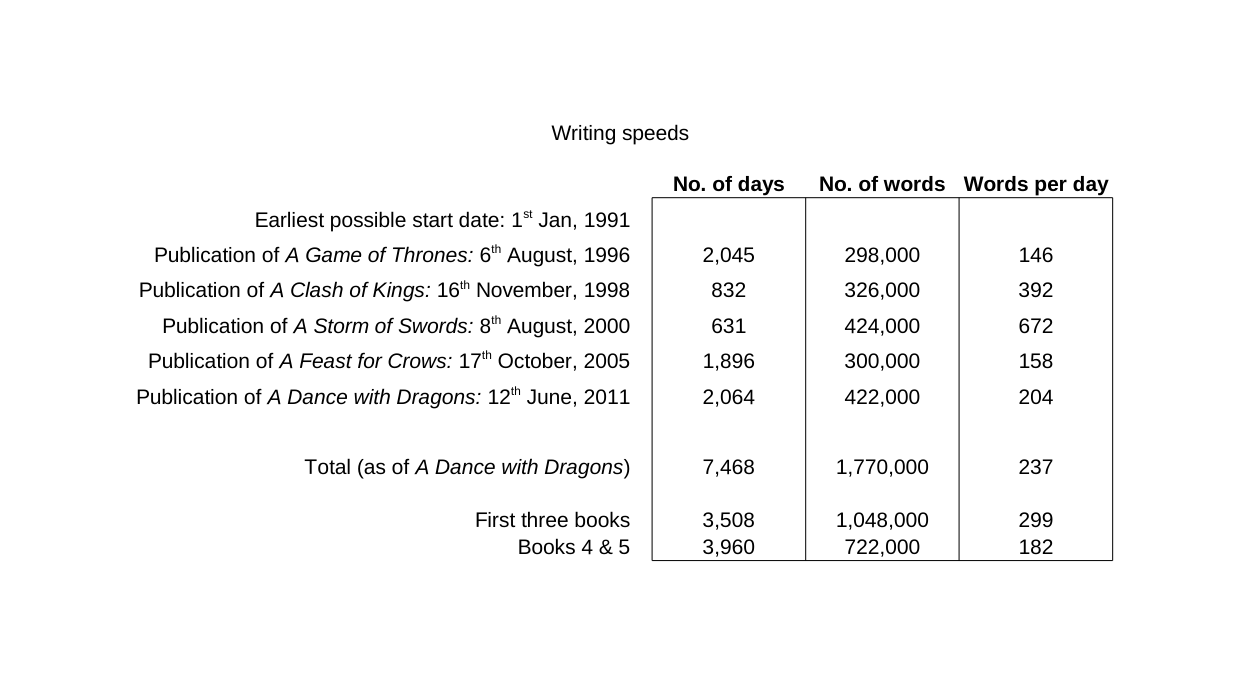
This made me curious about Mr. Martin’s writing productivity, so I did a little digging and found the following figures, calculated by his fans:

grrm_wordcount

Those numbers are rather stunning. He averaged only 200 words a day when writing A Dance with Dragons? Just for reference, this blog post is about seven hundred words so far, and I’m writing it while taking a break from my other writing (word count so far today: 1,100 words, and that’s a little low). Even if we allow for five drafts written at the same speed, five drafts still only comes to 1,000 words a day.

Now, I do think Mr. Gaiman makes a good point that it is neither healthy nor helpful to try and micromanage everything that a writer does. We can’t spend every waking hour working on the next book, and even if we did, it probably wouldn’t turn out as well, because refilling the creative well is an important part of the writing process. And I also have to admit that if you ran a similar calculation on my own books (especially the early ones), you would probably find some similarly embarrassing figures.

(Though to be fair to myself, I tend to have multiple irons in the fire at any given time, so a straight start date to publication date calculation doesn’t tell the whole story—and it probably doesn’t tell the whole story with George R.R. Martin as well. But still, even if those figures were twice as high, they would still be absurdly low for a working writer.)

When Mr. Gaiman and Mr. Martin say that the writing “comes when it comes” and there’s nothing they can do about it, I think they’re wrong. Dead wrong. Writing is an art, but it is also a craft. It can’t be forced, but it can be structured. Mr. Correia has evaluated how productively he writes and structured his convention-going plans accordingly. Has Mr. Martin?

I also think they’re dead wrong about the writer having no obligation to the reader. That’s total bunk. Reading is an act of collaboration between the writer and the reader: without readers, stories would never exist. They would just be markings on a page, or electrons on a drive, or at best ideas and daydreams in the writer’s head. If a tree falls in the forest, does it really make a sound? If a book is never opened, does it ever tell a story?

Part of this may be the difference in perspective between indie writers and traditionally published writers. In the traditional system, writers were paid an advance on royalties by their publishers. The contract also allowed for royalties, but those figures were set so low that most books never earned out their advance. Publishers made up for it by raising the advances for the writers they wanted to keep.

In contrast, indie writers live and die by their royalty checks. Had a good month? Congratulations, you can afford to eat. Had a bad month? Tsk, tsk. Better hurry up with that WIP of yours, because the longer it takes to publish it, the longer it takes for you to get paid.

But even for the fantastically successful writers who never have to worry about how they’ll pay their bills, I still believe that they have as much of an obligation to their readers as the rest of us. Without readers, we would not be able to do what we do. Without readers, it would be impossible to pursue writing as a career. We all want to live the dream, and the only way to do that is by treating our readers well.

So George R.R. Martin may not be your bitch, but I most certainly am. Writing is not something that happens only sometimes: it’s my job, and I do it every day. And as for accountability, I absolutely feel that I’m accountable to my readers. They are the whole reason I am able to do this in the first place. If that makes me their bitch, then so be it.

Larry Correia on creating “offensive” characters

Larry Correia has a fantastic post up on the pitfalls of political correctness when writing fictional characters. He not only nails it on the head, he takes a nail that’s been twisted in three different directions and rams it into the wood with just a couple of well-placed taps. Seriously, if you’re interested in writing at all, you should check the whole post out.

The main gist of it can be summed up by this quote:

Smart writers are going to focus on entertainment. They’re probably going to offend everybody at some point. But at least they won’t be boring while they do it.

I’ve said this before, and I’ll say it again, the unforgivable sin for writers is being boring. As a writer you can get away with damned near anything as long as you are entertaining a big enough audience.

There is a contingent of readers out there who exist only to nitpick and bitch. There aren’t that many of them, but they make up for it by being loud. Many authors are under the mistaken impression that you can make these readers happy. You can’t. At best you can appease them. Temporarily. But you will cross their invisible line sometime and they will get all sorts of outraged.

The latest person to get outraged was Melissa Harris Perry, who denounced Star Wars because Darth Vader was (and yet at the same time wasn’t) black. Seriously. It’s like she saw this clip and didn’t realize it was satire:

But I digress.

The reason it’s impossible to please politically correct SJW-types is because the way that they signal their virtue to other members of their tribe is by finding something to be outraged about. This is a consequence of their belief that the only way to fix society is through social revolution, a point that Dennis Prager deconstructs quite effectively. It’s all about how loud they can scream.

As Larry points out, trying to placate these perpetually outraged people is a game you can’t win—not unless you’re already a member of their tribe. This ironically makes them far more prejudiced than most of the people they’re so outraged at. When was the last time you heard the word “white” used as an insult? Has the word “cisgender” ever not been used as an epithet? “Privileged” is another one—without knowing anything about you as an individual, they have already passed judgment and despise you.

Again, this is why I support the Sad Puppies: because they have the courage to stand against these perpetually outraged types who would tear down everything in SF&F that they can find offense with. The most imaginative genre in fiction is no place for self-appointed thought police.

There is one important area where I disagree with Larry. He rejects the Bechdel test out of hand, where I think it still has value. As a litmus test, I totally agree with him: I’m against any kind of a litmust test for stories. But from a writing perspective, I think it can still be a very useful tool.

The Bechdel test is something that I usually have in the back of my mind when I write: not out of fear of offending the perpetually outraged, but in order to write more complex and interesting characters who can stand as heroes of their own stories. I don’t think we’re at odds on that point, since Larry himself says the same thing in his discussion of how to write a strong antagonist. To that extent, I personally find the test to be useful.

The point is, if you want to be a successful writer, don’t try to please everyone. As soon as you start to experience success, someone will inevitably take offense with you just to bring you down a notch. Don’t let them get to you. In the words of Brigham Young:

He who takes offense when no offense is intended is a fool, and he who takes offense when offense is intended is a greater fool.

A glorious fisking and what it means to be a real man

Oh my heck, I just read the most glorious fisking of my life over on Larry Correia’s blog. The subject is a New York Times article titled “27 Ways to be a Modern Man” (is it just me or is the NY Times taking its cues from Buzzfeed?), and Larry pulls no punches. Glorious. Absolutely glorious.

It got me thinking, though, about what it means to be a real man. Jokes about meat and action movies aside, there seems to be a lot of confusion about the subject these days. It’s actually getting to be a serious problem with our society, as evidenced by the fact that a list as pathetic as Brian Lombardi’s can be taken seriously enough to be published in a major national newspaper.

So without further ado, here’s my list:

1) A real man provides for the needs of his family.

The traditional role of fathers is to provide, or to supply what is wanted or needed. There are many good reasons for this. Families have needs, some of which women are uniquely suited to fulfill, others of which men are uniquely suited to fulfill. Individual circumstances necessitate adaptations, but a real man knows that his duty is to his family.

A real man provides his family with shelter and security, with material support and protection. He makes his family feel safe, both from evil and from want. He provides them with love, with advice, with a positive example and role model for them to emulate. He provides his children with everything they need to grow up healthy and have families of their own.

A real man is not an absent father—unless, of course, the State steals his children from him and makes that impossible. Misandry is a far greater problem in our society than misogyny, especially within family law, but that’s a subject for another time.

2) A real man respects women and girls.

To respect someone is to regard them as being worthy of admiration because of good qualities, and to treat them in a proper way. A real man respects and values women, and treats them accordingly.

He does not see them as objects for his lusts, but as human beings. He recognizes the importance of their contributions to society, especially as wives and mothers, and helps them to feel wanted and appreciated.

A real man never lashes out at or physically abuses a woman. If a woman abuses him, he does not abuse her back.

3) A real man is someone that others can depend on.

A real man is dependable. He keeps his promises. He does what he says he will do. He understands that people are depending on him: his spouse, his children, his family, his parents, brothers, sisters, and friends. Inasmuch as it is within his power, he does not disappoint them.

4) A real man takes care of himself.

A real man understands that he cannot help others unless he first helps himself. For that reason, he strives for independence and self-reliance, so that he can better serve those who depend on him.

A real man does not need to be mothered, especially not by his wife or girlfriend. He cleans up after himself. He showers and keeps himself clean. He knows how to do his own laundry. He knows how to clean his own dishes. He knows how to eat healthy and how to exercise. He knows how to manage his time.

In short, a real man has his shit together. He may be a child at heart, but he is also a responsible adult.

5) A real man knows how and when to lead.

A real man does not wait for his parents or his wife to tell him what to do. He does not leave the decision-making to other people when it’s his responsibility to step up and lead. He knows how to take charge when people are looking up to him, and how to inspire confidence in those who look to him for direction.

Because he knows how to lead, he also knows how to follow. He does not his drag his feet or grumble about the tasks he’s assigned to do, but fulfills them to the best of his ability. He knows when to take charge, but he also knows when to step down. He also knows when to get out of the way.

6) A real man knows the difference between taste, quality, and value.

This was the biggest issue that I had with the NY Times article: 80% of the stuff on Lombardi’s list were merely matters of personal taste. A real man understands that different people have tastes that are different from his, and is perfectly willing to accept that. He does not condemn others for having “wrongfun.”

That said, he can also recognize quality and value. He understands that a $10 knockoff tool may, in the long-run, be more expensive than a well-made $50 tool. He knows how to use the right tool for the job, and how be efficient and do quality work.

7) A real man strives constantly to learn, grow, and improve.

At the same time, a real man recognizes that he is not an expert in all fields. When out of his area of expertise, he is able to admit what he does not know and to accept counsel from those who know more than him.

Life is a process of constant growth. Just like a muscle will atrophy if it is not exercised, so too will our minds and spirits deteriorate if we do not constantly strive for self-improvement. A real man recognizes this and does all he can to be a better man.

8) A real man faces his fears with courage.

Courage is not the absence of fear: it is the strength to overcome fear. The difference between heroes and cowards is often no more than the decision to stand up and do. A real man understands this, and overcomes his fears to do what is necessary. From the outside, he may appear fearless, but the truth is that he simply knows how to face his fears.

9) A real man helps others to achieve greatness.

A real man is not interested in petty infighting or drama. He does not keep score or hold grudges. He does not feel that he is diminished in any way by the achievements of others. Instead, he inspires and lifts those around him, often without even realizing it. People naturally look up to him, because he brings out the best in them.

10) A real man’s greatness is measured by the way he treats those he loves.

A real man is not overly concerned with titles or awards. He knows that greatness is not bestowed upon him by those in positions of authority, but is attributed to him according to how he treats those whom he loves. Because of this, he has developed a tremendous capacity to serve his fellow men, and exercises that capacity daily.

“Greater love hath no man than this: that a man lay down his life for his friends.” That is the true measure of a man: how much he gives of himself. Some men literally give everything, dying to serve and protect their loved ones. Others give their lives by living, giving freely of their time, talents, and love.

Regardless, a real man does not live for himself alone. He always lives for others.

LTUE 2014

Without a doubt, my favorite sci-fi convention / writing conference / symposium is LTUE. I say this every year, but this year’s symposium was one of the best! Orson Scott Card and Brandon Sanderson were both there, along with a whole bunch of other authors and artists, local and otherwise. It drew a huge crowd, too–around 1,800 people over the course of the weekend–but there was plenty of space at the Provo Marriott, so it never felt too crowded.

If anything, I think that LTUE has gotten better since leaving BYU. There’s much more openness, much less administrative or bureaucratic restriction. Fans can dress up in cosplay and that’s okay, panels can discuss pop culture topics without having to pretend to have academic value, non-LDS panelists are free to share their perspectives without feeling like the religious censors are breathing down their backs, and we have a whole hotel hotel to ourselves, as opposed to a corner of the student center.

At the same time, all of the stuff that makes LTUE great is still there, and there in abundance. Since the vast majority of attendees are LDS, the panels all revolve around the LDS perspective and experience. In his main address, Orson Scott Card talked about how his experiences growing up in the church influenced the writing of Ender’s Game and his views on leadership. At the banquet, Brandon Sanderson referenced Orson F. Whitney’s famous Home Literature speech in discussing Mormons’ place in the current science fiction & fantasy field.

In other words, all the good stuff was still there this year, plus a liberal helping of cosplay and facial hair. And who can say no to that?

In any case, I had a blast. I was on five panels this year, and they were tons of fun. In particular, the Writing Romance panel was really great. Since I’m not familiar with romance as a genre, I was a bit worried that I’d be out of my league. But the discussion was all about how to put romance in your sci-fi, and I know a lot about that. At one point, I argued that men have just as much of a hunger for romance as women. That surprised some of the female panelists, but I definitely believe that that’s true. We got into a lengthy and interesting discussion out in the hallway, which is how the best panels seem to go.

One major shift I’ve noticed from previous years is that self-publishers and self-publishing has all but lost its stigma, with people talking openly about the benefits of that career path. In fact, it was a major undercurrent throughout the entire symposium. In the green room, we got into some really intense discussions about the AE report, which came out just days before the symposium began. It seemed that I was constantly hearing or overhearing people talk about whether and how to self-publish, and on several panels people were openly advising to skip traditional publishing altogether.

Three years ago, people would have treated me like I had leprosy if I openly admitted I was self-published. Now, everyone seems to be embracing it. It’s so awesome that we’re past the stigma, because it means that we can all be open and supportive of each other and focus on the important things, like writing the best possible stories and connecting with our readers.

By far, the best event I attended was John Brown’s presentation on Clear and Vivid Writing. HOLY CRAP GUYS. That presentation completely blew my mind. The powerpoint is up on John Brown’s blog, so you can grab it and see for yourself. All I can say is that the man is a writing genius. The presentation completely changed the way I think about my own writing, and will definitely influence what I write from here on out.

Another great event was Sandra Tayler’s presentation on how to build a fan community around your stuff. She talked about the difference between a following and a community (basically, a community is a following where the fans talk to each other), how to cultivate a safe and inviting place for your fans, and what to expect from when you first start out to when the community starts to get rather large. I still feel as if my writing career is just getting started, but her advice will no doubt be very useful in the coming years.

The What Makes a Hero panel was really great. Peter Orullian, Larry Correia, and Lisa Mangum were all on it, so the discussion was energetic and full of awesome, juicy stuff. The big takeaway I got from that one was that as long as the reader doesn’t throw the book across the room in disgust, you can always bring back a fallen character and redeem them. There is nothing so beyond the pale that makes it impossible for a character to step up and become the hero once again. It takes skill to pull it off, of course, but it can be done–and that is one of the most awesome things about what it means to be a hero.

There was a bunch of other stuff that I took away from LTUE this year, but those are the major things. By the end of it, I just wanted to sit down and write! The climactic final battle for my current WIP, Sons of the Starfarers: Comrades in Hope came to me in all its awesomeness as I attended the various panels, and holy crap am I so excited to get to that part! It’s going to be amazing, and the cliffhanger ending is going to make you scream so horribly, but that’s okay because the next book will pick up right where the previous one left off, then take things in an even more awesome direction.

In any case, that was LTUE this year. SO MUCH FUN. If every convention can be like this one, holy crap, sign me up for them all!

Monster Hunter International by Larry Correia

Owen Zastava Pitt wants nothing more than to be a mild-mannered accountant with a comfortable, boring life.  Unfortunately, fate has other plans.  His father–a retired green beret–brought him up to be a killing machine, with or without a firearm.  To pay for college, Owen worked alternately as a bouncer and a highly illegal cage fighter.  But all that’s behind him now; he has a respectable job–one where he isn’t required to kill things for a living.

When his boss turns out to be a werewolf, however, and Owen single-handedly kills him, all of that changes.  A guy shows up at the hospital with a business card for a company called “Monster Hunter International,” and promises to help him make a lot of money killing things for a living.  It turns out that vampires, wights, werewolves, and evil tentacled monsters are real, and the business of monster hunting is quite lucrative.

At first, Owen is hesitant.  But when an old Jewish man starts showing up in his dreams, telling him about an ancient, evil plot to subjugate the world,  he realizes that he has little choice in the matter.  Fate has given him a calling–or, as the old man likes to say, the “short end of stick.”

If  you’re a gun fanatic or a B-movie connoisseur, you’ll love this book.  It’s basically Men in Black meets Van Helsing, with enough firearms and weapons to make Rambo look tame.  Hundreds of mindless zombie wights?  Bring out your automatic 12 gauge shotgun.  Giant flying gargoyles the size of semi-trucks?  Hope you brought enough RPGs and grenade launchers to go around.  Hordes of undead swarming across Alabama?  Better arm the 5-kiloton tactical nukes.

The story was quite entertaining, with enough comedic and romantic subplots to keep things interesting.  The battle between good and evil was pretty clear cut and unambiguous, with evil being measured by how many tentacles a thing has, but some of the monsters (such as the vampires) were much more complex.  When you have to decapitate your buddies after they die, to make sure they don’t come back as something that will kill you, that makes things interesting.

I felt that the second half of the novel lagged a little, especially with the number of false endings.  However, the ending itself was quite satisfying, with an interesting twist that caught me a little by surprise.  The quality of Correia’s writing was a little weak in places, but the story was more about killing the bad guys than crafting beautiful prose.  In any case, I don’t think his intended audience will mind.

Overall, it was an entertaining, surprisingly fast read.  It’s not the type of thing I usually read, but I enjoyed it.  If you’re looking for deep, meaningful literature that changes the way you view the world, or a clean, wholesome read that’s free of excessive language or violence (Gamila, I’m talking to you), this book probably isn’t for you, but if you’re looking for an entertaining story about undead monsters where the good guys aren’t pussy-footing idiots, you’ll probably enjoy this book.  If you own more than one firearm, it’s a must-read.

Space Pirates of CONduit

So this weekend I went to CONduit up in Salt Lake city.  It was a great experience! Lots of fun, lots of friends, and lots of excellent panels on writing.

The usual crowd was there: Dan Wells, Brandon Sanderson, L. E. Modessitt, Bob Defendi, Dan Willis, Paul Genesse, Julie Wright, John Brown, Larry Corriea, James Dashner, Eric James Stone, and tons of others.  Besides the bigger names, I saw a lot of other aspiring writers like myself who have yet to make it big–friends from World Fantasy and LTUE.  It was good to catch up and reconnect.

Friday had a number of excellent panels.  My personal favorite was A Writer’s Life, in which a number of relatively newer writers gave advice on breaking in and talked about what their lives are like now that they’re published.

At one point on the panel, a fearful aspiring writer asked the question: “when do you know when it’s time to quit and give up?”  The responses from the panelists were quite insightful.  Basically, the only way to know that you need to quit writing is if you can imagine your life without it.  If you can’t, you may feel that you’re writing currently sucks, but you’ve still got stories in you, and those stories need to find a voice.

There were a number of other gold nuggets on that panel.  Larry Corriea surprised me by saying that there is no such thing as an “outline writer” or a “discovery writer”–that these concepts simply describe writing tools, and that different projects require different tools.  Julie Wright said that if you are not enough without a publishing deal, you will never be enough with it.  John Brown (I think) said that writer’s block doesn’t exist: if you’re blocked, it means either something’s wrong with you or something’s wrong with the story.

Saturday had a number of excellent panels as well.  The guest of honor was Barbara Hambly, and she was a delight: witty, saucy, and full of interesting stories and great advice.  For her main address, she simply talked about how her life has changed in the past thirty years, but it was fascinating.

One of the more interesting things she said was that God places an angel with a flaming sword in front of every door in our lives that we shouldn’t take.  Sometimes, it seems that you’re simply staring down a corridor full of guarded doors–and sometimes, especially towards the end of life, it seems that you’re staring down a corridor and the angels are saluting you.  That made her tear up–she’s had a long, rough, yet interesting and vibrant life.

When asked to elaborate on the decline of the fantasy market in the past twenty years, she gave a very interesting response.  Today, instead of buying fantasy novels by the pound, fans are immersing themselves in MMORPGs like World of Warcraft.  Because it requires much less effort to play a game than to read a book, people are turning to games as a substitute.

Another fascinating panel was Riding the Rocket, in which a number of established authors discussed the career blast off and what to expect.  Lee Modessitt made the point that there are two basic approaches to writing: storytelling or writing excellent prose.  In order to be successful, a writer has to master both, but they generally start out better at one than the other.  The key is to know which one you’re weaker at and consciously work on it.

When asked about their greatest fear, the unanimous answer was that they’re terrified their next book will tank and that they’ll fade into obscurity–that they’ll be forced to go back to that dreaded day job.  The only way to deal with that, though, is to keep writing, keep working on your craft, and control the things you can while not fretting too much about the things you can’t.  If you do what you can, things will generally work out for the best.

There were a ton of other excellent panels, other nuggets of wisdom.  I recorded a number of panels, but I’ve decided not to post the mp3s publicly here: if you want them, just email me and I’ll send you a copy.

All in all, I’m very glad I came!  Besides all the panels and networking opportunities, it was just a lot of fun to hang out and talk science fiction and fantasy with a bunch of like minded people.  CONduit is an awesome convention–if you’re a local Utah writer and you have the chance to come, I definitely recommend it!