Man, LTUE 2013 was this weekend, and it was AWESOME. One of the best conventions I’ve ever attended. I spoke on my first panel, attended my first book signing event as an author, and got to meet up with some old friends, as well as some amazing new people.
Since I live tweeted most of the panels I attended, I thought it might be interesting to repost a few of those here, with some additional thoughts. So…here goes!
THURSDAY
Every book exists in two genres; it’s the combination that makes the story. #LTUE
— Joe Vasicek (@onelowerlight) February 14, 2013
I believe this was Scott Parkin from the “What Do You Write?” panel. Good advice. Megan Whalen Turner also had some very interesting things to say on the subject of genre, which I have since forgotten. But I recorded it, and the recording will eventually be made publicly available in the LTUE conference archives, or so I’ve been told.
Okay, David Butler’s Mormon steampunk book sounds REALLY cool. #LTUE — Joe Vasicek (@onelowerlight) February 14, 2013
This one was from the “What Is ‘Punk’ Literature and Its Many Genres?” panel. David Butler and Larry Correia were HILARIOUS. Nearly got into a wrestling match right in front of us.
And when the esteemed Mr. Butler began to describe his book, I swear, a choir of steampunk angel Moronis somewhere began to sing a heavenly chorus. I mean, he had me with Edgar Allen Poe faking his death to become a secret agent, but Orson Pratt’s phlogiston guns? Eliza R. Snow as chief counterintelligence officer for the Kingdom of Deseret? I will definitely be checking out this book, City of the Saints (which is apparently a finalist for the 2013 Whitney Award).
David Butler is also a way cool guy. I hung out with him a bit in the dealer’s room, chatting about Mormon history, Lyman Wight (“shoot and be damned!”), Sir Richard Francis Burton’s expedition to Salt Lake City, and all sorts of other crazy zany stuff. And the whole time, he was playing a guitar. So yeah, definitely a way cool guy.
Dude! There’s this thing called the green room, and if you’re on a panel, YOU CAN GO THERE! #LTUE — Joe Vasicek (@onelowerlight) February 14, 2013
This discovery CHANGED MY LIFE. Also, it helped me to save immensely on lunch money, as well as join in on some way cool conversations with other panelists as they desperately tried to escape their fans. Okay, not really, but the green room was AWESOME.
A hook is something that gets the readers to start telling the story to themselves. @howardtayler #LTUE
— Joe Vasicek (@onelowerlight) February 14, 2013
Howard Taylor’s presentation on teasers was tremendously insightful. In a nutshell, he said that a teaser (aka book description on Amazon / back cover) should have or at least point to the following things:
- The inciting incident
- Character action
- Conflict
- Hook
We then went over a few examples, including some good ones that broke these rules, and finished up by doctoring a couple of teasers volunteered from the audience. Howard Taylor admitted to me later that he wasn’t entirely satisfied with the way he presented it, but I get the impression that he’s never entirely satisfied with anything less than perfection. It was a great workshop.
The right way to write a book is the way you want to write it. Every book is different. @lisamangum #LTUE
— Joe Vasicek (@onelowerlight) February 15, 2013
From “Engaging the Reader.” Great panel. Lisa Mangum described the planning / drafting / revising process for each of her first three novels, and they were all wildly different. With seven novels under my belt so far, I can definitely relate. Some, like Genesis Earth and Stars of Blood and Glory, practically write themselves. Others are like having a c-section with a hacksaw. And others…yeah, I’m not going to go there.
FRIDAY
My first ever panel at #LTUE was a success! Everyone else said really useful things and I had some funny stories.
— Joe Vasicek (@onelowerlight) February 15, 2013
Okay, maybe I said one useful thing: when there’s a language barrier, little things become big obstacles. One of the other panelists, Anna Del C. Dye, also had a bunch of stories about adapting to a foreign language and culture (in her case, the United States).
Overall, the panel was really, really fun! I also had some cards out for Star Wanderers: Outworlder, and a bunch of people came up afterward to get them. Guess I must have said something interesting. I hope you guys enjoy the book!
The trends in literature tend to echo socioeconomic trends and current events. #LTUE
— Joe Vasicek (@onelowerlight) February 15, 2013
To predict trends in science fiction and fantasy, pay attention to what’s popular with kids. #LTUE
— Joe Vasicek (@onelowerlight) February 15, 2013
From “Current Trends in SF.” Great panel–it totally wasn’t just another over-hyped discussion about what’s hot right now. I asked how the panelists think the trend cycle will change in the age of self-published ebooks, and they had some very interesting things to say. They all agreed that speed to market, while it may give some advantages, isn’t a make-or-break game changer, or even really a good strategy (unless you really love the trend you’re writing to). Some things change, others remain the same. It will be interesting to give this one a re-listen.
The cheese in the maze of publishing has been moved. @trhickman #LTUE
— Joe Vasicek (@onelowerlight) February 15, 2013
If you’re trying to carve out a niche in the long tail, the challenge is to make it possible for the right people to find your books. #LTUE
— Joe Vasicek (@onelowerlight) February 15, 2013
The key to success in the new world of publishing is to work even harder on your craft and tell amazing stories. #LTUE
— Joe Vasicek (@onelowerlight) February 15, 2013
From “Creators in the Community.” Probably one of the best panels of the entire convention. Tracy Hickman is really on top of the changes in the publishing world, and had a lot of interesting things to say about it in all of his panels. As for the subject of writerly communities, much wisdom and insight was shared by all of the panelists. Definitely look for this one.
Just did an interview with @dcr_show at #LTUE. Great guys–lots of fun!
— Joe Vasicek (@onelowerlight) February 15, 2013
Man, I’d forgotten how cool the guys at Dungeon Crawlers Radio are! They interviewed me back in 2011, when I was just getting ready to publish Genesis Earth. This time, we talked about space opera, sci-fi romance, language barriers in marriage and all the crazy things I have to look forward to, and a bunch of other stuff. I also shared some of my thoughts and opinions on self-publishing myths, especially regarding the “tsunami of crap.” We coined a new word, “nerdaissance,” to describe all the awesome new stuff that’s coming out now, thanks to the ease of self-publishing.
So yeah, it was a great interview! I’ll definitely be cross-linking once it goes live.
When a reader looks at a book cover, they should already be sold. The rest is a negotiation. Brian Beus #LTUE
— Joe Vasicek (@onelowerlight) February 16, 2013
From “Effective Book Covers.” Great panel with some very good artists and cover designers, including Isaac Stewart who does all the maps for Brandon Sanderson. Although some parts were geared toward illustrators, most of the advice was for writers (especially self-pubbing writers) who are looking to design their own covers. Lots of great and insightful perspectives from the visual arts side of things.
FRIDAY NIGHT BOOK SIGNING
Okay, I’ve got to be honest: when I went into the mass signing with my cardboard box of CreateSpace POD novels, I didn’t expect to sell anything. I figured that was just my ticket to get a seat at a table and hand out cards for Star Wanderers: Outworlder to some of the casual book browsers.
Well, I was pleasantly surprised! An uncle of one of my old mission companions was impressed enough to buy a couple of copies. I think he’s one of these guys who likes to buy things from new authors to help encourage them. It’s great to see people like that. He told me to keep writing, and I told him I definitely would!
Lots of people snagged the card for Outworlder, and I came up with a pretty decent pitch: “it’s about a starship pilot who accidentally marries a girl who doesn’t speak his language.” That raised a lot of eyebrows! A lot of people were really happy to see a science fiction story, especially a space adventure. I get the impression that there’s a craving for this kind of stuff in the market that isn’t currently being satisfied. So yeah, that was very encouraging!
After things wound down a bit, I wandered around the signing checking out some of the other books. Saw a couple that I recognized from the Kindle Boards, which was interesting. Chatted with them, as well as a bunch of geeky guys about chain mail, Halo, Frank Herbert, and all sorts of awesome stuff. Man, the best part about sci-fi/fantasy conventions is the chance to just talk with people! So much interesting stuff. It was great.
SATURDAY
If there’s something that rings really true for you, write it and figure out the market after it’s finished. @jscottsavage #LTUE
— Joe Vasicek (@onelowerlight) February 16, 2013
There are entire provinces in China that have never heard my name, and I’m okay with that. @trhickman #LTUE
— Joe Vasicek (@onelowerlight) February 16, 2013
Love your books, love your readers. @lisamangum #LTUE
— Joe Vasicek (@onelowerlight) February 16, 2013
From “Write For the Market or Write What You Know?” Another great panel. Definitely will be re-listening to that one.
The most important thing is to teach our children to read well and avoid anything with a love triangle in it. M Whalen Turner #LTUE
— Joe Vasicek (@onelowerlight) February 16, 2013
From the main address with Megan Whalen Turner. She talked about book censorship and the need to teach children how to make their own reading choices, rather than keeping them sheltered and making the choice for them. She pointed out how every time a New York Times article comes out bemoaning some YA book for inappropriate content, it’s kind of hypocritical because there are so many other books they miss. The Golden Compass, for example, didn’t even pop up on their radar until the movie came out. Kids don’t magically become mature, well-adjusted adults when they turn 18–we have to teach them to make these choices (and mistakes) for themselves.
Writing is like a mosaic. When it’s finished it’s a whole, but when you’re working with it, it’s lots of little pieces. LE Modesitt Jr #LTUE
— Joe Vasicek (@onelowerlight) February 16, 2013
From “How Does Your Story Mean?” Great discussion on the writing process. Saw a lot of other good live-tweets during this one.
The key to future space exploration and colonization? GOATS! @caveoprincipia #LTUE
— Joe Vasicek (@onelowerlight) February 16, 2013
Okay, I take back what I said about the best panel of the convention. THIS was definitely the best. “The Engines of Exploration,” with Howard Taylor, Megan Whalen Turner, Roger White, James Owen, Kevin Evans, and Charles Stanford–the panel was packed. It basically turned into a round-robin discussion of which commodities are most essential to modern civilization, which ones will be the most valuable in the event of a societal collapse, and which ones will take us to the stars. The eventual consensus on each of these eventually came down to goats. Seriously. GOATS!
The difference between romance and erotica is writing with emotion and writing without it. LL Muir #LTUE
— Joe Vasicek (@onelowerlight) February 17, 2013
Moms and librarians with pitchforks–that’s friggin scary. Amber Argyle #LTUE
— Joe Vasicek (@onelowerlight) February 17, 2013
From “Writing Romance Without Erotica.” Lots of delicious awkwardness, as well as some really interesting thoughts and perspectives on the subject of romance. One of the panelists talked about the importance of “character penetration” without realizing about halfway through the panel how hilarious that phrase sounded in this context. But yeah, there was also a lot of wisdom in there as well. There are a lot of strong opinions about sex and romance floating around in this part of the world, so it was a very spirited and interesting panel.
Book trailers don’t have a future and will be gone in 5 years (except as interactive content within the ebook). Michaelbrent Collings #LTUE
— Joe Vasicek (@onelowerlight) February 17, 2013
Writers are the strangest mix of narcissism and poor self esteem. Michaelbrent Collings #LTUE
— Joe Vasicek (@onelowerlight) February 17, 2013
We say don’t judge a book by it’s cover because we do. @davidjohnbutler#LTUE
— Joe Vasicek (@onelowerlight) February 17, 2013
The last panel of the convention (technically, symposium, but whatever) was “eBook Publishing” with some highly successful indies like Michaelbrent Collings. As you can tell from the tweets, it was a bit controversial, but very, very interesting. Questions were flying all over the place, on subjects ranging from formatting to building an audience. The biggest shock to me was that none of the panelists (none of them!) are on Smashwords. It’s a wild, wild west out here in indie-land. Makes me wonder, maybe I should publish to iTunes through another venue? Hmmmm…
So yeah, that was pretty much the whole convention/symposium. I finished it out by playing Alhambra with a bunch of friends from Kindal Debenham’s writing group who came down from Seattle and Idaho. Good, good times–it was actually kind of sad to say goodbye. Definitely worth coming 11 time zones to attend.
All I can say is that I am STOKED for Conduit!

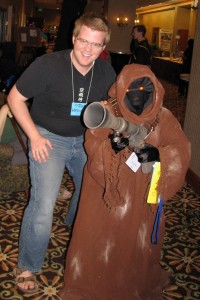 Conventions are definitely great for networking, but I absolutely hate walking up to a stranger and asking for favors. It makes me very nervous. As a result, I’ve adopted the philosophy of asking myself what I can offer the person I’m trying to connect with, rather than asking something of them. I tried to follow this philosophy at CONduit, even if all I could offer was a compliment on something they’d said on a panel.