P is for Parenthood

I’m currently in the process of writing the second edition of my newsletter exclusive, Science Fiction from A to Z, adding a bunch of new chapters and rewriting all of the old ones. For a blog post this week, I thought I’d share one of the new chapters. Let me know what you think!


I was going to make this section “P is for Pulp,” rounding out “G is for Golden Age,” “N is for New Wave,” “D is for Dark Age,” and “I is for Indie.” But I have to admit, I’m not as familiar with the pulp era of science fiction as I would like to be. I’ve read all of Robert E. Howard’s Conan and Solomon Kane stories, and Edgar Rice Burroughs’s A Princess of Mars (though not the rest of the Barsoom series, unfortunately. It’s on my TBR!) but that’s pretty much it. From what I understand, Jules Verne, H.G. Wells, and (of course) Mary Shelley all preceded this era, and I’m a little more familiar with them, but all I know about the pulp era is what I’ve heard from other sources, and I’d rather not regurgitate that without first exploring it myself.

Instead, I want to write about a major influence on every writer that gets almost no play whatsoever in public treatment of their work, but is arguably the single most important aspect of their lives: parenthood.

Becoming a parent really changes you. When I held my first child in my arms for the first time, a distinct thought came into my mind, almost like a voice: “this is her story now.” They say that we’re all the hero of our own story, and to a certain extent that’s true, but anyone who has brought a child into the world (or adopted a child as their own) has a much more complex and nuanced understanding and perspective. Even a terrible, abusive parent has still experienced what it’s like to become a link between the generations. That experience reshapes everything you do and are in ways that are impossible to appreciate until you’ve had it for yourself.

There is a subtle but distinct difference between books written by authors who have experienced parenthood vs. authors who are childless. I wasn’t as conscious of it until I became a parent myself, but even back in my days as a bachelor, I think I could still sense it, even though I didn’t know what it was. I suspect it’s why I’m a huge fan of David Gemmell, but not of George R.R. Martin, even though on the surface, they write the same kind of book. Both of them write dark and gritty fantasy, both of them are known for killing off major characters and doing horrible things to the ones who survive, and both of them are written quite well—in fact, on an artistic level, Martin is probably superior. But where Martin tends to obsess over themes of victimhood and victimization, Gemmell focuses more on heroism and what makes a hero. Gemmell had two children; Martin (so far as I can tell) has none.

In 2022, I made a new year’s resolution to read or DNF every novel that has won either a Hugo or a Nebula award. To prep for this resolution, I made a spreadsheet of all the novels, along with other pertinent information that interested me, such as each author’s gender, their approximate age when they won the award, and whether or not they have any children. I found some very interesting patterns. There were 110 novels in all, and fifty of them were written by authors who were childless (or at least did not have any mention of children in their author bios and/or Wikipedia entries). After 2015 and 2016 respectively, every Hugo and Nebula award-winning novelist (not counting the Retro-Hugos) has been childless—more specifically, childless women in their 40s and 50s, with one exception who is transgender (Charlie Jane Anders), one exception who is in her thirties (Arkady Martine), and one whose age I cannot determine (Sarah Pinsker). But all three of them are still childless, at least according to the internet.

Now, this is not to say that not having children makes you a terrible writer. In fact, it may actually make you a better writer, since you have more time and energy to devote to learning and improving the craft. But whether for good or ill, I do think that it gives you a handicap in terms of life experience. That handicap is going to influence both the subjects you choose to write about, and how you choose to write about them. I say this not just from my experience as a reader, but as a writer.

My wife and I married a little late, and by the time we had our first child, I’d already been writing professionally for about ten years. Up until that point, the reader I’d had in my mind was basically a younger version of myself. Bringing Stella Home is not a YA book, but a lot of my Amazon reviews assume that it is, probably because I was in college when I wrote it and was writing the sort of book that I wish I’d discovered back when I was in high school and reading things like Ender’s Game and Dune. After I’d experienced the real world and become sufficiently red-pilled, I wrote books like Gunslinger to the Stars for my naive college self. But since becoming a parent, my perspective has begun to change, and I find myself writing less for myself and more for my daughter—or rather, the kind of person I expect my daughter to grow up to be. I’m a lot more conscious of certain kinds of content, and while that doesn’t mean that I shy away from it, I do find myself asking: “What am I really trying to say here? What purpose does this really serve?”

The Genesis Earth Trilogy is a good example of this evolution in my own work. The first book, Genesis Earth, was my first published novel, and really was written for a young adult version of myself, which is why I chose to categorize it as YA science fiction. The whole story revolves around two young scientists on a mission to an alien planet, and how they come to discover just as much about each other as the planet they’ve been sent to explore. It took me ten years to write the next book, Edenfall, not because I didn’t know what would happen next, but because I didn’t feel like I was ready to write it. Then I got married, and that was the experience I needed to break through the block and finish the book—and it went in a much different direction than it would have, if I had written it while I was still single. But the conclusion to the trilogy, The Stars of Redemption, was the book that I wrote after my daughter was born, and that experience had a very profound impact not just on the story itself, but on the characters, the thematic elements, and the way the last book brought everything together from the first book to a meaningful conclusion. I know for a fact that I would not have been capable of writing such a book without the experience of becoming a father.

Reading Resolution

My resolution last year was to read or DNF 100 books. I was doing pretty well on it through the summer, but then I stopped using Goodreads and lost count. (No particular reason, other than that I just fell out of using the site. It’s clunky and difficult to navigate, and after I started using my wife’s spreadsheet system for tracking my reading, I just didn’t feel like posting updates.) Counting children’s books, I definitely hit 100—probably more like 120—but without counting children’s books, it was probably closer to 80.

I do really want to keep up on my long-term goal to become a better reader—or to be more well-read, which amounts to the same thing. This last week, I’ve been giving that goal some serious thought, and I’ve decided on the following new year’s resolution for 2022:

Read or DNF every novel that has won a Hugo or a Nebula award, and acquire all of the good ones.

Ever since 2015, I’ve been pretty jaded about the Hugos (and the Nebulas, to a lesser extent). However, for a long time they were the most important and authoritative awards in science fiction, and by using it as a reading list, I hope to get a better sense of how the genre has evolved over the years, including how in recent years it has fallen to the woke insanity of our time.

There are 110 novels that have won either a Hugo or a Nebula award (or both). Of those, I’ve already read or DNFed 33 as of today, January 1st. I anticipate that I will DNF many of the rest, but I’ll give them all an honest try, and differentiate between hard DNFs (where I know I’ll never get back to reading it) and soft DNFs (where I intend to come back to it later). For purposes of this resolution, though, I’ll count both, since as a reader I believe in DNFing early and often.

As for acquiring them, that shouldn’t be too hard, and will help to build our family library, which is one of my long-term goals. Paperback Swap is great for acquiring used books, especially mass market paperbacks, which is actually my preferred format for most books (great for stuffing in a back pocket or tossing in a backpack, and you don’t mind it as much if someone borrows and never returns it). The added benefit of using Paperback Swap is that it will help me to get rid of some of the books I’ve acquired over the years that I’ll probably never read.

That’s actually a huge problem for me, and I was thinking about making another resolution to have read at least half of the fiction books that we own before the end of the year, but I think this reading resolution will help with that enough that I don’t need to make it more complicated. I’ve found that it’s generally better to set one resolution and focus on that, rather than setting so many that I’ll probably forget all of them by mid-March. Besides, having a bunch of unread books isn’t actually much of a problem, unless you don’t have a place to store them. We do.

While putting together the spreadsheet of all the Hugo and Nebula winning books, I discovered some very interesting things. One of them had to do with the age of each winner at the time they won the award. The average age was about 46, with Samuel Delany coming in as the youngest for Babel-17 in 1967 at age 25, and Ursula K. Le Guin as the oldest for Powers in 2009, at age 80. (Her first novel to win either award was The Left Hand of Darkness, in 1970 when she was 41.) The average age skewed younger in earlier decades; now, it’s closer to 50.

Another very interesting thing to look at is which authors have had children and which ones haven’t. Of the Hugo and Nebula award-winning novels that I’ve DNFed, almost all of them are from authors who are childless. That’s not too surprising when you consider how much it changes your perspective on the world to have or adopt a child. What’s really surprising to me is how many of these authors are childless, and how many of the childless authors are writing books for children. Since 2015 and 2016 respectively, none of the living authors who have won a Hugo or a Nebula award for best novel have had any children of their own—or if they have, it’s not public knowledge and the internet doesn’t know.

So anyways, that’s basically the long and short of it. I’ll keep track of this goal through the detailed spreadsheet I’ve set up for it, and post updates throughout the year. And when I’m done with the Hugos and Nebulas, I’ll probably move on to the Dragon Awards, which may actually be harder since 1) there are more than half a dozen sub-categories, 2) many of the winning novels are the umpteenth book in a long-running series, and 3) I probably won’t DNF as many of them.

What are your reading resolutions?

Navigating Woke SF, Part 2: When Is It Not Worth Submitting?

So a couple of hours after I published my last blog post, China Mike Glyer of File 770 infamy picked it up for his daily pixel scroll. Hi, China Mike! I thought you might be looking for some red meat to feed your readers—aside from the Chinese clickfarms, of course—but I was especially pleased that you included my affiliate links with the excerpt you copy-pasted! Not only does this bring in some extra cash (thanks, China Mike!), but it also gives me some metrics to compare File 770 with, say, some of the other indie authors that I do newsletter swaps with. And wow… let’s just say there’s a reason why they call you China Mike Glyer and leave it at that.

So in today’s episode of red meat for China Mike, I’d like to pick up where I left off with the last post and pose the question: when is a science fiction market too woke to be worth submitting to? But to answer that question, we first need to answer: why bother submitting short stories to traditional markets at all, when self-publishing is an option?

It’s a good question, because there are a lot of good reasons to self-publish short stories. In my experience, they don’t earn particularly well on their own, but they are quite useful as newsletter magnets to gain new email subscribers, free ebook giveaways to let readers sample your work, and giveaways for newsletter subscribers to remind them that you exist and keep your books in the forefront of your mind. I make all my short story singles free on all the ebookstores, and keep them up until I have enough to bundle them into a collection, at which point I take them down and submit to the reprint markets. It’s a system that’s worked pretty well for me so far.

Potential Benefits of Submitting to Traditional Markets

So why submit to traditional markets first? Why hold off self-publishing in the hopes that you can sell first publication rights? Here are a few of the reasons:

  • The pay. A professional short story sale will bring in several hundred dollars, and even a semi-professional sale (1¢ per word or more) will typically earn more than pizza money. Over the lifetime of a typical story, that’s a good chunk of the income you can expect to earn from it (unless it’s optioned for a movie, of course).
  • Advertising. A short story sale, especially to a higher-paying market, will get your work—and your name—out to many readers who may have never heard of you before. Making your self-published short stories free accomplishes a similar thing, but with a different audience. Lots of readers who follow the magazines don’t typically look up free short stories on Amazon, though I’m sure that some of them do.
  • Prestige and reputation. Whenever you make a professional or semi-pro sale, that’s another human being proclaiming that your story is good enough to pay you for the privilege of publishing it. The SF&F short story markets are incredibly competitive, especially the higher-paying ones. Not all readers care about this, but being able to say that your stories have been published in Analog, or Asimov’s, or F&SF helps to set you apart from other authors—and many readers do sit up and notice. I certainly do.
  • Networking. Breaking into a short story market can be a great way to make connections with other writers and editors in the field, which can open up some really great opportunities later. I’ve had some really great experiences with this, and I look forward to having more in the future. You never know how things will turn out when you put yourself out there!

I suppose you could also include “awards” and “SFWA membership” on that list, but frankly I don’t care much about either of those. Contrary to the impression that China Mike wants to give you, I’m really not much of a drama llama, and as for awards… we’ll get there.

Potential Drawbacks of Submitting to Traditional Markets

Importantly, there are several potential drawbacks to putting your stories out on submission, especially if you have a viable self-publishing strategy. Some of those reasons include:

  • Lost time. It takes a lot of time to submit your stories to all the traditional markets, even just the professional ones. I used public data on The Submission Grinder to discover that the average wait time for professional SF&F markets is about 30 days, which means that if you want to submit to all of them, you won’t be able to self-publish that story for years.
  • Exclusivity. A lot of markets include an exclusivity period in their contracts, which can run upwards of a year or longer. Again, that’s a lot of lost time where you can’t self-publish that story, even if it does sell.
  • A very competitive market. You can keep a story out on submission for years, only to exhaust all but the token-paying markets. This isn’t necessarily a judgment of the story’s quality, either—I have stories that I’ve sent out 30+ times that have received more than 25% personalized rejections, that have never been picked up by a traditional publisher. There are just too many really good stories out there for the higher-paying markets to publish them all.
  • No simultaneous submissions. This one really bugs me. For some reason, most of the higher-paying SF&F markets don’t allow simultaneous submissions—that is, they demand the exclusive right to consider your story before they pay you a dime. What’s worse, the wait times for many of them can stretch on for months. This is how stories end up on submission for years—and all of that is time where you can’t self-publish.
  • Submissions bandwidth. At any given time, there are only between 10-20 SF&F markets open to submissions that pay more than 5¢ per word (for flash fiction, it can get up to 30). The average wait time for these markets is about 30 days, and most of them do not allow multiple submissions. Therefore, if you write more than one short story per month for an extended period of time, you will very quickly run into a bandwidth problem, where there aren’t any available markets to submit to.

So those are the potential costs and benefits that you have to contend with when writing and publishing short stories.

How Wokeness Changes the Equation

Now, let’s get to the first question: when is a short story market so woke that it isn’t worth submitting anything to them? This is something I’ve been thinking about a lot in the past few days, and while I don’t think it’s possible to come up with an objective, impartial standard, I do think that it’s important to draw the distinction, because wokeness changes the cost/benefit analysis substantially.

It wasn’t always this way. Traditional sci-fi publishing has trended to the political left (sometimes to the extreme political left) of mainstream American culture since the New Wave era back in the 60s and 70s. It seems that the campus radicals took over much of the field, not to mention the fact that American traditional publishing has always been centered in New York. But until just the last few years, it was still possible for left and right to coexist in our pluralistic society. People of different political persuasions could agree to disagree amicably, and while there may have still been whisper campaigns and secret author blacklists, you could still expect to see a healthy mix of opinions and perspectives in most places that published short stories.

That is not true today. Certain subjects and opinions have been deemed verboten, while others have been exalted to the status of eternal truth, and any story that questions or challenges the politically correct narrative doesn’t have a chance in most of these markets. In other words, science fiction has gone woke.

(As a side note, this reminds me of a review that I received for my short story “Payday,” in which the universal basic income leads to runaway hyperinflation, causing society to unravel and forcing the protagonist and his family to flee. Sound familiar? In the author’s note, I mentioned how the story had been rejected by all of the pro-paying science fiction markets, and the reader found that even more disturbing than the story itself.)

“Woke” is a slang term describing a basket of socioeconomic and political ideologies that are incompatible with and antithetical to individual rights and liberties. Taken to their logical conclusion, they end in the sort of totalitarian horrors the world saw in the 20th century (and continues to see today in communist China).

I recently listened to an episode of the Jordan B. Peterson podcast where he interviewed Yeonmi Park, a North Korean defector and human rights activist. It was an incredibly powerful interview—well worth listening to in its entirety. One of the things that really struck me was the fact that nightmare dystopian societies can only endure so long as everyone, in their own little way, tacitly supports the lie. In such a society, declaring the truth is itself a supreme act of insurrection, because (in the words of Solzhenitsyn) “one word of truth outweighs the whole world.”

In the science fiction markets that have been taken over by wokeness, the truth is silenced by vicious accusations of white supremacy, transphobia, post-colonialism, and a hundred other virtue-signalling examples of doublethink. If George Orwell published 1984 today, they would probably pan it as anti-Asian and push to get it cancelled or banned. There can be no compromise with these people, as there is no room for discussion or debate. These woke ideologies possess people, who cling to it like the worst possible kind of religion.

I used to think that a story from someone like me would still be able to slip through, if it was good enough. But then I spent a year subscribed to every science fiction and fantasy market that had a free podcast. Most of the stories were poor to mediocre, but the authors hit all the woke intersectional checkboxes—and made sure to tell you that in their author bios. There were some exceptions, of course, but that was the general rule. Whenever there was an exceptionally good story, it was usually from an author who only checked one or two of the boxes—but their story would usually check off a couple more, such as having an LGBTQ+ romantic subplot, or having mostly POC characters. And in the wokest sci-fi podcasts, the editors always made sure to pound you over the head with an explicit political message, sometimes even before the story itself.

Of course, there are still some short fiction markets that care more about the strength of your story than upholding the woke establishment narrative, or making sure all their authors hit all the right intersectional checkboxes. But not generally among the professional-paying markets.

So how woke is too woke?

The events of the past year have convinced me that wokeness is like a cancer: no matter how small or innocuous it is when it starts, if left untreated it will metastatize and grow. The only way to treat it is to remove it from your life. No compromise. No discussion or debate. The woke care nothing for right or wrong, truth or falsehood: only narrative and power. When they look at me, they do not see a person: they see a heirarchy of identities. And if my stories are any good—that is, if they serve the truth—then they see those stories as a threat. After all, “one word of truth outweighs the whole world.”

Therefore, it cannot be a question of degree. If a market has gone even slightly woke, then submitting your stories is an exercise in futility if you don’t hit the right checkboxes or will not bend the knee. And I will never bend the knee.

How To Tell If a Market Is Woke

So now, with a working definition of “woke” (promoting ideologies incompatible with and antithetical to individual rights and liberties) and the determination that wokeness is toxic in any degree, how can I tell if a market has gone truly woke?

First of all, I think it’s important to give everyone—and every market—the benefit of the doubt. There are still people on the political left who can break bread with and hold reasonable conversations with those on the other side of the aisle. Likewise, there are still short story markets that tend to lean left, but will still publish good stories by authors across the political spectrum.

Second, it’s also important to point out that just because an editor hits one or two—or most—of the woke intersectional checkboxes, that doesn’t necessarily mean that the market itself is woke. This isn’t a matter of balancing transgender people of color with straight white males—that’s merely wokeism in reverse! People are people are people, no matter how they identify. Anyone can become ideologically possessed, just as anyone can choose not to be.

So with that in mind, what are the red flags?

1) Has the market won any awards that have gone completely woke?

Specifically, I’m thinking here of the Hugo Awards. They were trending to the left for a very long time, but 2015 was the year that they specifically went woke by voting “no award” over several deserving authors and editors. The transformation was completed in 2017, when the new rules shut out the Sad and Rabid Puppies, and both of those movements died out.

Therefore, if a short story market has won a Hugo since 2015 or been nominated for a Hugo since 2017, I’m not going to bother submitting to them. And if a market has had stories that have won or been nominated for a Hugo in those years, I’m going to ignore the market as well, unless it appears to be a fluke or a one-off.

2) Does the market have an explicit diversity statement in their submission guidelines?

Diversity statements are not actually about reassuring minority authors that they are welcome to submit their stories. Instead, diversity statements are all about signalling. You can see this with the term “latinx.” The vast, vast majority of actual latinas and latinos have either never heard of the term or absolutely hate it, but because it’s a gender non-binary term, the woke absolutely love it—and use it primarily as a signal to other woke people just like them.

Therefore, if a market has an explicit diversity statement that contains woke signaling language, it’s going on the blacklist. Even if the market only put out a diversity statement to keep the woke mob from descending upon them, that’s still a sure sign that they’ve bent the knee.

Occasionally, a market won’t have a separate diversity statement, but will include language like “we welcome submissions from authors of all races, genders, and backgrounds.” In that case, it’s probably best to give them the benefit of the doubt. But if they use the word “latinx,” even once (or “folx,” or “black bodies,” or “indigenous,” or…), then that’s a clear signal that they’re woke.

3) Does the market publish content that is explicitly woke?

Editors always say that the best way to know what they’re looking for is to read a couple of issues or listen to a couple of episodes or stories. That seems like a reasonable standard, so I see no reason why I shouldn’t hold them to it.

Do the editors ever go off on explicitly woke political rants, or try to explain the message of the story in woke ideological terms? Do the author bios read like a checklist of woke intersectional identities? Are the stories themselves often thinly veiled rants about woke issues? Again, it’s important to apply the benefit of the doubt here, but you can tell a lot about a market by what they choose to publish. I won’t be wasting my time with the markets that regularly publish any of those things.

Conclusion

I believe that the culture is changing, and an anti-woke backlash is forming that will shock the people who are too deeply esconsed in their echo chambers (here’s to you, File 770) to see it coming. If I had to guess, I’d say that we hit peak woke in our culture about a year ago, and now that the pendulum is swinging the other way, nothing will stop it until it goes as far to the anti-woke side as it did to the woke side.

I’m not yet sure if this is good or bad. If we reject the lies that wokeism is built upon and embrace the individual rights and liberties that informed our founding documents, it could be very good indeed. But a lot of damage has already been done, and if we merely exchange leftist-flavored collectivism for rightist-flavored collectivism, it could be very, very bad.

That’s why writers and creators like me have a very important role to play—that is, those of us who aren’t afraid to speak one word of truth. That alone is reason enough not to waste one moment of time on these woke science fiction markets whose great day of power is swiftly coming to an end.

My short story strategy has changed a lot in the last year, much like our country. I still need to work through all of the implications of this change in order to formulate a new publishing strategy. But I’ll leave that for another post. This is sufficient for now.
Navigating Woke SF, Part 1: Short Story Markets and Author Blacklists

Last year, I had a short story published in the anthology Again, Hazardous Imaginings: More Politically Incorrect Science Fiction. Not only was it one of my highest paying short story sales to date, but it also made it onto the Tangent Online 2020 Recommended Reading List with a *** rating, their highest tier. Only 13 out of 293 stories on the list received that honor—and making the list at all was an accomplishment!

But a funny thing happened after the anthology came out: for a stretch of several months, I stopped receiving personalized rejections for my short story submissions, and instead got only form rejections. Normally when I write a cover letter for a short story submission, I mention the last three markets that I was published in. For example: “My stories have recently appeared in Again, Hazardous Imaginings; Twilight Tales LTUE Benefit Anthology, and Bards and Sages Quarterly (forthcoming).” In a typical month, I’ll get maybe a dozen or so form rejections and a couple of personalized rejections, depending on how many stories I have out on submission.

Back in March, I started to notice that I wasn’t getting any personalized rejections. Suspecting that my publication credit in Again, Hazardous Imaginings wasn’t helping me, I decided to change things up and only list my publication credits for stories listed in Locus Magazine’s Year In Review issue. My thinking was that all of the Hugo and Nebula eligible markets give their yearly reports in that issue, and since all of the editors want to acquire stories that are likely to win awards, a publication credit in one of those markets is more likely to get them to pay attention.

Lo and behold, I started getting personalized rejections again.

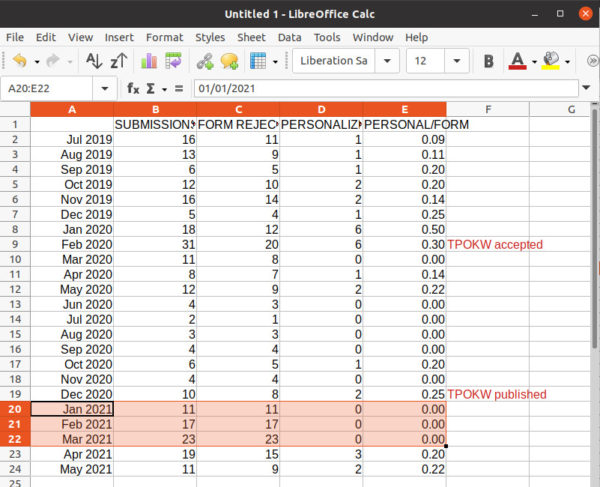
Just to make sure I wasn’t imagining things, I exported my data from The Submission Grinder and made a quick table of my submissions returned for each month going back to July 2019. Before “The Promise of King Washington” was accepted in February 2020, I was getting roughly one personalized rejection for every 5-8 form rejections. Then, for most of 2020, I went through a dry spell where I didn’t have many stories out on submission. Towards the end of the year, I got back in the saddle, and my personalized-to-form rejections ratio returned to what it had been earlier… but then Again, Hazardous Imaginings was published in December, and for the next three months, I received no personalized rejections at all. Then, around March-April, I stopped mentioning my publication credit in Again, Hazardous Imaginings… and I started getting personalized rejections again.

So what happened? Is there some sort of unofficial blacklist for stories published in Again, Hazardous Imaginings? Maybe, maybe not. I don’t know if any of the other authors in the anthology have had a similar experience, nor do I know for certain that mentioning the anthology in my publication credits caused this particular issue. It could be that I was submitting to higher paying markets at the beginning of 2021, and those markets just happen to be more stingy about personalized rejections. It could be that the pandemic has just sapped everyone’s energy.

But now that I’ve made this table, the one thing I cannot say is that the whole thing is just a figment of my imagination. There was a three-month period where I saw significantly fewer personalized rejections than usual, and it just so happened to coincide with the publication of the anthology Again, Hazardous Imaginings and my mentioning it as a publication credit in all of my cover letters.

It’s no big secret that most of the traditional short story markets in science fiction and fantasy trend somewhere between liberal and super woke. All you have to do to get a sense for this is subscribe to their podcasts or read their stories online. For most of 2020, I was subscribed to every science fiction podcast, and I frequently ended up skipping episodes because either the story was too woke, the author bio was little more than a checklist of intersectional victimhood groups, or the editor went off on some sort of political rant (typically of the “orange man bad” variety) that had little or nothing to do with the story. You can also get a good sense of the woke-ness by looking up these magazines’ submission guidelines and reading their diversity statements.

So for the last couple of months, I haven’t been listing Again, Hazardous Imaginings as a publication credit in any of my cover letters, and the response to my stories appears to have returned to the old normal… but it doesn’t sit right with me. Why should I have to hide that I was published in that anthology? Why shouldn’t I be proud of it? It did make Tangent Online’s recommended reading list with three stars, after all. Why should I waste my time submitting my stories to science fiction and fantasy markets that would see that publication credit as a black mark?

In other words, why not blacklist the blacklisters?

When an author decides not to submit their stories to a particular market, it’s often called a “self-rejection,” since the author has already decided that the story won’t be published before the editor gets a chance to consider it. But this is a little different. It’s not my own story that I’m rejecting, but the market as a whole. It’s making the conscious decision that if a magazine is too woke, I’m not going to have anything to do with it.

Here’s another way to think about it: why should I hold out for a year or longer, hoping to earn a couple of hundred bucks for it, when most of the markets that pay that well either aren’t interested in publishing the kind of politically incorrect stories that I tend to write, or aren’t going to publish an author like me who isn’t demonstrably woke enough? Even if I only end up selling it to a semi-pro market for less than fifty bucks, if it only takes a few months to make the sale because I’m not wasting time with the woke markets, does that make it worthwhile?

Or here’s yet another way to think about it: what other benefits do I get with my short story sales, besides how well it pays? If short stories are essentially advertisements for my other work, does it actually make sense to seek publication in the super woke markets, whose readers are mostly woke? Or does it make more sense to be published in the more conservative-leaning markets, with readers who are more likely to enjoy the other stuff that I write? And what about networking with similar-minded authors and editors? I made some really great connections through the anthology Again, Hazardous Imaginings, and even brought Andrew Fox, the editor, onto my newsletter for an interview. It was great!

All of this is happening as we’re starting to see an anti-woke cultural backlash gain momentum. Smarter people than me with a finger on the pulse of the culture say that the Snyder Cut is where the tide began to turn. The thing that tipped me off to it was the surprising waythat Coca-Cola walked back their critical race theory training after the “woke-a-cola” scandal. To my knowledge, there was no organized boycott, yet for a large corporation to backpedal so quickly tells me that they really took a hit to their bottom line.

In the coming months, I think we’re going to see a huge cultural shift against the woke moral panic that has gripped our nation for the last couple of years. That in itself is a subject for another post, but what it means for SF&F is that a lot of these woke awards and woke short story markets are well on their way to going broke. The few that endure will become niche markets for a very small audience that has completely divorced itself from the cultural mainstream—including the vast majority of SF&F readers.

Is it really worth hitching my wagon to such a horse? Or is it better to take a gamble on the up-and-coming markets that might not pay as much, but also aren’t carrying all the woke political baggage as magazines like Uncanny or Lightspeed?

Of course, if the answer to all of these questions is “yes, Joe—go for it!” the next big question is how to determine if a market is too woke? Because some of the markets have diversity statements that are fairly conservative-friendly, like “we welcome submissions from writers of all backgrounds!” and don’t use any of the woke value-signalling terms like “folx,” “latinx,” “QUILTBAG,” “indigenous,” “black bodies,” etc. In fact, I’m pretty sure that many of these markets only put out diversity statements to pacify the woke moral crusaders, in the same way that many boarded up stores and restaurants put up BLM signs hoping that the rioters sorry, the “peaceful protesters” would spare them.

One way to determine this is to look at which markets are chasing the wokest awards. The Hugos went woke in 2015, when “no award” swept the categories dominated by Sad Puppies nominees. That was really the moment when the fandom split, and the anti-woke readership abandoned the Hugos in disgust. The Rabid Puppies swept the 2016 nominations in what amounted to a hilarious sabotage operation (“Pounded in the Butt by Chuck Tingle’s Hugo,” hehe), but by 2017 that had all come to an end.

With that in mind, I went through all of the Hugo Awards to see which markets had either won an award or published a story that had won an award since 2015, and which markets had either been nominated or published stories that have been nominated since 2017. Here is what I found:

Hugo Winning Markets since 2015

  • Uncanny (5)
  • Lightspeed (1)

Markets with Hugo Winning Stories since 2015

  • Tor.com (5)
  • Apex (3)
  • Clarkesworld (2)
  • Lightspeed (1)
  • Uncanny (1)

Hugo Nominated Markets since 2017

  • Strange Horizons (5)
  • Beneath Ceaseless Skies (5)
  • Escape Pod (3)
  • Fireside (3)
  • FIYAH (3)
  • The Book Smugglers (2)
  • GigaNotoSaurus (1)
  • Cirsova (1)
  • Shimmer (1)
  • Podcastle (1)
  • Uncanny (1)

Markets with Hugo Nominated Stories since 2017

  • Tor.com (37)
  • Uncanny (18)
  • Clarkesworld (5)
  • Beneath Ceaseless Skies (3)
  • Fireside (2)
  • Lightspeed (2)
  • Asimov’s (1)
  • Strange Horizons (1)
  • Nightmare Magazine (1)
  • Diabolical Plots (1)

The counts for nominated markets/stories do not include the winners, but do include all of the nominations for 2021, even though the winners have not yet been decided.

I haven’t yet settled on a standard for deciding which markets are too woke for me to submit to. I suppose that’s something I’ll have to decide on a case-by-case basis, and for any who choose to follow my lead on this, it will have to be an individual decision. But I am rethinking the way I submit and publish my short stories, based on this experience. This post has already gone too long, and I still haven’t worked my new strategy out, but if you have any suggestions or ideas I’m interested to hear them.

Extra Sci-Fi S3E7: Dune – Wandering in the Desert

So the problem I have with most “ecological science fiction” is that it draws almost exclusively on the ideas of Malthusian economics—essentially, the argument that Thanos was right. The problem with this is that Malthusian theory has been disproven by every generation of humans to live on this planet for the last 150 years. It’s even more discredited than Marxism, which is another unscientific philosophy that “ecological science fiction” draws heavily from.

I remember an old 70s novel I picked up from the local used bookstore, where by the year 2000, Earth had warmed so much that Antarctica was the only habitable continent, and resources were so scarce that the main character—a buxom blonde—had to go topless. Yeah, very 70s. The premise of the novel was so absurd on its face that I couldn’t finish it.

I also remember an Octavia Butler book that I read. It was the sort of book that makes you chuck it at the wall once you’re finished. The plot went something like this: the main character has been abducted by aliens and drafted into their breeding program, and she spends the whole book trying to escape, only to learn that she’s already pregnant and never will. The end. The writing was pretty good, but the story was so horribly unsatisfying that I haven’t read anything by her since.

From what I can tell, most “ecological science fiction” is like that. Very pretty sentences, but horribly unsatisfying stories, with way too much preaching about how capitalism is evil and humans are destroying the planet. That’s probably why these books tend to win so many Hugo Awards.

Red Mars was okay, but it was less about Earth and more about Mars itself. I was personally more interested in the political intrigue among the colonists than the terraforming project, but both were pretty good. The characters all seemed a little bland to me, though, and I never really latched on to any of them, which is probably why I didn’t read the other books. From what I can tell, they got more preachy toward the end.

Everyone praises Dune for being an “ecological” novel, but to be frankly honest I never really got into that. The political intrigue and the struggle of Paul Atreides with his prescience was a lot more interesting to me, and while the ecological bits certainly played into the plot, I didn’t really care enough to pay much attention to that.

Also, the parts that I did pick up seemed pretty unbelievable to me. From what I remember, there was a second, much smaller type of worm that produced a certain kind of excretion which, if mixed with the spice, would cause a chain reaction that would completely destroy the Arrakis ecosystem. Something like Kurt Vonnegut’s ice 9, which instantaneously freezes any water it comes into contact with, which makes it the most dangerous substance on Earth because a single drop could freeze all the water on the planet. In my (albeit limited) experience, ecosystems always find their own equilibrium, which makes them resiliant against that sort of thing. But of course, that would probably interfere with the preaching that “ecological science fiction” tends to indulge in.

From what I can tell, Dune is one of the few pieces of “ecological science fiction” that hasn’t aged poorly, and that’s not because of the “ecological” bits, but in spite of them. Because the truth is that we live in a fantastically rich and abundant post-scarcity world, where “global warming” had to rebrand as “climate change” because none of the predictions came true, and the science has been so ridiculously politicized that the Green New Deal makes the Communist Manifesto look sane and reasonable.

Thanos was wrong. So too, apparently, is the entire field of “ecological science fiction.”

Response to Steve Davidson on Reconciling with the Puppies

So my last blog post about the Sad Puppies has turned into a kerfluffle of its own, which has been very interesting to watch as it unfolds. Mike Glyer of File 770 linked to it, Lou Antonelli’s File 666 picked it up, and Steve Davidson of Amazing Stories wrote a lengthy response to it, which I think is deserving of a response on my part.

Mr. Davidson’s post is interesting, and worth reading. We obviously don’t see eye to eye on a number of things, but it would be rather petty to go through our disagreements line by line. Instead, the part that I want to respond to is his call to action at the end:

Want to reconcile?  Here’s what puppies must do.

1: Stop scamming the system.  If you want to recommend works that you think are worthy of the award, go ahead and do so.  But drop the political agenda (you’re dragons are imaginary) and eliminate the hateful, snarky commentary

If you’re looking for “hateful, snarky commentary,” I’m sure that you’ll be able to find it. On the fringes of both sides, there are a lot of people with blogs and strong opinions. I’d count myself as one of them—while I align with the Sad Puppies, I’m not a leader or organizer by any stretch, just another guy with opinions and a blog. Don’t be so quick to look for ammunition, because there’s a lot of it lying around.

Kate Paulk, one of the Sad Puppy organizers, has pointed out that Sad Puppies 4 is open to nomination suggestions from anyone, which appears to be what you’re calling for. And honestly, I think a lot of us don’t want to see conservative writers edge out everyone else so much as to see them go head to head with more liberal writers on a more equal playing field. It’s not about slaying imaginary dragons so much as breaking down walls.

So on this first point, Mr. Davidson and I tend to be in agreement. This seems like a reasonable step for reconciliation, and it’s one that the Sad Puppies 4 already appear to be taking.

2: Stop attacking the very people who are offering you a bridge

If a bridge is being offered, I’m willing to take it. If people are just trying to get the last word in edgewise, which was the vibe I personally got from Mr. Martin’s original post, then it will probably just lead to more kerfluffles. Then again, if everyone’s fighting to get in the last word, the squabbling will never end, and while that may make for good sport, it makes for poor reconciliation. So again, fair point.

3: Please learn a little bit about the history of Worldcon and the Hugo Awards

I’m not entirely convinced that the Hugo Awards will continue to hold the same influential place in fandom in the next few years. Even with last year’s massive turnout, there were less than 6,000 ballots cast. With those low numbers, it wouldn’t take much for a rival convention to organize their own awards and eclipse the Hugos in short order—especially if a large contingent of fandom becomes disaffected.

This is why I think it’s important to distinguish between the Sad Puppies and the Rabid Puppies. A useful analogy can be drawn from Star Control II: The Ur-Quan Masters:


These are the Ur-Quan Kzer-Za. They want to make the galaxy safe by enslaving all intelligent life, either by encasing their home worlds in impenetrable slave shields, or by enlisting them as Heirarchy battle thralls to conquer and enslave other species.


These are the Ur-Quan Kohr-Ah. They want to make the galaxy safe by “cleansing,” or exterminating, all intelligent life. They are totally without mercy and cannot be pacified.

The Kzer-Za and Kohr-Ah are locked in a civil war over control of the Sa-Matra, an ancient precursor weapon that will enable the victor to conquer the galaxy. If you don’t find a way to stop them in time, then the Kohr-Ah will win the civil war and use the Sa-Matra to exterminate everyone.

The Sad Puppies are like the Kzer-Za, the Rabid Puppies are like the Kohr-Ah, and the Hugo Awards are like the Sa-Matra. The Rabid Puppies want to use the Hugo Awards to burn down the fan community, whereas the Sad Puppies want to reform the Hugo Awards to make Science Fiction less about political correctness and more about telling good stories.

Now, I am not a Sad Puppy spokesperson, so this may not be the most accurate or flattering analogy. Fellow puppies, please correct me if I’m wrong. But it’s worth pointing out that in the Star Control series, the Ur-Quan ultimately become pacified and join the New Alliance of Free Stars. This only happens after the Kohr-Ah have been defeated.

I think that’s what most of the Sad Puppies ultimately want: to have a place with the rest of fandom, where even if we sometimes have heated disagreements (has there ever been a time when all of fandom was in agreement about anything?), we aren’t cast out as “racists,” “Nazis,” or “misogynists,” as happened with Puppygate 2015.

The Rabid Puppies, on the other hand, just want to watch the world burn. And the more vociferous the rhetoric becomes, the more that it plays into their hands. Speaking as a Sad Puppy sympathizer who watched the 2015 Hugos from the sidelines, after all the abuse that I saw my friends receive, it kind of made me want to burn down the Hugos too.

You want to defeat the Rabids? Then reach out to the Sad Puppies, find commonalities with us, and make an alliance. If we can show the world that Science Fiction and Fantasy brings us all together in spite of our ideological differences, then all of fandom will win.

And so regarding Mr. Davidson’s third point, I don’t think it’s about respecting the prestige of the awards so much as listening to and understanding the other side of fandom. And I’ll admit, I can do a better job listening to the side of fandom that sees the puppies (sad or rabid) as the enemy. If they can return the favor, I think that will go a long way.

4: If you want to be counted as Fans, then be Fans.  Fans who care attend Worldcon, nominate their conscience and attend the business meeting to effect change they think is needed.  They work WITH and within fandom – they do not set themselves up as a cabal that engages in fear and hate.

If that’s a challenge to be more involved in the Hugo Awards, then it’s one that I can accept. In 2015, I largely watched from the sidelines, and if I do the same this year then my opinion is pretty empty. I do count myself as a part of fandom, and I can respect the call to put my money where my mouth is.

I’m not entirely convinced that “no one controls [the Hugos].” Overtly, of course not, but there are indirect ways to accomplish the same thing, through whisper campaigns and the manipulation of cliques. But as Mr. Davidson points out, it’s hypocritical to criticize that without also trying to get involved. And if that’s the invitation he’s extending, I am willing to accept—no hate required.

George R.R. Martin and Christmas Puppies

Sad-Puppies-4So it’s not yet 2016, and the first salvos in the Sad Puppies 4 campaign have already been fired, in the form of a kerfluffle over on George R.R. Martin’s blog.

For those of you who haven’t been following Sad Puppies, I can’t say I blame you. It’s basically an ongoing civil war within Science Fiction & Fantasy fandom, between those who believe that the genre should serve the cause of social justice, and those who believe that there should be room for writers on all sides of the political spectrum—that it should just be about telling good stories. Last year, the Sad Puppies (the ones who believe it should only be about the stories) swept the nominations for the Hugo Awards, the (onetime) most prestigious awards in the SF&F genre. The resulting brouhaha was not pretty.

Last year, George R.R. Martin was very aggressive in attacking the puppies. That’s what makes his latest puppy-related blog post so interesting. In it, he basically calls for an end to “puppygate” and for everyone to just get along. In his own words:

The last thing I want… the last thing anyone who truly loves science fiction, fantasy, and fandom would want… would be to have to go through the whole thing again in 2016. Whatever your view of how the Hugo Awards turned out at Sasquan, I think we can all agree that we would like MidAmericon II’s awards to be more joyful, less rancorous, less controversial.

Now, I don’t disagree with Mr. Martin’s sentiment. I too would like to see reconciliation and de-escalation of the ugliness that we saw from both sides in 2015. And to be fair, Mr. Martin does give a positive characterization of what’s going on right now with Sad Puppies 4. That’s a good first step.

The trouble is, you don’t achieve reconciliation by shouting at the other side to lay down their guns first. You achieve it by hearing and acknowledging their grievances. You might not agree that those grievances need to be rectified, which is fine—that’s what negotiations are for—but you do have to make an effort to listen to the other side. And it’s clear enough that Mr. Martin is not listening.

The core of the Sad Puppies movement is a rejection of elitism. In contrast, Mr. Martin’s position is that there are fans and there are Fans. Fans like him, for whom every aspect of their lives revolves around Science Fiction and Fantasy, should have more control, more respect, more ownership—in fine, they should matter more to the genre than the other kind of fans. When pressed, of course, he denies that any part of fandom is any better than the others, but that’s not what comes through in his other positions. “Separate but equal” is the phrase that comes to mind.

The problem here is that Mr. Martin wants to have his cake and eat it too. He wants the Sad Puppies to lay down their guns, but he doesn’t want to lay down his own. If he were genuine about burying the hatchet, he would acknowledge his own elitism, acknowledge that this is a grievance that the Puppies hold against him, and either recant his position or say “we’re going to have to agree to disagree.”

Personally, my position is the opposite of Mr. Martin’s. I think that SF&F should be a big tent that privileges or denies no one—that everyone who calls themselves a fan of the genre should be on equal grounds. After what happened in 2015, I’m as disgusted with the Hugo Awards as Feynman was disgusted with honors and epaulettes:

Am I willing to agree to disagree on that point? Sure, so long as I’m not cut out of the table—so long as I’m not branded a “racist,” or a “misogynist,” or a “neo-nazi” for aligning with the Sad Puppies. But the puppy-kickers and their SJW allies have deliberately mischaracterized us since the beginning, and I have no doubt that they will continue to do so in 2016.

Mr. Martin, if you’re reading this and if you’re genuine in your desire to avoid another “puppygate,” please don’t try to passive-aggressively handwave us away. I applaud your sentiment and believe that your heart is in the right place, but reconciliation requires genuinely listening to the people you disagree with.

The Decline and Fall of Fandom and the Hugo Awards

Lately, I’ve taken a serious interest in family history. A huge amount of records have gone online in the past decade, making it far easier to trace your ancestors. Before that, my father was able to trace the Vasicek line to the Czech lands (places with cool names like Frenštát, Vratimov, Trojanovice, Staříč, etc), but that was as far as he could go. Just a couple of years ago, however, my sister found the parish records for that region. They’re mostly all scanned and online, and they go back as far as the late 15th century to the start of the Hapsburgs. The pieces are all there—all we have to do is put them together.

Needless to say, this has got me really excited. It also made me wonder: how far back is it possible go? According to my sister, who is also a certified genealogist, the European records start to get really sketchy around the 7th or 8th century. Only the royal lines go back that far, and since they were all trying to connect themselves to mythical figures and Biblical characters, the records are not very reliable.

So I went to Wikipedia to look up the period of Late Antiquity leading up to the 7th century, and soon became completely absorbed in it. This is the period when the Roman Empire collapsed, leaving Europe in a hot mess. The Vandals, Franks, Goths, Visigoths, Ostrogoths, Huns, and Saxons were running around all over the place, sometimes fighting for the Romans, sometimes fighting against them, constantly fighting each other, and migrating clear across the continent in their search for new homelands.

As clear as I can make it out, this is how it basically went down:

There once was a tribe on the Italian penninsula that built a city called Rome. Through innovations in engineering, warfare, governance, and philosophy, they conquered virtually all of the known world and built a mighty empire. Rome became legendary as the center of it all.

Over time, however, the Romans became decadent and corrupt. The empire slowly began to disintegrate and fall apart, though great pains were taken to preserve the appearance that all was well. By the end of the third century, it had effectively split into two halves: the eastern empire and the western empire. This division fell roughly along cultural lines: the Greco-Roman culture in the east, and the Latin-Roman culture in the west.

Around this time, a barbarian tribe (or alliance of tribes) appeared on the northeastern frontiers of the empire. Known as the Huns, these barbarians launched an invasion of Europe that completely shuffled the deck. They only briefly threatened the Romans, but had a much larger impact on the barbarian tribes of Europe, displacing them from their homelands and forcing them to seek a new home. This launched what is known as the migration period.

There were a lot of barbarian tribes seeking a new homeland: the Franks, the Saxons, the Goths, Visigoths, Ostrogoths, and the Vandals. With the Huns at their backs, they invaded the Roman Empire, which was the weaker of the two.

…except “invade” isn’t quite the right word. Many of these tribes became allies or foederati of the Romans (often after defeating them). Even some Hunnic tribes were absorbed into the empire in this way, and were often employed as mercenaries to fight against the Frankish, Gothic, and Vandal tribes that hadn’t allied with Rome. The salient point is that Rome had become weak, and thus had to make concessions to these barbarians who were starting to flood the empire.

At the end of the fourth century, a tribe of Visigoths that had settled in the eastern empire became upset with the way that the Romans were treating them. After being starved, taxed, and treated as sub-human, they took up arms under a leader named Alaric the First. They were unable to make much headway against the eastern empire, so instead they went west and invaded the Italian penninsula.

Over the course of the next two decades, the western empire vacillated between accomodating them, backstabbing them, and declaring outright war. This was mostly due to internal power struggles that had little to do with the Visigoths. Even though Alaric threatened the heart of the western empire and laid seige to Rome three times, they treated him with outright contempt, blatantly violating previous agreements and going so far as to ambush him under a flag of truce.

In 408, the internal power struggle eliminated the faction that was willing to accomodate the Visigoths. Shortly thereafter, Alaric decided that he’d had enough and marched on Rome. In 410, he sacked the city, shocking the civilized world.

Up until that point, Rome was considered sacrosanct. Sure, the barbarians were overrunning the frontiers and threatening vast swaths of the empire, but Rome was the cultural and spiritual center of the world. How could it possibly fall? But it did, and following the sack in 455 at the hands of the Vandals, the Roman Empire never regained its former glory.

Reading up on this history at the same time as the 2015 Hugo Awards played out has made me notice a bunch of similarities between the two events. Obviously, the decline and fall of Rome is not a perfect analogy for the decline and fall of the Hugo Awards, but there are some very interesting parallels.

The Hugo Awards were founded in the 1950s, back when SF&F fandom was a tiny community of geeks on the fringes of society, and not taken seriously by anyone in the cultural mainstream. Over the next several decades, the geeks took over the world, dominating the popular culture with things like Star Wars, Star Trek, Lord of the Rings, Harry Potter, Game of Thrones, etc.

But somewhere along the way, this happened:

Fandom (with a capital F) became decadent and corrupt as the Truefen jealously guarded their turf, creating all sorts of weird Hugo categories (“related work”? “short-form” editor vs. “long-form” editor?) and pushing back against the mainstreaming of the SF&F field. As a result, Worldcon went from the premier SF&F convention to a second-tier convention that falls well short of Dragoncon, Gencon, San Diego Comic Con, Salt Lake Comic Con and Fan Ex, etc, all of which are 1-2 orders of magnitude larger than Worldcon now. The once-prestigious Hugos were now decided by mere hundreds of votes.

Around this time, a tribe (or alliance of tribes) of cultural Marxists began to invade the cultural space. Also known as Social Justice Warriors (SJWs), they began to dominate multiple forms of media, pushing out many of the more conservative readers and viewers who resisted. Fandom (with a capital F) gradually embraced them, using them as mercenaries in their internal power struggles.

By this time, Fandom had split into two broad divisions: Baen and Tor. Baen books were more about action & adventure, while Tor books were more about social issues (though of course there was some overlap). These two houses dominated the field, but it was the Tor side of Fandom that had more ownership in the Hugos than the Baen side.

The SF&F fans who had been displaced by the SJW invasion formed the Sad Puppies and Rabid Puppies. To Fandom, however, they were all just “wrongfans”—essentially, barbarians. And it wouldn’t exactly be right to say that the puppies “invaded” Fandom, because many of them were already there or were willing to coexist and make alliances. Others, of course, were not.

Vox Day entered the scene as one of the disgruntled puppies who had had enough of Fandom. The Tor side was far more susceptible to his machinations, responding to him in knee-jerk fashion at every turn, so he went after them. In 2015, he sacked the Hugos, causing “no award” to sweep five categories (and place in eight more).

To an impartial observer, Vox Day was the only clear victor of the 2015 Hugo Awards. How else can you explain all the “no awards”? His stated goal was never to win the Hugos, it was to destroy them, and he accomplished that spectacularly. When an esteemed professional such as Toni Weisskopf loses to “no award” purely out of guilt by association (on a ballot decided by less than 6,000 total votes, no less), how can anyone possibly take the Hugos seriously anymore? What was once considered the most prestigious award in the SF&F field has now proven to be a narrow, exlusivist club of politically like-minded elitists.

Fandom (capital F) accomplished many wonderful things back in the days before SF&F entered the mainstream. In a very real sense, they conquered the world. But by doggedly trying to hold on to their turf and refusing to let others play with their toys, especially those who see the world differently than them, they are declining. Like the sack of Rome in 410, the sack of the Hugo Awards in 2015 was a watershed moment that demonstrated just how much the old order had decayed.

Can the Hugo Awards be saved? I seriously doubt it. The “truefans” will jealously clutch it to their chests until they die, and with the graying of fandom, that will probably be accomplished fairly soon. But just as the Renaissance rose from the long-cold ashes of the Roman Empire, so too I hope that something good will eventually come out of all of this. Because really, there is a place in fandom (lower-case f) for everyone, and that has never changed.

Sad Puppies 3: A Play in Three Parts

PART THE FIRST

Sad Puppies: Wouldn’t it be great if the Hugo Awards weren’t about identity politics anymore? If conservatives and libertarians weren’t shut out by the blatantly liberal bias? If we didn’t care about a writer’s skin color, or their gender, or their sexual orientation, but about the quality of their stories?

Social Justice Warriors: EVIL RACIST CISGENDER SCUM! You only say that because you’re WHITE, MALE, and PRIVILEGED!

Sad Puppies: Actually—

Puppy Kickers: Haha! We beat you wrongfans last year, and we’ll beat you again this year! Sad puppies suck!

Sad Puppies: Oh yeah?

Sad Puppies sweep the 2015 Hugo nominations.

Puppy Kickers: What the hell, puppies? You violated the gentleman’s agreement that has governed the Hugos since time immemorial!

Sad Puppies: Of course we did! Your “gentleman’s agreement” was elitist and wrong.

Puppy Kickers: Oh yeah? THIS MEANS WAR!

PART THE SECOND

Flashback to before the nominations. Enter Vox Day.

Vox Day: Fear and tremble, denizens of fandom! I will wreak vengeance on my enemies and destroy the Hugo Awards for all time! BWAHAHAHAHA!

Social Justice Warriors: Vox Day is EVIL! THIS MEANS WAR!!

Sad Puppies: No, don’t destroy the Hugos, Vox! There’s still a chance they can be saved.

Vox: Hmm, very well. But I shall not march in lock-step with you.

Vox Day organizes the Rabid Puppies slate. Return to present.

Puppy Kickers: Look, the Sad Puppies slate is almost identical to the Rabid Puppies slate! The Sad Puppies are really just followers of Vox Day!

Sad PuppiesThat’s not true. We were actually the ones to convince him to—

Social Justice Warriors: RACISTS! NAZIS! MISOGYNISTS! RACISTS! NAZIS! MISOGYNISTS!

Sad Puppies: Actually, if you look at our slate, you’ll see that—

Puppy Kickers: RACISTS! NAZIS! MISOGYNISTS! RACISTS! NAZIS! MISOGYNISTS!

Rabid Puppies: It’s no use to try to reason with these people. Sinistra delenda est!

PART THE THIRD

Puppy Kickers: Slate voting is EVIL! We must defeat the puppies at all costs to prove that vote rigging has no place in the Hugo Awards!

Social Justice Warriors: Here is a voting guide for how to make the puppies lose.

Sad Puppies: You hypocrites! How is that not rigging the vote?

Puppy Kickers: Haha, we don’t care! We’ll vote the way the SJWs tell us to, and brag about how we haven’t read any of the books on your crummy slate.

Sad Puppies: But—but there are a lot of good people here that are overdue for recognition! Toni Weiskopff, Kevin J. Anderson, Jim Butcher… and there are a lot of great new authors too, like Kary English. Our slate isn’t remotely racist or sexist. We’ve got people from all across the political spectrum too, because all we really care about is telling good stories!

Social Justice Warriors: We don’t care! If we can’t have the Hugos, NO ONE CAN!

The 2015 Hugo Awards. “No award” sweeps five categories.

Social Justice Warriors: VICTORY!

Puppy Kickers: Um, yeah! What they said! Uh… guys?

Vox Day: BWAHAHAHA! You fell for my Xanatos Gambit, you pitiful mindless fools! I HAVE DESTROYED THE HUGO AWARDS!

Rabid Puppies: All hail Vox Day, slayer of worlds! Sinistra delenda est!

Sad Puppies: Wow. Just… wow.

Rabid Puppies: Join us, Sad Puppies. Yield yourselves up unto us, and unite with us and become acquainted with our secret works. Sinistra delenda est!

Social Justice Warriors: Next year, we should give Anita Sarkeesian a Hugo!

My take on the Sad Puppies

There’s been a lot of mud-slinging in the past few months regarding the Sad Puppies, and it’s increasingly difficult to navigate the SF&F side of the internet without getting caught up in it. I’ve been reluctant to weigh in publicly on Sad Puppies 3, simply because I’ve been dissapointed to find that authors whom I otherwise love and respect saying things that I find reprehensible. As Mark Twain so famously said, better to keep your mouth shut and appear stupid than to open it and remove all doubt.

That said, I think we’re fast approaching the point (if we haven’t passed it already) where neutrality and silence are just as contemptible as outright partisanship. Lines are being crossed, and people are being bullied and defamed. In such an environment, I would rather have people know where I stand than to try to pretend that nothing is happening.

For the purpose of this post, I’m going to assume that you already know the basics about what’s going on. If you don’t, I would recommend you start by reading these two posts by Brad Torgerson announcing Sad Puppies 3 and explaining why it’s necessary, Larry Correia’s explanation for why he started the whole thing, and Eric Flint’s rebuttal to them both.

The Sad Puppies controversy is a bit complicated, and my position doesn’t fall neatly into any one camp. There are people like Brad Torgersen and Eric Flint that I respect on both sides of the controversy. That said, the people that I find toxic all fall squarely into the anti-puppy camp. They are the ones who define fandom the most narrowly, and in my experience they are the ones with the most intolerant views.

My own experience with Worldcon and the Hugos is rather limited. I attended Renovation 69 in 2011 and was actually rather struck with how small and insular the convention seemed to be. Until then, I had revered the Hugo Award as the most prestigious award in the SF&F field, and when I realized that the vast majority of readers were not represented at the con, that prestige was tarnished. But my response at the time was to shrug and say “oh well.”

I don’t say this to disparage Worldcon at all, because I enjoyed myself there and would genuinely like to attend as often as I could. But the Hugos themselves lost quite a bit of their allure, and I no longer felt it so important to participate in the voting or involve myself in them.

When Sad Puppies 1 happened, I therefore stayed mostly on the sidelines. I sympathized with Larry Correia, both because I’ve met him in person and found him to be an affable fellow, and also because we share similar political and religious views. However, I didn’t really get involved.

For Sad Puppies 2, I also mostly stayed out of it. There were quite a bit more rumblings the second year, and when the anti-puppies rubbed their victory into everyone’s faces following the 2014 Hugo, I was seriously unimpressed with their behavior (especially Scalzi’s).

So when the Sad Puppies swept the Hugo nominations in 2015, I have to admit that it felt pretty gratifying. I already knew that the Hugos didn’t really represent my side of fandom, and I’d had enough experience with the anti-puppies to see through their hypocrisy and intolerance. Then the SF&F corner of the internet exploded, and things became truly popcorn-worthy.

Which brings us to where we are today. In some ways, I still feel like I don’t have a dog in this fight. I don’t have a membership to Worldcon 2015, I have no particular interest in either killing or saving the Hugo Awards, and don’t really have any aspirations to win a Hugo or any other major awards for that matter. As a self-published indie author, my readers are my greatest reward.

But in another sense, I cannot avoid having a dog in this fight. Science Fiction and Fantasy is my livelihood, and the Sad Puppies controversy affects the very core of my field. Authors whom I look up to and respect have become targets of some of the worst smear tactics, and if no one stands up against these bullies, things are only going to get worse. The lines have been drawn, the wagons have been circled, and my voice, however small, is needed in this hour.

With that out of the way, here is where I stand:

I believe that everyone who loves science fiction and fantasy has and should have a place in this genre, no matter how reprehensible I find them or how vehemently I disagree with their views.

I believe that SF&F authors flourish best when there is no single dogma, political or otherwise, that dominates the field. Those who enforce their brand of social justice through bullying and smear campaigns are anathema to everything that makes science fiction and fantasy great.

I believe that TRUE DIVERSITY in the SF&F field is good and worth working toward. TRUE DIVERSITY includes women, people of color, other ethnic minorities, and people of every gender and sexual orientation. It also includes Republicans, Conservatives, Libertarians, residents of the “flyover states,” and devout practitioners of every faith, be they Christians, Mormons, Muslims, Jews, Buddhists, Sikhs, or supplicants at the temple of Athe.

I believe that sexism that is directed against men is still sexism.

I believe that racism that is directed against whites is still racism.

I believe that it is impossible to defeat racism and sexism through racist and sexist means. Those who attempt to do so are bigots and hypocrites of the worst possible stripe.

I believe that no one is entitled to any award. True recognition is earned, not bestowed.

I believe that books should be judged solely on the merits of the story itself, and not on the merits of the author.

I believe that readers should be free to read whatever they want, and not have to answer to anyone or feel guilty for their reading choices.

I believe that the Sad Puppies have legitimate grievances, and that they have done nothing wrong or dishonorable by pushing their Hugo slate. I’m not sure if I can say the same of the Rabid Puppies, but to the extent that they’ve played by the Hugo voting rules, I can’t say that I hold that against them.

I believe that people should be judged by their own words and actions, not by what others say about them.

I do not believe in guilt by association.

I do not believe in unsubstantiated accusations of racism, sexism, homophobia, or affiliation with the National Socialist German Worker’s Party or any of its ideological offshoots. In today’s climate, those are all four-letter words as far as I’m concerned.

I do not believe that gatekeepers add anything of value by excluding people from the field.

I do not believe that fandom is an exclusive club.

I do not believe that the Hugos are representative of the entire field, nor that any single award is or should be.

I do not believe that the Sad Puppies are out destroy all that is good in science fiction and fantasy (or the Rabid Puppies, for that matter). I doubt that any single faction could accomplish that even if they wanted to.

Above all else, I respect my readers. I am grateful for them. I would not be able to do what I do without them.

I understand that many of my readers may not share my personal views. I also understand that it is possible to respect someone and still disagree with them. I hope to always be worthy of respect. But whether others choose to respect me or not, I must live in such a way that I can always respect myself.