So a couple of hours after I published my last blog post, China Mike Glyer of File 770 infamy picked it up for his daily pixel scroll. Hi, China Mike! I thought you might be looking for some red meat to feed your readers—aside from the Chinese clickfarms, of course—but I was especially pleased that you included my affiliate links with the excerpt you copy-pasted! Not only does this bring in some extra cash (thanks, China Mike!), but it also gives me some metrics to compare File 770 with, say, some of the other indie authors that I do newsletter swaps with. And wow… let’s just say there’s a reason why they call you China Mike Glyer and leave it at that.
So in today’s episode of red meat for China Mike, I’d like to pick up where I left off with the last post and pose the question: when is a science fiction market too woke to be worth submitting to? But to answer that question, we first need to answer: why bother submitting short stories to traditional markets at all, when self-publishing is an option?
It’s a good question, because there are a lot of good reasons to self-publish short stories. In my experience, they don’t earn particularly well on their own, but they are quite useful as newsletter magnets to gain new email subscribers, free ebook giveaways to let readers sample your work, and giveaways for newsletter subscribers to remind them that you exist and keep your books in the forefront of your mind. I make all my short story singles free on all the ebookstores, and keep them up until I have enough to bundle them into a collection, at which point I take them down and submit to the reprint markets. It’s a system that’s worked pretty well for me so far.
Potential Benefits of Submitting to Traditional Markets
So why submit to traditional markets first? Why hold off self-publishing in the hopes that you can sell first publication rights? Here are a few of the reasons:
- The pay. A professional short story sale will bring in several hundred dollars, and even a semi-professional sale (1¢ per word or more) will typically earn more than pizza money. Over the lifetime of a typical story, that’s a good chunk of the income you can expect to earn from it (unless it’s optioned for a movie, of course).
- Advertising. A short story sale, especially to a higher-paying market, will get your work—and your name—out to many readers who may have never heard of you before. Making your self-published short stories free accomplishes a similar thing, but with a different audience. Lots of readers who follow the magazines don’t typically look up free short stories on Amazon, though I’m sure that some of them do.
- Prestige and reputation. Whenever you make a professional or semi-pro sale, that’s another human being proclaiming that your story is good enough to pay you for the privilege of publishing it. The SF&F short story markets are incredibly competitive, especially the higher-paying ones. Not all readers care about this, but being able to say that your stories have been published in Analog, or Asimov’s, or F&SF helps to set you apart from other authors—and many readers do sit up and notice. I certainly do.
- Networking. Breaking into a short story market can be a great way to make connections with other writers and editors in the field, which can open up some really great opportunities later. I’ve had some really great experiences with this, and I look forward to having more in the future. You never know how things will turn out when you put yourself out there!
I suppose you could also include “awards” and “SFWA membership” on that list, but frankly I don’t care much about either of those. Contrary to the impression that China Mike wants to give you, I’m really not much of a drama llama, and as for awards… we’ll get there.
Potential Drawbacks of Submitting to Traditional Markets
Importantly, there are several potential drawbacks to putting your stories out on submission, especially if you have a viable self-publishing strategy. Some of those reasons include:
- Lost time. It takes a lot of time to submit your stories to all the traditional markets, even just the professional ones. I used public data on The Submission Grinder to discover that the average wait time for professional SF&F markets is about 30 days, which means that if you want to submit to all of them, you won’t be able to self-publish that story for years.
- Exclusivity. A lot of markets include an exclusivity period in their contracts, which can run upwards of a year or longer. Again, that’s a lot of lost time where you can’t self-publish that story, even if it does sell.
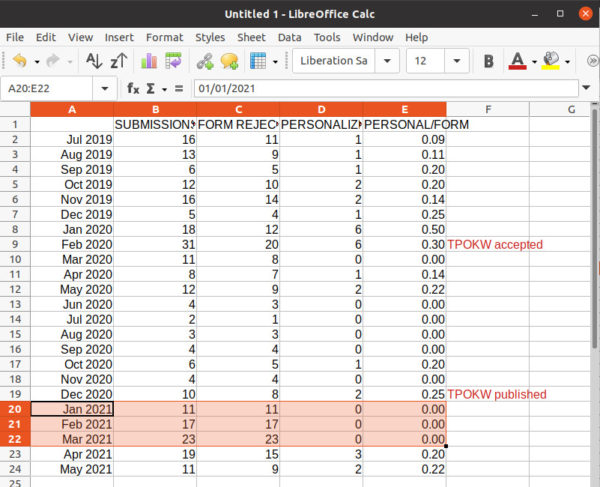
- A very competitive market. You can keep a story out on submission for years, only to exhaust all but the token-paying markets. This isn’t necessarily a judgment of the story’s quality, either—I have stories that I’ve sent out 30+ times that have received more than 25% personalized rejections, that have never been picked up by a traditional publisher. There are just too many really good stories out there for the higher-paying markets to publish them all.
- No simultaneous submissions. This one really bugs me. For some reason, most of the higher-paying SF&F markets don’t allow simultaneous submissions—that is, they demand the exclusive right to consider your story before they pay you a dime. What’s worse, the wait times for many of them can stretch on for months. This is how stories end up on submission for years—and all of that is time where you can’t self-publish.
- Submissions bandwidth. At any given time, there are only between 10-20 SF&F markets open to submissions that pay more than 5¢ per word (for flash fiction, it can get up to 30). The average wait time for these markets is about 30 days, and most of them do not allow multiple submissions. Therefore, if you write more than one short story per month for an extended period of time, you will very quickly run into a bandwidth problem, where there aren’t any available markets to submit to.
So those are the potential costs and benefits that you have to contend with when writing and publishing short stories.
How Wokeness Changes the Equation
Now, let’s get to the first question: when is a short story market so woke that it isn’t worth submitting anything to them? This is something I’ve been thinking about a lot in the past few days, and while I don’t think it’s possible to come up with an objective, impartial standard, I do think that it’s important to draw the distinction, because wokeness changes the cost/benefit analysis substantially.
It wasn’t always this way. Traditional sci-fi publishing has trended to the political left (sometimes to the extreme political left) of mainstream American culture since the New Wave era back in the 60s and 70s. It seems that the campus radicals took over much of the field, not to mention the fact that American traditional publishing has always been centered in New York. But until just the last few years, it was still possible for left and right to coexist in our pluralistic society. People of different political persuasions could agree to disagree amicably, and while there may have still been whisper campaigns and secret author blacklists, you could still expect to see a healthy mix of opinions and perspectives in most places that published short stories.
That is not true today. Certain subjects and opinions have been deemed verboten, while others have been exalted to the status of eternal truth, and any story that questions or challenges the politically correct narrative doesn’t have a chance in most of these markets. In other words, science fiction has gone woke.
(As a side note, this reminds me of a review that I received for my short story “Payday,” in which the universal basic income leads to runaway hyperinflation, causing society to unravel and forcing the protagonist and his family to flee. Sound familiar? In the author’s note, I mentioned how the story had been rejected by all of the pro-paying science fiction markets, and the reader found that even more disturbing than the story itself.)
“Woke” is a slang term describing a basket of socioeconomic and political ideologies that are incompatible with and antithetical to individual rights and liberties. Taken to their logical conclusion, they end in the sort of totalitarian horrors the world saw in the 20th century (and continues to see today in communist China).
I recently listened to an episode of the Jordan B. Peterson podcast where he interviewed Yeonmi Park, a North Korean defector and human rights activist. It was an incredibly powerful interview—well worth listening to in its entirety. One of the things that really struck me was the fact that nightmare dystopian societies can only endure so long as everyone, in their own little way, tacitly supports the lie. In such a society, declaring the truth is itself a supreme act of insurrection, because (in the words of Solzhenitsyn) “one word of truth outweighs the whole world.”
In the science fiction markets that have been taken over by wokeness, the truth is silenced by vicious accusations of white supremacy, transphobia, post-colonialism, and a hundred other virtue-signalling examples of doublethink. If George Orwell published 1984 today, they would probably pan it as anti-Asian and push to get it cancelled or banned. There can be no compromise with these people, as there is no room for discussion or debate. These woke ideologies possess people, who cling to it like the worst possible kind of religion.
I used to think that a story from someone like me would still be able to slip through, if it was good enough. But then I spent a year subscribed to every science fiction and fantasy market that had a free podcast. Most of the stories were poor to mediocre, but the authors hit all the woke intersectional checkboxes—and made sure to tell you that in their author bios. There were some exceptions, of course, but that was the general rule. Whenever there was an exceptionally good story, it was usually from an author who only checked one or two of the boxes—but their story would usually check off a couple more, such as having an LGBTQ+ romantic subplot, or having mostly POC characters. And in the wokest sci-fi podcasts, the editors always made sure to pound you over the head with an explicit political message, sometimes even before the story itself.
Of course, there are still some short fiction markets that care more about the strength of your story than upholding the woke establishment narrative, or making sure all their authors hit all the right intersectional checkboxes. But not generally among the professional-paying markets.
So how woke is too woke?
The events of the past year have convinced me that wokeness is like a cancer: no matter how small or innocuous it is when it starts, if left untreated it will metastatize and grow. The only way to treat it is to remove it from your life. No compromise. No discussion or debate. The woke care nothing for right or wrong, truth or falsehood: only narrative and power. When they look at me, they do not see a person: they see a heirarchy of identities. And if my stories are any good—that is, if they serve the truth—then they see those stories as a threat. After all, “one word of truth outweighs the whole world.”
Therefore, it cannot be a question of degree. If a market has gone even slightly woke, then submitting your stories is an exercise in futility if you don’t hit the right checkboxes or will not bend the knee. And I will never bend the knee.
How To Tell If a Market Is Woke
So now, with a working definition of “woke” (promoting ideologies incompatible with and antithetical to individual rights and liberties) and the determination that wokeness is toxic in any degree, how can I tell if a market has gone truly woke?
First of all, I think it’s important to give everyone—and every market—the benefit of the doubt. There are still people on the political left who can break bread with and hold reasonable conversations with those on the other side of the aisle. Likewise, there are still short story markets that tend to lean left, but will still publish good stories by authors across the political spectrum.
Second, it’s also important to point out that just because an editor hits one or two—or most—of the woke intersectional checkboxes, that doesn’t necessarily mean that the market itself is woke. This isn’t a matter of balancing transgender people of color with straight white males—that’s merely wokeism in reverse! People are people are people, no matter how they identify. Anyone can become ideologically possessed, just as anyone can choose not to be.
So with that in mind, what are the red flags?
1) Has the market won any awards that have gone completely woke?
Specifically, I’m thinking here of the Hugo Awards. They were trending to the left for a very long time, but 2015 was the year that they specifically went woke by voting “no award” over several deserving authors and editors. The transformation was completed in 2017, when the new rules shut out the Sad and Rabid Puppies, and both of those movements died out.
Therefore, if a short story market has won a Hugo since 2015 or been nominated for a Hugo since 2017, I’m not going to bother submitting to them. And if a market has had stories that have won or been nominated for a Hugo in those years, I’m going to ignore the market as well, unless it appears to be a fluke or a one-off.
2) Does the market have an explicit diversity statement in their submission guidelines?
Diversity statements are not actually about reassuring minority authors that they are welcome to submit their stories. Instead, diversity statements are all about signalling. You can see this with the term “latinx.” The vast, vast majority of actual latinas and latinos have either never heard of the term or absolutely hate it, but because it’s a gender non-binary term, the woke absolutely love it—and use it primarily as a signal to other woke people just like them.
Therefore, if a market has an explicit diversity statement that contains woke signaling language, it’s going on the blacklist. Even if the market only put out a diversity statement to keep the woke mob from descending upon them, that’s still a sure sign that they’ve bent the knee.
Occasionally, a market won’t have a separate diversity statement, but will include language like “we welcome submissions from authors of all races, genders, and backgrounds.” In that case, it’s probably best to give them the benefit of the doubt. But if they use the word “latinx,” even once (or “folx,” or “black bodies,” or “indigenous,” or…), then that’s a clear signal that they’re woke.
3) Does the market publish content that is explicitly woke?
Editors always say that the best way to know what they’re looking for is to read a couple of issues or listen to a couple of episodes or stories. That seems like a reasonable standard, so I see no reason why I shouldn’t hold them to it.
Do the editors ever go off on explicitly woke political rants, or try to explain the message of the story in woke ideological terms? Do the author bios read like a checklist of woke intersectional identities? Are the stories themselves often thinly veiled rants about woke issues? Again, it’s important to apply the benefit of the doubt here, but you can tell a lot about a market by what they choose to publish. I won’t be wasting my time with the markets that regularly publish any of those things.
Conclusion
I believe that the culture is changing, and an anti-woke backlash is forming that will shock the people who are too deeply esconsed in their echo chambers (here’s to you, File 770) to see it coming. If I had to guess, I’d say that we hit peak woke in our culture about a year ago, and now that the pendulum is swinging the other way, nothing will stop it until it goes as far to the anti-woke side as it did to the woke side.
I’m not yet sure if this is good or bad. If we reject the lies that wokeism is built upon and embrace the individual rights and liberties that informed our founding documents, it could be very good indeed. But a lot of damage has already been done, and if we merely exchange leftist-flavored collectivism for rightist-flavored collectivism, it could be very, very bad.
That’s why writers and creators like me have a very important role to play—that is, those of us who aren’t afraid to speak one word of truth. That alone is reason enough not to waste one moment of time on these woke science fiction markets whose great day of power is swiftly coming to an end.
My short story strategy has changed a lot in the last year, much like our country. I still need to work through all of the implications of this change in order to formulate a new publishing strategy. But I’ll leave that for another post. This is sufficient for now.

 So it’s not yet 2016, and the first salvos in the Sad Puppies 4 campaign have already been fired, in the form of
  As clear as I can make it out, this is how it basically went down:
 Fandom (with a capital F) became decadent and corrupt as the Truefen jealously guarded their turf, creating all sorts of weird Hugo categories (“related work”? “short-form” editor vs. “long-form” editor?) and pushing back against the mainstreaming of the SF&F field. As a result, Worldcon went from the premier SF&F convention to a second-tier convention that falls well short of Dragoncon, Gencon, San Diego Comic Con, Salt Lake Comic Con and Fan Ex, etc, all of which are 1-2 orders of magnitude larger than Worldcon now. The once-prestigious Hugos were now decided by mere hundreds of votes.