How SFWA ruined science fiction (and why it needs to die)

There was a time when science fiction was bigger than fantasy. More people read it, more authors wrote it, and more editors demanded it. Would-be fantasy authors were steered toward writing science fiction, because they knew that it would sell better than the stuff they actually wanted to write.

Now, the roles are reversed. More people read fantasy, more authors write it, and more editors are demanding it (except in the short story world, but none of them are in it for the money, which proves my point). For every year of the Goodreads Choice Awards, the fantasy section has gotten more total votes than the science fiction section. And authors like me, who often prefer to write science fiction, are instead veering more toward fantasy, because we can see that it sells better.

I’m not decrying this shift. I enjoy fantasy differently than I enjoy science fiction, but I genuinely enjoy them both. And as science fiction writers have pivoted to writing fantasy, I think it’s improved fantasy considerably, with magic systems that actually have rules and fantasy worlds that are actually realistic, given our understanding of physics, geography, etc. So just to be clear, I’m not complaining about this.

But I have wondered more than once how it got to be this way. What caused science fiction to fall out of favor? What made readers turn toward fantasy instead? Why has science fiction been on a general decline for the better part of half a century?

There was a time when science fiction was fun and inspiring. When scientists, engineers, inventors, and pioneers cited their favorite science fiction stories as major inspiration for their work. These were the people who put satellites in orbit, who put a man on the moon, who invented computers and the internet and in many ways built our modern world. And it worked both ways: not only did the fiction writers inspire the scientists and pioneers, but the new discoveries and inventions inspired the next generation of science fiction writers to write fun and inspiring stories about that.

What broke the cycle? What got us to the point where today’s kids no longer dream about becoming astronauts or paleontologists, but about being YouTube stars and “influencers,” whatever the hell that means? Why is there such a dearth of truly inspiring science fiction nowadays?

To be sure, there are a lot of factors at play, and no one single person or organization bears all of the responsibility. But if I had to point to just one thing as the primary cause, it would be SFWA.

The Science Fiction and Fantasy Writer’s Association, formerly known as the Science Fiction and Fantasy Writers of America, formerly known as the Science Fiction Writers of America, was started in 1965 by noted author and Futurian member Damon Knight. (Who were the Futurians? We’ll come to that later.) It is a professional organization for writers with a membership requirement of making at least 3 professional short story sales (only from SFWA-approved markets, of course), or a professional novel sale (also only from SFWA-approved markets), or to make something like $5,000 in sales on a single title if you’re self-published (which involves opening the kimono to these sleazeballs), or… frankly, I don’t know what the membership requirements are these days, and I don’t think SFWA does either, because their membership requirements page currently says that they have “a plan to create a comprehensive market matrix or scorecard to better guide creators toward professional publishers,” and that they are just now “starting with short fiction markets on this rollout.” Whatever the hell that means.

In practice, SFWA is a very snobbish club of “important” science fiction (and fantasy?) writers, or rather, a club of snobbish people who consider themselves to be important. Every year, they give us the Nebula Awards, which are supposed to represent the “best of the best” that science fiction (and fantasy?) has to offer.

The reason I’m keeping “fantasy” in parentheses is because the organization was very clearly founded with a focus on science fiction, and to the extent that it later expanded to include fantasy, it did so as a means to stay relevant in a world where fantasy had come to dominate science fiction. At least, that’s what I gather. But even if I’m wrong about that, I’m not wrong that the SF in SFWA originally standed for “science fiction,” and that the addition of fantasy came much later—and not without a ridiculous amount of controversy typical of this toxic and disfunctional organization.

Those of you who have been following the devolution of the genre since the dumpster fire that was the response to the Sad Puppies will no doubt agree that SFWA is a major part of the problem. But the thing that may (or may not) surprise you is that SFWA was toxic from the moment of its inception, and was always the primary factor in science fiction’s decline.

To see why, let’s go back to the Futurians. This was a small but tight-knit community of superfans, kind of like the Inklings, whose members went on to found Worldcon, the Hugos, DAW books, the Nebulas—and yes, SFWA itself. These were all people who grew up with the pulps, were active during the golden age, and became the movers and shakers in the field in the latter half of the 20th century: people like Donald A. Wollheim, Frederik Pohl, Isaac Asimov, Damon Knight, and others.

The key thing to know about the Futurians is that they were left-wing radicals. In the 1930s, when communism was a very dirty word, Pohl was literally a communist. Wollheim was also a believer in communism, and stated that science fiction writers and fans “should actively work for the realization of the scientific world-state as the only genuine justification for their activities and existence.” (Carr, Terry (1979). Classic Science Fiction: The First Golden Age p430) According to Asimov, the Futurians broke off from the Greater New York Science Fiction Club precisely because of their political and ideological differences. In short, the Futurians were all true blue, dyed-in-the-wool, die-hard Marxists of one stripe or another, and they were very overt about bringing their politics into their fiction.

When I first started to get involved in fandom, I heard an apocryphal story that at the very first Worlcon, there was a schism between the group of fans who wanted science fiction to advance the cause of global communism—basically, the Futurians’ view—and the majority of fans, who just wanted to read and talk about fun science fiction stories. That first major schism (or so the story goes) became the root cause of every fannish conflict and controversy that has ever happened since.

Now, if we had to sum up the chaos and insanity of the last ten years in just three words, most of us would probably agree that “politics ruins everything” is a fair assessment. For science fiction, it was no different. The science fiction of the golden age, for all its flaws, was fun, adventurous, inspiring—and not overtly political (for the most part). Then, in the 60s and 70s, science fiction took a strong turn to the political left, glorifying sexual liberation and Marxist utopias, and pounding the idea that the world was going to end very soon in some sort of climate catastrophe, or a nuclear holocaust brought on by politicians like Goldwater and Reagan.

I used to think that science fiction was an inherently political genre, but why should it be? After all, there is nothing inherently political about science. If the pandemic has taught us anything, it’s that the moment science becomes politicized into “The Science,” it becomes toxic and unreliable. And the more I read, the more I’m convinced that this is true of science fiction as well. The difference between art and propaganda, truth and narrative, is the same difference between science and “The Science.”

What happened in the 60s and 70s was science fiction’s version of the long march through the institutions, as the Futurians and their ideological allies came to dominate the professional side of the field. Even though they were outnumbered and their political views put them solidly in the minority, they took their love of science fiction way more seriously than everyone else, and so while a lot of those early fans of the 40s and 50s either grew out of science fiction or moved on to other things, the Futurians and their allies stayed. Science fiction was their life. Science fiction was their passion. And thus they became the next generation of authors, editors, and publishers.

Through SFWA, they were able to leverage their position and influence into real power. With Worldcon and the Hugos, anyone who was willing to shell out the money could vote or join the convention, and a lot of people did. It was much more democratic that way. But with SFWA, you had to sell enough stories to the qualifying markets—and increasingly, all of those qualifying markets came to be run by left-wing political ideologues.

In a recent Project Veritas expose, an engineer at Twitter explained that one of the reasons why Twitter has such a left-wing bias is because the left-wing extremists refuse to compromise on any of their views. According to the engineer, right-wingers tend to say “I disagree with what the other side is saying, but I don’t think they should be silenced for it,” whereas left-wingers tend to say “that’s violence and hate speech, and if you don’t censor it, I won’t use your platform.” Because the left-wingers are the super-users, Twitter is more likely to cater to them, and thus rewards their extremism instead of limiting it.

A similar dynamic emerged in science fiction, where the left-wing editors and publishers—many of whom had always viewed science fiction as a means to achieving their ideological ends—rewarded politically like-minded authors with story sales, publishing contracts, favorable reviews, and the Nebula Award. These left-wing authors went on to join SFWA and vote for other left-wing authors in the Nebulas, feeding the cycle.

Meanwhile, all the other authors and fans—the ones who cared more about telling good stories than conveying a political message—only stuck around so long as the quality of the stories hit a certain minimum threshold. And I’ll be the first to point out that there were many left-wing authors who wrote genuinely good stories: Ursula K. Le Guin, for example. But there were also some real hacks who were awarded the Nebula mainly because of their politics. Since the minimum threshold was different for every reader, as the stories got more political, more and more readers abandoned science fiction.

In other words, the reason why science fiction became so political was because the institutions—most notably, SFWA—rewarded political purity more than they rewarded telling a good story. From the beginning, SFWA had this toxic dynamic, because it was founded by political ideologues who wanted to use science fiction to achieve their ideological ends. And because politics ruins everything, SFWA ruined science fiction.

How does all of this end? With an insanely toxic purity spiral and a collapse into cultural irrelevance. That is what we are witnessing right now, with the recent brouhaha over Mercedes Lackey accidentally saying “colored people” instead of “people of color.” (Both terms are equally racist, by the way: it’s just that the one flavor of racism is more fashionable right now.) The purity spiral has been ongoing for years, perhaps since SFWA’s inception, and the collapse into cultural irrelevance is well underway. The only questions left are 1) how much damage will be done before SFWA fades into much-deserved obscurity, and 2) if science fiction has a comeback from its long decline, who or what will turn it around?

As to the second question, it’s possible that the damage is permanent and nothing will stem the genre’s decline. That’s what ultimately happened to the western, after all. Or maybe it will follow the same path that horror did, with some authors adapting to the changing market and rebranding as something else (ie urban fantasy, paranormal romance), while the genre purists languish, at least in terms of commercial viability.

Or maybe, if SFWA just dies, science fiction will begin to experience a renaissance. Same thing at this point if Worldcon doesn’t survive the pandemic (or gets totally captured by the Chinese, which honestly would be an improvement). With the advent of indie publishing, the field is very different right now, and we’ve already seen some amazing indie authors like Andy Weir and Hugh Howey take the field by storm. Without the toxicity of SFWA holding us back, I think we will see some very good things come out of the genre in the coming years.

But for that to happen, SFWA really does need to die, or at least fade into cultural irrelevance like the Author’s Guild and the Libertarian Party. Starve the beast. Don’t let them have any of your money. Mock the organization relentlessly, both online and offline, or else ignore them entirely. And if a book or a story wins a Nebula, take that as a mark against it. I’ve read all but five of the Hugo and Nebula award winning novels, and now I can say with certainty that the best predictor that I will personally hate a book is if it won a Nebula but not a Hugo. Test that out for yourself. If you haven’t been red-pilled yet, you’ll probably be surprised.

Also, check out this podcast if you haven’t already. Good stuff as always from Steve Diamond and Larry Correia.
Guest Post by Timothy C. Ward

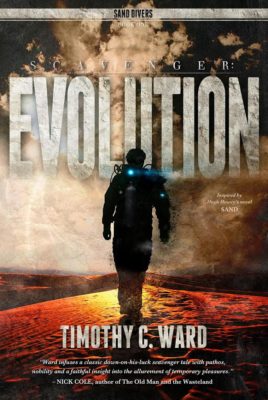
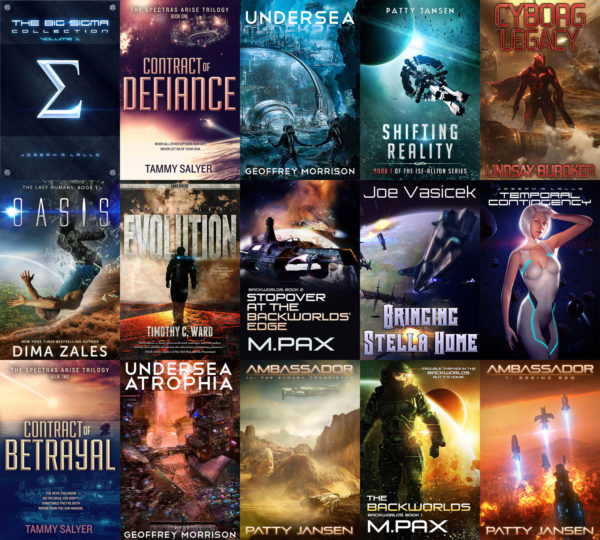
Hi guys! This is the penultimate week that the Sci-Fi StoryBundle is available, and I have a guest post today from Tim Ward, one of my fellow authors. His book Scavenger: Evolution is one of the bonus books, and it takes place in the universe of Hugh Howey’s Sand. To talk a little bit about that, here’s Tim:


My debut novel, Scavenger: Evolution was inspired by a time in publishing where “fan fiction” evolved into shared world fiction, and the weakening of a stigma that it would be lesser quality than the original source material. Kindle Worlds gained popularity through shared world stories set in famous works, with Hugh Howey’s Wool as one example.

I met Hugh through some podcast interviews I did for my first podcast, AudioTim. I loved his story of long term, overnight success, but more so, I loved his stories. Sand told the tale of a family adrift in a world covered in sand, where sand divers hunt for buried treasure and the lost city of Danvar.

In one scene, after a catastrophe, an unnamed sand diver is noted for scavenging in the rubble of a newly buried location. Knowing that Hugh allowed people to write in his Wool universe, I asked him if I could write a story in his Sand world even though it wasn’t yet open in Kindle Worlds. He gave me permission, and I took off with the idea of who this sand diver was and whom he was searching for.

The characters of Scavenger: Evolution became a former dive master, Rushing Stenson, and his wife Star, who lost their infant to a sand spill two years earlier. Their relationship never recovered, and the story starts with Rush as a custodian at a saloon, struggling with giving up on life and giving in to the temptations that surround him. He is offered a job that could give him the financial freedom to leave, and in the midst of his adventure, he will be forced to examine what life he could have with his wife if he decided to fight instead of giving up.

The story works as a stand alone, with really only the world and the starting point of the sand diving technology as the hooks that keep it in Hugh’s universe. I wrote a sequel, Scavenger: A.I. where I expand on my idea of what caused that portion of a future America to be covered in sand. Our heroes uncover the technological cause of the apocalypse, and then struggle to keep it contained before it makes them pawns in its resurrection.

Joe mentioned earlier posts on his blog that discuss TV tropes that inspired stories. In mine, I’d have to credit Stargate: SG-1 as a main influence in its story threads surrounding the replicators. The tone of my story is more along the lines of Alien, and its trope of terror in entering a lost civilization to discover ancient technology. Anyone who enjoys discovery, pulse pounding action, and a foundation of emotional turmoil between loved ones, should find a solid read in my Scavenger duology.

Scavenger: Evolution is the first book in the series, and is available as a bonus book in the Sci-fi Adventure Bundle.


Why writing retreats and seminars make me uneasy

Writing retreats and seminars make me uneasy. I’ve never attended one, mostly because the prices tend to run so high, and that’s part of what makes me so uneasy about them. Yes, writing is a business, and yes, the author deserves to be paid, but paid for what exactly? For telling stories, or for telling other people how to tell stories?

There’s an unfortunate tendency in the writing world, especially the SF&F corner of the writing world, for us to elevate authors to a quasi-godlike status and take them as a definitive final authority on the field. Certainly, when Brandon Sanderson or Orson Scott Card gives an opinion, I give it more weight than an anonymous handle on a message board somewhere. At the same time, though, an opinion is just an opinion, no matter where it comes from.

You don’t have to shell out a lot of money to learn the craft of writing. There are lots of excellent books on the subject, as well as online communities, videos on Youtube–I think all of Brandon Sanderson’s lectures from his English 318R class at BYU are now up on Youtube. More importantly, there’s no one stopping you from sitting down in front of a computer (or setting out a pen and paper) and learning from doing it yourself. So why do we need all these huge, expensive retreats and seminars?

Perhaps my view on this subject is different because I’m an indie writer. One of the great things about self-publishing is that it tears down the walls, throws open the gates, and levels the playing field for everyone. Since we all can be authors now, the pedestals are a lot shorter. The old authorities are no longer quite so definitive, because there’s so much room for experimentation in this new marketplace.

In the indie writing community, there’s a very strong ethic of sharing. Hugh Howey is probably the biggest example of this. He repeatedly goes out of his way to help his fellow writers, putting together the Author Earnings Report and being very generous in sharing everything he’s learned. He’s also very modest about it, constantly putting other, lesser-known authors forward as much better writers than he is. Instead of capitalizing on his knowledge by creating artificial scarcity, he puts it all out there on his blog and the internet communities where he participates.

Of course, retreats and seminars are just as useful for the networking opportunities as they are for the actual instruction. The thing is, just how useful is that networking really? The market is open–we all have access to readers now. The gatekeepers no longer have the power to make or break anyone’s career. And if you’re in the business of writing and telling stories, what better way to network is there than doing exactly that? Sure, it can boost your career to be on a first-name basis with a successful author/editor, but if you don’t also have the writing chops to back that up, it’s not going to do you much good.

I don’t want to call in doubt the motivations of those authors who do put on retreats and seminars. I think that for the most part, their motives are pure. But the structure is one of artificial scarcity that props up this legacy model of gatekeepers and pedestals. It makes me uneasy, because it grants too much of an air of solemnity and authority in a field where the brightest new voices are often self-taught.

Perhaps the thing that makes me most uneasy about these retreats and seminars is the fact that I’ve received so much bad writing advice over the years. To the extent that I have succeeded at all, it has been in spite of the advice I’ve received, not because of it. When I see people turning around and selling their advice for top dollar, it makes me very uneasy, regardless of their motivation in doing it.

I never want to participate as an instructor in expensive retreats or seminars. I don’t feel comfortable supporting that sort of thing. If I ever do get to the point where people would pay to hear me pontificate, I’m going to be very careful not to put myself out there as a definitive authority, since I’m sure any of my advice will be just as harmful to the wrong person as it is helpful to the right person. As for networking, I’d much rather do that through collaborating, reviewing, guest blogging, and putting anthologies together.

Slow, but still making progress

Sorry for neglecting the blog this week.  I took a temp job to earn some cash, and that’s been sucking up most of my time lately.  Fortunately, it should be over sometime next week.

In the meantime, I found a place to live for the next few months.  I’m in the basement of an old house, rooming with a former classmate from Brandon Sanderson’s English 318 class.  So far, it’s actually been pretty awesome.  The rent is dirt cheap and you get what you pay for, but there aren’t any rats and the heater works fine.  It should be a good place to spend the winter.

Progress on Stars of Blood and Glory has slowed down somewhat, mostly due to the temp work, but it’s still coming along steadily.  If all goes well, I’ll have it polished and sent out to my editor by the end of next week, which leaves only the cover art to figure out.  I’m going all out for this one, just like I did with Desert Stars and Bringing Stella Home.

Also, I just (re)started Lifewalker, a post-apocalyptic novel previously titled The Chronicles of Lifewalker.  I know, I should be putting more time into getting Stars of Blood and Glory ready for publication, but this project has been begging to be written since 2011.  I wrote a first chapter two years ago, but the narrative voice wasn’t working too well.  Basically, I was trying too hard to imitate 19th century prose without having read enough to know how to do it well.  Instead, I decided to toss all that stuff out and write the dang story without being overly restrictive.  I think it’s going to turn out well.

Blah blah blah oh did I mention that I checked out a couple of David Gemmell books from the Provo Library?  Well, I did.  They are the last two books in the Drenai series that I haven’t read, and I am soooo excited to sink my teeth into them.  Just started The First Chronicles of Druss the Legend last night, and it is AMAZING.  Expect to see a review here soon.

Speaking of which, I should probably reread Wool and review it sometime.  Hugh Howey really took the publishing world by storm last year, and he’s doing some truly amazing things for indie writers.  His books are great, too–definitely worth picking one up.

That’s just about all right now.  I’ll probably put in another hour of writing/revising, then turn in for the night.  Later!

If you’re thinking of self publishing, read this. All of it.

I just read a fascinating Q&A on Reddit with Hugh Howey, author of the self-published phenomenon Wool.  After six trancelike hours reading through all the comments, all I can say is “wow.”

Okay, I guess I can say a little more.  Yesterday, I listened to Brandon Sanderson’s lecture on self-publishing from his English 318 class this year.  While I agree with much of what he says, a lot of it is already out of date.  Probably the biggest thing is whether it’s still advantageous for indies to go with a traditional publisher after making a name for themselves.  In 2011, Amanda Hocking had some good reasons for going traditional.  In 2012, Hugh Howey has some very good reasons not to.

The other big thing, though, is this idea of author platform–that to be a successful indie, you have to find some way to drive large numbers of people to your books.  Well, not necessarily.  Hugh Howey was a nobody for three years, and the title that finally pushed him over the tipping point was the one he promoted the least.  To me, that shows:

  1. current sales are not a predictor of future sales, and
  2. a great book will grow into its audience independent of its author.

Granted, there may be a threshold that needs to be crossed before word-of-mouth really starts to kick in, but if a nobody with passable cover art and no author platform can cross it, that threshold isn’t very high–and that’s good news for all of us.

The way I see it, there are three big myths that writers struggle with in making the shift from traditional to indie publishing:

1) The flood of crap books will keep you from getting noticed

This grows out of the paradigm of limited shelf space–that the best way to get noticed is to have your book occupy more space relative to all the other books on the shelf.  This might be true in the brick and mortar world, but the rules are much different in the digital realm.

Think about it: how many new blogs are launched every single day?  Thousands, if not hundreds of thousands.  And yet people still find the good content amid the sea of crap.  On Youtube, an average of one hour of video content is uploaded every single second.  And yet there are still entertainers making a lot of money through their Youtube channels.

The rules in the digital realm are completely different from everything in the physical world.  Figuring that out requires a huge paradigm shift, one that even indie writers struggle with.

2) Publishing a book is an event that must be promoted

This grows out of the paradigm of velocity, or as Kris Rusch puts it, the “produce model” of publishing:

Every month publishing comes out with brand new product. Shelf space is limited in every single brick-and-mortar bookstore.  Big Publishing makes the bulk of its money during the first few months of a book’s existence.  So if a book sits on a bookstore’s shelf until the book sells and that sale takes six months to a  year, the bookstore and the publisher lose money.

Better to dump the old inventory on a monthly basis—for full credit for unsold items—than it is to have the inventory sit on the shelves and grow “stale.”

Of course, the flaw in this logic is that digital shelf space is unlimited, therefore books do not “spoil.” No matter how much time passes, an ebook can still be found in the same place.

Therefore, does it really make sense to make a big deal over an indie book release?  Maybe to jump start some word-of-mouth, but it’s not like your career is going to be harmed if you do nothing.  In fact, it might be better to hold off until you have a few more titles up, so that when you give the first one that push, readers will have something else to read once they’ve finished it.

3) To succeed you need to find a way to “break in”

This grows out of the gatekeeper paradigm, where the system is closed and the few entry points are guarded by a select group of taste makers whose job is to bestow legitimacy on those who meet the qualifications to get in.  It’s the concept of patronage, where success comes from being chosen by a wealthy benefactor, and it’s connected with the idea that you haven’t truly “arrived” until <fill in the blank>.

The flaw with this paradigm, of course, is that publishing is no longer a closed system.  The gates haven’t just been flung open, the walls themselves have been torn down.  The job of the taste makers is no longer to protect readers from the dross, but to lead them to the gems–which is honestly much closer to what it should have been in the first place.

So what does this mean for creators?  It means that there’s no longer a system to break into.  You don’t need to write better than everyone else, you just need to find (and keep) your 1,000 true fans.  Success isn’t bestowed upon you by some higher authority, it’s something that you discover on your own as you hone your craft and build your business.

Honestly, this is one that I still have a lot of trouble with.  When I left to teach English in Georgia, in the back of my mind I had this vague notion that I was going into a self-imposed exile, and wouldn’t come back or settle down until I’d “broken in.” Of course, this made me quite discouraged, because it felt like things were out of my control–or worse, that I’d somehow failed.

But listening to Brandon’s lecture and reading Howey’s Q&A session helped me to remember that it’s all still in my control.  I don’t need a benefactor, I just need a good plan, if that makes any sense.  So right now, I’m thinking things through and making the necessary revisions to that plan.  There probably won’t be any big ones–I still think I’m more or less on the right track–but it will be good to update my paradigm.

By the way, the title of this post applies to the Q&A with Hugh Howey, not to the post itself.  Though if you are thinking of self publishing, I hope it’s helped out in some way.

Also, I just finished part I of Wool, and it deserves every bit of praise that it’s got.  Expect to see a review of the omnibus shortly.