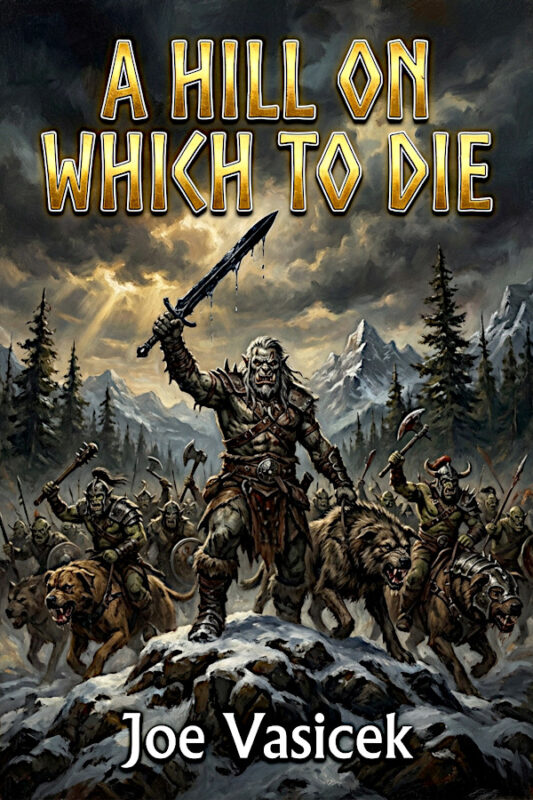
Courage and pride can look almost identical from the outside. Both can drive a warrior to stand his ground, draw his sword, and face death without flinching—but A Hill On Which To Die asks what separates a meaningful sacrifice from a pointless act of self-destruction. Through Garak-Nur, an aging orc war chief struggling to preserve his clan and his authority, this gritty dark fantasy story explores the dangerous line between risking yourself for others and risking others for your own reputation.
Where the Idea Came From
The story began with a phrase I encountered in the comments section of a news article: “Is this the hill on which you want to die?” The question was originally about choosing which arguments are worth fighting online, but it immediately suggested something much more literal—a story about an old orc warrior who must repeatedly decide whether the conflict before him is truly worth his life. Once I imagined Garak-Nur facing a younger challenger in a duel to the death, I knew the question would follow him throughout the story until he finally found the hill on which he was willing to die.
How Courage and Pride Shape the Story
At the beginning of the story, Garak’s courage is tempered by hard-earned wisdom. He is not afraid to fight or die, but he understands that violence should accomplish something. When the Witch-King’s messenger turns the younger warriors of Great Crag against him, Garak does not make a glorious but futile last stand. Instead, he abandons his ancestral home and leads his loyal followers into the wilderness, accepting exile, uncertainty, and the loss of his former power in order to preserve their freedom. Later, he enters an abandoned dwarven stronghold, confronts a dragon alone, and accepts humiliation in exchange for a safe home for the new Black Pine Clan. In these moments, Garak’s willingness to sacrifice himself makes him courageous because his actions serve something greater than his own honor.
The distinction becomes clearer after Nari-Sen defeats him in single combat. Garak swallows the humiliation and orders his warriors to accept her judgment because attacking her followers would cost the clan lives it cannot afford to lose. But once his defeat begins to weaken his authority, he becomes increasingly obsessed with restoring his reputation. He launches a dangerous raid in the middle of winter—not because Black Pine urgently needs territory, food, or captives, but because he wants to prove that he is still worthy to lead. His pride turns his followers’ suffering into a tool for protecting his position. Garak remains physically brave, but the purpose of his bravery has changed: instead of risking himself for the clan, he risks the clan for himself.
What This Theme Says About Us
Pride is dangerous precisely because it can disguise itself as courage. We may tell ourselves that we are defending a principle, protecting our dignity, or refusing to surrender when we are really trying to avoid embarrassment, admit weakness, or accept that our role has changed. True courage is not always the loudest or most defiant choice. Sometimes it means walking away from a fight, enduring humiliation, surrendering power, or allowing someone else to take our place. A Hill On Which To Die asks us to consider not only what we are willing to sacrifice for our convictions, but who else may be forced to pay the price when we mistake our wounded pride for a noble cause.
Why This Theme Matters to Me
David Gemmell has long been one of my favorite fantasy writers, especially because of the raw violence, gritty heroism, and moral clarity that give his stories such power. In writing A Hill On Which To Die, I wanted to capture some of that energy while exploring a hero who is admirable, brutal, wise, and deeply flawed all at once. Garak-Nur is not someone I would ever want to become, but following him forced me to think seriously about leadership, mortality, and the moment when a strength that once made someone heroic begins to become his downfall.
Where to Get the Book








Related Posts and Pages
Explore my other standalone books here.
Return to the book page for A Hill On Which To Die.