One of the key things that makes space different from Earth is that nothing is ever stationary. Anything close to our planet that isn’t moving at a good clip (measured in miles/kilometers per second) is liable to plummet like a brick. Gravity is still in effect, even though you’re in free fall and thus don’t really feel it.
The way to get around the falling problem is to orbit whatever celestial body you’re plummeting towards. When your tangential velocity gets high enough, gravity becomes your centripetal acceleration, and the system becomes rotational rather than discrete. In other words, you’re still falling, but you’re moving fast enough to cross the edge of the horizon before you hit.
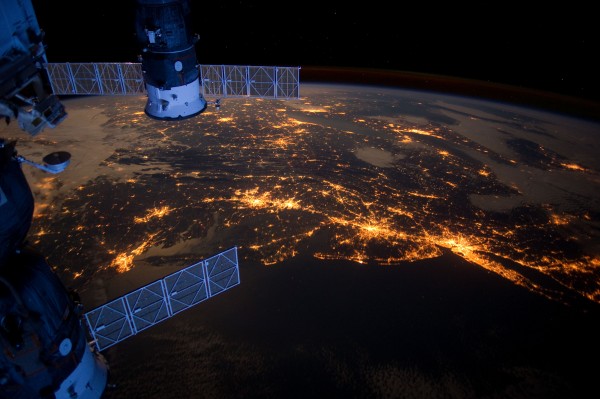
Just to give you a scale of how fast you have to go to make this work, the International Space Station (ISS) is orbiting at about 230 miles (370 kilometers) above sea level, and it makes a complete rotation around the earth every 90 minutes. That means that the good folks who live and work up there see about 16 sunrises and sunsets per day.
If you’ve spent your whole life living planetside, orbital mechanics can be a bit difficult to grasp. Here are just a few of the basics:
Since orbit is basically free fall, you don’t need to fire your engines to stay aloft. In fact, once you’re parked in a stable orbit, you can stay there almost indefinitely. This is how satellites work: we use a rocket to put them in position, but once they’re there all they need is a minor adjustment from time to time. The moon is basically a giant natural satellite, and it doesn’t need any sort of thrust to stay aloft.
As objects fall closer to the body they’re orbiting, they orbit faster. Just think about how figure skaters speed up when they pull their arms in closer to their bodies. The main reason for this is that the object has a much shorter distance to travel to make a complete revolution. To understand how this works, take a CD and measure the inside edge versus the outside edge.
However, since your tangential velocity is proportional to your centripetal acceleration (ie gravity), the way to jump to a higher orbit is to speed up. Conversely, the way to fall to a lower orbit is to slow down. An object’s angular momentum (mass X tangential velocity) is proportional to the distance of the object from the rotational system’s center of mass, so changing the object’s velocity will also change its distance from the center.
So if you’re in a spaceship and you’re about to collide with an object on a parallel orbit, the way to avoid it is not to nose your ship up like an airplane. Instead, fire your engines and try to go faster (or slower, as the case may be). It’s a bit counter-intuitive, but your altitude will change accordingly. The anime/manga series Planetes really got this right.
However, even though you’re moving faster at a higher orbit, you have a lot more distance to travel, so it actually takes longer to make a complete orbit. If you go high enough, you can eventually get to the point where the orbital period equals the rotational period of the celestial body you’re orbiting. We call this a geosynchronous orbit. If you’re orbiting around the celestial body’s equator, then to a person on the surface, it appears as if you’re stationary. You’re not, of course–nothing in space really is–but both you and the person on the planet’s surface are moving in tandem, so that’s how it appears.
Ever wonder why satellite dishes all point in the same direction? This is why. The signal comes from a satellite in geostationary orbit, where it doesn’t move relative to the people on the surface. Thus, if you know where to point your dish, you will always get a signal since the satellite doesn’t appear to move.
An orbit doesn’t have to be circular, but the barycenter (ie the center of mass for the whole system, where the mass of both objects cancels each other out) has to be at one of the focal points of an ellipse. This is how comets work. An object in an elliptical orbit will speed up when it gets closer to the object it’s orbiting, and slow down when it gets further away.
It’s possible–indeed, quite common–to orbit two celestial bodies simultaneously. For example, since the Earth orbits the sun, anything orbiting the Earth must also orbit the sun at the same time. If you’re close enough to the Earth, this doesn’t really matter since the Earth exerts a much more immediate force. But when you get further away, interesting things start to happen.

A Lagrangian point is a point of gravitational balance between two orbiting celestial bodies of unequal mass. Basically, they’re points of equilibrium where objects appear to remain stationary, so long as they continue to orbit in tandem with the other two celestial bodies.
In science fiction, these are great places to put space stations and other orbital settlements, since they appear as fixed points relative to the planet or moon that they’re moving around. In real life, asteroids tend to clump around these points in a planet’s orbit, especially the L5 and L4 points. Jupiter has so many of them that we call them the Trojans and the Greeks.
Since orbital mechanics can be a bit difficult to grasp, a lot of science fiction gets it wrong, especially space opera. For a recent example, just look at the Halo series–unless those Covenant ships have some sort of magical drive, there’s no way they could hover above the surfaces of planets the way they do. Orbiting does NOT equal hovering. And in Halo: Reach, where Jorge knocks out the main ship for the Covenant advance force … yeah, if a ship that large actually fell from orbit into the surface of a planet, it would be moving fast enough to make a crater the size of a small continent, kicking up enough dust and debris to cause a mass extinction event like the one that killed the Dinosaurs.
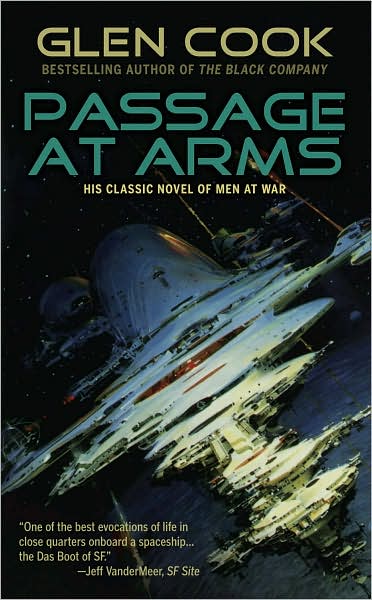
At the same time, when a science fiction story goes the length to get the orbital mechanics right, it can add a surprising amount of realism. A good example of this is Passage at Arms by Glen Cook. I loved how he depicted the orbital siege of the main colony world, with the way the orbital space battles looked like from the planet’s surface. The human forces were able to keep a toehold on space due to a low orbiting asteroid that the aliens couldn’t get to without exposing their forces to attack, and that served as the staging ground for the main characters to fight back.
For hard sci-fi, orbital mechanics is absolutely essential–you’ll be tarred and feathered if you get any of it wrong. For soft sci-fi like space opera, it’s not essential, but it adds a lot to the story if you can get it right. In any magic system, the limitations are what make it interesting. If you’re writing science fiction, then physics is your magic system, so knowing how it works can really add a lot to your story.
For example, in the recent Schlock Mercenary storyline, the characters board a spaceship with an artificial gravity generator centered around a large cylindrical pylon that runs the length of the ship. One of the implications of having Earth-strength gravity around such a small object is that you can actually throw a baseball into orbit. And that’s just the beginning! Needless to say, I’m really interested to see where Howard Tayler takes this story in the weeks and months to come.
Even though I write more space opera / science fantasy type stuff, I do the best I can to get my orbital dynamics right. You can see this in the space battles in Stars of Blood and Glory and Bringing Stella Home, as well as the setting elements in Desert Stars. When the desert tribesmen look up at the night sky, they gaze at the stars and satellites–hundreds of satellites, many of them starships bound for distant spaceports on the more civilized side of the world. One of the reviewers said that the world felt so real it was almost like he could reach out and touch it, so I guess I did something right. I’ll definitely keep it up in the future.
 If you fell in love with science fiction when you were twelve, chances were it was because of the awesome space battles. That was certainly the case with me. When I saw Star Wars for the first time, I spent hours running around the house pretending I was flying my own starfighter. In some ways, I’ve never really stopped. 😛