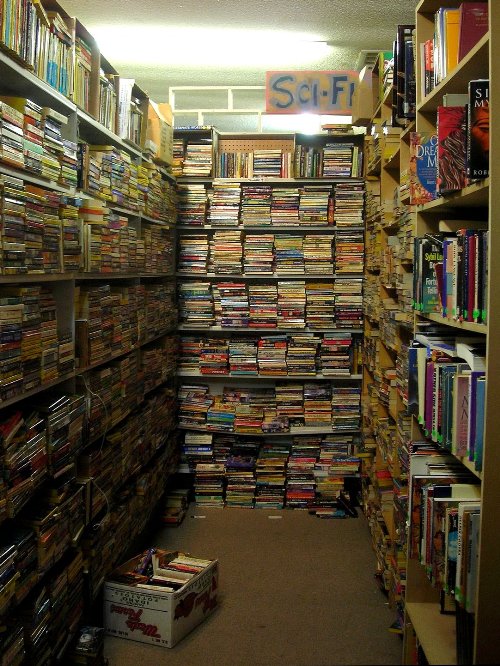
 Has space opera passed its zenith?
Sometimes, it certainly looks that way. All the major stuff seems to be reprints of past series and reboots of decades-old franchises. Star Trek, Star Wars, Stargate, Battlestar Galactica, Ender’s Game, Dune, Babylon 5–all the big names seem to have had their start at least a generation ago. At any science fiction convention, you’re likely to see more gray-haired men than kids in their teens and twenties. And if you go to a publishing conference, new adult, urban fantasy, and paranormal romance are ascendant.
I’ve noticed that people are using the term “science fiction” increasingly to describe stories that don’t have anything to do with space. Dystopian, post-apocalyptic, steampunk, even time travel–all of these subgenres are certainly part of the fold, but they’re very different from the stories about starships and alien worlds. And then you have all the markets for short fiction that have been forced out of business–and even a few larger publishers, like Night Shade Books which is now selling off all its assets (read: authors) to avoid bankruptcy.
I remember going to World Fantasy 2010 in Columbus, Ohio, and feeling dismayed at the complete lack of science fiction. World Fantasy is (or was, at least) the premier professional conference for speculative fiction literature, but all of the attention was going to urban fantasy and steampunk. On the freebie table where publishers often dumped ARCs and review copies of their books, the only space opera stuff I really saw were a couple of titles by Glen Cook and one other guy–and I watched that table hawkishly for the full three days of the conference.
Sometimes, it seems as if it would be so much better if I had grown up in the 80s. That’s when science fiction really had its heyday. But all through the 90s, the genre seems to have been on the decline, much like NASA and the US space program.
So is space-centered science fiction on the way out? Have we passed the glory days, and it’s now just a long decline until it becomes an obscure niche, beloved by some, but enigmatic to others?
In spite of everything I said above, I actually don’t think so. In fact, I think we’re on the cusp of a science fiction renaissance, and that sci-fi geeks like myself will look back twenty years from now and wish that they were born in our era. Here’s why:
1) Scientific discoveries are transforming the way we see the universe.
The day I posted P is for Planets, NASA’s Kepler mission announced the discovery of three Earth-like worlds orbiting in the habitable zones of their stars. The existence of alien Earths is not conjecture–it’s a confirmed fact. As our ability to study these worlds improves, it’s only a matter of time, IMO, before we find a world that has life.
We’ve discovered the Higgs-Boson. We’re unraveling the fundamental building blocks of the universe. We’ve built telescopes to look back to the dawn of time itself, and we’re learning more about the cosmology of the universe every year. Perhaps even more remarkably, we understand now how little it is that we actually know–that the entirety of the observable universe is only about 5% of it, and even that’s optimistic.
All of this will take time to trickle down to the popular consciousness, but with all the new discoveries that are happening, I think that’s already in the process of happening. In particular, I think the recent discoveries in the realm of exoplanets and astrobiology are going to shake things up in a major way in the next five or ten years.
2) The privatization of space travel is paving the way for a rapid expansion into space.
The US space program has been plagued with funding problems since at least the end of the Cold War space race. Since the space shuttle program was retired just last year, the only way for our astronauts to get into space is through the Russian Soyuz spacecraft at Baikonur. If NASA had to put a man on the moon, they do not currently have the knowledge or technology necessary to do it.
In the private sector, though, it’s been a very different story. SpaceX has had a number of successful launches recently, most notably sending the first unmanned resupply capsule up to the International Space Station. And just a couple days ago, Virgin Galactic had the first successful test flight of its rocket-powered spacecraft.
It’s sad to see the space shuttle go, but there are a lot of reasons why the program was flawed and inefficient to begin with. By handing things off to the private sector and turning space exploration into a viable business venture, we can hopefully overcome those inefficiencies and eventually make space accessible to the general public.
And then you have the organizations like Mars One that are looking even further ahead to the colonization of Mars. There’s a groundswell of excitement for Martian colonization that is starting to get some real money behind it. Will it go anywhere? It’s hard to say right now, but even if it suffers another decade or two of setbacks, it’s getting public attention, especially from the younger generation.
3) Video games are bringing a fresh new look and feel to the genre.
Not all of the big sci-fi series hail from 70s and 80s. Halo started up as recently as 2001, and it’s a multi-billion dollar franchise with games, books–even Legos. In fact, there are lots of sci-fi video game franchises right now, many of them right on par with other classic space opera. Just look at Starcraft, for example, or Mass Effect, or Eve Online and Sins of a Solar Empire. The number of sci-fi games has been exploding.
In fact, this explosion has been happening for some time. While literary science fiction may have suffered something of a decline back in the 90s, that was the heyday of games like Master of Orion and Sid Meier’s Alpha Centauri. Flight simulators like Flight Commander and X-wing proliferated like crazy, while even some of the classic RPGs like Final Fantasy borrowed heavily from science fiction tropes. And those are just a few of the games that I can list off the top of my head!
Whether or not literary sf is on the decline, a whole new generation has been introduced to the genre through the medium of video gaming. This is not just a small niche audience playing this stuff, either–in the US at least, Halo is as mainstream as Monopoly or Settlers of Catan. In fact, you could say that science fiction is more mainstream now than it ever has been, and a lot of that is due to sci-fi video games.
4) The e-publishing golden age is giving us thousands of new voices.
But what about the world of literary sf? Are we in a decline? Do people just not read science fiction anymore? How bright is the future for science fiction literature?
Actually, this is the area where I’m the most optimistic of all.
The publishing industry is changing at the speed of light, much in the same way that the music industry changed about a decade ago. Just as the MP3 revolution allowed all sorts of eclectic yet entrepreneurial artists to thrive without the oversight of record labels, the epublishing revolution is opening all sorts of doors for the enterprising author. And while the changes are driving publishers (such as NSB) out of business, they are enabling authors who only sell in the mid-list range to make a respectable living.
At Worldcon 2011, Ginger Buchanan (senior editor at Tor) asserted that there has never been a runaway science fiction bestseller. In the eyes of New York publishing, that may be true–but New York has a notorious record for missing the catch in pursuit of one big fish. Because of epublishing, whole new genres like New Adult that publishers thought would never sell are now going mainstream.
And even the niches that stay niches are becoming quite lucrative for the authors who can build a decent following. When author cuts out the middlemen and develops a direct relationship with the readership, it only takes a thousand true fans or so become a financial success. As Kris Rusch pointed out so aptly, those numbers may bring only scorn from New York, but for the writers who actually produce the content, that’s a vein of pure gold.
I can’t tell you how many success stories I’ve heard from fellow sci-fi writers over on the Kindle Boards, who started just for the grocery money and ended up quitting their day jobs. But as Hugh Howey pointed out, the runaway bestsellers are not the true story of the epublishing revolution–it’s the little guys who only sell a few hundred copies a month but are earning enough to support themselves writing what they love.
Indeed, we’re already starting to see an explosion of new science fiction, thanks largely to the ease of electronic self-publishing. I’ve only read a few of them so far, but Nathan Lowell stands out among them, as well as my good friend Kindal Debenham. These guys and so many others are bringing a fresh new voice to space opera, revitalizing the genre in ways that simply weren’t economical back in the days of Big Publishing.
So even if space opera as a literary genre isn’t quite large enough to go mainstream, it is large enough to support a wide range of new voices under the emerging business models. And as the epublishing revolution continues to mature, I think we’re going to see a new golden age comparable to the era of the pulp adventure stories.
I’ve been publishing my own work since 2011, and I can attest that there’s never been a better time to be a writer. I’m not quite making enough to go full-time yet, but at the rate things are going, it will only be a year or two before I realize my dream of making a living telling stories that I love. And if they’re the kind of stories that you love too, then that’s great news for all of us!
So has science fiction reached its zenith? I don’t think so. It went mainstream about a generation ago, which was definitely a huge moment, but for the last few decades it’s been in the process of branching out and rediscovering itself. Right now, I think we’re on the verge of a wonderful new renaissance that is going to blow us all away. As a lifelong reader and writer of science fiction, I certainly hope that’s the case. And because of the reasons listed above, I sincerely believe that it is.