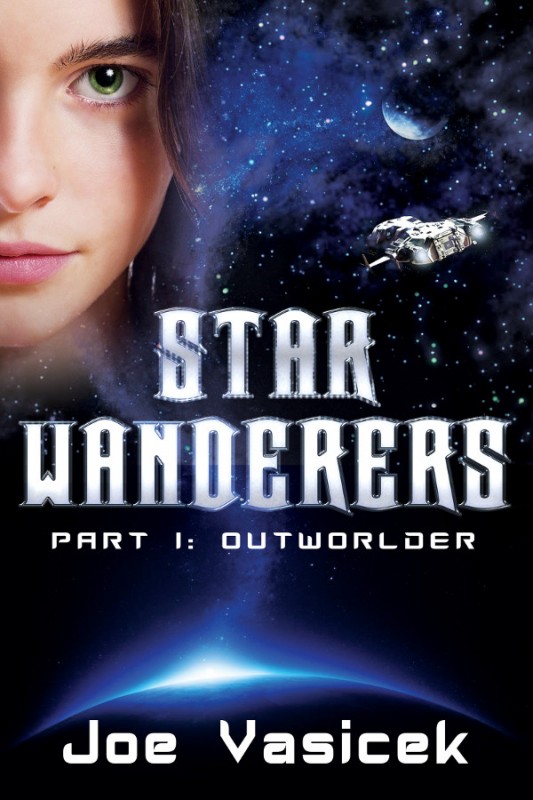
New Star Wanderers cover reveal!

Behold!

This is officially the new ebook cover for Star Wanderers. I’ve uploaded it to all platforms, though I haven’t updated the epub files yet. I’ll also update the paperbacks as soon as I have a chance, though that may take a while, especially with the new baby.

This image was AI generated using Stable Diffusion. It went through a lot of iterations, and can probably use some improvement, but this is the best I can do with the skills I currently have. Maybe a couple of years from now, after I’ve mastered the technology, I’ll make a new cover for this title. But I think this one is good enough to keep for a while.

Just for fun, here are some of the old covers:

The original novel cover, which this latest one has replaced.

The second omnibus cover, from the novella series. The cover itself is by Libbie Grant, though the planet itself is a screenshot I took from Celestia.

The art from the complete series omnibus, which replaced the first two omnibuses and was the immediate precursor to the novelization itself.

The original cover for the first omnibus. The art is by Ina Wong, who also did the current cover art for The Sword Keeper.

This is the original art for the second omnibus, by Derek Murphy.

This is my personal favorite from the art by Libbie Grant. She did all eight novellas and both ominbus editions in this style.

This is the second cover for the original novelette. Derek saw my crappy self-made cover and offered to make me this one for free, so that he could showcase both of them in a before-and-after post on his blog. It worked out really well!

And this is the original ebook cover art for the first novelette that started it all. I had just launched Desert Stars, after draining my bank account to publish it since the kickstarter had failed (This was back in 2011, and I had no idea how to run a kickstarter—or how to profitably publish a book, for that matter). Since I didn’t want to spend another $900 to publish a full-length novel to the sound of crickets, I decided to turn my current WIP into a novella series, put them all out on a shoestring budget, and reinvest whatever money they earned into better editing and cover art.

The image is taken from NASA and is totally in the public domain, and I think the font is too, or at least it’s freeware of some kind. I put it together over the summer, when I was home from teaching English overseas in the Republic of Georgia. For this one, I think I used my desktop, but most of the other ones in this style were done on my tiny ASUS netbook with a screen the size of a postcard, in an old farmhouse in a tiny Georgian village at the foot of the Caucasus Mountains, which had no heating aside from the woodburning stove downstairs. The power would also frequently go out for hours at a time.

I wrote a bunch of the original novellas out there, in that tiny little Georgian village. And now, they’re all combined into one novel, which I’m turning into a trilogy right now! Just need to finish revising the second book, hopefully before that new baby comes. I should probably stop procrastinating.

Can this video possibly be more Georgian?

All it needs is a couple of old men playing backgammon on a folding table by the side of the road… although that’s something you see more of in the town, not the village.

For goodness’ sakes, it even has a rooster crowing at the end!

Motatseba, or how to bag a wife—literally (Blast from the Past: April 2012)

With the rise of #MeToo, I thought it would be interesting to revisit this old post from my time in the Republic of Georgia. Here in the US, we seem to be in the process of completely reworking the societal norms for how men and woman interact in the public sphere. On one extreme, we have serial predators getting ousted from power in industries that enabled their abuses for years. On the other extreme, we have the perpetually outraged calling for blood because someone greeted a woman in public with an unwanted hug. False and anonymous accusations abound, while clear and obvious abusers like the Clintons have gotten off scot-free. In short, it’s a mess.

Changes this drastic always produce unintended consequences. One of the unintended consequences of #MeToo may be the blurring of the lines of consent. After all, if a woman can call it rape because she decided afterward that she regretted it, is positive consent worth anything in the first place? In eastern Europe and central Asia, consent has also been blurred, which is part of the reason why bridenapping is still a thing. In Georgia, I came face to face with this reality.

Let me make it clear that I do not condone bridenapping in any form. Cultures are not equal, and some cultures (or some aspects of a culture) are better than others. A culture that condones the kidnapping and forced marriage of women is much worse than a culture that ennobles and empowers women to be agents of their own destiny.

With that in mind, here’s the updated post.


მოტაცება (pronounced motatseba) is the Georgian word for bride kidnapping, as opposed to regular kidnapping, which takes a different word. It’s an ancient practice in the Caucasus region that still occasionally happens, especially in the rural areas. Today, most Georgians condemn it, but there’s still a whole slew of lingering cultural subtexts that can be very difficult for a Westerner like me to understand and navigate.

This is how it works: boy meets girl. Boy decides to marry girl. Boy gets his friends together and kidnaps the girl, with or without her consent, holding her captive overnight. The next morning, boy contacts girl’s parents to ask for girl’s hand in marriage.

Since the girl has been held overnight, the implication is that she’s been raped (which may or may not be true). Therefore, to avoid a scandal which could tarnish the family’s reputation, the parents will usually marry their daughter off as quickly as possible. However, if the girl can escape, or the girl’s brothers can rescue her before nightfall, the crisis can be averted.

Basically, it’s capture the flag with sex.

I first heard about motatseba from this post on Georgia On My Mind, back when I was looking into teaching English. It disturbed me, but not enough to dissuade me from coming to Georgia. A couple of weeks ago, however, I learned that that was how my host parents got married.

Here’s the thing, though: they both seem to remember it fondly. In fact, when my host mom saw a comedy skit on the subject, she couldn’t stop laughing. Her mom lives with them now, and from time to time they go out to visit his family in the village, so it looks like everyone’s on pretty good terms.

So what the heck happened?

Here’s the story, as best as I can piece it together. They were introduced by his sister, who was her coworker at the hospital. He liked her, but was too poor to afford a dowry, having just gotten out of the Red Army. After a month, he got together with some friends and tricked her into coming out to his family’s house out in the village. She was surprised and upset at first, of course, but her parents gave their consent, probably because she was starting to get into old maid territory (she was 29 at the time). They were married the next day by a magistrate. Now, they’ve got four kids—a huge family, by Georgian standards—and seem to be happy together.

As a Westerner, it blows my mind that a strong, healthy family can come out of something as violent as an act of kidnapping. Indeed, I have yet to be convinced that that’s a normal outcome. However, after asking around and doing some research, I’ve come to realize that motatseba isn’t a black and white issue: there are all sorts of cultural subtexts that make it much more complicated.

The key to understanding how all this works is the following proverb, which underscores Georgian concepts of gender roles and the differences between men and women:

If a woman says no, she means maybe. If she says maybe, she means yes. If she says yes, she is not a woman.

From this, two things follow:

Men should be more assertive

As a man in Georgia, I get this all the time. All three of my co-teachers are women, and all of them constantly defer to me, even though they have far more teaching experience than I do. When I had some pretty serious differences over teaching methodologies with one of them, she suggested that I take over the next lesson and teach it without her interference, so that she could get a better idea that way.  This isn’t the case with the female volunteers. Many of them complain about how hard it is to get anyone to take their suggestions seriously.

A woman can never say no—or yes

If “no” is constantly interpreted as “maybe,” then it follows that no one is going to believe that a woman is even capable of saying “no.” On the other hand, if a real woman can never say “yes,” then the man ultimately has to take matters into his own hands. This turns the whole concept of rape into a nebulous gray area, which is why motatseba isn’t universally considered to be a horrible thing.

This is not to say that in Georgian culture, women are doormats or property (even though that’s what some TLGers claim). Women have a number of support networks, such as family, friends, and other women, and can use these networks to ward off unwanted attention. When I asked my host sister if she’s worried that she would ever be kidnapped, she said no, because if she was, her brothers would kick some serious ass.

On top of all this, Georgians have no real concept of casual dating. If a girl and a guy are seeing each other, they’re either married or about to be married. This shows up in the way they use Facebook and other social networks: instead of listing themselves as “in a relationship,” the girl will give her password to the guy she’s dating. And they don’t just do it because the guy demands it—when my host sister was seeing someone, he asked her if she wanted to give her password to him, as if that was the natural next step in their relationship. From the way she told me, she seemed to be worried that she’d made a mistake by telling him no.

Combine all of these together, and you should start to get a clearer picture of some of the subtext surrounding motatseba.

When I asked my first co-teacher about it, she said it was only an ancient practice and absolutely didn’t happen anymore. When I brought up rape and asked if that was also a part of it, she was horrified and didn’t want to talk about it. However, when I asked if it’s possible for a happy marriage to come of it, she kind of smiled a little and said that if the woman likes it, then why not?

My second co-teacher was much more straightforward with me. Yes, it happens occasionally, though it was a lot more “fashionable” about twenty or thirty years ago. No, it’s not romantic. Yes, a lot of the marriages aren’t very happy, which is why so many of them end in divorce. She told me that one of her friends from college was married through motatseba, and that she knows of at least one case in our school where an 8th grader was kidnapped and married. However, motatseba is now considered a serious crime, so it’s not as common as it used to be.

My third co-teacher’s answer was a lot sketchier. The first time I asked about it was in passing, as she walked in on the conversation I was having with my first co-teacher. When I asked her about rape, she laughed and said “well yes, of course it happens!” as if that wasn’t a big deal. Later, however, she sat me down and said quite seriously that motatseba is a horrible thing, that it’s a criminal act, that it doesn’t happen anymore, etc etc.

However—and this was perhaps the most illuminating thing—she said that sometimes, when a guy and a girl are in love, but she’s being wishy-washy and non-committal, he’ll sweep her off her feet and carry her off. In fact, that was what happened with her: her boyfriend wanted to marry her, but she kept putting it off, so one day he tricked her into getting in the car and told her “all right, enough is enough—we’re getting married this weekend.” And they did.

When I asked her if that was motatseba, she said no, but the subtext was clearly similar. A real man knows how to assert himself and take what he wants. Since a real woman will never say yes, sometimes you just have to man up and tell her how it’s going to be.  And don’t worry if she says no—she just doesn’t know yet that she wants it. She’ll come around eventually. They always do.

It sounds pretty horrible, but that seems to be how it works. And really, there are gradations of it. Most Georgians will agree that it’s wrong for a guy to kidnap a girl he doesn’t know so that he can rape her. But if the guy and the girl know each other, and are already pretty serious, and he wants to speed things up—or, alternately, if she knows her parents would never say yes otherwise—that’s when everyone starts to wink and nod.

And really, can we say that our culture’s problems are any less abhorrent? What about teenage pregnancy? Secret abortions? Date rape? At least with motatseba, the guy is trying to marry the girl, not just sleep with her and walk away. If it’s just sex that the guy is after, there are plenty of other options for that.

Either way, learning about motatseba firsthand has certainly been an interesting anthropological experience.


Color Revolutions and Collusion News Network

For most of 2012, I lived in Georgia, a former Soviet Republic of the USSR. I came to know the people, the culture, and the politics of that part of the world first-hand. In particular, I was there for the 2012 elections, a watershed moment for modern Georgian politics.

Bidzina Ivanishvili, billionaire, founder of the Georgian Dream party, and prime minister from 2012 to 2013.

A little bit of background. Georgia won its independence in the 90s during the fall of the Soviet Union, and immediately fell itself into a civil war. Three regions broke off: Adjara in the south, South Ossetia in the north, and Abkhazia in the northwest. It was a very difficult time, where the national army was little more than a deputized gang of thugs.

Eduard Shevardnadze, former Soviet Politburo member and President of Georgia until 2005.

When the chaos settled down, the man in charge was Eduard Shevardnadze, a former high-ranking member of the Soviet Politburo. If you had to compare it to something, it would be like the United States falling apart and George W. Bush taking over Texas. An old establishment politician from a dynastic family returning to his newly independent home country to head it during troubled times.

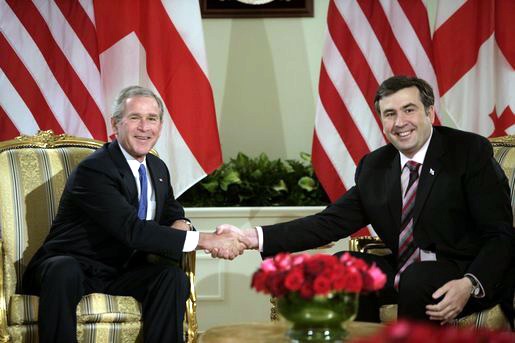
Mikheil Saakashvili (Right), former president of Georgia. He came to power in the Soros-funded Rose Revolution, pushed for Georgia to join Nato, and fought a disastrous war with Russia in 2008. After he was ousted from power, he became a governor in Ukraine, following the Euromaidan Revolution that brought Ukraine into the Western orbit. American collusion, anyone?

But then, in 2005, something interesting happened: a “color revolution” broke out. George Soros, members and allies of the Bush Administration, and other foreign actors began to stir up protests in Tbilisi against Shevardnadze’s government. The tensions culminated with Mikheil Saakashvili and other agitators storming parliament with roses in their hands, taking over the podium and forcing Shevardnadze to flee with his bodyguards. He later resigned, and Saakashvili ran unopposed in the following election. He won by 96.2%.

The August 2008 war between Russia and Georgia. It began when Saakashvili ordered his forces to shell Tskhinvali in Russian-occupied South Ossetia, and ended with the total defeat of the Georgian armed forces, with Russia reinforcing and formally recognizing the separatist regions of Abkhazia and South Ossetia. Many ethnic Georgians lost their lives or became internally displaced refugees within their own country.

It was political theater of the highest order, accomplished by collusion with a meddling foreign power. Once Saakashvili was in charge, Georgian foreign policy took a hard turn towards the West, causing massive tensions with Russia that culminated in the 2008 Russo-Georgian War.

This was a very bad move. Georgia is basically the Mexico of Russia; the two countries are closely linked both culturally and economically, with a large volume of remittances flowing from expatriots in Russia back to their families in Georgia. By turning so sharply to the West—not to mention, starting an actual war—Saakashvili did his people a great disservice.

Fast forward to 2012. I was teaching English in a village called Rokhi, about half an hour south of Kutaisi. I knew the basic outlines of this history, but very few of the specifics. The people were generally friendly to Americans, but they were very quiet about politics, at least to me.

Then the elections happened, and against all odds the Georgian Dream party completely overthrew Saakashvili’s ruling party in the parliament. Politicians started fleeing across the border into Turkey. Those who didn’t flee were arrested, sometimes on spurious charges, sometimes on legitimate ones. The courts became weaponized in a political struggle between Saakashvili and the Georgian Dream. It wasn’t a transfer of power so much as an ongoing coup.

All of a sudden, people starting speaking up and telling me what they really thought. While Saakashvili was in power, people were always careful around me because they assumed (since I was an American) that I was some sort of spy. But when the Georgian Dream Party took over, people felt it was safe to share their true feelings about how much they hated this guy who had taken over their country and driven it into the ground.

This is what foreign collusion and meddling looks like. America does it all the time. There’s a saying in the former Eastern Bloc that goes something like this:

“Why has there never been a color revolution in the United States?”

“Because there is no US embassy in the United States!”

Except now, I’m not so sure. Because the hyperbolic media response to the latest mass shooting in Florida shares some very disturbing similarities with a color revolution, and it frankly scares the hell out of me.

Take the CNN town hall that happened earlier this week. That wasn’t democracy in action, or even journalism. It was political theater, pure and simple. It was a political witch hunt and full-on push for gun confiscation.

A lot of things about the Florida shooting don’t add up. The alleged gunman managed to slip away with the fleeing students, instead of getting killed by law enforcement on the scene as is the pattern with most mass shootings. The FBI knew about this kid, had a file on him, knew what he was planning, and did nothing—absolutely nothing—to stop him. His classmates just happen to be pro-gun control activists, and they just happen to put together this massive national children’s crusade literally before the funerals for all the victims have been held.

Look, I’m not saying the kids are crisis actors. I’m not saying that what they went through isn’t absolutely horrific, or that they don’t have a right to feel the way that they do. What I’m saying is that the politicization of this shooting is massively suspicious and full of red flags.

Consider the three major mass shootings that happened last year, and the differences in the media’s response to each of them.

The first was the Congressional baseball shooting in June. A Bernie Sanders supporter tried to assassinate most of the Republican caucus by hunting them down at a baseball practice. It was deliberate, it was planned, and it very nearly threw this country into a major political crisis.

Within a week, the major news outlets were no longer covering the story.

The Las Vegas shooting was next, in October. A horrible tragedy and watershed moment for mass shootings in America. And yet, after all these months, there are so many unanswered questions. Where are the Casino tapes? Why haven’t we seen them? What was the involvement of the shooter’s girlfriend? Who is the other person of interest that the FBI hasn’t revealed? Was there a second shooter? What about all of the problems with the timeline?

None of these questions have gotten much airplay outside of alternative media. Also, the fact that the shooter was on mood-altering drugs hasn’t factored into the public debate nearly as much as the guns that he used—or didn’t. We don’t really know.

A month later, in November, we had the Sutherland Springs church shooting. The shooter was stopped by a bystander with a gun. A classic example of how the right to bear arms protects and makes us safer.

Once again, the mainstream media buried the story within a week.

Now we have the Florida shooting, with its own set of details that don’t quite add up. Far from burying the story, the mainstream media has blown it up to eleven, with nonstop political theater, witch hunts, appeals to emotion, and above all else, unyielding demands for a total confiscation and ban on all guns.

Who benefits from the politicization of mass shootings? The people who want to destroy the right to bear arms. Who is that? No one so much as the people who want to sow chaos in this country.

If the feds attempted a total gun confiscation, it would spark a second American civil war. Russia would benefit greatly from this. And if the confiscation were ultimately successful, it would leave us that much more vulnerable to a foreign takeover in the style of a color revolution.

This is the stuff of political thrillers, and it’s happening in realtime before our very eyes.

Who’s behind this? I don’t know. I have my suspicions, but I cannot yet say anything with any degree of certainty. But because certain factions benefit from the politicization of these mass shootings, I believe they will continue, and will probably increase in frequency.

We hear of wars in far countries, and say that there will soon be great wars in far countries, but do we know the hearts of the people in our own land?

If ye are prepared, ye shall not fear.

The road to Kutaisi

Here is another unpublished post I found while rummaging through some of the old drafts on my blog. I wrote it while I was teaching English in Georgia, and probably intended to publish it after I’d taken some pictures, but never got around to it.

I lived in Kutaisi, but made it out to Tbilis about two or three times per month. Over the course of my time there, I came to know this road very well. It took about three and a half hours to travel from Didube Station in Tbilisi to Tchavtchavadze Station in Kutaisi, with a short rest stop in Surami (where they make delicious nazuki bread!). This post covers the first half of the journey, just before stopping in Surami.

Originally, I was going to hunt down some pictures from the internet to fill in the descriptions here, but nothing I found really fit my memories of the experience. They say a picture is worth a thousand words, so hopefully this 800 word blog post is enough to paint a picture in your mind. Just for fun, I’ve added a timelapse video of various places in Georgia, many of which I visited and remember fondly.

Kargi majos!

sakartveloIt starts in Tbilisi, the only truly modern city in a country of villages, some larger and more ancient than others. On the dusty, cracked pavement of Didube station, the sun beats down hard on the crowds milling about the dozens of mini-markets, bakeries, apothekas, and lottery dispensers. The smell of cigarettes mingles with the dust and car exhaust, punctuated only occassionally by the delicious smell of freshly cooked shaurma.

Marshrutkas and taxis fill almost every available space, their drivers shouting out the end destinations loudly and impatiently, eager to get back on the road. Large white signs with red and blue letters proclaim in bold Georgian script the names of the major towns and cities: Qazbegi, Poti, Batumi, Zestaponi, and Kutaisi.

The fastest and most popular means of transport across Georgia is the marshrutka, a van-sized microbus with a high roof and twenty some-odd seats crammed as close together as the interior will allow. Luggage typically goes in back, though there’s often less than half a meter’s clearance between the rear doors and the back four seats. Large blue and white oval lights run down the center of the ceiling, with matching blue seat covers and window curtains. Icons of the Orthodox saints can be found at the front, just above the driver holding his cigarette beside the half-opened window.

Once every seat has been filled, some with mothers holding their eight and nine year-old children on their tightly cramped knees, the marshrutka pulls out of the station and out into the city. Old Russian clunkers mingle with European sedans and Japanese station wagons, while closer to the highway, large eighteen wheelers pull red and blue trailers for Turkish freight companies. Old Soviet apartments and giant oaks and poplars provide ample shade, while children play between the white-painted tree trunks in parks along the median.

As the marshrutka pulls onto the main highway, the city gives way to steep, green hills covered in verdant forest. Every other one seems to be capped with an old stone monastery, and the more devout travelers make the sign of the cross as the marshrutka drives by. The sun’s brilliant rays shine through the clouds, illuminating villages in the distance, their medieval churches and cathedrals standing above the silver rooftops like shepherds watching over their flocks.

In a little less than an hour, the marshrutka passes through the first major tunnel and into the heart of Shida Kartli. The hills give way to a wide plain. Except for a few villages peppered here and there, the landscape is mostly free of large settlements. The magestic Greater Caucasus mountains line the horizon to the north, their white-capped peaks blending in with the clouds. To the south, the Lesser Cacausus range looms much closer, as if jealous of its older brother and eager to prove itself superior.

Before coming to Gori, the road several refugee villages from the 2008 South Ossetian conflict. Hundreds of identical red-roofed huts line the dirt roads like concrete tents, their perfect rows unbroken except for a school and a police station in the very center. The contested territory lies just over the nearby hill, perhaps less than an hour away.

If you keep an eye out, you can catch a glimpse of the statue of Stalin as the road passes Gori. Perhaps the most famous Georgian from the modern era, Stalin grew up here as Iosebi Dugashvili. Some of the locals still offer toasts to his name. The more prominent landmark, however, is the road construction for a giant highway causeway that crosses a wide brook and passes into the second major tunnel of the journey. A bumpy two-lane road leads past the construction and on to the tunnel.

The Lesser Caucasus quickly sweep up from the south, transforming the plain into rolling foothills. A gentle spring rain falls over the land, a sign of storms on the other side of the mountains.

The Self-Sufficient Writer: What I Learned by Leaving the Country

When I left the United States in 2012, I didn’t have self-reliance in mind. The plan was to break out of the cycle of poverty I’d been living in by starting a career teaching English overseas, bouncing around the world as a global nomad. If I landed a good paying ESL job somewhere like the Persian Gulf, I could come back to the States with a couple hundred thousand dollars and not have to worry about money for a long, long time. And even if I didn’t, I’d still get to see the world.

As a side note, there are quite a few people who do exactly that. While I was overseas, I met a lot of ex-pats who haven’t been back to their home country in years, traveling the world as global nomads picking up jobs wherever they can. While ESL can be something of a dead-end if it’s the only thing you pursue, there are tons of opportunities all over the world to teach English. In a lot of places, all you have to do to find work is show up.

After researching my options, I decided to volunteer with the Teach and Learn with Georgia program. The TLG program was set up by the Ministry of Education of the Republic of Georgia (formerly part of the Soviet Union) to put a native English speaker in every school in the country. I didn’t speak Georgian at all and I didn’t know anything about the country or the people, but they would take just about anybody and pay for my plane tickets up front. After getting a year of ESL experience, I could get a free ticket basically anywhere in the world—exactly the kind of launching pad that I’d been looking for.

That was the plan anyway. Like most plans, however, it fell apart and turned into something completely different. Instead of launching an ESL career, I learned that I really had no interest teaching English. I did, however, learn quite a lot about self-sufficiency.

Georgia is an interesting country. It’s got a population of about 5 million, with a little over a million people living in the capital and largest city, Tbilisi. The rest are basically scattered across the countryside in towns and villages. Kutais is the second largest city, but it’s really just a very big village with a quaint European town in the center. Yes, people live in fifty year-old communist-era apartments (“Krushchevkas”), but they still kept chickens and livestock in the yard, and usually had a grandparent or two still living in one of the outlying villages who tended to the family land.

For five months, I lived in the Avtokarkhana district in Kutaisi with a local family. After the summer, I spent another four months in Rokhi, a small village between Kutaisi and Vani, at a farmhouse owned by the math teacher at the village school.

I learned a lot of unexpected lessons from my time in Georgia, many of which I’m still parsing through. The two biggest ones that set me on a course of self-sufficiency are this:

Lesson 1: What a collapsed society looks like.

Contemporary Georgia is not a collapsed society. They’re actually growing pretty well, with a large influx of foreign investment and all sorts of recent improvements (including a new police force that makes it one of the safest countries to visit in all of Europe). But in the nineties, the country suffered a major socio-economic collapse, resulting in a civil war and the secession of three separatist regions: Adjara, Abkhazia, and South Ossetia.

All around me, I saw signs of that collapse. Most of the basic infrastructure was built during the communist era, and most of it was dilapidated or barely functional. In Kutaisi, we saved our plastic water bottles and kept them full for times when the water went out (which happened frequently in the summer). In the village, power outages happened almost daily, sometimes forcing me to go to bed at 7:00 pm just because it was too dark to do anything else.

Of course, there was a lot that had survived the collapse. In some places, people probably hardly noticed that a collapse had happened at all. A collapse does not hit all people equally, and there’s a very big difference between the collapse itself and people’s experience of it. The old women who grew up under communism had mostly fond memories of that time and wished that they could return to it. Everyone else’s attitude toward that was basically “hell, no!”

When I came back to the United States, something very strange and disturbing happened. I started to notice ways in which our own society is starting to slide toward the same state of collapse that the people in Georgia are currently pulling themselves out of. Our infrastructure is not as dilapidated as Georgia’s, but give it another ten years and it will be. In some sectors, most notably the state-run sectors like Amtrak, it already is.

We may have won the Cold War, but that doesn’t prove that our socio-economic system works. All it proved was that the Soviets collapsed faster. Our modern American society is not immune from collapse.

Lesson 2: What a home economy looks like.

According to the Merriam-Webster dictionary, an economy is “the process or system by which goods and services are produced, sold, and bought in a country or region.” A home economy, then, is the system by which goods and services are produced, sold, and bought within the home. If your home does not produce anything, you do not have a home economy.

As a volunteer, I received a 500 GEL (approximately $300) stipend each month from the Ministry of Education. This was actually more than the base salary for most Georgian school teachers at the time. Georgia is a poor country, but living expenses are certainly much higher than $300 a month—especially for a family. How, then, did school teachers manage to get by?

They had a home economy.

This was especially true in the village. We kept chickens, cows, sheep, and pigs, made our own cheese, grew our own grapes, made our own wine, etc etc. We had our own well, kept a large garden, went hunting when the weather was good, and baked most of our own bread. More than half of what we ate was easily produced right there on our own farm. And because we had a couple of fairly large vineyard, when grapes were in season, we loaded up the back of a truck and sold them at the market in Kutaisi.

For someone who grew up in a middle-class American suburb, this was absolutely fascinating. Most people here in the States do not have a home economy because they do not produce anything. They do not keep a garden, grow their own food, or do much of anything else that would be useful if the US dollar were suddenly to collapse. The only way most people can support themselves is to earn an income outside of the home—that, or go into debt. For almost half of the US population, an unexpected $400 expense would force them to either beg, borrow, or steal.

I have no idea what the personal finances looked like for the family I stayed with, but I know that if all of the outside income dried up, we would still have food on the table. Why? Because we grew it. We grew a lot of it, in fact—enough that we could probably barter for what we didn’t grow. It was hard work living that sort of lifestyle, but it brings a sense of security—real security—that you cannot get in any other way.

More than anything else I saw or experienced, this self-sufficient lifestyle had the greatest impact on me. By the time I was ready to come home, I was already thinking about how I would implement it in my own life. I had learned that true economic security comes not from the government, your job, or society at large, but from living in such a way that you can provide for your own needs and wants—from living a self-sufficient lifestyle. And that’s what I set out to do.

The Self-Sufficient Writer (Index)

#WIP excerpts: THE SWORD KEEPER, chapter 2.1

I really like this excerpt. I wrote it while I was living in a farmhouse in rural Georgia (the country, not the state). A lot of the stuff from this scene was pulled directly from my own experience. We had chickens, cows, pigs, sheep (dumbest animals I’ve ever seen!), and grew grapes, pomegranates, persimmons, and a whole bunch of other stuff. It was pretty awesome.

In the late summer, the hens had chicks. At first, there were about twenty little fuzzballs following each hen, but as the chicks got bigger, their numbers became fewer and fewer. Then, just as the winter snows started to hit, a wolf came down from the mountains and ate one of the mother hens. Only one of her chicks survived—the smallest of the brood. He almost didn’t make it, but I went out the way to take special care of him, and he survived.

So yeah, this section is pulled almost directly from my own experience. Nika is the kind of gentle boy who would do exactly that sort of thing, and that carries over into his friendship with Tamuna.

====================

“Hey! Where do you think you’re going?”

Nika stopped at the farmhouse gate and sheepishly turned to face his father. “To the tavern,” he muttered, hoping that was an acceptable response.

“Why, son? The tavern’s closed.”

“Sopiko said she still needs me.” And Tamuna’s been sick all day.

His father jabbed the pitchfork into the ground and cursed. “That damn woman had better be paying you for this. Have you had your supper yet?”

“No, sir, I—”

“Good. Eat it there.” He turned to the yard, where Nika’s two older brothers had paused in their work. “Giga! Lasha! What are you doing standing around? Get back to stacking those cornstalks!”

“Yes, sir.”

“Remember, who doesn’t work, doesn’t eat!”

Nika took that as his cue to leave. He slipped out the gate and pulled it shut before dashing across the dusty lane and into the fallow field across the farmhouse. The tall grass brushed against his legs, ticking his skin through the holes in his pants, but he kept running until he was well out of his father’s sight. Only then did he slow down enough to catch his breath.

Tamuna had been sick all day, so sick that Sopiko had closed down the tavern, which she never, ever did. When he’d arrived in the morning, the door had been locked—only after knocking for several minutes had Sopiko finally opened it.

“You’d better come back later,” Sopiko had told him when he’d come around back. “Tamuna’s taken ill, and we’ve closed down the tavern until she comes around again.”

“She has?” Nika had asked, his stomach falling. “What do you mean? Is she going to be all right? What happened?”

“We don’t know. We found her passed out on the floor in the private room, and she hasn’t woken up since. Come back this evening—we may need you then.”

Nika had wanted to ask more, but Sopiko had pressed a few coppers into his hand and sent him on his way home. His father had thrown the money angrily against the wall, and probably would have beaten him, except that his mother had intervened. He was a harsh man, and as the youngest, Nika wasn’t his favorite. Sometimes, Nika wondered if his father cared about him at all.

Thoughts like these always made him feel dark and oppressed, as if he carried a heavy weight on his shoulders. But the cool autumn breeze and the splash of gold across the evening sky soon lightened his spirits. A rooster crowed somewhere in the distance, and the sound of cows mooing in the thicket made him smile. Old Tom’s cow had had a calf just a few days ago, and he’d been there to see the birth. It was amazing, how the little ones could walk almost from the moment they left the womb. He always loved the way the mothers cared for their young—not just cows, but every animal.

Sometimes, when he wasn’t busy, he liked to sit in the shade of a tree and watch the mother hens roam the yard with their brood. While the little chicks pecked and played, the mothers always stood watch over them, chasing away anyone who dared come close. And in the evening, while the other chickens flew into the trees to roost, the mother would stay on the ground and gather all her chicks under her wings, keeping them safe throughout the night.

Of course, there was always a straggler who was smaller than all the others, who didn’t get to the food as fast, or couldn’t keep up with the rest. Nika’s heart always went out to them—he knew that the mother hen wanted to help, but with so many other chicks to look after, there wasn’t much she could do. He would often take the straggler aside and hand-fed him to make sure he grew up strong. It didn’t always work, but sometimes, it was enough to save them.

The footpath through the field opened up to the wide lane that led from the village to the mountains just beyond. He passed a few cows and a small clutch of geese, who moved to the other side of the road as he walked past. He stepped quickly, almost running even though the tavern wasn’t far and there was still a good hour of daylight left. If Tamuna was still sick, that would be very bad. He wished there was something he could do for her.

She had a habit of coming to him, after her chores were all done and she had a chance to talk. He often stayed in the stables late into the night just to hear from her. In a lot of ways, she was a straggler just like him. She didn’t have any older brothers or sisters to push her around, but she didn’t have a lot of friends either. Everyone in the village still saw her as an outsider, including her own aunt. Just as the mother hens knew the difference between their chicks and the ones that didn’t truly belong to them, Sopiko knew that Tamuna wasn’t her true daughter. It showed in the stern way she often treated her, though Tamuna would never believe it, no matter how much he tried to point it out to her. When she needed someone to talk to, though, he was always there. Life was tough without a friend to confide in—he knew that all too well.

When he arrived at the tavern, the CLOSED sign hung on the front door, but a strange commotion seemed to be coming from inside. Nika frowned as he opened the gate and walked over to the stables. To his surprise, he found them almost completely full—not with the short, gray-haired Kartlis that were so common in the Kevonas, but mighty Arbuli war horses. They whinnied and stomped their hooves as he entered, clearly not used to being confined.

“There, there,” he said, picking up his brush. “It’s all right, it’s all right.” He glanced over his shoulder at the house—something was clearly happening over there, but much as he wanted to see what it was, he knew he’d be chided for lapsing in his chores. Still…

Tamuna is in there, he told himself as he returned the brush to its hook on the wall. I have to make sure she’s all right.

W is for Writing the Next One

If you want to make a living as a writer, you’ve got to write a lot of books. One book is not sufficient to make a career, unless you’re the exception that proves the rule. But that’s okay, because writing is probably the thing that made you want to do this as a career in the first place. I mean, if writing is the thing that you love, wouldn’t you jump at the chance to do it more?

Sadly, I think a lot of writers put way too much pressure on themselves to produce the next book, and too often that takes all the fun out of the writing process itself, turning it into a miserable slog. I’ve certainly been there myself, and I have to say, the whole thing was just ridiculous. As soon as I regained my own confidence, I abandoned all those silly rules and metrics and just decided to write my own way, no matter whether it was right or not.

I used to keep a detailed spreadsheet where I tracked my daily word count, making all these pretty graphs to show how much work I was producing. Then I went overseas for a year, and the stress of living abroad made it difficult to keep up.

I found myself writing or revising stuff just to boost my word count, and abandoning projects at the first sign of a snag just because I knew that if I didn’t keep my momentum, the stresses of living in a foreign country would force me to take a break. It actually threw me into a funk for a while–not because I wasn’t creating stories, but because I wasn’t keeping my word counts.

So I decided to toss all that stuff out the window, and in the last 2-3 weeks before I went home for the summer, I wrote Star Wanderers: Dreamweaver (Part V) from start to finish. Once the pressure was gone, the story practically wrote itself.

Some writers thrive on external pressures like word counts, timers, and the like. Others think that they thrive, but they really don’t. They cling to writing rules and writing metrics out of habit, or because they’re familiar, or because someone with more experience told them that they should. The truth, though, is that every writer is different, and what works to keep one motivated might just get in the way of another.

It can change over the course of your career, too. The chief advantage of using these metrics is that it gives you a sense of progress, which can buoy you up substantially when you’re first starting out. It can be a real challenge getting through your first novel, or even your second or third, so having a way to measure your day-to-day work can be extremely helpful. But after you’ve written a few books and gotten your feet underneath you, those metrics can get in the way, especially if they make you feel guilty.

Of all the kinds of guilt out there, writerly guilt is probably the stupidest. There is nothing immoral or taboo about not hitting your daily word count. It does not make you a bad person or violate the laws of the universe. Why would you put that burden on yourself? It’s not like anyone else is putting it on you. Life is too short to beat yourself up for not writing.

Instead, learn to channel all the things that make writing fun. It can be, after all–that’s how we all got started in the first place! If you can learn to capture the thing that makes writing fun for you, and not lose sight of that, then even when the going gets tough and the writing becomes a slog, you can still get through it and come out with something that you feel proud of.

Not every part of the writing process is fun, just like not every process of climbing a mountain is fun. But taken as a whole, it’s exhilarating and awesome. I mean, check out this video of these two guys climbing Shkhara, the highest mountain in Georgia. There were moments in that expedition that were tough, but the challenge only made it more worthwhile. It’s the same with writing.

I love writing. I want to write more than a hundred books before I die, and I’m already well on my way. Writing an awesome story is its own reward, even though there are many other rewards that often come afterward. Having people read and enjoy your stories is the greatest reward of all, and it more than pays for all of the hard parts that come before.

On an episode of Writing Excuses, Tracy Hickman once said that no matter how many books you write, it’s important to believe that you haven’t written your best book yet. I’ve definitely found that to be true. That’s not to discourage you that the stuff that you’ve written is bad, but to encourage you that your next one will be even better. And more often than not, it will!

Q is for Quitting the Day Job (or never having one to begin with)

Writing is one of those gigs where everyone expects you to have a day job, since common wisdom says that writers don’t make money. In traditional publishing, that may be generally true, but self-publishing is an entirely different game. It isn’t necessarily easy to make a living as an indie writer, but it is possible–much more possible than it is in the traditional industry.

I can’t speak authoritatively on when it’s right to quit the day job because I never really had one. I graduated in 2010, during the height of the “jobless recovery”–the soporific catchphrase invented by Washington policy wonks to describe the weird phenomenon where GDP was improving but unemployment was still in the crapper. For everyone outside of the Emerald City of Washington, we were still deep in the quagmire of the Great Recession.

I had just gotten back from an internship in the Emerald City that had severely disillusioned me to all things political. That rendered my degree in Political Science pretty much useless, and I found myself hitting the streets of Provo looking for something–anything–that would pay. I sold my body as a plasma donor, I sold my soul as a call center interviewer, and eventually I settled into that weird blend of mercenary prostitution that constitutes temp work. But even the temp jobs were scarce, and I found myself living from month to month, barely scraping enough to get by.

That’s when I learned about self-publishing. By this point, I already knew that I wanted to be a full-time writer. That was my plan A, and since it didn’t look like I’d ever land a steady day job, there was no plan B to fall back on. The stuff I was writing didn’t seem to be anything New York was interested in–not enough to pay a living wage, at least–so I jumped into self-publishing with both feet and never looked back.

When you first start out self-publishing, chances are that you’ll languish in obscurity for a while, barely selling enough books to make pizza money month to month. That was certainly the case with me. My economic situation wasn’t improving, so in 2012 I decided to go overseas and teach English in the Republic of Georgia.

GEORGIA | hyper – travel from Piotr Wancerz | Timelapse Media on Vimeo.

Besides temp work (which doesn’t really count), teaching English is the closest thing I’ve had to a day job. And while I loved the adventure of living in another country, the job itself wasn’t really all that fulfilling. It was really hard to balance writing with all the other stuff going on, even though the job took no more than 20 hours per week. It took up a lot of mental space, and that was enough to make writing really difficult.

So I came back to the States in 2013 and did my best to settle back in. Then, a weird thing started to happen. My books, which before had only earned pizza money, suddenly started earning grocery money. That soon grew to grocery and gas money, and before the end of the year, I was making rent money on top of that as well. My Star Wanderers books had started to take off, and even though they weren’t spectacular bestsellers, they pushed me up to the point where writing was my primary source of income.

Today it’s still touch and go, but I’m more or less making a living off of my books. I’m considering going overseas again, only this time, I’d live off of my royalties instead of getting an ESL job. Then again, there’s this girl I’ve been seeing, and she might keep me in this country for a while. If things work out, I have no idea how that would change things, but I imagine it would raise the making-a-living bar pretty substantially. With the way my book sales are growing, though, I’m confident that things will work out.

Back when I still planned on getting a day job, I thought that there would be some sort of magic threshold where, once I crossed it, I would make my entire living off of my writing career and would never work another job again. Instead, what I’ve found is that it’s more of a zone, where some (or perhaps even most) of your income is from book sales, but you still have to take on an occasional paying gig to make ends meet. There is no magic threshold at which you’ve “made it,” it’s more about just making it up as you go along.

All of this is made much, much easier by the fact that Amazon pays monthly royalties like clockwork. Barnes & Noble does too, and Smashwords and Kobo are also reliable, though a little less predictable as to when they’ll get their money to you (Smashwords seems to be holding onto my royalties until the end of this month, which is really annoying because usually they pay in the first week of each quarter). Since sales reports are instantaneous, I can look at how my books sold in March and know how much I’ll make in May.

It also helps that my earnings per book are significantly higher as an indie than they would be if I were signed with a traditional publisher. I don’t get an advance, but that’s okay because advances these days are pitiful anyway (seriously, $5,000 paid out over the course of two or three years? That’s less than I made as a volunteer ESL teacher in Georgia). And since I can publish as many books as I can write, I’ve been able to put out a lot more books as an indie, without the hassle of trying to run them past a committee of overworked editors in the bowels of some New York publishing house.

As for when it’s right to quit your day job, I have absolutely no idea because I never had one. But the fact that I (a nobody) am making it even without a day job says a lot. If you want to quit your day job and make a living as a writer, your chances of making it are a lot better if you take the indie route.

Lindsey Stirling, Nichieri, Susan Boyle, and thoughts on discoverability and greatness

I saw a couple of things on Youtube that made me think recently about the importance of quality work, especially in the arts.

I’m a casual fan of Lindsey Stirling–I’ve watched most of her videos, put them on in the background from time to time, and get a kick out of following her career. For those of you unfamiliar with her, she’s a Youtube sensation who combines violin music, dance, and dubstep/electronica, often in some interesting and beautiful places. This is her most popular video, and probably her best work so far:

Her career is interesting because it follows a path very similar to a lot of self-published authors. She started by putting out videos on Youtube, built up a huge following that way, turned down a number of deals from traditional record labels and put out her first album herself. Now, she’s touring all over the world, collaborating with a bunch of other Youtube artists, and doing a lot of other amazing stuff completely independently.

The other day, I was really surprised that she was on America’s Got Talent back in 2010. Apparently, this was before she got really big, and the connections she made while on the show helped her find success later on:

Two things stood out to me from that video.  First, the judges were right–even though she was pushing herself, this was not her best work, and it showed in a way that was rather glaring. I hate to say that because I like so much of her stuff, but it’s really true–her performance fell short.

The second thing that stood out to me was her response to the criticism. It must have been incredibly painful to stand up there in front of everybody and get hammered like that, but she still managed to smile, be gracious, thank the judges, and focus on the positive without being confrontational. That takes class.

When I was in Georgia, I watched a lot of TV, especially on the Rustavi 2 channel. One of the most popular shows is Nichieri (ნიჭიერი), a talent competition show set up much like The X Factor or America’s Got Talent. Even though I didn’t really understand anything the people were saying, I could still really tell when a contestant did some truly amazing.

There’s something about greatness that makes you sit up and pay attention–something that makes it stand out on its own. It’s something timeless and stirring, something that drives you to keep coming back to it, or at least to remember it long after it’s passed. With poor quality stuff, like bad writing, clumsy performance, or the like, you tend to forget it (unless of course it’s a spectacular failure, which in a weird way gains a sort of greatness of its own to a certain extent). But good quality stuff sticks with you–indeed, it’s almost like it becomes a part of you. It certainly becomes part of the culture.

When it comes to talent shows like Nichieri, The X Factor, and America’s Got Talent, the greatest moment has to be Susan Boyle. Everything about it is just perfect, from the awkward, homely way she started out to how she blew everyone away with her stellar performance. She didn’t look like she had it, and she certainly didn’t act like she had it, but she did, and she knew it. She didn’t settle for anything less than her best, and she didn’t let anyone else put her down.

In a lot of my discussions with other indie writers, we talk a lot about discoverability. We’re all anxious to be read, to be heard, to be discovered–to get our shining moment. The thing is, though, that moment is not enough if you don’t have quality work. It’s not going to keep you down or “ruin” your career, necessarily–Lindsey Stirling has come a long way since her disappointing performance on America’s Got Talent. But that’s only because she produces quality work.

I think I need to spend a lot less time trying to boost my discoverability and a lot more into producing the best work that I possibly can. The thing to remember, though, is that quality is subjective and you can’t please everyone. As Lindsey later said, “A lot of people have told me along the way that my style and the music I do … is unmarketable. But the only reason I’m successful is because I have stayed true to myself.” You can’t compare yourself against others, either–you can only really compete against yourself.

How do you know when you’ve done your best? That can be a little tricky, partly because it’s a moving target. I think Genesis Earth and Bringing Stella Home represent my best work at the time, though when I look back at those books I see things that could be improved. I tend to think that Desert Stars is my best work to date, though I’m not so sure anymore. Do I only think that because I struggled so much and for so long with that book? Just because something is a joy to create doesn’t mean that it’s any less than something you toiled and suffered over.

Star Wanderers was both a gift story and an experiment. The novella format was new to me at the time, so I did a lot of learning on it. Outworlder, Dreamweaver, Homeworld, and Deliverance came to me in a white-hot creative heat, but Sacrifice and Reproach were a real struggle. Is there a discernible difference in quality between them? Not that I can tell. I do think that the later stories hold together better on their own, though. I didn’t really hit my stride with the novella format until I started branching off into other characters’ viewpoints.

This is all on my mind because my next big project, Sons of the Starfarers, is something that I really want to do right. I don’t just want to write it for the sake of putting it out there (though I recognize that writing quickly doesn’t always mean sacrificing quality). I don’t just want to put it out so that I can make my work more “discoverable,” though that’s certainly a motivation. I don’t even just want to do my best. I want to improve my writing and storytelling so much that this becomes the best thing that I’ve ever written.

At LTUE a few years back, Tracy Hickman said that as writers, it is important for us to believe that we have not yet written our best book. That’s so incredibly true. You have to always believe that you can do better, not to make you depressed when you look back, but to make you enthusiastic as you look forward. Imagine what would have happened if Lindsey Stirling thought that her performance on America’s Got Talent was the best that she’d ever do! Her career hadn’t even dawned yet.

I think it’s the same with me. I’ve gained a little exposure, suffered a few setbacks, and experienced a small measure of success, but the big stuff is yet to come. And even though I may not want to be the next Brandon Sanderson or Orson Scott Card in terms of popularity, I do need to shoot high in terms of quality. Before I work on my discoverability, I need to make sure that I’m putting out some truly amazing stuff. I need to shoot for greatness.