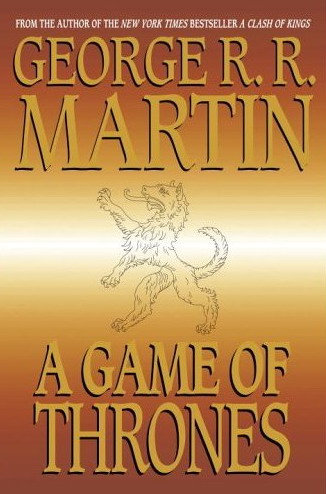
A Game of Thrones by George R. R. Martin

Almost twenty years have passed since the fall of the Targaryen dynasty–twenty years since the last of the dragons was seen in the Land of the Seven Kingdoms.  Now, the libertine Robert Baratheon sits on the Iron Throne, blind to the conspiracies and secret combinations that surround him.

In this dangerous time, Ser Jon Arryn, the King’s Hand, dies of mysterious causes.  Most of the realm accepts the official story that the death was natural, but when Arryn’s wife Lysa sends a letter to her sister, Catelyn and her husband Ser Eddard Stark immediately suspect that the death was orchestrated by the Lannisters.  Only one thing remains: to travel to King’s Landing and uncover the proof.  Soon, King Robert calls on Ser Eddard to become his new Hand, giving them the perfect opportunity to do this.

Little does Ser Eddard know, the intrigue goes much deeper than any of them realize.  For the Lannisters are gathering an army, and Queen Cersei and her brother, Ser Jaime, harbor a secret that would tear the realm apart.  Meanwhile, the last of the Targaryens bears a child prophesied to rule the world, while far to the North, an ancient evil bides its time, waiting to sweep the seven kingdoms with horror the likes of which has not been seen in a thousand years.

Winter is coming–and the people of the Seven Kingdoms are ill prepared to face it.

Everyone seems to be talking about George R. R. Martin’s Song of Ice and Fire series these days–next to The Wheel of Time, it’s probably the biggest epic fantasy line of the last ten or fifteen years.  Martin is well known for killing off his characters and writing in shades of gray, so I thought it would be good to give this series a try.

As soon as I picked up the book, I was hooked.  Martin knows how to craft a beautiful, engrossing fantasy world.  In order to leave no doubt on that point, observe:

Yeah, that pretty much sums up what Martin did with his Land of the Seven Kingdoms. It’s an awesome fantasy world, and I found myself lost in it from the first page.

I must admit, however, after hearing so much about the Song of Ice and Fire series, I was surprised at how few characters died in this book. That’s not to say everyone survived–in fact, Martin killed my favorite character, which made me feel HORRIBLE–but I was expecting there to be more. However, this is the first book in the series, so I assume that the really crazy stuff happens later.

While overall I loved A Game of Thrones, I admit I did have a few misgivings about the book. Martin really does write in shades of gray, and while that makes the story unpredictable and surprising, it also makes things very dark and austere. Martin seems to have no interest in redeeming his characters, and when any of them try to be noble, he cuts them down at every turn.

Personally, I don’t care for that. Flawed characters may be more relateable, but seriously flawed characters (or characters with no interest in overcoming their flaws) turn me off. In this way, Martin is practically the antithesis of David Gemmell; whereas Gemmell makes you love his characters despite their flaws, Martin keeps you reading in spite of the fact that you hate all his characters.

How does he do it? By creating a beautiful, wondrous world. By crafting a masterful story full of intricate twists and turns. By making you hate some of the characters so #%$^! much that you have to stick around and see how they die. It’s all entertaining and extremely engrossing, but at the end of it all, I didn’t come away with any real love for Martin’s characters–except perhaps for a couple of Eddard’s kids, who are still young enough to be somewhat innocent.

I suppose it’s all a part of this new non-conciliatory movement in fantasy. Don’t get me wrong; A Game of Thrones is an EXCELLENT book, but it’s very…non-conciliatory. If that’s your thing, more power to you, but I personally prefer stories about redemption, where romance still lives and even the most unlikely character can be a True Hero, if only for a few fleeting, glorious moments.

Dog dead workdays and killing your characters

This post is going to be super quick because I’m dead tired.

Due to power surges and computer glitches, I had to work overtime today and yesterday at the warehouse, so I really haven’t had time for anything except writing and a little socializing at Leading Edge.  However, things are going well.  I’ll get the extra hours off on Friday, which means a big chunk of free time to do whatever I want.

I broke 3k words today in Mercenary Savior. It was awesome.  I love revision–taking something good and making it really shine.  Just hit some major climaxes and killed off a side character, which is always exhilarating if you do it right.

As a footnote to that, I’m reading George R. R. Martin’s Game of Thrones, and I just reached the part where he kills off the first major character.  What’s more, he was my favorite character in the book so far!!! AAUGGH!  Why, Mr. Martin?  Why???  Yet I must confess, killing him was necessary to take the story to the next level of awesomeness <grumble>.

I’ve been thinking a lot about killing characters recently, and I figure the best way to do it is to recognize that everyone has to go sometime (in real life if not always in fantasy), and to write accordingly.  We tend to ignore our own mortality, when really, there can be so much meaning to it.  After all, to die for something is to make the ultimate sacrifice.  If you make sure your characters die for a reason–either heroic or tragic (or both)–then I think that’s the key to make it work.

The Book Academy Conference at UVU was great; I’ll do a writeup on that soon, probably over the weekend.  I probably won’t post the audio files, but if you want them, just email me and I’ll send you the link.

I’ve been waking up early each day this week, and it’s been great. I’m so much more productive in the morning, writing wise.  It’s like a computer: when you first boot up, your desktop is so clean. With only the startup programs running in the background, everything feels uncluttered.

At the end of the day, though, it’s the exact opposite. You’ve got maybe a dozen applications running, and it’s all too easy to get distracted by switching from one to the other. What’s more, you just don’t have the energy to get things done.

The downside (if you can call it that) is that it’s only midnight and already I’m about to collapse.  Oh well–guess I’ll just have to go to bed earlier.

In closing, let me leave you with this really weird, slightly disturbing anime clip I found on youtube of a vegetable committing seppuko. I guess it has something to do with the rest of the post, seeing as I went on a tangent about killing characters. Anyhow, this is the friendship among vegetables…

Job – reliable internet = spotty posting

Sorry for the general lack of posts these past few days.  I haven’t fallen off the face of the Earth (yet), I’m just working full time and living in a place that doesn’t have reliable internet.  Someone in the complex tried to set up a wireless router, and now the internet is down.  For some reason, the broadweave guys haven’t fixed it yet.

Student housing in Provo sux.

Anyways, here’s what’s going on in my life.  I found a temporary full-time job working in a warehouse.  They let me listen to my headphones while I work, so I’ve been catching up on a lot of podcasts and old recordings from cons and English 318.  It’s actually kind of awesome.  Definitely better than the call center.

I’m in the midst of finishing the research for the “class that wouldn’t die” article.  Basically, I have about half a dozen more interviews to do, then write up the rough draft.  I’m having lots of fun meeting all these awesome people and putting this article together.

But between work and the article, I’m finding it much harder to keep up with my writing.  I’m still producing about 2k consistently, but that’s not quite enough to have Mercenary Savior finished by World Fantasy.  Looks like I’ll have to sprint on the weekends.

I’m not too worried about it at this point, though.  The revision is going great–in fact, I might post a few excerpts.  I know the story’s solid, and the characters are a joy–especially Tamu, the slutty, self-centered concubine that becomes something of a mentor for Stella (to her horror, of course).

The Hameji are also quite interesting; one of my goals in this revision is to portray the rationale for their behavior as clearly as I possibly can.  Towards that end, I have a list of points about their culture that I want to get across in the narrative, and I’m keeping track of which scenes convey which points.  The goal is to have at least three scenes for each point, which will involve some substantial revision.  But if it works, the Hameji will go from horrific, brutal antagonists in the beginning to sympathetic if still brutal by the end–kind of like George R. R. Martin’s stuff.

Speaking of George R. R. Martin, I’m reading A GAME OF THRONES right now and I’m absolutely loving it!  I wish I had the time to sit down and read this book for hours.  Alas, the only way I can do that is to give up writing, and I can’t do that.  Weekends, though–better wait for the weekend.

Anyway, that’s what’s going on.  I’d better go to bed now, before I jinx myself tomorrow morning.  Or maybe I already have?  Blarg.  Night.

Red Mars by Kim Stanley Robinson

For eons, sandstorms have swept the barren, desolate landscape of the red planet.  For centuries, Mars has beckoned to mankind to come and conquer its hostile climate.  Now, in the year 2026, a group of one hundred colonists is about to fulfill that destiny.

I first picked up this book two and a half years ago, when I was still trying to read a novel a week.  I’ve got to be honest; this was the book that made me break that new years resolution.  It is freaking huge, and some points are more interesting than others.

That said, this is an awesome piece of hard science fiction.  Lots of people have written about Mars, but very few have done it believably.  Kim Stanley Robinson does an job here–you can tell that he put in a ton of research, both into Martian geography (areology?) and feasible technology.

When I read science fiction, however, that’s not what I generally read for.  I’m more interested in characters, conflict, and thematic elements–in other words, the stuff that makes for a good story.  As far as that stuff goes, my opinion of Red Mars is somewhat mixed.

For example, the first chapter starts out with a murder, as seen from the point of view of the murderer.  Right away, I’ve got a reason not to sympathize with the main viewpoint character.  When we get into his mind and I see his motivations for killing the character, I like him even less–and he’s one of the main, driving characters.

Some of the characters are more sympathetic, and I enjoyed the sections in their point of view.  Others, however, were just plain boring–I neither loved them nor despised them.  Because of this, a lot of the character drama early in the novel didn’t engage me much; stuff was happening, but I didn’t really care.

When it comes to setting, Red Mars is also somewhat mixed.  Robinson goes to great depths to describe the Martian landscape, and several of his setting descriptions were quite interesting and wonderful.  At the same time, he explains everything in a very clinical, scientific way–his imagery is never as poetic and captivating as Ray Bradbury’s, or Ursula K. Le Guin’s, or George R. R. Martin’s.  I came away with a lot more knowledge about Mars, but not quite as much of a sense of wonder.

Things did get interesting once the political tensions started to come into play.  Robinson’s portrayal of the colonization of Mars raises a lot of interesting questions about the political relationship between Earth and Mars once those colonies start to become self-sufficient.  He follows things through right to the war for independence, and the implications of the conflict are quite interesting.  I finished the last hundred pages or so at a sprint.

All in all, I wouldn’t recommend this book unless you’re already a fan of hard science fiction.  Like most hard sf, character and conflict plays second string to scientific plausibility.  Within its sub-genre, however, Red Mars is awesome.  Let’s just put it this way: even though I got bored with it the first time, I knew I would one day pick it up and finish it.  I don’t regret that I did.

Dying of the Light by George R. R. Martin

Worlorn is a planet without a sun, wandering on the fringes of the galaxy where the skies are starless.  Though it came to life briefly as it passed the red giant Fat Satan, those days are over, and the world is slowly dying.
Dirk T’Larien never thought he would find himself on such a forsaken world. But when his onetime lover, Gwen Delvano, sends him a plea for help, he realizes that more than anything, he wants to have her back.

It will not be easy, however.  Gwen is betheyn to two men: Jaantony Vikary, whom she loves, and Garse Janacek, whom she hates.  Both are from Kavalar, a warlike planet where offworlders are considered subhuman.  And even though Worlorn is slowly dying, a colony of extremist Kavalars has taken root, planning to bring back the old ways when offworlders were hunted like beasts.

I picked up this book at Pioneer Books a couple weeks ago; I saw that it was by George R. R. Martin and decided to give it a try.  I was very much impressed.  For the last hundred pages, I couldn’t put it down, and the story haunted me for a couple days after I’d finished it.

The strongest element of the story was definitely the setting.  The story may be set in a grand galactic empire with spaceships and alien worlds, but make no mistake, this beautiful piece of space opera reads more like fantasy than science fiction.  There’s even a thirty page glossary of terms in the back, for ease of reference.

The effect of Martin’s grandiose worldbuilding is a haunting sense of wonder that keeps you, as the reader, hooked.  The more you read, the more you immerse yourself in the world; and the more you immerse yourself, the more you want to read.  After the story ends, you still find yourself thinking about the fantastic worlds, as if you’ve actually been there.  It’s awesome.

Another thing that kept me hooked was the basic premise of the plot.  The main character, Dirk T’Larien, is trying to win back the affection of an ex-girlfriend and get back together.  That’s something with which I can definitely relate–the ex even has the same name (roughly) as a girl I once chased after (quite unrequitedly, may I add).  Because of this, I was drawn into the story right away.

Martin is known for his plot twists, however, and though the story began as a basic love triangle, it very quickly became… something else.  I’m not entirely sure how to describe it without giving major spoilers, but I will say that I found it impossible to predict how this story would end.  I found that a lot more annoying than enjoyable, however–just when I thought things were headed in a certain direction, something happened to nullify everyone’s efforts and turn things completely around.

Despite this, however, the story…worked.  I don’t know quite how to describe it.  The basic markers were all there, even though they were jumbled in unpredictable patterns.  No death was meaningless, no success was insignificant; there was no excess baggage in the story that didn’t somehow belong.

All around, it was a very good book.  Kind of dark, but not nearly as edgy as I was expecting.  This is definitely the kind of science fiction that a fantasy reader would go for–and probably most science fiction readers as well.

The time sink

Man, life is different outside of school.  So much time, so little structure.  I find that I either write a lot, or I get distracted on some side project and write almost nothing.

For example, my bike broke down last week.  Since that’s currently my only form of transportation besides walking, I spent a good amount of time this week fixing it.  In fact…I took it apart and completely rebuilt it on a new frame.  It was fun, educational, satisfying, and a good way to meet girls, but it took a lot of time away from writing.

Job hunting is another example.  I signed up with a temp agency this past week, but haven’t seen any work yet, so I’m still somewhat antsy.  It’s not easy watching money leave when you have no way to replenish it.  But when your mind is on getting a job, it’s very hard to think about anything else.

I dunno.  Maybe I’m just very bad at multitasking.  But tonight, for the first time in a few days, I put all that aside and completely submersed myself in the act of writing.  Boy, it sucked up a lot of time…but at the end, it felt so good.  So satisfying.

I need more of that, if I’m going to make this writing thing take off.  Got to outline a space for every necessary thing (including writing) and be careful about not overfilling that space.  Looking for work is good, but thinking about it so much that I don’t have time for other things, that’s not good.

In the meantime, I’ll try to find some balance and update this blog more often.  It’s my only active blog now, so I figure I should write more frequently.  One thing I want to do with this free time is read more; I read a George R. R. Martin book last week, and I’m finishing up Dave Wolverton’s On My Way To Paradise for the second time right now.  Expect some book reviews in the near future.

(hmm…I wonder if I could find a way to review books and get paid for it?)

Graduation!

So last week, I graduated from college!  That’s right: college is OVER!  No more papers, no more homework, no more tests or quizzes or theses or final projects…at least until I decide I miss it all and go back to grad school.
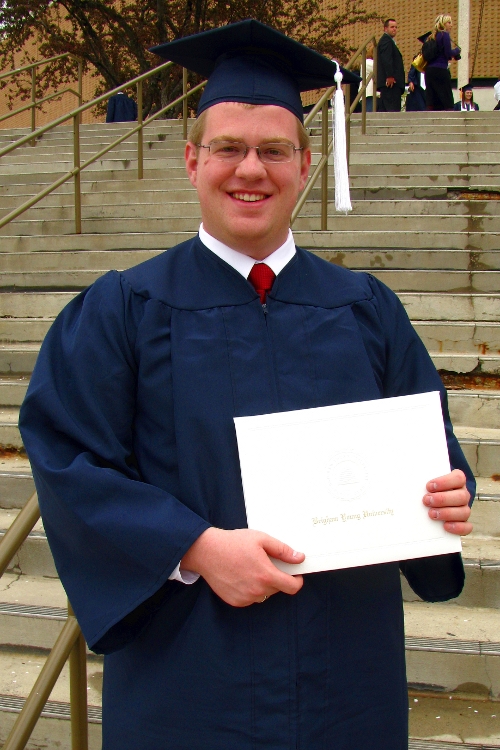
It was a big week, not only because of the ceremonies, but because of all the family that came down for the event.  It was great to see all my sisters, baby Jane, a bunch of my cousins who came down for our Italian barbeque (salad, lasagna, and garlic bread on the porch), and everyone else who came.

The ceremonies were interesting too.  Elder Christofferson gave the commencement speech, and I was very pleased that he referenced Hugh Nibley.  Man, if Nibley were still alive (or maybe if he could come back from the dead), it would be absolutely awesome if he could give the commencement address, but Elder Christofferson was pretty good too.

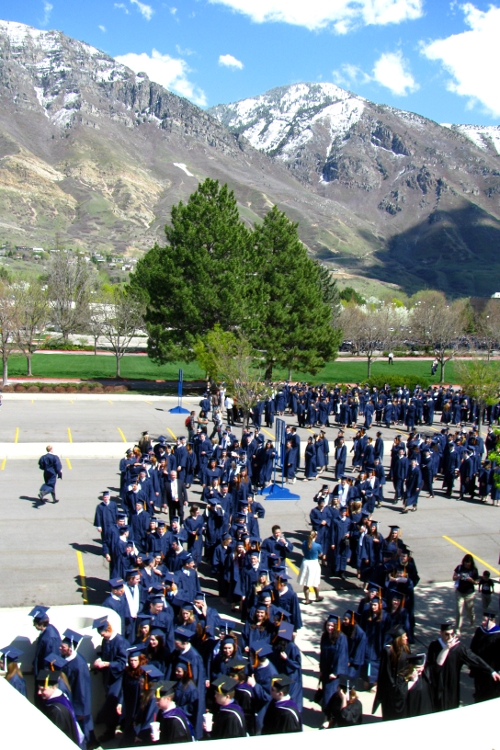
The convocation Friday was very long, but fortunately I snuck a novel in: Dying of the Light by George R. R. Martin.  Made some decent headway in it, too.  There was a very interesting talk, though.  One of the retiring faculty told a story from when she was a student in a wilderness class.

As they were making their way down a river canyon and came to the end of the bank, she thought to herself “it will be alright if I can just keep my boots dry.” As the water became deeper, that changed to “it will be alright if I can keep my pack dry.” Eventually, however, they had to swim, and everything got wet.  Still, they made a fire, dried everything out, and had a good time.

The story was meant to illustrate that life in the real world is like that.  When you start out, you worry about a lot of things, but when you look back after many years have passed, those small setbacks don’t seem like anything to worry too much about.

Well, that’s where I am right now: unemployed, looking for a plan for the next five years.  My plan A is still to break into publishing, but I’m going to need a secondary career or day job to  get by in the short to medium term.  I have no idea what that entails,  but at least I’m graduating debt free, with money in the bank.  That helps.

Two years ago, I was terrified of graduating and setting out into the “real world.” A year ago, I realized I had grown out of college life and needed to move on.  Now, I have no idea what I’m doing, but life is an adventure and I’m confident things will work out for the best.