Fantasy from A to Z: A is for Archetypes

I love fantasy books. I love the sense of adventure and possibility that I feel from reading a good fantasy story. I love how the best ones transport me to worlds untainted and unpolluted by modernity, rich in their own history and culture. I especially love it when these worlds are populated with characters who I feel could be my friends, their stories told in such a way that I almost feel I know them better than I know myself. 

Every literary genre is defined by the primary emotions they are supposed to evoke in the reader. Thus, romance is all about the emotions associated with love and longing, horror is all about the emotions associated with fear and dread, mystery is all about the emotions associated with discovery and making sense of the world, etc. 

Fantasy and science fiction are the two major divisions of the speculative fiction genre. The way I like to think of them is like two sides of the same coin. Both are defined by the sense of wonder they evoke, but where science fiction tends to be oriented toward the future, fantasy is oriented toward the past. 

To me, this is the biggest thing that distinguishes fantasy from science fiction: the deep, almost nostalgic yearning for a long-forgotten past. This goes much deeper than superficial aesthetic details, such as the idea that if your story has trees, it must be fantasy, but if it has rivets it must be science fiction. Trees hearken back to a world before the modern era, when we lived much closer to the rhythms of nature. Rivets, on the other hand, hearken to a world utterly reshaped by human technology and engineering.

But if this is the case—if fantasy is all about a nostalgic yearning for a lost, pre-modern age—why does so much fantasy take place in a world that is not our own? Yes, if you read the lore for J.R.R. Tolkien’s Middle Earth and Robert E. Howard’s Hyborean age, you eventually learn that these worlds are supposed to be far ancient versions of Earth—but no one thinks or cares about that when they’re reading the stories. And these days, most fantasy worlds don’t even try to pretend that they have a connection with Earth. So how can they possibly channel that sense of nostalgic yearning?

Through archetypes.

“Type” is another word for symbol, and “arch-” is a prefix meaning the chief or principle thing. Thus, an “archetype” is the chief or principal symbol of a thing, such that every real-world example of that thing is a manifestation of its archetype. 

It’s kind of like the inverse of a stereotype. When we stereotype someone, we mentally categorize them based on superficial characteristics like race, gender, age, etc, purposefully ignoring the things that make them different from other people. We start broad and go narrow. Archetypes, on the other hand, start narrow and go broad. The archetype of a hero slaying a dragon can be taken to represent anything from confronting childhood trauma to overcoming a deep-seated addiction—or something completely different. 

The dragon starts off small, hatching from an egg, but if it is not slain when it is young and non-threatening, it grows into something huge and fearsome and almost impossible to slay. It also guards a horde of treasure, which can only be won by slaying it. Does that remind you of anything in your own life? If the story is told well enough, it should, because of how it points to certain universal truths. A problem that isn’t solved when it is small will often grow until it is almost impossible to solve. The greatest reward can often only be gained by doing the most difficult thing.

The best fantasy books use archetypes to evoke that sense of wonder that defines the genre—and because these archetypes are so timeless, they often evoke a sense of familiarity and nostalgia. In the best books, they also imbue the surface-level story with deep layers of meaning, making it a rewarding experience to come back and reread it again.

I love stories that are full of meaning. But in order to be truly meaningful, a book shouldn’t set out with a specific message in mind. Rather, the best books use well-constructed archetypes to resonate with the ideas that the author wants to explore—and often, the readers will draw conclusions that the author never consciously intended. To me, this is the hallmark of the best kind of fantasy book—and of archetypes done well.
Short-form vs. long-form fantasy

For the last month, I’ve been doing a lot of research into the fantasy genre, rereading all of the original Conan the Barbarian stories by Robert E. Howard and a bunch of the other ones too, by authors like L. Sprague De Camp, Lin Carter, Bjorn Nyberg, Robert Jordan, etc. I’ve also been reading a lot of epic fantasy, like the Wheel of Time series by Robert Jordan and the Stormlight Archive by Brandon Sanderson. And I’ve also read some essays on the genre, most notably “The Critics, the Monsters, and the Fantasists” by Ursula K. Le Guin, and “The Making of the American Fantasy Genre” by David Hartwell. Oh, and opening a bunch of chats with ChatGPT, though those are of limited usefulness (for some reason, ChatGPT hallucinates like crazy when you ask it to recommend any noblebright fantasy that isn’t more than two or three decades old).

From what I’ve gathered, there are basically two camps or schools within secondary-world fantasy: the heroic / sword & sorcery camp, based off of Howard’s Conan the Barbarian, and the epic fantasy camp, based off of Tolkien’s Lord of the Rings. According to David Hartwell, those are the only two franchises to achieve breakout success: everything else has either achieved only moderate commercial success in its time before petering out, or gained only a niche audience. Apart from Conan, the fantasy genre as a whole didn’t really take off until Terry Brooks immitated Tolkien with his Shannara series, thus launching a wave of Tolkienesque epic fantasy in the 70s and 80s that morphed into Grimdark in the 90s, 00s, and 10s.

So for a while, I was looking into all the various tropes and archetypes that make Conan and LOTR tick, and trying to use those to differentiate the two. But lately, I’ve been wondering if maybe I’ve been overthinking all of this, and the real difference between the two is that Tolkien mastered long-form fantasy, and Howard mastered short-form fantasy. In other words, what if the defining difference between the two camps doesn’t have to do with tropes so much as with the length of the actual story?

I suspect that short-form fantasy is poised to make a resurgence, especially with all of the challenges associated with writing and selling long-form fantasy in the 2020s. Larry Correia is right: Rothfuss and Martin have ruined the epic fantasy field for new authors by failing to finish their series in a reasonable timeframe. Unless you are independently wealthy or already have a large and loyal following of readers, it just doesn’t make commercial sense to write a lengthy series of +200k-word fantasy epics. Better to write shortier, punchier 40k-word novels instead, especially if you can churn them out every other month or so. That seems to be the model that works best for indies, at least in adjacent genres like urban fantasy and paranormal.

Anyway, that’s my current thinking on the subject. What’s your take on it?

G is for Genre

Are there certain genres that indie writers should write in if they want to be successful? Are there other genres that they should avoid?

This is one of those pieces of common wisdom that really irks me, and not just because I write in a genre (science fiction) that isn’t as mainstream or popular as others. I think it’s a myth that you have to write in a “hot” genre in order to have success, especially if you’re an indie author. Here’s why:

1. You don’t have to be a bestseller to be an indie success.

This is something that Hugh Howie repeats all the time: that the true success stories in self-publishing aren’t the mega bestsellers like him or Bella Andre or H.M. Ward or Amanda Hocking, but the thousands and thousands of little guys who are carving out a comfortable space for themselves in this new world of publishing. You don’t have to be a huge bestseller to make a living as an indie writer–you can do quite well for yourself with a small but dedicated fan base.

I’m sure there are some people whose personal definition of success includes the kind of fame and recognition that comes along with being a bestseller. That’s fine–everyone has to define what ‘success’ means for themselves, based on their own personal goals and dreams. But being a bestseller is definitely not the baseline, at least for an indie writer.

2. Ebooks and epublishing have opened exciting new opportunities for niche genres.

Before epublishing, you needed a fairly extensive infrastructure to bring a book to market. Besides designing the book, you had to pay for printing, pay for shipping, pay for distribution and marketing to bookstores, pay for returns and remainders … the list goes on and on. Consequently, it was harder for niche genres to really get a foothold.

With ebooks, the economics of publishing have been flipped on their head. The marginal cost of producing another ebook is zero–digital content can be copied endlessly at virtually no cost. Shipping costs are also zero, and global distribution is as easy as uploading the book to Amazon’s servers–again, at zero cost.

Because of this, there’s room now for niche genres with much smaller readerships to actually turn a profit. And that’s what we’re seeing–an explosion of all sorts of niche, specialty, and experimental new genres. Books no longer have to be just like the Latest Big Thing (only different) in order to earn back their costs. There’s room for everyone in the new world of publishing.

3. It’s better to write what you love than to write what you think will sell.

The two aren’t always mutually exclusive, of course. Maybe you love a variety of genres, so that you’d be equally satisfied writing romance as you would writing something more niche like Amish vampire steampunk. But if all you’re doing is chasing the money, chances are that your heart won’t be in it nearly as much as it would if you were writing what you love. And if your heart isn’t in it, you won’t be able to bring that creative passion to the project that readers really love.

When I wrote Star Wanderers, I was following my passion. It was a science fiction story unlike any I’d either written or read, but I followed it where it took me without worrying whether it would sell. The genre description that best fits that series would probably be romantic frontier space opera–definitely a niche. But because I was passionate about it, the books were able to find readers who share that passion and touch them in ways that other books hadn’t. And guess what? Those are my best selling books.

There is a business side to publishing, but there is also an artistic side. You’ve got to be true to both. If your inner artist thrives on the challenge of chasing the market, great–go for it. But if doing that feels like you’re being unfaithful to your creative vision, you’ll probably write a better book if you strive to be authentic. And ultimately, I think that authenticity has a lot more to do with a book’s success than the genre it’s written in.

Readers are far, far more diverse than we give them credit. So long as you can write well and tell a good story, you can find success no matter which genre you write in.

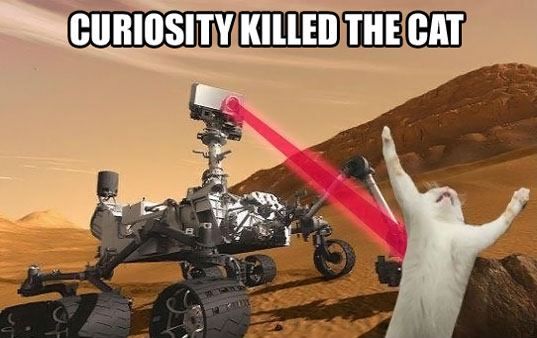
Trope Tuesday: Curiosity is a Crapshoot

curiosity
Is there life on Mars? NOT ANYMORE!

Is curiosity a bad thing?  Well, it depends how genre savvy you are.  It seemed to work out pretty well for Alice, but not quite so well for Pandora (or the rest of the ancient Greek world, for that matter).  Curious monkeys seem to come out all right, and their constantly curious counterparts also seem to do okay in the end, but anytime you run into schmuck bait you know that things aren’t going to turn out well.

The truth is, for just about every stock Aesop warning about the perils of being overly nosy, you can find another one exalting it as a virtue.  In fact, you could say that curiosity is a crapshoot.

But what is curiosity exactly?  The Merriam-Webster dictionary defines it as “desire to know,” and “interest leading to inquiry.” As you can imagine, there are situations where this could be good or bad.  Thus, what a story says about curiosity often changes depending on its genre.

For example, in most horror stories, curiosity and nosiness are usually bad, leading the protagonists to go places where they shouldn’t and uncover things that should never have been uncovered.  At the same time, a lack of curiosity can also be fatal … in fact, a lot of things can be fatal in a horror story.

In mythology and folklore, curiosity is often even worse.  From Pandora to Eve, Psyche to the proverbial cat, curiosity leads to Very Bad Things.  Perhaps this is because these kinds of stories are mostly tales of warning, passed on from generation to generation as a way to preserve our collective knowledge about the dangers of the world, rather than inspire us to go out and face them.

(As a side note, there are a few exceptions in the realm of folklore.  In the Bluebeard myth, curiosity killed off all of Bluebeard’s previous wives, but combined with cleverness, faith, and friendship, it saved the last one’s life.)

In fantasy, curiosity is often a mixed box bag.  For example, take the hobbits: most of them are perfectly content to live out their lives in the shire, but the few who are inquisitive enough to venture outside end up saving the world in a way that the elves, dwarves, and humans never could.  At the same time, it puts them through a great deal of pain, even after the world is saved–neither Bilbo nor Frodo are ever able to be content in the shire again.

Curiosity, in other words, is complicated.  It’s not just a quirk or a character flaw–it’s an underlying quality of the hero’s journey.  Without curiosity, either of the world around him or the internal struggles within, the hero would be content to live out an unremarkable life.  Certainly he wouldn’t have the capacity for the cleverness, guile, wisdom, and sensitivity that he needs in order to descend into the darkest dungeon, face his own nadir, and return with the elixir of life.  Curiosity may lead to sorrow, pain, or even death, but it also leads to adventure.

As a subgenre of fantasy, many of these issues carry over into the realm of science fiction.  And yet, as a genre unto itself, science fiction has a distinctly positive view of curiosity compared to other genres.  Science is nothing if not the primary process of human inquiry, where curiosity is not only a virtue but the virtue, one of the most important aspects of humanity.  Consider these words from Adam Steltzner, one of the leading engineers of the NASA Mars Curiosity mission:

Likewise, curiosity is a staple of science fiction.  In Star Trek, it’s the basis of the entire mission: “to explore strange new worlds, to seek out new life and new civilizations, to boldly go where no one has gone before.” In Doctor Who, it’s how the Doctor finds his companions.  In Babylon 5, it’s Delenn’s curiosity about the humans that ultimately saves all the alien races.  And in 2001: A Space Odyssey, it’s the gift from the black monolith that helps monkeys to turn bones into space stations (well, not literally, but you get the idea).

Curiosity isn’t a central theme in most of my books, but it is a major part of Genesis Earth.  If anything, that book is about the importance of balancing curiosity about our universe with curiosity about ourselves and what it means to be human.  In Star Wanderers, Noemi’s curiosity is a huge part of her story, helping her to turn around a horrible (not to mention awkward) situation.  In Desert Stars, curiosity is complicated; it leads Jalil far away from home and puts a schism between him and the girl who loves him, but it also leads him to discover the truth about who he is, giving him the strength to return.

In general, I suppose it all comes down not only to genre, but to the underlying worldview of the author of the story.  Since I have a very positive and enthusiastic view of curiosity, it usually works out for the best in the stories that I write. Then again, perhaps that’s why I’m drawn to science fiction … how about you?

Thoughts after finishing Vortex by Robert Charles Wilson

Whoa.

If I had to sum up my thoughts with one word, that would be it–though of course, by itself that word is hopelessly inadequate.  Let’s just say that, for me at least, this  was a truly astounding book, a literary journey that left me wide-eyed with my mouth hanging open, blinking wearily as I looked up from the last page and returned, reluctantly, to the world of physical reality.

I don’t plan to spend this blog post talking about how awesome this book is, however; I’ll save that for a review.  Rather, I want to spend some time talking about how this book has influenced the way I think about science fiction and my own writing, and to share a few of my thoughts having just finished it less than an hour ago.

If anything, this book has shown me that science fiction–real science fiction–is about staring into the unblinking void of the cosmos with a deep and abiding need to find answers, or perhaps more accurately, to ask questions.  This inevitably produces a sense of wonder, but that’s merely incidental; the genre is really about fulfilling an almost religious need to connect with something greater than oneself.

I enjoy reading science fiction and experiencing that connection, but I don’t need it–not in the way that I sense some of the grand masters of the genre truly did.  Instead, I hunger for the sense of wonder and adventure that is more characteristic of fantasy.  In my own writing, it’s not so much the grand sweep of the cosmos that interests me as much as the intimacies of human nature–which isn’t to say that the two are incompatible, but that my preferences lean more to the one than the other.

What I’m saying is that it’s not science fiction that I write, so much as science fantasy.  I still feel drawn to space adventures and the trappings of science fiction–I’m not at all interested in writing about elves or dragons–but at their heart, the books I write are more fantasy than true science fiction.

Which might be a purely esoteric distinction to the average reader, but if it helps me to understand my own writing, it’s a distinction worth making.  If science fantasy is the sub-genre that really speaks to me, then that’s the kind of literature that I should explore.  Of course, it’s important to be well-read in multiple genres, but if there’s a particular one in which you want to write, it stands to reason that that’s the one on which you need to be an expert.

So that’s my new goal: to explore fantasy, science fantasy in particular, and the ways in which other sub-genres like space opera and space adventure lean more toward the fantasy side of things than pure science fiction. And to keep reading really awesome books.