Trope Tuesday: Smart People Play Chess

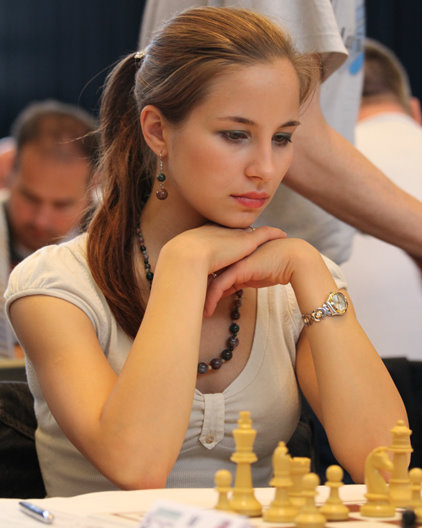
Why?  Because Anastasia Gavrilova playing chess is HOT.
And if you’re Anastasia Gavrilova, chess gives you +10 charisma as well.

Want a fast and easy way to show that your characters are smart?  Not bookish, necessarily, or nerdy, or even the designated smart guy in the five-man band, but intellectually adept no matter what else their role in the story?  Well, you could indicate that through inordinate loquaciousness, but too much of that tends to make your dialog unreadable (not to mention, it’s way overdone).  You could have them rock a chalkboard, but not every story takes place in high school, and finding a chalkboard outside of academia is a bit of a challenge.  So what else can you do to indicate a high level of intelligence?

Show them playing chess.

It’s true.  Stereotypes aside, one of the most effective ways to indicate that your characters are intelligent is to show them playing chess.  From Star Trek to Discworld, Independence day to Doctor Who, Big Bang Theory to Harry Potter to Command & Conquer, chess is a fast, dirty, and effective way to show intelligence.  And while popular conceptions of chess nerds give the game a bit of baggage, it’s not as bad as you might think.  Sure, Sheldon might fit the stereotype, but Cain and Spock certainly don’t.  Even David Levinson from Independence Day turns out to be something of a badass in the end.

So why is chess such an effective way to show that a character is smart?  Probably because of all the other tropes associated with chess.  As one of the oldest and deepest strategy games of all time, chess is thoroughly embedded into our cultural consciousness.  Chess motifs are common in all sorts of stories, and the chess master is a significant character archetype.  There’s a reason we call the most complicated gambit pileup Xanatos Speed Chess.

Besides all the archetypal reasons for this trope, there are quite a few real-world reasons as well.  Playing chess can potentially do all sorts of interesting things to your brain, like stave off Alzheimer’s and improve your concentration and problem-solving skills.  All over the world, people associate chess skills with intellectual prowess, and after you’ve played a few games, it’s not hard to see why.  According to Carl Sagan, the game requires “strategy, foresight, analytical powers, and the ability to cross-correlate large numbers of variables and learn from experience.” If you’ve got all of those, chances are you’re at least above average.

Of course, this trope can be inverted in some clever and interesting ways.  In Bill and Ted’s Bogus Journey, for example, the ditzy main characters challenge Death to games of Battleship, Clue, Twister … basically, a whole host of non-cerebral games, in lieu of the expected trope.  In Foxtrot, the only character who loves chess is the Dad, who is rather dumb compared to his kids (maybe they all got bored of it?).  The classic example, though, has got to be Star Wars, where Chewbacca’s emotional impulsiveness is lampshaded over a game of <X> chess:

I haven’t used this trope a whole lot in my own work yet, but I just started work again on The Sword Keeper, an epic fantasy novel where chess tropes are going to be a major part of the story.  The mentor figure is something of a chess master, though because he’s a sentient sword he can’t experience or interact with the world except through his telepathic connection with the main character, a simple tavern girl.  She knows the basic rules of chess, however, (“chadrak” in this universe) and so one of the ways the sword trains her is through putting her through chess scenarios.  Later, it becomes apparent that the story itself is kind of like a game of chess, with the major characters loosely correlating with the different pieces, and the main character as the queen.  I’m excited–it’s going to be really cool. 😀

So yeah, this is definitely a trope you’re going to see from me in the future, and not just as a one-scene throwaway either.  Stay tuned for more!
Some thoughts on internet access, self-discipline, and productivity

As many of you probably know, for the past four months I’ve been living in a small Georgian village in the foothills of the Caucasus Mountains.  It isn’t as remote as some places in this country (like Tusheti, where some people still practice pagan animal sacrifices), but my internet access has been limited, especially compared to the 24/7 access I had back in the States.

I knew that coming in, and was actually looking forward to it.  I had the option to buy a USB stick from the phone company that would give me service, but I wanted to experience living off the grid for a while to see if that would increase my writing productivity.  Long story short: it didn’t.

In order to use the internet, I have to take a marshrutka (small passenger bus) about half an hour to Kutaisi, where the most convenient place to get wifi is McDonalds.  I can usually go for two or three days without internet, but so many other things in my life (work, family, publishing) are tied up in it that it’s not a good idea to go much longer.

Since each trip takes a huge chunk out of my day, it’s become a lot harder to keep and maintain any sort of momentum on any of my writing projects.  Also, cutting out the internet hasn’t increased my self-discipline at all, it’s just driven me to find different ways to distract myself.

In the end, I think I actually would have been more productive if I’d ponied up the 70 GEL and bought a USB stick from the phone company.  I certainly would have saved a lot of money, considering all that I’ve spent on these trips to Kutaisi.  But at least I’ve learned a few things from the experience.

First, I’ve learned that all of the high-priority things that I absolutely must do on the internet only amount to an hour or two each week.  And even for most of those things, it isn’t a disaster if I put them off for a day or two.  It’s possible to structure your internet time around everything else in your life, rather than vice versa.  In fact, that’s almost certainly a better way to live.

Second, the enjoyment I get from recreational internet usage maxes out after about two hours.  Anything beyond that, and I become something of a zombie.  It’s a weird feeling when you run out of things to do on the internet, but when you realize that you don’t actually enjoy scrolling down an endless list of photos and status updates, it’s a lot easier to pull back and say “no.”

Third, you don’t need social media to sell books.  I made more in book sales in the first week of this month than I did in the first quarter of this year, and my Facebook and Twitter pages are a wasteland.  It might help you if you already enjoy that sort of thing, but it’s not an absolute requirement for success.  Certainly, you don’t have to open a vein and spill everything.

Fourth, exercising good self-discipline doesn’t mean cutting something completely out of your life, but learning how to properly manage it.  The internet isn’t an either/or thing, it’s a matter of finding and maintaining the proper balance.  In the future, I plan to do what Dean and Kris recommend, which is to have two computers: one for internet usage, and one for writing.

Fifth, for me personally, it’s actually healthy to have a couple of harmless distractions available while I write.  I deleted all of the games off of my computer about a month ago, and I haven’t been able to write more than a thousand words a day ever since–often, much less.  Before, whenever I hit a rough patch, I would play a quick round of super-melee in Star Control II and come back to it with fresh eyes.  Without that, I find myself taking my butt out of the proverbial chair and wandering around until I find something else to do, which inevitably takes more time and energy.  A lot of games (Tetris, Spider Solitaire) are addicting and should be nixed, but for me personally at least, opening up something that isn’t a time-sink can actually help to keep me going.

That’s just about all I can come up with now.  I’m sure there are other lessons to be had, but these are the major ones.  I’m coming back to the States on the 31st, and should be back in Utah in time for LTUE and Conduit.  It’s going to be interesting living with 24/7 internet access again; hopefully, it won’t be too hard to adapt back.

Life in Georgia is like a game of backgammon

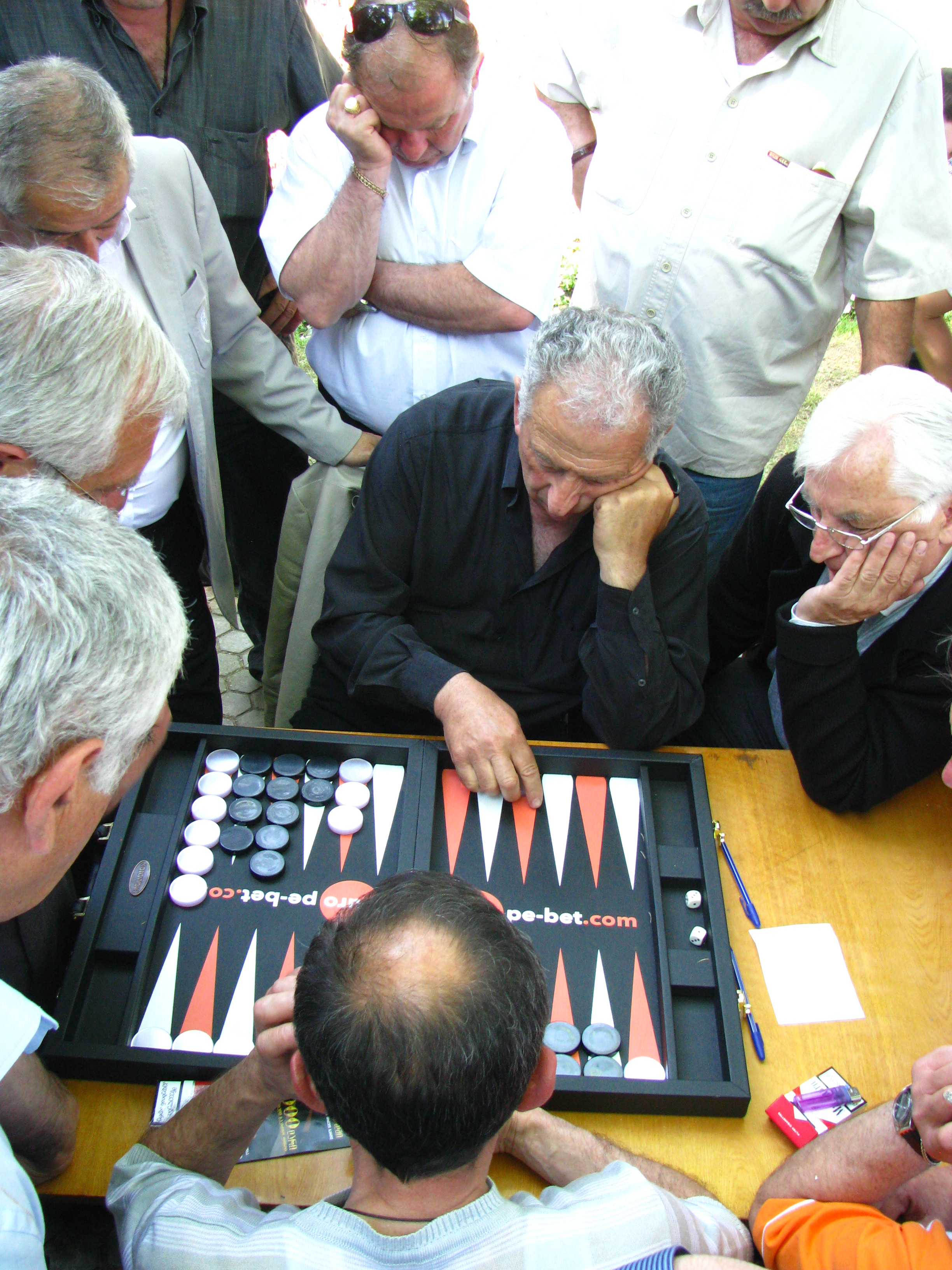
Just another game of high stakes backgammon.

Everywhere I go, I see people playing ნარდი (“nardi”), known in English as backgammon.  Men and women, children and the elderly–everyone knows how to play, and just about every family owns a backgammon set.  It’s popular everywhere in Georgia, but it’s especially popular here in Kutaisi, where it’s not uncommon to see clusters of old men playing on the side of the street.

I recently played in a nardi tournament at my school.  Long story short, I was massacred (I still want a rematch with the principal), but the experience got me thinking about how the game kind of parallels what life is like in Georgia.  As a foreigner, I’m sure I don’t have a complete picture, but it’s an interesting way to look at things, and I don’t think it’s completely off base.

So anyways, here’s my theory on how life in Georgia is like a game of backgammon:

1: Everything is driven by chance.

In backgammon, every turn starts with a roll of the dice.  Likewise, in Georgia, people tend to approach life like a game of chance.  Good things happen, bad things happen, but you’re never totally in control of your own destiny.  When your luck turns sour, the best thing you can do is just resign yourself to it until things get better.

One thing I’ve noticed about my host family is that they play the lottery almost every day.  Even when they aren’t playing, they usually tune in to see the results, probably just from force of habit.  I don’t know if every family is like this, but there are stands to buy lottery tickets in every major district of the city, and every kiosk sells them.

It’s not just the lottery, either–there are tons of casinos too.  In fact, Georgia is a very popular tourist destination for Israelis simply because of all the gambling.  That doesn’t mean that everyone in the country is a hardcore gambler, though–but if life is ultimately a game of chance, you might as well put a line or two in the water, right?

2: Skill is the ability to manipulate chance in your favor.

Even though backgammon is essentially a game of chance, there’s a lot of strategy to it too.  The key is to maximize your own options while limiting the options of your opponent.  It’s all about knowing when to move aggressively, and when to protect your own interests.

Likewise, even though Georgians put a lot of trust in luck, they also know that it’s better to make your own luck than to wait for luck to find you.  While my host family does spend a little bit on the lottery, they spend a lot more on physical improvements and their kids’ education.  My host dad works until 8pm every night, sometimes later.  They aren’t rich, but they’re taking advantage of opportunities their parents didn’t have, and making sure their children have more opportunities than they did.

3: No amount of skill can change the established pattern.

There’s not a whole lot of variation in backgammon.  Every game starts with the same setup, and follows the same general pattern: block your opponent while doing your best to advance.  Once your last piece passes your opponent’s last piece, it becomes a race to see who can get all their pieces home first.  Short of changing the rules, there’s really no way to break the game.

Likewise, life in Georgia is still very much about tradition.  If you were born in Kutaisi, you’ll probably die in Kutaisi.  If your parents are Orthodox, then that’s what you are, too.  If you’re a woman, you live under a certain set of restrictions and expectations.  Likewise, if you’re a man, there are certain things you’re expected to do to prove your manhood.

No matter how much Georgia changes to become part of the modern world, it’s an ancient country with a very, very long memory.  Most social norms aren’t going to change overnight, and some of them probably won’t change at all.  While this might seem incredibly stifling to us in the West, it does have its advantages, such as offering everyone a sense of identity and giving them a place where they know that they belong.

So that’s my theory.  I don’t know if this is why backgammon resonates so much with the people here, but it’s a fun way to look at it.  Now I just need to figure out which game is the most like life in the US.  Poker?  Monopoly?  Dungeons & Dragons?