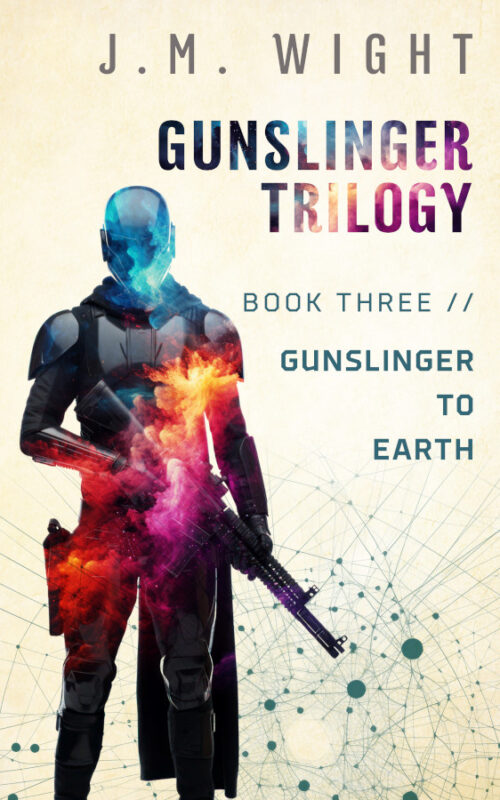
At its core, Gunslinger to Earth, the space-opera finale of the Gunslinger Trilogy, asks a simple but lifelong question: What do you choose to believe when the universe refuses to give you certainty? When Earth vanishes into an impossible anomaly—and later reappears transformed—no one can prove exactly what happened. The characters must decide for themselves what is true, what is worth fighting for, and who they will become in the face of the miraculous.
Where the Idea Came From
The theme grew out of a major turning point in my own life. I started this book just after I began dating the woman who would become my wife and while I was reinventing my writing process to tell better stories. It was a season of uncertainty, hope, and change, full of questions I didn’t know how to answer. That personal crossroads naturally shaped the theme of the story into one about faith, conviction, and choosing a future even when you can’t see what comes next.
How the Choice to Believe Shapes the Story
Throughout Gunslinger to Earth, every major character is confronted with a moment where proof is impossible, but a choice is required. Rex must decide whether to trust Charlotte, whether to follow Sam and Jane, whether to cross the wormhole, and ultimately whether to stay in paradise or return to a mortal life with someone he loves. No one can make these choices for him—not Sam, not Jane, not Charlotte—because the heart of his journey is learning to choose his own truth instead of waiting for certainty that will never come.
On a cosmic scale, the entire plot turns on the same dilemma—an end-times science fiction mystery wrapped in the language of prophecy. The anomaly that swallowed Earth may be the fulfillment of ancient prophecies, or it may be an alien event we don’t yet understand. Mahijah may be exactly who he claims to be, or something else entirely. No lab test or political briefing can answer those questions. Sam, Jane, Rex, the empaths, and the remnants of Earthfleet all have to decide for themselves what they believe—and those choices lead them to the endings they earn. The story isn’t about proving the miracle; it’s about how people respond when the miraculous breaks into their lives—the heart of the choice to believe.
What the Choice to Believe Says About Us
We all live in a world where certainty is rare, where conflicting stories demand our loyalty, and where the most important truths—love, faith, family, hope—are things you commit to long before you can prove them. Gunslinger to Earth reflects that deeply human reality in a character-driven science fiction way. It suggests that belief isn’t about having perfect evidence; it’s about having the courage to choose who you’re going to be and what kind of future you want to build. At the end of the day, the world is shaped not just by what happens to us, but by what we decide to believe about ourselves, about others, and about the meaning of our lives.
Why This Theme Matters to Me
When I wrote Gunslinger to Earth, the closing volume of the Gunslinger Trilogy, I was learning to make those kinds of choices in my own life—about faith, about love, and about the kind of writer and person I wanted to become. It was a moment when I had to step forward without seeing the whole path. That experience shaped the story in ways I couldn’t fully articulate at the time, but I can see clearly now. This book matters to me because it’s ultimately about hope: the hope that even in chaos, even in uncertainty, we can choose what we believe—and those choices can lead us somewhere good.
I am 90% certain that the views I am about to share are the reason that I was disinvited as a panelist from LTUE, Utah Valley’s local science fiction convention/symposium. LTUE used to be a fantastic convention, and I still have a lot of friends who are regulars there. But sadly, the convention has become increasingly woke in the past few years, and now appears to be entering the “go broke” phase of that process. It didn’t help that just a few weeks before the 2022 convention, they decided to require proof of vaccination from all attendees, and refused to offer refunds on memberships that had already been purchased.
I recognize that I probably wouldn’t have been disinvited from the convention if I’d just passively gone along with the preferred pronouns thing, staying in my lane and not making waves. But here’s the thing: because of my personal views on the issue, that would have been moral cowardice. And moral cowardice is, I believe, the root cause of much of the insanity happening in the world today. It’s the reason why those 19 kids in Uvalde, Texas are dead: because of the moral cowardice of the police who refused to do their damned jobs and stop the mass shooter. It’s the same moral cowardice that allows evil people in high places to silence their underlings, for fear of losing their pensions, or positions, or jobs, or whatever. It’s the same moral cowardice that allows groomers and radical ideologues to use social media to dominate the culture war, because good and reasonable people are afraid that if they say what they honestly believe, they will incur the wrath of an online mob and be canceled. I don’t agree 100% with Tim Pool on how to put this principle into practice, but I do agree that arguing “I have kids, I can’t afford to be canceled and lose my job” isn’t enough to absolve you of your moral cowardice. The only way to reverse the madness that our world is currently passing through is for a critical mass of us to stand up, be brave, and reject the moral cowardice that has gotten us into this mess in the first place. After all, it’s not like the nature of evil has changed in the last few years.
So I hope you’ll excuse the rant, but the things I’m about to say are things that would qualify me as a moral coward if I refused to say them. I believe them that firmly. And before anyone accuses me of “violence” (as we see so often from those who wrongly conflate speech for violence and violence for speech), I want you to know that there is no hatred or malice in my heart that is driving me to say these things: only a firm and unyielding conviction of the truth, as I understand it.
In the last few years, it has become fashionable for people to post their “preferred pronouns” on their online profiles, or to give their “preferred pronouns” when introducing themselves. The underlying idea is that it is wrong to assume a person’s gender, and that if someone considers themselves to be queer or transgender, we should all affirm their delusions. Indeed, calling transgenderism a delusion is enough to incur the wrath of the online hate mobs and get you canceled for being a “transphobe.” But here’s the thing:
I will not respect your pronouns.
I will never respect your pronouns.
“Preferred pronouns” are a form of controlled speech, and controlling people’s speech is how you control their minds. But I don’t want my mind to be controlled, especially not by people who I believe to be deluded at best, and malicious at worst. People who would like to see my views silenced and my person canceled.
You see, I reject the idea that gender and biological sex are separable. I believe that gender is innate, immutable, and biologically essential. Yes, I recognize that there are nuances to the biology of sex, like people who are born with XXY chromosomes or other intersex conditions. It doesn’t change my personal view that gender and biological sex are inseparably connected.
My views are rooted in my personal faith. In fact, my church’s teachings are very clear about the role of gender in our lives:
All human beings—male and female—are created in the image of God. Each is a beloved spirit son or daughter of heavenly parents, and, as such, each has a divine nature and destiny. Gender is an essential characteristic of individual premortal, mortal, and eternal identity and purpose.
So for me, the question of gender is not a small issue. It is central to my faith, which makes it a hill that I am absolutely willing to die on.
But here’s the thing: if you don’t share my religious views, I totally understand. I’m not trying to preach to you, or convert you, or force you to accept my views on this issue. We can agree to disagree and still get along just fine with each other, even if you believe in transgenderism and preferred pronouns.
I just want you to return the favor.
When you try to control my speech by insisting that I use your “preferred pronouns”–especially when you get all worked up about it–what I hear is “fuck your religion, fuck your faith, fuck your God, and fuck you. Bend the knee, you transphobic white supremacist, or I will put a target on your back and destroy you.”
No, thank you.
I’m not going to deny a central tenet of my faith. I’m not going to be cowed into affirming something that I believe to be wrong. I hold no malice toward those who disagree with me, but I refuse to live by lies or to bend the knee to the false gods of the woke regime.
And because of how important this issue is to me, I’m not going to be passive about it, either. That is why my “preferred pronouns” are His Majesty / His Majesty’s. I am 100% serious about that. And don’t forget the capitalization, you bigot.
“But Joe! How can you insist that people use your preferred pronouns when you refuse to use theirs? Doesn’t that make you a hypocrite?”
You need to familiarize yourself with Saul Alinsky’s Rules for Radicals, my friend. Rule 4: “Make the enemy live up to its own book of rules.” Also, rule 5: “Ridicule is man’s most potent weapon. There is no defense. It is almost impossible to counterattack ridicule. Also it infuriates the opposition, who then react to your advantage.”
When I started doing this, it was just a harmless joke. Intuitively, though, it just didn’t seem right to answer “what are your preferred pronouns?” with the blandly normal (and thus obviously discouraged) “he/him.” I didn’t go out of my way to make that joke, but in instances where I couldn’t avoid it, such as when the submission guidelines (or convention questionaires) required that I give my preferred pronouns, that was the answer I always gave.
And I sincerely believe that it is the right answer. I didn’t choose this ridiculous regime, but if you’re going to force me to live under it, then I’m going to make you live by your own rules, dammit. That’s what you get for trying to control my mind by controlling my speech. And if you’re going to blacklist me, or disinvite me, or call me a “transphobe,” or otherwise excommunicate me from your society, so be it. I will not bend the knee.
A man is an adult male human. Pronouns: he/him.
A woman is an adult female human. Pronouns: she/her.
They/them is typically used to indicate plural, but can be used in some circumstances to refer to an individual when it is not possible to determine their gender. However, no one’s gender is inherently such that “they/them” pronouns are requisite in all cases.
If that offends you, get over yourself. I say that with all of the love in my icy cold heart. Seriously, you will be happier, healthier, and more fulfilled if you change your life to conform to reality, rather than trying to change reality to conform with yourself.
But I’m not going to force your speech. If you want to post your “preferred pronouns” on your profile, or introduce yourself with them, I’m not going to be offended or try to stop you. I just won’t use them.
As for my “preferred pronouns,” how you respond to those tells me everything I need to know about you.
I never know which posts of mine China Mike Glyer is going to pick up for his pixel scroll, or whatever he calls the daily bucket of chum that he feeds the folks over at File 770 (the ones who aren’t Chinese bots, anyway). I’ve written at much greater length about my 2022 reading resolution here, and my insights and impressions gained through the experience here and here, but for some reason the post he decided to pick up was the last one. Perhaps he thought that it would be better at ginning up outrage than the other posts? But if that were the case, surely he would have picked up the one before that instead. It was practically written for ginning up outrage among the File 770 crowd (or at least the ones who aren’t Chinese bots).
So when I got the pingback last night, I glanced over the post over at File 770 and saw this comment from Cora Buhlert:
I have to admit that whether or not writers have children is not a characteristic I pay the slightest bit of attention to. Never mind that it is difficult to tell, because even today, not every writer chooses to talk about their family or private life.
But I guess that Joe Vasicek is the sort of person for whom people without children, particularly women without children, are by definition evil.
Cora is an indie writer from Germany that I used to interact with a lot on the KBoards Writer’s Cafe, and some other indie author hangouts. She’s earned the ire of Larry Correia a couple of times, and she has a bad tendency to straw man any opinions or perspectives that challenge her worldview. On one thread, we went back and forth over whether Hitler was a creation of the political right or the political left. I tried to explain that “left” and “right” mean different things in the US than they do in Europe, but it was like trying to have a discussion with a brick wall.
So it doesn’t surprise me in the least that she’s completely mischaracterized me in the comment above. I do not believe that childless women are evil—if I did, I would not have served in the bishopric of a mid-singles ward (a mid-singles ward is a Latter-day Saints congregation of unmarried and divorced people in their 30s and 40s. I was the ward clerk—basically, the guy who handled all the finances and other paperwork for the congregation). My faith teaches me that people are not evil, but are all children of God, no matter who they are born to or what their life choices may be.
In fact, my interest in the parental status of the Hugo and Nebula winning authors has nothing to do with religion or morality, and everything to do with life experience. I didn’t get married until almost a decade after I had started to write professionally, and the experience of becoming a father was so completely lifechanging that it’s transformed my writing as well: what I choose (and don’t choose) to write about, who I choose (and don’t choose) to write for, as well as the themes and ideas that I explore in my books.
You can see this transformation if you read my Genesis Earth Trilogy. Genesis Earth was my first novel, but it wasn’t until almost nine years later—after I’d met my wife and was engaged to be married—that I felt I had the life experience necessary to write the sequel, Edenfall. And the final book, The Stars of Redemption, was not the sort of thing I was capable of writing until after I had become a father and knew what it was like to help bring a child into the world.
When my daughter was born, the very first thought that came into my mind was “this is her story now, not yours.” We all like to say that we’re the hero of our own story, and in a very basic way, that’s true. But when you become a parent (assuming that you’re a responsible parent, and not a scumbag), you’re no longer living just for yourself, but for your children. “He who findeth his life shall lose it: and he that loseth his life for my sake shall find it.”
Having a child changes your perspective on everything. Among other things, you have a much deeper and more personal investment in the future, since you know that your child will inherit that world. Your perspective on your own family history changes too, as you have become a link in the generations, not merely a byproduct of it. Life becomes a lot harder, but it also becomes more meaningful. Things that took up a great deal of your time and attention when you were single suddenly become trivial, and other things that didn’t make much sense to you about people before suddenly click into place.
So that was why, when I decided to read all of the Hugo and Nebula winning novels, I was curious about the parental status of the authors. I wanted to know if the experience of being a parent had affected the quality of their writing, since I know it’s affected mine. And honestly, it’s not that hard to look up: almost all of these authors have Wikipedia pages with a section about their personal lives. Obviously, the details about their children are sparse, but the only thing I cared about was whether or not they had any.
(As a side note, there were other stats that I decided to track, such as the age of the author when they won the award. That hasn’t seemed to have impacted my taste, except that I have not enjoyed a single award-winning novel by an author who was in their 20s at the time that they won. The only exception was Isaac Asimov with the retro-Hugo for The Mule (Foundation and Empire), but that wasn’t awarded until after he was dead. There are also three authors whose age I was unable to determine from a quick internet search: Michael Swanwick, Sarah Pinsker, and Charlie Jane Anders.)
(As another side note, I’ll be the first to admit that I may have made some errors in my research. For example, if a five-minute internet search on an author didn’t tell me anything about their kids, I assumed they didn’t have any. It’s entirely possible that they just prefer to keep that information private. Also, I didn’t bother to look up when they had their children, so it’s possible that they were still childless at the time they won the award.)
Why should I be interested in this sort of thing? Why look at things like an author’s age, gender, or parental status?
Two reasons. The first is that I wanted to do a deep dive on the Hugos and the Nebulas, the two awards which represent themselves as representing the very best of the science fiction genre. Since that is the genre that I write, I want to understand not just the kind of books that win these awards, but the kind of authors who win them. The goal is to have a deeper understanding of the genre, and to look for trends and movements within it.
Second, and more importantly, I want to have a better understanding of my own reading tastes. All of this is subjective, of course, since the act of reading is always a collaboration between the reader and the writer. I’m sure that some of the books I think are terrible are considered by others to be the best in the world, and vice versa. My goal is to look for patterns that will tell me whether I’m likely to enjoy a book (or an author), so that I can find the best books more efficiently. I don’t do this for all of the books that I read, but since the Hugo and Nebula winning books are supposed to be the very best, I figured it was worth it to do a deeper analysis—especially since my goal is to read all of them.
The thing that surprises me is that it isn’t parental status that matters, but gender + parental status. I can think of a couple of reasons why this would be the case. The most obvious is that it’s easier for me to empathize with a childless man, since that was me for such a long time. And I do think that’s a major part of it.
But I also think that there’s something specifically about being a mother—or deliberately choosing not to be one—that’s also a factor. And yes, I’m talking about biological essentialism. I mean, I’m not a biologist, but I know that I will never be able to be a mother—that’s a life experience that I will never be able to have. Conversely, I will never be able to deny my potential motherhood, an equally major life decision. Both of those experiences are bound to have a major impact on an author’s writing, either way.
I also think this factor is what lies at the heart of Roe v. Wade, the worst decided Supreme Court case since Dred Scott v. Sanford. Certainly the cultural impact of that decision has profoundly influenced how our society views children and motherhood. It’s also why I am sooo looking forward to Matt Walsh’s documentary What Is a Woman? coming out in two weeks:
With all of this in mind, I find it fascinating that every Hugo Award for best novel after 2015 (the year that the Sad Puppies had their high water mark) was won, as far as I can tell, by a childless woman. It would be interesting to see if that trend extends to nominees, or to the other categories like best short story, best novelette, and best novella. Maybe I’ll look that up sometime.
And now that I’ve referenced Roe v. Wade, I’m sure that Cora Buhlert (if she’s reading this) is saying to herself: “yup, he just thinks that all childless women are evil.” And to the extent that File 770 is read by humans and not bots, they’re no doubt picking and choosing those parts of this post that confirm their prejudices (if China Mike Glyer even has the balls to cross link to a post that includes that trailer—do it, China Mike! I dare you!)
But I don’t really care either way, because now I have a much better understanding of my own personal reading tastes, and how they contrast with the Hugo/Nebula crowd. For me, the best books are those that are written by authors who have had the life experience of being a mother, and the worst books are by those who have chosen to deny themselves that path. Apparently, the Hugo/Nebula crowd takes the opposite view. Good to know.